FOOD PROCESSING AND
PRESERVATION
PBS-FPP-311
3
STERILIZATION
 Heat sterilization is the unit operation in which foods
are heated at a sufficiently high temperature and for a
sufficiently long time to destroy microbial and enzyme
activity.
 As a result, sterilized foods have a shelf life in excess of
six months at ambient temperatures.
Enzyme and microbial resistance to heat
 Thermal calculations involve the need for knowledge of
 the concentration of microorganisms to be destroyed
 The acceptable concentration of microorganisms that can
remain behind
 Thermal resistance of the targeted microorganisms
 Temperature time relationship required for destruction of
the targeted organisms
Factors affecting sterilization time
 The time and temperature required for the sterilization
of foods are influenced by several factors;
 the heat resistance of micro-organisms or enzymes
likely to be present in the food
 the heating conditions
 the type of microorganisms found on the food
 the size of the container
 the acidity or pH of the food
 and the method of heating
Enzyme and microbial resistance to heat
 In order to determine the process time for a given food,
it is necessary to have information about both the heat
resistance of micro-organisms, particularly heat
resistant spores, or enzymes that are likely to be
present and the rate of heat penetration into the food.
 The preservative effect of heat processing is due to the
denaturation of proteins which destroys enzyme
activity and enzyme-controlled metabolism in micro-
organisms
Enzyme and microbial resistance to heat
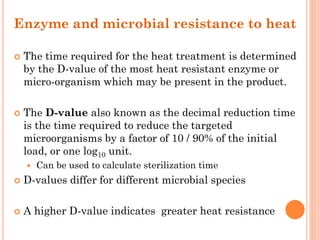
 The rate of destruction is a first order reaction; - when
food is heated to a temperature that is high enough to
destroy contaminating micro-organisms, the same
percentage die in a given time interval regardless of
the numbers present initially
 the rate of microbial death remains proportional to the
number of viable microorganisms present at any given time.
 This is known as the logarithmic order of death
 It illustrates how the number of viable microorganisms
decreases exponentially as they are exposed to a lethal
agent.
 It is described by a death rate curve
Enzyme and microbial resistance to heat
 The time required for the heat treatment is determined
by the D-value of the most heat resistant enzyme or
micro-organism which may be present in the product.
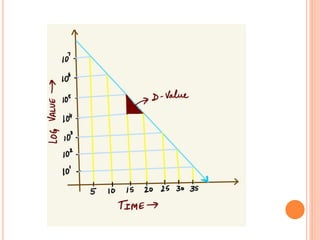
 The D-value also known as the decimal reduction time
is the time required to reduce the targeted
microorganisms by a factor of 10 / 90% of the initial
load, or one log10 unit.
 Can be used to calculate sterilization time
 D-values differ for different microbial species
 A higher D-value indicates greater heat resistance
Enzyme and microbial resistance to heat
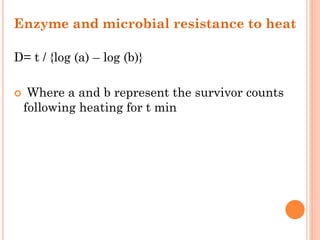
D= t / {log (a) – log (b)}
 Where a and b represent the survivor counts
following heating for t min
Enzyme and microbial resistance to heat
Factors on which it depends:
 Type of microbes: smaller microbes will die faster in
comparison to larger microbes
 The shape of bacteria: bacteria with capsule and
cocci structure are harder to kill.
 Temperature: More temperature will lead to more
effectiveness.
Enzyme and microbial resistance to heat
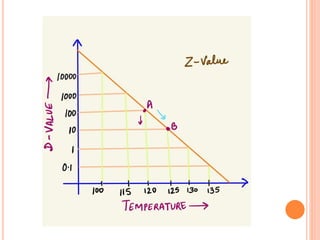
 Z-value is the no-of degrees the temperature has to be increased to
achieve a tenfold (i.e. 1 log 10) reduction in the D-value.
 the change in temperature required to achieve a tenfold (one log) change
in the D-value.
 For example, if the Z-value of a population is 10 degrees, then
increasing the sterilization temperature 10 degrees will result in a log
reduction of the D-value.
 The smaller the Z value, means greater sensitive are the
microorganisms towards change in temperature
 For e.g.: bacteria with spores have a Z value ranging from 10°C to
15°C and bacteria without spores has a z value of 4°C to 6°C, now we
can notice that z value of bacteria without spores is lower as
compared to bacteria with spores because they are far easier to kill
and they are less resistant to heat
 The value of Z for C. botulinum is 10˚C
Enzyme and microbial resistance to heat
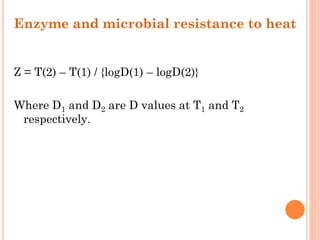
Z = T(2) – T(1) / {logD(1) – logD(2)}
Where D1 and D2 are D values at T1 and T2
respectively.
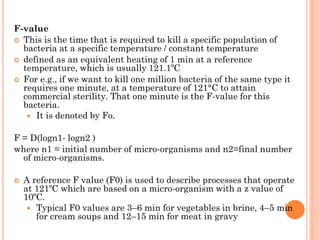
F-value
 This is the time that is required to kill a specific population of
bacteria at a specific temperature / constant temperature
 defined as an equivalent heating of 1 min at a reference
temperature, which is usually 121.1ºC
 For e.g., if we want to kill one million bacteria of the same type it
requires one minute, at a temperature of 121°C to attain
commercial sterility. That one minute is the F-value for this
bacteria.
 It is denoted by Fo.
F = D(logn1- logn2 )
where n1 = initial number of micro-organisms and n2=final number
of micro-organisms.
 A reference F value (F0) is used to describe processes that operate
at 121ºC which are based on a micro-organism with a z value of
10ºC.
 Typical F0 values are 3–6 min for vegetables in brine, 4–5 min
for cream soups and 12–15 min for meat in gravy
Heat penetration rate
 The rate of heat penetration is measured by measuring
the temperature at the centre of a container (the point
of slowest heating) ]food during processing
 The rate will depend on the following factors;
 Type of product
 Size of container
 Agitation of the container
 Temperature of the retort
 Shape of the container
 Type of glass
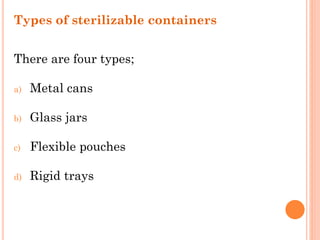
Types of sterilizable containers
There are four types;
a) Metal cans
b) Glass jars
c) Flexible pouches
d) Rigid trays
Effects of sterilization on Food Quality
- Reading assignment
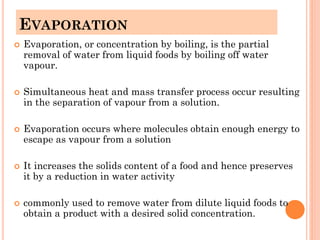
EVAPORATION
 Evaporation, or concentration by boiling, is the partial
removal of water from liquid foods by boiling off water
vapour.
 Simultaneous heat and mass transfer process occur resulting
in the separation of vapour from a solution.
 Evaporation occurs where molecules obtain enough energy to
escape as vapour from a solution
 It increases the solids content of a food and hence preserves
it by a reduction in water activity
 commonly used to remove water from dilute liquid foods to
obtain a product with a desired solid concentration.
 Evaporation is used to pre-concentrate foods (for
example fruit juice, milk and coffee) prior to drying,
freezing or sterilization
 It reduces weight and volume.
 This saves energy in subsequent operations and reduces
storage, transport and distribution costs.
 There is also greater convenience for the consumer (for
example fruit drinks for dilution, concentrated soups,
tomato or garlic pastes, sugar) or for the manufacturer
(for example liquid pectin, fruit concentrates for use in
ice cream or baked goods).
 Changes to food quality that result from the relatively
severe heat treatment are minimized by the design and
operation of the equipment.
 During evaporation, sensible heat is transferred from
steam to the food, to raise the temperature to its
boiling point.
 Latent heat of vaporization is then supplied by the
steam to form bubbles of vapor, which leave the surface
of the boiling liquid.
 The rate of evaporation is determined by both the rate
of heat transfer into the food and the rate of mass
transfer of vapor from the food
Factors affecting the rate of evaporation
 Rate at which heat can be transferred to the liquid
 Quantity of heat required to evaporate each kg of
water
 Maximum allowable temperature of the liquid
 Pressure at which the evaporation takes place
 Changes that may occur in the food stuff during the
coarse of the evaporation process
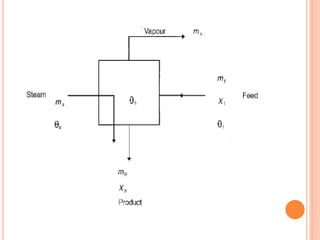
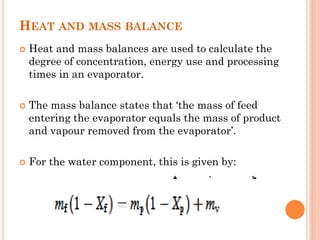
HEAT AND MASS BALANCE
 Heat and mass balances are used to calculate the
degree of concentration, energy use and processing
times in an evaporator.
 The mass balance states that ‘the mass of feed
entering the evaporator equals the mass of product
and vapour removed from the evaporator’.
 For the water component, this is given by:
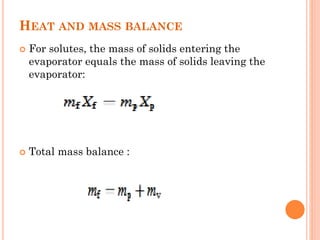
HEAT AND MASS BALANCE
 For solutes, the mass of solids entering the
evaporator equals the mass of solids leaving the
evaporator:
 Total mass balance :
Factors influencing the rate of heat transfer
1. Temperature difference between the steam and
boiling liquid.
2. Deposits on heat transfer surfaces - fouling
3. Boundary firms -
EVAPORATOR COMPOSITION
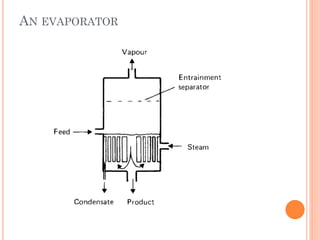
 A heat source: It is generally comprised of a heat
exchanger for the evaporation of water.
 An evaporation vessel: It drives out water from the
product as vapor.
 A vapor separation vessel: It separates vapor and
product.
 A vacuum system: It draws water vapor out of the
separation vessel. This vacuum also reduces pressure
in the evaporation vessel, which reduces the boiling
point.
AN EVAPORATOR

Food Processing and preservation 3 - Sterilization.pdf

  • 1.
  • 2.
    STERILIZATION  Heat sterilizationis the unit operation in which foods are heated at a sufficiently high temperature and for a sufficiently long time to destroy microbial and enzyme activity.  As a result, sterilized foods have a shelf life in excess of six months at ambient temperatures.
  • 3.
    Enzyme and microbialresistance to heat  Thermal calculations involve the need for knowledge of  the concentration of microorganisms to be destroyed  The acceptable concentration of microorganisms that can remain behind  Thermal resistance of the targeted microorganisms  Temperature time relationship required for destruction of the targeted organisms
  • 4.
    Factors affecting sterilizationtime  The time and temperature required for the sterilization of foods are influenced by several factors;  the heat resistance of micro-organisms or enzymes likely to be present in the food  the heating conditions  the type of microorganisms found on the food  the size of the container  the acidity or pH of the food  and the method of heating
  • 5.
    Enzyme and microbialresistance to heat  In order to determine the process time for a given food, it is necessary to have information about both the heat resistance of micro-organisms, particularly heat resistant spores, or enzymes that are likely to be present and the rate of heat penetration into the food.  The preservative effect of heat processing is due to the denaturation of proteins which destroys enzyme activity and enzyme-controlled metabolism in micro- organisms
  • 6.
    Enzyme and microbialresistance to heat  The rate of destruction is a first order reaction; - when food is heated to a temperature that is high enough to destroy contaminating micro-organisms, the same percentage die in a given time interval regardless of the numbers present initially  the rate of microbial death remains proportional to the number of viable microorganisms present at any given time.  This is known as the logarithmic order of death  It illustrates how the number of viable microorganisms decreases exponentially as they are exposed to a lethal agent.  It is described by a death rate curve
  • 7.
    Enzyme and microbialresistance to heat  The time required for the heat treatment is determined by the D-value of the most heat resistant enzyme or micro-organism which may be present in the product.  The D-value also known as the decimal reduction time is the time required to reduce the targeted microorganisms by a factor of 10 / 90% of the initial load, or one log10 unit.  Can be used to calculate sterilization time  D-values differ for different microbial species  A higher D-value indicates greater heat resistance
  • 9.
    Enzyme and microbialresistance to heat D= t / {log (a) – log (b)}  Where a and b represent the survivor counts following heating for t min
  • 10.
    Enzyme and microbialresistance to heat Factors on which it depends:  Type of microbes: smaller microbes will die faster in comparison to larger microbes  The shape of bacteria: bacteria with capsule and cocci structure are harder to kill.  Temperature: More temperature will lead to more effectiveness.
  • 11.
    Enzyme and microbialresistance to heat  Z-value is the no-of degrees the temperature has to be increased to achieve a tenfold (i.e. 1 log 10) reduction in the D-value.  the change in temperature required to achieve a tenfold (one log) change in the D-value.  For example, if the Z-value of a population is 10 degrees, then increasing the sterilization temperature 10 degrees will result in a log reduction of the D-value.  The smaller the Z value, means greater sensitive are the microorganisms towards change in temperature  For e.g.: bacteria with spores have a Z value ranging from 10°C to 15°C and bacteria without spores has a z value of 4°C to 6°C, now we can notice that z value of bacteria without spores is lower as compared to bacteria with spores because they are far easier to kill and they are less resistant to heat  The value of Z for C. botulinum is 10˚C
  • 13.
    Enzyme and microbialresistance to heat Z = T(2) – T(1) / {logD(1) – logD(2)} Where D1 and D2 are D values at T1 and T2 respectively.
  • 14.
    F-value  This isthe time that is required to kill a specific population of bacteria at a specific temperature / constant temperature  defined as an equivalent heating of 1 min at a reference temperature, which is usually 121.1ºC  For e.g., if we want to kill one million bacteria of the same type it requires one minute, at a temperature of 121°C to attain commercial sterility. That one minute is the F-value for this bacteria.  It is denoted by Fo. F = D(logn1- logn2 ) where n1 = initial number of micro-organisms and n2=final number of micro-organisms.  A reference F value (F0) is used to describe processes that operate at 121ºC which are based on a micro-organism with a z value of 10ºC.  Typical F0 values are 3–6 min for vegetables in brine, 4–5 min for cream soups and 12–15 min for meat in gravy
  • 15.
    Heat penetration rate The rate of heat penetration is measured by measuring the temperature at the centre of a container (the point of slowest heating) ]food during processing  The rate will depend on the following factors;  Type of product  Size of container  Agitation of the container  Temperature of the retort  Shape of the container  Type of glass
  • 16.
    Types of sterilizablecontainers There are four types; a) Metal cans b) Glass jars c) Flexible pouches d) Rigid trays
  • 17.
    Effects of sterilizationon Food Quality - Reading assignment
  • 18.
    EVAPORATION  Evaporation, orconcentration by boiling, is the partial removal of water from liquid foods by boiling off water vapour.  Simultaneous heat and mass transfer process occur resulting in the separation of vapour from a solution.  Evaporation occurs where molecules obtain enough energy to escape as vapour from a solution  It increases the solids content of a food and hence preserves it by a reduction in water activity  commonly used to remove water from dilute liquid foods to obtain a product with a desired solid concentration.
  • 19.
     Evaporation isused to pre-concentrate foods (for example fruit juice, milk and coffee) prior to drying, freezing or sterilization  It reduces weight and volume.  This saves energy in subsequent operations and reduces storage, transport and distribution costs.  There is also greater convenience for the consumer (for example fruit drinks for dilution, concentrated soups, tomato or garlic pastes, sugar) or for the manufacturer (for example liquid pectin, fruit concentrates for use in ice cream or baked goods).  Changes to food quality that result from the relatively severe heat treatment are minimized by the design and operation of the equipment.
  • 20.
     During evaporation,sensible heat is transferred from steam to the food, to raise the temperature to its boiling point.  Latent heat of vaporization is then supplied by the steam to form bubbles of vapor, which leave the surface of the boiling liquid.  The rate of evaporation is determined by both the rate of heat transfer into the food and the rate of mass transfer of vapor from the food
  • 22.
    Factors affecting therate of evaporation  Rate at which heat can be transferred to the liquid  Quantity of heat required to evaporate each kg of water  Maximum allowable temperature of the liquid  Pressure at which the evaporation takes place  Changes that may occur in the food stuff during the coarse of the evaporation process
  • 23.
    HEAT AND MASSBALANCE  Heat and mass balances are used to calculate the degree of concentration, energy use and processing times in an evaporator.  The mass balance states that ‘the mass of feed entering the evaporator equals the mass of product and vapour removed from the evaporator’.  For the water component, this is given by:
  • 24.
    HEAT AND MASSBALANCE  For solutes, the mass of solids entering the evaporator equals the mass of solids leaving the evaporator:  Total mass balance :
  • 25.
    Factors influencing therate of heat transfer 1. Temperature difference between the steam and boiling liquid. 2. Deposits on heat transfer surfaces - fouling 3. Boundary firms -
  • 26.
    EVAPORATOR COMPOSITION  Aheat source: It is generally comprised of a heat exchanger for the evaporation of water.  An evaporation vessel: It drives out water from the product as vapor.  A vapor separation vessel: It separates vapor and product.  A vacuum system: It draws water vapor out of the separation vessel. This vacuum also reduces pressure in the evaporation vessel, which reduces the boiling point.
  • 27.