High pressure processing (HPP) is a promising
“non-thermal” technology that has been developed
with the aim of obtaining microbiologically safe food
products while avoiding undesirable changes in the
sensory, physicochemical, and nutritional properties
of foods. Thus HPP has become one of the
innovative food processing technologies most
accepted by consumers.
 First research in 1890s – Milk Pathogens.
 Non-thermal processing technology (combination
with heat possible).
 First commercialized in Japan in the early 1990s
for pasteurization of acid foods for chilled storage.
 High pressure treated foodstuffs have been
marketed in Japan since 1990, in Europe and the
United States since 1996 & Australia since 2001.
 Rapid commercialization since 2000.
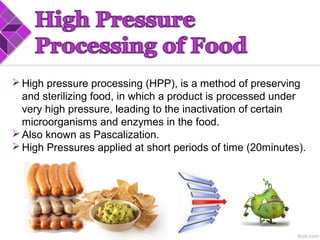
High pressure processing (HPP), is a method of preserving
and sterilizing food, in which a product is processed under
very high pressure, leading to the inactivation of certain
microorganisms and enzymes in the food.
Also known as Pascalization.
High Pressures applied at short periods of time (20minutes).
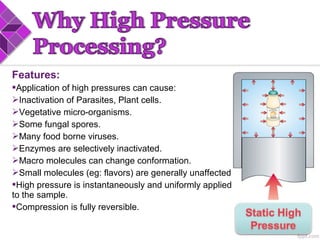
Features:
Application of high pressures can cause:
Inactivation of Parasites, Plant cells.
Vegetative micro-organisms.
Some fungal spores.
Many food borne viruses.
Enzymes are selectively inactivated.
Macro molecules can change conformation.
Small molecules (eg: flavors) are generally unaffected
High pressure is instantaneously and uniformly applied
to the sample.
Compression is fully reversible.
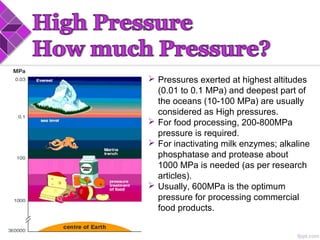
 Pressures exerted at highest altitudes
(0.01 to 0.1 MPa) and deepest part of
the oceans (10-100 MPa) are usually
considered as High pressures.
 For food processing, 200-800MPa
pressure is required.
 For inactivating milk enzymes; alkaline
phosphatase and protease about
1000 MPa is needed (as per research
articles).
 Usually, 600MPa is the optimum
pressure for processing commercial
food products.
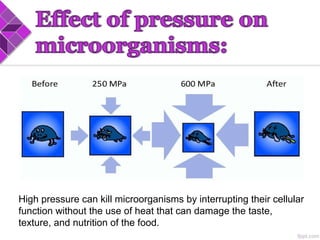
High pressure can kill microorganisms by interrupting their cellular
function without the use of heat that can damage the taste,
texture, and nutrition of the food.
Le Chatelier’s principle: Any phenomenon (phase transition, change
in molecular Configuration, chemical reaction) accompanied by a decrease
in volume is enhanced by pressure. Accordingly, pressure shifts the
system to that of lowest volume.
Isostatic principle: Food products are compressed by uniform
pressure from every direction and then returned to their original shape
when the pressure is released. The products are compressed
independently of the product size and geometry because transmission of
pressure to the core is not mass/time dependent thus the process is
minimized If a food product contains sufficient moisture, pressure will not
damage the product at the macroscopic levels as long as the pressure is
applied uniformly in all directions.
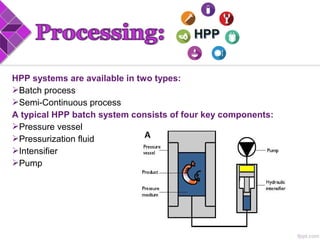
HPP systems are available in two types:
Batch process
Semi-Continuous process
A typical HPP batch system consists of four key components:
Pressure vessel
Pressurization fluid
Intensifier
Pump
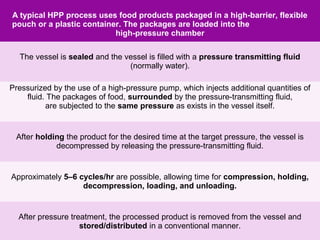
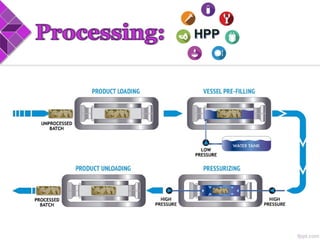
A typical HPP process uses food products packaged in a high-barrier, flexible
pouch or a plastic container. The packages are loaded into the
high-pressure chamber
The vessel is sealed and the vessel is filled with a pressure transmitting fluid
(normally water).
Pressurized by the use of a high-pressure pump, which injects additional quantities of
fluid. The packages of food, surrounded by the pressure-transmitting fluid,
are subjected to the same pressure as exists in the vessel itself.
After holding the product for the desired time at the target pressure, the vessel is
decompressed by releasing the pressure-transmitting fluid.
Approximately 5–6 cycles/hr are possible, allowing time for compression, holding,
decompression, loading, and unloading.
After pressure treatment, the processed product is removed from the vessel and
stored/distributed in a conventional manner.
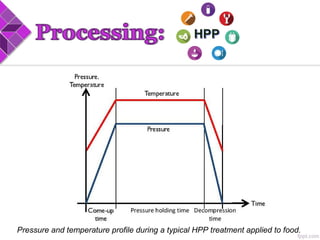
Pressure and temperature profile during a typical HPP treatment applied to food.
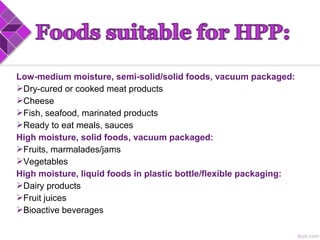
Low-medium moisture, semi-solid/solid foods, vacuum packaged:
Dry-cured or cooked meat products
Cheese
Fish, seafood, marinated products
Ready to eat meals, sauces
High moisture, solid foods, vacuum packaged:
Fruits, marmalades/jams
Vegetables
High moisture, liquid foods in plastic bottle/flexible packaging:
Dairy products
Fruit juices
Bioactive beverages
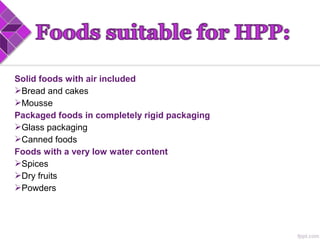
Solid foods with air included
Bread and cakes
Mousse
Packaged foods in completely rigid packaging
Glass packaging
Canned foods
Foods with a very low water content
Spices
Dry fruits
Powders
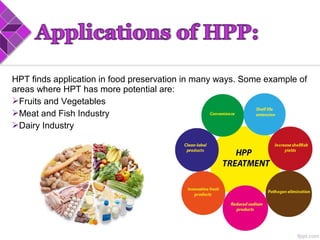
HPT finds application in food preservation in many ways. Some example of
areas where HPT has more potential are:
Fruits and Vegetables
Meat and Fish Industry
Dairy Industry
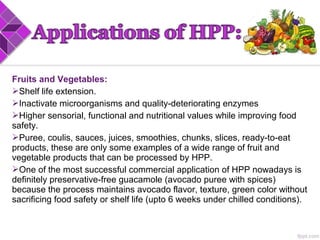
Fruits and Vegetables:
Shelf life extension.
Inactivate microorganisms and quality-deteriorating enzymes
Higher sensorial, functional and nutritional values while improving food
safety.
Puree, coulis, sauces, juices, smoothies, chunks, slices, ready-to-eat
products, these are only some examples of a wide range of fruit and
vegetable products that can be processed by HPP.
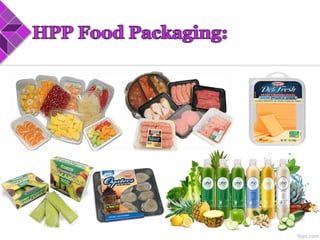
One of the most successful commercial application of HPP nowadays is
definitely preservative-free guacamole (avocado puree with spices)
because the process maintains avocado flavor, texture, green color without
sacrificing food safety or shelf life (upto 6 weeks under chilled conditions).
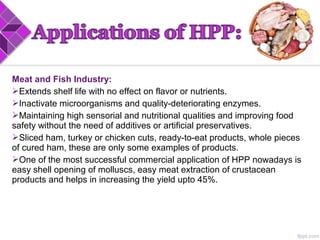
Meat and Fish Industry:
Extends shelf life with no effect on flavor or nutrients.
Inactivate microorganisms and quality-deteriorating enzymes.
Maintaining high sensorial and nutritional qualities and improving food
safety without the need of additives or artificial preservatives.
Sliced ham, turkey or chicken cuts, ready-to-eat products, whole pieces
of cured ham, these are only some examples of products.
One of the most successful commercial application of HPP nowadays is
easy shell opening of molluscs, easy meat extraction of crustacean
products and helps in increasing the yield upto 45%.
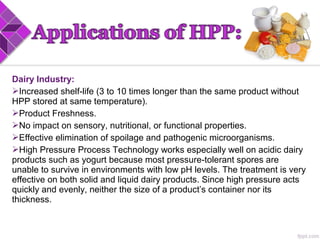
Dairy Industry:
Increased shelf-life (3 to 10 times longer than the same product without
HPP stored at same temperature).
Product Freshness.
No impact on sensory, nutritional, or functional properties.
Effective elimination of spoilage and pathogenic microorganisms.
High Pressure Process Technology works especially well on acidic dairy
products such as yogurt because most pressure-tolerant spores are
unable to survive in environments with low pH levels. The treatment is very
effective on both solid and liquid dairy products. Since high pressure acts
quickly and evenly, neither the size of a product’s container nor its
thickness.
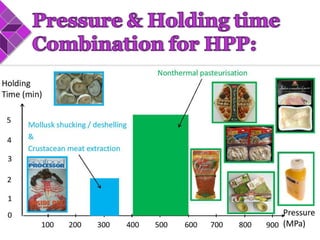
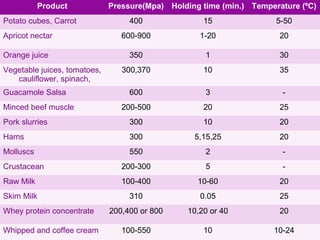
Product Pressure(Mpa) Holding time (min.) Temperature (ºC)
Potato cubes, Carrot 400 15 5-50
Apricot nectar 600-900 1-20 20
Orange juice 350 1 30
Vegetable juices, tomatoes,
cauliflower, spinach,
300,370 10 35
Guacamole Salsa 600 3 -
Minced beef muscle 200-500 20 25
Pork slurries 300 10 20
Hams 300 5,15,25 20
Molluscs 550 2 -
Crustacean 200-300 5 -
Raw Milk 100-400 10-60 20
Skim Milk 310 0.05 25
Whey protein concentrate 200,400 or 800 10,20 or 40 20
Whipped and coffee cream 100-550 10 10-24
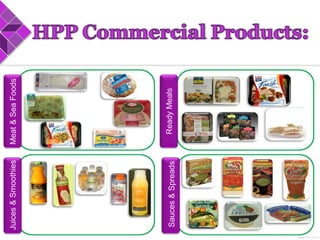
Meat&SeaFoods
ReadyMeals
Juices&Smoothies
Sauces&Spreads
HPP is the best option to preserve and respect
the functionality of thermosensitive bioactive
components present in colostrum such as
immunoglobulins, lactoferrin and growth factors.
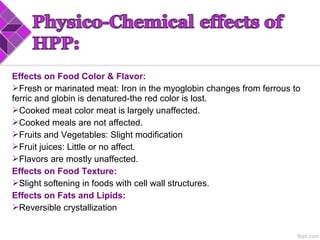
Effects on Food Color & Flavor:
Fresh or marinated meat: Iron in the myoglobin changes from ferrous to
ferric and globin is denatured-the red color is lost.
Cooked meat color meat is largely unaffected.
Cooked meals are not affected.
Fruits and Vegetables: Slight modification
Fruit juices: Little or no affect.
Flavors are mostly unaffected.
Effects on Food Texture:
Slight softening in foods with cell wall structures.
Effects on Fats and Lipids:
Reversible crystallization
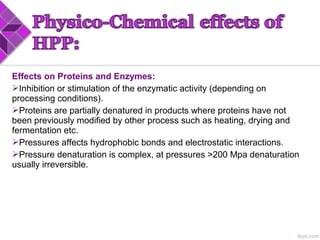
Effects on Proteins and Enzymes:
Inhibition or stimulation of the enzymatic activity (depending on
processing conditions).
Proteins are partially denatured in products where proteins have not
been previously modified by other process such as heating, drying and
fermentation etc.
Pressures affects hydrophobic bonds and electrostatic interactions.
Pressure denaturation is complex, at pressures >200 Mpa denaturation
usually irreversible.
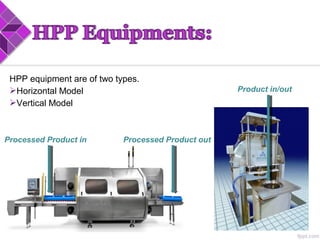
HPP equipment are of two types.
Horizontal Model
Vertical Model
Product in/out
Processed Product in Processed Product out
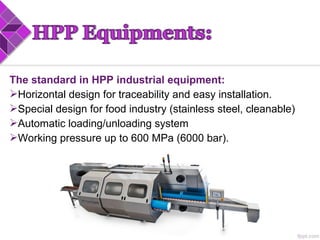
The standard in HPP industrial equipment:
Horizontal design for traceability and easy installation.
Special design for food industry (stainless steel, cleanable)
Automatic loading/unloading system
Working pressure up to 600 MPa (6000 bar).
 Flexible packaging (>15% volume contraction)
 Extra tight seals.
 Rounded & reinforced edges.
 Minimal head space.
 Modified Atmospheric Packaging (MAP) possible
 Tear strength, puncture resistance and surface smoothness generally
not affected by HPP.
 Often flexible pouches or bottles are inserted in secondary cardboard
containers after processing.
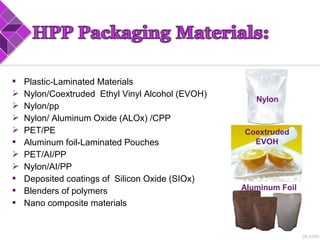
 Plastic-Laminated Materials
 Nylon/Coextruded Ethyl Vinyl Alcohol (EVOH)
 Nylon/pp
 Nylon/ Aluminum Oxide (ALOx) /CPP
 PET/PE
 Aluminum foil-Laminated Pouches
 PET/AI/PP
 Nylon/AI/PP
 Deposited coatings of Silicon Oxide (SIOx)
 Blenders of polymers
 Nano composite materials
Nylon
Coextruded
EVOH
Aluminum Foil
 USDA has approved HPP as an intervention method for listeria
contaminated pre-packed ready-to-eat (RTE) meat products.
 U.S Food & Drug Administration (FDA) has accepted the commercial
use of HPP for application of low acid foods.
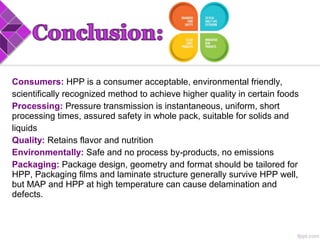
Consumers: HPP is a consumer acceptable, environmental friendly,
scientifically recognized method to achieve higher quality in certain foods
Processing: Pressure transmission is instantaneous, uniform, short
processing times, assured safety in whole pack, suitable for solids and
liquids
Quality: Retains flavor and nutrition
Environmentally: Safe and no process by products, no emissions‐
Packaging: Package design, geometry and format should be tailored for
HPP, Packaging films and laminate structure generally survive HPP well,
but MAP and HPP at high temperature can cause delamination and
defects.
https://prezi.com/dtgk80590g0g/hiperbaric-applications-of-hpp/
http://www.hopefresh.com/
http://www.hiperbaric.com/en/hpp
http://www.suflux.com/EN/products/FoodIsostaticPress.html
http://www.promatecfoodventures.com/doc/FoodTechnology_1108feat_preservingfoods.pdf
http://www.thenfl.com/wp-content/uploads/High-Pressure-Processing-Insights_20131.pdf
http://ohioline.osu.edu/fse-fact/pdf/0001.pdf
http://seafood.oregonstate.edu/.pdf%20Links/High-Pressure-Processing-Basics.pdf
http://fshn.illinois.edu/food_processing_forum/presentations/c2_Dallas_presentation.pdf
http://www.uniservices.co.nz/Portals/0/All%20One%20Pagers/High%20Pressure%20Processing
%20of%20Food.pdf
http://www.hiperbaric.com/en/applications
High pressure processing of food

High pressure processing of food

  • 2.
    High pressure processing(HPP) is a promising “non-thermal” technology that has been developed with the aim of obtaining microbiologically safe food products while avoiding undesirable changes in the sensory, physicochemical, and nutritional properties of foods. Thus HPP has become one of the innovative food processing technologies most accepted by consumers.
  • 4.
     First researchin 1890s – Milk Pathogens.  Non-thermal processing technology (combination with heat possible).  First commercialized in Japan in the early 1990s for pasteurization of acid foods for chilled storage.  High pressure treated foodstuffs have been marketed in Japan since 1990, in Europe and the United States since 1996 & Australia since 2001.  Rapid commercialization since 2000.
  • 5.
    High pressure processing(HPP), is a method of preserving and sterilizing food, in which a product is processed under very high pressure, leading to the inactivation of certain microorganisms and enzymes in the food. Also known as Pascalization. High Pressures applied at short periods of time (20minutes).
  • 6.
    Features: Application of highpressures can cause: Inactivation of Parasites, Plant cells. Vegetative micro-organisms. Some fungal spores. Many food borne viruses. Enzymes are selectively inactivated. Macro molecules can change conformation. Small molecules (eg: flavors) are generally unaffected High pressure is instantaneously and uniformly applied to the sample. Compression is fully reversible.
  • 7.
     Pressures exertedat highest altitudes (0.01 to 0.1 MPa) and deepest part of the oceans (10-100 MPa) are usually considered as High pressures.  For food processing, 200-800MPa pressure is required.  For inactivating milk enzymes; alkaline phosphatase and protease about 1000 MPa is needed (as per research articles).  Usually, 600MPa is the optimum pressure for processing commercial food products.
  • 8.
    High pressure cankill microorganisms by interrupting their cellular function without the use of heat that can damage the taste, texture, and nutrition of the food.
  • 9.
    Le Chatelier’s principle:Any phenomenon (phase transition, change in molecular Configuration, chemical reaction) accompanied by a decrease in volume is enhanced by pressure. Accordingly, pressure shifts the system to that of lowest volume. Isostatic principle: Food products are compressed by uniform pressure from every direction and then returned to their original shape when the pressure is released. The products are compressed independently of the product size and geometry because transmission of pressure to the core is not mass/time dependent thus the process is minimized If a food product contains sufficient moisture, pressure will not damage the product at the macroscopic levels as long as the pressure is applied uniformly in all directions.
  • 10.
    HPP systems areavailable in two types: Batch process Semi-Continuous process A typical HPP batch system consists of four key components: Pressure vessel Pressurization fluid Intensifier Pump
  • 11.
    A typical HPPprocess uses food products packaged in a high-barrier, flexible pouch or a plastic container. The packages are loaded into the high-pressure chamber The vessel is sealed and the vessel is filled with a pressure transmitting fluid (normally water). Pressurized by the use of a high-pressure pump, which injects additional quantities of fluid. The packages of food, surrounded by the pressure-transmitting fluid, are subjected to the same pressure as exists in the vessel itself. After holding the product for the desired time at the target pressure, the vessel is decompressed by releasing the pressure-transmitting fluid. Approximately 5–6 cycles/hr are possible, allowing time for compression, holding, decompression, loading, and unloading. After pressure treatment, the processed product is removed from the vessel and stored/distributed in a conventional manner.
  • 12.
    Pressure and temperatureprofile during a typical HPP treatment applied to food.
  • 15.
    Low-medium moisture, semi-solid/solidfoods, vacuum packaged: Dry-cured or cooked meat products Cheese Fish, seafood, marinated products Ready to eat meals, sauces High moisture, solid foods, vacuum packaged: Fruits, marmalades/jams Vegetables High moisture, liquid foods in plastic bottle/flexible packaging: Dairy products Fruit juices Bioactive beverages
  • 16.
    Solid foods withair included Bread and cakes Mousse Packaged foods in completely rigid packaging Glass packaging Canned foods Foods with a very low water content Spices Dry fruits Powders
  • 17.
    HPT finds applicationin food preservation in many ways. Some example of areas where HPT has more potential are: Fruits and Vegetables Meat and Fish Industry Dairy Industry
  • 18.
    Fruits and Vegetables: Shelflife extension. Inactivate microorganisms and quality-deteriorating enzymes Higher sensorial, functional and nutritional values while improving food safety. Puree, coulis, sauces, juices, smoothies, chunks, slices, ready-to-eat products, these are only some examples of a wide range of fruit and vegetable products that can be processed by HPP. One of the most successful commercial application of HPP nowadays is definitely preservative-free guacamole (avocado puree with spices) because the process maintains avocado flavor, texture, green color without sacrificing food safety or shelf life (upto 6 weeks under chilled conditions).
  • 19.
    Meat and FishIndustry: Extends shelf life with no effect on flavor or nutrients. Inactivate microorganisms and quality-deteriorating enzymes. Maintaining high sensorial and nutritional qualities and improving food safety without the need of additives or artificial preservatives. Sliced ham, turkey or chicken cuts, ready-to-eat products, whole pieces of cured ham, these are only some examples of products. One of the most successful commercial application of HPP nowadays is easy shell opening of molluscs, easy meat extraction of crustacean products and helps in increasing the yield upto 45%.
  • 20.
    Dairy Industry: Increased shelf-life(3 to 10 times longer than the same product without HPP stored at same temperature). Product Freshness. No impact on sensory, nutritional, or functional properties. Effective elimination of spoilage and pathogenic microorganisms. High Pressure Process Technology works especially well on acidic dairy products such as yogurt because most pressure-tolerant spores are unable to survive in environments with low pH levels. The treatment is very effective on both solid and liquid dairy products. Since high pressure acts quickly and evenly, neither the size of a product’s container nor its thickness.
  • 22.
    Product Pressure(Mpa) Holdingtime (min.) Temperature (ºC) Potato cubes, Carrot 400 15 5-50 Apricot nectar 600-900 1-20 20 Orange juice 350 1 30 Vegetable juices, tomatoes, cauliflower, spinach, 300,370 10 35 Guacamole Salsa 600 3 - Minced beef muscle 200-500 20 25 Pork slurries 300 10 20 Hams 300 5,15,25 20 Molluscs 550 2 - Crustacean 200-300 5 - Raw Milk 100-400 10-60 20 Skim Milk 310 0.05 25 Whey protein concentrate 200,400 or 800 10,20 or 40 20 Whipped and coffee cream 100-550 10 10-24
  • 23.
  • 24.
    HPP is thebest option to preserve and respect the functionality of thermosensitive bioactive components present in colostrum such as immunoglobulins, lactoferrin and growth factors.
  • 25.
    Effects on FoodColor & Flavor: Fresh or marinated meat: Iron in the myoglobin changes from ferrous to ferric and globin is denatured-the red color is lost. Cooked meat color meat is largely unaffected. Cooked meals are not affected. Fruits and Vegetables: Slight modification Fruit juices: Little or no affect. Flavors are mostly unaffected. Effects on Food Texture: Slight softening in foods with cell wall structures. Effects on Fats and Lipids: Reversible crystallization
  • 26.
    Effects on Proteinsand Enzymes: Inhibition or stimulation of the enzymatic activity (depending on processing conditions). Proteins are partially denatured in products where proteins have not been previously modified by other process such as heating, drying and fermentation etc. Pressures affects hydrophobic bonds and electrostatic interactions. Pressure denaturation is complex, at pressures >200 Mpa denaturation usually irreversible.
  • 27.
    HPP equipment areof two types. Horizontal Model Vertical Model Product in/out Processed Product in Processed Product out
  • 28.
    The standard inHPP industrial equipment: Horizontal design for traceability and easy installation. Special design for food industry (stainless steel, cleanable) Automatic loading/unloading system Working pressure up to 600 MPa (6000 bar).
  • 29.
     Flexible packaging(>15% volume contraction)  Extra tight seals.  Rounded & reinforced edges.  Minimal head space.  Modified Atmospheric Packaging (MAP) possible  Tear strength, puncture resistance and surface smoothness generally not affected by HPP.  Often flexible pouches or bottles are inserted in secondary cardboard containers after processing.
  • 30.
     Plastic-Laminated Materials Nylon/Coextruded Ethyl Vinyl Alcohol (EVOH)  Nylon/pp  Nylon/ Aluminum Oxide (ALOx) /CPP  PET/PE  Aluminum foil-Laminated Pouches  PET/AI/PP  Nylon/AI/PP  Deposited coatings of Silicon Oxide (SIOx)  Blenders of polymers  Nano composite materials Nylon Coextruded EVOH Aluminum Foil
  • 32.
     USDA hasapproved HPP as an intervention method for listeria contaminated pre-packed ready-to-eat (RTE) meat products.  U.S Food & Drug Administration (FDA) has accepted the commercial use of HPP for application of low acid foods.
  • 33.
    Consumers: HPP isa consumer acceptable, environmental friendly, scientifically recognized method to achieve higher quality in certain foods Processing: Pressure transmission is instantaneous, uniform, short processing times, assured safety in whole pack, suitable for solids and liquids Quality: Retains flavor and nutrition Environmentally: Safe and no process by products, no emissions‐ Packaging: Package design, geometry and format should be tailored for HPP, Packaging films and laminate structure generally survive HPP well, but MAP and HPP at high temperature can cause delamination and defects.
  • 34.