![Primary pests of cereals
01] Sitophilus spp – Wheat grain
• Sitophilus granarius is essentially a temperate pest and
is not found in tropical countries,
• Sitophilus zeamais and S.oryzae are commonly found
throughout the world
• tropical and subtropical regions
• especially where ambient humidities are fairly high.](https://image.slidesharecdn.com/storagepestmanagement-200213063448/85/Storage-pest-management-12-320.jpg)
![02] Rhyzopertha dominica and Prostephanus truncatus
• Rhyzopertha dominica is widespread throughout the
tropics and subtropics,
• most important pest of wheat and paddy rice
• And also cereals and roots such as dried cassava
• Both species are adapted to higher temperatures and lower
moisture contents than Sitophilus spp.
• dominant pest in hot, drier areas.](https://image.slidesharecdn.com/storagepestmanagement-200213063448/85/Storage-pest-management-13-320.jpg)
![03] Sitotroga cerealella
• Sitotroga cerealella attacks any cereal with grains
• large enough to support larval development.
• This moth is widespread over tropical and subtropical parts.
• sometimes entering warmer temperate areas.
• Adults are good fliers and cross-infestation occurs easily
• most frequently encountered in farm storage.
• Because high loss in larvae stage](https://image.slidesharecdn.com/storagepestmanagement-200213063448/85/Storage-pest-management-14-320.jpg)
![Primary pests of pulses
01] Acanthoscelides obtectus
• The beetles are capable of tolerating quite low
temperatures,
• Adult beetles are able to infest beans before or after
harvest](https://image.slidesharecdn.com/storagepestmanagement-200213063448/85/Storage-pest-management-15-320.jpg)
![02] Callosobruchus spp
• Species of Callosobruchus are important primary pests
of a number of legumes
• including cowpeas, pigeonpeas, chickpeas, adzuki
beans, peas, grams and soyabeans.](https://image.slidesharecdn.com/storagepestmanagement-200213063448/85/Storage-pest-management-16-320.jpg)
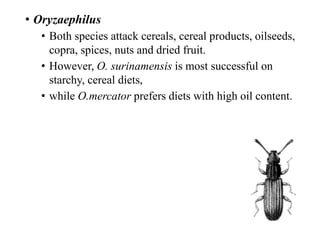
![Grounds
01] Preventive Maintenance
• Improperly stored equipment, litter, waste,
• immediate remove from the buildings
• to reduce pest harborages.
• Properly slope and adequately drain the grounds to avoid
contamination.
• Poor drainage also provides;
• breeding place for insects, microorganisms and
• water source for rodents.](https://image.slidesharecdn.com/storagepestmanagement-200213063448/85/Storage-pest-management-20-320.jpg)
![02] Nonchemical Management
• Consider various types of rodent, insect and bird traps.
• Implement pest monitoring programs including pheromone(s) and
sticky traps.
03] Pesticide Management
Insects
• Install solid insecticidal baits in and around breeding sites
• Treat approved insecticides, especially near potential insect
breeding sites.
Birds
• Use chemical bird repellents where possible on bird harborage and
nesting sites.
• Avicides may be selectively used in many ways.](https://image.slidesharecdn.com/storagepestmanagement-200213063448/85/Storage-pest-management-22-320.jpg)
![Buildings
01] Preventive Maintenance
• Rodent proof all doors, walls, windows and roofs.
• Screen all windows that can be opened.
• Eliminate cracks, crevices, recesses and ledges
• To control of potential pest harborages.
• Eliminate access to ledges and roofing areas for birds.
• Locate equipment off the floor and away from walls or seal
equipment to walls and floors.](https://image.slidesharecdn.com/storagepestmanagement-200213063448/85/Storage-pest-management-23-320.jpg)
![02] Nonchemical Management
• Housekeeping – Keep all areas free of,
• loose materials such as cardboard, rags, processing waste
and equipment.
• Clean both the interior and exterior of all equipment (electrical
and mechanical) often.
• Inside buildings, utilize electrified grids for attracting insects.
However,
• outside buildings electrified grids may do more harm than
good.
• Beneficial insect](https://image.slidesharecdn.com/storagepestmanagement-200213063448/85/Storage-pest-management-24-320.jpg)
![Storage Warehouse
1] Preventive Maintenance
• Inspection of all incoming vehicles as well as ingredients and
materials
• to check that pests are not brought into storage areas.
2] Nonchemical Controls
• Store ingredients and materials away from walls far enough to
permit access for inspection and sanitation.
(Rodents)
• Place rodent traps (windup and snap) at or near all doors.
• Record catches for each trap.
(Insects)
• Utilize air curtains at dock and pedestrian doors
(Birds)
• Selectively use revolving bird lights or vibration mechanism](https://image.slidesharecdn.com/storagepestmanagement-200213063448/85/Storage-pest-management-25-320.jpg)
![3]Pesticide Management
• Use rodent bait stations containing anticoagulants
C:UsersBavaneethanPicturesCapture789.PNG
• to supplement rodent traps (where company policy
permits).
• Space treatment with non residuals.
• Crack and crevice treatment with insecticides.
• Fumigate raw bulk commodities when infested during
receiving and, if possible,
• before entering the processing plant.
• Frequent inspections are necessary to determine that all
controls are functioning correctly.](https://image.slidesharecdn.com/storagepestmanagement-200213063448/85/Storage-pest-management-26-320.jpg)
![Processing Area
01] Preventive Maintenance
• Detailed monitoring program
• Total facility IPM program
02] Nonchemical Management
• Place rodent traps near doors - monitor for activity.
• Ensure proper sanitation and elimination of harborages.
03] Pesticide Management
• Space treatment with non-residual.
• Crack and crevice treatment with residuals.
• Contact treatment with non residuals.
• Frequent inspections of all programs are necessary.](https://image.slidesharecdn.com/storagepestmanagement-200213063448/85/Storage-pest-management-27-320.jpg)

This document discusses pests that can infest stored grains and describes strategies for managing pest infestations. It identifies two main types of pests - primary pests that can directly infest grains and secondary pests that infest already damaged grains. Specific primary pests of cereals and pulses are outlined. The document also recommends an integrated pest management approach involving preventative maintenance, non-chemical controls, and pesticide use to control pests in storage rooms, buildings, warehouses, and processing areas. Frequent inspections are emphasized to ensure management strategies are effective.


