ULTRA HIGH TEMPERATURE PROCESSING
Of Food Products
Prepared by:-
Sourabh Bhartia
B.Sc. & M.Sc.
(Food Processing & Technology)
UTD, AVVV, BSP (C.G.)
sourabhbhartia@gmail.com
www.linkedin.com/in/sourabh-bhartia
Prepared by: Sourabh Bhartia
CONTENTS
 WHAT IS UHT PROCESSING ?_________________ 1
 PURPOSE OF UHT PROCESSING_______________2
 METHODS OF UHT PROCESSING______________4
 DIRECT HEATING SYSTEMS__________________ 5
 INJECTION, INFUSION & ELECTRIC HEATING_6
 INDIRECT HEATING SYSTEMS________________7
 PLATE HEAT EXCHANGER___________________ 8
 TUBULAR HEAT EXCHANGER________________10
 SCRAPED SURFACE HEAT EXCHANGER ______11
 ADVANTAGES & DISADVANTAGES____________13
 BIBLIOGRAPHY_____________________________ 14
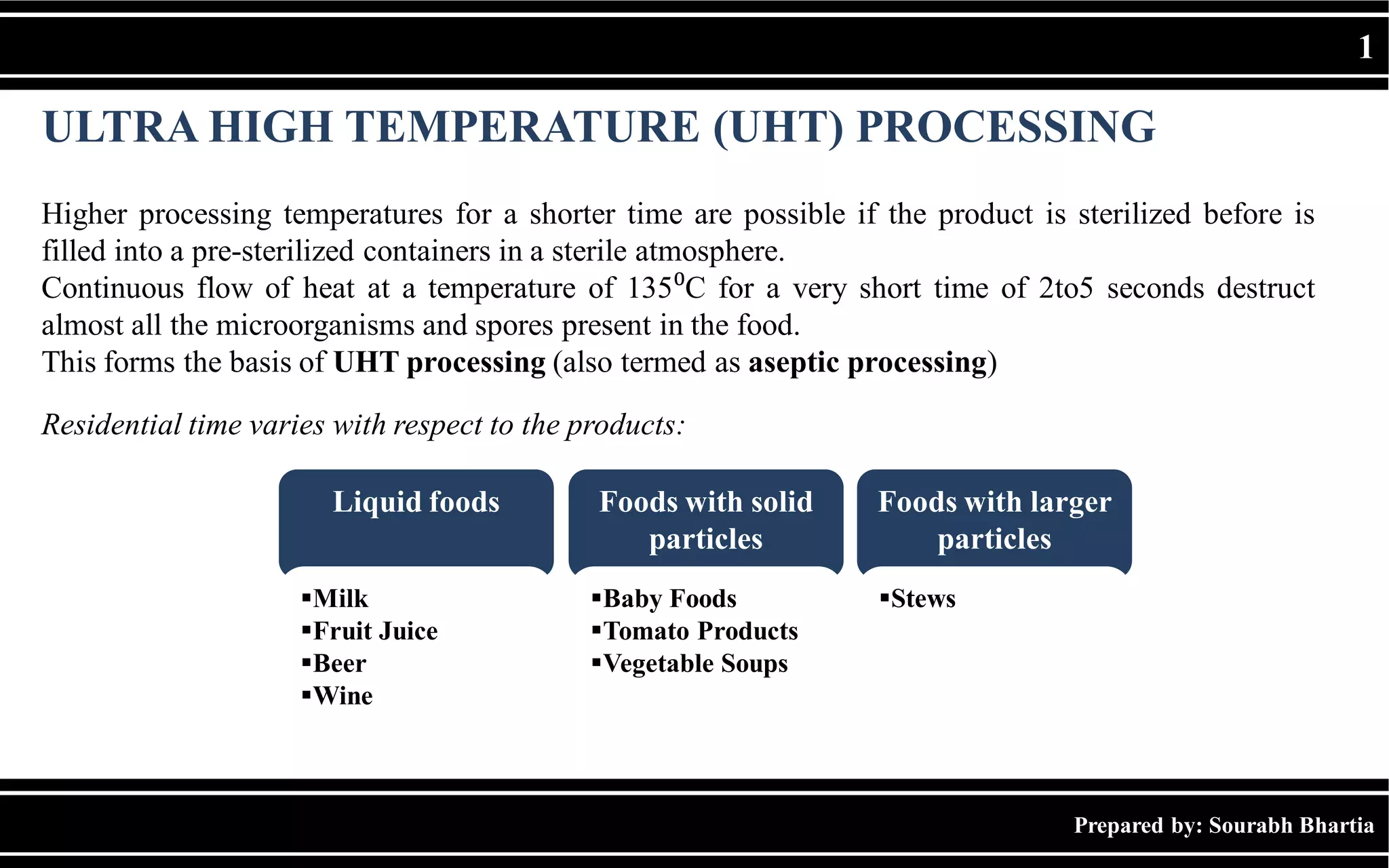
Liquid foods Foods with solid
particles
Foods with larger
particles
Milk
Fruit Juice
Beer
Wine
Baby Foods
Tomato Products
Vegetable Soups
Stews
Prepared by: Sourabh Bhartia
1
ULTRA HIGH TEMPERATURE (UHT) PROCESSING
Higher processing temperatures for a shorter time are possible if the product is sterilized before is
filled into a pre-sterilized containers in a sterile atmosphere.
Continuous flow of heat at a temperature of 135⁰C for a very short time of 2to5 seconds destruct
almost all the microorganisms and spores present in the food.
This forms the basis of UHT processing (also termed as aseptic processing)
Residential time varies with respect to the products:
Prepared by: Sourabh Bhartia
2
PURPOSE OF UHT PROCESSING
 To achieve a longer shelf life.
 To kill all heat resistant spore forming bacteria in milk,
For e.g., Bacillus Licheniformis, Bacillus Subtilus;
 To inactivate enzymes (Ultra High temperature
processing/High Temperature for Short Time through
High Hydrostatic Pressure), For e.g., to inactivate
pectinol and filtragol used in processing of beverages;
 For inactivation of yeasts, For e.g., Saccharomyces
cerevisiae in beer;
 To increase the sugar concentration in candy
processing.
Candy Processing Thermometer
Prepared by: Sourabh Bhartia
3
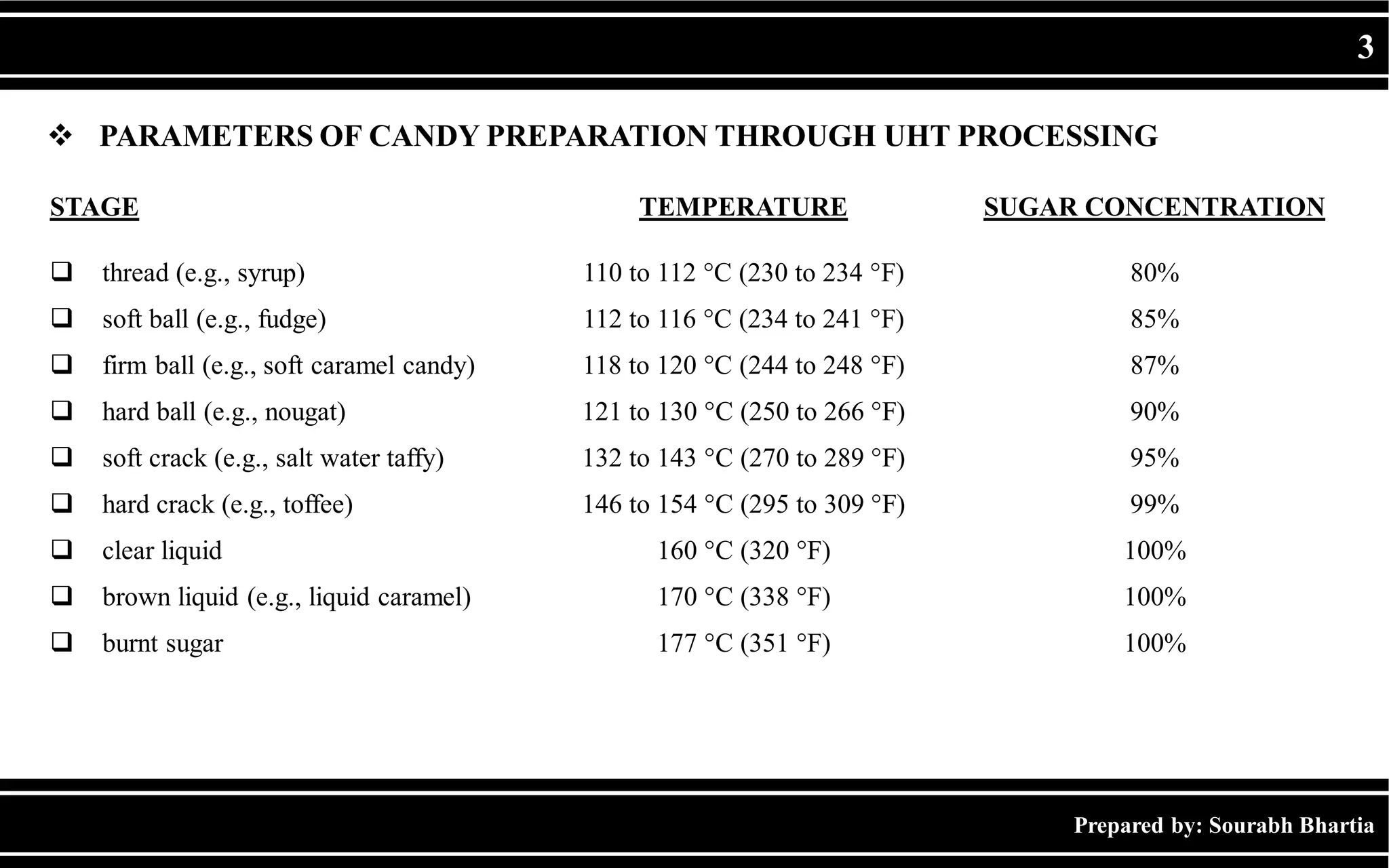
 PARAMETERS OF CANDY PREPARATION THROUGH UHT PROCESSING
STAGE TEMPERATURE SUGAR CONCENTRATION
 thread (e.g., syrup) 110 to 112 °C (230 to 234 °F) 80%
 soft ball (e.g., fudge) 112 to 116 °C (234 to 241 °F) 85%
 firm ball (e.g., soft caramel candy) 118 to 120 °C (244 to 248 °F) 87%
 hard ball (e.g., nougat) 121 to 130 °C (250 to 266 °F) 90%
 soft crack (e.g., salt water taffy) 132 to 143 °C (270 to 289 °F) 95%
 hard crack (e.g., toffee) 146 to 154 °C (295 to 309 °F) 99%
 clear liquid 160 °C (320 °F) 100%
 brown liquid (e.g., liquid caramel) 170 °C (338 °F) 100%
 burnt sugar 177 °C (351 °F) 100%
Prepared by: Sourabh Bhartia
4
METHODS OF UHT PROCESSING
 There are 2 methods to perform a UHT processing:
DIRECT HEATING
INDIRECT HEATING
Prepared by: Sourabh Bhartia
5
DIRECT HEATING SYSTEMS
The high temperature steam is directly applied to the food material under strict controlled conditions.
 Processing temperature of 140⁰C is quickly reached and hold it for 4 seconds.
 The temperature is reduced by flash cooling in a vacuum vessel.
 The short time process will not affect the nutritional qualities
There are 3 types of direct heating systems:-
INJECTION
INFUSION
ELECTRIC HEATING
Prepared by: Sourabh Bhartia
6
1. Injection:-
 High pressure steam is directly applied into the food product by steam injector which raises the
temperature rapidly;
 Then the food product is flash cooled in a vacuum;
 Since this method is energy intensive and cause flavor damage, this method is suitable for limited
kind of food products.
2. Infusion:-
 The product is pumped through a distributing nozzle into a chamber of steam with high pressure.
 More surface area of the food product is exposed to steam in this system.
 Immediately after processing, flash cooling is applied to the food product in a vacuum chamber.
 Infusion method is an instant heating and cooling process.
 Localized over heating is not applicable and highly suitable for low and high viscous food
products
3. Electric heating:-
 Electric current is directly passing through the food products.
 This system is applicable for liquid foods and particulate foods
 Electrical resistance for liquid foods and solid creates problems in this system
Prepared by: Sourabh Bhartia
7
INDIRECT HEATING SYSTEMS
 A partition placed between food product and Steam/Refrigerant where the partition acts as a
heating or cooling medium.
 The heating medium pass through one side of partition and food product pass through the other
side of partition through the partition plate where heat is transferred.
 The similar process occurs during cooling also.
 In this method there is no direct contact between the food product and the heating medium
 Flow rate of the product, physical properties of the food material, residential time and cleaning
are the important parameter to be considered before processing
There are 3 types of direct heating systems:-
PLATE HEAT EXCHANGER
TUBULAR HEAT EXCHANGER
SCRAPED SURFACE HEAT EXCHANGER
Prepared by: Sourabh Bhartia
8
PLATE HEAT EXCHANGER
 Plate heat exchangers are originally developed for the pasteurization of milk, plate heat exchangers
are now used for a vast variety of heating, cooling and evaporation applications in the food industry.
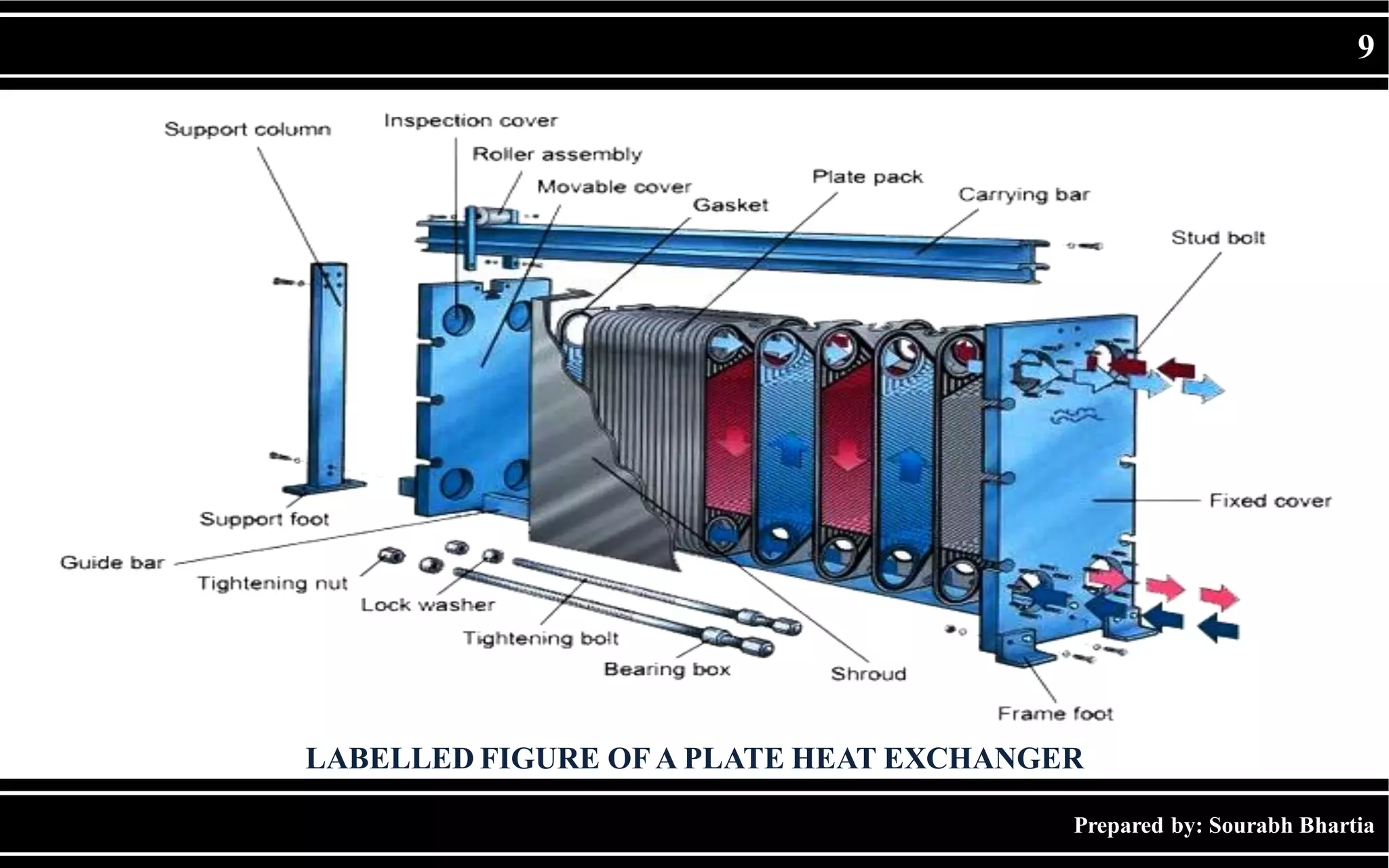
They consist of a stack of corrugated thin metal plates, pressed together so as to form two
continuous flow channels for the fluids exchanging heat. Gaskets are placed between the plates to
prevent leakage.
Advantages of the plate heat exchangers:
 Flexibility: the capacity can be increased or decreased by adding or removing plates.
 Sanitation: by opening the stack, both sides of the entire exchange area are made accessible for
cleaning and inspection.
 High heat transfer coefficient, due to increased turbulence in the narrow flow channel
 Compactness: high exchange surface to volume ratio.
Disadvantages of the plate heat exchangers:
 The narrow size of the flow channels results in high pressure drop and limits its use to low viscosity
fluids not containing large suspended particles.
 The need for gaskets is also a disadvantage.
Prepared by: Sourabh Bhartia
9
LABELLED FIGURE OFA PLATE HEAT EXCHANGER
Prepared by: Sourabh Bhartia
10
TUBULAR HEAT EXCHANGER
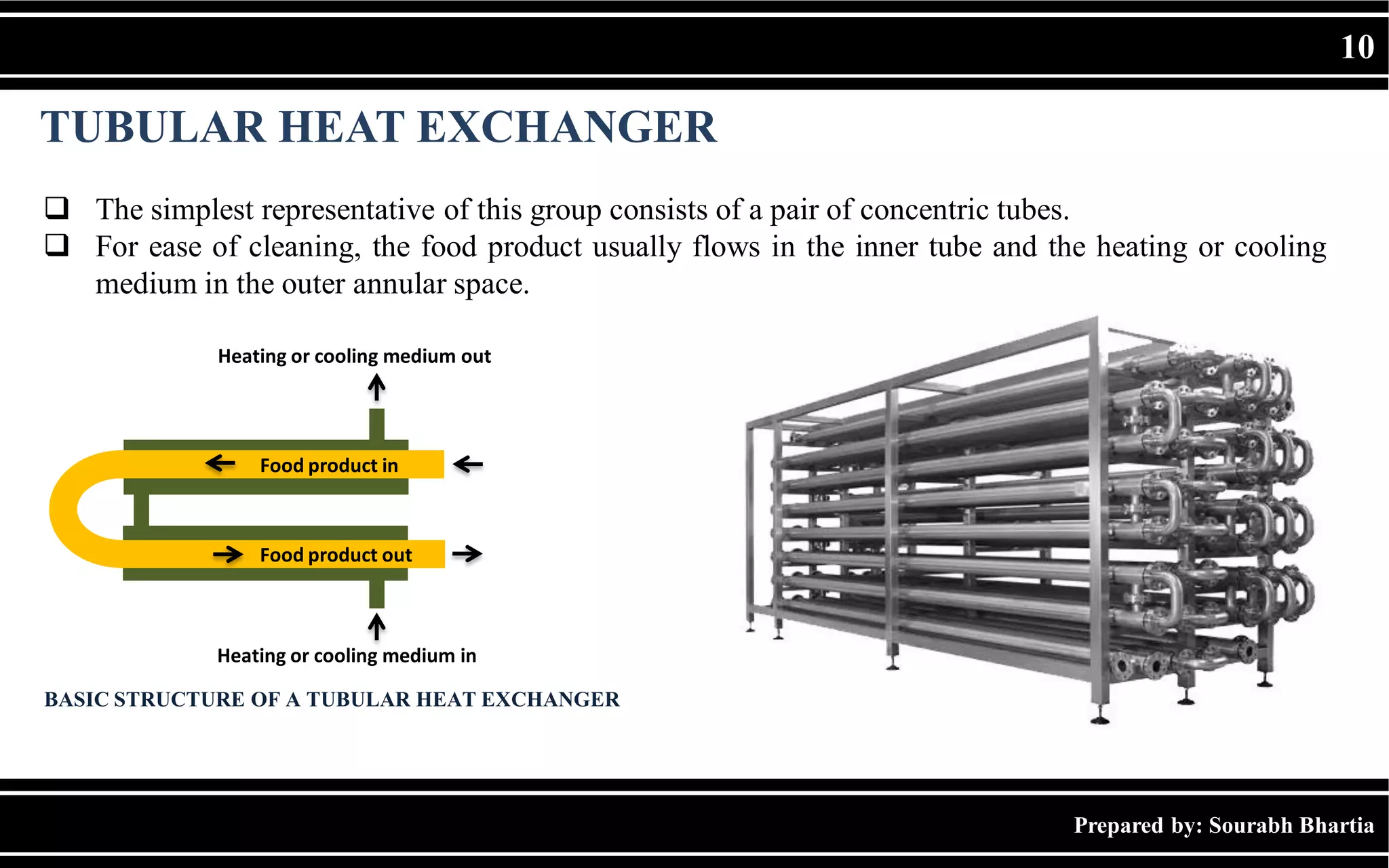
 The simplest representative of this group consists of a pair of concentric tubes.
 For ease of cleaning, the food product usually flows in the inner tube and the heating or cooling
medium in the outer annular space.
Heating or cooling medium out
Heating or cooling medium in
Food product out
Food product in
BASIC STRUCTURE OF A TUBULAR HEAT EXCHANGER
Prepared by: Sourabh Bhartia
11
SCRAPED SURFACE HEAT EXCHANGER
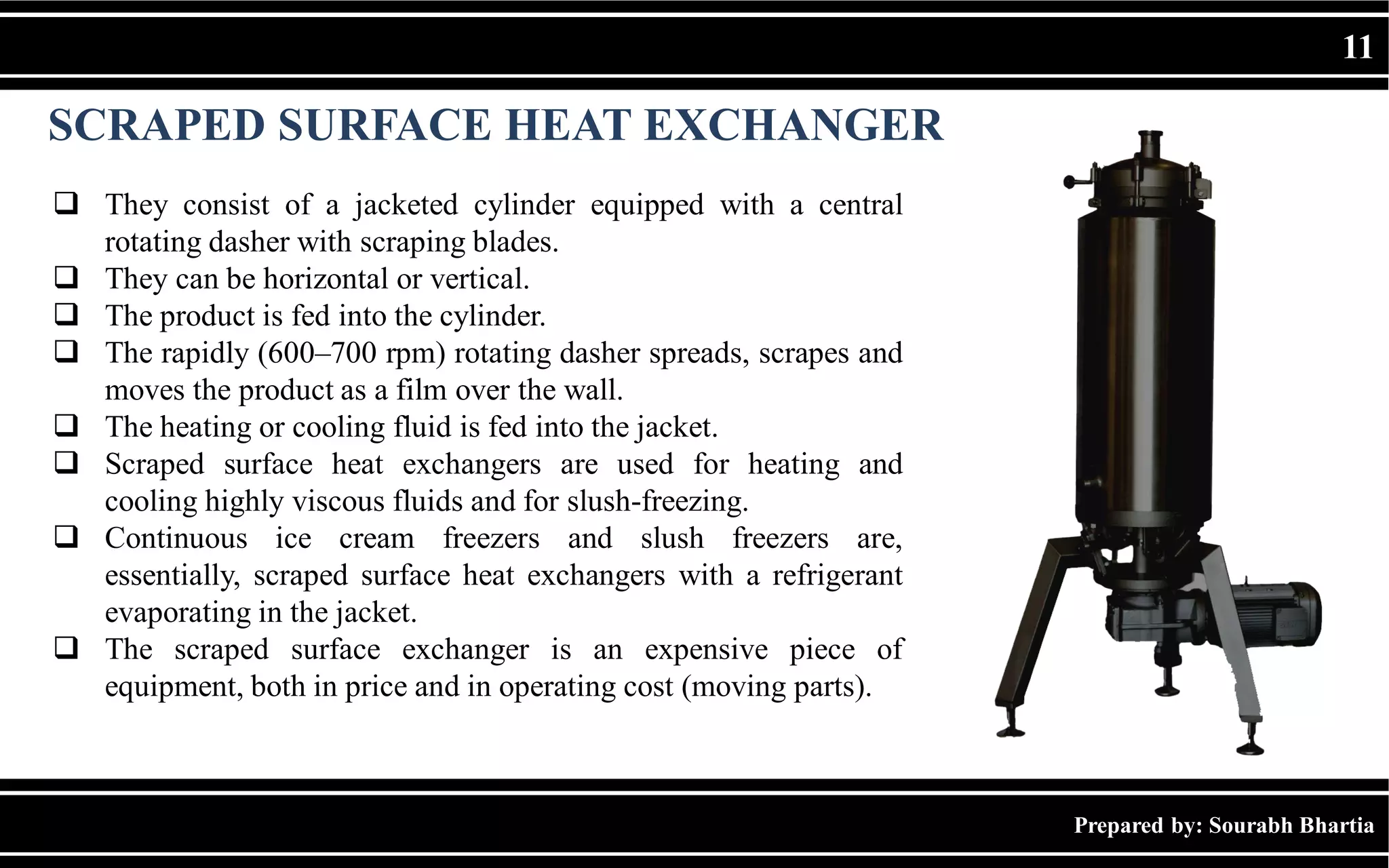
 They consist of a jacketed cylinder equipped with a central
rotating dasher with scraping blades.
 They can be horizontal or vertical.
 The product is fed into the cylinder.
 The rapidly (600–700 rpm) rotating dasher spreads, scrapes and
moves the product as a film over the wall.
 The heating or cooling fluid is fed into the jacket.
 Scraped surface heat exchangers are used for heating and
cooling highly viscous fluids and for slush-freezing.
 Continuous ice cream freezers and slush freezers are,
essentially, scraped surface heat exchangers with a refrigerant
evaporating in the jacket.
 The scraped surface exchanger is an expensive piece of
equipment, both in price and in operating cost (moving parts).
Prepared by: Sourabh Bhartia
12
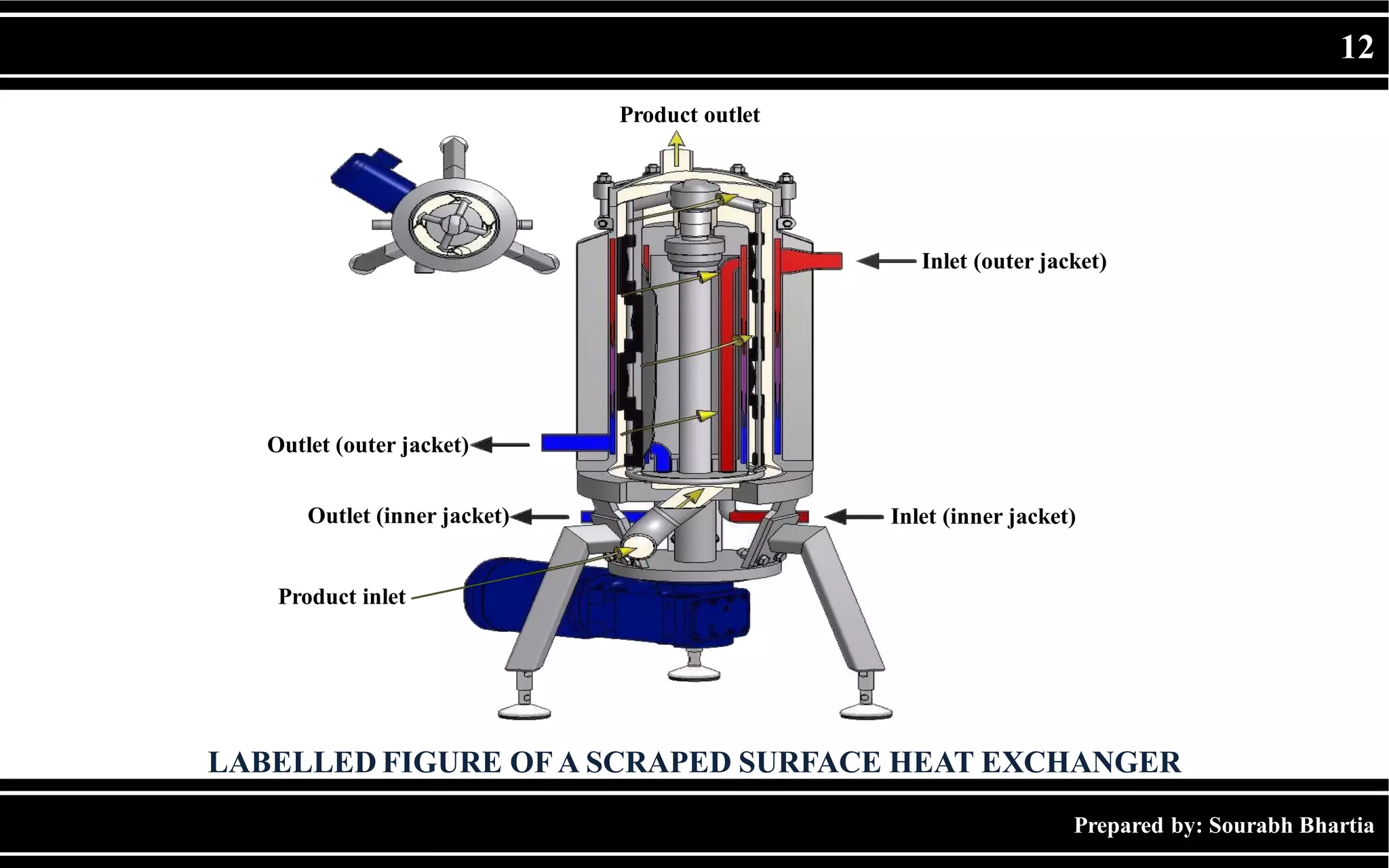
LABELLED FIGURE OFA SCRAPED SURFACE HEAT EXCHANGER
Product inlet
Outlet (inner jacket) Inlet (inner jacket)
Inlet (outer jacket)
Outlet (outer jacket)
Product outlet
Prepared by: Sourabh Bhartia
13
ADVANTAGES OF UHT PROCESSING
 High Quality: The D & Z values are higher for quality factors than microorganisms. The
reduction in process time due to high temperature (UHTST) & the minimal come up & cool
down time leads to a higher quality product.
 Longer shelf life: Greater than 6 months
 Packaging Size: Processing conditions are independent of container size, thus allowing for
the filling of large containers for food service or sale to food manufacturers.
DISADVANTAGES OF UHT PROCESSING
 Sterility: Complexity of equipment and plant are needed to maintain sterile atmosphere
between processing & packaging (packaging materials, pipe work, tanks, pumps) therefore,
this process needs higher skilled operators.
 Other sterilization required: As process equipment, containers, lids, aseptic tunnel
 Particle size: With larger particulates there is a danger of overcooking of surfaces and need
to transport material; both limits particle size.
Prepared by: Sourabh Bhartia
14
BIBLIOGRAPHY
 Food process engineering & technology, ZEKI BERK
 Food processing technology: Principles & Practices, P.J.FELLOWS
 Improving the thermal processing of foods, PHILIP RICHARDSON
Prepared by: Sourabh Bhartia
15
THANKYOU

Ultra High Temperature Processing of Food Products

  • 1.
    ULTRA HIGH TEMPERATUREPROCESSING Of Food Products Prepared by:- Sourabh Bhartia B.Sc. & M.Sc. (Food Processing & Technology) UTD, AVVV, BSP (C.G.) sourabhbhartia@gmail.com www.linkedin.com/in/sourabh-bhartia
  • 2.
    Prepared by: SourabhBhartia CONTENTS  WHAT IS UHT PROCESSING ?_________________ 1  PURPOSE OF UHT PROCESSING_______________2  METHODS OF UHT PROCESSING______________4  DIRECT HEATING SYSTEMS__________________ 5  INJECTION, INFUSION & ELECTRIC HEATING_6  INDIRECT HEATING SYSTEMS________________7  PLATE HEAT EXCHANGER___________________ 8  TUBULAR HEAT EXCHANGER________________10  SCRAPED SURFACE HEAT EXCHANGER ______11  ADVANTAGES & DISADVANTAGES____________13  BIBLIOGRAPHY_____________________________ 14
  • 3.
    Liquid foods Foodswith solid particles Foods with larger particles Milk Fruit Juice Beer Wine Baby Foods Tomato Products Vegetable Soups Stews Prepared by: Sourabh Bhartia 1 ULTRA HIGH TEMPERATURE (UHT) PROCESSING Higher processing temperatures for a shorter time are possible if the product is sterilized before is filled into a pre-sterilized containers in a sterile atmosphere. Continuous flow of heat at a temperature of 135⁰C for a very short time of 2to5 seconds destruct almost all the microorganisms and spores present in the food. This forms the basis of UHT processing (also termed as aseptic processing) Residential time varies with respect to the products:
  • 4.
    Prepared by: SourabhBhartia 2 PURPOSE OF UHT PROCESSING  To achieve a longer shelf life.  To kill all heat resistant spore forming bacteria in milk, For e.g., Bacillus Licheniformis, Bacillus Subtilus;  To inactivate enzymes (Ultra High temperature processing/High Temperature for Short Time through High Hydrostatic Pressure), For e.g., to inactivate pectinol and filtragol used in processing of beverages;  For inactivation of yeasts, For e.g., Saccharomyces cerevisiae in beer;  To increase the sugar concentration in candy processing. Candy Processing Thermometer
  • 5.
    Prepared by: SourabhBhartia 3  PARAMETERS OF CANDY PREPARATION THROUGH UHT PROCESSING STAGE TEMPERATURE SUGAR CONCENTRATION  thread (e.g., syrup) 110 to 112 °C (230 to 234 °F) 80%  soft ball (e.g., fudge) 112 to 116 °C (234 to 241 °F) 85%  firm ball (e.g., soft caramel candy) 118 to 120 °C (244 to 248 °F) 87%  hard ball (e.g., nougat) 121 to 130 °C (250 to 266 °F) 90%  soft crack (e.g., salt water taffy) 132 to 143 °C (270 to 289 °F) 95%  hard crack (e.g., toffee) 146 to 154 °C (295 to 309 °F) 99%  clear liquid 160 °C (320 °F) 100%  brown liquid (e.g., liquid caramel) 170 °C (338 °F) 100%  burnt sugar 177 °C (351 °F) 100%
  • 6.
    Prepared by: SourabhBhartia 4 METHODS OF UHT PROCESSING  There are 2 methods to perform a UHT processing: DIRECT HEATING INDIRECT HEATING
  • 7.
    Prepared by: SourabhBhartia 5 DIRECT HEATING SYSTEMS The high temperature steam is directly applied to the food material under strict controlled conditions.  Processing temperature of 140⁰C is quickly reached and hold it for 4 seconds.  The temperature is reduced by flash cooling in a vacuum vessel.  The short time process will not affect the nutritional qualities There are 3 types of direct heating systems:- INJECTION INFUSION ELECTRIC HEATING
  • 8.
    Prepared by: SourabhBhartia 6 1. Injection:-  High pressure steam is directly applied into the food product by steam injector which raises the temperature rapidly;  Then the food product is flash cooled in a vacuum;  Since this method is energy intensive and cause flavor damage, this method is suitable for limited kind of food products. 2. Infusion:-  The product is pumped through a distributing nozzle into a chamber of steam with high pressure.  More surface area of the food product is exposed to steam in this system.  Immediately after processing, flash cooling is applied to the food product in a vacuum chamber.  Infusion method is an instant heating and cooling process.  Localized over heating is not applicable and highly suitable for low and high viscous food products 3. Electric heating:-  Electric current is directly passing through the food products.  This system is applicable for liquid foods and particulate foods  Electrical resistance for liquid foods and solid creates problems in this system
  • 9.
    Prepared by: SourabhBhartia 7 INDIRECT HEATING SYSTEMS  A partition placed between food product and Steam/Refrigerant where the partition acts as a heating or cooling medium.  The heating medium pass through one side of partition and food product pass through the other side of partition through the partition plate where heat is transferred.  The similar process occurs during cooling also.  In this method there is no direct contact between the food product and the heating medium  Flow rate of the product, physical properties of the food material, residential time and cleaning are the important parameter to be considered before processing There are 3 types of direct heating systems:- PLATE HEAT EXCHANGER TUBULAR HEAT EXCHANGER SCRAPED SURFACE HEAT EXCHANGER
  • 10.
    Prepared by: SourabhBhartia 8 PLATE HEAT EXCHANGER  Plate heat exchangers are originally developed for the pasteurization of milk, plate heat exchangers are now used for a vast variety of heating, cooling and evaporation applications in the food industry. They consist of a stack of corrugated thin metal plates, pressed together so as to form two continuous flow channels for the fluids exchanging heat. Gaskets are placed between the plates to prevent leakage. Advantages of the plate heat exchangers:  Flexibility: the capacity can be increased or decreased by adding or removing plates.  Sanitation: by opening the stack, both sides of the entire exchange area are made accessible for cleaning and inspection.  High heat transfer coefficient, due to increased turbulence in the narrow flow channel  Compactness: high exchange surface to volume ratio. Disadvantages of the plate heat exchangers:  The narrow size of the flow channels results in high pressure drop and limits its use to low viscosity fluids not containing large suspended particles.  The need for gaskets is also a disadvantage.
  • 11.
    Prepared by: SourabhBhartia 9 LABELLED FIGURE OFA PLATE HEAT EXCHANGER
  • 12.
    Prepared by: SourabhBhartia 10 TUBULAR HEAT EXCHANGER  The simplest representative of this group consists of a pair of concentric tubes.  For ease of cleaning, the food product usually flows in the inner tube and the heating or cooling medium in the outer annular space. Heating or cooling medium out Heating or cooling medium in Food product out Food product in BASIC STRUCTURE OF A TUBULAR HEAT EXCHANGER
  • 13.
    Prepared by: SourabhBhartia 11 SCRAPED SURFACE HEAT EXCHANGER  They consist of a jacketed cylinder equipped with a central rotating dasher with scraping blades.  They can be horizontal or vertical.  The product is fed into the cylinder.  The rapidly (600–700 rpm) rotating dasher spreads, scrapes and moves the product as a film over the wall.  The heating or cooling fluid is fed into the jacket.  Scraped surface heat exchangers are used for heating and cooling highly viscous fluids and for slush-freezing.  Continuous ice cream freezers and slush freezers are, essentially, scraped surface heat exchangers with a refrigerant evaporating in the jacket.  The scraped surface exchanger is an expensive piece of equipment, both in price and in operating cost (moving parts).
  • 14.
    Prepared by: SourabhBhartia 12 LABELLED FIGURE OFA SCRAPED SURFACE HEAT EXCHANGER Product inlet Outlet (inner jacket) Inlet (inner jacket) Inlet (outer jacket) Outlet (outer jacket) Product outlet
  • 15.
    Prepared by: SourabhBhartia 13 ADVANTAGES OF UHT PROCESSING  High Quality: The D & Z values are higher for quality factors than microorganisms. The reduction in process time due to high temperature (UHTST) & the minimal come up & cool down time leads to a higher quality product.  Longer shelf life: Greater than 6 months  Packaging Size: Processing conditions are independent of container size, thus allowing for the filling of large containers for food service or sale to food manufacturers. DISADVANTAGES OF UHT PROCESSING  Sterility: Complexity of equipment and plant are needed to maintain sterile atmosphere between processing & packaging (packaging materials, pipe work, tanks, pumps) therefore, this process needs higher skilled operators.  Other sterilization required: As process equipment, containers, lids, aseptic tunnel  Particle size: With larger particulates there is a danger of overcooking of surfaces and need to transport material; both limits particle size.
  • 16.
    Prepared by: SourabhBhartia 14 BIBLIOGRAPHY  Food process engineering & technology, ZEKI BERK  Food processing technology: Principles & Practices, P.J.FELLOWS  Improving the thermal processing of foods, PHILIP RICHARDSON
  • 17.
    Prepared by: SourabhBhartia 15 THANKYOU