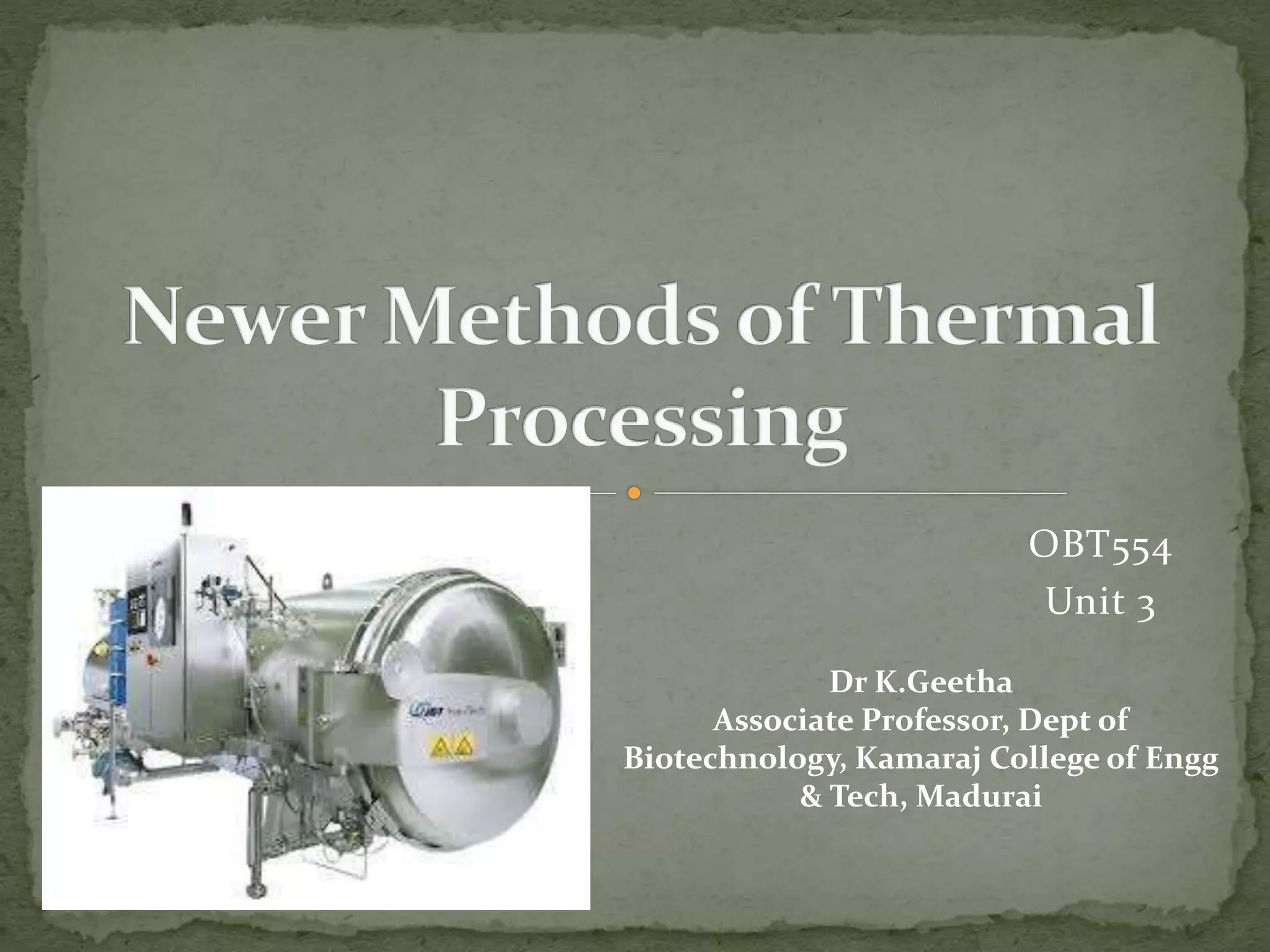
OBT554
Unit 3
Dr K.Geetha
Associate Professor, Dept of
Biotechnology, Kamaraj College of Engg
& Tech, Madurai
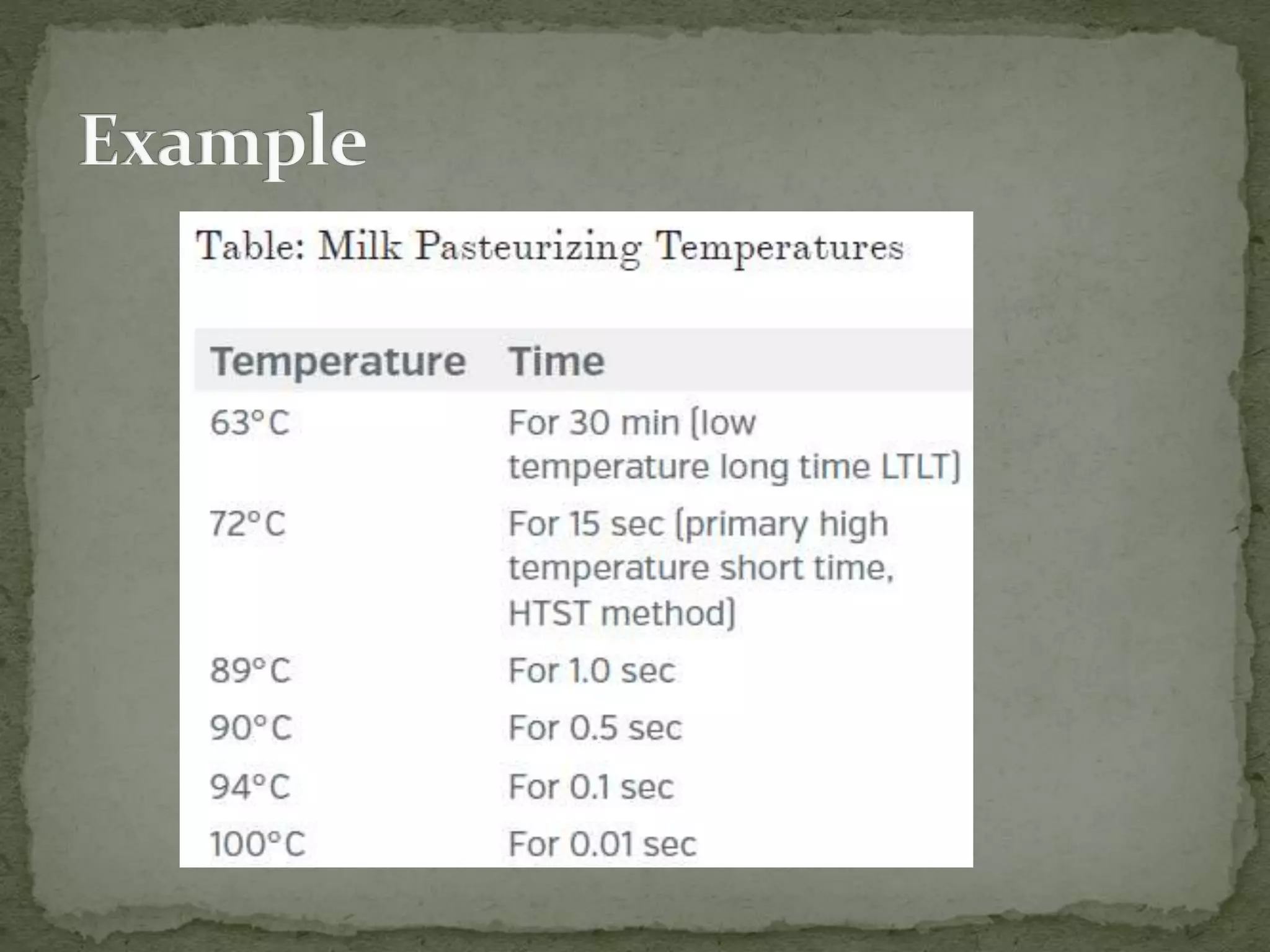
Definition: the combination of temperature and time
required to eliminate a desired number of
microorganisms from a food product.
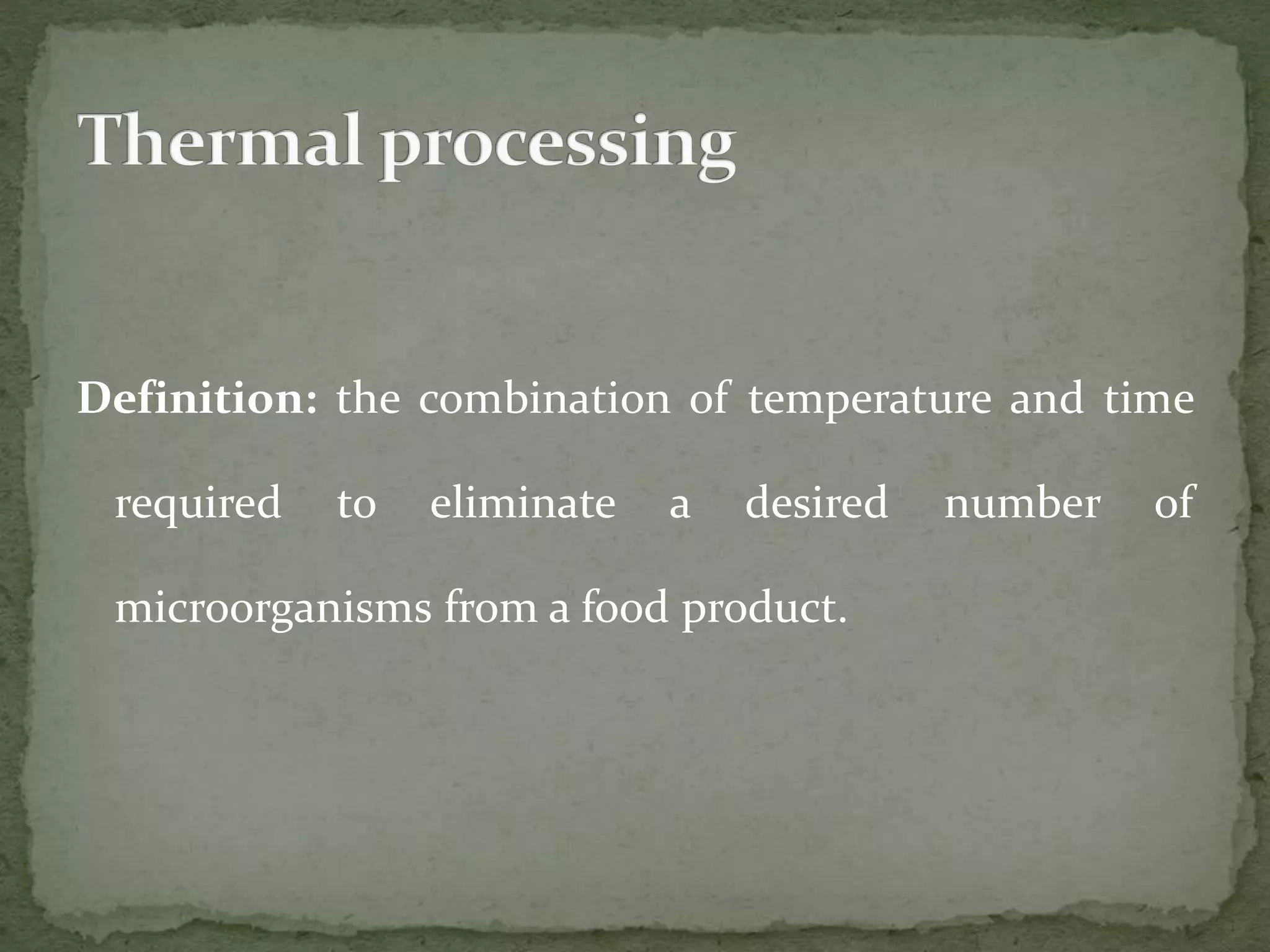
 The basic purpose for the thermal processing of
foods is,
 to reduce or destroy microbial activity,
 reduce or destroy enzyme activity,
 to produce physical or chemical changes,
 to make the food meet a certain quality standard.
 There are three main temperature categories employed
in thermal processing:
 Blanching - Mild processes
 Pasteurization - Mild processes
 Sterilization - More severe processes like Canning,
Baking, Roasting, Frying
 The primary purpose of blanching is to destroy
enzyme activity in fruit and vegetables.
 It is not intended as a sole method of preservation,
 But as a pre-treatment prior to freezing, drying and
canning.
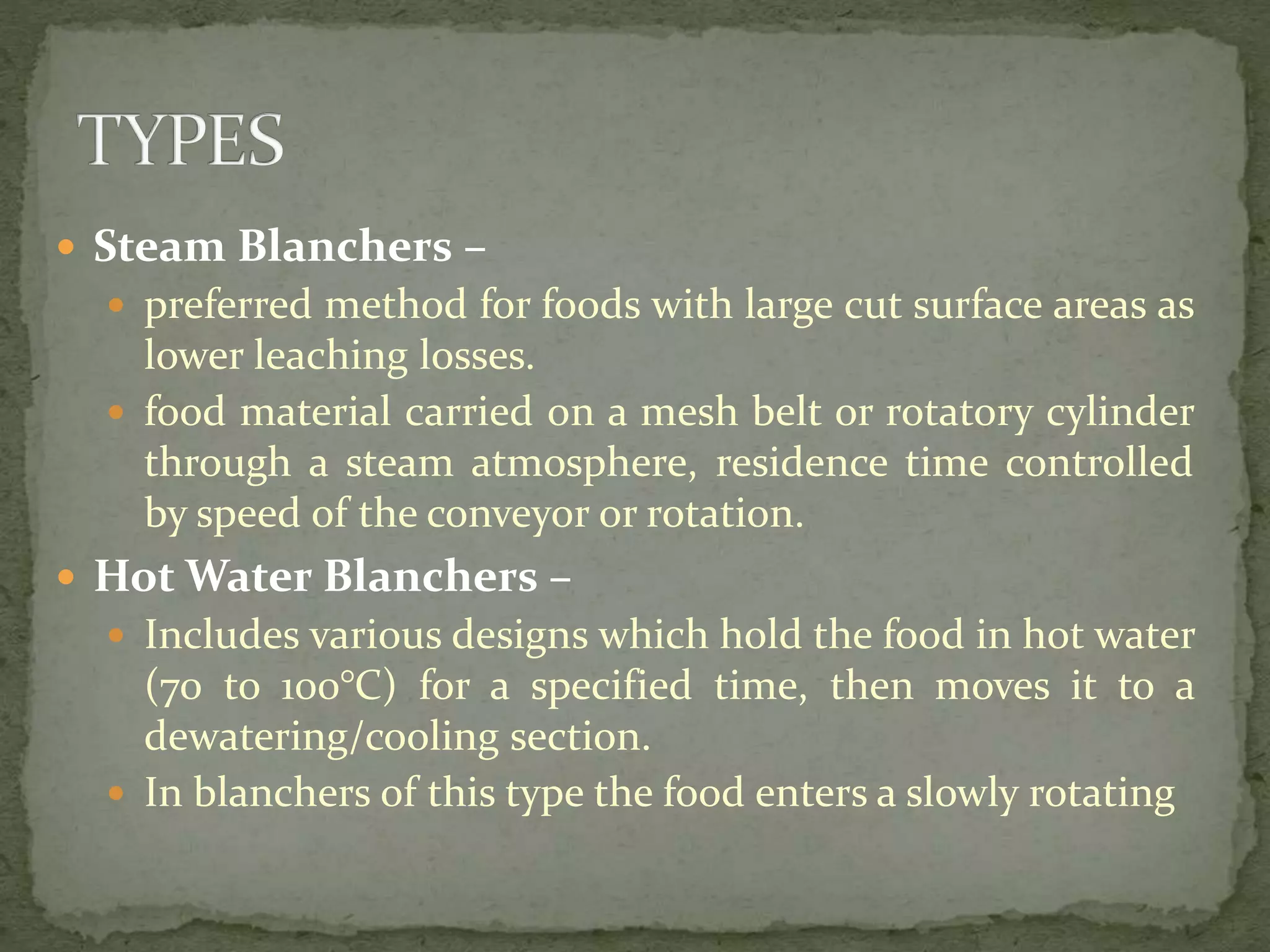
 Blanching is carried out at up to 100°C using hot water
 Some use of fluidised bed blanchers, utilising a
mixture of air and steam.
 There is also some use of microwaves for blanching.
 Steam Blanchers –
 preferred method for foods with large cut surface areas as
lower leaching losses.
 food material carried on a mesh belt or rotatory cylinder
through a steam atmosphere, residence time controlled
by speed of the conveyor or rotation.
 Hot Water Blanchers –
 Includes various designs which hold the food in hot water
(70 to 100°C) for a specified time, then moves it to a
dewatering/cooling section.
 In blanchers of this type the food enters a slowly rotating
 faster,
 more uniform heating,
 good mixing of the product,
 reduction in effluent,
 shorter processing time and hence reduced loss of
soluble and heat sensitive components
 Pasteurization is a relatively
mild heat treatment in which
food is heated to <100°c.
 It is widely used throughout
the food industry.
 It can be used to destroy
enzymes.
 It can be used to destroy
relatively heat sensitive
Micro-organisms
 It is used to extend shelf life.
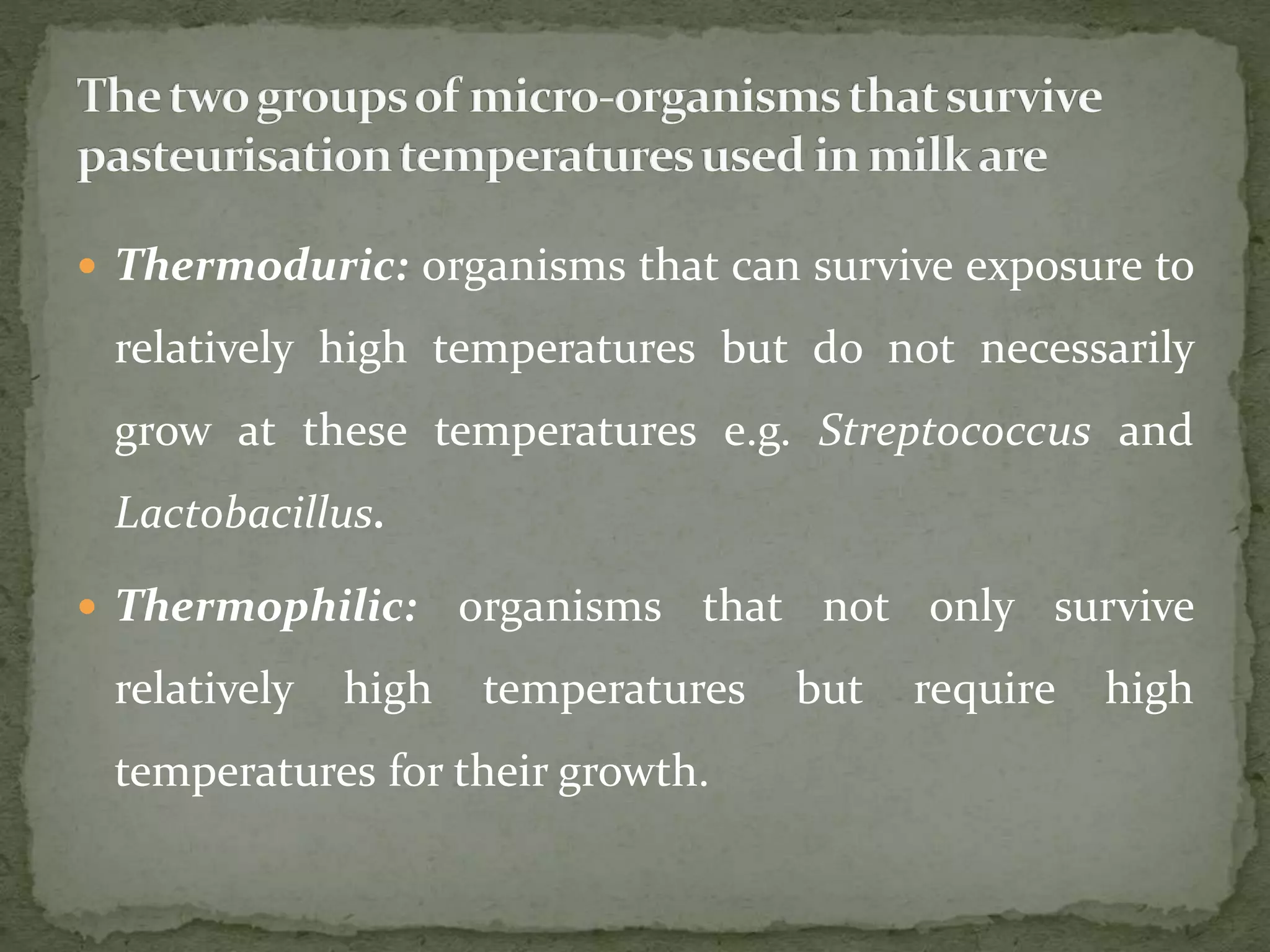
 Thermoduric: organisms that can survive exposure to
relatively high temperatures but do not necessarily
grow at these temperatures e.g. Streptococcus and
Lactobacillus.
 Thermophilic: organisms that not only survive
relatively high temperatures but require high
temperatures for their growth.
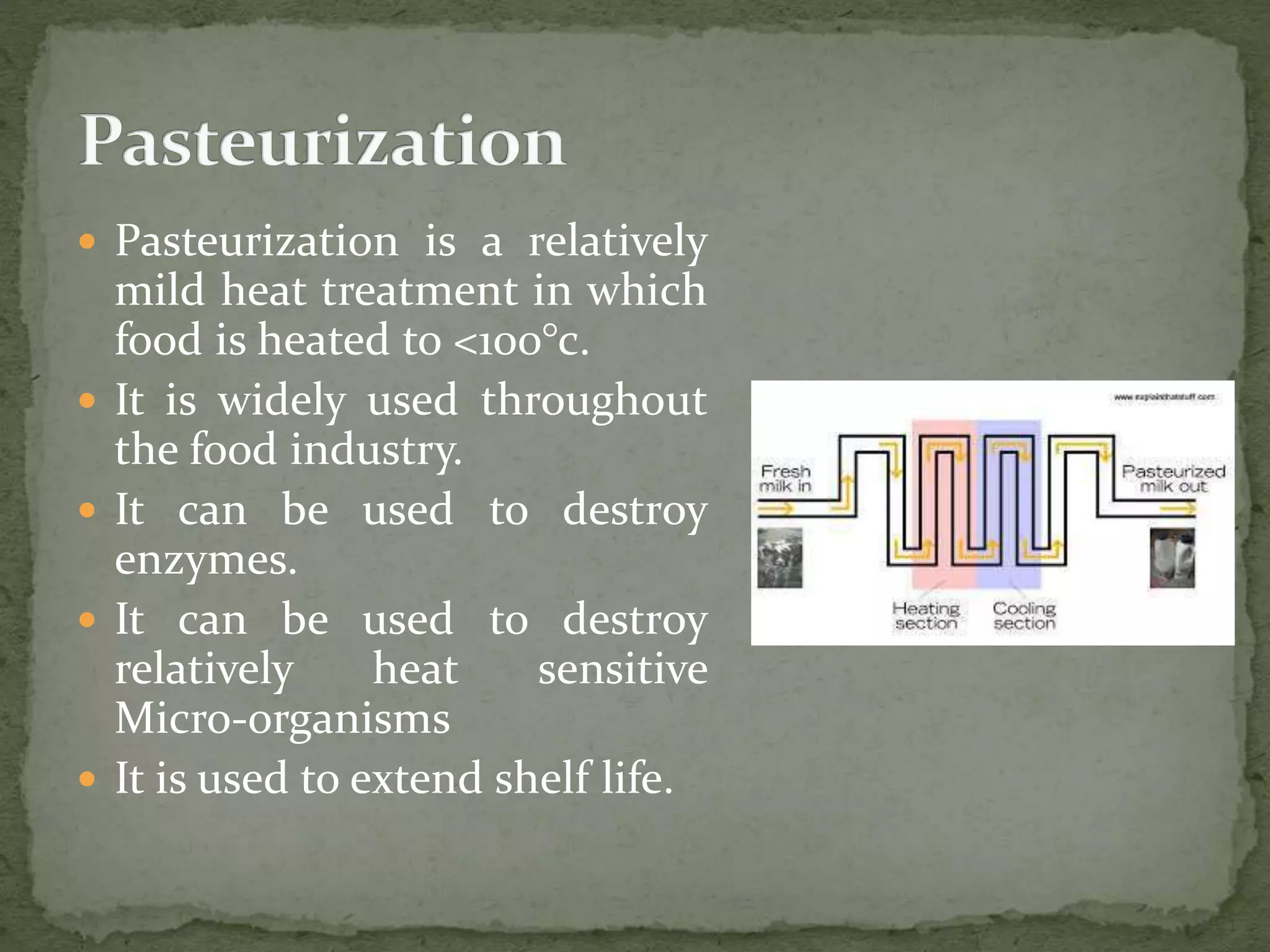
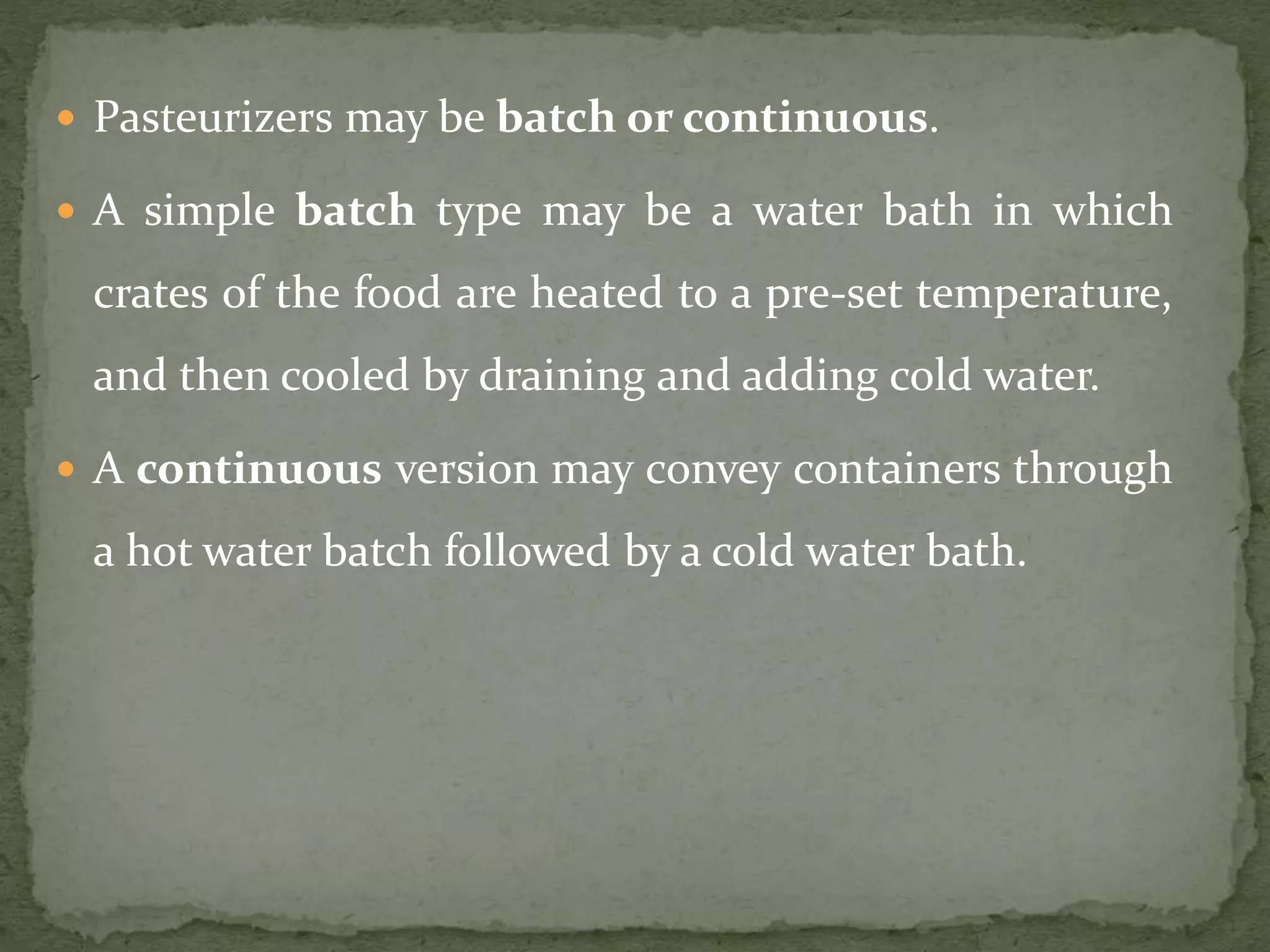
 Pasteurizers may be batch or continuous.
 A simple batch type may be a water bath in which
crates of the food are heated to a pre-set temperature,
and then cooled by draining and adding cold water.
 A continuous version may convey containers through
a hot water batch followed by a cold water bath.
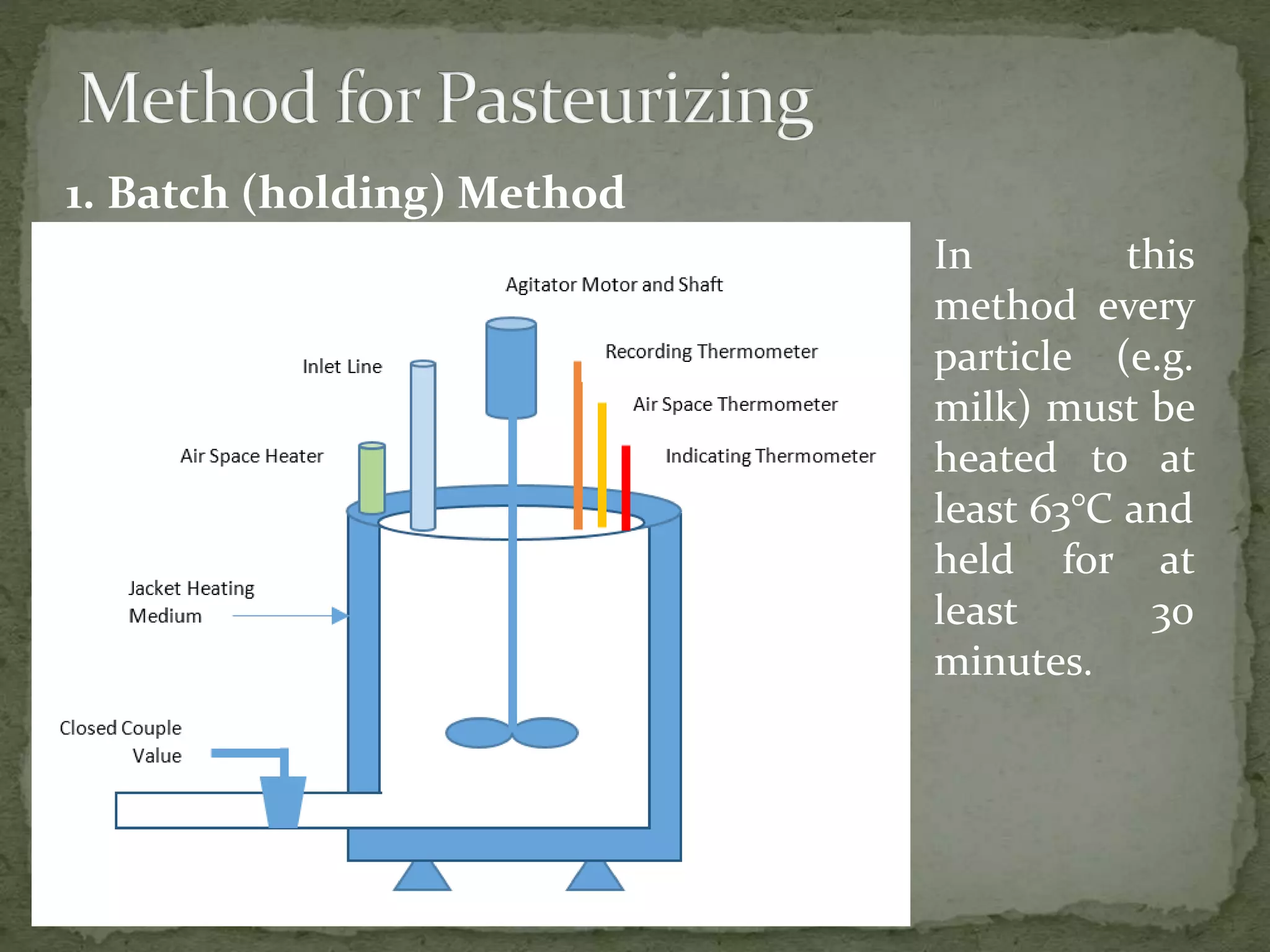
1. Batch (holding) Method
In this
method every
particle (e.g.
milk) must be
heated to at
least 63°C and
held for at
least 30
minutes.
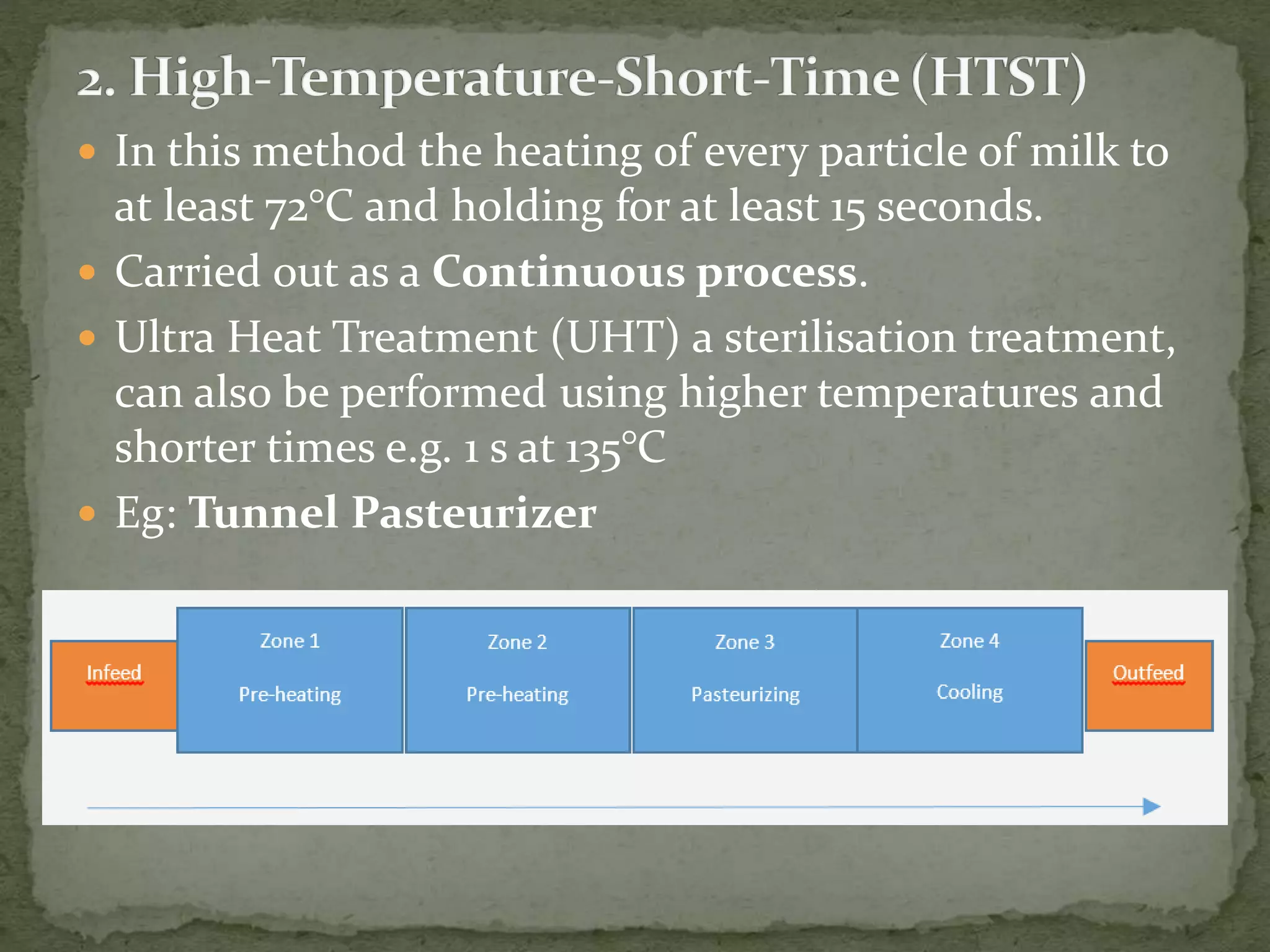
 In this method the heating of every particle of milk to
at least 72°C and holding for at least 15 seconds.
 Carried out as a Continuous process.
 Ultra Heat Treatment (UHT) a sterilisation treatment,
can also be performed using higher temperatures and
shorter times e.g. 1 s at 135°C
 Eg: Tunnel Pasteurizer
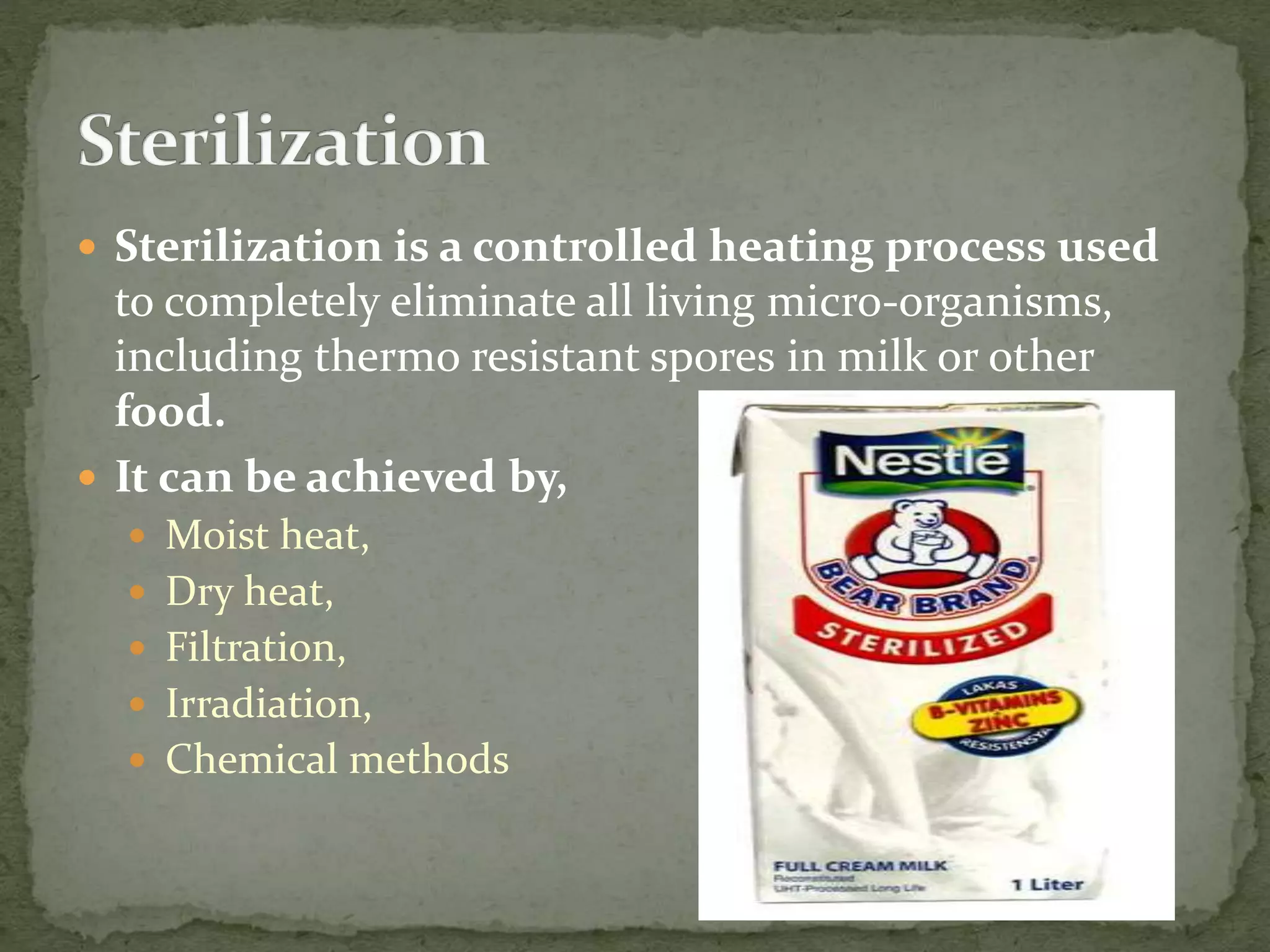
 Sterilization is a controlled heating process used
to completely eliminate all living micro-organisms,
including thermo resistant spores in milk or other
food.
 It can be achieved by,
 Moist heat,
 Dry heat,
 Filtration,
 Irradiation,
 Chemical methods
 Phase 1 = (heating phase) heating medium (water or
steam) the product temperature is increased from ambient
to the required sterilization temperature
 Phase 2 = (holding phase) temperature is maintained for a
defined time.
 Phase 3 = (cooling phase) the temperature in the can is
decreased by introduction of cold water into the autoclave.
 Autoclaves or retorts
 Simple small autoclaves
 Larger autoclaves
 Rotary Autoclaves
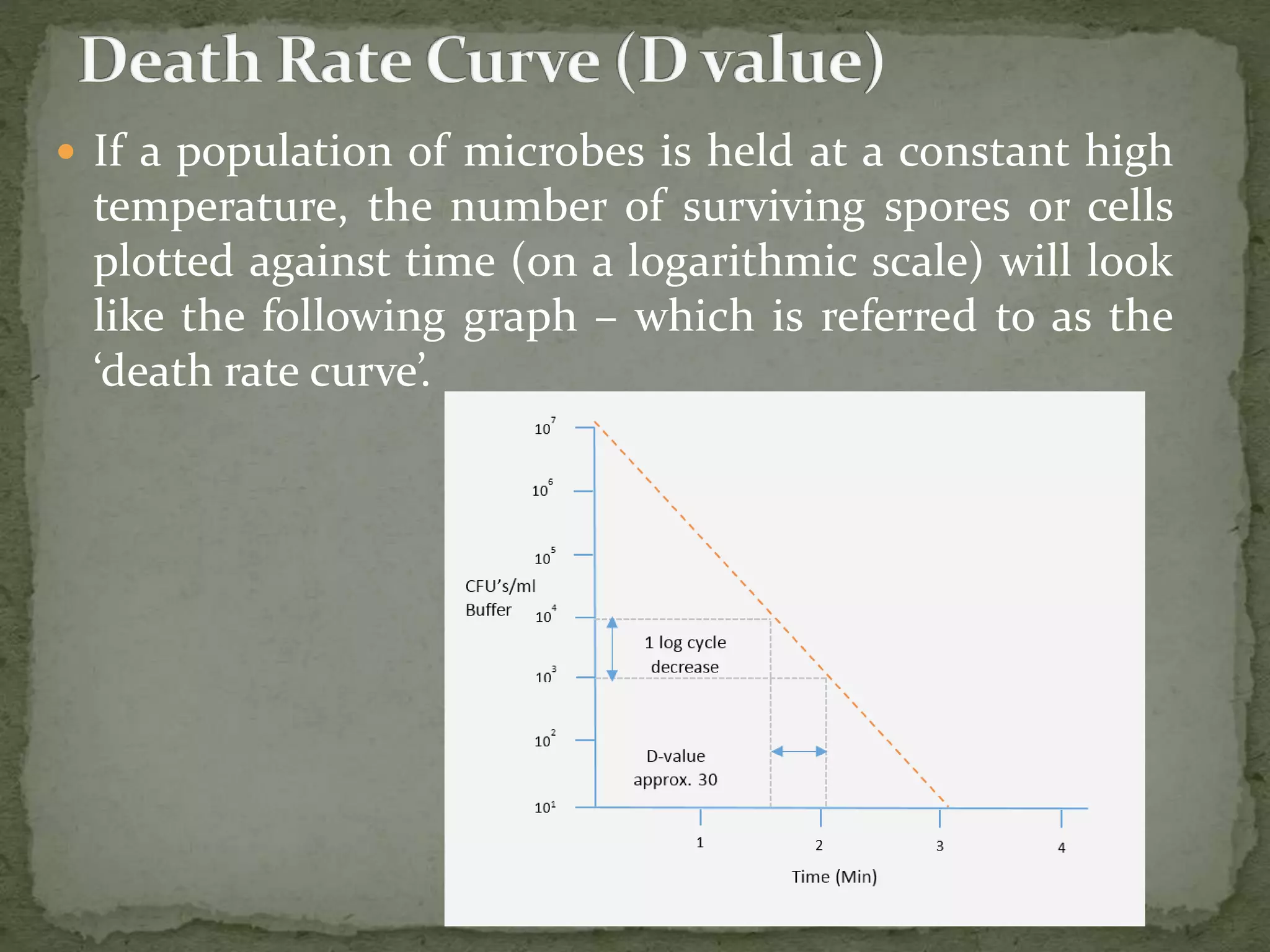
 If a population of microbes is held at a constant high
temperature, the number of surviving spores or cells
plotted against time (on a logarithmic scale) will look
like the following graph – which is referred to as the
‘death rate curve’.
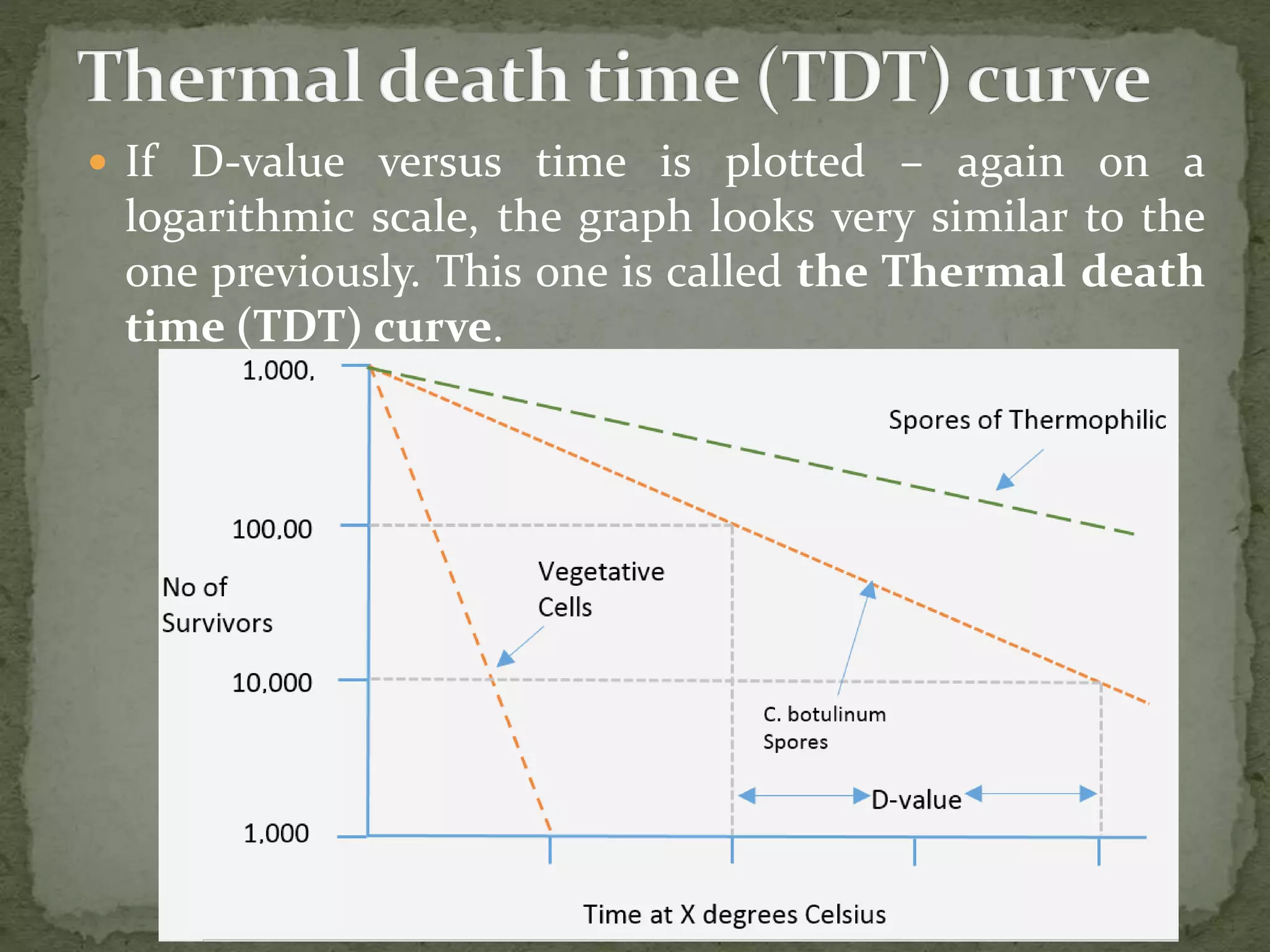
 If D-value versus time is plotted – again on a
logarithmic scale, the graph looks very similar to the
one previously. This one is called the Thermal death
time (TDT) curve.
 Factors affecting heat resistance of microorganism
 Age of cell: younger cell are less heat resistance
 Initial concentration of spore or cells: more the number
greater the heat treatment
 The medium in which growth has occurred: a more
nutritious medium increases heat resistance
 Moisture content: dry food tend to require more serve heat
treatment during sterilization
 pH of medium: cell or spore have great heat resistance at or
natural pH values
 Two strategies:
 A) High Temparature-Short Time (HTST) processing,
with associated aseptic packaging
 B) By delivering heat in new ways e.g. by Microwaves or
by Electric resistance (“OHMIC”) heating of food
 Examples:
 Retorts
 Using plastic packaging in retort operations
 Ohmic heating
 Microwaves sterilization
 The Campden and Chorleywood Food Research
Association is a centre of technical excellence for the
food industry.
Newer methods of thermal processing

Newer methods of thermal processing

  • 1.
    OBT554 Unit 3 Dr K.Geetha AssociateProfessor, Dept of Biotechnology, Kamaraj College of Engg & Tech, Madurai
  • 2.
    Definition: the combinationof temperature and time required to eliminate a desired number of microorganisms from a food product.
  • 3.
     The basicpurpose for the thermal processing of foods is,  to reduce or destroy microbial activity,  reduce or destroy enzyme activity,  to produce physical or chemical changes,  to make the food meet a certain quality standard.
  • 4.
     There arethree main temperature categories employed in thermal processing:  Blanching - Mild processes  Pasteurization - Mild processes  Sterilization - More severe processes like Canning, Baking, Roasting, Frying
  • 5.
     The primarypurpose of blanching is to destroy enzyme activity in fruit and vegetables.  It is not intended as a sole method of preservation,  But as a pre-treatment prior to freezing, drying and canning.
  • 6.
     Blanching iscarried out at up to 100°C using hot water  Some use of fluidised bed blanchers, utilising a mixture of air and steam.  There is also some use of microwaves for blanching.
  • 7.
     Steam Blanchers–  preferred method for foods with large cut surface areas as lower leaching losses.  food material carried on a mesh belt or rotatory cylinder through a steam atmosphere, residence time controlled by speed of the conveyor or rotation.  Hot Water Blanchers –  Includes various designs which hold the food in hot water (70 to 100°C) for a specified time, then moves it to a dewatering/cooling section.  In blanchers of this type the food enters a slowly rotating
  • 8.
     faster,  moreuniform heating,  good mixing of the product,  reduction in effluent,  shorter processing time and hence reduced loss of soluble and heat sensitive components
  • 9.
     Pasteurization isa relatively mild heat treatment in which food is heated to <100°c.  It is widely used throughout the food industry.  It can be used to destroy enzymes.  It can be used to destroy relatively heat sensitive Micro-organisms  It is used to extend shelf life.
  • 11.
     Thermoduric: organismsthat can survive exposure to relatively high temperatures but do not necessarily grow at these temperatures e.g. Streptococcus and Lactobacillus.  Thermophilic: organisms that not only survive relatively high temperatures but require high temperatures for their growth.
  • 12.
     Pasteurizers maybe batch or continuous.  A simple batch type may be a water bath in which crates of the food are heated to a pre-set temperature, and then cooled by draining and adding cold water.  A continuous version may convey containers through a hot water batch followed by a cold water bath.
  • 13.
    1. Batch (holding)Method In this method every particle (e.g. milk) must be heated to at least 63°C and held for at least 30 minutes.
  • 14.
     In thismethod the heating of every particle of milk to at least 72°C and holding for at least 15 seconds.  Carried out as a Continuous process.  Ultra Heat Treatment (UHT) a sterilisation treatment, can also be performed using higher temperatures and shorter times e.g. 1 s at 135°C  Eg: Tunnel Pasteurizer
  • 15.
     Sterilization isa controlled heating process used to completely eliminate all living micro-organisms, including thermo resistant spores in milk or other food.  It can be achieved by,  Moist heat,  Dry heat,  Filtration,  Irradiation,  Chemical methods
  • 16.
     Phase 1= (heating phase) heating medium (water or steam) the product temperature is increased from ambient to the required sterilization temperature  Phase 2 = (holding phase) temperature is maintained for a defined time.  Phase 3 = (cooling phase) the temperature in the can is decreased by introduction of cold water into the autoclave.
  • 17.
     Autoclaves orretorts  Simple small autoclaves  Larger autoclaves  Rotary Autoclaves
  • 18.
     If apopulation of microbes is held at a constant high temperature, the number of surviving spores or cells plotted against time (on a logarithmic scale) will look like the following graph – which is referred to as the ‘death rate curve’.
  • 19.
     If D-valueversus time is plotted – again on a logarithmic scale, the graph looks very similar to the one previously. This one is called the Thermal death time (TDT) curve.
  • 20.
     Factors affectingheat resistance of microorganism  Age of cell: younger cell are less heat resistance  Initial concentration of spore or cells: more the number greater the heat treatment  The medium in which growth has occurred: a more nutritious medium increases heat resistance  Moisture content: dry food tend to require more serve heat treatment during sterilization  pH of medium: cell or spore have great heat resistance at or natural pH values
  • 21.
     Two strategies: A) High Temparature-Short Time (HTST) processing, with associated aseptic packaging  B) By delivering heat in new ways e.g. by Microwaves or by Electric resistance (“OHMIC”) heating of food  Examples:  Retorts  Using plastic packaging in retort operations  Ohmic heating  Microwaves sterilization
  • 22.
     The Campdenand Chorleywood Food Research Association is a centre of technical excellence for the food industry.