
1
Y.Bavaneethan.
Lecturer
Department of Food Technology
SLGTI.
1/5/2018 Y.BAVANEETHAN
Baking and Roasting
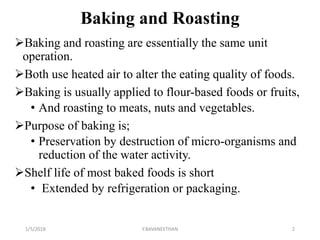
Baking and roasting are essentially the same unit
operation.
Both use heated air to alter the eating quality of foods.
Baking is usually applied to flour-based foods or fruits,
• And roasting to meats, nuts and vegetables.
Purpose of baking is;
• Preservation by destruction of micro-organisms and
reduction of the water activity.
Shelf life of most baked foods is short
• Extended by refrigeration or packaging.
1/5/2018 2Y.BAVANEETHAN
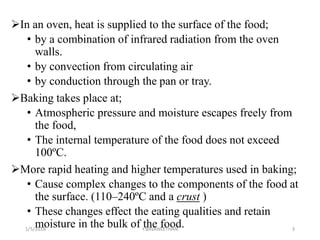
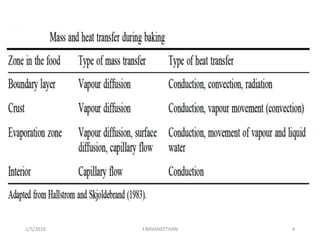
In an oven, heat is supplied to the surface of the food;
• by a combination of infrared radiation from the oven
walls.
• by convection from circulating air
• by conduction through the pan or tray.
Baking takes place at;
• Atmospheric pressure and moisture escapes freely from
the food,
• The internal temperature of the food does not exceed
100ºC.
More rapid heating and higher temperatures used in baking;
• Cause complex changes to the components of the food at
the surface. (110–240ºC and a crust )
• These changes effect the eating qualities and retain
moisture in the bulk of the food.1/5/2018 3Y.BAVANEETHAN
1/5/2018 4Y.BAVANEETHAN
Equipment
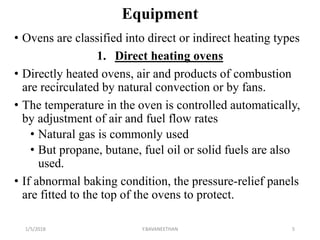
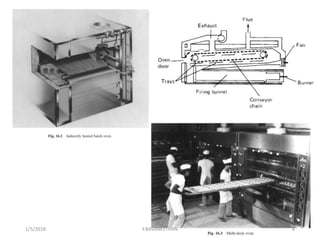
• Ovens are classified into direct or indirect heating types
1. Direct heating ovens
• Directly heated ovens, air and products of combustion
are recirculated by natural convection or by fans.
• The temperature in the oven is controlled automatically,
by adjustment of air and fuel flow rates
• Natural gas is commonly used
• But propane, butane, fuel oil or solid fuels are also
used.
• If abnormal baking condition, the pressure-relief panels
are fitted to the top of the ovens to protect.
1/5/2018 5Y.BAVANEETHAN
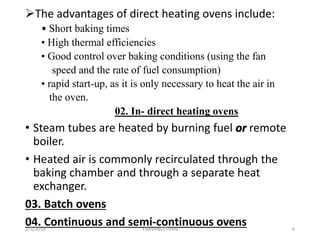
The advantages of direct heating ovens include:
• Short baking times
• High thermal efficiencies
• Good control over baking conditions (using the fan
speed and the rate of fuel consumption)
• rapid start-up, as it is only necessary to heat the air in
the oven.
02. In- direct heating ovens
• Steam tubes are heated by burning fuel or remote
boiler.
• Heated air is commonly recirculated through the
baking chamber and through a separate heat
exchanger.
03. Batch ovens
04. Continuous and semi-continuous ovens1/5/2018 6Y.BAVANEETHAN
1/5/2018 7Y.BAVANEETHAN
1/5/2018 8Y.BAVANEETHAN
1/5/2018 9Y.BAVANEETHAN
Deep frying
Involves the immersion of food in a pan of hot fat. Deep fried
foods are high in Fat but;
• Less fat is absorbed if the oil is very hot when the food is put
into it.
Food that are deep fried ,should be coated to prevent overcooking
and;
• prevent the food breaking up and absorbing too much fat.
When the food is placed in the hot fat;
• Eg: the egg in the coating coagulates rapidly and thus forms a
protective layer around the food.
• The food inside continues to cook by conduction and retains its
flavour and texture.
Deep fat fryers are safer because they control the oil temperature.
.
1/5/2018 10Y.BAVANEETHAN
Shallow frying
 Involves the cooking of food in layer of hot fat that comes half
way up the food.
 Heat is conducted from the base of the pan to one surface of the
food at a time.
• This means the food has to be turned at regular intervals to
ensure even cooking.
 Food that is shallow fried does not necessarily have to be coated.
Dry frying
 Some foods e.g. bacon and sausages can be fried without the
addition of fat as
• They contain sufficient fat to prevent sticking to the pan.
 Non stick pans are most suitable for this form of frying
1/5/2018 11Y.BAVANEETHAN
Stir Frying
• All ingredients should be finely chopped. into small pieces so
that it cooks quickly.
• A teaspoon of oil is heated in the pan and the food is put in and
stirred continuously to ensure even cooking.
• Few nutrients are lost and the food remains crisp and well
flavoured.
• It is a quick and healthy method of cooking.
1/5/2018 12Y.BAVANEETHAN
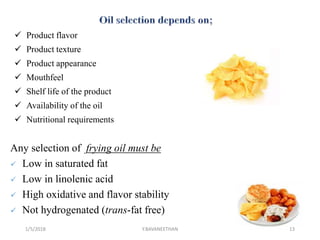
 Product flavor
 Product texture
 Product appearance
 Mouthfeel
 Shelf life of the product
 Availability of the oil
 Nutritional requirements
Any selection of frying oil must be
 Low in saturated fat
 Low in linolenic acid
 High oxidative and flavor stability
 Not hydrogenated (trans-fat free)
1/5/2018 13Y.BAVANEETHAN
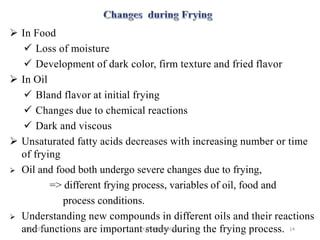
 In Food
 Loss of moisture
 Development of dark color, firm texture and fried flavor
 In Oil
 Bland flavor at initial frying
 Changes due to chemical reactions
 Dark and viscous
 Unsaturated fatty acids decreases with increasing number or time
of frying
 Oil and food both undergo severe changes due to frying,
=> different frying process, variables of oil, food and
process conditions.
 Understanding new compounds in different oils and their reactions
and functions are important study during the frying process.1/5/2018 14Y.BAVANEETHAN
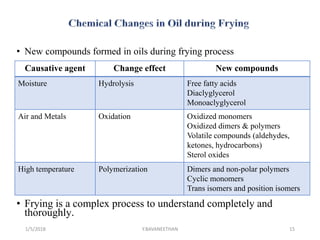
• New compounds formed in oils during frying process
• Frying is a complex process to understand completely and
thoroughly.
Causative agent Change effect New compounds
Moisture Hydrolysis Free fatty acids
Diaclyglycerol
Monoaclyglycerol
Air and Metals Oxidation Oxidized monomers
Oxidized dimers & polymers
Volatile compounds (aldehydes,
ketones, hydrocarbons)
Sterol oxides
High temperature Polymerization Dimers and non-polar polymers
Cyclic monomers
Trans isomers and position isomers
1/5/2018 15Y.BAVANEETHAN
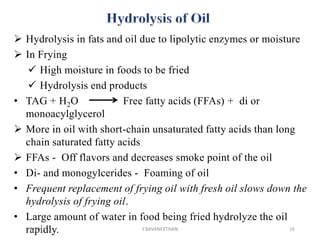
 Hydrolysis in fats and oil due to lipolytic enzymes or moisture
 In Frying
 High moisture in foods to be fried
 Hydrolysis end products
• TAG + H2O Free fatty acids (FFAs) + di or
monoacylglycerol
 More in oil with short-chain unsaturated fatty acids than long
chain saturated fatty acids
 FFAs - Off flavors and decreases smoke point of the oil
• Di- and monogylcerides - Foaming of oil
• Frequent replacement of frying oil with fresh oil slows down the
hydrolysis of frying oil.
• Large amount of water in food being fried hydrolyze the oil
rapidly.1/5/2018 16Y.BAVANEETHAN
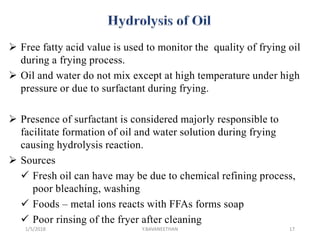
 Free fatty acid value is used to monitor the quality of frying oil
during a frying process.
 Oil and water do not mix except at high temperature under high
pressure or due to surfactant during frying.
 Presence of surfactant is considered majorly responsible to
facilitate formation of oil and water solution during frying
causing hydrolysis reaction.
 Sources
 Fresh oil can have may be due to chemical refining process,
poor bleaching, washing
 Foods – metal ions reacts with FFAs forms soap
 Poor rinsing of the fryer after cleaning
1/5/2018 17Y.BAVANEETHAN
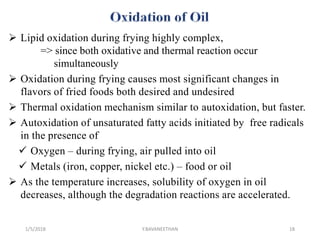
 Lipid oxidation during frying highly complex,
=> since both oxidative and thermal reaction occur
simultaneously
 Oxidation during frying causes most significant changes in
flavors of fried foods both desired and undesired
 Thermal oxidation mechanism similar to autoxidation, but faster.
 Autoxidation of unsaturated fatty acids initiated by free radicals
in the presence of
 Oxygen – during frying, air pulled into oil
 Metals (iron, copper, nickel etc.) – food or oil
 As the temperature increases, solubility of oxygen in oil
decreases, although the degradation reactions are accelerated.
1/5/2018 18Y.BAVANEETHAN
1/5/2018 19Y.BAVANEETHAN

Baking and Roasting and Frying

  • 1.
    1 Y.Bavaneethan. Lecturer Department of FoodTechnology SLGTI. 1/5/2018 Y.BAVANEETHAN
  • 2.
    Baking and Roasting Bakingand roasting are essentially the same unit operation. Both use heated air to alter the eating quality of foods. Baking is usually applied to flour-based foods or fruits, • And roasting to meats, nuts and vegetables. Purpose of baking is; • Preservation by destruction of micro-organisms and reduction of the water activity. Shelf life of most baked foods is short • Extended by refrigeration or packaging. 1/5/2018 2Y.BAVANEETHAN
  • 3.
    In an oven,heat is supplied to the surface of the food; • by a combination of infrared radiation from the oven walls. • by convection from circulating air • by conduction through the pan or tray. Baking takes place at; • Atmospheric pressure and moisture escapes freely from the food, • The internal temperature of the food does not exceed 100ºC. More rapid heating and higher temperatures used in baking; • Cause complex changes to the components of the food at the surface. (110–240ºC and a crust ) • These changes effect the eating qualities and retain moisture in the bulk of the food.1/5/2018 3Y.BAVANEETHAN
  • 4.
  • 5.
    Equipment • Ovens areclassified into direct or indirect heating types 1. Direct heating ovens • Directly heated ovens, air and products of combustion are recirculated by natural convection or by fans. • The temperature in the oven is controlled automatically, by adjustment of air and fuel flow rates • Natural gas is commonly used • But propane, butane, fuel oil or solid fuels are also used. • If abnormal baking condition, the pressure-relief panels are fitted to the top of the ovens to protect. 1/5/2018 5Y.BAVANEETHAN
  • 6.
    The advantages ofdirect heating ovens include: • Short baking times • High thermal efficiencies • Good control over baking conditions (using the fan speed and the rate of fuel consumption) • rapid start-up, as it is only necessary to heat the air in the oven. 02. In- direct heating ovens • Steam tubes are heated by burning fuel or remote boiler. • Heated air is commonly recirculated through the baking chamber and through a separate heat exchanger. 03. Batch ovens 04. Continuous and semi-continuous ovens1/5/2018 6Y.BAVANEETHAN
  • 7.
  • 8.
  • 9.
  • 10.
    Deep frying Involves theimmersion of food in a pan of hot fat. Deep fried foods are high in Fat but; • Less fat is absorbed if the oil is very hot when the food is put into it. Food that are deep fried ,should be coated to prevent overcooking and; • prevent the food breaking up and absorbing too much fat. When the food is placed in the hot fat; • Eg: the egg in the coating coagulates rapidly and thus forms a protective layer around the food. • The food inside continues to cook by conduction and retains its flavour and texture. Deep fat fryers are safer because they control the oil temperature. . 1/5/2018 10Y.BAVANEETHAN
  • 11.
    Shallow frying  Involvesthe cooking of food in layer of hot fat that comes half way up the food.  Heat is conducted from the base of the pan to one surface of the food at a time. • This means the food has to be turned at regular intervals to ensure even cooking.  Food that is shallow fried does not necessarily have to be coated. Dry frying  Some foods e.g. bacon and sausages can be fried without the addition of fat as • They contain sufficient fat to prevent sticking to the pan.  Non stick pans are most suitable for this form of frying 1/5/2018 11Y.BAVANEETHAN
  • 12.
    Stir Frying • Allingredients should be finely chopped. into small pieces so that it cooks quickly. • A teaspoon of oil is heated in the pan and the food is put in and stirred continuously to ensure even cooking. • Few nutrients are lost and the food remains crisp and well flavoured. • It is a quick and healthy method of cooking. 1/5/2018 12Y.BAVANEETHAN
  • 13.
     Product flavor Product texture  Product appearance  Mouthfeel  Shelf life of the product  Availability of the oil  Nutritional requirements Any selection of frying oil must be  Low in saturated fat  Low in linolenic acid  High oxidative and flavor stability  Not hydrogenated (trans-fat free) 1/5/2018 13Y.BAVANEETHAN
  • 14.
     In Food Loss of moisture  Development of dark color, firm texture and fried flavor  In Oil  Bland flavor at initial frying  Changes due to chemical reactions  Dark and viscous  Unsaturated fatty acids decreases with increasing number or time of frying  Oil and food both undergo severe changes due to frying, => different frying process, variables of oil, food and process conditions.  Understanding new compounds in different oils and their reactions and functions are important study during the frying process.1/5/2018 14Y.BAVANEETHAN
  • 15.
    • New compoundsformed in oils during frying process • Frying is a complex process to understand completely and thoroughly. Causative agent Change effect New compounds Moisture Hydrolysis Free fatty acids Diaclyglycerol Monoaclyglycerol Air and Metals Oxidation Oxidized monomers Oxidized dimers & polymers Volatile compounds (aldehydes, ketones, hydrocarbons) Sterol oxides High temperature Polymerization Dimers and non-polar polymers Cyclic monomers Trans isomers and position isomers 1/5/2018 15Y.BAVANEETHAN
  • 16.
     Hydrolysis infats and oil due to lipolytic enzymes or moisture  In Frying  High moisture in foods to be fried  Hydrolysis end products • TAG + H2O Free fatty acids (FFAs) + di or monoacylglycerol  More in oil with short-chain unsaturated fatty acids than long chain saturated fatty acids  FFAs - Off flavors and decreases smoke point of the oil • Di- and monogylcerides - Foaming of oil • Frequent replacement of frying oil with fresh oil slows down the hydrolysis of frying oil. • Large amount of water in food being fried hydrolyze the oil rapidly.1/5/2018 16Y.BAVANEETHAN
  • 17.
     Free fattyacid value is used to monitor the quality of frying oil during a frying process.  Oil and water do not mix except at high temperature under high pressure or due to surfactant during frying.  Presence of surfactant is considered majorly responsible to facilitate formation of oil and water solution during frying causing hydrolysis reaction.  Sources  Fresh oil can have may be due to chemical refining process, poor bleaching, washing  Foods – metal ions reacts with FFAs forms soap  Poor rinsing of the fryer after cleaning 1/5/2018 17Y.BAVANEETHAN
  • 18.
     Lipid oxidationduring frying highly complex, => since both oxidative and thermal reaction occur simultaneously  Oxidation during frying causes most significant changes in flavors of fried foods both desired and undesired  Thermal oxidation mechanism similar to autoxidation, but faster.  Autoxidation of unsaturated fatty acids initiated by free radicals in the presence of  Oxygen – during frying, air pulled into oil  Metals (iron, copper, nickel etc.) – food or oil  As the temperature increases, solubility of oxygen in oil decreases, although the degradation reactions are accelerated. 1/5/2018 18Y.BAVANEETHAN
  • 19.