Y.Bavaneethan
Lecturer
Department of Food Technology.
SLGTI, Sri Lanka.
Importance of Moisture Assay
• One of the most fundamental and important analytical
procedures,
• can be performed on a food product quality.
• The dry matter that remains after moisture removal is commonly
referred to as total solids.
• This analytical value is of great economic importance to a food
manufacturer, because water is an inexpensive filler.
• Determination of moisture is important economically to the
processor and the consumer.
• Moisture content of a food product will affect its stability and
quality.
• Moisture is inversely proportional to the amount of dry matter in
the food.
Importance of determination of moisture content in food stuff
• Moisture content is one of the most commonly measured properties of food
materials. It is important to food scientists for a number of different reasons:
01] Legal and Labeling Requirements: There are legal limits to the maximum
or minimum amount of water that must be present in certain types of food.
02] Economic: The cost of many foods depends on the amount of water they
contain - water is an inexpensive ingredient, and manufacturers often try to
incorporate as much as possible in a food, without exceeding some maximum
legal requirement.
03] Microbial Stability: The propensity of microorganisms to grow in foods
depends on their water content. For this reason many foods are dried below
some critical moisture content.
04] Food Quality: The texture, taste, appearance and stability of foods depends
on the amount of water they contain.
05] Food Processing Operations: A knowledge of the moisture content is often
necessary to predict the behavior of foods during processing, e.g. mixing,
drying, flow through a pipe or packaging.
1. Moisture is a quality factor in the preservation of some products and affects stability in
(a) Dehydrated vegetables and fruits
(b) Dried milks
(c) Powdered eggs
(d) Dehydrated potatoes
(e) Spices and herbs
2. Moisture is used as a quality factor for,
(a) Jams and jellies to prevent sugar crystallization
(b) Sugar syrups
(c) Prepared cereals – conventional; 4–8% ,puffed;7–8%
3. Reduced moisture is used for convenience in packaging or shipping of,
(a) Concentrated milks
(b) Liquid cane sugar (67% solids) and liquid corn sweetener (80% solids)
(c) Dehydrated products (these are difficult to package if too high in moisture)
(d) Concentrated fruit juices
4. Moisture (or solids) content is often specified in compositional standards,
(a) Cheddar cheese must be ≤39% moisture.
(b) Enriched flour must be ≤15% moisture.
(c) Pineapple juice must have soluble solids of ≥10.5°Brix (conditions specified).
(d)Glucose syrup must have ≥70% total solids.
(e) The percentage of added water in processed meats is commonly specified.
The types of water in a food stuff
1. Bulk water: -
• Bulk water is free from any other constituent so that each water molecules is
surrounded only by other water molecules.
• Therefore, has physico-chemical properties that are the same as those of
pure-water,
Eg: melting point, boiling point, density, compressibility, heat of
vaporization electron magnetic absorption spectra.
2. Capillary or trapped water: -
• Capillary water is held in narrow channels capillary forces.
• Trapped water is held within spaces within a food that are surrounded by a
physical barrier
• That prevent the water molecules from easily escaping
• The majority of this type of water is in normal water - has Physico-
chemical properties similar to that of bulk water.
3. Physically bonded water: -
• Water molecule in many foods is not completely surrounded by other water
molecules,
• but is in molecular contact with other food constituent
• E.g. protein, carbohydrate or minerals.
• The bonds between water molecules and these constituents are often
significantly different from normal water,
• Has different physico-chemical properties than bulk water
4. Chemically bonded water: -
• Some of the water molecule present in a food may be chemically bonded to
other molecules as water of crystallization is as hydrate
• Eg: NaS04.10H20.
• These bonds are mush stronger than the normal water,
• Chemically bonded water has very different physico-chemical properties to
bulkwater.
• Eg: lower melting point, higher boiling point.
Different Methods of Moisture Determination
A. OVENDRYINGMETHODS
Oven drying methods, the sample is heated under specified
conditions,
• the loss of weight is used to calculate the moisture content of the
sample.
The moisture determined is highly dependent on:
• the type of oven
• conditions within the oven
• the time and temperature of drying.
Various oven methods are approved by AOAC International for
determining the moisture in many food products.
1. Removal of Moisture
Any oven method used to evaporate moisture,
• Main fact that the boiling point of water is 100◦C;
• however, this considers only pure water at sea level.
• Free water is the easiest form of water to remove
Moisture removal is sometimes best achieved in a two-stage
process.
Liquid products (e.g., juices, milk)
• commonly pre-dried over a steam bath before drying in an
oven.
 Products such as bread and dried grain are often air dried,
then oven dried,
The moisture content calculated from moisture loss at both air
and oven drying steps.
The rate and efficiency of moisture removal depend on:
• Particle size,
• particle size distribution,
• sample sizes, and
• Surface area during drying.
2. Decomposition of Other Food Constituents
Moisture loss from a sample,
• Time and temperature are two major functional factors.
Decomposition enters to samples,
• When time is extended too much OR
• Temperature is too high.
Most methods for food moisture analysis,
• compromise between time and a particular temperature
Major problem
• Separate all the types of water from food constituents.
• Example => Carbohydrates decompose at 100◦C according to the
following reaction:
The moisture generated in carbohydrate decomposition is not the moisture
• Some other chemical reactions (e.g., sucrose hydrolysis) can result in
utilization of moisture.
• volatile constituents – cause higher weight loss during moisture
measurement
• These are change the moisture measurement.
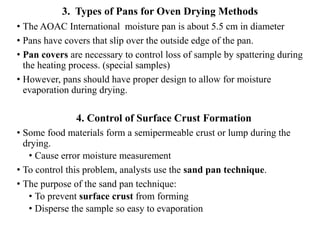
3. Types of Pans for Oven Drying Methods
• The AOAC International moisture pan is about 5.5 cm in diameter
• Pans have covers that slip over the outside edge of the pan.
• Pan covers are necessary to control loss of sample by spattering during
the heating process. (special samples)
• However, pans should have proper design to allow for moisture
evaporation during drying.
4. Control of Surface Crust Formation
• Some food materials form a semipermeable crust or lump during the
drying.
• Cause error moisture measurement
• To control this problem, analysts use the sand pan technique.
• The purpose of the sand pan technique:
• To prevent surface crust from forming
• Disperse the sample so easy to evaporation
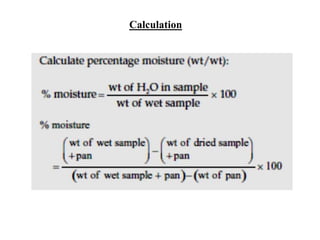
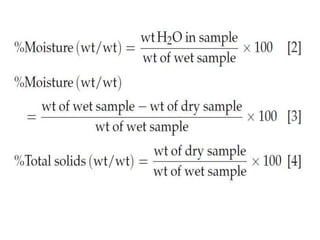
Calculation
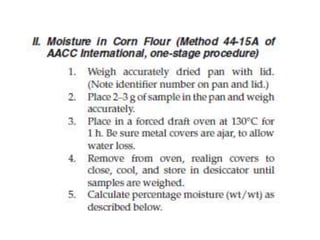
B. ForcedDraft Oven
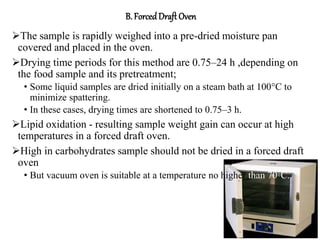
The sample is rapidly weighed into a pre-dried moisture pan
covered and placed in the oven.
Drying time periods for this method are 0.75–24 h ,depending on
the food sample and its pretreatment;
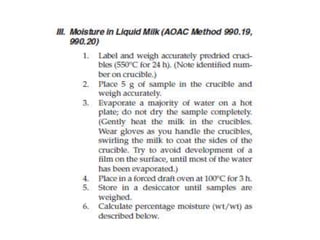
• Some liquid samples are dried initially on a steam bath at 100°C to
minimize spattering.
• In these cases, drying times are shortened to 0.75–3 h.
Lipid oxidation - resulting sample weight gain can occur at high
temperatures in a forced draft oven.
High in carbohydrates sample should not be dried in a forced draft
oven
• But vacuum oven is suitable at a temperature no higher than 70◦C.
Vacuum Oven
Drying under reduced pressure (25–100mm Hg),
• One is able to obtain a more complete removal of water and
volatiles without decomposition within a 3–6-h drying time.
Vacuum ovens need a dry air purge in addition to temperature
and vacuum controls to operate.
Moisture determination and Total solid

Moisture determination and Total solid

  • 1.
    Y.Bavaneethan Lecturer Department of FoodTechnology. SLGTI, Sri Lanka.
  • 2.
    Importance of MoistureAssay • One of the most fundamental and important analytical procedures, • can be performed on a food product quality. • The dry matter that remains after moisture removal is commonly referred to as total solids. • This analytical value is of great economic importance to a food manufacturer, because water is an inexpensive filler. • Determination of moisture is important economically to the processor and the consumer. • Moisture content of a food product will affect its stability and quality. • Moisture is inversely proportional to the amount of dry matter in the food.
  • 3.
    Importance of determinationof moisture content in food stuff • Moisture content is one of the most commonly measured properties of food materials. It is important to food scientists for a number of different reasons: 01] Legal and Labeling Requirements: There are legal limits to the maximum or minimum amount of water that must be present in certain types of food. 02] Economic: The cost of many foods depends on the amount of water they contain - water is an inexpensive ingredient, and manufacturers often try to incorporate as much as possible in a food, without exceeding some maximum legal requirement. 03] Microbial Stability: The propensity of microorganisms to grow in foods depends on their water content. For this reason many foods are dried below some critical moisture content. 04] Food Quality: The texture, taste, appearance and stability of foods depends on the amount of water they contain. 05] Food Processing Operations: A knowledge of the moisture content is often necessary to predict the behavior of foods during processing, e.g. mixing, drying, flow through a pipe or packaging.
  • 4.
    1. Moisture isa quality factor in the preservation of some products and affects stability in (a) Dehydrated vegetables and fruits (b) Dried milks (c) Powdered eggs (d) Dehydrated potatoes (e) Spices and herbs 2. Moisture is used as a quality factor for, (a) Jams and jellies to prevent sugar crystallization (b) Sugar syrups (c) Prepared cereals – conventional; 4–8% ,puffed;7–8% 3. Reduced moisture is used for convenience in packaging or shipping of, (a) Concentrated milks (b) Liquid cane sugar (67% solids) and liquid corn sweetener (80% solids) (c) Dehydrated products (these are difficult to package if too high in moisture) (d) Concentrated fruit juices 4. Moisture (or solids) content is often specified in compositional standards, (a) Cheddar cheese must be ≤39% moisture. (b) Enriched flour must be ≤15% moisture. (c) Pineapple juice must have soluble solids of ≥10.5°Brix (conditions specified). (d)Glucose syrup must have ≥70% total solids. (e) The percentage of added water in processed meats is commonly specified.
  • 5.
    The types ofwater in a food stuff 1. Bulk water: - • Bulk water is free from any other constituent so that each water molecules is surrounded only by other water molecules. • Therefore, has physico-chemical properties that are the same as those of pure-water, Eg: melting point, boiling point, density, compressibility, heat of vaporization electron magnetic absorption spectra. 2. Capillary or trapped water: - • Capillary water is held in narrow channels capillary forces. • Trapped water is held within spaces within a food that are surrounded by a physical barrier • That prevent the water molecules from easily escaping • The majority of this type of water is in normal water - has Physico- chemical properties similar to that of bulk water.
  • 6.
    3. Physically bondedwater: - • Water molecule in many foods is not completely surrounded by other water molecules, • but is in molecular contact with other food constituent • E.g. protein, carbohydrate or minerals. • The bonds between water molecules and these constituents are often significantly different from normal water, • Has different physico-chemical properties than bulk water 4. Chemically bonded water: - • Some of the water molecule present in a food may be chemically bonded to other molecules as water of crystallization is as hydrate • Eg: NaS04.10H20. • These bonds are mush stronger than the normal water, • Chemically bonded water has very different physico-chemical properties to bulkwater. • Eg: lower melting point, higher boiling point.
  • 7.
    Different Methods ofMoisture Determination A. OVENDRYINGMETHODS Oven drying methods, the sample is heated under specified conditions, • the loss of weight is used to calculate the moisture content of the sample. The moisture determined is highly dependent on: • the type of oven • conditions within the oven • the time and temperature of drying. Various oven methods are approved by AOAC International for determining the moisture in many food products. 1. Removal of Moisture Any oven method used to evaporate moisture, • Main fact that the boiling point of water is 100◦C; • however, this considers only pure water at sea level. • Free water is the easiest form of water to remove
  • 8.
    Moisture removal issometimes best achieved in a two-stage process. Liquid products (e.g., juices, milk) • commonly pre-dried over a steam bath before drying in an oven.  Products such as bread and dried grain are often air dried, then oven dried, The moisture content calculated from moisture loss at both air and oven drying steps. The rate and efficiency of moisture removal depend on: • Particle size, • particle size distribution, • sample sizes, and • Surface area during drying.
  • 9.
    2. Decomposition ofOther Food Constituents Moisture loss from a sample, • Time and temperature are two major functional factors. Decomposition enters to samples, • When time is extended too much OR • Temperature is too high. Most methods for food moisture analysis, • compromise between time and a particular temperature Major problem • Separate all the types of water from food constituents. • Example => Carbohydrates decompose at 100◦C according to the following reaction: The moisture generated in carbohydrate decomposition is not the moisture • Some other chemical reactions (e.g., sucrose hydrolysis) can result in utilization of moisture. • volatile constituents – cause higher weight loss during moisture measurement • These are change the moisture measurement.
  • 10.
    3. Types ofPans for Oven Drying Methods • The AOAC International moisture pan is about 5.5 cm in diameter • Pans have covers that slip over the outside edge of the pan. • Pan covers are necessary to control loss of sample by spattering during the heating process. (special samples) • However, pans should have proper design to allow for moisture evaporation during drying. 4. Control of Surface Crust Formation • Some food materials form a semipermeable crust or lump during the drying. • Cause error moisture measurement • To control this problem, analysts use the sand pan technique. • The purpose of the sand pan technique: • To prevent surface crust from forming • Disperse the sample so easy to evaporation
  • 11.
  • 16.
    B. ForcedDraft Oven Thesample is rapidly weighed into a pre-dried moisture pan covered and placed in the oven. Drying time periods for this method are 0.75–24 h ,depending on the food sample and its pretreatment; • Some liquid samples are dried initially on a steam bath at 100°C to minimize spattering. • In these cases, drying times are shortened to 0.75–3 h. Lipid oxidation - resulting sample weight gain can occur at high temperatures in a forced draft oven. High in carbohydrates sample should not be dried in a forced draft oven • But vacuum oven is suitable at a temperature no higher than 70◦C.
  • 17.
    Vacuum Oven Drying underreduced pressure (25–100mm Hg), • One is able to obtain a more complete removal of water and volatiles without decomposition within a 3–6-h drying time. Vacuum ovens need a dry air purge in addition to temperature and vacuum controls to operate.