Descriptive Statistics
      Research Writing
      Aiden Yeh, PhD
   Descriptive statistics is the term given to the analysis of
     data that helps describe, show or summarize data in a
     meaningful way such that, for example, patterns might
     emerge from the data.
    Descriptive statistics do not, however, allow us to make
     conclusions beyond the data we have analysed or reach
     conclusions regarding any hypotheses we might have
     made. They are simply a way to describe our data.


https://statistics.laerd.com/statistical-guides/descriptive-inferential-statistics.php
    For example, if we had the results of 100 pieces
    of students' coursework, we may be interested in
    the overall performance of those students. We
    would also be interested in the distribution or
    spread of the marks. Descriptive statistics allow
    us to do this.
   Using statistics and graphs
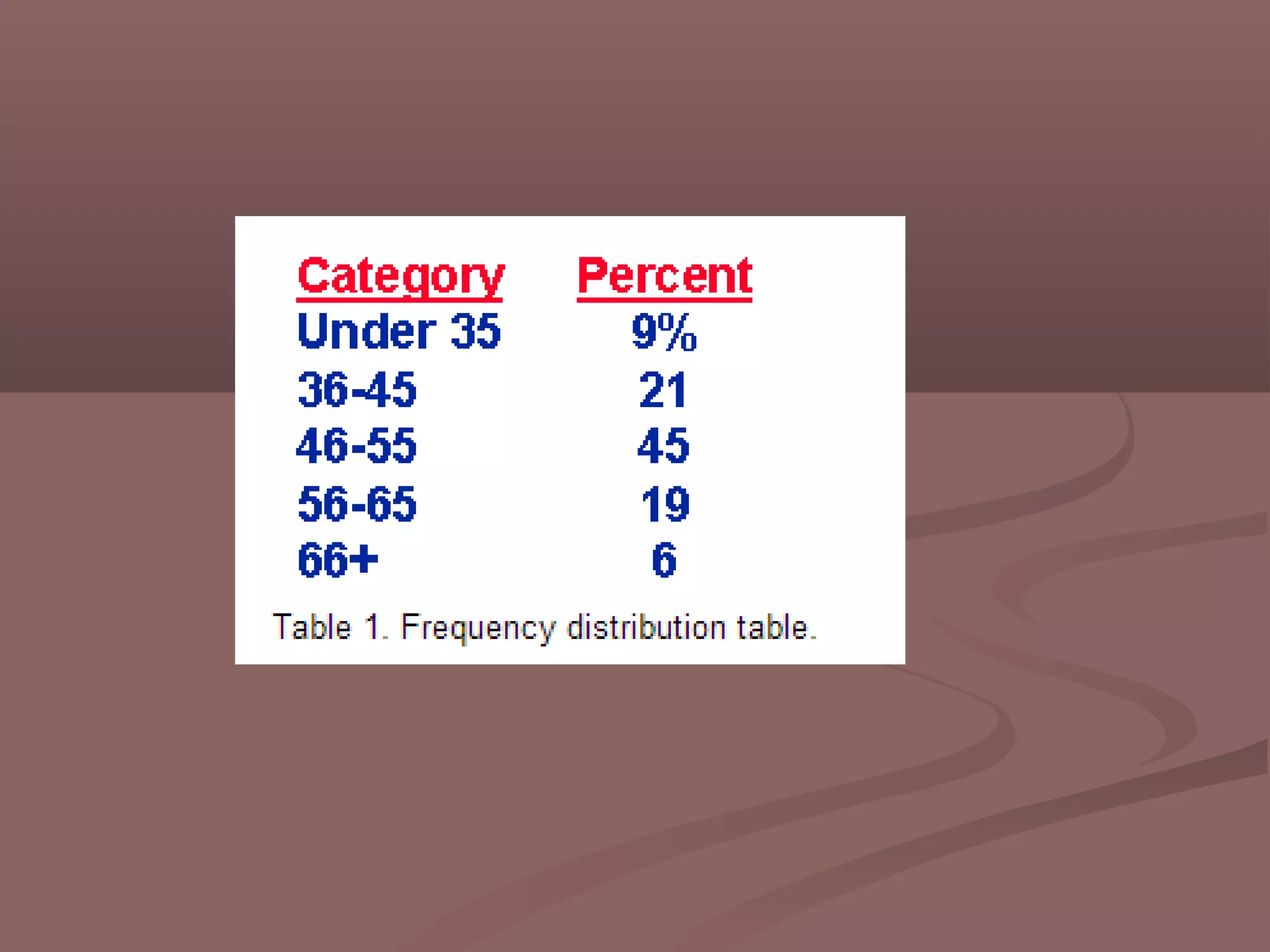
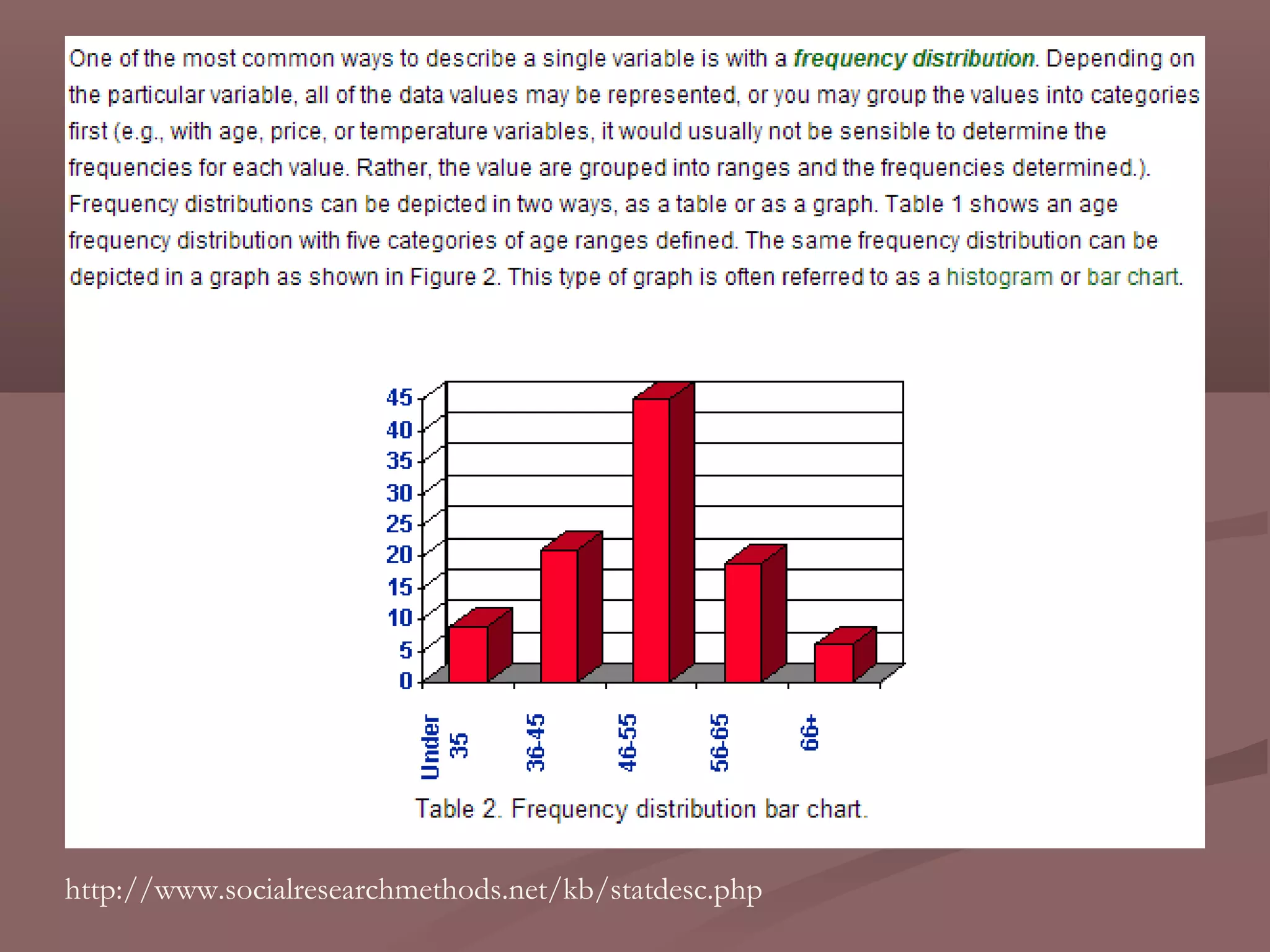
Frequency Distribution
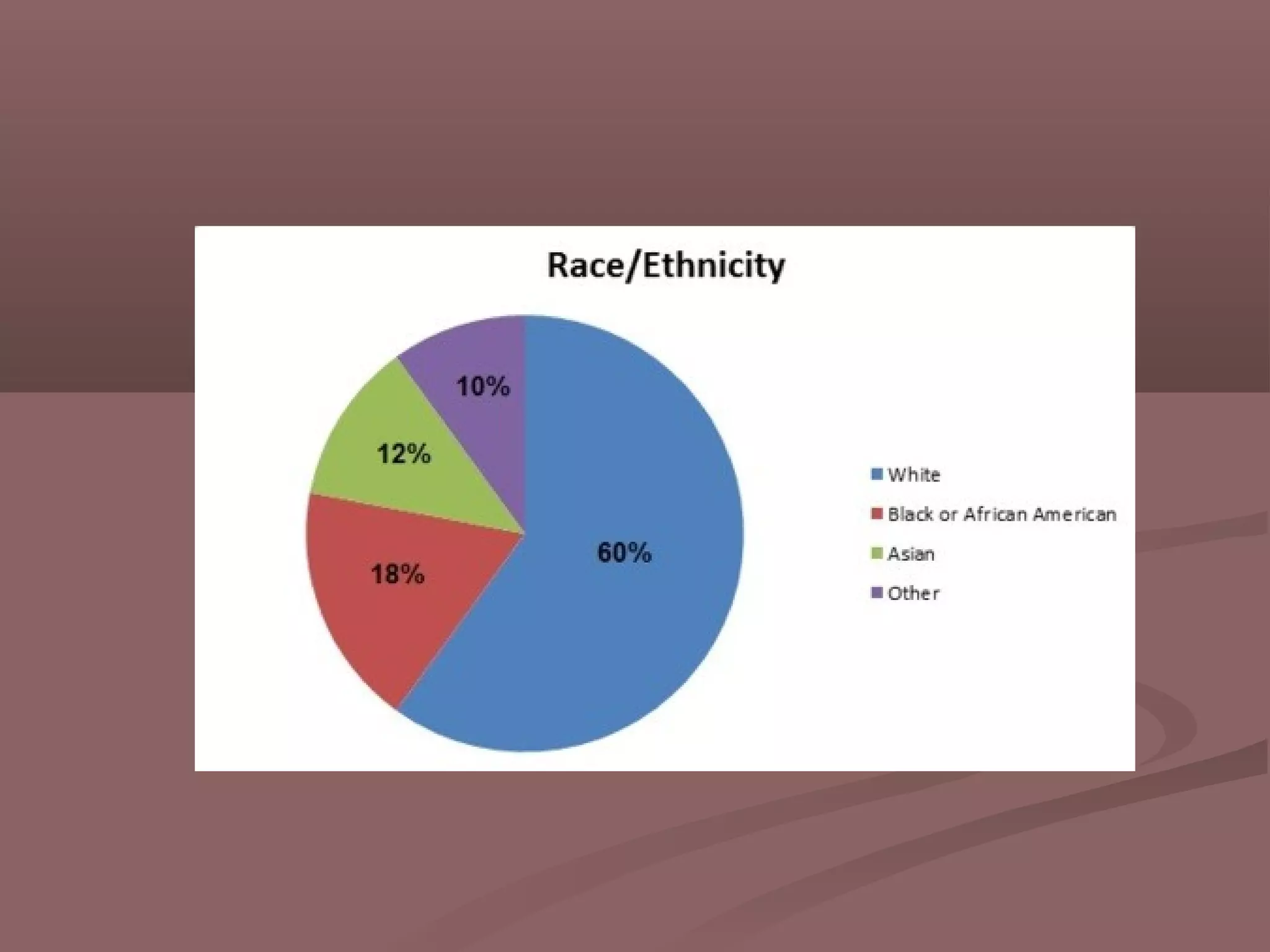
      The distribution is a summary of the frequency of
       individual values or ranges of values for a variable. The
       simplest distribution would list every value of a variable
       and the number of persons who had each value. For
       instance, a typical way to describe the distribution of
       college students is by year in college, listing the number
       or percent of students at each of the four years. Or, we
       describe gender by listing the number or percent of
       males and females. In these cases, the variable has few
       enough values that we can list each one and summarize
       how many sample cases had the value. 
http://www.socialresearchmethods.net/kb/statdesc.php
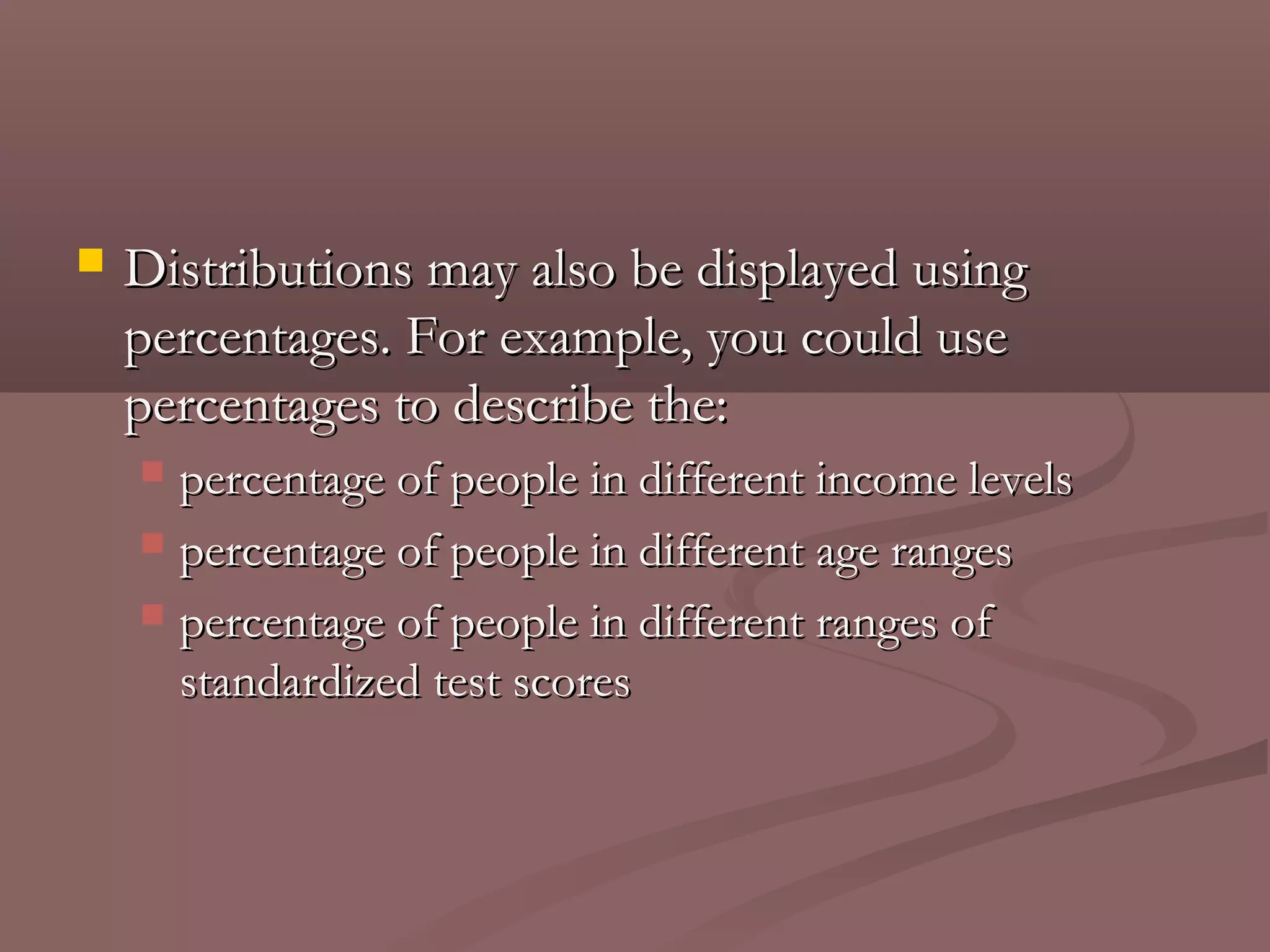
   Distributions may also be displayed using
    percentages. For example, you could use
    percentages to describe the:
     percentage of people in different income levels
     percentage of people in different age ranges

     percentage of people in different ranges of
      standardized test scores
   Measures of central tendency: these are ways
    of describing the central position of a frequency
    distribution for a group of data. In this case, the
    frequency distribution is simply the distribution
    and pattern of marks scored by the 100 students
    from the lowest to the highest. We can describe
    this central position using a number of statistics,
    including the mode, median, and mean.
   There are three major types of estimates of
    central tendency:
     Mean
     Median

     Mode
   The Mean or average is probably the most commonly
    used method of describing central tendency. To
    compute the mean all you do is add up all the values
    and divide by the number of values. For example, the
    mean or average quiz score is determined by summing
    all the scores and dividing by the number of students
    taking the exam. For example, consider the test score
    values:
   15, 20, 21, 20, 36, 15, 25, 15
   The sum of these 8 values is 167, so the mean is 167/8
    = 20.875.
   The Median is the score found at the exact middle of
    the set of values. One way to compute the median is to
    list all scores in numerical order, and then locate the
    score in the center of the sample. For example, if there
    are 500 scores in the list, score #250 would be the
    median. If we order the 8 scores shown above, we
    would get:
                15,15,15,20,20,21,25,36
   There are 8 scores and score #4 and #5 represent the
    halfway point. Since both of these scores are 20, the
    median is 20. If the two middle scores had different
    values, you would have to interpolate to determine the
    median.
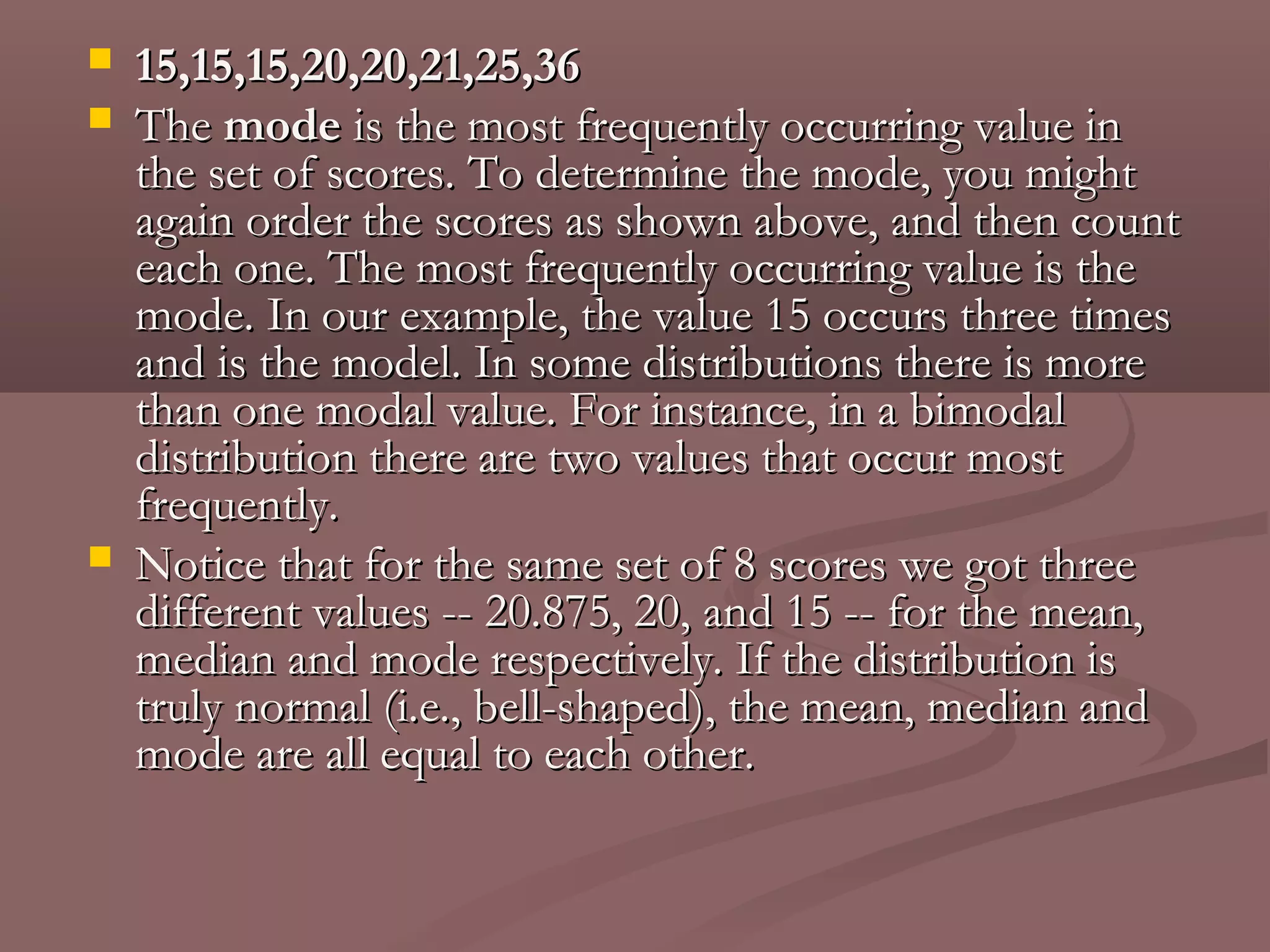
   15,15,15,20,20,21,25,36
   The mode is the most frequently occurring value in
    the set of scores. To determine the mode, you might
    again order the scores as shown above, and then count
    each one. The most frequently occurring value is the
    mode. In our example, the value 15 occurs three times
    and is the model. In some distributions there is more
    than one modal value. For instance, in a bimodal
    distribution there are two values that occur most
    frequently.
   Notice that for the same set of 8 scores we got three
    different values -- 20.875, 20, and 15 -- for the mean,
    median and mode respectively. If the distribution is
    truly normal (i.e., bell-shaped), the mean, median and
    mode are all equal to each other.
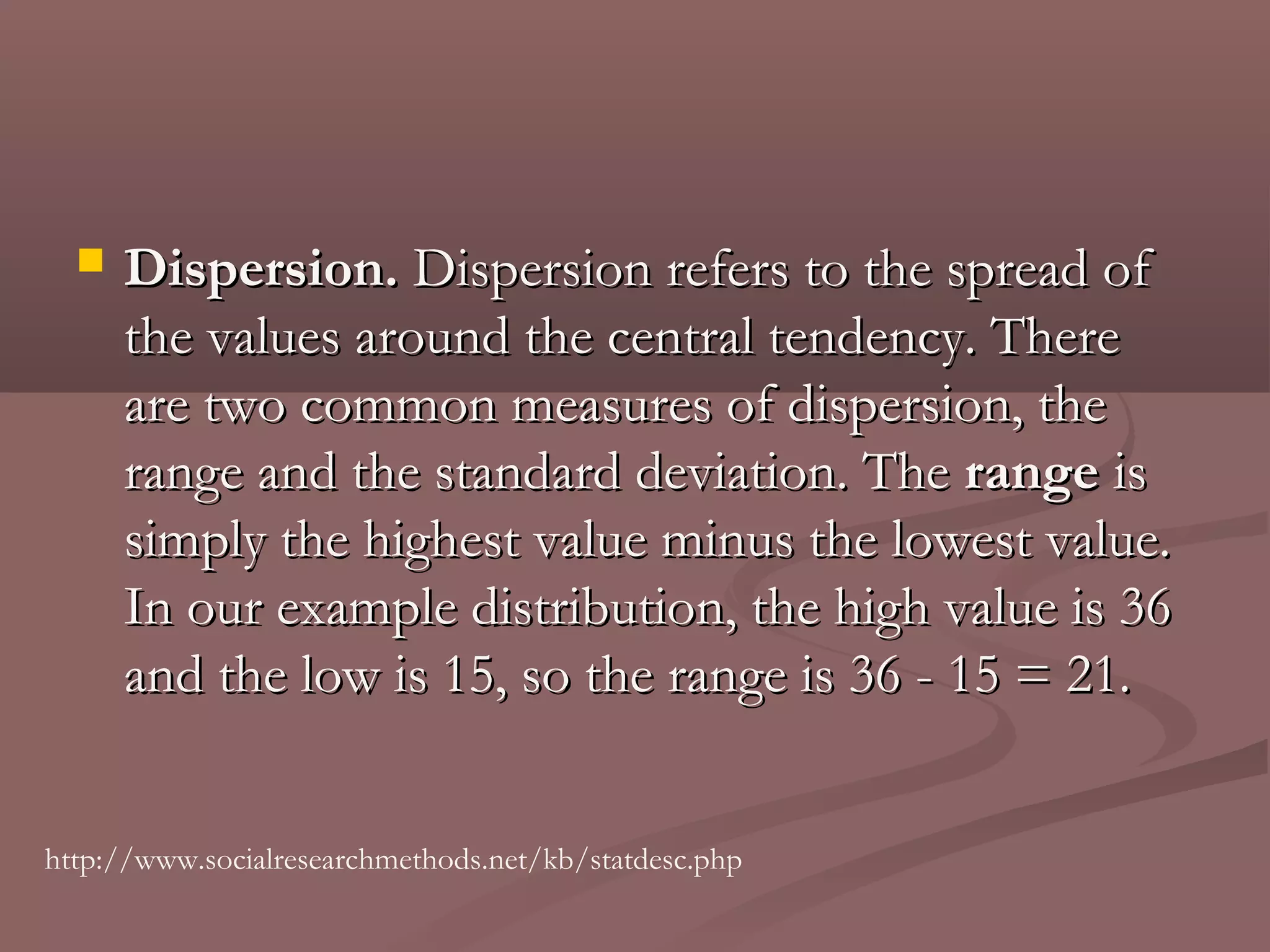
   Dispersion. Dispersion refers to the spread of
      the values around the central tendency. There
      are two common measures of dispersion, the
      range and the standard deviation. The range is
      simply the highest value minus the lowest value.
      In our example distribution, the high value is 36
      and the low is 15, so the range is 36 - 15 = 21.


http://www.socialresearchmethods.net/kb/statdesc.php
Standard Deviation

Descriptive statistics

  • 1.
    Descriptive Statistics Research Writing Aiden Yeh, PhD
  • 2.
    Descriptive statistics is the term given to the analysis of data that helps describe, show or summarize data in a meaningful way such that, for example, patterns might emerge from the data.  Descriptive statistics do not, however, allow us to make conclusions beyond the data we have analysed or reach conclusions regarding any hypotheses we might have made. They are simply a way to describe our data. https://statistics.laerd.com/statistical-guides/descriptive-inferential-statistics.php
  • 3.
     For example, if we had the results of 100 pieces of students' coursework, we may be interested in the overall performance of those students. We would also be interested in the distribution or spread of the marks. Descriptive statistics allow us to do this.  Using statistics and graphs
  • 5.
    Frequency Distribution  The distribution is a summary of the frequency of individual values or ranges of values for a variable. The simplest distribution would list every value of a variable and the number of persons who had each value. For instance, a typical way to describe the distribution of college students is by year in college, listing the number or percent of students at each of the four years. Or, we describe gender by listing the number or percent of males and females. In these cases, the variable has few enough values that we can list each one and summarize how many sample cases had the value.  http://www.socialresearchmethods.net/kb/statdesc.php
  • 7.
  • 8.
    Distributions may also be displayed using percentages. For example, you could use percentages to describe the:  percentage of people in different income levels  percentage of people in different age ranges  percentage of people in different ranges of standardized test scores
  • 9.
    Measures of central tendency: these are ways of describing the central position of a frequency distribution for a group of data. In this case, the frequency distribution is simply the distribution and pattern of marks scored by the 100 students from the lowest to the highest. We can describe this central position using a number of statistics, including the mode, median, and mean.
  • 10.
    There are three major types of estimates of central tendency:  Mean  Median  Mode
  • 11.
    The Mean or average is probably the most commonly used method of describing central tendency. To compute the mean all you do is add up all the values and divide by the number of values. For example, the mean or average quiz score is determined by summing all the scores and dividing by the number of students taking the exam. For example, consider the test score values:  15, 20, 21, 20, 36, 15, 25, 15  The sum of these 8 values is 167, so the mean is 167/8 = 20.875.
  • 12.
    The Median is the score found at the exact middle of the set of values. One way to compute the median is to list all scores in numerical order, and then locate the score in the center of the sample. For example, if there are 500 scores in the list, score #250 would be the median. If we order the 8 scores shown above, we would get: 15,15,15,20,20,21,25,36  There are 8 scores and score #4 and #5 represent the halfway point. Since both of these scores are 20, the median is 20. If the two middle scores had different values, you would have to interpolate to determine the median.
  • 13.
    15,15,15,20,20,21,25,36  The mode is the most frequently occurring value in the set of scores. To determine the mode, you might again order the scores as shown above, and then count each one. The most frequently occurring value is the mode. In our example, the value 15 occurs three times and is the model. In some distributions there is more than one modal value. For instance, in a bimodal distribution there are two values that occur most frequently.  Notice that for the same set of 8 scores we got three different values -- 20.875, 20, and 15 -- for the mean, median and mode respectively. If the distribution is truly normal (i.e., bell-shaped), the mean, median and mode are all equal to each other.
  • 14.
    Dispersion. Dispersion refers to the spread of the values around the central tendency. There are two common measures of dispersion, the range and the standard deviation. The range is simply the highest value minus the lowest value. In our example distribution, the high value is 36 and the low is 15, so the range is 36 - 15 = 21. http://www.socialresearchmethods.net/kb/statdesc.php
  • 15.