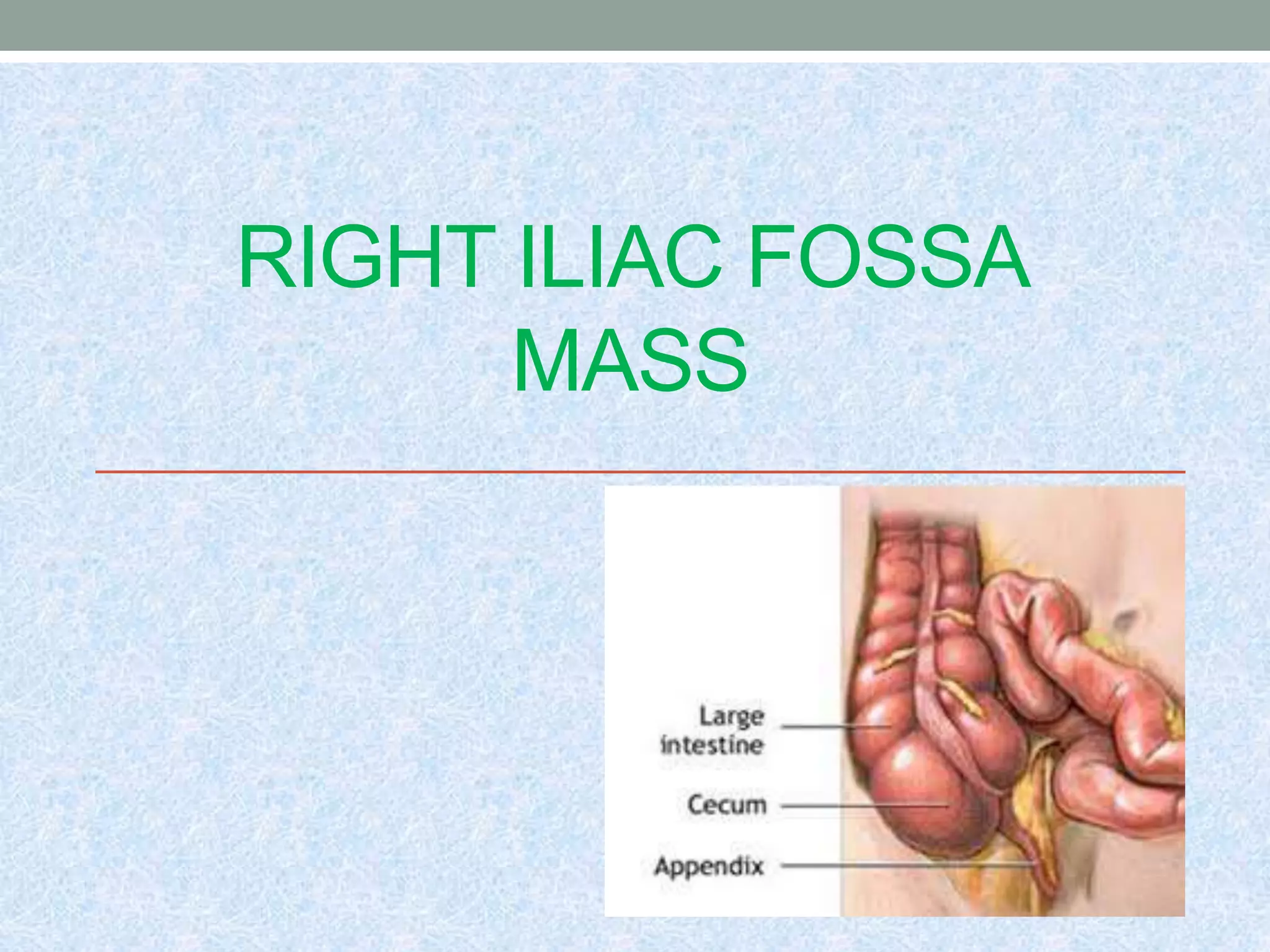
RIGHT ILIAC FOSSA
MASS
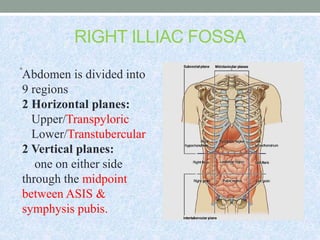
RIGHT ILLIAC FOSSA
•
Abdomen is divided into
9 regions
2 Horizontal planes:
Upper/Transpyloric
Lower/Transtubercular
2 Vertical planes:
one on either side
through the midpoint
between ASIS &
symphysis pubis.
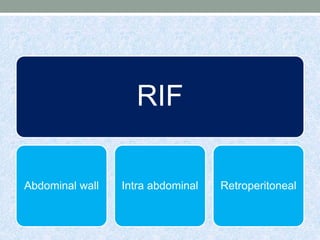
RIF
Abdominal wall Intra abdominal Retroperitoneal
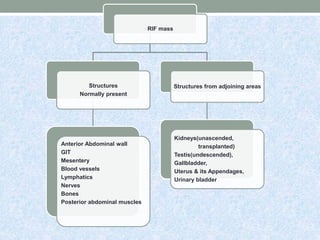
RIF mass
Structures
Normally present
Anterior Abdominal wall
GIT
Mesentery
Blood vessels
Lymphatics
Nerves
Bones
Posterior abdominal muscles
Structures from adjoining areas
Kidneys(unascended,
transplanted)
Testis(undescended),
Gallbladder,
Uterus & its Appendages,
Urinary bladder
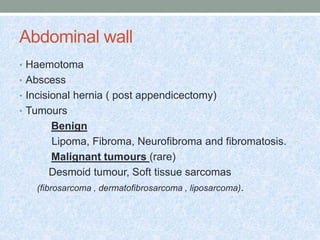
Abdominal wall
• Haemotoma
• Abscess
• Incisional hernia ( post appendicectomy)
• Tumours
Benign
Lipoma, Fibroma, Neurofibroma and fibromatosis.
Malignant tumours (rare)
Desmoid tumour, Soft tissue sarcomas
(fibrosarcoma , dermatofibrosarcoma , liposarcoma).
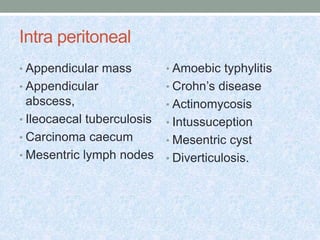
Intra peritoneal
• Appendicular mass
• Appendicular
abscess,
• Ileocaecal tuberculosis
• Carcinoma caecum
• Mesentric lymph nodes
• Amoebic typhylitis
• Crohn’s disease
• Actinomycosis
• Intussuception
• Mesentric cyst
• Diverticulosis.
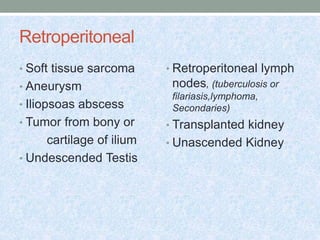
Retroperitoneal
• Soft tissue sarcoma
• Aneurysm
• Iliopsoas abscess
• Tumor from bony or
cartilage of ilium
• Undescended Testis
• Retroperitoneal lymph
nodes, (tuberculosis or
filariasis,lymphoma,
Secondaries)
• Transplanted kidney
• Unascended Kidney
Miscellaneous
• loose bodies
• foreign body
• ovarian mass/tubo-ovarian mass
• Uterine mass
APPENDICULAR MASS
complication of acute appendicitis.
 Mass consists of greater omentum with oedematous caecal wall
& loops of distal small intestine with inflammed appendix in
centre,
natural phenomenon to contain spread of infection
Firm , tender, irregular mass in RIF ,with localised guarding &
rigidity & systemic manifestations
 USG and CECT –helpful in assessing the nature & size of mass
1.Conservative(Ocshner-Sherren regimen)
 pulse and temperature monitoring
Monitoring the size of mass
I.V Fluids & I.V Antibiotics
Interval-Appendicectomy after 6 weeks
2.Emergency Surgery
Rising pulse rate & temperature
persistant vomiting
Increasing abdominal pain
Increase in size of the mass,
APPENDICULAR ABSCESS
 Complication of acute appendicitis
 Pt. is toxic ,with high grade fever & tachycardia.
 tender mass with indistinct borders , guarding &
rigidity
 USG/CT for size of abscess
 Treatement
conservative( < 4 cms)
USG guided aspiration( > 4 cms )
surgical drainage ( failure of other modes )
Interval appendicectomy after 12 weeks
Neoplasms of the appendix
Carcinoid tumour (argentaffinoma)
arise from Kulchitsky cells of the crypts of Lieberkühn
vermiform appendix is the most common site
 most common neoplasm of the vermiform appendix
 it’s commonly a incidental finding / painless well defined
firm to hard mass
carcinoid syndrome(flushing & diorrhoea) in liver
metastases
Investigations
24 hrs urine 5HIAA,
 sr.chromogranin A ,
USG ,
CECT ,
SOMATOSTATIN RECEPTOR SCINTIGRAPHY
Treatment
< 1 cm – appendicectomy
>1 cm – right hemicolectomy
metastases – metastasectomy
Mucocele of the appendix
• retained mucous secretions / tumour
• mimicks sub acute appendicitis, infection leads to
empyema.
• Rupture causes pseudomyxoma peritonei.
• USG / CT
• benign – appendicectomy
• psuedomyxoma peritoni - cytoreductive surgery/
- intra-peritoneal chemotherapy
Adenocarcinoma
• Rare
• presents as painless hard mass
• USG / CECT / colonoscopy
• Right hemicolectomy
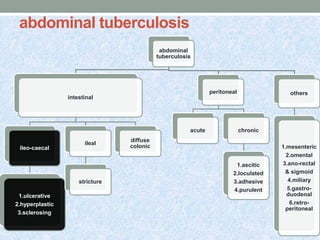
abdominal tuberculosis
abdominal
tuberculosis
intestinal
ileo-caecal
1.ulcerative
2.hyperplastic
3.sclerosing
ileal
stricture
diffuse
colonic
peritoneal
acute chronic
1.ascitic
2.loculated
3.adhesive
4.purulent
others
1.mesenteric
2.omental
3.ano-rectal
& sigmoid
4.miliary
5.gastro-
duodenal
6.retro-
peritoneal
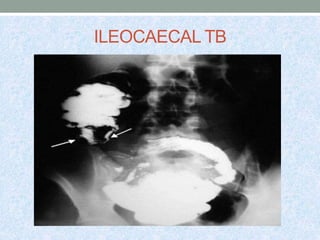
ILEOCAECAL- TUBERCULOSIS
Site : ileum, proximal colon and peritoneum are commonly
affected
Etiology ; mycobacterium tuberculosis
Mode of spread:
1.Ingestion of food contaminated with tubercle bacilli
2.Ingestion of infected tubercle bacilli containing sputum
3.Haematogenous spread from pulmonary tuberculosis.
4.Lymphatic spread through tuberculous cervical adenitis.
5 .Retrograde spread through genitourinary tract in females
Types: 1. ulcerative. 2. hyperplastic 3. mixed
Mass in abdominal TB
• mesenteric TB
• Hyperplastic type of ileocaecal TB
• Peritoneal TB (loculated ascities )
Hyperplastic type :
less virulent infection, good host resistance
 intermittent abdominal pain, diarrhoea,
 steatorrhea, anemia and wt.loss , low grade fever
 intestinal obstruction (acute / sub-acute)
 irregular firm non-tender mass
 investigations
CXR, AXR, USG, CECT, colonoscopy , D-lap , mantoux ,
ELISA , PCR
 Treatement
umcomplicated - ATT
complicated - ileocaecal resection
ILEOCAECAL TB
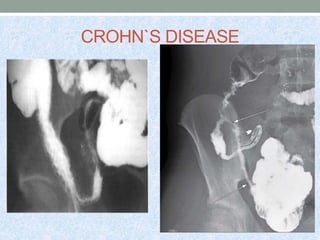
CROHN`S DISEASE
Can involve any part of GIT . ileocoloic region most common site
skip lesions
 (cobblestone appearance) Mucosal ulceration with oedema of
mucosa between the ulcers
 Transmural inflammation leading to adhesions & inflammatory
masses formation with mesenteric abscess & fistula formation into
adjacent organs.
 Serosa is opaque,with mesenteric thickening &enlarged mesenteric
lymph nodes.
 CECT , Barium meal follow through , colonoscopy & biopsy
 uncomplicated - steroids , anti-inflammatory, immunosupressants
Complicated – resection & ostomy/ reconstruction
CROHN`S DISEASE
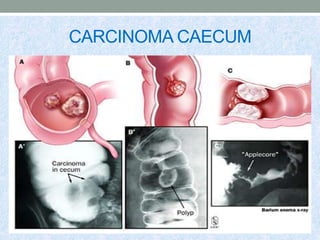
CARCINOMA CAECUM
CARCINOMACAECUM
3rd common site for colonic carcinoma
 unexplained anemia is the common presentation
Altered bowel habits , obstruction , perfotation
 hard, nontender, fixed mass
• Aetiology ;
• 1. DIET -Red meat, saturated fat and cholesterol
• 2.Alcohol and smoking
• 3.Radiation
• 4. Post-cholecystectomy and ileal resection and
ureterocolostomy status
• 5.Genetic causes
Familial Adenomatous polyposis coli.
Gardner's syndrome and Turcot’s syndrome.
Peutz jeger’s syndrome and Juvenile polyposis syndrome.
HNPCC , Lynch syndrome1, Lynch syndrome 2
Aspirin and other NSAIDs, calcium are protective
against large bowel cancers
Types
1.Polypoidal
2. Ulcerative,
3.Annular,
4.Mucinous.
Investigations-stool for occult blood,
Barium meal follow through-irregular filling defect in caecum
& normal terminal ileum
Colonoscopy & Biopsy
Treatement - Right hemicolectomy, chemotherapy (FOLFOX)
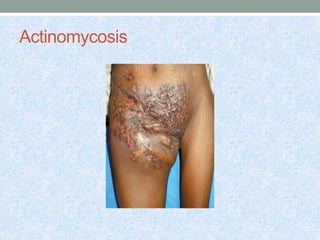
ACTINOMYCOSIS
 anaerobic gram positive branching filamentous fungal
like bacterium Actinomycosis israeli (‘Ray fungus.’)
Types : 1. cervicofascial 2. thoracic ,
3.Abdominal actinomycosis (rare)
 fixed indurated mass in right iliac fossa with abscess
and multiple sinuses , discharging sulphur granules
 No intestinal luminal narrowing or lymph node
involvement
Treatement: high dose penicillin or co-trimoxazole
Actinomycosis
AMOEBOMA
Entamoeba histolytica (trophozoite)
 feco-oral route
 flask shaped ulcers in ileum and large bowel
 Blood and mucus diarrhoea , pain abdomen , mass abdomen
 stool examination , colonoscopy & biopsy , PCR
Treatement : metronidazole 800mg tds for 7-10 days.
Diloxanate furoate, Paromomycin
and Iodoquinol.
surgery for complications like obstruction
MESENTRIC CYSTS
1.chylolymphatic cysts
congenital maldeveloped lymphatic system
commonest type
enucleation
2.enterogenous cysts
duplication or diverticulum of adjacent bowel
contains all layers of bowel
tillaux triad
resection and reconstruction
3.congenital remnant cysts
4.teratomatous dermoid cyst
5.traumatic mesenteric haematoma and cyst formation
6.mesenteric cold abscess formation
7.hydatid cyst of mesentery.
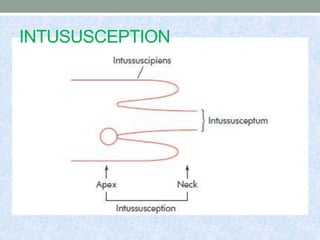
INTUSUSCEPTION
INTUSUSCEPTION
Cause:
Children : Hyperplasia of peyer’s patches
Adult : polyps, submucosal lipoma, tumour, prolonged fasting
Types: ileo-ileal , ileo-colic , Colocolic common in adults
Pathology
3 parts
Entering or inner tubes ( blood supply is commonly impaired)
Returning or middle part,
sheath or outer tube(Intessuscipiens)
o acute / sub-acute
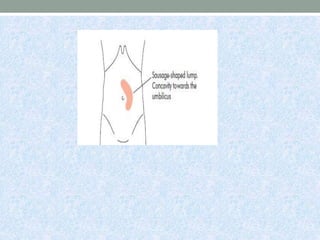
o colicky abdominal pain ,bilious vomiting , abdominal lump
freely mobile , becomes firm on palpation , intestinal
obstruction , guarding & rigidity ( gangrene )
o red current jelly stool
o emptiness on the RIF(sign de dance)
o investigations
AXR – absent caecal gas / multiple air-fluid levels
barium enema – claw sign
USG – psuedokidney sign/ bull’s eye sign
CECT
o treatment
hydrostatic reduction
resection and reconstruction
.
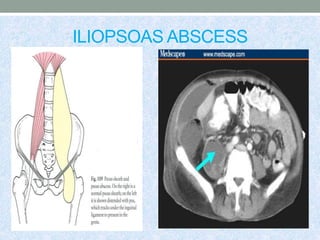
ILIOPSOAS ABSCESS
PSOAS ABSCESS
It’s a cold abscess due to Tuberculosis of Thoracolumbar spine
(Pott`s disease)
 caseating pus from vertebra gravitates via medial arcuate ligament
underneath psoas sheath
 psoas sign - Thigh is in fixed flexion position due to
psoas muscle spasm
 Cross fluctuation – pus tracks below inguinal ligament
into thigh
 Spinal tenderness/Gibbus can be demonstrated.
 X-ray of spine ,CT , MRI
 Treatment –Image guided aspiration / I & D
ATT
spinal support with bed rest
Retroperitoneal tumours
• painless ill-defined masses , restricted mobility , doesn’t
fall on knee-elbow position
• USG , CECT , MRI , biopsy
• benign – excision
• sarcoma – wide local excision / chemoradiation
• lymphoma – chemo–radiation
• Secondaries – palliative therapy
Aneurysm
• well defined fusiform pulsatile mass
• may present with distal ischemia
• USG ,duplex , Angiography
• stenting / resection & reconstruction
OTHER CAUSES
ROUND WORM BOLUS MASS
soft tender mass in RIF.
With H/O of passing round worms in Stools.
Most common in children in endemic areas,causing intestinal
obstruction.
TUMOURS OF ILIAC CREST
Osteochondroma,hard fixed bony swelling .
RARE CAUSES
• KIDNEY- Unascended kidneys/mobile normal kidneys
• TESTIS- Undescended testis
• GALL BLADDER- Huge distended GB
• UTERUS & APPENDAGES-Tubo-ovarian
mass,ovarian cyst,fibroid uterus
• URINARY BLADDER DIVERTICULUM
Rif mass

Rif mass

  • 1.
  • 2.
    RIGHT ILLIAC FOSSA • Abdomenis divided into 9 regions 2 Horizontal planes: Upper/Transpyloric Lower/Transtubercular 2 Vertical planes: one on either side through the midpoint between ASIS & symphysis pubis.
  • 3.
    RIF Abdominal wall Intraabdominal Retroperitoneal
  • 4.
    RIF mass Structures Normally present AnteriorAbdominal wall GIT Mesentery Blood vessels Lymphatics Nerves Bones Posterior abdominal muscles Structures from adjoining areas Kidneys(unascended, transplanted) Testis(undescended), Gallbladder, Uterus & its Appendages, Urinary bladder
  • 5.
    Abdominal wall • Haemotoma •Abscess • Incisional hernia ( post appendicectomy) • Tumours Benign Lipoma, Fibroma, Neurofibroma and fibromatosis. Malignant tumours (rare) Desmoid tumour, Soft tissue sarcomas (fibrosarcoma , dermatofibrosarcoma , liposarcoma).
  • 6.
    Intra peritoneal • Appendicularmass • Appendicular abscess, • Ileocaecal tuberculosis • Carcinoma caecum • Mesentric lymph nodes • Amoebic typhylitis • Crohn’s disease • Actinomycosis • Intussuception • Mesentric cyst • Diverticulosis.
  • 7.
    Retroperitoneal • Soft tissuesarcoma • Aneurysm • Iliopsoas abscess • Tumor from bony or cartilage of ilium • Undescended Testis • Retroperitoneal lymph nodes, (tuberculosis or filariasis,lymphoma, Secondaries) • Transplanted kidney • Unascended Kidney
  • 8.
    Miscellaneous • loose bodies •foreign body • ovarian mass/tubo-ovarian mass • Uterine mass
  • 9.
    APPENDICULAR MASS complication ofacute appendicitis.  Mass consists of greater omentum with oedematous caecal wall & loops of distal small intestine with inflammed appendix in centre, natural phenomenon to contain spread of infection Firm , tender, irregular mass in RIF ,with localised guarding & rigidity & systemic manifestations  USG and CECT –helpful in assessing the nature & size of mass
  • 10.
    1.Conservative(Ocshner-Sherren regimen)  pulseand temperature monitoring Monitoring the size of mass I.V Fluids & I.V Antibiotics Interval-Appendicectomy after 6 weeks 2.Emergency Surgery Rising pulse rate & temperature persistant vomiting Increasing abdominal pain Increase in size of the mass,
  • 11.
    APPENDICULAR ABSCESS  Complicationof acute appendicitis  Pt. is toxic ,with high grade fever & tachycardia.  tender mass with indistinct borders , guarding & rigidity  USG/CT for size of abscess  Treatement conservative( < 4 cms) USG guided aspiration( > 4 cms ) surgical drainage ( failure of other modes ) Interval appendicectomy after 12 weeks
  • 12.
    Neoplasms of theappendix Carcinoid tumour (argentaffinoma) arise from Kulchitsky cells of the crypts of Lieberkühn vermiform appendix is the most common site  most common neoplasm of the vermiform appendix  it’s commonly a incidental finding / painless well defined firm to hard mass carcinoid syndrome(flushing & diorrhoea) in liver metastases
  • 13.
    Investigations 24 hrs urine5HIAA,  sr.chromogranin A , USG , CECT , SOMATOSTATIN RECEPTOR SCINTIGRAPHY Treatment < 1 cm – appendicectomy >1 cm – right hemicolectomy metastases – metastasectomy
  • 14.
    Mucocele of theappendix • retained mucous secretions / tumour • mimicks sub acute appendicitis, infection leads to empyema. • Rupture causes pseudomyxoma peritonei. • USG / CT • benign – appendicectomy • psuedomyxoma peritoni - cytoreductive surgery/ - intra-peritoneal chemotherapy
  • 15.
    Adenocarcinoma • Rare • presentsas painless hard mass • USG / CECT / colonoscopy • Right hemicolectomy
  • 16.
  • 17.
    ILEOCAECAL- TUBERCULOSIS Site :ileum, proximal colon and peritoneum are commonly affected Etiology ; mycobacterium tuberculosis Mode of spread: 1.Ingestion of food contaminated with tubercle bacilli 2.Ingestion of infected tubercle bacilli containing sputum 3.Haematogenous spread from pulmonary tuberculosis. 4.Lymphatic spread through tuberculous cervical adenitis. 5 .Retrograde spread through genitourinary tract in females Types: 1. ulcerative. 2. hyperplastic 3. mixed
  • 18.
    Mass in abdominalTB • mesenteric TB • Hyperplastic type of ileocaecal TB • Peritoneal TB (loculated ascities )
  • 19.
    Hyperplastic type : lessvirulent infection, good host resistance  intermittent abdominal pain, diarrhoea,  steatorrhea, anemia and wt.loss , low grade fever  intestinal obstruction (acute / sub-acute)  irregular firm non-tender mass  investigations CXR, AXR, USG, CECT, colonoscopy , D-lap , mantoux , ELISA , PCR  Treatement umcomplicated - ATT complicated - ileocaecal resection
  • 20.
  • 21.
    CROHN`S DISEASE Can involveany part of GIT . ileocoloic region most common site skip lesions  (cobblestone appearance) Mucosal ulceration with oedema of mucosa between the ulcers  Transmural inflammation leading to adhesions & inflammatory masses formation with mesenteric abscess & fistula formation into adjacent organs.  Serosa is opaque,with mesenteric thickening &enlarged mesenteric lymph nodes.  CECT , Barium meal follow through , colonoscopy & biopsy  uncomplicated - steroids , anti-inflammatory, immunosupressants Complicated – resection & ostomy/ reconstruction
  • 22.
  • 23.
  • 24.
    CARCINOMACAECUM 3rd common sitefor colonic carcinoma  unexplained anemia is the common presentation Altered bowel habits , obstruction , perfotation  hard, nontender, fixed mass
  • 25.
    • Aetiology ; •1. DIET -Red meat, saturated fat and cholesterol • 2.Alcohol and smoking • 3.Radiation • 4. Post-cholecystectomy and ileal resection and ureterocolostomy status • 5.Genetic causes Familial Adenomatous polyposis coli. Gardner's syndrome and Turcot’s syndrome. Peutz jeger’s syndrome and Juvenile polyposis syndrome. HNPCC , Lynch syndrome1, Lynch syndrome 2 Aspirin and other NSAIDs, calcium are protective against large bowel cancers
  • 26.
    Types 1.Polypoidal 2. Ulcerative, 3.Annular, 4.Mucinous. Investigations-stool foroccult blood, Barium meal follow through-irregular filling defect in caecum & normal terminal ileum Colonoscopy & Biopsy Treatement - Right hemicolectomy, chemotherapy (FOLFOX)
  • 27.
    ACTINOMYCOSIS  anaerobic grampositive branching filamentous fungal like bacterium Actinomycosis israeli (‘Ray fungus.’) Types : 1. cervicofascial 2. thoracic , 3.Abdominal actinomycosis (rare)  fixed indurated mass in right iliac fossa with abscess and multiple sinuses , discharging sulphur granules  No intestinal luminal narrowing or lymph node involvement Treatement: high dose penicillin or co-trimoxazole
  • 28.
  • 29.
    AMOEBOMA Entamoeba histolytica (trophozoite) feco-oral route  flask shaped ulcers in ileum and large bowel  Blood and mucus diarrhoea , pain abdomen , mass abdomen  stool examination , colonoscopy & biopsy , PCR Treatement : metronidazole 800mg tds for 7-10 days. Diloxanate furoate, Paromomycin and Iodoquinol. surgery for complications like obstruction
  • 30.
    MESENTRIC CYSTS 1.chylolymphatic cysts congenitalmaldeveloped lymphatic system commonest type enucleation 2.enterogenous cysts duplication or diverticulum of adjacent bowel contains all layers of bowel tillaux triad resection and reconstruction 3.congenital remnant cysts 4.teratomatous dermoid cyst 5.traumatic mesenteric haematoma and cyst formation 6.mesenteric cold abscess formation 7.hydatid cyst of mesentery.
  • 31.
  • 32.
    INTUSUSCEPTION Cause: Children : Hyperplasiaof peyer’s patches Adult : polyps, submucosal lipoma, tumour, prolonged fasting Types: ileo-ileal , ileo-colic , Colocolic common in adults Pathology 3 parts Entering or inner tubes ( blood supply is commonly impaired) Returning or middle part, sheath or outer tube(Intessuscipiens)
  • 34.
    o acute /sub-acute o colicky abdominal pain ,bilious vomiting , abdominal lump freely mobile , becomes firm on palpation , intestinal obstruction , guarding & rigidity ( gangrene ) o red current jelly stool o emptiness on the RIF(sign de dance) o investigations AXR – absent caecal gas / multiple air-fluid levels barium enema – claw sign USG – psuedokidney sign/ bull’s eye sign CECT o treatment hydrostatic reduction resection and reconstruction .
  • 35.
  • 36.
    PSOAS ABSCESS It’s acold abscess due to Tuberculosis of Thoracolumbar spine (Pott`s disease)  caseating pus from vertebra gravitates via medial arcuate ligament underneath psoas sheath  psoas sign - Thigh is in fixed flexion position due to psoas muscle spasm  Cross fluctuation – pus tracks below inguinal ligament into thigh  Spinal tenderness/Gibbus can be demonstrated.  X-ray of spine ,CT , MRI  Treatment –Image guided aspiration / I & D ATT spinal support with bed rest
  • 37.
    Retroperitoneal tumours • painlessill-defined masses , restricted mobility , doesn’t fall on knee-elbow position • USG , CECT , MRI , biopsy • benign – excision • sarcoma – wide local excision / chemoradiation • lymphoma – chemo–radiation • Secondaries – palliative therapy
  • 38.
    Aneurysm • well definedfusiform pulsatile mass • may present with distal ischemia • USG ,duplex , Angiography • stenting / resection & reconstruction
  • 39.
    OTHER CAUSES ROUND WORMBOLUS MASS soft tender mass in RIF. With H/O of passing round worms in Stools. Most common in children in endemic areas,causing intestinal obstruction. TUMOURS OF ILIAC CREST Osteochondroma,hard fixed bony swelling .
  • 40.
    RARE CAUSES • KIDNEY-Unascended kidneys/mobile normal kidneys • TESTIS- Undescended testis • GALL BLADDER- Huge distended GB • UTERUS & APPENDAGES-Tubo-ovarian mass,ovarian cyst,fibroid uterus • URINARY BLADDER DIVERTICULUM