
DR.ZOHAIB NADEEM
PGR-1 SU-II
OBJECTIVES OF THIS
PRESENTATION WILL BE
 To know Anatomy of spleen
 Indications of splenectomy
 Splenectomy in trauma Patient
 Grading of splenic Injury and their management
 Post-Op care, Early and late complications
 Vaccination protocol
 Proper Education and counseling of Asplenic patient
ANATOMY
 Spleen lies in posterior portion of lt upper quadrant,
deep to ninth ,tenth and eleven ribs
 Convex surface lies under lt hemidiaphargm
 Concavities on medial side due to impression by
neighbouring structures.
 Average length 7-11cm
 Weight 150 grams
 Tail of pancreas lies incontact with spleen in 30% and
within 1cm in 70%
BLOOD SUPPLY OF SPLEEN
 Splenic Artery is the largest
branch of Celiac trunk. It has
a torturous course(about
13cm), run along the upper
border of the pancrease ,
divided into 5-6 branches
before enter the hilum of
spleen.
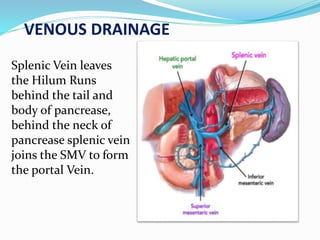
VENOUS DRAINAGE
Splenic Vein leaves
the Hilum Runs
behind the tail and
body of pancrease,
behind the neck of
pancrease splenic vein
joins the SMV to form
the portal Vein.
LYMPHATIC DRAINAGE
 The lymph Vessels
Emerge from the hilum
and pass through a few
lymph nodes along the
coarse of splenic artery
and then drain into
celiac lymph nodes.
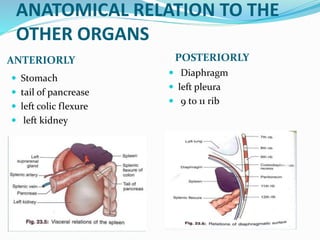
ANATOMICAL RELATION TO THE
OTHER ORGANS
ANTERIORLY POSTERIORLY
 Stomach
 tail of pancrease
 left colic flexure
 left kidney
 Diaphragm
 left pleura
 9 to 11 rib
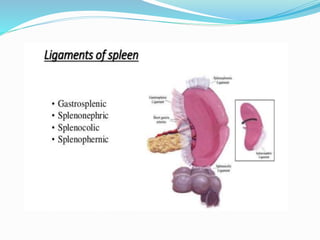
SUSPENSARY LIGAMENTS
 Provide attachement of spleen
with adjacent structures
 These ligaments are avascular
except gastrosplenic ligament
(containing short gastric and
gastroepiploic artery)
MECHANISM OF INJURY
 Blunt abdominal trauma
 from compression or deceleration
 (motor vehicle accidents, falls ,direct blow to
abdomen,with haematological abnormalities)
 Penetrating trauma rare
PRESENTATION
 Clinical symptoms vary
 Pt may present with lt upper abdominal or flank pain
 Reffered pain to lt shoulder (kehr sign)
 Some may be asymptomatic
SIGNS
 Physical examination is insensitive and non
specific.
 Pt may have signs of lt upper quadrant tenderness
or signs of generalized peritoneal irritation.
 May present with tachycardia ,Tachypnea, anxiety ,
Hypotension (shock)
MANAGEMENT
 Operative Vs Non Operative
 Nonoperative management of splenic injury is
successful in >90% of children, irrespective of the
grade of splenic injury.
 Non operative management successful in adults 65%
FACTORS FOR DICISION
 Haemodynamic stability on presentation
 Age of patient
 Other associated injuries
 Grade of splenic injury
BASIC PRINCIPLES
 Unstable patients suspected of splenic injury and
intra-abdominal hemorrhage should undergo
exploratory laparotomy and splenic repair or
removal.
 Blunt trauma patient with evidence of
hemodynamic instability unresponsive to fluid
challenge with no other signs of external
hemorrhage should be considered to have a life-
threatening solid organ (splenic) injury until
proven otherwise.
IMAGING
 FAST ( Focused Assessment with sonography in Trauma)
 Execellent for documenting the presence or
absence of intraabdominal fluid in
haemodynamically unstable patients.
 limitations in identifying solid organ injury,
especially at lower grades of injury.
FAST
PLAIN RADIOGRAPHY
 The most common finding associated with
splenic injury is left lower rib fracture. Rib
fractures signify that adequate force has
been transmitted to the LUQ to cause
splenic pathology.
 Classic triad indicative of acute splenic
rupture (ie, Left Hemidiaphragm Elevation,
Left Lower Lobe Atelectasis, And Pleural
Effusion)
CT SCAN ABDOMEN
In Haemodynamically stable patients
It is investigation of choice
Sensitivity and specificity are high for
detection of splenic trauma.
Intravenous contrast material is
necessary for complete evaluation
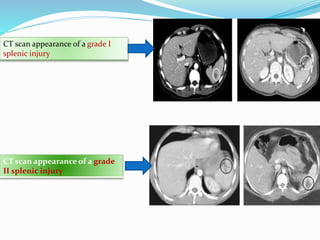
CT scan appearance of a grade I
splenic injury
CT scan appearance of a grade
II splenic injury
CT scan appearance of a
grade III splenic injury,
rupture of subcapsular
hematoma
CT scan of a grade IV
splenic injury
CT scan of a grade V
splenic injury
ANGIOGRAPHY
 Used more frequently for primary therapeutic management
of splenic injuries.
 Angiography is usually performed after CT scanning
images are obtained showing an arterial contrast blush or
active extravasation
 Therapeutic angioembolization of active bleeding sites.
CRITERIA FOR NONOPERATIVE
MANAGEMENT
 Haemodynamic stability
 Negative abdominal scan
 Absence of contrast extravasation on CT
 Absence of other clear indications for exploratory
laprotomy
 Absence of conditions associated with increased
risk of bleeding (Coagalpathy, use of
anticoagulants, cardiac failure, )
SURGICAL TREATMENT
 Adult patients with grade I or II injury can often
be treated nonoperatively
 Patients with grade IV or V splenic injuries are
often unstable.
 Grade III splenic injuries (certainly in children,
and in selected adults) can be treated
nonoperatively based on stability and reliable
physical examination.
SURGERY
 Operative therapy of choice is splenic conservation
where possible to avoid the risk of death from
overwhelming postsplenectomy sepsis that can
occur after splenectomy for trauma. However, in
the presence of multiple injuries or critical
instability, splenectomy is more rapid and
judicious.
SURGERY
 Exploration is through a long midline incision. The
abdomen is packed and explored. Exsanguinating
hemorrhage and gastrointestinal soilage are
controlled first
 Splenic ligamentous attachments are taken down
sharply or bluntly to allow for rotation of the
spleen and the vasculature to the center of the
abdominal wound and to identify the splenic
artery and vein for ligation.
surgery by su-II………
SPLENECTOMY BY SU-II TEAM
SURGERY BY SU-II TEAM
SPLENECTOMY CONTD;
 Once the splenic artery and vein are identified and
controlled by ligation,
 The gastrosplenic ligament with the short gastric
vessels is divided and ligated near the spleen to
avoid injury or late necrosis of the gastric wall.
 Drains are typically unnecessary unless concern
exists over injury to the tail of the pancreas during
operation.
SPLENORRAHPHY
 Parenchyma saving operation of spleen
 The technique is dictated by the magnitude of the
splenic injury
 Nonbleeding Grade I splenic injury may require no
further treatment. Topical hemostatic agents, an
argon beam coagulator, or electrocautery
SPLENORRAHPHY
 In Grade 2 and 3 suture repair (horizontal mattress) ,
or mesh wrap of capsular defects. Suture repair in
adults often requires Teflon pledgets to avoid tearing
of the splenic capsule
AUTOTRANSPLANTATION
 implanting multiple 1-mm slices of the spleen
in the omentum after splenectomy.
 This technique remains experimental
role controversial
AUTOTRANSPLANTATION BY
SU-II TEAM
PARTIAL SPLENECTOMY
 Grade IV to V splenic injury may require anatomic
resection, including ligation of the lobar artery.
POST OP CARE
 Recurrent bleeding in the case of splenorrhaphy or
new bleeding from missed or inadequately ligated
vascular structures should be considered in the
first 24-48 hours.
 Immunizations against Pneumococcus species as a
routine of postoperative management.(24 hours -2
weeks)
 Some centers also routinely vaccinate for
Haemophilus and Meningococcus species
COMPLICATIONS
EARLY COMPLICATION LATE COMPLICATIONS
 Bleeding
 Acute gastric distention
 Gastric necrosis
 Recurrent splenic bed
bleeding
 Pancreatits due to damage
of pancreatic tail, localised
abcess or pancreatic fistula
 left Basal Atelectasis,
pleural effusion
 Subpherinic abscess
 Thrombocytosis , if blood
platelet count exceed 1x10 6
/ml , prophylatic aspirin is
recommended to prevent
axillary or other venous
thrombosis.
 OPSI (1 – 6 Week)
 DVT
DVT AFTER SPLENECTOMY
 Splenectomy  thrombocytosis ( platelets)
 increases risk of DVT
 Portal vein thrombosis
 Abd pain, anorexia, thrombocytosis
 CT with IV contrast
 Prevention of DVT
 Sequential compression devises on legs
 Subcutaneous heparin
OPPORTUNISTIC POST
SPLENECTOMY INFECTIONS (OPSI)
 Opsi is serious concern in post splenectomy patient
 Mostly caused by Strep. Pneumoniae, N.meningitides ,
Haemophilus influenza and E. coli.
 Opsi risk increased in those patient who undergo
splenectomy following
Patients treated with chemoradiotherapy.
Thalassemia
Sickle cell diseases
Auto immune anemia or thrombocytopenia
OPSI CONTINUES
 OPSI can b prevented through
 Proper education
 Timely Immunisation and Antibiotic
prophlaxis
 Prompt Treatment of infections.
continous
 The children who undergone splenectomy before
the age of five years should be treated with a daily
dose of penicillin until the age of ten years.
 Prophylaxis in Older children should be continued
at least until the age of 16 years. But its use is less
well defined in adults.
VACCINATION PROTOCOL
 If elective splenectomy is planned, consideration should be
given to vaccinating against pneumococus , meningococus
C both repeated every five years.
 Yearly Influenza vaccination has been recommended as
there is some evidence that it may reduce the risk of
secondary bacterial infection.
 Such vaccinations should be administered at least 2 weeks
before elective surgery or as soon as possible after recovery
from surgery but before discharge from hospital.
 Pneumococal vaccination is recommended in those
patients aged over Two years.
ADMINISTERATION OF VACCINE
PATIENT COUNSELLING
 A SPLENIC Patient Should carry a medical alert and up-to-
date vaccination card
 Require specific advice regarding travelling and animal
handling.
 Patients who have undergone splenectomy and are
travelling to countries where malaria is present are strongly
advised to use all physical anti-mosquito barriers, as well as
anti-malrial therapy.
 Notify their doctor immediately of any acute febrile illness
 Seek prompt treatment even after minor dog bite or other
animal bite.Spesis due to capnocytophaga canimorsus may
result from dog ,cat or other animal bites.
THANKS AND LOVE
FOR SU-II FAMILY

Spleenectomy

  • 1.
  • 2.
    OBJECTIVES OF THIS PRESENTATIONWILL BE  To know Anatomy of spleen  Indications of splenectomy  Splenectomy in trauma Patient  Grading of splenic Injury and their management  Post-Op care, Early and late complications  Vaccination protocol  Proper Education and counseling of Asplenic patient
  • 3.
    ANATOMY  Spleen liesin posterior portion of lt upper quadrant, deep to ninth ,tenth and eleven ribs  Convex surface lies under lt hemidiaphargm  Concavities on medial side due to impression by neighbouring structures.  Average length 7-11cm  Weight 150 grams  Tail of pancreas lies incontact with spleen in 30% and within 1cm in 70%
  • 5.
    BLOOD SUPPLY OFSPLEEN  Splenic Artery is the largest branch of Celiac trunk. It has a torturous course(about 13cm), run along the upper border of the pancrease , divided into 5-6 branches before enter the hilum of spleen.
  • 7.
    VENOUS DRAINAGE Splenic Veinleaves the Hilum Runs behind the tail and body of pancrease, behind the neck of pancrease splenic vein joins the SMV to form the portal Vein.
  • 8.
    LYMPHATIC DRAINAGE  Thelymph Vessels Emerge from the hilum and pass through a few lymph nodes along the coarse of splenic artery and then drain into celiac lymph nodes.
  • 9.
    ANATOMICAL RELATION TOTHE OTHER ORGANS ANTERIORLY POSTERIORLY  Stomach  tail of pancrease  left colic flexure  left kidney  Diaphragm  left pleura  9 to 11 rib
  • 11.
    SUSPENSARY LIGAMENTS  Provideattachement of spleen with adjacent structures  These ligaments are avascular except gastrosplenic ligament (containing short gastric and gastroepiploic artery)
  • 14.
    MECHANISM OF INJURY Blunt abdominal trauma  from compression or deceleration  (motor vehicle accidents, falls ,direct blow to abdomen,with haematological abnormalities)  Penetrating trauma rare
  • 15.
    PRESENTATION  Clinical symptomsvary  Pt may present with lt upper abdominal or flank pain  Reffered pain to lt shoulder (kehr sign)  Some may be asymptomatic
  • 16.
    SIGNS  Physical examinationis insensitive and non specific.  Pt may have signs of lt upper quadrant tenderness or signs of generalized peritoneal irritation.  May present with tachycardia ,Tachypnea, anxiety , Hypotension (shock)
  • 17.
    MANAGEMENT  Operative VsNon Operative  Nonoperative management of splenic injury is successful in >90% of children, irrespective of the grade of splenic injury.  Non operative management successful in adults 65%
  • 18.
    FACTORS FOR DICISION Haemodynamic stability on presentation  Age of patient  Other associated injuries  Grade of splenic injury
  • 19.
    BASIC PRINCIPLES  Unstablepatients suspected of splenic injury and intra-abdominal hemorrhage should undergo exploratory laparotomy and splenic repair or removal.  Blunt trauma patient with evidence of hemodynamic instability unresponsive to fluid challenge with no other signs of external hemorrhage should be considered to have a life- threatening solid organ (splenic) injury until proven otherwise.
  • 20.
    IMAGING  FAST (Focused Assessment with sonography in Trauma)  Execellent for documenting the presence or absence of intraabdominal fluid in haemodynamically unstable patients.  limitations in identifying solid organ injury, especially at lower grades of injury.
  • 21.
  • 22.
    PLAIN RADIOGRAPHY  Themost common finding associated with splenic injury is left lower rib fracture. Rib fractures signify that adequate force has been transmitted to the LUQ to cause splenic pathology.  Classic triad indicative of acute splenic rupture (ie, Left Hemidiaphragm Elevation, Left Lower Lobe Atelectasis, And Pleural Effusion)
  • 23.
    CT SCAN ABDOMEN InHaemodynamically stable patients It is investigation of choice Sensitivity and specificity are high for detection of splenic trauma. Intravenous contrast material is necessary for complete evaluation
  • 26.
    CT scan appearanceof a grade I splenic injury CT scan appearance of a grade II splenic injury
  • 27.
    CT scan appearanceof a grade III splenic injury, rupture of subcapsular hematoma CT scan of a grade IV splenic injury CT scan of a grade V splenic injury
  • 28.
    ANGIOGRAPHY  Used morefrequently for primary therapeutic management of splenic injuries.  Angiography is usually performed after CT scanning images are obtained showing an arterial contrast blush or active extravasation  Therapeutic angioembolization of active bleeding sites.
  • 30.
    CRITERIA FOR NONOPERATIVE MANAGEMENT Haemodynamic stability  Negative abdominal scan  Absence of contrast extravasation on CT  Absence of other clear indications for exploratory laprotomy  Absence of conditions associated with increased risk of bleeding (Coagalpathy, use of anticoagulants, cardiac failure, )
  • 31.
    SURGICAL TREATMENT  Adultpatients with grade I or II injury can often be treated nonoperatively  Patients with grade IV or V splenic injuries are often unstable.  Grade III splenic injuries (certainly in children, and in selected adults) can be treated nonoperatively based on stability and reliable physical examination.
  • 32.
    SURGERY  Operative therapyof choice is splenic conservation where possible to avoid the risk of death from overwhelming postsplenectomy sepsis that can occur after splenectomy for trauma. However, in the presence of multiple injuries or critical instability, splenectomy is more rapid and judicious.
  • 33.
    SURGERY  Exploration isthrough a long midline incision. The abdomen is packed and explored. Exsanguinating hemorrhage and gastrointestinal soilage are controlled first  Splenic ligamentous attachments are taken down sharply or bluntly to allow for rotation of the spleen and the vasculature to the center of the abdominal wound and to identify the splenic artery and vein for ligation. surgery by su-II………
  • 35.
  • 36.
  • 37.
    SPLENECTOMY CONTD;  Oncethe splenic artery and vein are identified and controlled by ligation,  The gastrosplenic ligament with the short gastric vessels is divided and ligated near the spleen to avoid injury or late necrosis of the gastric wall.  Drains are typically unnecessary unless concern exists over injury to the tail of the pancreas during operation.
  • 38.
    SPLENORRAHPHY  Parenchyma savingoperation of spleen  The technique is dictated by the magnitude of the splenic injury  Nonbleeding Grade I splenic injury may require no further treatment. Topical hemostatic agents, an argon beam coagulator, or electrocautery
  • 39.
    SPLENORRAHPHY  In Grade2 and 3 suture repair (horizontal mattress) , or mesh wrap of capsular defects. Suture repair in adults often requires Teflon pledgets to avoid tearing of the splenic capsule
  • 40.
    AUTOTRANSPLANTATION  implanting multiple1-mm slices of the spleen in the omentum after splenectomy.  This technique remains experimental role controversial AUTOTRANSPLANTATION BY SU-II TEAM
  • 41.
    PARTIAL SPLENECTOMY  GradeIV to V splenic injury may require anatomic resection, including ligation of the lobar artery.
  • 42.
    POST OP CARE Recurrent bleeding in the case of splenorrhaphy or new bleeding from missed or inadequately ligated vascular structures should be considered in the first 24-48 hours.  Immunizations against Pneumococcus species as a routine of postoperative management.(24 hours -2 weeks)  Some centers also routinely vaccinate for Haemophilus and Meningococcus species
  • 43.
    COMPLICATIONS EARLY COMPLICATION LATECOMPLICATIONS  Bleeding  Acute gastric distention  Gastric necrosis  Recurrent splenic bed bleeding  Pancreatits due to damage of pancreatic tail, localised abcess or pancreatic fistula  left Basal Atelectasis, pleural effusion  Subpherinic abscess  Thrombocytosis , if blood platelet count exceed 1x10 6 /ml , prophylatic aspirin is recommended to prevent axillary or other venous thrombosis.  OPSI (1 – 6 Week)  DVT
  • 44.
    DVT AFTER SPLENECTOMY Splenectomy  thrombocytosis ( platelets)  increases risk of DVT  Portal vein thrombosis  Abd pain, anorexia, thrombocytosis  CT with IV contrast  Prevention of DVT  Sequential compression devises on legs  Subcutaneous heparin
  • 45.
    OPPORTUNISTIC POST SPLENECTOMY INFECTIONS(OPSI)  Opsi is serious concern in post splenectomy patient  Mostly caused by Strep. Pneumoniae, N.meningitides , Haemophilus influenza and E. coli.  Opsi risk increased in those patient who undergo splenectomy following Patients treated with chemoradiotherapy. Thalassemia Sickle cell diseases Auto immune anemia or thrombocytopenia
  • 46.
    OPSI CONTINUES  OPSIcan b prevented through  Proper education  Timely Immunisation and Antibiotic prophlaxis  Prompt Treatment of infections.
  • 47.
    continous  The childrenwho undergone splenectomy before the age of five years should be treated with a daily dose of penicillin until the age of ten years.  Prophylaxis in Older children should be continued at least until the age of 16 years. But its use is less well defined in adults.
  • 48.
    VACCINATION PROTOCOL  Ifelective splenectomy is planned, consideration should be given to vaccinating against pneumococus , meningococus C both repeated every five years.  Yearly Influenza vaccination has been recommended as there is some evidence that it may reduce the risk of secondary bacterial infection.  Such vaccinations should be administered at least 2 weeks before elective surgery or as soon as possible after recovery from surgery but before discharge from hospital.  Pneumococal vaccination is recommended in those patients aged over Two years.
  • 49.
  • 50.
    PATIENT COUNSELLING  ASPLENIC Patient Should carry a medical alert and up-to- date vaccination card  Require specific advice regarding travelling and animal handling.  Patients who have undergone splenectomy and are travelling to countries where malaria is present are strongly advised to use all physical anti-mosquito barriers, as well as anti-malrial therapy.  Notify their doctor immediately of any acute febrile illness  Seek prompt treatment even after minor dog bite or other animal bite.Spesis due to capnocytophaga canimorsus may result from dog ,cat or other animal bites.
  • 51.
    THANKS AND LOVE FORSU-II FAMILY