BLUNT ABDOMINAL
TRAUMA
SPLENIC TRAUMA
PRESENTED BY:DR.SAUMYA
CHIEF:DR.SURESH BABU M.S.
HOD:DR.BANUREKHA M.S.,DGO
SPLENIC RUPTURE
 Splenic rupture can occur as trauma to normal spleen or
diseased spleen
 Atraumatic rupture of a diseased spleen [pathologic rupture]
and spontaneous rupture of normal spleen [spontaneous
idiopathic rupture]
 Spleen is the most common solid organ injured in blunt injury
abdomen
 Classically associated with left lower ribs fracture
 Delayed rupture is a characteristic feature in Subcapsular
hematoma
 A ruptured spleen can cause life-threatening bleeding into the
abdominal cavity.
 H/O Blunt abdominal or lower thoracic trauma
 Penetrating trauma to Left Hypochondrium
 Iatrogenic
 Spontaneous rupture
- Malaria
- Leukemia
- Infectious mononucleosis
ETIOLOGY
• Injury types
• Laceration
• Hilar injury
• Subcapsular hematoma
• Injury associated with other organ
injuries
• Mechanism of injury
• Crushing
• Deceleration
• Sudden increase in intra abdominal
pressure
SPLENIC RUPTURE
 H/O Trauma
 Pain abdomen
 Occasional distension and vomiting
 In severe bleeding associated with shock, syncope or
dizziness
 Kher’s sign Pain over left shoulder joint
 Fixed dullness to percussion on the left, and shifting
dullness on the right (Ballance’s sign).
 Tenderness all over the abdomen with or without guarding
and rigidity
CLINICAL FEATURES
SPLENIC RUPTURE
 Other causes for hemoperitoneum
 Liver injury
 Ruptured ectopic pregnancy
 Ruptured abdominal aortic aneurysm
 Acute hemorrhagic pancreatitis
DIFFERENTIAL DIAGNOSIS
Investigations (Imaging Modalities)
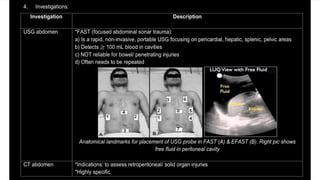
 • Focused Assessment with Sonography for Trauma (FAST):
 - Rapid, bedside detection of free fluid
 • CT Scan (gold standard):
 - Provides detailed grading of injury
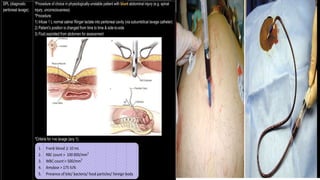
 • Diagnostic peritoneal lavage (rarely used now)
 • Hemodynamic monitoring: Assesses severity
INVESTIGATIONS
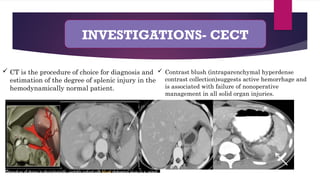
INVESTIGATIONS- CECT
 CT is the procedure of choice for diagnosis and
estimation of the degree of splenic injury in the
hemodynamically normal patient.
 Contrast blush (intraparenchymal hyperdense
contrast collection)suggests active hemorrhage and
is associated with failure of nonoperative
management in all solid organ injuries.
DPA/DPL
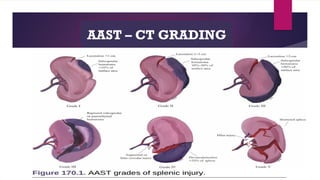
AAST – CT GRADING
Classification of Splenic Injuries
 • Based on AAST (American Association for the Surgery of Trauma):
 - Grade I: Subcapsular hematoma <10% or capsular tear <1 cm
 - Grade II: Hematoma 10-50% or laceration 1-3 cm depth
 - Grade III: Hematoma >50% or laceration >3 cm
 - Grade IV: Laceration involving segmental vessels or devascularization
 - Grade V: Completely shattered spleen or hilar vascular injury
Management Approaches
 • Non-operative management (NOM):
 - Indicated in hemodynamically stable patients
 - Includes close monitoring, blood transfusions
 - Role of angioembolization in high-grade injuries
 • Surgical intervention:
 - Splenectomy: Preferred in unstable or severe injuries
 - Splenorrhaphy: Organ-preserving techniques
TREATMENT
Nonoperative management
 Requires ICU monitoring in a dedicated
trauma center and immediate ability to
convert to operative management should
that become necessary
Indications
 Hemodynamic stability
 Minimal evidence of blood loss, < 2 units
packed red blood cells as transfusion
requirement
 Absence of active contrast extravasation on
CT scan
 Absence of other indication for laparotomy
 Length of intensive care unit (ICU) monitoring is generally
24 to 48 hours initially, with serial hematocrit evaluation
and continuous hemodynamic monitoring
 Blood transfusion is limited to 2 units of packed red blood
cells. If the patient has an ongoing transfusion
requirement of more than 2 units, operative management
should be performed
 The majority of pediatric splenic trauma is successfully
managed nonoperatively.
 Recovery recommendations include restricted activity in
terms of contact sports, running, or similar stresses for 3
months following injury.
 Angiography is performed in patients who are
hemodynamically normal and have a blush on initial CT
scan.
Indications for Surgery
 • Hemodynamic unstability despite resuscitation
 • Failure of non-operative management (NOM)
 • High-grade injuries (Grade IV/V) with vascular involvement
 • Associated injuries requiring laparotomy
 • Splenic rupture with free intraperitoneal hemorrhage
TREATMENT
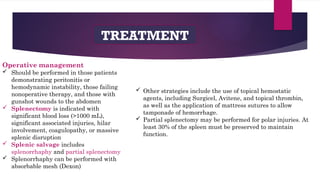
Operative management
 Should be performed in those patients
demonstrating peritonitis or
hemodynamic instability, those failing
nonoperative therapy, and those with
gunshot wounds to the abdomen
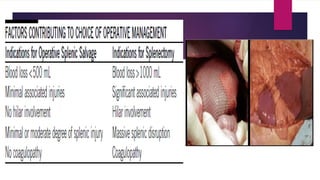
 Splenectomy is indicated with
significant blood loss (>1000 mL),
significant associated injuries, hilar
involvement, coagulopathy, or massive
splenic disruption
 Splenic salvage includes
splenorrhaphy and partial splenectomy
 Splenorrhaphy can be performed with
absorbable mesh (Dexon)
 Other strategies include the use of topical hemostatic
agents, including Surgicel, Avitene, and topical thrombin,
as well as the application of mattress sutures to allow
tamponade of hemorrhage.
 Partial splenectomy may be performed for polar injuries. At
least 30% of the spleen must be preserved to maintain
function.
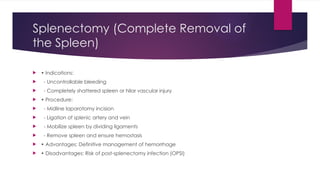
Splenectomy (Complete Removal of
the Spleen)
 • Indications:
 - Uncontrollable bleeding
 - Completely shattered spleen or hilar vascular injury
 • Procedure:
 - Midline laparotomy incision
 - Ligation of splenic artery and vein
 - Mobilize spleen by dividing ligaments
 - Remove spleen and ensure hemostasis
 • Advantages: Definitive management of hemorrhage
 • Disadvantages: Risk of post-splenectomy infection (OPSI)
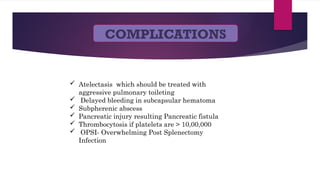
COMPLICATIONS
 Atelectasis which should be treated with
aggressive pulmonary toileting
 Delayed bleeding in subcapsular hematoma
 Subpherenic abscess
 Pancreatic injury resulting Pancreatic fistula
 Thrombocytosis if platelets are > 10,00,000
 OPSI- Overwhelming Post Splenectomy
Infection
Post-Splenectomy Care
 • Vaccinations:
 - Pneumococcal, meningococcal, Haemophilus influenzae type b (Hib)
 • Antibiotic prophylaxis:
 - For invasive infections, especially in children
 • Patient education:
 - Importance of medical attention for febrile illnesses
 - Risk of overwhelming infections
OPSI
 Syndrome consists of rapid development of
severe sepsis with hypotension, disseminated
intravascular coagulation, respiratory distress,
and coma within hours of presentation
 Incidence. This is a rare complication of
splenectomy. 50% to 70% of OPSI occurs less
than 2 years after splenectomy.
 Mortaltiy is 50% to 70% for patients
presenting with full-blown OPSI
 Organisms. S. pneumoniae is responsible for
50% to 90% of infections. Others include N.
meningitides, H. influenzae
 Treatment. Aggressive empiric antibiotic therapy
should be initiated awaiting
pan-culture/sensitivities.
 Prophylaxis. Presplenectomy immunization (2 weeks
before splenectomy) is optimal but most often
impossible for traumatic splenectomy.
 Immunization for Pneumococcus, Meningococcus,
and H. influenzae type B should be administered
prior to discharge Pneumovax. Pneumococcal
booster should be considered every 5 to 6 years for
high-risk patients.
THANKYOU

splenic trauma , grading and it's management

  • 1.
    BLUNT ABDOMINAL TRAUMA SPLENIC TRAUMA PRESENTEDBY:DR.SAUMYA CHIEF:DR.SURESH BABU M.S. HOD:DR.BANUREKHA M.S.,DGO
  • 2.
    SPLENIC RUPTURE  Splenicrupture can occur as trauma to normal spleen or diseased spleen  Atraumatic rupture of a diseased spleen [pathologic rupture] and spontaneous rupture of normal spleen [spontaneous idiopathic rupture]  Spleen is the most common solid organ injured in blunt injury abdomen  Classically associated with left lower ribs fracture  Delayed rupture is a characteristic feature in Subcapsular hematoma  A ruptured spleen can cause life-threatening bleeding into the abdominal cavity.
  • 3.
     H/O Bluntabdominal or lower thoracic trauma  Penetrating trauma to Left Hypochondrium  Iatrogenic  Spontaneous rupture - Malaria - Leukemia - Infectious mononucleosis ETIOLOGY • Injury types • Laceration • Hilar injury • Subcapsular hematoma • Injury associated with other organ injuries • Mechanism of injury • Crushing • Deceleration • Sudden increase in intra abdominal pressure
  • 4.
    SPLENIC RUPTURE  H/OTrauma  Pain abdomen  Occasional distension and vomiting  In severe bleeding associated with shock, syncope or dizziness  Kher’s sign Pain over left shoulder joint  Fixed dullness to percussion on the left, and shifting dullness on the right (Ballance’s sign).  Tenderness all over the abdomen with or without guarding and rigidity CLINICAL FEATURES
  • 5.
    SPLENIC RUPTURE  Othercauses for hemoperitoneum  Liver injury  Ruptured ectopic pregnancy  Ruptured abdominal aortic aneurysm  Acute hemorrhagic pancreatitis DIFFERENTIAL DIAGNOSIS
  • 6.
    Investigations (Imaging Modalities) • Focused Assessment with Sonography for Trauma (FAST):  - Rapid, bedside detection of free fluid  • CT Scan (gold standard):  - Provides detailed grading of injury  • Diagnostic peritoneal lavage (rarely used now)  • Hemodynamic monitoring: Assesses severity
  • 7.
  • 8.
    INVESTIGATIONS- CECT  CTis the procedure of choice for diagnosis and estimation of the degree of splenic injury in the hemodynamically normal patient.  Contrast blush (intraparenchymal hyperdense contrast collection)suggests active hemorrhage and is associated with failure of nonoperative management in all solid organ injuries.
  • 9.
  • 10.
    AAST – CTGRADING
  • 11.
    Classification of SplenicInjuries  • Based on AAST (American Association for the Surgery of Trauma):  - Grade I: Subcapsular hematoma <10% or capsular tear <1 cm  - Grade II: Hematoma 10-50% or laceration 1-3 cm depth  - Grade III: Hematoma >50% or laceration >3 cm  - Grade IV: Laceration involving segmental vessels or devascularization  - Grade V: Completely shattered spleen or hilar vascular injury
  • 12.
    Management Approaches  •Non-operative management (NOM):  - Indicated in hemodynamically stable patients  - Includes close monitoring, blood transfusions  - Role of angioembolization in high-grade injuries  • Surgical intervention:  - Splenectomy: Preferred in unstable or severe injuries  - Splenorrhaphy: Organ-preserving techniques
  • 13.
    TREATMENT Nonoperative management  RequiresICU monitoring in a dedicated trauma center and immediate ability to convert to operative management should that become necessary Indications  Hemodynamic stability  Minimal evidence of blood loss, < 2 units packed red blood cells as transfusion requirement  Absence of active contrast extravasation on CT scan  Absence of other indication for laparotomy  Length of intensive care unit (ICU) monitoring is generally 24 to 48 hours initially, with serial hematocrit evaluation and continuous hemodynamic monitoring  Blood transfusion is limited to 2 units of packed red blood cells. If the patient has an ongoing transfusion requirement of more than 2 units, operative management should be performed  The majority of pediatric splenic trauma is successfully managed nonoperatively.  Recovery recommendations include restricted activity in terms of contact sports, running, or similar stresses for 3 months following injury.  Angiography is performed in patients who are hemodynamically normal and have a blush on initial CT scan.
  • 14.
    Indications for Surgery • Hemodynamic unstability despite resuscitation  • Failure of non-operative management (NOM)  • High-grade injuries (Grade IV/V) with vascular involvement  • Associated injuries requiring laparotomy  • Splenic rupture with free intraperitoneal hemorrhage
  • 15.
    TREATMENT Operative management  Shouldbe performed in those patients demonstrating peritonitis or hemodynamic instability, those failing nonoperative therapy, and those with gunshot wounds to the abdomen  Splenectomy is indicated with significant blood loss (>1000 mL), significant associated injuries, hilar involvement, coagulopathy, or massive splenic disruption  Splenic salvage includes splenorrhaphy and partial splenectomy  Splenorrhaphy can be performed with absorbable mesh (Dexon)  Other strategies include the use of topical hemostatic agents, including Surgicel, Avitene, and topical thrombin, as well as the application of mattress sutures to allow tamponade of hemorrhage.  Partial splenectomy may be performed for polar injuries. At least 30% of the spleen must be preserved to maintain function.
  • 17.
    Splenectomy (Complete Removalof the Spleen)  • Indications:  - Uncontrollable bleeding  - Completely shattered spleen or hilar vascular injury  • Procedure:  - Midline laparotomy incision  - Ligation of splenic artery and vein  - Mobilize spleen by dividing ligaments  - Remove spleen and ensure hemostasis  • Advantages: Definitive management of hemorrhage  • Disadvantages: Risk of post-splenectomy infection (OPSI)
  • 18.
    COMPLICATIONS  Atelectasis whichshould be treated with aggressive pulmonary toileting  Delayed bleeding in subcapsular hematoma  Subpherenic abscess  Pancreatic injury resulting Pancreatic fistula  Thrombocytosis if platelets are > 10,00,000  OPSI- Overwhelming Post Splenectomy Infection
  • 19.
    Post-Splenectomy Care  •Vaccinations:  - Pneumococcal, meningococcal, Haemophilus influenzae type b (Hib)  • Antibiotic prophylaxis:  - For invasive infections, especially in children  • Patient education:  - Importance of medical attention for febrile illnesses  - Risk of overwhelming infections
  • 20.
    OPSI  Syndrome consistsof rapid development of severe sepsis with hypotension, disseminated intravascular coagulation, respiratory distress, and coma within hours of presentation  Incidence. This is a rare complication of splenectomy. 50% to 70% of OPSI occurs less than 2 years after splenectomy.  Mortaltiy is 50% to 70% for patients presenting with full-blown OPSI  Organisms. S. pneumoniae is responsible for 50% to 90% of infections. Others include N. meningitides, H. influenzae  Treatment. Aggressive empiric antibiotic therapy should be initiated awaiting pan-culture/sensitivities.  Prophylaxis. Presplenectomy immunization (2 weeks before splenectomy) is optimal but most often impossible for traumatic splenectomy.  Immunization for Pneumococcus, Meningococcus, and H. influenzae type B should be administered prior to discharge Pneumovax. Pneumococcal booster should be considered every 5 to 6 years for high-risk patients.
  • 21.