SPLENECTOMY
DR MITHUN BENJAMIN
• The spleen is a large, encapsulated, complex mass of vascular and
lymphoid tissue situated in the upper left quadrant of the
abdominal cavity between the fundus of the stomach and the
diaphragm
• The adult spleen is usually 9–14 cm long, 6–8 cm wide and 3–5 cm thick, and
fits comfortably in the individual’s cupped hand. It reaches its largest
dimension in puberty
• 150 to 350 g
• A splenic lobule that fails to coalesce with the developing spleen can persist
as a supernumerary or accessory spleen
• It is most frequently located between the 9 and 11th ribs, with its
long axis along the tenth rib
• Its posterior border is approximately 4 cm from the midline at the
level of the tenth thoracic vertebral spine and it extends about 3 cm
anterior to the mid-axillary line
RELATION
• The spleen has superolateral diaphragmatic and inferomedial
visceral surfaces
• superior and inferior poles
• DIAPHRAGMATIC SURFACE- left pleural costodiaphragmatic recess,
lower lobe of the left lung and the 9 to 11th left ribs by the
underside of the left dome of the diaphragm
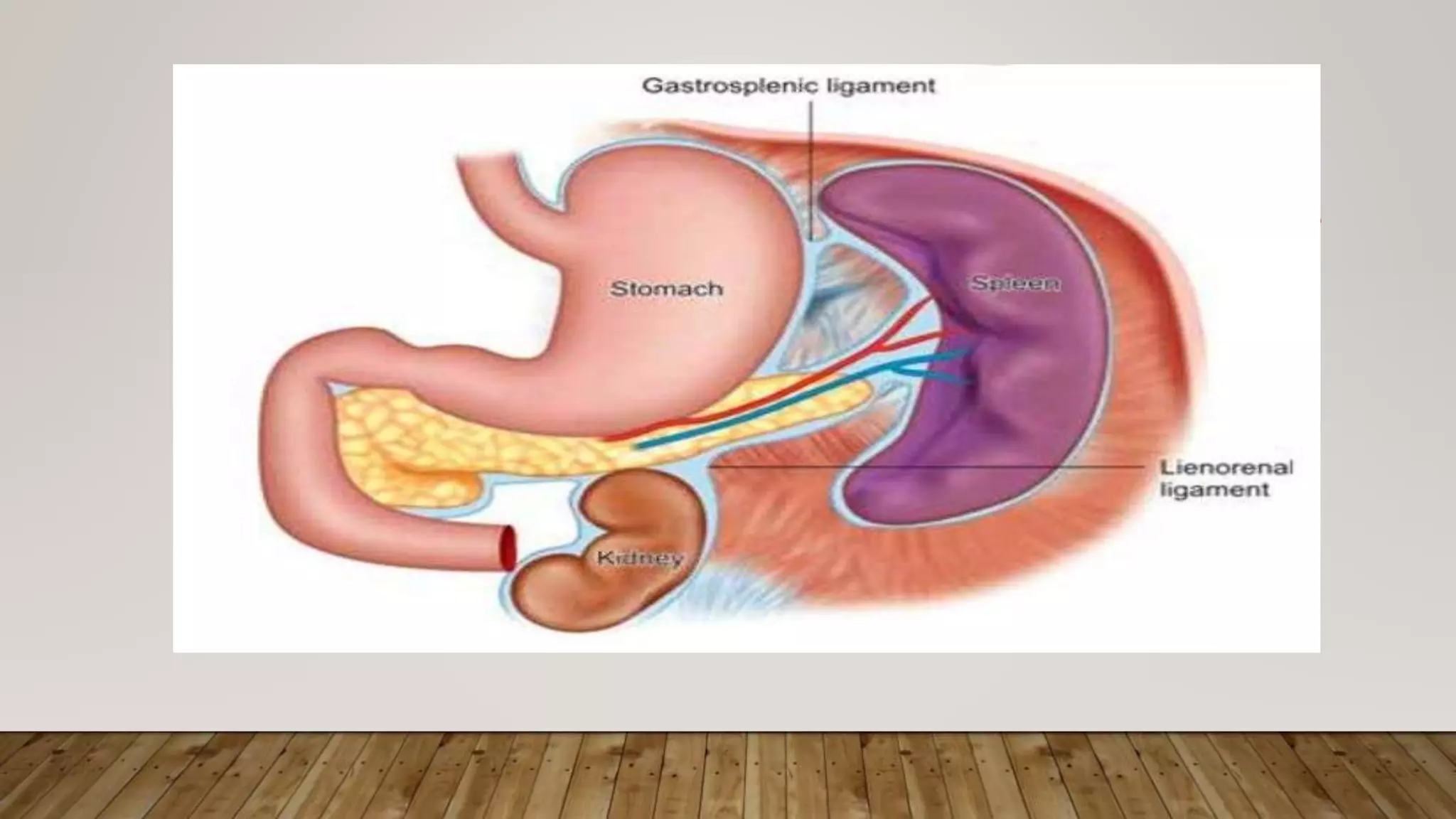
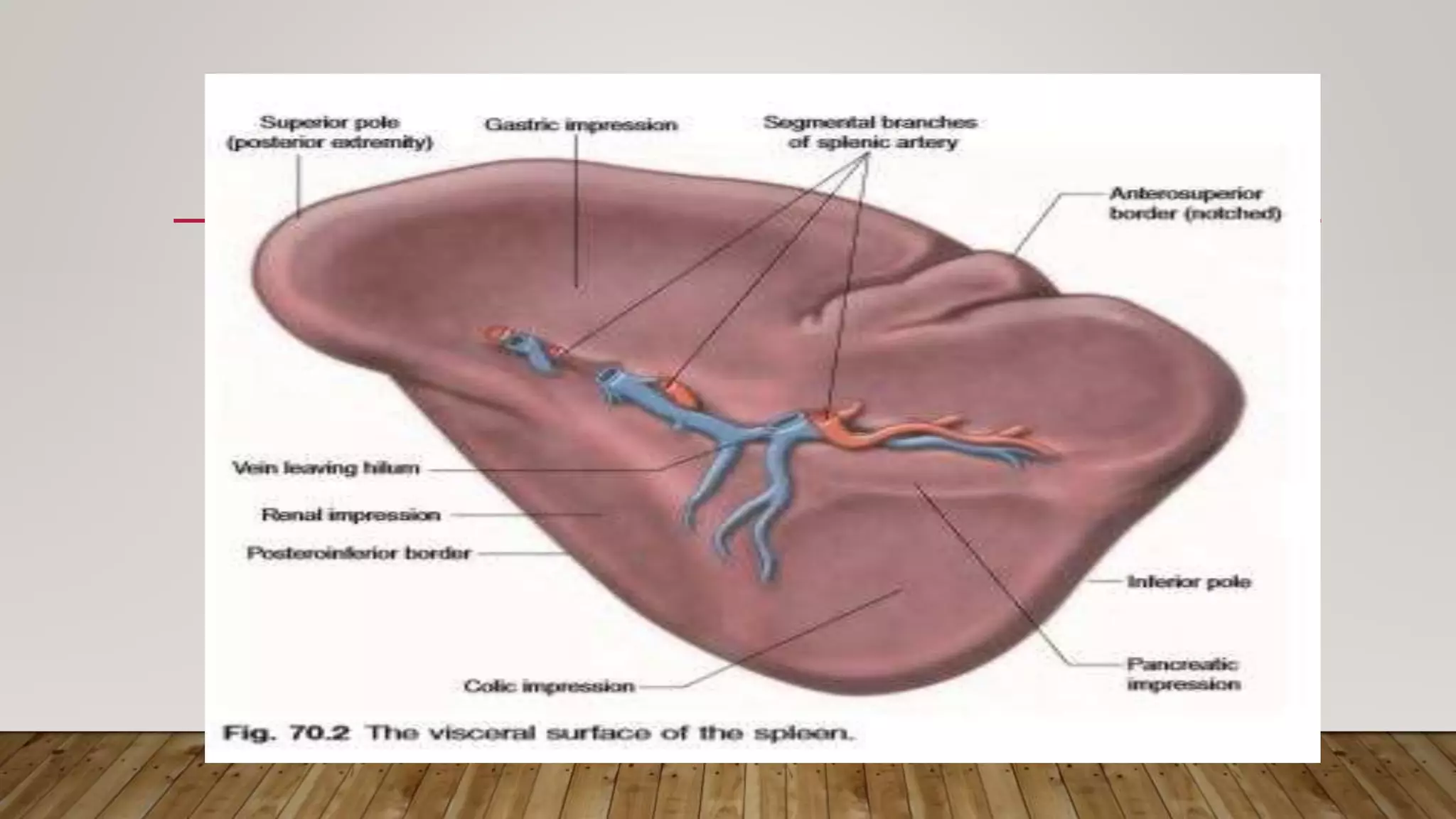
• VISERAL -gastric, renal and colic impressions
• GASTRIC- Fundus, upper body and upper greater curvature of the
stomach. It is separated from the stomach by a peritoneal recess,
limited by the gastrosplenic ligament.
• RENAL- Posteroinferior part of the visceral surface, separated from
the gastric impression above by a ridge of splenic tissue and the
splenic hilum. Is related to the upper lateral area of the anterior
surface of the left kidney and sometimes to the superior pole of the
left suprarenal gland
• COLIC- Inferior pole of the spleen and is related to the splenic
flexure of the colon and the phrenicocolic ligament
• The anterosuperior border separates the diaphragmatic surface from the
gastric impression and is usually convex. Inferiorly, it may bear one or two
notches that have persisted from the lobulated form of the spleen in early
fetal life.
• The posteroinferior border separates the renal impression from the
diaphragmatic surface and is more rounded and blunt than the
anterosuperior border
• The superior pole corresponds to the posterior extremity and usually faces
the vertebral column.
• The inferior pole is longer and less angulated than the superior pole and
connects the anterosuperior and posteroinferior borders anteriorly; it is
related to the colic impression and often lies adjacent to the splenic flexure
and phrenicocolic ligament
BLOOD SUPPLY
• Almost always, the splenic artery arises from the coeliac trunk. However, it may
originate from the common hepatic artery or the left gastric artery, or rarely
directly from the aorta either in isolation or as a splenomesenteric trunk
• From its origin, the artery runs a little way inferiorly before turning to the left
behind the stomach to run horizontally posterior to the upper border of the body
and tail of the pancreas.
• The splenic artery courses anterior to the left kidney and left suprarenal gland,
and runs in the splenorenal ligament behind or above the tail of the pancreas
• The superior pole of the spleen gains an additional arterial supply, distinct from
the splenic hilar vessels, from the short gastric arteries in the gastrosplenic
ligament
• The magistral type, which branches into terminal and polar arteries
near the hilum of the spleen; and the distributed type, which, as the
name implies, gives off its branches early and distant from the
hilum.
• enter the hilum they divide into four or five segmental arteries that
each supply a segment of splenic tissue. There is relatively little
arterial collateral circulation between segments, which means that
occlusion of a segmental vessel often leads to infarction of part of
the spleen
• Segmental arteries divide within the splenic trabeculae and give rise
to follicular arterioles, which are surrounded by a thick lymphoid
sheath of white pulp. There is considerable communication between
arterioles. lymphatic tissue that continues until the vessels thin to
capillaries. These lymphatic sheaths make up the white pulp of the
spleen and are interspersed among the arteriolar branches as
lymphatic follicles. The white pulp then interfaces with the red pulp
at the marginal zone. It is in this marginal zone that the arterioles
lose their lymphatic tissue and the vessels evolve into thin-walled
splenic sinuses and sinusoids.
• The sinusoids then merge into venules, draining into veins that
travel along the trabeculae to form splenic veins that mirror their
arterial counterparts. The splenic vein leaves the splenic hilum and
travels posteriorly to the pancreas, joining with pancreatic branches
and often the inferior mesenteric vein to finally receive the superior
mesenteric vein, forming the portal vein.
RED PULP
• The red pulp constitutes up to 90% of the total splenic volume and
is a unique filtration device that enables the spleen to clear
particulate material from the blood as it perfuses the organ. It
contains large numbers of venous sinusoids that ultimately drain
into tributaries of the splenic vein.
• The sinusoids are separated from each other by a fibrocellular
network of small bundles of collagen fibres, the reticulum,
numerous reticular fibroblasts and splenic macrophages- splenic
cords
• Blood from the open ends of the capillaries that originate from
penicillar arterioles percolates through the reticular spaces within
the splenic cords. Macrophages in the spaces remove blood-borne
particulate material, including ageing and damaged erythrocytes. If
the number of damaged erythrocytes increases reticular cells
proliferate and the red pulp expands, causing the spleen to enlarge
WHITE PULP
• In an adult, white pulp accounts for between 5% and 20% of the splenic tissue.
• In their terminal few millimetres, their connective tissue adventitia is replaced by
a sheath of T lymphocytes, the peri-arteriolar lymphatic sheath (PALS). This is
expanded in places by aggregations of B lymphocytes, lymphoid follicles
measuring 0.25–1 mm in diameter and visible to the naked eye on the freshly cut
surface of the spleen as white semi-opaque dots, in contrast to the surrounding
deep reddish purple of the red pulp
• After antigenic stimulation, they become sites of intensive B-cell proliferation,
developing germinal centres similar to those found in lymph nodes; antigen
presentation by follicular dendritic cells is involved in this process. Germinal
centres regress when the stimulus abates. Follicles tend to atrophy with
advancing age and may be absent in the very elderly
NERVE SUPPLY
• The spleen is innervated by both components of the autonomic
nervous system; the sympathetic supply is dominant. Postganglionic
sympathetic nerves from the coeliac plexus and parasympathetic
nerves from the vagal trunks travel with the splenic vessels
FUNCTIONS
• immunological defence
• metabolism and maintenance of circulating blood elements
• In the fetus, it is also a major site of haemopoiesis and can resume this
role postnatally in certain pathological conditions
• reservoir -8% red blood cell mass
1. The sequestration of red blood cells (for maturation) and platelets
(reservoir).
2. Properdin and tuftsin
• Kher sign- push up to diaphragm – left shoulder pain
• Balance sign- non shifting dullness
SPLENECTOMY
• Elective splenectomy is most commonly carried out for idiopathic
thrombocytopenic purpura (ITP) and haemolytic anaemia
• Laparoscopic splenectomy is the standard approach for elective splenectomy ,The
advantages of laparoscopic splenectomy include less postoperative pain, more
rapid recovery and fewer respiratory complications when compared to open
splenectomy
• Open splenectomy should be reserved for failure of the laparoscopic technique,
emergency splenectomy for trauma and when the necessary laparoscopic skills or
equipment are not available
PREPARATION
• Vaccinate patients 2 weeks prior to surgery to decrease the risk of post-
splenectomy sepsis Immunize against pneumococcal infections (Pneumovax II 0.5
ml IM/SC, Sanofi Pasteur) and Haemophilus influenza type b (Hib) and
meningococcus group C infections (Menitorix 0.5 ml IM, GlaxoSmithKline
• Pre operative splenic artery embolization, reduced splenic volume and avoidance of
the risk of arteriovenous fistula from stapling acrossthe splenic hilum, risk of
bleeding or decrease significant
• splenomegaly
• Blood product
• Npo, rt, enema , consent
• Position the patient in a left lateral position. This position facilitates
retraction of the stomach and omentum away from the spleen and
improves access
• Create a pneumoperitoneum using a Veress needle technique at the
umbilicus or an open technique at the camera port site
• Exact port placement depends on the size of the spleen. For a normal sized
spleen place the 11-mm camera port above the umbilicus and to the left of
the midline. Place a 5-mm port in the epigastrium and a 12-mm port for
stapler and retrieval bag in the left lateral position .An additional port for a
fan retractor may be necessary.
• Perform a systematic exploration looking for splenunculi (small
nodules of splenic tissue away from the main body of the spleen),
which may be found anywhere in the abdominal cavity, but are
commonly located at the hilum of the spleen and adjacent to the
tail of the pancreas
• Use open Johannes forceps to gently retract the spleen medially.
Divide splenic attachments about 1 cm away from the spleen and
use these attachments to retract the spleen
• Continue the dissection, using the harmonic scalpel or hook
diathermy, from the inferior pole of the spleen to the superior pole
and spleen can be moved medially to expose the back of the splenic
hilum . It is important to clear the back of the splenic hilum carefully
at this stage and identify the tail of the pancreas to avoid damaging
it at a later stage
• Return to the lower pole of the spleen and begin the medial
dissection by dividing the serosa over the hilar vessels
• Pass towards the upper pole of the spleen you will encounter the
short gastric vessels. Divide these now with the harmonic scalpel.
Alternatively, they can be divided together with the hilar vessels
using a vascular stapler.
• A fan retractor may be used by the first assistant from the right
upper quadrant position to retract the splenic flexure and, later in
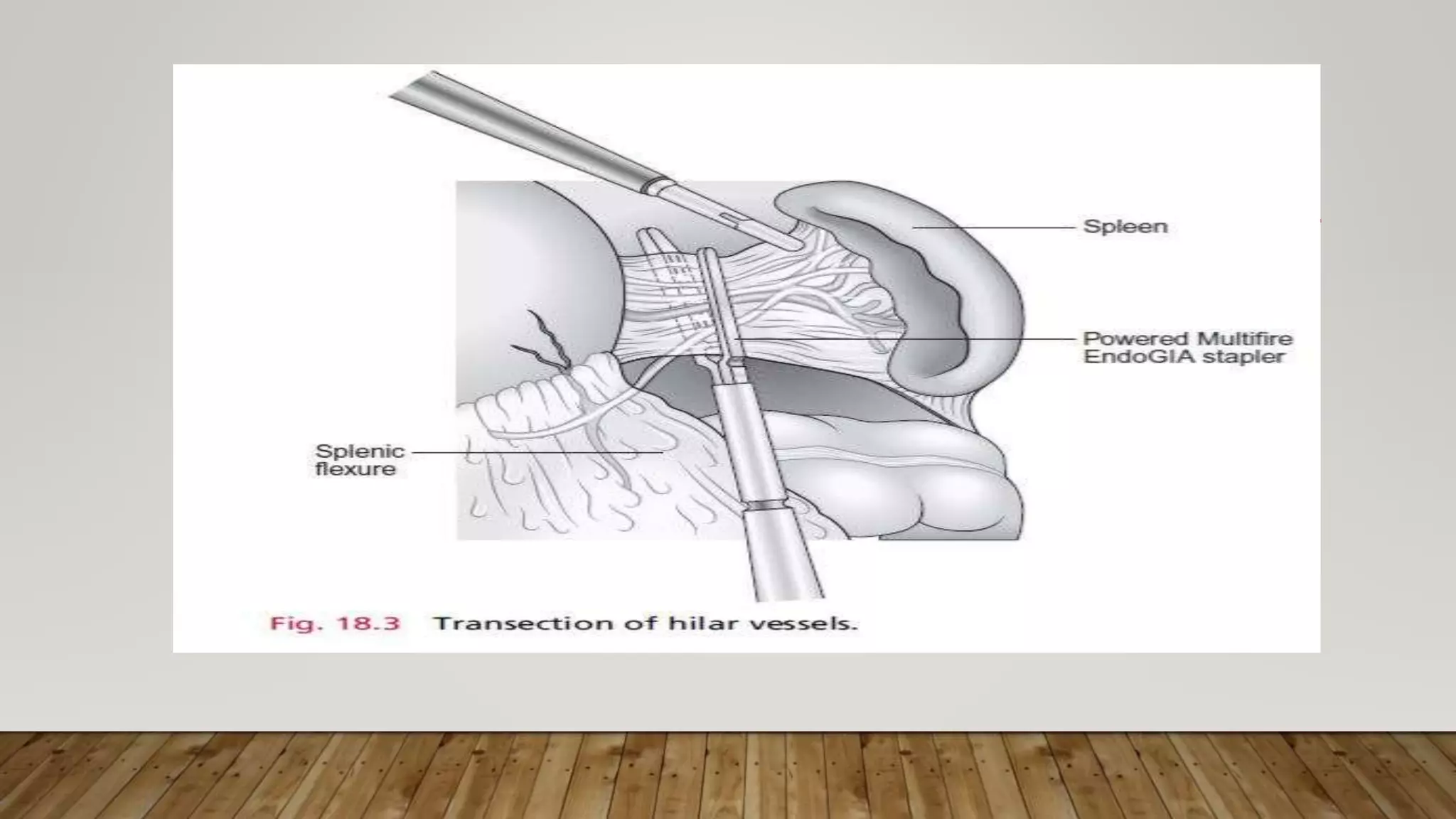
• Once a clear view in front and behind the hilum is obtained, place a
vascular stapler across the vessels at the hilum of the spleen and divide
the splenic artery and vein. Take care to remain close to the spleen as
straying medially may damage the tail of the pancreas.
• Once all the vessels are divided, lift the spleen anteriorly to allow division
of any remaining posterior attachments using a harmonic scalpel
• The splenophrenic ligaments at the top of the spleen to stop it falling
into the abdominal cavity: these are divided once the spleen has been
placed in the retrieval bag
• Partially withdraw the bag through the 12-mm port and use a finger
or sponge holding forceps through the port site to break down the
spleen whilst it is still intra-abdominal. Remove the spleen
piecemeal from the bag using a combination of sponge holding
forceps and a sucker.
OPEN SPLENECTOMY
• Make an upper midline or left subcostal incision through the abdominal wall
• In elective cases, anterior approach is ideal; in trauma and emergency situation,
posterior approach is the preferred one, Make a careful search for splenunculi.
• Ligate the splenic artery at the beginning of the operation if the spleen is very large
or prior to infusing platelets in patients with ITP . the lesser sac entered by dividing
10 cm of the gastrocolic omentum using diathermy or a harmonic scalpel. Incise
the peritoneum at the superior border of the pancreas to identify the tortuous
splenic artery. Use a right angle forceps to pass a ligature behind the splenic artery
and ligate it in continuity with a large non-absorbable suture
• left hand to draw the spleen medially and have your assistant retract
the abdominal wall laterally.
• Incise the peritoneum that attaches the spleen to the lateral sidewall
. Extend this incision up along the lateral border of the spleen
towards the diaphragm. Because of its position this cannot always
be achieved under direct vision. Extend this incision downwards
around the lower pole of the spleento identify the splenic flexure
and separate it from the spleen
• Dividing lateral attachment allows your left hand to gently move the
spleen medially and upwards into the abdominal wound and divide the
adhesions from the upper pole of the spleen to the diaphragm
• Divide the peritoneum over the front of the splenic hilum from the lower
pole to the upper pole. The short gastric arteries are divided
• Divide the splenic vessels between large clips. Several clips may be
required to take all the vessels. Be careful not to injure the tail of the
pancreas at this point
CONSERVATIVE SPLENECTOMY
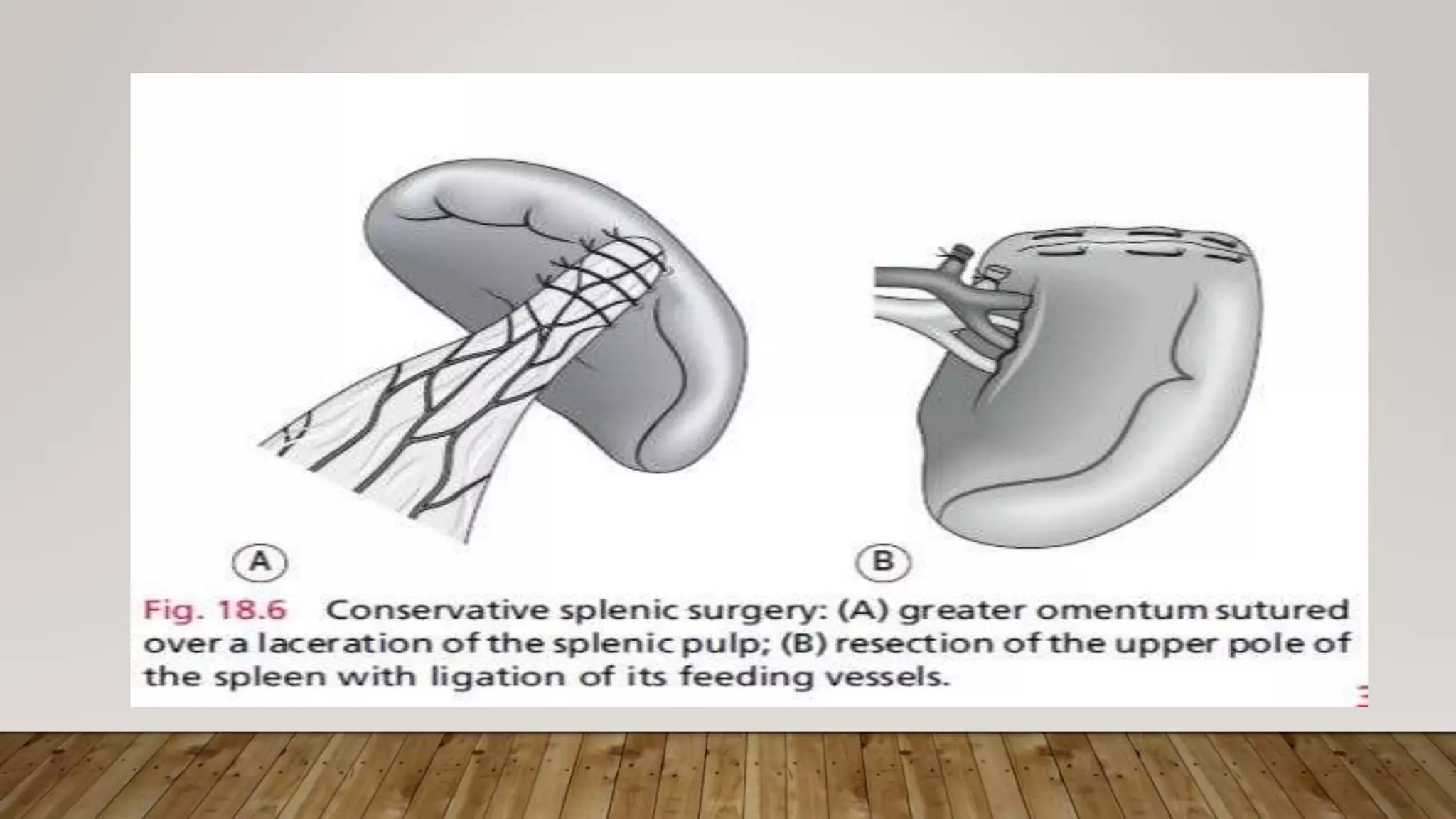
• Immediately remove a spleen that is either fragmented or avulsed from its
vascular pedicle. Under these circumstances consider auto transplantation of
splenic tissue by suturing a piece of omentum around a sliver of removed
splenic pulp to encourage splenic regeneration(splenosis)
• If the extent of the damage and bleeding is less severe, gently mobilize the
spleen into the wound after dividing its peritoneal attachments. Remove
attached clot and examine the organ thoroughly. Decide whether topical
haemostatic agents, partial splenectomy or some form of splenic repair is
feasible, with or without ligation of the splenic artery or its branches
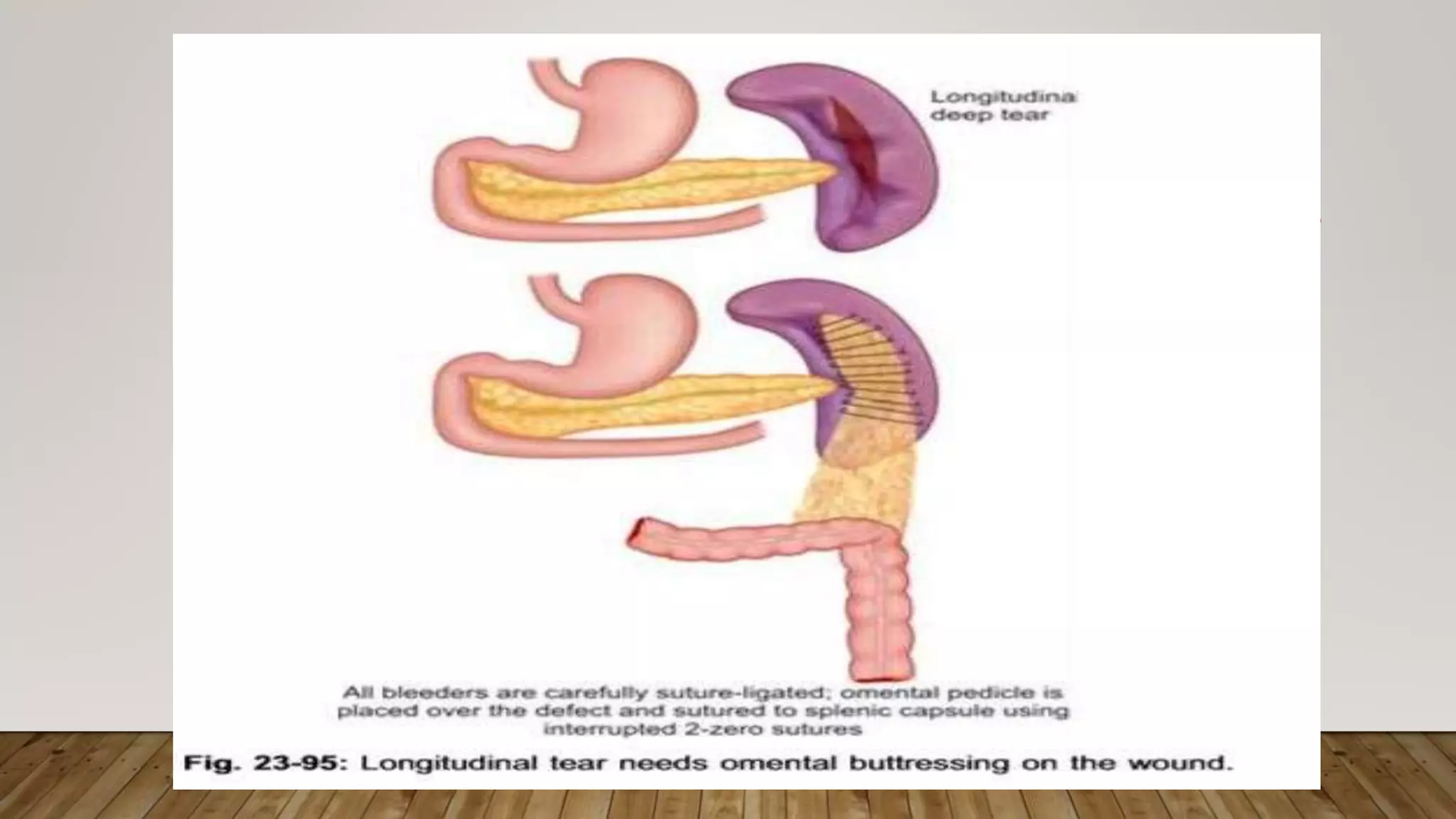
• Capsular tears and other minor injuries can often be controlled by
application of a haemostatic agent
• Deeper or more extensive lacerations may still be suitable for repair.
Mobilize the spleen, at least in part. Use synthetic absorbable
sutures on a long blunt needle. Take deep bites of splenic tissue on
either side of the tear, and tie the sutures snugly. Use omentum or
Teflon buttresses to prevent the stitches cutting through, together
with a topical haemostatic agent to control surface bleeding.
MESH
• In open method in trauma, absorbable mesh is wrapped around
completely. It is partly haemostatic and creates tamponade also. Diff
erent methods are there to place the mesh as a wrap. Mesh may be
wrapped around completely and at the hilar level it is bunched
loosely using purse string suture.
• Another method, a large absorbable mesh is taken. At its centre, a
circular gap is made through which poles of the spleen are slid and
mesh is wrapped from hilum outwards; mesh margins are sutured
on the parietal surface of the spleen.
• For partial splenectomy, fully mobilize the organ and carefully
dissect in the splenic hilum to identify and ligate the segmental
arteries and veins. Incise the capsule of the spleen at the line of
ischaemia and use a finger-fracture technique to resect the upper or
lower pole. Secure haemostasis by means of synthetic absorbable
sutures or with argon coagulation. Preserve at least 30% of the
spleen volume to maintain adequate splenic function.
• Marsupialization (Greek: maryp(p)ion ¼ a pouch; removing the top) of a thin-
walled congenital or traumatic cyst avoids splenectomy but there is a risk of
recurrence
POST OPERATIVE
• Check the haemoglobin, white cell and platelet counts postoperatively.
Leucocytosis and thrombocythaemia nearly always ensue, with peaks at 7–14
days.
• Persistent leucocytosis and pyrexia suggest the possibility of a subphrenic
abscess.
• Consider antiplatelet medication such as aspirin if the platelet count exceeds
1000X109
per litre
• After an emergency splenectomy, vaccinate the patient once fully recovered
• Monitor the haemoglobin level and remove the drain, if used, when it ceases to
function
COMPLICATION
• Intra operative - bleeding. Small splenic tears may be controlled with compression
by surrounding tissues and haemostatic diathermy or get control of the hilar
vessels
• Postoperative haemorrhage is reported to occur in 2–5% of patients after
splenectomy bleeding. The usual sites are the hilar or short gastric vessels: require
re laparotomy
• Thrombocytosis can occur following splenectomy, leading to deep venous
thrombosis and pulmonary emboli
• Respiratory complications such as pneumonia, atelectasis, and pleural effusion are
by far the most common morbidity following open splenectomy, occurring in 20–
• Injury to adjacent organs: the splenic flexure of the colon, the greater curvature
of the stomach and the tail of the pancreas are all susceptible to damage
during splenectomy. Undetected pancreatic injury may later present as
pancreatic ascites, a subphrenic collection or pancreatic fistula.
• Accessory spleens are noted in 15–30% of patients and account for late failure
of splenectomy in ITP.
• Subphrenic collection: this may develop due to minor bleeding or
serous oozing from the raw area in the diaphragm and
retroperitoneum. If this happens, carefully monitor the platelet
count and clotting parameters. A CT (computed tomography) scan
is often required to confirm the diagnosis trauma.
• A subphrenic collection can usually be drained percutaneously with
antibiotic cover but may occasionally require a laparotomy.
• 4%
OVERWHELMING POST-SPLENECTOMY INFECTION
(OPSI)
• As there is reduced IgM, tuftin, properdin and other antibodies, phagocytosis of
encapsulated bacteria is defective. So, the postsplenectomised patient is more
prone for Pneumococcal septicaemia (commonest), N. meningitides, H. infl
uenzae and Babesia microti infections
• Splenectomy there is a 1–2.5% risk of developing overwhelming septicaemia
from encapsulated bacteria, usually within 2 years of operation. The risk is
higher in young children (4–10%) and after splenectomy for haematological
disease adults. The mortality rate of post-splenectomy sepsis is higher in
children (50%)
• Features—Prodromal phase—fever, chills, sore throat; hypotension, shock; DIC;
respiratory distress, coma, death
PREVENTION
• Prompt medical attention, particularly for respiratory illness.
Patients should be advised regarding immunization and foreign and
to carry an information card at all times.
• All patients should be advised to have yearly influenza
immunization.
• Vaccination
THANK YOU

Splenectomy

  • 1.
  • 2.
    • The spleenis a large, encapsulated, complex mass of vascular and lymphoid tissue situated in the upper left quadrant of the abdominal cavity between the fundus of the stomach and the diaphragm
  • 3.
    • The adultspleen is usually 9–14 cm long, 6–8 cm wide and 3–5 cm thick, and fits comfortably in the individual’s cupped hand. It reaches its largest dimension in puberty • 150 to 350 g • A splenic lobule that fails to coalesce with the developing spleen can persist as a supernumerary or accessory spleen
  • 4.
    • It ismost frequently located between the 9 and 11th ribs, with its long axis along the tenth rib • Its posterior border is approximately 4 cm from the midline at the level of the tenth thoracic vertebral spine and it extends about 3 cm anterior to the mid-axillary line
  • 5.
    RELATION • The spleenhas superolateral diaphragmatic and inferomedial visceral surfaces • superior and inferior poles • DIAPHRAGMATIC SURFACE- left pleural costodiaphragmatic recess, lower lobe of the left lung and the 9 to 11th left ribs by the underside of the left dome of the diaphragm
  • 6.
    • VISERAL -gastric,renal and colic impressions • GASTRIC- Fundus, upper body and upper greater curvature of the stomach. It is separated from the stomach by a peritoneal recess, limited by the gastrosplenic ligament. • RENAL- Posteroinferior part of the visceral surface, separated from the gastric impression above by a ridge of splenic tissue and the splenic hilum. Is related to the upper lateral area of the anterior surface of the left kidney and sometimes to the superior pole of the left suprarenal gland • COLIC- Inferior pole of the spleen and is related to the splenic flexure of the colon and the phrenicocolic ligament
  • 9.
    • The anterosuperiorborder separates the diaphragmatic surface from the gastric impression and is usually convex. Inferiorly, it may bear one or two notches that have persisted from the lobulated form of the spleen in early fetal life. • The posteroinferior border separates the renal impression from the diaphragmatic surface and is more rounded and blunt than the anterosuperior border • The superior pole corresponds to the posterior extremity and usually faces the vertebral column. • The inferior pole is longer and less angulated than the superior pole and connects the anterosuperior and posteroinferior borders anteriorly; it is related to the colic impression and often lies adjacent to the splenic flexure and phrenicocolic ligament
  • 11.
    BLOOD SUPPLY • Almostalways, the splenic artery arises from the coeliac trunk. However, it may originate from the common hepatic artery or the left gastric artery, or rarely directly from the aorta either in isolation or as a splenomesenteric trunk • From its origin, the artery runs a little way inferiorly before turning to the left behind the stomach to run horizontally posterior to the upper border of the body and tail of the pancreas. • The splenic artery courses anterior to the left kidney and left suprarenal gland, and runs in the splenorenal ligament behind or above the tail of the pancreas • The superior pole of the spleen gains an additional arterial supply, distinct from the splenic hilar vessels, from the short gastric arteries in the gastrosplenic ligament
  • 13.
    • The magistraltype, which branches into terminal and polar arteries near the hilum of the spleen; and the distributed type, which, as the name implies, gives off its branches early and distant from the hilum. • enter the hilum they divide into four or five segmental arteries that each supply a segment of splenic tissue. There is relatively little arterial collateral circulation between segments, which means that occlusion of a segmental vessel often leads to infarction of part of the spleen
  • 14.
    • Segmental arteriesdivide within the splenic trabeculae and give rise to follicular arterioles, which are surrounded by a thick lymphoid sheath of white pulp. There is considerable communication between arterioles. lymphatic tissue that continues until the vessels thin to capillaries. These lymphatic sheaths make up the white pulp of the spleen and are interspersed among the arteriolar branches as lymphatic follicles. The white pulp then interfaces with the red pulp at the marginal zone. It is in this marginal zone that the arterioles lose their lymphatic tissue and the vessels evolve into thin-walled splenic sinuses and sinusoids.
  • 15.
    • The sinusoidsthen merge into venules, draining into veins that travel along the trabeculae to form splenic veins that mirror their arterial counterparts. The splenic vein leaves the splenic hilum and travels posteriorly to the pancreas, joining with pancreatic branches and often the inferior mesenteric vein to finally receive the superior mesenteric vein, forming the portal vein.
  • 16.
    RED PULP • Thered pulp constitutes up to 90% of the total splenic volume and is a unique filtration device that enables the spleen to clear particulate material from the blood as it perfuses the organ. It contains large numbers of venous sinusoids that ultimately drain into tributaries of the splenic vein. • The sinusoids are separated from each other by a fibrocellular network of small bundles of collagen fibres, the reticulum, numerous reticular fibroblasts and splenic macrophages- splenic cords
  • 17.
    • Blood fromthe open ends of the capillaries that originate from penicillar arterioles percolates through the reticular spaces within the splenic cords. Macrophages in the spaces remove blood-borne particulate material, including ageing and damaged erythrocytes. If the number of damaged erythrocytes increases reticular cells proliferate and the red pulp expands, causing the spleen to enlarge
  • 19.
    WHITE PULP • Inan adult, white pulp accounts for between 5% and 20% of the splenic tissue. • In their terminal few millimetres, their connective tissue adventitia is replaced by a sheath of T lymphocytes, the peri-arteriolar lymphatic sheath (PALS). This is expanded in places by aggregations of B lymphocytes, lymphoid follicles measuring 0.25–1 mm in diameter and visible to the naked eye on the freshly cut surface of the spleen as white semi-opaque dots, in contrast to the surrounding deep reddish purple of the red pulp • After antigenic stimulation, they become sites of intensive B-cell proliferation, developing germinal centres similar to those found in lymph nodes; antigen presentation by follicular dendritic cells is involved in this process. Germinal centres regress when the stimulus abates. Follicles tend to atrophy with advancing age and may be absent in the very elderly
  • 20.
    NERVE SUPPLY • Thespleen is innervated by both components of the autonomic nervous system; the sympathetic supply is dominant. Postganglionic sympathetic nerves from the coeliac plexus and parasympathetic nerves from the vagal trunks travel with the splenic vessels
  • 21.
    FUNCTIONS • immunological defence •metabolism and maintenance of circulating blood elements • In the fetus, it is also a major site of haemopoiesis and can resume this role postnatally in certain pathological conditions • reservoir -8% red blood cell mass 1. The sequestration of red blood cells (for maturation) and platelets (reservoir). 2. Properdin and tuftsin
  • 24.
    • Kher sign-push up to diaphragm – left shoulder pain • Balance sign- non shifting dullness
  • 25.
    SPLENECTOMY • Elective splenectomyis most commonly carried out for idiopathic thrombocytopenic purpura (ITP) and haemolytic anaemia • Laparoscopic splenectomy is the standard approach for elective splenectomy ,The advantages of laparoscopic splenectomy include less postoperative pain, more rapid recovery and fewer respiratory complications when compared to open splenectomy • Open splenectomy should be reserved for failure of the laparoscopic technique, emergency splenectomy for trauma and when the necessary laparoscopic skills or equipment are not available
  • 27.
    PREPARATION • Vaccinate patients2 weeks prior to surgery to decrease the risk of post- splenectomy sepsis Immunize against pneumococcal infections (Pneumovax II 0.5 ml IM/SC, Sanofi Pasteur) and Haemophilus influenza type b (Hib) and meningococcus group C infections (Menitorix 0.5 ml IM, GlaxoSmithKline • Pre operative splenic artery embolization, reduced splenic volume and avoidance of the risk of arteriovenous fistula from stapling acrossthe splenic hilum, risk of bleeding or decrease significant • splenomegaly • Blood product • Npo, rt, enema , consent
  • 28.
    • Position thepatient in a left lateral position. This position facilitates retraction of the stomach and omentum away from the spleen and improves access • Create a pneumoperitoneum using a Veress needle technique at the umbilicus or an open technique at the camera port site • Exact port placement depends on the size of the spleen. For a normal sized spleen place the 11-mm camera port above the umbilicus and to the left of the midline. Place a 5-mm port in the epigastrium and a 12-mm port for stapler and retrieval bag in the left lateral position .An additional port for a fan retractor may be necessary.
  • 30.
    • Perform asystematic exploration looking for splenunculi (small nodules of splenic tissue away from the main body of the spleen), which may be found anywhere in the abdominal cavity, but are commonly located at the hilum of the spleen and adjacent to the tail of the pancreas • Use open Johannes forceps to gently retract the spleen medially. Divide splenic attachments about 1 cm away from the spleen and use these attachments to retract the spleen
  • 31.
    • Continue thedissection, using the harmonic scalpel or hook diathermy, from the inferior pole of the spleen to the superior pole and spleen can be moved medially to expose the back of the splenic hilum . It is important to clear the back of the splenic hilum carefully at this stage and identify the tail of the pancreas to avoid damaging it at a later stage • Return to the lower pole of the spleen and begin the medial dissection by dividing the serosa over the hilar vessels • Pass towards the upper pole of the spleen you will encounter the short gastric vessels. Divide these now with the harmonic scalpel. Alternatively, they can be divided together with the hilar vessels using a vascular stapler. • A fan retractor may be used by the first assistant from the right upper quadrant position to retract the splenic flexure and, later in
  • 33.
    • Once aclear view in front and behind the hilum is obtained, place a vascular stapler across the vessels at the hilum of the spleen and divide the splenic artery and vein. Take care to remain close to the spleen as straying medially may damage the tail of the pancreas. • Once all the vessels are divided, lift the spleen anteriorly to allow division of any remaining posterior attachments using a harmonic scalpel • The splenophrenic ligaments at the top of the spleen to stop it falling into the abdominal cavity: these are divided once the spleen has been placed in the retrieval bag
  • 34.
    • Partially withdrawthe bag through the 12-mm port and use a finger or sponge holding forceps through the port site to break down the spleen whilst it is still intra-abdominal. Remove the spleen piecemeal from the bag using a combination of sponge holding forceps and a sucker.
  • 35.
    OPEN SPLENECTOMY • Makean upper midline or left subcostal incision through the abdominal wall • In elective cases, anterior approach is ideal; in trauma and emergency situation, posterior approach is the preferred one, Make a careful search for splenunculi. • Ligate the splenic artery at the beginning of the operation if the spleen is very large or prior to infusing platelets in patients with ITP . the lesser sac entered by dividing 10 cm of the gastrocolic omentum using diathermy or a harmonic scalpel. Incise the peritoneum at the superior border of the pancreas to identify the tortuous splenic artery. Use a right angle forceps to pass a ligature behind the splenic artery and ligate it in continuity with a large non-absorbable suture
  • 39.
    • left handto draw the spleen medially and have your assistant retract the abdominal wall laterally. • Incise the peritoneum that attaches the spleen to the lateral sidewall . Extend this incision up along the lateral border of the spleen towards the diaphragm. Because of its position this cannot always be achieved under direct vision. Extend this incision downwards around the lower pole of the spleento identify the splenic flexure and separate it from the spleen
  • 40.
    • Dividing lateralattachment allows your left hand to gently move the spleen medially and upwards into the abdominal wound and divide the adhesions from the upper pole of the spleen to the diaphragm • Divide the peritoneum over the front of the splenic hilum from the lower pole to the upper pole. The short gastric arteries are divided • Divide the splenic vessels between large clips. Several clips may be required to take all the vessels. Be careful not to injure the tail of the pancreas at this point
  • 41.
    CONSERVATIVE SPLENECTOMY • Immediatelyremove a spleen that is either fragmented or avulsed from its vascular pedicle. Under these circumstances consider auto transplantation of splenic tissue by suturing a piece of omentum around a sliver of removed splenic pulp to encourage splenic regeneration(splenosis) • If the extent of the damage and bleeding is less severe, gently mobilize the spleen into the wound after dividing its peritoneal attachments. Remove attached clot and examine the organ thoroughly. Decide whether topical haemostatic agents, partial splenectomy or some form of splenic repair is feasible, with or without ligation of the splenic artery or its branches
  • 42.
    • Capsular tearsand other minor injuries can often be controlled by application of a haemostatic agent • Deeper or more extensive lacerations may still be suitable for repair. Mobilize the spleen, at least in part. Use synthetic absorbable sutures on a long blunt needle. Take deep bites of splenic tissue on either side of the tear, and tie the sutures snugly. Use omentum or Teflon buttresses to prevent the stitches cutting through, together with a topical haemostatic agent to control surface bleeding.
  • 43.
    MESH • In openmethod in trauma, absorbable mesh is wrapped around completely. It is partly haemostatic and creates tamponade also. Diff erent methods are there to place the mesh as a wrap. Mesh may be wrapped around completely and at the hilar level it is bunched loosely using purse string suture. • Another method, a large absorbable mesh is taken. At its centre, a circular gap is made through which poles of the spleen are slid and mesh is wrapped from hilum outwards; mesh margins are sutured on the parietal surface of the spleen.
  • 44.
    • For partialsplenectomy, fully mobilize the organ and carefully dissect in the splenic hilum to identify and ligate the segmental arteries and veins. Incise the capsule of the spleen at the line of ischaemia and use a finger-fracture technique to resect the upper or lower pole. Secure haemostasis by means of synthetic absorbable sutures or with argon coagulation. Preserve at least 30% of the spleen volume to maintain adequate splenic function.
  • 45.
    • Marsupialization (Greek:maryp(p)ion ¼ a pouch; removing the top) of a thin- walled congenital or traumatic cyst avoids splenectomy but there is a risk of recurrence
  • 48.
    POST OPERATIVE • Checkthe haemoglobin, white cell and platelet counts postoperatively. Leucocytosis and thrombocythaemia nearly always ensue, with peaks at 7–14 days. • Persistent leucocytosis and pyrexia suggest the possibility of a subphrenic abscess. • Consider antiplatelet medication such as aspirin if the platelet count exceeds 1000X109 per litre • After an emergency splenectomy, vaccinate the patient once fully recovered • Monitor the haemoglobin level and remove the drain, if used, when it ceases to function
  • 49.
    COMPLICATION • Intra operative- bleeding. Small splenic tears may be controlled with compression by surrounding tissues and haemostatic diathermy or get control of the hilar vessels • Postoperative haemorrhage is reported to occur in 2–5% of patients after splenectomy bleeding. The usual sites are the hilar or short gastric vessels: require re laparotomy • Thrombocytosis can occur following splenectomy, leading to deep venous thrombosis and pulmonary emboli • Respiratory complications such as pneumonia, atelectasis, and pleural effusion are by far the most common morbidity following open splenectomy, occurring in 20–
  • 50.
    • Injury toadjacent organs: the splenic flexure of the colon, the greater curvature of the stomach and the tail of the pancreas are all susceptible to damage during splenectomy. Undetected pancreatic injury may later present as pancreatic ascites, a subphrenic collection or pancreatic fistula. • Accessory spleens are noted in 15–30% of patients and account for late failure of splenectomy in ITP.
  • 52.
    • Subphrenic collection:this may develop due to minor bleeding or serous oozing from the raw area in the diaphragm and retroperitoneum. If this happens, carefully monitor the platelet count and clotting parameters. A CT (computed tomography) scan is often required to confirm the diagnosis trauma. • A subphrenic collection can usually be drained percutaneously with antibiotic cover but may occasionally require a laparotomy. • 4%
  • 53.
    OVERWHELMING POST-SPLENECTOMY INFECTION (OPSI) •As there is reduced IgM, tuftin, properdin and other antibodies, phagocytosis of encapsulated bacteria is defective. So, the postsplenectomised patient is more prone for Pneumococcal septicaemia (commonest), N. meningitides, H. infl uenzae and Babesia microti infections • Splenectomy there is a 1–2.5% risk of developing overwhelming septicaemia from encapsulated bacteria, usually within 2 years of operation. The risk is higher in young children (4–10%) and after splenectomy for haematological disease adults. The mortality rate of post-splenectomy sepsis is higher in children (50%) • Features—Prodromal phase—fever, chills, sore throat; hypotension, shock; DIC; respiratory distress, coma, death
  • 54.
    PREVENTION • Prompt medicalattention, particularly for respiratory illness. Patients should be advised regarding immunization and foreign and to carry an information card at all times. • All patients should be advised to have yearly influenza immunization. • Vaccination
  • 55.

Editor's Notes

  • #4 . This fully functional island of splenic tissue is found in approximately 10% of individuals and may be located in any part of the abdomen, or even outside it, but is most commonly present near the splenic hilum within the gastrosplenic ligament or greater omentum
  • #5 it has to triple in size before it becomes palpable below the left costal margin
  • #12 , in common with the left gastric and common hepatic arteries. PANCREATIC, SHORT GASTRIC, LEFT GASTROEPIPLOEIC
  • #14 The magistral type of splenic arterial anatomy occurs in 30% of individuals compared with the distributed type (70%).
  • #22 This production is usurped by the bone marrow during the fifth month of gestation, It is likely that the spleen’s mechanical filtration, properdin(COMPLEMENT ACTIVATION) and tuftsin (the phagocytic activity of mononuclear phagocytes and polymorphonuclear leukocytes)
  • #27 Up to 10% of splenectomies performed are secondary to iatrogenic injury.
  • #29 10 mm port is umbilical for camera; 5 mm left hand working port is between epigastrium and camera; 10 mm right hand working port is at left midclavicuar line, if endovascular stapler is being used this port should be 12 mm; 5 mm epigastric port for retraction of the stomach; left anterior axillary line 5 mm port when needed to retract spleen
  • #36 Consider injecting 1 ml of 1: 10 000 adrenaline (epinephrine) into the splenic artery immediately before ligating it. This can shrink the size of a massive spleen and facilitate the subsequent dissection. Post – like lap , ant as mentioned. Trauma – pack then resuscitate the start
  • #49 2 YR PNEUMO, 5 YR MENINGO
  • #51 A colonic or stomach injury should be closed using interrupted seromuscular absorbable sutures. Injury to the tail of pancreas may require either primary repair or resection
  • #55 PPV 23 is the commonest vaccine used.