DEFINITION
Spirometry is derived from the Latin words
SPIRO (to breathe) and METER (to
measure).
Spirometry is a method of assessing lung
function by measuring the volume of air that
the patient can expel from the lungs after a
maximal inspiration.
a method of assessing lung function
HISTORY
The spirometer was originally invented in the 1840’s by John
Hutchinson an English surgeon. The volume of exhaled air from
fully inflated lungs could accurately be measured by exhaling into a
tube leading into the bucket. Helped in measurement of Vital
Capacity.
In 1950 Dr. Tiffeneau of France introduced the forced
measurement of air volume during a given time frame, i.e., forced
expiratory volume in 1 second, FEV1.
Wright B.M. and McKerrow C.B. introduced the peak flow
meter in 1959.
In 2008, Advanced Medical Engineering developed the world's
first wireless spirometer with 3D Tilt-Sensing for far greater
quality control in the testing environment.
The First
Spirometer
INDICATIONS
Spirometry is the best way of detecting the presence of airway obstruction
and making a definitive diagnosis of asthma and COPD. In COPD its uses
are
Measure airflow obstruction to help make a definitive diagnosis of
COPD.
Confirm presence of airway obstruction.
Assess severity of airflow obstruction in COPD.
Detect airflow obstruction in smokers who may have few or no
symptoms.
Monitor disease progression in COPD.
Assess one aspect of response to therapy.
Assess prognosis (FEV1) in COPD.
Perform pre-operative assessment.
ADDITIONALUSES
Make a diagnosis and assess severity in a range
of other respiratory conditions
Distinguish between obstruction and restriction a
s
causes of breathlessness
Screen workforces in occupational environments
Assess fitness to dive
Perform pre-employment screening in certain
professions
Typesof Spirometers
Bellows spirometers:
Measure volume; mainly in lung function units
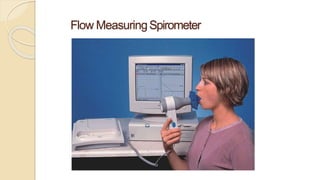
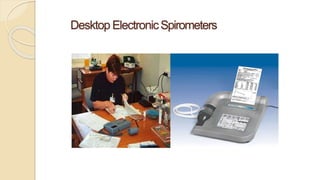
Electronic desk top spirometers:
Measure flow and volume with real time display
Small hand-held spirometers:
Inexpensive and quick to use but no print out
Volume Measuring Spirometer
Flow MeasuringSpirometer
Desktop ElectronicSpirometers
SmallHand-held Spirometers
LUNG VOLUMESAND CAPACITIES
Tidal volume: that volume of air moved into or out of the lungs during
quiet breathing
Inspiratory reserve volume: the maximal volume that can be inhaled
from the end-inspiratory level
Inspiratory capacity: the sum of IRV and TV
Expiratory reserve volume: the maximal volume of air that can be
exhaled from the end-expiratory position
Vital capacity: the volume of air breathed out after the deepest
inhalation.
Total lung capacity: the volume in the lungs at maximal inflation, the
sum of VC and RV.
Residual volume: the volume of air remaining in the lungs after a
maximal exhalation
StandardSpirometric Indicies
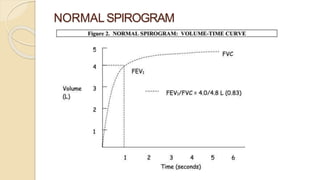
FEV1- Forced expiratory volume in one second: The volume of air
expired in the first second of the blow
FVC - Forced vital capacity: The total volume of air that can be forcibly
exhaled in one breath
FEV1/FVC ratio: The fraction of air exhaled in the first second relative to
the total volume exhaled
FEV6 – Forced expired volume in sixseconds:
Often approximates the FVC. Easier to perform in older and COPD
patients but role in COPD diagnosis remains underinvestigation
MEFR –Mid-expiratory flow rates:
Derived from the mid portion of the flow volume curve but is notuseful
for COPD diagnosis
PROCEDURE
Withholding Medications
Before performing spirometry, withhold:
 Short acting β2-agonists for 6 hours
 Long acting β2-agonists for 12hours
 Ipratropium for 6 hours
 Tiotropium for 24 hours
Optimally, subjects should avoid caffeine and
cigarette smoking for 30 minutes before performing
spirometry
Performing Spirometry - Preparation
1. Explain the purpose of the test and demonstrate
the procedure
2. Record the patient’s age, height and gender and
enter on the spirometer
3. Note when bronchodilator was last used
4. Have the patient sitting comfortably
5. Loosen any tight clothing
6. Empty the bladder beforehand if needed
Breath in until the lungs are full
Hold the breath and seal the lips tightly
around a clean mouthpiece
Blast the air out as forcibly and fast as
possible. Provide lots of encouragement!
Continue blowing until the lungs feel empty
Watch the patient during the blow to assure
the lips are sealed around the mouthpiece
Check to determine if an adequate trace
has been achieved
Repeat the procedure at least twice more
until ideally 3 readings within 100 ml or 5%
of each other are obtained
Spirometry - Possible Side Effects
Feeling light-headed
Headache
Facial redness
Fainting: reduced venous return or vasovagal
attack (reflex)
Transient urinary incontinence
Spirometry should be avoided after recent heart attack or
stroke
Spirogram Patterns
Normal
Obstructive
Restrictive
Mixed Obstructive and Restrictive
NORMAL SPIROGRAM
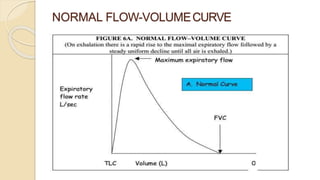
NORMAL FLOW-VOLUMECURVE
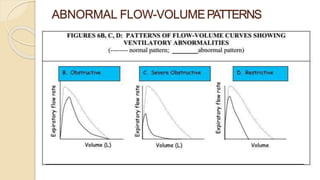
ABNORMAL FLOW-VOLUMEPATTERNS
Diseases Associated With
Airflow Obstruction
COPD
Asthma
Bronchiectasis
Cystic Fibrosis
Post-tuberculosis
Lung cancer (greater risk in COPD)
Obliterative Bronchiolitis
SpirometricDiagnosis ofCOPD
COPD is confirmed by post–bronchodilator
FEV1/FVC < 0.7
Post-bronchodilator FEV1/FVC measured 1
5
minutes after 400µg salbutamol or
equivalent
Bronchodilator Reversibility Testing
Provides the best achievable FEV1
(and
FVC)
 Helps to differentiateCOPDfromasthma
 Must be interpretedwithclinicalhistory
 - neitherasthmanor COPD are diagnosed
on spirometryalone
Bronchodilator ReversibilityTesting
Can be done on first visit if no diagnosishas
been made
Best done as a planned procedure: pre- and
post-bronchodilator tests require a minimum of
15minutes
Post-bronchodilator only saves time but does not
help confirm if asthma is present
Short-acting bronchodilators need to be
withheld for at least 4 hours prior to test
Bronchodilator Reversibility Testing
Bronchodilator* Dose FEV1 before and
after
Salbutamol 200 – 400 µg via
large volume
spacer
15 minutes
Terbutaline 500 µg via
Turbohaler®
15 minutes
Ipratropium 160 µg** via
spacer
45 minutes
Bronchodilator Reversibility Testing in COPD
POST BRONCHODILATORSPIROMETRY
Spirometry

Spirometry

  • 2.
    DEFINITION Spirometry is derivedfrom the Latin words SPIRO (to breathe) and METER (to measure). Spirometry is a method of assessing lung function by measuring the volume of air that the patient can expel from the lungs after a maximal inspiration. a method of assessing lung function
  • 3.
    HISTORY The spirometer wasoriginally invented in the 1840’s by John Hutchinson an English surgeon. The volume of exhaled air from fully inflated lungs could accurately be measured by exhaling into a tube leading into the bucket. Helped in measurement of Vital Capacity. In 1950 Dr. Tiffeneau of France introduced the forced measurement of air volume during a given time frame, i.e., forced expiratory volume in 1 second, FEV1. Wright B.M. and McKerrow C.B. introduced the peak flow meter in 1959. In 2008, Advanced Medical Engineering developed the world's first wireless spirometer with 3D Tilt-Sensing for far greater quality control in the testing environment.
  • 4.
  • 5.
    INDICATIONS Spirometry is thebest way of detecting the presence of airway obstruction and making a definitive diagnosis of asthma and COPD. In COPD its uses are Measure airflow obstruction to help make a definitive diagnosis of COPD. Confirm presence of airway obstruction. Assess severity of airflow obstruction in COPD. Detect airflow obstruction in smokers who may have few or no symptoms. Monitor disease progression in COPD. Assess one aspect of response to therapy. Assess prognosis (FEV1) in COPD. Perform pre-operative assessment.
  • 6.
    ADDITIONALUSES Make a diagnosisand assess severity in a range of other respiratory conditions Distinguish between obstruction and restriction a s causes of breathlessness Screen workforces in occupational environments Assess fitness to dive Perform pre-employment screening in certain professions
  • 7.
    Typesof Spirometers Bellows spirometers: Measurevolume; mainly in lung function units Electronic desk top spirometers: Measure flow and volume with real time display Small hand-held spirometers: Inexpensive and quick to use but no print out
  • 8.
  • 9.
  • 10.
  • 11.
  • 12.
    LUNG VOLUMESAND CAPACITIES Tidalvolume: that volume of air moved into or out of the lungs during quiet breathing Inspiratory reserve volume: the maximal volume that can be inhaled from the end-inspiratory level Inspiratory capacity: the sum of IRV and TV Expiratory reserve volume: the maximal volume of air that can be exhaled from the end-expiratory position Vital capacity: the volume of air breathed out after the deepest inhalation. Total lung capacity: the volume in the lungs at maximal inflation, the sum of VC and RV. Residual volume: the volume of air remaining in the lungs after a maximal exhalation
  • 14.
    StandardSpirometric Indicies FEV1- Forcedexpiratory volume in one second: The volume of air expired in the first second of the blow FVC - Forced vital capacity: The total volume of air that can be forcibly exhaled in one breath FEV1/FVC ratio: The fraction of air exhaled in the first second relative to the total volume exhaled FEV6 – Forced expired volume in sixseconds: Often approximates the FVC. Easier to perform in older and COPD patients but role in COPD diagnosis remains underinvestigation MEFR –Mid-expiratory flow rates: Derived from the mid portion of the flow volume curve but is notuseful for COPD diagnosis
  • 15.
  • 16.
    Withholding Medications Before performingspirometry, withhold:  Short acting β2-agonists for 6 hours  Long acting β2-agonists for 12hours  Ipratropium for 6 hours  Tiotropium for 24 hours Optimally, subjects should avoid caffeine and cigarette smoking for 30 minutes before performing spirometry
  • 17.
    Performing Spirometry -Preparation 1. Explain the purpose of the test and demonstrate the procedure 2. Record the patient’s age, height and gender and enter on the spirometer 3. Note when bronchodilator was last used 4. Have the patient sitting comfortably 5. Loosen any tight clothing 6. Empty the bladder beforehand if needed
  • 18.
    Breath in untilthe lungs are full Hold the breath and seal the lips tightly around a clean mouthpiece Blast the air out as forcibly and fast as possible. Provide lots of encouragement! Continue blowing until the lungs feel empty
  • 19.
    Watch the patientduring the blow to assure the lips are sealed around the mouthpiece Check to determine if an adequate trace has been achieved Repeat the procedure at least twice more until ideally 3 readings within 100 ml or 5% of each other are obtained
  • 20.
    Spirometry - PossibleSide Effects Feeling light-headed Headache Facial redness Fainting: reduced venous return or vasovagal attack (reflex) Transient urinary incontinence Spirometry should be avoided after recent heart attack or stroke
  • 21.
  • 22.
  • 23.
  • 25.
  • 26.
    Diseases Associated With AirflowObstruction COPD Asthma Bronchiectasis Cystic Fibrosis Post-tuberculosis Lung cancer (greater risk in COPD) Obliterative Bronchiolitis
  • 27.
    SpirometricDiagnosis ofCOPD COPD isconfirmed by post–bronchodilator FEV1/FVC < 0.7 Post-bronchodilator FEV1/FVC measured 1 5 minutes after 400µg salbutamol or equivalent
  • 28.
    Bronchodilator Reversibility Testing Providesthe best achievable FEV1 (and FVC)  Helps to differentiateCOPDfromasthma  Must be interpretedwithclinicalhistory  - neitherasthmanor COPD are diagnosed on spirometryalone
  • 29.
    Bronchodilator ReversibilityTesting Can bedone on first visit if no diagnosishas been made Best done as a planned procedure: pre- and post-bronchodilator tests require a minimum of 15minutes Post-bronchodilator only saves time but does not help confirm if asthma is present Short-acting bronchodilators need to be withheld for at least 4 hours prior to test
  • 30.
    Bronchodilator Reversibility Testing Bronchodilator*Dose FEV1 before and after Salbutamol 200 – 400 µg via large volume spacer 15 minutes Terbutaline 500 µg via Turbohaler® 15 minutes Ipratropium 160 µg** via spacer 45 minutes
  • 31.
  • 32.