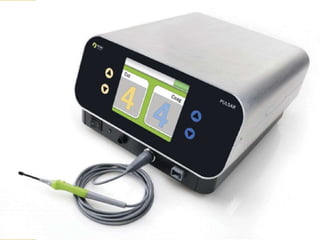
Electrosurgical Unit 
Presented By: 
Prasad vagal 
Shraddha Khatavkar
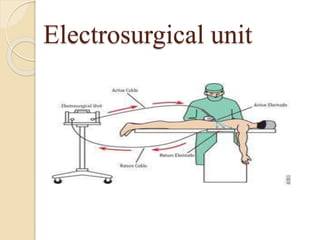
Electrosurgical unit
Principle 
 Electro surgery is the application of a 
high-frequency electric current to 
biological tissue as a means to cut, 
coagulate, desiccate, or fulgurate 
tissue. 
 Electrosurgical devices are frequently 
used during surgical operations 
helping to prevent blood loss in 
hospital operating rooms or in out 
patient procedures.
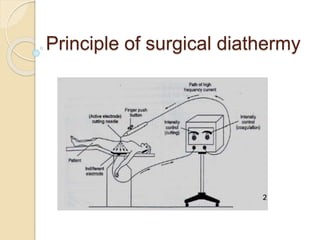
Principle of surgical diathermy
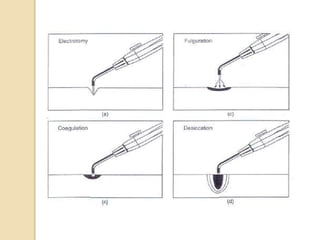
Types of electrosurgical 
technique 
1. Electro-surgical coagulation 
2. Fulguration 
3. Desiccation 
4. Electrotomy
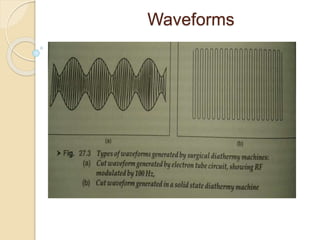
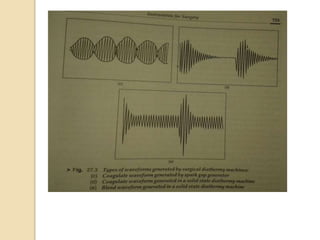
Waveforms
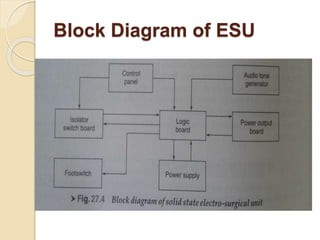
Block Diagram of ESU
Types of ESU 
• Monopolar technique 
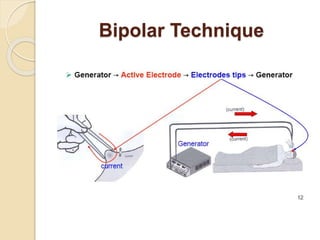
• Bipolar technique
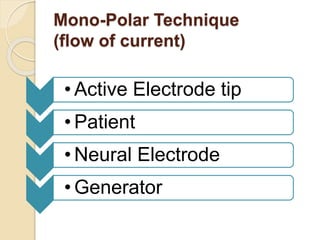
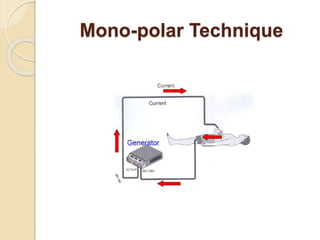
Mono-Polar Technique 
(flow of current) 
• Active Electrode tip 
• Patient 
• Neural Electrode 
• Generator
Mono-polar Technique
Bipolar Technique
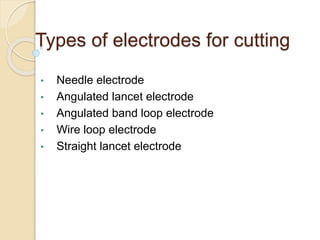
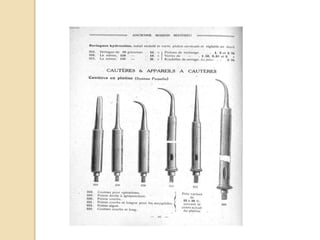
Types of electrodes for cutting 
• Needle electrode 
• Angulated lancet electrode 
• Angulated band loop electrode 
• Wire loop electrode 
• Straight lancet electrode
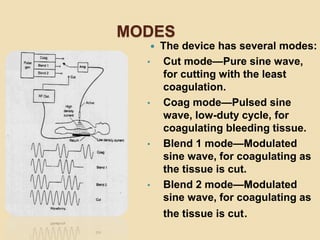
MODES 
 The device has several modes: 
• Cut mode—Pure sine wave, 
for cutting with the least 
coagulation. 
• Coag mode—Pulsed sine 
wave, low-duty cycle, for 
coagulating bleeding tissue. 
• Blend 1 mode—Modulated 
sine wave, for coagulating as 
the tissue is cut. 
• Blend 2 mode—Modulated 
sine wave, for coagulating as 
the tissue is cut.
Safety aspects in electro 
surgical unit 
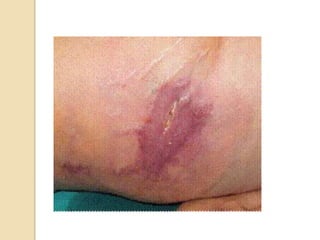
i. Burns 
ii. High frequency current 
iii. Explosion hazards
Staff safety 
 Avoid contact with the neutral electrode 
 When applying current, always be sure to wear 
gloves and touch the equipment or patient body 
with the entire palm of the hand, not with a 
single finger. 
 Electrosurgical equipment needs to be grounded 
in order to minimize interference with video 
endoscopic systems. 
 Smoke generated during electrosurgical 
procedures can be irritating and potentially 
harmful to personnel; surgical masks and 
adequate ventilation of smoke may be useful
Advantages over other 
techniques 
• The laser is less efficient, less powerful, 
more costly, more bulky in the operating 
room and less understood due to a smaller 
case history data base work to discourage 
its use in many cases. 
 So much depends upon the skill of the 
surgeon in the use of any surgical knife, that 
the selection is often a professional 
judgment.
Thank you !!!
Bibliography 
a. Iambiomed 
b. R S Khandpur 
c. Wikipedia

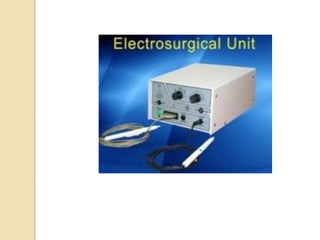
Electrosurgical unit

  • 1.
    Electrosurgical Unit PresentedBy: Prasad vagal Shraddha Khatavkar
  • 2.
  • 5.
    Principle  Electrosurgery is the application of a high-frequency electric current to biological tissue as a means to cut, coagulate, desiccate, or fulgurate tissue.  Electrosurgical devices are frequently used during surgical operations helping to prevent blood loss in hospital operating rooms or in out patient procedures.
  • 6.
  • 7.
    Types of electrosurgical technique 1. Electro-surgical coagulation 2. Fulguration 3. Desiccation 4. Electrotomy
  • 9.
  • 11.
  • 12.
    Types of ESU • Monopolar technique • Bipolar technique
  • 13.
    Mono-Polar Technique (flowof current) • Active Electrode tip • Patient • Neural Electrode • Generator
  • 14.
  • 15.
  • 16.
    Types of electrodesfor cutting • Needle electrode • Angulated lancet electrode • Angulated band loop electrode • Wire loop electrode • Straight lancet electrode
  • 18.
    MODES  Thedevice has several modes: • Cut mode—Pure sine wave, for cutting with the least coagulation. • Coag mode—Pulsed sine wave, low-duty cycle, for coagulating bleeding tissue. • Blend 1 mode—Modulated sine wave, for coagulating as the tissue is cut. • Blend 2 mode—Modulated sine wave, for coagulating as the tissue is cut.
  • 21.
    Safety aspects inelectro surgical unit i. Burns ii. High frequency current iii. Explosion hazards
  • 23.
    Staff safety Avoid contact with the neutral electrode  When applying current, always be sure to wear gloves and touch the equipment or patient body with the entire palm of the hand, not with a single finger.  Electrosurgical equipment needs to be grounded in order to minimize interference with video endoscopic systems.  Smoke generated during electrosurgical procedures can be irritating and potentially harmful to personnel; surgical masks and adequate ventilation of smoke may be useful
  • 24.
    Advantages over other techniques • The laser is less efficient, less powerful, more costly, more bulky in the operating room and less understood due to a smaller case history data base work to discourage its use in many cases.  So much depends upon the skill of the surgeon in the use of any surgical knife, that the selection is often a professional judgment.
  • 25.
  • 26.
    Bibliography a. Iambiomed b. R S Khandpur c. Wikipedia