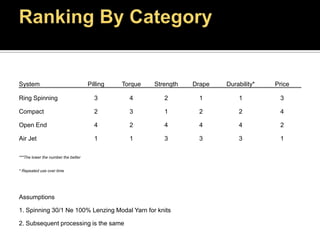
Spinning SystemsLearning the differences
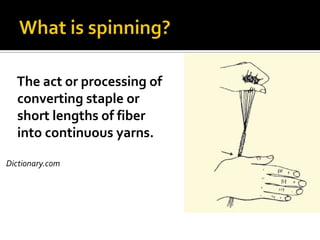
What is spinning?    The act or processing of converting staple or short lengths of fiber into continuous yarns.Dictionary.com
Most common types of spinning for apparel fabricsRing Spinning
Compact
Open End
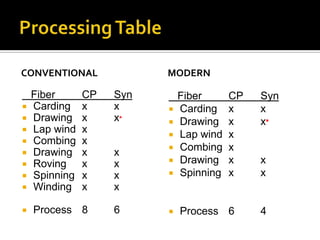
Air jetProcessing TableConventional   Fiber	CP	SynCarding	x	xDrawing	x	x*Lap wind	x	Combing	x	Drawing	x	xRoving	x	xSpinning	x	xWinding	x	xProcess	8	6Modern   Fiber	CP	SynCarding	x	xDrawing	x	x*Lap wind	xCombing	xDrawing	x	xSpinning	x	xProcess	6	4
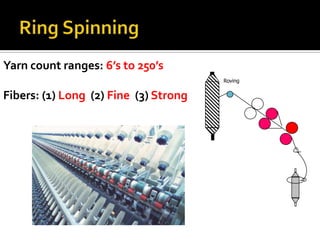
RovingYarn count ranges: 6’s to 250’sFibers: (1) Long  (2) Fine  (3) StrongRing Spinning
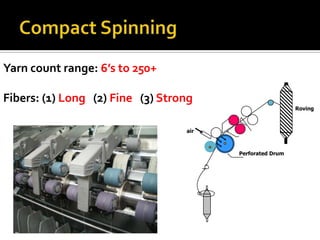
Yarn count range: 6’s to 250+Fibers: (1) Long   (2) Fine   (3) StrongRovingairPerforated DrumCompact Spinning
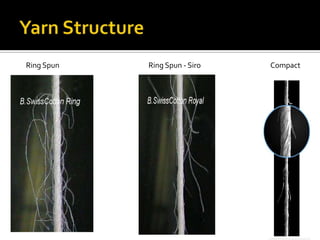
Yarn StructureCompactRing Spun - SiroRing Spun
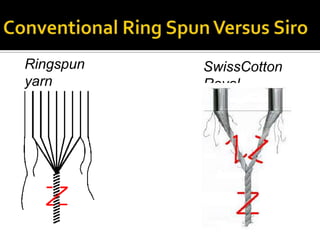
Ringspun yarnSwissCotton RoyalConventional Ring Spun Versus Siro
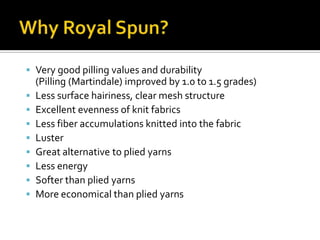
Why Royal Spun?Very good pilling values and durability (Pilling (Martindale) improved by 1.0 to 1.5 grades)
Less surface hairiness, clear mesh structure
Excellent evenness of knit fabrics
Less fiber accumulations knitted into the fabric
Luster
Great alternative to plied yarns
Less energy
Softer than plied yarns
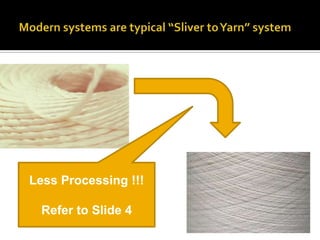
More economical than plied yarnsModern systems are typical “Sliver to Yarn” systemLess Processing !!!Refer to Slide 4
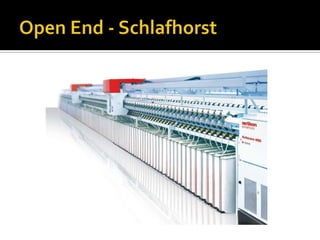
Open End - Schlafhorst
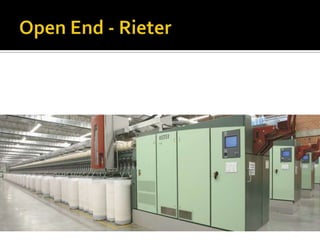
Open End - Rieter
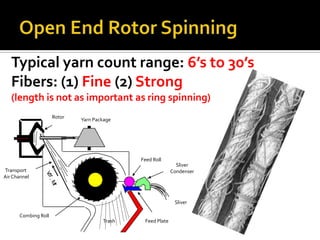
Typical yarn count range: 6’s to 30’sFibers: (1) Fine (2) Strong (length is not as important as ring spinning)RotorYarn PackageFeed RollSliverCondenserTransport Air ChannelVdf, MfSliverCombing RollFeed PlateTrashOpen End Rotor Spinning
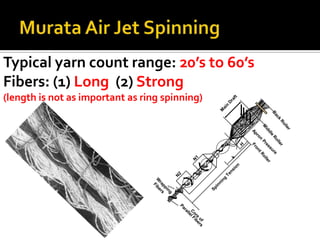
Typical yarn count range: 20’s to 60’sFibers: (1) Long  (2) Strong (length is not as important as ring spinning)Main DraftBack RollerbMiddle RollerApron PressureHFront RollerkN1N2Spinning TensionWrapping FibersParallel FibersCore of Murata Air Jet Spinning
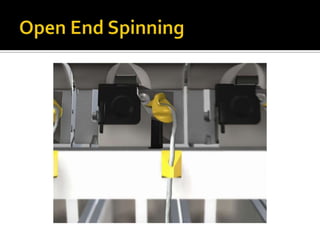
Open End Spinning
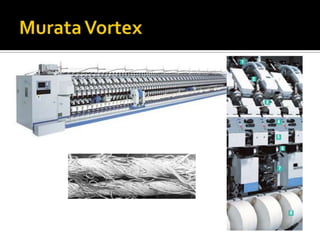
Murata Vortex
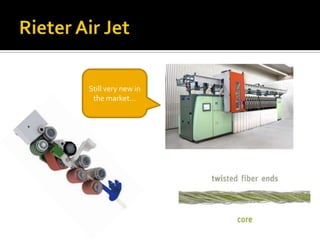
Rieter Air JetStill very new in the market…
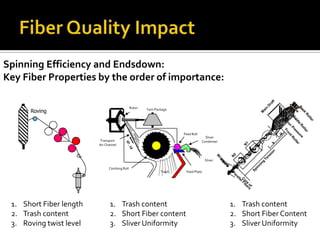
RovingSpinning Efficiency and Endsdown:Key Fiber Properties by the order of importance:Main DraftRotorYarn PackageBack RollerbMiddle RollerApron PressureHFront RollerFeed RollkN1SliverCondenserTransport Air ChannelVdfN2Spinning Tension, MfFibersWrapping SliverShort Fiber lengthTrash content Roving twist levelTrash contentShort Fiber content Sliver UniformityTrash contentShort Fiber ContentSliver UniformityCombing RollParallel FibersCore of Feed PlateTrashFiber Quality Impact
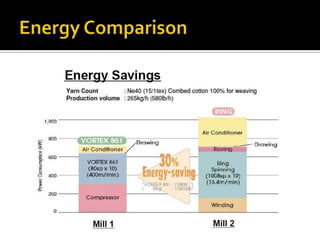
Energy Comparison
Different Yarn Counts = Different Quality LevelsDo all yarns within the same spinning system require the same type and quality of fibers?
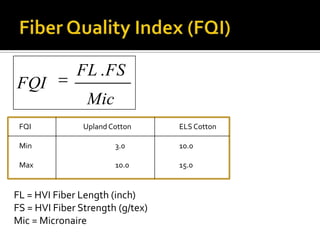
FQI		Upland Cotton		ELS Cotton	Min			3.0		10.0Max			10.0		15.0FL = HVI Fiber Length (inch)FS = HVI Fiber Strength (g/tex)Mic = MicronaireFiber Quality Index (FQI)
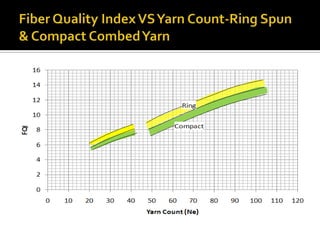
Different Yarn Counts Require Different Fiber Indexes

Spinning Systems

  • 1.
  • 2.
    What is spinning? The act or processing of converting staple or short lengths of fiber into continuous yarns.Dictionary.com
  • 3.
    Most common typesof spinning for apparel fabricsRing Spinning
  • 4.
  • 5.
  • 6.
    Air jetProcessing TableConventional Fiber CP SynCarding x xDrawing x x*Lap wind x Combing x Drawing x xRoving x xSpinning x xWinding x xProcess 8 6Modern Fiber CP SynCarding x xDrawing x x*Lap wind xCombing xDrawing x xSpinning x xProcess 6 4
  • 7.
    RovingYarn count ranges:6’s to 250’sFibers: (1) Long (2) Fine (3) StrongRing Spinning
  • 8.
    Yarn count range:6’s to 250+Fibers: (1) Long (2) Fine (3) StrongRovingairPerforated DrumCompact Spinning
  • 9.
  • 10.
  • 11.
    Why Royal Spun?Verygood pilling values and durability (Pilling (Martindale) improved by 1.0 to 1.5 grades)
  • 12.
    Less surface hairiness,clear mesh structure
  • 13.
  • 14.
    Less fiber accumulationsknitted into the fabric
  • 15.
  • 16.
  • 17.
  • 18.
  • 19.
    More economical thanplied yarnsModern systems are typical “Sliver to Yarn” systemLess Processing !!!Refer to Slide 4
  • 20.
    Open End -Schlafhorst
  • 21.
  • 22.
    Typical yarn countrange: 6’s to 30’sFibers: (1) Fine (2) Strong (length is not as important as ring spinning)RotorYarn PackageFeed RollSliverCondenserTransport Air ChannelVdf, MfSliverCombing RollFeed PlateTrashOpen End Rotor Spinning
  • 23.
    Typical yarn countrange: 20’s to 60’sFibers: (1) Long (2) Strong (length is not as important as ring spinning)Main DraftBack RollerbMiddle RollerApron PressureHFront RollerkN1N2Spinning TensionWrapping FibersParallel FibersCore of Murata Air Jet Spinning
  • 24.
  • 25.
  • 26.
    Rieter Air JetStillvery new in the market…
  • 27.
    RovingSpinning Efficiency andEndsdown:Key Fiber Properties by the order of importance:Main DraftRotorYarn PackageBack RollerbMiddle RollerApron PressureHFront RollerFeed RollkN1SliverCondenserTransport Air ChannelVdfN2Spinning Tension, MfFibersWrapping SliverShort Fiber lengthTrash content Roving twist levelTrash contentShort Fiber content Sliver UniformityTrash contentShort Fiber ContentSliver UniformityCombing RollParallel FibersCore of Feed PlateTrashFiber Quality Impact
  • 28.
  • 29.
    Different Yarn Counts= Different Quality LevelsDo all yarns within the same spinning system require the same type and quality of fibers?
  • 30.
    FQI Upland Cotton ELS Cotton Min 3.0 10.0Max 10.0 15.0FL= HVI Fiber Length (inch)FS = HVI Fiber Strength (g/tex)Mic = MicronaireFiber Quality Index (FQI)
  • 31.
    Different Yarn CountsRequire Different Fiber Indexes
  • 32.
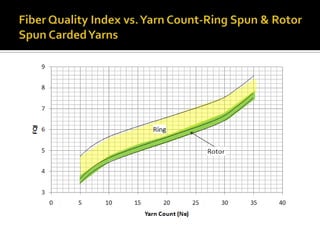
    Fiber Quality Indexvs. Yarn Count-Ring Spun & Rotor Spun Carded Yarns
  • 33.
    Fiber Quality IndexVS Yarn Count-Ring Spun & Compact Combed Yarn
  • 34.
    Different Cotton canResultin substantial difference in Quality and CostIs Cotton just Cotton or a Different Cotton can Make a World of Difference?
  • 35.
  • 36.
    What questions shouldI ask?There are literally hundreds of variables in the spinning process which influence the outcome of fabric and garments.
  • 37.
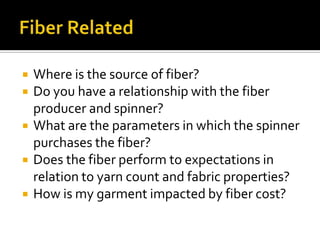
    Fiber RelatedWhere isthe source of fiber?Do you have a relationship with the fiber producer and spinner?What are the parameters in which the spinner purchases the fiber?Does the fiber perform to expectations in relation to yarn count and fabric properties?How is my garment impacted by fiber cost?
  • 38.
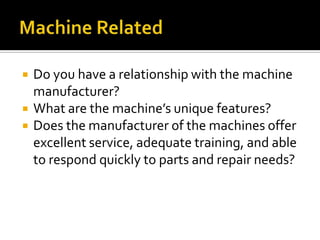
    Machine RelatedDo youhave a relationship with the machine manufacturer?What are the machine’s unique features?Does the manufacturer of the machines offer excellent service, adequate training, and able to respond quickly to parts and repair needs?
  • 39.
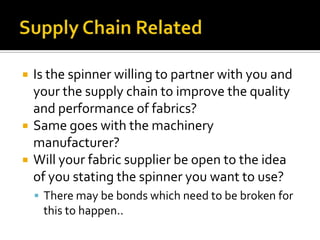
    Supply Chain RelatedIsthe spinner willing to partner with you and your the supply chain to improve the quality and performance of fabrics?Same goes with the machinery manufacturer?Will your fabric supplier be open to the idea of you stating the spinner you want to use?There may be bonds which need to be broken for this to happen..
  • 40.
    CreditsDr. Yehia El-Mogahzy,AuburnUniversityyehiae@eng.auburn.eduRob Beal, Oerlikonrob.beals@oerlikon.comMark Lingerfelt, Muratecmlingerfelt@muratec-usa.comHans Rothen, RieterHans.rothen@rieter.com

Editor's Notes

  • #2 1:00 PM Innovations in Knitwear: Yarn Spinning David Sasso, Vice President of Sales, Buhler Yarns – Jefferson, GA, USA Learn the differences between open-end, ring-spun, compact, and air-jet spinning from a knitting industry veteran of 25 years. How do these spinning techniques impact price, torquing, pilling,and strength? What are some new technologies in the yarn market? Learn to ask the right questions of your suppliers to get the knit fabric to meet your expectations.
  • #3 The act or process of converting staple or short lengths of fiber into continuous yarn.”
  • #5 * - Some manufacturers do 2 or 3 process drawing to achieve maximum blending, fiber parallel, and silver mass uniformity (CVm). Also, many companies have equipment to do a intimate blend. By this, the fibers are blended prior to carding.
  • #7 Compact spinning requires more maintenance and energythan conventional ring spun mainly because the fibers are compacted by using suction through the perforated drum. If the holes get clogged, then the yarn is not compacted. This would show up as a form of barre in the fabric. There are detection devices called clearers which can look for an increase of yarn hairiness and/or yarn diameter.
  • #9 There is another type spinning technology in the ring spun category which is called Siro. Explain the advantages of a siro.
  • #31 So many companiesstop short of