By
Himanshu Gupta
Introduction
 Categorized under mechanical bonding
technique.
 Stitch bonding is a hybrid technology, which
uses elements of various technologies from non
woven to sewing & knitting.
 It can be done with or without addition of a
thread, when no thread is used it is often termed
as “Loop formation”.
Principal
 Locking of layers of Cross laid webs of fibres,
non woven or other flat sheet into the warp knit
structure, thus combining knit fabric properties
with base structure with selected mechanical &
functional features for its end use.
 Stitch bonding consist of pointed needles
arranged in a row, moving reciprocal back &
fourth into the fibrous layers synchronized
insertion of stitching yarn by each penetration
of needle. Latches pulls the yarn from one side
to the other side.
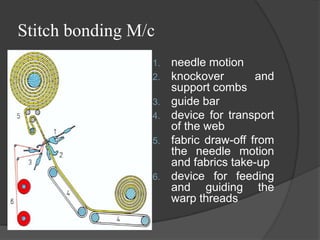
Stitch bonding M/c
1. needle motion
2. knockover and
support combs
3. guide bar
4. device for transport
of the web
5. fabric draw-off from
the needle motion
and fabrics take-up
6. device for feeding
and guiding the
warp threads
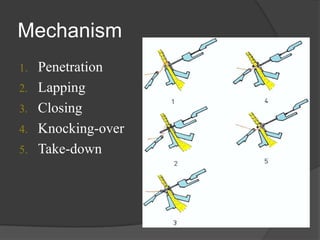
Mechanism
1. Penetration
2. Lapping
3. Closing
4. Knocking-over
5. Take-down
Stitch bonding systems or
technique
 Stitch bonding of webs with stitching
thread.
( MALIWATT TECHNIQUE)
 Stitch bonding of webs without stitching
thread.
(MALIVILIES TECHNIQUE)
 Stitch bonding of webs with loop formation
(MALIPOL,VOLTEX, KUNIT
MULTIKNIT TECHNIQUE).
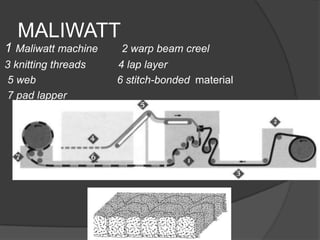
MALIWATT
1 Maliwatt machine 2 warp beam creel
3 knitting threads 4 lap layer
5 web 6 stitch-bonded material
7 pad lapper
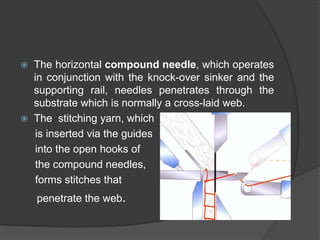
 The horizontal compound needle, which operates
in conjunction with the knock-over sinker and the
supporting rail, needles penetrates through the
substrate which is normally a cross-laid web.
 The stitching yarn, which
is inserted via the guides
into the open hooks of
the compound needles,
forms stitches that
penetrate the web.
Maliwatt application
 Soft furnishings, upholstery fabrics for mattresses and
blankets.
 Transportation cloth.
 Cleaning cloths, fabrics for hygiene and sanitary
purposes.
 Secondary carpet backing.
 Lining fabrics, interlining for shoes and apparel.
 Adhesive tapes (e.g., those used for harnessing electric
cables in automobiles)
 Insulating materials.
 Geo textiles, filter fabrics.
Properties
Malivlies
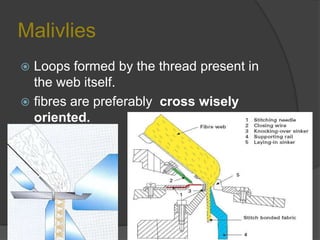
 Loops formed by the thread present in
the web itself.
 fibres are preferably cross wisely
oriented.
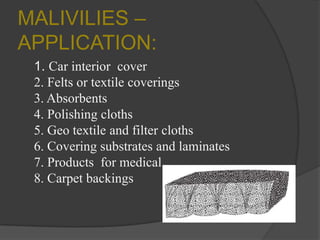
MALIVILIES –
APPLICATION:
1. Car interior cover
2. Felts or textile coverings
3. Absorbents
4. Polishing cloths
5. Geo textile and filter cloths
6. Covering substrates and laminates
7. Products for medical
8. Carpet backings
Properties
MALIPOL
 Malipol stitch bonding systems have the
following main elements.
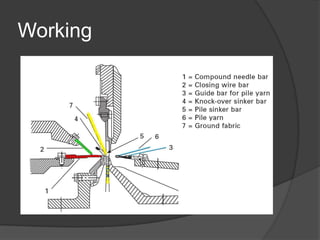
 pile yarn
 ground fabric
 stitch bonding head
 fabric take-down and batching
 The compound needles penetrate the ground
fabric and the stitching or pile yarn is
overlapped in the needle hook.
 The pile yarn is also laid on top of the pile
sinker at the same time so that a tricot racking is
used to create the pile and knit the yarn into the
ground structure.
Working
Malipol - areas of
application
 blankets
 cleaning textiles (wiping mop)
 pile fabric for velcro fastening stripes
 lining plush and soft-toy plush
 bathroom sets
 one-sided terry fabric
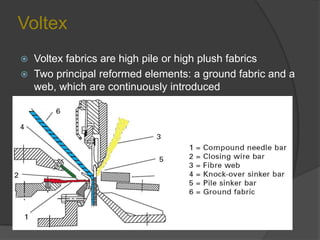
Voltex
 Voltex fabrics are high pile or high plush fabrics
 Two principal reformed elements: a ground fabric and a
web, which are continuously introduced
Application
 lining fabrics
 soft-toy plush
 shoe uppers and shoe lining
 floor coverings
 upholstery fabrics.
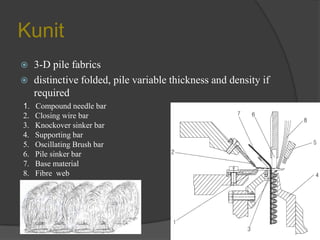
Kunit
 3-D pile fabrics
 distinctive folded, pile variable thickness and density if
required
1. Compound needle bar
2. Closing wire bar
3. Knockover sinker bar
4. Supporting bar
5. Oscillating Brush bar
6. Pile sinker bar
7. Base material
8. Fibre web
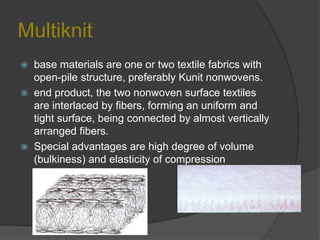
Multiknit
 base materials are one or two textile fabrics with
open-pile structure, preferably Kunit nonwovens.
 end product, the two nonwoven surface textiles
are interlaced by fibers, forming an uniform and
tight surface, being connected by almost vertically
arranged fibers.
 Special advantages are high degree of volume
(bulkiness) and elasticity of compression
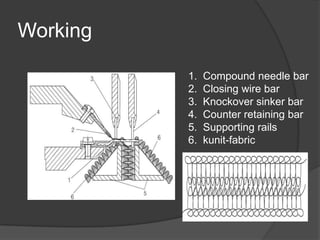
Working
1. Compound needle bar
2. Closing wire bar
3. Knockover sinker bar
4. Counter retaining bar
5. Supporting rails
6. kunit-fabric
 The compound needles take the pile fibres of both
fabrics to make them, in the middle between the
two fabrics, into a third layer of loops.
 Application
 1. WADDING FOR FURNITURE
2. FILTER CLOTH
3. INSULATION MATERIALS
4. LININGS FOR CLOTHING
5. HEAT- RETARDANT MATERIALS
6. SOUND- ABSORBING MATERIALS
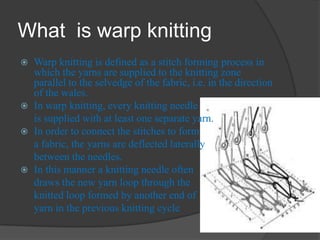
What is warp knitting
 Warp knitting is defined as a stitch forming process in
which the yarns are supplied to the knitting zone
parallel to the selvedge of the fabric, i.e. in the direction
of the wales.
 In warp knitting, every knitting needle
is supplied with at least one separate yarn.
 In order to connect the stitches to form
a fabric, the yarns are deflected laterally
between the needles.
 In this manner a knitting needle often
draws the new yarn loop through the
knitted loop formed by another end of
yarn in the previous knitting cycle
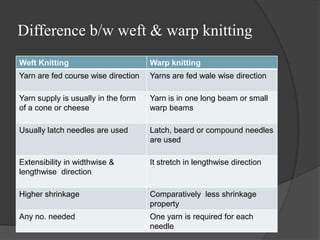
Difference b/w weft & warp knitting
Weft Knitting Warp knitting
Yarn are fed course wise direction Yarns are fed wale wise direction
Yarn supply is usually in the form
of a cone or cheese
Yarn is in one long beam or small
warp beams
Usually latch needles are used Latch, beard or compound needles
are used
Extensibility in widthwise &
lengthwise direction
It stretch in lengthwise direction
Higher shrinkage Comparatively less shrinkage
property
Any no. needed One yarn is required for each
needle
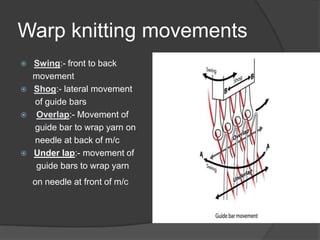
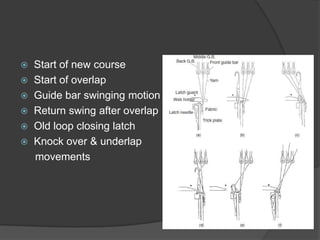
Warp knitting movements
 Swing:- front to back
movement
 Shog:- lateral movement
of guide bars
 Overlap:- Movement of
guide bar to wrap yarn on
needle at back of m/c
 Under lap:- movement of
guide bars to wrap yarn
on needle at front of m/c
 Start of new course
 Start of overlap
 Guide bar swinging motion
 Return swing after overlap
 Old loop closing latch
 Knock over & underlap
movements
Applications
 Apparel :- Sportswear, track suits, leisure wear &
safety reflective vests.
 Household :- Furnishing, laundry bags, mosquito
nets.
 Automotive :- Car cushion head rest lining, sun
shades and motorbikes helmets.
 Industrial :- Pvc backing, production masks, caps
& gloves.
Thank you

Web stitching & stitch bonding warp knitt

  • 1.
  • 2.
    Introduction  Categorized undermechanical bonding technique.  Stitch bonding is a hybrid technology, which uses elements of various technologies from non woven to sewing & knitting.  It can be done with or without addition of a thread, when no thread is used it is often termed as “Loop formation”.
  • 3.
    Principal  Locking oflayers of Cross laid webs of fibres, non woven or other flat sheet into the warp knit structure, thus combining knit fabric properties with base structure with selected mechanical & functional features for its end use.  Stitch bonding consist of pointed needles arranged in a row, moving reciprocal back & fourth into the fibrous layers synchronized insertion of stitching yarn by each penetration of needle. Latches pulls the yarn from one side to the other side.
  • 4.
    Stitch bonding M/c 1.needle motion 2. knockover and support combs 3. guide bar 4. device for transport of the web 5. fabric draw-off from the needle motion and fabrics take-up 6. device for feeding and guiding the warp threads
  • 5.
    Mechanism 1. Penetration 2. Lapping 3.Closing 4. Knocking-over 5. Take-down
  • 6.
    Stitch bonding systemsor technique  Stitch bonding of webs with stitching thread. ( MALIWATT TECHNIQUE)  Stitch bonding of webs without stitching thread. (MALIVILIES TECHNIQUE)  Stitch bonding of webs with loop formation (MALIPOL,VOLTEX, KUNIT MULTIKNIT TECHNIQUE).
  • 7.
    MALIWATT 1 Maliwatt machine2 warp beam creel 3 knitting threads 4 lap layer 5 web 6 stitch-bonded material 7 pad lapper
  • 8.
     The horizontalcompound needle, which operates in conjunction with the knock-over sinker and the supporting rail, needles penetrates through the substrate which is normally a cross-laid web.  The stitching yarn, which is inserted via the guides into the open hooks of the compound needles, forms stitches that penetrate the web.
  • 9.
    Maliwatt application  Softfurnishings, upholstery fabrics for mattresses and blankets.  Transportation cloth.  Cleaning cloths, fabrics for hygiene and sanitary purposes.  Secondary carpet backing.  Lining fabrics, interlining for shoes and apparel.  Adhesive tapes (e.g., those used for harnessing electric cables in automobiles)  Insulating materials.  Geo textiles, filter fabrics.
  • 10.
  • 11.
    Malivlies  Loops formedby the thread present in the web itself.  fibres are preferably cross wisely oriented.
  • 12.
    MALIVILIES – APPLICATION: 1. Carinterior cover 2. Felts or textile coverings 3. Absorbents 4. Polishing cloths 5. Geo textile and filter cloths 6. Covering substrates and laminates 7. Products for medical 8. Carpet backings
  • 13.
  • 14.
    MALIPOL  Malipol stitchbonding systems have the following main elements.  pile yarn  ground fabric  stitch bonding head  fabric take-down and batching  The compound needles penetrate the ground fabric and the stitching or pile yarn is overlapped in the needle hook.  The pile yarn is also laid on top of the pile sinker at the same time so that a tricot racking is used to create the pile and knit the yarn into the ground structure.
  • 15.
  • 16.
    Malipol - areasof application  blankets  cleaning textiles (wiping mop)  pile fabric for velcro fastening stripes  lining plush and soft-toy plush  bathroom sets  one-sided terry fabric
  • 17.
    Voltex  Voltex fabricsare high pile or high plush fabrics  Two principal reformed elements: a ground fabric and a web, which are continuously introduced
  • 18.
    Application  lining fabrics soft-toy plush  shoe uppers and shoe lining  floor coverings  upholstery fabrics.
  • 19.
    Kunit  3-D pilefabrics  distinctive folded, pile variable thickness and density if required 1. Compound needle bar 2. Closing wire bar 3. Knockover sinker bar 4. Supporting bar 5. Oscillating Brush bar 6. Pile sinker bar 7. Base material 8. Fibre web
  • 20.
    Multiknit  base materialsare one or two textile fabrics with open-pile structure, preferably Kunit nonwovens.  end product, the two nonwoven surface textiles are interlaced by fibers, forming an uniform and tight surface, being connected by almost vertically arranged fibers.  Special advantages are high degree of volume (bulkiness) and elasticity of compression
  • 21.
    Working 1. Compound needlebar 2. Closing wire bar 3. Knockover sinker bar 4. Counter retaining bar 5. Supporting rails 6. kunit-fabric
  • 22.
     The compoundneedles take the pile fibres of both fabrics to make them, in the middle between the two fabrics, into a third layer of loops.  Application  1. WADDING FOR FURNITURE 2. FILTER CLOTH 3. INSULATION MATERIALS 4. LININGS FOR CLOTHING 5. HEAT- RETARDANT MATERIALS 6. SOUND- ABSORBING MATERIALS
  • 24.
    What is warpknitting  Warp knitting is defined as a stitch forming process in which the yarns are supplied to the knitting zone parallel to the selvedge of the fabric, i.e. in the direction of the wales.  In warp knitting, every knitting needle is supplied with at least one separate yarn.  In order to connect the stitches to form a fabric, the yarns are deflected laterally between the needles.  In this manner a knitting needle often draws the new yarn loop through the knitted loop formed by another end of yarn in the previous knitting cycle
  • 25.
    Difference b/w weft& warp knitting Weft Knitting Warp knitting Yarn are fed course wise direction Yarns are fed wale wise direction Yarn supply is usually in the form of a cone or cheese Yarn is in one long beam or small warp beams Usually latch needles are used Latch, beard or compound needles are used Extensibility in widthwise & lengthwise direction It stretch in lengthwise direction Higher shrinkage Comparatively less shrinkage property Any no. needed One yarn is required for each needle
  • 26.
    Warp knitting movements Swing:- front to back movement  Shog:- lateral movement of guide bars  Overlap:- Movement of guide bar to wrap yarn on needle at back of m/c  Under lap:- movement of guide bars to wrap yarn on needle at front of m/c
  • 27.
     Start ofnew course  Start of overlap  Guide bar swinging motion  Return swing after overlap  Old loop closing latch  Knock over & underlap movements
  • 28.
    Applications  Apparel :-Sportswear, track suits, leisure wear & safety reflective vests.  Household :- Furnishing, laundry bags, mosquito nets.  Automotive :- Car cushion head rest lining, sun shades and motorbikes helmets.  Industrial :- Pvc backing, production masks, caps & gloves.
  • 29.