Presented by: Rajeev Kumar (21) Sanath kr. Pegu (24) Sushant kumar (25)
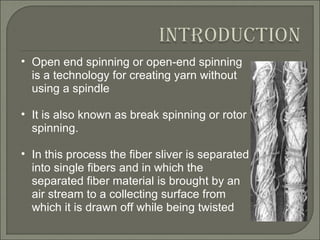
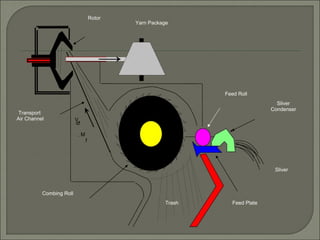
Open end spinning or open-end spinning is a technology for creating yarn without using a spindle It is also known as break spinning or rotor spinning. In this process the fiber sliver is separated into single fibers and in which the separated fiber material is brought by an air stream to a collecting surface from which it is drawn off while being twisted
The principle behind open end spinning is similar to that of a clothes dryer spinning full of sheets.  If you could open the door and pull out a sheet, it would spin together as you pulled it out Sliver from the card goes into the rotor, is spun into yarn and comes out, wrapped up on a bobbin, all ready to go to the next step
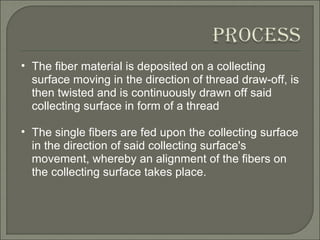
The fiber material is deposited on a collecting surface moving in the direction of thread draw-off, is then twisted and is continuously drawn off said collecting surface in form of a thread The single fibers are fed upon the collecting surface in the direction of said collecting surface's movement, whereby an alignment of the fibers on the collecting surface takes place.
V df , M f Transport  Air Channel Rotor Yarn Package Feed Roll Sliver Condenser Sliver Feed Plate Trash Combing Roll
In conventional spinning ,the fiber supply is reduced to the required mass per unit length by drafting & then consolidated into a yarn by the application of twist. There is no opportunity for the internal stresses created in the fibers during drafting to relax In open end spinning, the fiber supply is reduced, as far as possible , to individual fibers, which are then carried forward on an air-stream as free fibers.
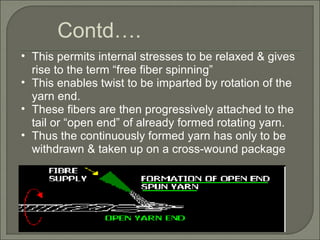
This permits internal stresses to be relaxed & gives rise to the term “free fiber spinning” This enables twist to be imparted by rotation of the yarn end. These fibers are then progressively attached to the tail or “open end” of already formed rotating yarn. Thus the continuously formed yarn has only to be withdrawn & taken up on a cross-wound package Contd….
There is no roving stage or re-packaging on an auto-coner.  This system is much less labour intensive and faster than ring spinning with rotor speeds up to 140,000rpm.  Typical yarn count range: 6’s to 30’s Fibers: (1) Fine (2) Strong
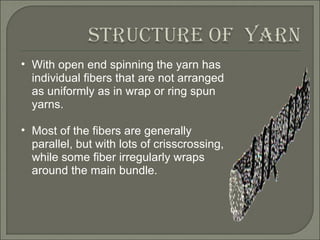
With open end spinning the yarn has individual fibers that are not arranged as uniformly as in wrap or ring spun yarns.  Most of the fibers are generally parallel, but with lots of crisscrossing, while some fiber irregularly wraps around the main bundle.
The disadvantage of open-end spinning is that it is limited to coarse counts. Consequently cloth made from open-end yarn having a 'fuzzier' feel and poorer wear resistance.
 

Open end spinning

  • 1.
    Presented by: RajeevKumar (21) Sanath kr. Pegu (24) Sushant kumar (25)
  • 2.
    Open end spinningor open-end spinning is a technology for creating yarn without using a spindle It is also known as break spinning or rotor spinning. In this process the fiber sliver is separated into single fibers and in which the separated fiber material is brought by an air stream to a collecting surface from which it is drawn off while being twisted
  • 3.
    The principle behindopen end spinning is similar to that of a clothes dryer spinning full of sheets. If you could open the door and pull out a sheet, it would spin together as you pulled it out Sliver from the card goes into the rotor, is spun into yarn and comes out, wrapped up on a bobbin, all ready to go to the next step
  • 4.
    The fiber materialis deposited on a collecting surface moving in the direction of thread draw-off, is then twisted and is continuously drawn off said collecting surface in form of a thread The single fibers are fed upon the collecting surface in the direction of said collecting surface's movement, whereby an alignment of the fibers on the collecting surface takes place.
  • 5.
    V df ,M f Transport Air Channel Rotor Yarn Package Feed Roll Sliver Condenser Sliver Feed Plate Trash Combing Roll
  • 6.
    In conventional spinning,the fiber supply is reduced to the required mass per unit length by drafting & then consolidated into a yarn by the application of twist. There is no opportunity for the internal stresses created in the fibers during drafting to relax In open end spinning, the fiber supply is reduced, as far as possible , to individual fibers, which are then carried forward on an air-stream as free fibers.
  • 7.
    This permits internalstresses to be relaxed & gives rise to the term “free fiber spinning” This enables twist to be imparted by rotation of the yarn end. These fibers are then progressively attached to the tail or “open end” of already formed rotating yarn. Thus the continuously formed yarn has only to be withdrawn & taken up on a cross-wound package Contd….
  • 8.
    There is noroving stage or re-packaging on an auto-coner. This system is much less labour intensive and faster than ring spinning with rotor speeds up to 140,000rpm. Typical yarn count range: 6’s to 30’s Fibers: (1) Fine (2) Strong
  • 9.
    With open endspinning the yarn has individual fibers that are not arranged as uniformly as in wrap or ring spun yarns. Most of the fibers are generally parallel, but with lots of crisscrossing, while some fiber irregularly wraps around the main bundle.
  • 10.
    The disadvantage ofopen-end spinning is that it is limited to coarse counts. Consequently cloth made from open-end yarn having a 'fuzzier' feel and poorer wear resistance.
  • 11.