Shyamoli Textile Engineering College
Tanvir Mahtab
Id:Te-80/18
Welcome to my presentation
RotorSpinning
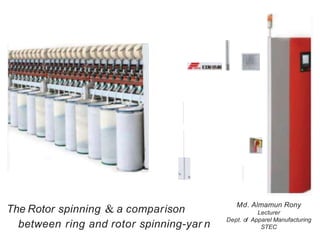
The Rotor spinning & a comparison
between ring and rotor spinning-yar n
Md. Almamun Rony
Lecturer
Dept. of Apparel Manufacturing
STEC
Rotor spinning
Rotor Spinning is a more recent method of ya rn formation compa red to
Ring Spinning. The first functioning of rotor spinning, machine was
presented at the ITMA in 1967. Yarn spinning according to the rotor
spinning principle predominates for a ll non conventiona l spinning
methods. It omits the step of forming a roving. After drafting, the sliver
is fed into a rotary beater. This device ensures that the fibers are beaten
into a thin supply which enters a duct and gets deposited on the sides of
the disc{ rotor}.The tra nsportation of the fibers is achieved through air
currents.
This is a form of open-end spinning where twist is introduced into the
ya rn without the need for package rotation Allowing for higher twisting
speeds with a relatively low power cost. In rotor spinning a continuous
supply of fibres is delivered from delivery rollers off a drafting system or
from an opening unit.
Character istics
• Higher Productivity
• Large Sliver Can
• Large Final Package
• Less Power Consumption
• Automation
• Flexibility of spinning component
• Handling count range
Important parts of a rotor spinning machine
Feed roller
Feed trough
Opening roller
Naval
Feed tube
Rotor
Rotor groove
Withdrawa l
roller
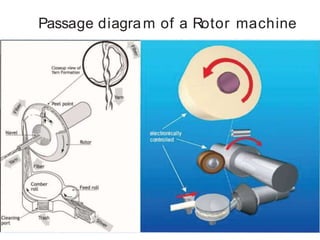
Passage diagram of a Rotor machine
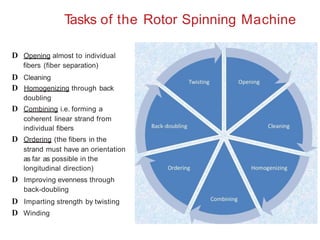
Tasks of the Rotor Spinning Machine
D Opening almost to individual
fibers (fiber separation)
D Cleaning
D Homogenizing through back
doubling
D Combining i.e. forming a
coherent linear strand from
individual fibers
D Ordering (the fibers in the
strand must have an orientation
as far as possible in the
longitudinal direction)
D Improving evenness through
back-doubling
D Imparting strength by twisting
D Winding
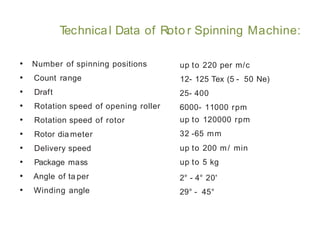
Technical Data of Roto r Spinning Machine:
• Number of spinning positions
• Count range
• Draft
• Rotation speed of opening roller
• Rotation speed of rotor
• Rotor dia meter
• Delivery speed
• Package mass
• Angle of ta per
• Winding angle
up to 220 per m/c
12- 125 Tex (5 - 50 Ne)
25- 400
6000- 11000 rpm
up to 120000 rpm
32 -65 mm
up to 200 m/ min
up to 5 kg
2° - 4° 20'
29° - 45°
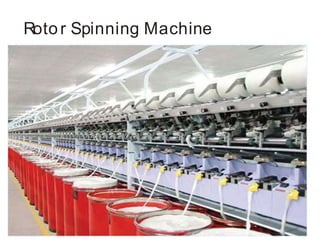
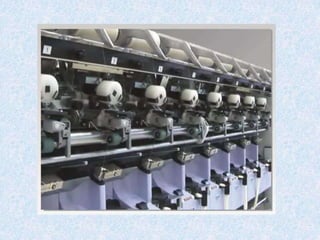
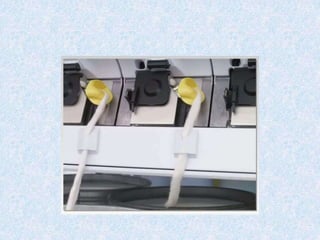
Rotor Spinning Machine
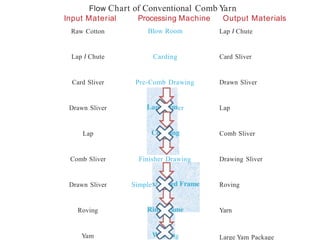
Flow Chart of Conventional Comb Yarn
Input Material
Raw Cotton
Card Sliver
Processing Machine
Blow Room
Output Materials
Lap I Chute
Carding Card Sliver
Pre-Comb Drawing Drawn Sliver
Lap I Chute
Lap
er LapDrawn Sliver
Comb Sliver
Comb Sliver Finisher Drawing Drawing Sliver
Drawn Sliver Simple Roving
Roving Yarn
Yam g Large Yam Package
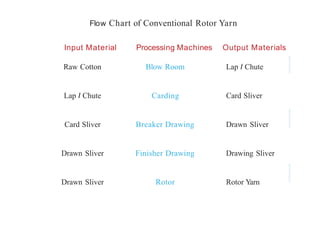
Flow Chart of Conventional Rotor Yarn
Input Material Processing Machines Output Materials
Raw Cotton Blow Room Lap I Chute
Lap I Chute Carding Card Sliver
Card Sliver Breaker Drawing Drawn Sliver
Drawn Sliver Finisher Drawing Drawing Sliver
Drawn Sliver Rotor Rotor Yarn
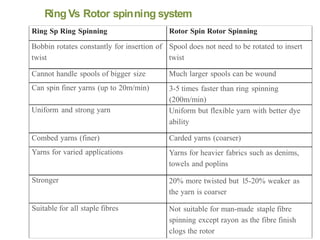
Ring Vs Rotor spinning system
Ring Sp Ring Spinning Rotor Spin Rotor Spinning
Bobbin rotates constantly for insertion of
twist
Spool does not need to be rotated to insert
twist
Cannot handle spools of bigger size Much larger spools can be wound
Can spin finer yarns (up to 20m/min) 3-5 times faster than ring spinning
(200m/min)
Uniform and strong yarn Uniform but flexible yarn with better dye
ability
Combed yarns (finer) Carded yarns (coarser)
Yarns for varied applications Yarns for heavier fabrics such as denims,
towels and poplins
Stronger 20% more twisted but 15-20% weaker as
the yarn is coarser
Suitable for all staple fibres Not suitable for man-made staple fibre
spinning except rayon as the fibre finish
clogs the rotor
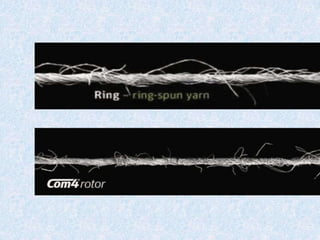
Rotor spun yarn Vs Ring spun yarn
Advantages over ring spun yarn
• Better CV% of strength
• Higher elongation at break
• Better mass irregularity ( over short lengths)
• Lower imperfection index
• Greater volume
• Higher abrasion resistance
• Higher stiffness
• Harder Handle
• Less power consumption
• Lower energy consumption with productivity
Disadvantages over ring spun yarn
• Breaking strength lower than ring spun Yarn
• Less yarn count range
• Possible yarn counts rotor Ne 3 - 60 and Ring Ne 6 - 200
Comparison between Ring and Rotor yarn [20 Ne]
Note: This experimenta l data is an average test result out of 8-10 tests. The tests were
done at The Delta Spinning mills Ltd.
Parameters Ring yarn {Card) Rotor yarn
Tenacity (cN/Tex) 17.5 15.1
CSP 2550 1830
Elongation % 3.75 4.35
TPI 14.23 18.31
Uster U% 9.774 9.41
CVm% [ cm] 12.412 11.872
CVm% [3m] 2.882 2.91
Thin [-40%]/Km 20.687 36.56
Thick [+35%] 446.25 178.75
Thick [+50%] 48.125 5
Neps [+200%] 60.3125 26.25
Hairiness Index [H] 7.21 4.65
Garments
Rotor spinning

Rotor spinning

  • 1.
    Shyamoli Textile EngineeringCollege Tanvir Mahtab Id:Te-80/18
  • 2.
    Welcome to mypresentation RotorSpinning
  • 3.
    The Rotor spinning& a comparison between ring and rotor spinning-yar n Md. Almamun Rony Lecturer Dept. of Apparel Manufacturing STEC
  • 4.
    Rotor spinning Rotor Spinningis a more recent method of ya rn formation compa red to Ring Spinning. The first functioning of rotor spinning, machine was presented at the ITMA in 1967. Yarn spinning according to the rotor spinning principle predominates for a ll non conventiona l spinning methods. It omits the step of forming a roving. After drafting, the sliver is fed into a rotary beater. This device ensures that the fibers are beaten into a thin supply which enters a duct and gets deposited on the sides of the disc{ rotor}.The tra nsportation of the fibers is achieved through air currents. This is a form of open-end spinning where twist is introduced into the ya rn without the need for package rotation Allowing for higher twisting speeds with a relatively low power cost. In rotor spinning a continuous supply of fibres is delivered from delivery rollers off a drafting system or from an opening unit.
  • 5.
    Character istics • HigherProductivity • Large Sliver Can • Large Final Package • Less Power Consumption • Automation • Flexibility of spinning component • Handling count range
  • 6.
    Important parts ofa rotor spinning machine Feed roller Feed trough Opening roller Naval Feed tube Rotor Rotor groove Withdrawa l roller
  • 7.
    Passage diagram ofa Rotor machine
  • 8.
    Tasks of theRotor Spinning Machine D Opening almost to individual fibers (fiber separation) D Cleaning D Homogenizing through back doubling D Combining i.e. forming a coherent linear strand from individual fibers D Ordering (the fibers in the strand must have an orientation as far as possible in the longitudinal direction) D Improving evenness through back-doubling D Imparting strength by twisting D Winding
  • 9.
    Technical Data ofRoto r Spinning Machine: • Number of spinning positions • Count range • Draft • Rotation speed of opening roller • Rotation speed of rotor • Rotor dia meter • Delivery speed • Package mass • Angle of ta per • Winding angle up to 220 per m/c 12- 125 Tex (5 - 50 Ne) 25- 400 6000- 11000 rpm up to 120000 rpm 32 -65 mm up to 200 m/ min up to 5 kg 2° - 4° 20' 29° - 45°
  • 10.
  • 13.
    Flow Chart ofConventional Comb Yarn Input Material Raw Cotton Card Sliver Processing Machine Blow Room Output Materials Lap I Chute Carding Card Sliver Pre-Comb Drawing Drawn Sliver Lap I Chute Lap er LapDrawn Sliver Comb Sliver Comb Sliver Finisher Drawing Drawing Sliver Drawn Sliver Simple Roving Roving Yarn Yam g Large Yam Package
  • 14.
    Flow Chart ofConventional Rotor Yarn Input Material Processing Machines Output Materials Raw Cotton Blow Room Lap I Chute Lap I Chute Carding Card Sliver Card Sliver Breaker Drawing Drawn Sliver Drawn Sliver Finisher Drawing Drawing Sliver Drawn Sliver Rotor Rotor Yarn
  • 15.
    Ring Vs Rotorspinning system Ring Sp Ring Spinning Rotor Spin Rotor Spinning Bobbin rotates constantly for insertion of twist Spool does not need to be rotated to insert twist Cannot handle spools of bigger size Much larger spools can be wound Can spin finer yarns (up to 20m/min) 3-5 times faster than ring spinning (200m/min) Uniform and strong yarn Uniform but flexible yarn with better dye ability Combed yarns (finer) Carded yarns (coarser) Yarns for varied applications Yarns for heavier fabrics such as denims, towels and poplins Stronger 20% more twisted but 15-20% weaker as the yarn is coarser Suitable for all staple fibres Not suitable for man-made staple fibre spinning except rayon as the fibre finish clogs the rotor
  • 16.
    Rotor spun yarnVs Ring spun yarn Advantages over ring spun yarn • Better CV% of strength • Higher elongation at break • Better mass irregularity ( over short lengths) • Lower imperfection index • Greater volume • Higher abrasion resistance • Higher stiffness • Harder Handle • Less power consumption • Lower energy consumption with productivity Disadvantages over ring spun yarn • Breaking strength lower than ring spun Yarn • Less yarn count range • Possible yarn counts rotor Ne 3 - 60 and Ring Ne 6 - 200
  • 17.
    Comparison between Ringand Rotor yarn [20 Ne] Note: This experimenta l data is an average test result out of 8-10 tests. The tests were done at The Delta Spinning mills Ltd. Parameters Ring yarn {Card) Rotor yarn Tenacity (cN/Tex) 17.5 15.1 CSP 2550 1830 Elongation % 3.75 4.35 TPI 14.23 18.31 Uster U% 9.774 9.41 CVm% [ cm] 12.412 11.872 CVm% [3m] 2.882 2.91 Thin [-40%]/Km 20.687 36.56 Thick [+35%] 446.25 178.75 Thick [+50%] 48.125 5 Neps [+200%] 60.3125 26.25 Hairiness Index [H] 7.21 4.65
  • 19.