Advanced Yarn Manufacturing Azmir Latif, MSc in textile Engineering
Introduction
Filament-core yarns are produced to take advantage of both filament and staple fibre
properties. They offer good strength and uniformity without sacrificing the staple fibre
yarn-like surface characteristics. Core-spun yarns containing spandex provide fabric
designers with broad possibilities, because such stretchable yarns can be constructed
with a wide range of properties using virtually any type of hard fibres as the cover
yarn. However, a disadvantage of the core yarns is that the staple fibre sheath may slip
along the filament when being pulled to pass over or when being rubbed by machine
parts during further mechanical processes. But it is very easy to produce core-spun
yarn containing spandex in a conventional ring frame after doing some modification of
the machine. By taking some measure it is possible to make good quality core-spun
yarn containing spandex. Core-spinning is a process by which fibres are twisted around an
existing yarn, either filament or staple spun yarn, to produce a sheath– core structure in which
the already formed yarn is the core.
Core-spun yarns are two-component structure with Core and sheath. Generally continuous
filament yarn is used as core and the staple fibres used as sheath covering. The core-spun yarn
used to enhance functional properties of the fabrics such as strength, durability and stretch
comfort.
Methods for production of Core spun yarns
The production of Core-spun yarns done successfully by many spinning systems. Each system
has its own features .The conventional ring spinning is simple and economy but the core
positioning in the centre is difficult and major strip back problem may arise during
subsequent process and the core filaments get twisted. In Dref III the core positioning can be
set accurately and used to produce the industrial and conductive yarns. Probable methods of
core-spun yarn production are discussed below.
1. Conventional core spinning attachment with ring spinning systems
2. S.R.R.C Core wrap spinning method
3. A.R.S. Patterned Spinning system
4. Core-twin spinning system
5. Composite electrostatic spinning system
6. Rotor spinning system
7. Friction spinning system and
8. Air jet spinning system
Properties of spandex:
Core-spun yarns containing Spandex provide fabric designers with broad possibilities, because
such stretchable yarns can be constructed with a wide range of properties using virtually any type
of "hard" fibres as the cover yarn. LYCRA is the registered trademark for DuPont's elastane yarn
of coalesced filament with high stretch and recovery power. Spandex yarn or lycra has variable
properties which ensure its high utility as the core in elastic core-spun yarn. These include:
Advanced Yarn Manufacturing Azmir Latif, MSc in textile Engineering
1. High modulus (power at stretch)
2. Fine and very fine yarn counts
3. Capacity to heat set
4. Clear, dull and bright lusters
5. Capacity to dye, if required
Basic requirements to produce core-spun yarn containing spandex:
1. Uniform, high quality roving.
2. Spinning draft below 30.
3. Accurately adjusted rings and travellers and plumbed (aligned) spindles.
4. Maintained spinning aprons, drafting rollers and cost strictly.
5. Replaced slipping or worn gears and sprockets.
6. Excellent cleaning devices to prevent fly deposits
Sufficient light to easily detect any breaks of the extremely fine spandex yarns.
Spandex is a continuous filament yarn. It must be handled carefully to prevent damage.
Spandex tubes should not be bumper, thrown or mishandled in any away. Care in unpacking is
required to avoid scuffing the shoulders.
Draft Control:
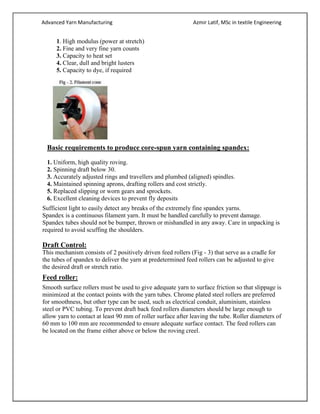
This mechanism consists of 2 positively driven feed rollers (Fig - 3) that serve as a cradle for
the tubes of spandex to deliver the yarn at predetermined feed rollers can be adjusted to give
the desired draft or stretch ratio.
Feed roller:
Smooth surface rollers must be used to give adequate yarn to surface friction so that slippage is
minimized at the contact points with the yarn tubes. Chrome plated steel rollers are preferred
for smoothness, but other type can be used, such as electrical conduit, aluminium, stainless
steel or PVC tubing. To prevent draft back feed rollers diameters should be large enough to
allow yarn to contact at least 90 mm of roller surface after leaving the tube. Roller diameters of
60 mm to 100 mm are recommended to ensure adequate surface contact. The feed rollers can
be located on the frame either above or below the roving creel.
Advanced Yarn Manufacturing Azmir Latif, MSc in textile Engineering
Package spacer:
Spacers must be used to prevent the yarn tubes from mowing horizontally along the feed roller.
Figure-6 shows a cotton spinning frame conversion into a corespinning system.
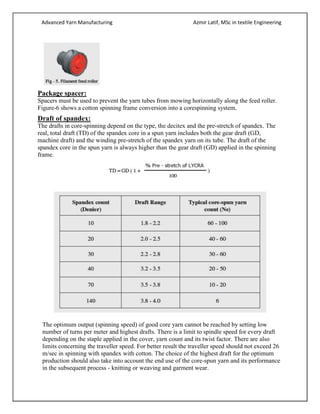
Draft of spandex:
The drafts in core-spinning depend on the type, the decitex and the pre-stretch of spandex. The
real, total draft (TD) of the spandex core in a spun yarn includes both the gear draft (GD,
machine draft) and the winding pre-stretch of the spandex yarn on its tube. The draft of the
spandex core in the spun yarn is always higher than the gear draft (GD) applied in the spinning
frame.
The optimum output (spinning speed) of good core yarn cannot be reached by setting low
number of turns per meter and highest drafts. There is a limit to spindle speed for every draft
depending on the staple applied in the cover, yarn count and its twist factor. There are also
limits concerning the traveller speed. For better result the traveller speed should not exceed 26
m/sec in spinning with spandex with cotton. The choice of the highest draft for the optimum
production should also take into account the end use of the core-spun yarn and its performance
in the subsequent process - knitting or weaving and garment wear.
Advanced Yarn Manufacturing Azmir Latif, MSc in textile Engineering
Spandex storage time:
The best performance of spandex in spinning is obtained with a relatively fresh yarn. Thus,
mill storage time of spandex tubes should not exceed:
# 4 month of age for 44 decitex
# 6 month of age for 78 to 156 decitex spandex yarn
For the optimum processing of spandex it is recommended the following point:
# avoid an excess of yarn stock
# place order for no more than 4 to 6 weeks production needs
# apply the "first in- first out" stock turnover
Conventional Core spinning attachment in Ring frame
A core spinning attachment in ring spinning is shown in Fig.1. The attachment consists of
metal plate (Bracket) bent to a shape. One end of the device is fitted on the roving traverse
guide bar such that the relative position of the roving and the core filament may be kept
constant all the time. There is a provision to vary the position of the device if required. The
other end of the plate is fitted with a porcelain guide that feed the core filament at a precise
position behind the front drafting rollers. This devise is fitted with a pre-tensioner and is kept
in a horizontal plane. Varying the number of tension discs may vary the input tension of the
core filament. The package containing core filament material is suspended from a bar such
that they could rotate easily, thus avoiding any tendency to stretch the filament before it is fed
to the tensioning device.
Advanced Yarn Manufacturing Azmir Latif, MSc in textile Engineering
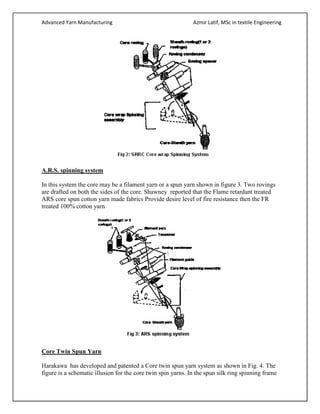
S.R.R.C. Core wrap spinning system
Southern Regional Research Center has developed a core spinning system [1] is shown in Fig.
2. In conventional core-spinning system yarns are merely a ply twisted and does not have
good core coverage, strip back problem may arise during subsequent mechanical processing.
The core wrap yarns produced by the SRRC core spinning system consists of a central core of
a particular filament or staple fiber and core material is almost coaxially and totally wrapped
with cotton on any other staple fiber. It is claimed that a high degree of coherence is obtained
between the constituent fibers. The core-wrap assembly is used as twist breaker, which helps
the sheath fibres to cover the filament.
Advanced Yarn Manufacturing Azmir Latif, MSc in textile Engineering
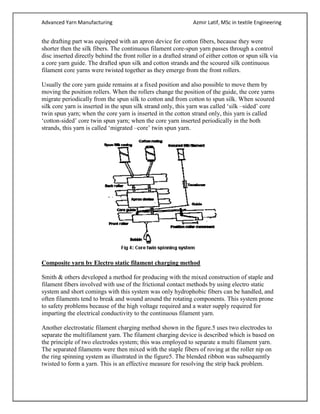
A.R.S. spinning system
In this system the core may be a filament yarn or a spun yarn shown in figure 3. Two rovings
are drafted on both the sides of the core. Shawney reported that the Flame retardant treated
ARS core spun cotton yarn made fabrics Provide desire level of fire resistance then the FR
treated 100% cotton yarn
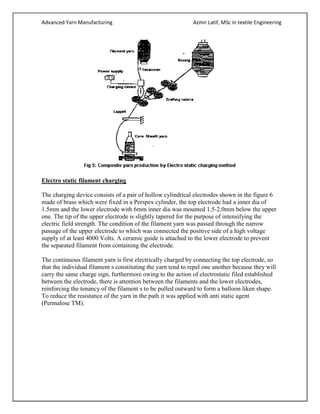
Core Twin Spun Yarn
Harakawa has developed and patented a Core twin spun yarn system as shown in Fig. 4. The
figure is a schematic illusion for the core twin spin yarns. In the spun silk ring spinning frame
Advanced Yarn Manufacturing Azmir Latif, MSc in textile Engineering
the drafting part was equipped with an apron device for cotton fibers, because they were
shorter then the silk fibers. The continuous filament core-spun yarn passes through a control
disc inserted directly behind the front roller in a drafted strand of either cotton or spun silk via
a core yarn guide. The drafted spun silk and cotton strands and the scoured silk continuous
filament core yarns were twisted together as they emerge from the front rollers.
Usually the core yarn guide remains at a fixed position and also possible to move them by
moving the position rollers. When the rollers change the position of the guide, the core yarns
migrate periodically from the spun silk to cotton and from cotton to spun silk. When scoured
silk core yarn is inserted in the spun silk strand only, this yarn was called ‘silk –sided’ core
twin spun yarn; when the core yarn is inserted in the cotton strand only, this yarn is called
‘cotton-sided’ core twin spun yarn; when the core yarn inserted periodically in the both
strands, this yarn is called ‘migrated –core’ twin spun yarn.
Composite yarn by Electro static filament charging method
Smith & others developed a method for producing with the mixed construction of staple and
filament fibers involved with use of the frictional contact methods by using electro static
system and short comings with this system was only hydrophobic fibers can be handled, and
often filaments tend to break and wound around the rotating components. This system prone
to safety problems because of the high voltage required and a water supply required for
imparting the electrical conductivity to the continuous filament yarn.
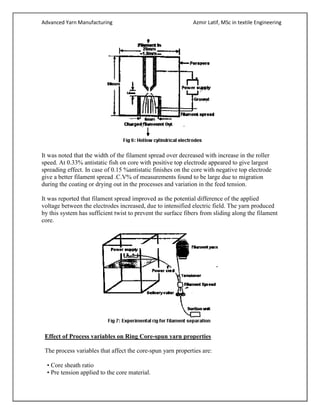
Another electrostatic filament charging method shown in the figure.5 uses two electrodes to
separate the multifilament yarn. The filament charging device is described which is based on
the principle of two electrodes system; this was employed to separate a multi filament yarn.
The separated filaments were then mixed with the staple fibers of roving at the roller nip on
the ring spinning system as illustrated in the figure5. The blended ribbon was subsequently
twisted to form a yarn. This is an effective measure for resolving the strip back problem.
Advanced Yarn Manufacturing Azmir Latif, MSc in textile Engineering
Electro static filament charging
The charging device consists of a pair of hollow cylindrical electrodes shown in the figure 6
made of brass which were fixed in a Perspex cylinder, the top electrode had a inner dia of
1.5mm and the lower electrode with 6mm inner dia was mounted 1.5-2.0mm below the upper
one. The tip of the upper electrode is slightly tapered for the purpose of intensifying the
electric field strength. The condition of the filament yarn was passed through the narrow
passage of the upper electrode to which was connected the positive side of a high voltage
supply of at least 4000 Volts. A ceramic guide is attached to the lower electrode to prevent
the separated filament from containing the electrode.
The continuous filament yarn is first electrically charged by connecting the top electrode, so
that the individual filament s constituting the yarn tend to repel one another because they will
carry the same charge sign, furthermore owing to the action of electrostatic filed established
between the electrode, there is attention between the filaments and the lower electrodes,
reinforcing the tenancy of the filament s to be pulled outward to form a balloon liken shape.
To reduce the resistance of the yarn in the path it was applied with anti static agent
(Permalose TM).
Advanced Yarn Manufacturing Azmir Latif, MSc in textile Engineering
It was noted that the width of the filament spread over decreased with increase in the roller
speed. At 0.33% antistatic fish on core with positive top electrode appeared to give largest
spreading effect. In case of 0.15 %antistatic finishes on the core with negative top electrode
give a better filament spread .C.V% of measurements found to be large due to migration
during the coating or drying out in the processes and variation in the feed tension.
It was reported that filament spread improved as the potential difference of the applied
voltage between the electrodes increased, due to intensified electric field. The yarn produced
by this system has sufficient twist to prevent the surface fibers from sliding along the filament
core.
Effect of Process variables on Ring Core-spun yarn properties
The process variables that affect the core-spun yarn properties are:
• Core sheath ratio
• Pre tension applied to the core material.
Advanced Yarn Manufacturing Azmir Latif, MSc in textile Engineering
• Spinning draft
• Number of roving feed and
• Twist
Core- sheath ratio
It has been found that decreasing sheath content will increase the strength of the core-spun
yarn. Apart from this there is an improvement in the extension and the evenness properties. In
the case of core-spun sewing threads, a 2: 1 ratio of core sheath gives poor core coverage, and
may raise problem of stripping off the sheath during the sewing, whereas, with a 1:1 core
sheath ratio the striping off problem reported to minimize.
Pre- tension to Core material
The pre tension is needed to regulate the geometrical position of the filament. This input
tension varies with the twist factor, size and the quality of the filaments used.
Balasubramaniam furnished a method for optimizing the tension of the core filament in the
core spinning process. Colored filament was passed over a tension device of attachment and
fed before the nip of the front roller of the ring frame. The pre tension was gradually raised
until the colored filament is completely covered by the cotton fibres, and this value was taken
as the optimum input tension. It was approximately 10% of the breaking load of the core yarn.
An introduction of a compensatory tensioner can be reducing the tension variation. An
extension of 1 % to the core filaments while feeding to the ring frame ensures no buckling or
curling of sheath fibres. Core yarns are usually pre- tensioned to an extension of around 5-
10% for flat continuous filaments yarns, about 30% for textured yarns and up to 400% for an
electrometric core. If insufficiently tensioned, the filament will either periodically appear at
the yarn surface, grin through or become wrapped around the fibre ribbon as the ribbon being
twisted.
Spinning draft
Spinning drafts can be varied to obtain the required yarn count based on the core the sheath
ratio.
Number of Roving feed
The possible ways of feeding the core material at the front roller nip with respect to roving
are:
• Filament at the center of the rovings
• Filament at the sides of the roving
• Filament on the top of the roving.
Two-rove feeding (Filament at the center of the rovings) provides better core positioning and
control during spinning influences the structure and properties of core-spun yarns.
Advanced Yarn Manufacturing Azmir Latif, MSc in textile Engineering
Twist
Adequate cohesion obtained in individual yarns at high twist rates and it is minimize the
sheath slippage .In addition to this, the filament pre-twist in opposite direction to the ring
twist reduce the sheath slippage. The extension of the core-spun yarn tends to reduce at higher
twist levels .
Core-spun yarn production by Rotor spinning system
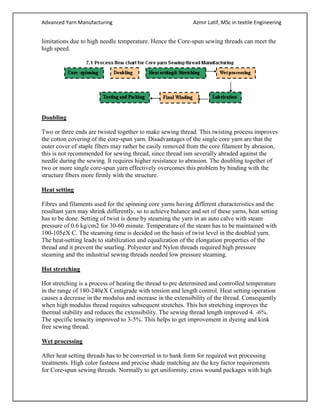
Nield and Ali have developed a technique in rotor-spinning machine to produce core-spun
yarns as shown in Fig. 8. Twist efficiency and pre-tension of filament are the influencing
factors in core spinning. In order to increase the contact area between yarn arm and doffing
tube (for increasing the twist efficiency), a copper flange was soldered to the inner end of the
doffing tube. The doffing tube was mounted on a ball bearing, rotated by a separate drive
opposite to the rotation of the rotor with a speed ratio of 1:9. The rotating doffing tube inserts
a false twist and pushes twist back to the peel-off point. The rotation of rotor wraps the yarn
arm around the continuous filament core. A minimum pre-tension is necessary to avoid
filament flung out in to the rotor-collecting surface. The core is not twisted during this
process. It is economical to produce coarse core-spun yarns through rotor machine than the
ring core-spun yarns.
Core-spun yarn production by Friction spinning system
In friction spinning system the fibres are individually collected and twisted to form yarn. A
wide range of staple length can be processed by this system. In Dref II system, the deposition
and the twist of fibres on to the yarn–tail is to be replaced by a filament core to obtain full
coverage of core. Dref-III (Wrap spinning system) is a frictional spinning process; a drafted
ribbon of parallel fibres that constitute the bulk of the spun yarn is wrapped by either surface
fibres protruding from the ribbon or by continuous filaments so as to impart coherence and
strength to the resulting yarn.
Advanced Yarn Manufacturing Azmir Latif, MSc in textile Engineering
It is believed that the core is false twisted by the rotation of the friction drums before being
wrapped by the sheath fibres. Strength of the Dref III core-spun yarns have direct relationship
with the strength of core filaments and number of sheath fibres that are active in generating
radial pressure due to their structural helical configurations. The effectiveness of wrapping of
sheath fibres depends on physical and mechanical characteristics of fibres, configuration,
length variations, firmness of the wrap and wrap angle.
Core-spun yarn production by MJS spinning system
it was reported that the Air-jet spinning could be used for producing core yarns after optimizing
process parameters. A relatively higher first nozzle pressure is advantageous for improving
sheath-slippage resistance. The use of higher spinning speed and wider condenser markedly
improves the tenacity, breaking extension, initial modulus and sheath-slippage resistance and
affects the yarn hairiness, mass irregularity and flexural rigidity. However, yarn properties
deteriorate at high spinning speed especially for finer yarns. The schematic diagram of MJS
spinning system for the production of core- spun yarn is shown in Fig.9
Core-spun sewing threads
The sewing thread is subjected to heavy stresses and strain at the various points during the
processes. The speed of the needle is accelerated to over 180 km/hr in the forwarded direction
brought to rest suddenly and again accelerated to backwards before returning to the rest. The
whole cycle is repeated approximately 120times per seconds. Incase of lock stitch the seam
sewn at 12stitches per inches each length of thread is passed through the needle up to 40 times
before being set in to the fabric. Depends on fabric thickness, the sewing machine needle
reaches temperature of about 360 „aC at 4000 s.p.m., the temperature of the needle during the
operation depends on the number of piles of fabric to be sewn and the frictional forces
between the needle to fabric and needle to thread.[13] 100%Cotton threads has difficult to
accompany the sewing machine with high speed rate, similarly 100%Synthetic threads has
Advanced Yarn Manufacturing Azmir Latif, MSc in textile Engineering
limitations due to high needle temperature. Hence the Core-spun sewing threads can meet the
high speed.
Doubling
Two or three ends are twisted together to make sewing thread. This twisting process improves
the cotton covering of the core-spun yarn. Disadvantages of the single core yarn are that the
outer cover of staple fibers may rather be easily removed from the core filament by abrasion,
this is not recommended for sewing thread, since thread ism severally abraded against the
needle during the sewing. It requires higher resistance to abrasion. The doubling together of
two or more single core-spun yarn effectively overcomes this problem by binding with the
structure fibers more firmly with the structure.
Heat setting
Fibres and filaments used for the spinning core yarns having different characteristics and the
resultant yarn may shrink differently, so to achieve balance and set of these yarns, heat setting
has to be done. Setting of twist is done by steaming the yarn in an auto calve with steam
pressure of 0.6 kg/cm2 for 30-60 minute. Temperature of the steam has to be maintained with
100-105¢X C. The steaming time is decided on the basis of twist level in the doubled yarn.
The heat-setting leads to stabilization and equalization of the elongation properties of the
thread and it prevent the snarling. Polyester and Nylon threads required high pressure
steaming and the industrial sewing threads needed low pressure steaming.
Hot stretching
Hot stretching is a process of heating the thread to pre determined and controlled temperature
in the range of 180-240¢X Centigrade with tension and length control. Heat setting operation
causes a decrease in the modulus and increase in the extensibility of the thread. Consequently
when high modulus thread requires subsequent stretches. This hot stretching improves the
thermal stability and reduces the extensibility. The sewing thread length improved 4. -6%.
The specific tenacity improved to 3-5%. This helps to get improvement in dyeing and kink
free sewing thread.
Wet processing
After heat setting threads has to be converted in to hank form for required wet processing
treatments. High color fastness and precise shade matching are the key factor requirements
for Core-spun sewing threads. Normally to get uniformity, cross wound packages with high
Advanced Yarn Manufacturing Azmir Latif, MSc in textile Engineering
pressure equipment¡¦s used.
Lubrication
Gliding and cooling effect on the needle could be done with effective lubricants. Good
lubricant must not clogs on the needle eye or causes stain. The lubricant must allow the thread
to unwind evenly from the package. The friction between the abrading surface should be
minimized with lubrications inexpensive lubricants will be preferred.
Final Winding
The core spun sewing threads after the treatments, to be wound on a suitable package like
spool, cop or king spool with required length .
Advantages of Core-spun yarns
Development of core-spun yarn with ring spinning system unveils path for new products
including high performance textiles, sewing threads and in the garmenting areas due to its
exceptional strength, outstanding abrasion resistance, consistence performance sewing machine,
elasticity for the stretch requirements, excellent resistance in perspiration, ideal wash and wear
performance and permanent press.
Conclusion:
A common problem in production of core–spun yarns on the Ring spinning frame is the slippage
of the staple fibers as sheath fibers relative to the core. This effect is known as ‘strip-back’ or
barberpole. This problem may lead to an incomplete core coverage and results in end–breaks in
subsequent processing. Core yarns have a structure in which one of the component, usually a
synthetic filament either mono or multi, is covered by another component, a staple fiber sheath.
The chief aim of using core yarn is to take advantage of the different properties of its both
components. The filament improves yarn strength and also permits the use of lower twist level,
while the sheath provides the staple fiber yarn appearance and surface physical properties. The
technique for the preparation of core-spun yarn is very simple and the selection of core and cover
materials can be made from a variety of fibers with predetermined end use. Nylon and Polyester
continuous filaments are the common core materials. A common problem with corespun yarns
made on a ring-spinning frame is the slippage of the staple fibers relative to the filament, which
gives a length of bare filament with a clump of fibers at one end.Usually defects are found at the
beginning or end of the yarn tube or where a break is replaced on a spinning frame. Operators
should inspect the yarn carefully from the spinning bobbin when knotting and ensure good core-
spun yarn is being used to repair the break. Fault free core-spun yarn is desirable to everyone.
Good quality core-spun yarn containing spandex production is possible by considering above
mentioned quality parameter.

Core yarn spinning

  • 1.
    Advanced Yarn ManufacturingAzmir Latif, MSc in textile Engineering Introduction Filament-core yarns are produced to take advantage of both filament and staple fibre properties. They offer good strength and uniformity without sacrificing the staple fibre yarn-like surface characteristics. Core-spun yarns containing spandex provide fabric designers with broad possibilities, because such stretchable yarns can be constructed with a wide range of properties using virtually any type of hard fibres as the cover yarn. However, a disadvantage of the core yarns is that the staple fibre sheath may slip along the filament when being pulled to pass over or when being rubbed by machine parts during further mechanical processes. But it is very easy to produce core-spun yarn containing spandex in a conventional ring frame after doing some modification of the machine. By taking some measure it is possible to make good quality core-spun yarn containing spandex. Core-spinning is a process by which fibres are twisted around an existing yarn, either filament or staple spun yarn, to produce a sheath– core structure in which the already formed yarn is the core. Core-spun yarns are two-component structure with Core and sheath. Generally continuous filament yarn is used as core and the staple fibres used as sheath covering. The core-spun yarn used to enhance functional properties of the fabrics such as strength, durability and stretch comfort. Methods for production of Core spun yarns The production of Core-spun yarns done successfully by many spinning systems. Each system has its own features .The conventional ring spinning is simple and economy but the core positioning in the centre is difficult and major strip back problem may arise during subsequent process and the core filaments get twisted. In Dref III the core positioning can be set accurately and used to produce the industrial and conductive yarns. Probable methods of core-spun yarn production are discussed below. 1. Conventional core spinning attachment with ring spinning systems 2. S.R.R.C Core wrap spinning method 3. A.R.S. Patterned Spinning system 4. Core-twin spinning system 5. Composite electrostatic spinning system 6. Rotor spinning system 7. Friction spinning system and 8. Air jet spinning system Properties of spandex: Core-spun yarns containing Spandex provide fabric designers with broad possibilities, because such stretchable yarns can be constructed with a wide range of properties using virtually any type of "hard" fibres as the cover yarn. LYCRA is the registered trademark for DuPont's elastane yarn of coalesced filament with high stretch and recovery power. Spandex yarn or lycra has variable properties which ensure its high utility as the core in elastic core-spun yarn. These include:
  • 2.
    Advanced Yarn ManufacturingAzmir Latif, MSc in textile Engineering 1. High modulus (power at stretch) 2. Fine and very fine yarn counts 3. Capacity to heat set 4. Clear, dull and bright lusters 5. Capacity to dye, if required Basic requirements to produce core-spun yarn containing spandex: 1. Uniform, high quality roving. 2. Spinning draft below 30. 3. Accurately adjusted rings and travellers and plumbed (aligned) spindles. 4. Maintained spinning aprons, drafting rollers and cost strictly. 5. Replaced slipping or worn gears and sprockets. 6. Excellent cleaning devices to prevent fly deposits Sufficient light to easily detect any breaks of the extremely fine spandex yarns. Spandex is a continuous filament yarn. It must be handled carefully to prevent damage. Spandex tubes should not be bumper, thrown or mishandled in any away. Care in unpacking is required to avoid scuffing the shoulders. Draft Control: This mechanism consists of 2 positively driven feed rollers (Fig - 3) that serve as a cradle for the tubes of spandex to deliver the yarn at predetermined feed rollers can be adjusted to give the desired draft or stretch ratio. Feed roller: Smooth surface rollers must be used to give adequate yarn to surface friction so that slippage is minimized at the contact points with the yarn tubes. Chrome plated steel rollers are preferred for smoothness, but other type can be used, such as electrical conduit, aluminium, stainless steel or PVC tubing. To prevent draft back feed rollers diameters should be large enough to allow yarn to contact at least 90 mm of roller surface after leaving the tube. Roller diameters of 60 mm to 100 mm are recommended to ensure adequate surface contact. The feed rollers can be located on the frame either above or below the roving creel.
  • 3.
    Advanced Yarn ManufacturingAzmir Latif, MSc in textile Engineering Package spacer: Spacers must be used to prevent the yarn tubes from mowing horizontally along the feed roller. Figure-6 shows a cotton spinning frame conversion into a corespinning system. Draft of spandex: The drafts in core-spinning depend on the type, the decitex and the pre-stretch of spandex. The real, total draft (TD) of the spandex core in a spun yarn includes both the gear draft (GD, machine draft) and the winding pre-stretch of the spandex yarn on its tube. The draft of the spandex core in the spun yarn is always higher than the gear draft (GD) applied in the spinning frame. The optimum output (spinning speed) of good core yarn cannot be reached by setting low number of turns per meter and highest drafts. There is a limit to spindle speed for every draft depending on the staple applied in the cover, yarn count and its twist factor. There are also limits concerning the traveller speed. For better result the traveller speed should not exceed 26 m/sec in spinning with spandex with cotton. The choice of the highest draft for the optimum production should also take into account the end use of the core-spun yarn and its performance in the subsequent process - knitting or weaving and garment wear.
  • 4.
    Advanced Yarn ManufacturingAzmir Latif, MSc in textile Engineering Spandex storage time: The best performance of spandex in spinning is obtained with a relatively fresh yarn. Thus, mill storage time of spandex tubes should not exceed: # 4 month of age for 44 decitex # 6 month of age for 78 to 156 decitex spandex yarn For the optimum processing of spandex it is recommended the following point: # avoid an excess of yarn stock # place order for no more than 4 to 6 weeks production needs # apply the "first in- first out" stock turnover Conventional Core spinning attachment in Ring frame A core spinning attachment in ring spinning is shown in Fig.1. The attachment consists of metal plate (Bracket) bent to a shape. One end of the device is fitted on the roving traverse guide bar such that the relative position of the roving and the core filament may be kept constant all the time. There is a provision to vary the position of the device if required. The other end of the plate is fitted with a porcelain guide that feed the core filament at a precise position behind the front drafting rollers. This devise is fitted with a pre-tensioner and is kept in a horizontal plane. Varying the number of tension discs may vary the input tension of the core filament. The package containing core filament material is suspended from a bar such that they could rotate easily, thus avoiding any tendency to stretch the filament before it is fed to the tensioning device.
  • 5.
    Advanced Yarn ManufacturingAzmir Latif, MSc in textile Engineering S.R.R.C. Core wrap spinning system Southern Regional Research Center has developed a core spinning system [1] is shown in Fig. 2. In conventional core-spinning system yarns are merely a ply twisted and does not have good core coverage, strip back problem may arise during subsequent mechanical processing. The core wrap yarns produced by the SRRC core spinning system consists of a central core of a particular filament or staple fiber and core material is almost coaxially and totally wrapped with cotton on any other staple fiber. It is claimed that a high degree of coherence is obtained between the constituent fibers. The core-wrap assembly is used as twist breaker, which helps the sheath fibres to cover the filament.
  • 6.
    Advanced Yarn ManufacturingAzmir Latif, MSc in textile Engineering A.R.S. spinning system In this system the core may be a filament yarn or a spun yarn shown in figure 3. Two rovings are drafted on both the sides of the core. Shawney reported that the Flame retardant treated ARS core spun cotton yarn made fabrics Provide desire level of fire resistance then the FR treated 100% cotton yarn Core Twin Spun Yarn Harakawa has developed and patented a Core twin spun yarn system as shown in Fig. 4. The figure is a schematic illusion for the core twin spin yarns. In the spun silk ring spinning frame
  • 7.
    Advanced Yarn ManufacturingAzmir Latif, MSc in textile Engineering the drafting part was equipped with an apron device for cotton fibers, because they were shorter then the silk fibers. The continuous filament core-spun yarn passes through a control disc inserted directly behind the front roller in a drafted strand of either cotton or spun silk via a core yarn guide. The drafted spun silk and cotton strands and the scoured silk continuous filament core yarns were twisted together as they emerge from the front rollers. Usually the core yarn guide remains at a fixed position and also possible to move them by moving the position rollers. When the rollers change the position of the guide, the core yarns migrate periodically from the spun silk to cotton and from cotton to spun silk. When scoured silk core yarn is inserted in the spun silk strand only, this yarn was called ‘silk –sided’ core twin spun yarn; when the core yarn is inserted in the cotton strand only, this yarn is called ‘cotton-sided’ core twin spun yarn; when the core yarn inserted periodically in the both strands, this yarn is called ‘migrated –core’ twin spun yarn. Composite yarn by Electro static filament charging method Smith & others developed a method for producing with the mixed construction of staple and filament fibers involved with use of the frictional contact methods by using electro static system and short comings with this system was only hydrophobic fibers can be handled, and often filaments tend to break and wound around the rotating components. This system prone to safety problems because of the high voltage required and a water supply required for imparting the electrical conductivity to the continuous filament yarn. Another electrostatic filament charging method shown in the figure.5 uses two electrodes to separate the multifilament yarn. The filament charging device is described which is based on the principle of two electrodes system; this was employed to separate a multi filament yarn. The separated filaments were then mixed with the staple fibers of roving at the roller nip on the ring spinning system as illustrated in the figure5. The blended ribbon was subsequently twisted to form a yarn. This is an effective measure for resolving the strip back problem.
  • 8.
    Advanced Yarn ManufacturingAzmir Latif, MSc in textile Engineering Electro static filament charging The charging device consists of a pair of hollow cylindrical electrodes shown in the figure 6 made of brass which were fixed in a Perspex cylinder, the top electrode had a inner dia of 1.5mm and the lower electrode with 6mm inner dia was mounted 1.5-2.0mm below the upper one. The tip of the upper electrode is slightly tapered for the purpose of intensifying the electric field strength. The condition of the filament yarn was passed through the narrow passage of the upper electrode to which was connected the positive side of a high voltage supply of at least 4000 Volts. A ceramic guide is attached to the lower electrode to prevent the separated filament from containing the electrode. The continuous filament yarn is first electrically charged by connecting the top electrode, so that the individual filament s constituting the yarn tend to repel one another because they will carry the same charge sign, furthermore owing to the action of electrostatic filed established between the electrode, there is attention between the filaments and the lower electrodes, reinforcing the tenancy of the filament s to be pulled outward to form a balloon liken shape. To reduce the resistance of the yarn in the path it was applied with anti static agent (Permalose TM).
  • 9.
    Advanced Yarn ManufacturingAzmir Latif, MSc in textile Engineering It was noted that the width of the filament spread over decreased with increase in the roller speed. At 0.33% antistatic fish on core with positive top electrode appeared to give largest spreading effect. In case of 0.15 %antistatic finishes on the core with negative top electrode give a better filament spread .C.V% of measurements found to be large due to migration during the coating or drying out in the processes and variation in the feed tension. It was reported that filament spread improved as the potential difference of the applied voltage between the electrodes increased, due to intensified electric field. The yarn produced by this system has sufficient twist to prevent the surface fibers from sliding along the filament core. Effect of Process variables on Ring Core-spun yarn properties The process variables that affect the core-spun yarn properties are: • Core sheath ratio • Pre tension applied to the core material.
  • 10.
    Advanced Yarn ManufacturingAzmir Latif, MSc in textile Engineering • Spinning draft • Number of roving feed and • Twist Core- sheath ratio It has been found that decreasing sheath content will increase the strength of the core-spun yarn. Apart from this there is an improvement in the extension and the evenness properties. In the case of core-spun sewing threads, a 2: 1 ratio of core sheath gives poor core coverage, and may raise problem of stripping off the sheath during the sewing, whereas, with a 1:1 core sheath ratio the striping off problem reported to minimize. Pre- tension to Core material The pre tension is needed to regulate the geometrical position of the filament. This input tension varies with the twist factor, size and the quality of the filaments used. Balasubramaniam furnished a method for optimizing the tension of the core filament in the core spinning process. Colored filament was passed over a tension device of attachment and fed before the nip of the front roller of the ring frame. The pre tension was gradually raised until the colored filament is completely covered by the cotton fibres, and this value was taken as the optimum input tension. It was approximately 10% of the breaking load of the core yarn. An introduction of a compensatory tensioner can be reducing the tension variation. An extension of 1 % to the core filaments while feeding to the ring frame ensures no buckling or curling of sheath fibres. Core yarns are usually pre- tensioned to an extension of around 5- 10% for flat continuous filaments yarns, about 30% for textured yarns and up to 400% for an electrometric core. If insufficiently tensioned, the filament will either periodically appear at the yarn surface, grin through or become wrapped around the fibre ribbon as the ribbon being twisted. Spinning draft Spinning drafts can be varied to obtain the required yarn count based on the core the sheath ratio. Number of Roving feed The possible ways of feeding the core material at the front roller nip with respect to roving are: • Filament at the center of the rovings • Filament at the sides of the roving • Filament on the top of the roving. Two-rove feeding (Filament at the center of the rovings) provides better core positioning and control during spinning influences the structure and properties of core-spun yarns.
  • 11.
    Advanced Yarn ManufacturingAzmir Latif, MSc in textile Engineering Twist Adequate cohesion obtained in individual yarns at high twist rates and it is minimize the sheath slippage .In addition to this, the filament pre-twist in opposite direction to the ring twist reduce the sheath slippage. The extension of the core-spun yarn tends to reduce at higher twist levels . Core-spun yarn production by Rotor spinning system Nield and Ali have developed a technique in rotor-spinning machine to produce core-spun yarns as shown in Fig. 8. Twist efficiency and pre-tension of filament are the influencing factors in core spinning. In order to increase the contact area between yarn arm and doffing tube (for increasing the twist efficiency), a copper flange was soldered to the inner end of the doffing tube. The doffing tube was mounted on a ball bearing, rotated by a separate drive opposite to the rotation of the rotor with a speed ratio of 1:9. The rotating doffing tube inserts a false twist and pushes twist back to the peel-off point. The rotation of rotor wraps the yarn arm around the continuous filament core. A minimum pre-tension is necessary to avoid filament flung out in to the rotor-collecting surface. The core is not twisted during this process. It is economical to produce coarse core-spun yarns through rotor machine than the ring core-spun yarns. Core-spun yarn production by Friction spinning system In friction spinning system the fibres are individually collected and twisted to form yarn. A wide range of staple length can be processed by this system. In Dref II system, the deposition and the twist of fibres on to the yarn–tail is to be replaced by a filament core to obtain full coverage of core. Dref-III (Wrap spinning system) is a frictional spinning process; a drafted ribbon of parallel fibres that constitute the bulk of the spun yarn is wrapped by either surface fibres protruding from the ribbon or by continuous filaments so as to impart coherence and strength to the resulting yarn.
  • 12.
    Advanced Yarn ManufacturingAzmir Latif, MSc in textile Engineering It is believed that the core is false twisted by the rotation of the friction drums before being wrapped by the sheath fibres. Strength of the Dref III core-spun yarns have direct relationship with the strength of core filaments and number of sheath fibres that are active in generating radial pressure due to their structural helical configurations. The effectiveness of wrapping of sheath fibres depends on physical and mechanical characteristics of fibres, configuration, length variations, firmness of the wrap and wrap angle. Core-spun yarn production by MJS spinning system it was reported that the Air-jet spinning could be used for producing core yarns after optimizing process parameters. A relatively higher first nozzle pressure is advantageous for improving sheath-slippage resistance. The use of higher spinning speed and wider condenser markedly improves the tenacity, breaking extension, initial modulus and sheath-slippage resistance and affects the yarn hairiness, mass irregularity and flexural rigidity. However, yarn properties deteriorate at high spinning speed especially for finer yarns. The schematic diagram of MJS spinning system for the production of core- spun yarn is shown in Fig.9 Core-spun sewing threads The sewing thread is subjected to heavy stresses and strain at the various points during the processes. The speed of the needle is accelerated to over 180 km/hr in the forwarded direction brought to rest suddenly and again accelerated to backwards before returning to the rest. The whole cycle is repeated approximately 120times per seconds. Incase of lock stitch the seam sewn at 12stitches per inches each length of thread is passed through the needle up to 40 times before being set in to the fabric. Depends on fabric thickness, the sewing machine needle reaches temperature of about 360 „aC at 4000 s.p.m., the temperature of the needle during the operation depends on the number of piles of fabric to be sewn and the frictional forces between the needle to fabric and needle to thread.[13] 100%Cotton threads has difficult to accompany the sewing machine with high speed rate, similarly 100%Synthetic threads has
  • 13.
    Advanced Yarn ManufacturingAzmir Latif, MSc in textile Engineering limitations due to high needle temperature. Hence the Core-spun sewing threads can meet the high speed. Doubling Two or three ends are twisted together to make sewing thread. This twisting process improves the cotton covering of the core-spun yarn. Disadvantages of the single core yarn are that the outer cover of staple fibers may rather be easily removed from the core filament by abrasion, this is not recommended for sewing thread, since thread ism severally abraded against the needle during the sewing. It requires higher resistance to abrasion. The doubling together of two or more single core-spun yarn effectively overcomes this problem by binding with the structure fibers more firmly with the structure. Heat setting Fibres and filaments used for the spinning core yarns having different characteristics and the resultant yarn may shrink differently, so to achieve balance and set of these yarns, heat setting has to be done. Setting of twist is done by steaming the yarn in an auto calve with steam pressure of 0.6 kg/cm2 for 30-60 minute. Temperature of the steam has to be maintained with 100-105¢X C. The steaming time is decided on the basis of twist level in the doubled yarn. The heat-setting leads to stabilization and equalization of the elongation properties of the thread and it prevent the snarling. Polyester and Nylon threads required high pressure steaming and the industrial sewing threads needed low pressure steaming. Hot stretching Hot stretching is a process of heating the thread to pre determined and controlled temperature in the range of 180-240¢X Centigrade with tension and length control. Heat setting operation causes a decrease in the modulus and increase in the extensibility of the thread. Consequently when high modulus thread requires subsequent stretches. This hot stretching improves the thermal stability and reduces the extensibility. The sewing thread length improved 4. -6%. The specific tenacity improved to 3-5%. This helps to get improvement in dyeing and kink free sewing thread. Wet processing After heat setting threads has to be converted in to hank form for required wet processing treatments. High color fastness and precise shade matching are the key factor requirements for Core-spun sewing threads. Normally to get uniformity, cross wound packages with high
  • 14.
    Advanced Yarn ManufacturingAzmir Latif, MSc in textile Engineering pressure equipment¡¦s used. Lubrication Gliding and cooling effect on the needle could be done with effective lubricants. Good lubricant must not clogs on the needle eye or causes stain. The lubricant must allow the thread to unwind evenly from the package. The friction between the abrading surface should be minimized with lubrications inexpensive lubricants will be preferred. Final Winding The core spun sewing threads after the treatments, to be wound on a suitable package like spool, cop or king spool with required length . Advantages of Core-spun yarns Development of core-spun yarn with ring spinning system unveils path for new products including high performance textiles, sewing threads and in the garmenting areas due to its exceptional strength, outstanding abrasion resistance, consistence performance sewing machine, elasticity for the stretch requirements, excellent resistance in perspiration, ideal wash and wear performance and permanent press. Conclusion: A common problem in production of core–spun yarns on the Ring spinning frame is the slippage of the staple fibers as sheath fibers relative to the core. This effect is known as ‘strip-back’ or barberpole. This problem may lead to an incomplete core coverage and results in end–breaks in subsequent processing. Core yarns have a structure in which one of the component, usually a synthetic filament either mono or multi, is covered by another component, a staple fiber sheath. The chief aim of using core yarn is to take advantage of the different properties of its both components. The filament improves yarn strength and also permits the use of lower twist level, while the sheath provides the staple fiber yarn appearance and surface physical properties. The technique for the preparation of core-spun yarn is very simple and the selection of core and cover materials can be made from a variety of fibers with predetermined end use. Nylon and Polyester continuous filaments are the common core materials. A common problem with corespun yarns made on a ring-spinning frame is the slippage of the staple fibers relative to the filament, which gives a length of bare filament with a clump of fibers at one end.Usually defects are found at the beginning or end of the yarn tube or where a break is replaced on a spinning frame. Operators should inspect the yarn carefully from the spinning bobbin when knotting and ensure good core- spun yarn is being used to repair the break. Fault free core-spun yarn is desirable to everyone. Good quality core-spun yarn containing spandex production is possible by considering above mentioned quality parameter.