How to   the ect 100%              Knit
Create   P erf   Cotton


             A Technical Guide to Improving Your Knit Products

                                          PRODUCE FIRST QUALITY KNITS
                                             REDUCE SURFACE FUZZING
                           100
                          Cot %            INCREASE COLOR RETENTION
                             ton
                                                 CONTROL SHRINKAGE
About 60% of all garments sold at retail in the United States are knit products. In order to engineer the performance
                                                                                                        right
your customers expect in a knit garment at the price they are willing to pay, it is important to make the
decisions about each stage of the manufacturing process. Today’s customers have myriad choices in
apparel, so they often show little brand loyalty, and if a purchase fails to meet their expectations , they are
often willing to try something different.


The consumer’s garment care practices can significantly affect the    overall appearance and           performance
of a cotton knit garment. Improper care results in disruption of the fabric surface, causing the garment to lose its
new appearance and to wear      out prematurely. If a knit product has a tendency to fuzz easily or lose
its color quickly, this only makes the problem worse.


              Consumers average 5 loads of
              laundry per week and expect
              to wash a dark garment 15
              times before it fades.
n
                                                                                                                            1 00%Cotto
How to Create the Perfect Knit
                                                            A Technical Guide to Improving Your Knit Products

For over 25 years, Cotton Incorporated has conducted research examining the various cotton knit manufacturing processes and their effects on the
performance and overall quality of the resulting consumer products. The quality of the final product is directly affected by decisions made about the
manufacturing process with respect to fiber selection, yarn spinning systems, fabric construction, fabric preparation, and dyeing and finishing. Decisions
about any of these manufacturing steps can give rise to problems downstream that may not be easily remedied, resulting in a less-than-optimal product.
Such problems can be anticipated and prevented if you make well-informed decisions to engineer a product that meets both the retailer’s performance
specifications and price point and the consumer’s expectation of quality. Savvy choices will result in a product that is a good value and performs well in
terms of color retention, fabric appearance, and shrinkage. Armed with knowledge of the various manufacturing operations and how each step affects
the next, your company can make better-informed decisions that will help you


•        save time and money at each manufacturing stage, by reducing costly
         mistakes and off-quality goods,

•        deliver a higher-quality product, resulting in fewer customer returns and greater
         consumer satisfaction, and

•        develop value-added products that garner higher margins.
Type of Product
                               Decision Chart for Production of Knit Garments
 Being Made?


    Fiber            Yarn                                                     Murata Vortex
                                        Carding         Drawing
   Selection        Quality?                                                    Spinning


                                                        Combing                 Open End
                                                                                                                              Pique
                                                                                Spinning
                                                                                                           Type of
                                                                                                         Fabric to be                    Product
                                                                                                                             Interlock
                                        Roving                                                              Knit?                        Color?
                                                                              Compact Ring
                                                                                Spinning
                                                                                                                             Jersey

                                                                              Conventional
                                                                              Ring Spinning                                                     Scour                   Bleach


                                                                                                                                                            Cost?
                                                                                                                                                    Fabric Characteristics?
                                                                                                                                                        Performance?


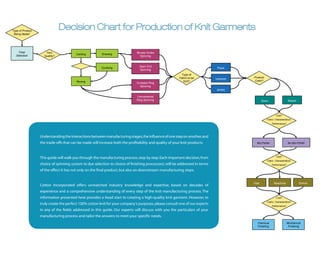
                  Understanding the interactions between manufacturing stages, the influence of one step on another, and
                  the trade-offs that can be made will increase both the profitability and quality of your knit products.                   Bio-Polish                  No Bio-Polish


                                                                                                                                                            Cost?
                  This guide will walk you through the manufacturing process, step by step. Each important decision, from
                                                                                                                                                    Fabric Characteristics?
                  choice of spinning system to dye selection to choice of finishing process(es), will be addressed in terms                              Performance?

                  of the effect it has not only on the final product, but also on downstream manufacturing steps.


                                                                                                                                         Vats             Reactives              Directs
                  Cotton Incorporated offers unmatched industry knowledge and expertise, based on decades of
                  experience and a comprehensive understanding of every step of the knit manufacturing process. The
                  information presented here provides a head start to creating a high-quality knit garment. However, to                                     Cost?
                                                                                                                                                    Fabric Characteristics?
                  truly create the perfect 100% cotton knit for your company’s purposes, please consult one of our experts
                                                                                                                                                        Performance?
                  in any of the fields addressed in this guide. Our experts will discuss with you the particulars of your
                  manufacturing process and tailor the answers to meet your specific needs.
                                                                                                                                           Chemical                    Mechanical
                                                                                                                                           Finishing                    Finishing
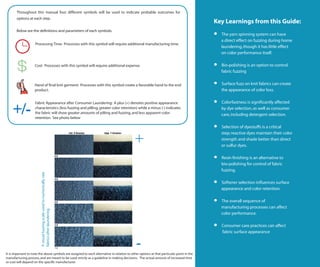
Throughout this manual four different symbols will be used to indicate probable outcomes for
       options at each step.
                                                                                                                                          Key Learnings from this Guide:
       Below are the definitions and parameters of each symbols.
                                                                                                                                           The yarn spinning system can have
                                                                                                                                            a direct effect on fuzzing during home
                     Processing Time: Processes with this symbol will require additional manufacturing time.
                                                                                                                                            laundering, though it has little effect
                                                                                                                                            on color performance itself.


        $           Cost: Processes with this symbol will require additional expense.                                                      Bio-polishing is an option to control
                                                                                                                                            fabric fuzzing


                    Hand of final knit garment: Processes with this symbol create a favorable hand to the end                               Surface fuzz on knit fabrics can create
                    product.                                                                                                                the appearance of color loss.


     +/-
                     Fabric Appearance after Consumer Laundering: A plus (+) denotes positive appearance                                   Colorfastness is significantly affected
                     characteristics (less fuzzing and pilling, greater color retention) while a minus (-) indicates                        by dye selection, as well as consumer
                     the fabric will show greater amounts of pilling and fuzzing, and less apparent color                                   care, including detergent selection.
                     retention. See photo below

                                                                                                                                           Selection of dyestuffs is a critical


                                                                                             +
                                                                                                                                            step; reactive dyes maintain their color
                                                                                                                                            strength and shade better than direct
                                                                                                                                            or sulfur dyes.

                                                                                                                                           Resin finishing is an alternative to
                                                                                                                                            bio-polishing for control of fabric
                                                                                                                                            fuzzing.
                         A visual fuzzing scale used to numerically rate


                                                                                                                                           Softener selection influences surface
                                                                                                                                            appearance and color retention.

                                                                                                                                           The overall sequence of
                                                                                                                                            manufacturing processes can affect
                         fabrics after laundering


                                                                                                                                            color performance.

                                                                                                                                           Consumer care practices can affect
                                                                                                                                            fabric surface appearance


                                                                                             -
It is important to note the above symbols are assigned to each alternative in relation to other options at that particular point in the
manufacturing process, and are meant to be used strictly as a guideline in making decisions. The actual amount of increased time
or cost will depend on the specific manufacturer.
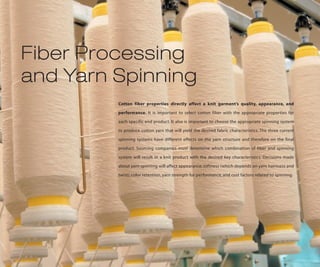
Fiber Processing
and Yarn Spinning
         Cotton fiber properties directly affect a knit garment’s quality, appearance, and

         performance. It is important to select cotton fiber with the appropriate properties for

         each specific end product. It also is important to choose the appropriate spinning system

         to produce cotton yarn that will yield the desired fabric characteristics. The three current

         spinning systems have different effects on the yarn structure and therefore on the final

         product. Sourcing companies must determine which combination of fiber and spinning

         system will result in a knit product with the desired key characteristics. Decisions made

         about yarn spinning will affect appearance, softness (which depends on yarn hairiness and

         twist), color retention, yarn strength for performance, and cost factors related to spinning.
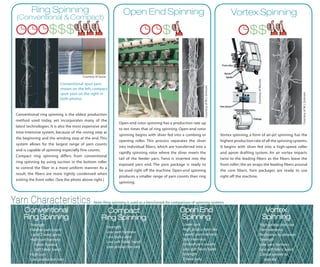
Ring Spinning                                               Open End Spinning                                                                Vortex Spinning
 (Conventional & Compact)

                    $$$                                                                      $                                                                    $$


                                        Courtesy of Sussa


                                                                                                                                                                        Courtesy of Murata
                           Conventional spun yarn


                                                                                                                      Courtesy of M.J. Grimson
                           shown on the left, compact
                           spun yarn on the right in


                                                                                                                                                                                                        Courtesy of M.J. Grimson
                           both photos


 Conventional ring spinning is the oldest production
 method used today, yet incorporates many of the
                                                                   Open-end rotor spinning has a production rate up
 latest technologies. It is also the most expensive and
                                                                   to ten times that of ring spinning. Open-end rotor
 time-intensive system, because of the roving step at
                                                                   spinning begins with sliver fed into a combing or                             Vortex spinning, a form of air-jet spinning, has the
 the beginning and the winding step at the end. This
                                                                   opening roller. This process separates the sliver                             highest production rate of all the spinning systems.
 system allows for the largest range of yarn counts
                                                                   into individual fibers, which are transferred into a                          It begins with sliver fed into a high-speed roller
 and is capable of spinning especially fine counts.
                                                                   rapidly spinning rotor where the sliver meets the                             and apron drafting system. An air vortex imparts
 Compact ring spinning differs from conventional
                                                                   tail of the feeder yarn. Twist is inserted into the                           twist to the leading fibers as the fibers leave the
 ring spinning by using suction in the bottom roller
                                                                   exposed yarn end. The yarn package is ready to                                front roller; the air wraps the leading fibers around
 to control the fiber in a more uniform manner. As a
                                                                   be used right off the machine. Open-end spinning                              the core fibers. Yarn packages are ready to use
 result, the fibers are more tightly condensed when
                                                                   produces a smaller range of yarn counts than ring                             right off the machine.
 exiting the front roller. (See the photo above right.)
                                                                   spinning.


Yarn Characteristics                            Note: Ring spinning is used as a benchmark for comparison of spinning systems

     Conventional                                      Compact                                         Open End                                                                               Vortex
     Ring Spinning                                   Ring Spinning                                     Spinning                                                                              Spinning
         Strength                                                                                        Lower cost                                                            High production rate
                                                            Strength
         Flexible yarn count                                                                             High production rate                                                  Yarn evenness
                                                            Low yarn hariness
         S and Z twist yarns                                                                             Lowest yarn hariness                                                  Resistance to abrasion
                                                            Less bulky yarn
         High yarn hariness                                                                              Yarn evenness                                                         Strength
                                                            Less soft fabric hand
            Fabric fuzzing                                                                               Limited yarn counts                                                   Low yarn hariness
                                                            Low production rate
            Soft fabric hand                                                                             Less soft fabric hand                                                 Less soft fabric hand
         High cost                                                                                       Strength                                                              Critical system to
         Low production rate                                                                             Z twist only                                                             operate
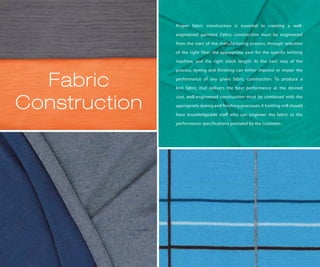
Proper fabric construction is essential to creating a well-

               engineered garment. Fabric construction must be engineered

               from the start of the manufacturing process, through selection

               of the right fiber, the appropriate yarn for the specific knitting

               machine, and the right stitch length. At the next step of the

               process, dyeing and finishing can either improve or impair the


  Fabric       performance of any given fabric construction. To produce a

               knit fabric that delivers the best performance at the desired


Construction
               cost, well-engineered construction must be combined with the

               appropriate dyeing and finishing processes. A knitting mill should

               have knowledgeable staff who can engineer the fabric to the

               performance specifications provided by the customer.
Engineering Cotton Knits
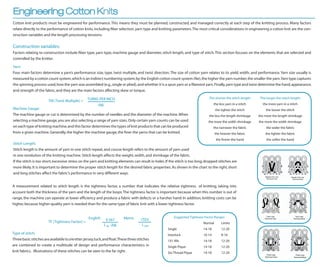
Cotton knit products must be engineered for performance. This means they must be planned, constructed, and managed correctly at each step of the knitting process. Many factors
relate directly to the performance of cotton knits, including fiber selection, yarn type and knitting parameters. The most critical considerations in engineering a cotton knit are the con-
struction variables and the length processing tensions.


Construction variables:
Factors relating to construction include fiber type, yarn type, machine gauge and diameter, stitch length, and type of stitch. This section focuses on the elements that are selected and
controlled by the knitter.

Yarn:
Four main factors determine a yarn’s performance: size, type, twist multiple, and twist direction. The size of cotton yarn relates to its yield, width, and performance. Yarn size usually is
measured by a cotton count system, which is an indirect numbering system; by the English cotton count system (Ne), the higher the yarn number, the smaller the yarn. Yarn type captures
the spinning process used, how the yarn was assembled (e.g., single or plied), and whether it is a spun yarn or a filament yarn. Finally, yarn type and twist determine the hand, appearance,
and strength of the fabric, and they are the main factors affecting skew or torque.

                                                  TURNS PER INCH                                                                The shorter the stitch length:    The longer the stitch length:
                        TM (Twist Multiple) =
                                                         √NE                                                                         the less yarn in a stitch      the more yarn in a stitch
Machine Gauge:                                                                                                                        the tighter the stitch          the looser the stitch
The machine gauge or cut is determined by the number of needles and the diameter of the machine. When                           the less the length shrinkage    the more the length shrinkage
selecting a machine gauge, you are also selecting a range of yarn sizes. Only certain yarn counts can be used                   the more the width shrinkage     the more the width shrinkage
on each type of knitting machine, and this factor determines the types of knit products that can be produced                         the narrower the fabric          the wider the fabric
from a given machine. Generally, the higher the machine gauge, the finer the yarns that can be knitted.                                the heavier the fabric         the lighter the fabric
                                                                                                                                      the firmer the hand              the softer the hand
Stitch Length:
Stitch length is the amount of yarn in one stitch repeat, and course length refers to the amount of yarn used
in one revolution of the knitting machine. Stitch length affects the weight, width, and shrinkage of the fabric.
If the stitch is too short, excessive stress on the yarn and knitting elements can result in holes. If the stitch is too long, dropped stitches are
more likely. It is important to determine the proper stitch length for the desired fabric properties. As shown in the chart to the right, short
and long stitches affect the fabric’s performance in very different ways.


A measurement related to stitch length is the tightness factor, a number that indicates the relative tightness of knitting, taking into
account both the thickness of the yarn and the length of the loops. The tightness factor is important because when this number is out of
range, the machine can operate at lower efficiency and produce a fabric with defects or a harsher hand. In addition, knitting costs can be
higher, because higher-quality yarn is needed than for the same type of fabric knit with a lower tightness factor.


                                                   English                Metric                         Suggested Tightness Factor Ranges
                                                                9.567                 √TEX
                        TF (Tightness Factor) =                                                                              Normal       Limits
                                                               L in √NE                L cm
                                                                                                     Single                  14-18        12-20
Type of stitch:                                                                                      Interlock               10-14        8-16
Three basic stitches are available to a knitter: jersey, tuck, and float.These three stitches         1X1 Rib                 14-18        12-20
are combined to create a multitude of design and performance characteristics in                      Single Pique            14-18        12-20
knit fabrics. Illustrations of these stitches can be seen to the far right.                          Six-Thread Pique        14-18        12-20
Controlling Shrinkage
In today’s competitive markets, where high quality is expected at a low price, apparel companies are demanding low shrinkage. Furthermore, shrinkage must be consistent from garment
to garment in the same style and fabric construction. The term “shrinkage” is commonly used to mean any dimensional change in a fabric or garment - either shrinkage or growth - caused
by the application of force or a change in environment. For a cotton garment, shrinkage characteristics affect parameters such as seam puckering, torquing, and overall garment fit.


Shrinkage during the manufacturing process is caused by two types of factors: those relating to the construction of the fabric or garment and those relating to how the fabric or garment
is processed.


Construction Shrinkage:
Dimensional changes during construction occur as a result of such parameters as fiber, yarn, machine gauge, total number of needles, stitch or course length, and type of stitch. This type
of shrinkage is controlled by careful selection of construction parameters to meet fabric specifications.


Processing Shrinkage:
Dimensional changes during processing can occur during any dyeing or finishing step (whether chemical or mechanical) and usually affect both the length and width of the fabric. Keys
to reducing shrinkage and improving fabric performance are processing the fabric with minimal tension and using compacting or relaxed drying steps.

Various wet processing techniques have different effects on shrinkage. In general,
batch processing (in a jet dyeing machine) applies less linear tension on the fabric
than continuous processing. Processes such as napping, sanding, and merceriza-
tion apply high tension, while others such as relaxed drying apply low tension.
Weft knits can be processed either open width or in tubular form. Each process
applies tension in different ways, and different processes used on the same greige
and dyed fabric will result in different performance. Resin treatment also has a
                                                                                                                                   Width stretched
huge effect on both fabric strength and shrinkage.
                                                                                                                     Above and right are illustrations of a regular

Relaxed Drying                                                                                      Relaxed stitch   fabric and fabrics that have been stretched.
                                                                                                                                                                      Length stretched
and Compacting
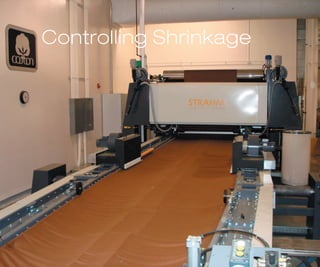
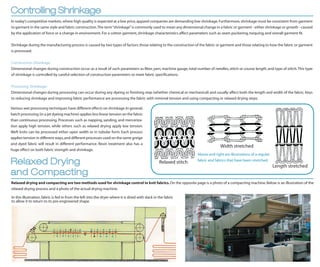
Relaxed drying and compacting are two methods used for shrinkage control in knit fabrics. On the opposite page is a photo of a compacting machine. Below is an illustration of the
relaxed drying process and a photo of the actual drying machine.

In this illustration, fabric is fed in from the left into the dryer where it is dried with slack in the fabric
to allow it to return to its pre-engineered shape.
Fabric
Preparation
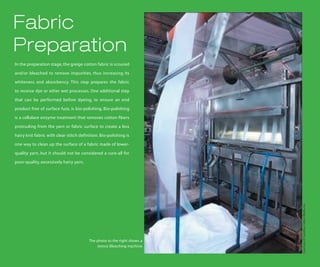
In the preparation stage, the greige cotton fabric is scoured

and/or bleached to remove impurities, thus increasing its

whiteness and absorbency. This step prepares the fabric

to receive dye or other wet processes. One additional step

that can be performed before dyeing, to ensure an end

product free of surface fuzz, is bio-polishing. Bio-polishing

is a cellulase enzyme treatment that removes cotton fibers

protruding from the yarn or fabric surface to create a less

hairy knit fabric with clear stitch definition. Bio-polishing is

one way to clean up the surface of a fabric made of lower-

quality yarn, but it should not be considered a cure-all for

poor-quality, excessively hairy yarn.


                                                                          Courtesy of Carolina Cotton Works, Inc.
                                         The photo to the right shows a
                                             Jemco Bleaching machine
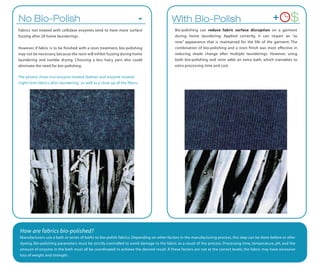
No Bio-Polish                                                                 -          With Bio-Polish                                             +         $
Fabrics not treated with cellulase enzymes tend to have more surface                       Bio-polishing can reduce fabric surface disruption on a garment
fuzzing after 20 home launderings.                                                         during home laundering. Applied correctly, it can impart an “as
                                                                                           new” appearance that is maintained for the life of the garment. The
However, if fabric is to be finished with a resin treatment, bio-polishing                 combination of bio-polishing and a resin finish was most effective in
may not be necessary, because the resin will inhibit fuzzing during home                   reducing shade change after multiple launderings. However, using
laundering and tumble drying. Choosing a less hairy yarn also could                        both bio-polishing and resin adds an extra bath, which translates to
eliminate the need for bio-polishing.                                                      extra processing time and cost.

The photos show non-enzyme treated (below) and enzyme treated
(right) knit fabrics after laundering, as well as a close up of the fibers.


 How are fabrics bio-polished?
 Manufacturers use a bath or series of baths to bio-polish fabrics. Depending on other factors in the manufacturing process, this step can be done before or after
 dyeing. Bio-polishing parameters must be strictly controlled to avoid damage to the fabric as a result of the process. Processing time, temperature, pH, and the
 amount of enzyme in the bath must all be coordinated to achieve the desired result. If these factors are not at the correct levels, the fabric may have excessive
 loss of weight and strength.
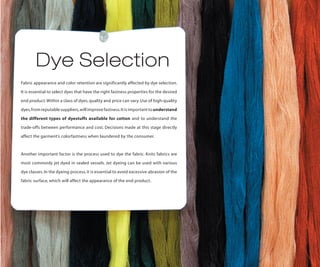
Dye Selection
Fabric appearance and color retention are significantly affected by dye selection.

It is essential to select dyes that have the right fastness properties for the desired

end product. Within a class of dyes, quality and price can vary. Use of high-quality

dyes, from reputable suppliers, will improve fastness. It is important to understand

the different types of dyestuffs available for cotton and to understand the

trade-offs between performance and cost. Decisions made at this stage directly

affect the garment’s colorfastness when laundered by the consumer.


Another important factor is the process used to dye the fabric. Knits fabrics are

most commonly jet dyed in sealed vessels. Jet dyeing can be used with various

dye classes. In the dyeing process, it is essential to avoid excessive abrasion of the

fabric surface, which will affect the appearance of the end product.
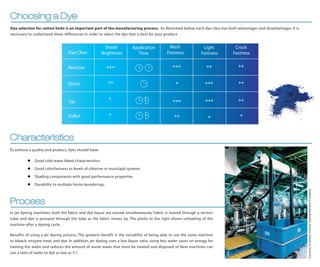
Choosing a Dye
Dye selection for cotton knits is an important part of the manufacturing process. As illustrated below, each dye class has both advantages and disadvantages. It is
necessary to understand these differences in order to select the dye that is best for your product.


                                                         Shade         Application           Wash                Light        Crock
                                   Dye Class           Brightness        Time               Fastness            Fastness     Fastness


                                   Reactive              +++                                   +++                 ++           ++


                                   Direct                 ++                                     +                +++           ++


                                                          +                                    +++                +++           ++
                                   Vat

                                   Sulfur                 +                                     ++                  +            +


Characteristics
To achieve a quality end product, dyes should have:

              Good cold water bleed characteristics

              Good colorfastness to levels of chlorine in municipal systems

              Shading components with good performance properties

              Durability to multiple home launderings


                                                                                                                                                                      Courtesy of Gaston County Dyeing Machine Company
Process
In jet dyeing machines, both the fabric and dye liquor are moved simultaneously. Fabric is moved through a venturi
tube, and dye is pumped through the tube as the fabric moves by. The photo to the right shows unloading of the
machine after a dyeing cycle.

Benefits of using a jet dyeing process: The greatest benefit is the versatility of being able to use the same machine
to bleach, enzyme treat, and dye. In addition, jet dyeing uses a low liquor ratio; using less water saves on energy for
heating the water and reduces the amount of waste water that must be treated and disposed of. New machines can
use a ratio of water to dye as low as 5:1.
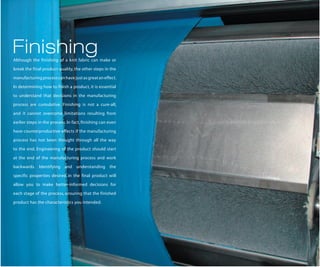
Finishing
Although the finishing of a knit fabric can make or

break the final product quality, the other steps in the

manufacturing process can have just as great an effect.

In determining how to finish a product, it is essential

to understand that decisions in the manufacturing

process are cumulative. Finishing is not a cure-all,

and it cannot overcome limitations resulting from

earlier steps in the process. In fact, finishing can even

have counterproductive effects if the manufacturing

process has not been thought through all the way

to the end. Engineering of the product should start

at the end of the manufacturing process and work

backwards. Identifying and understanding the

specific properties desired in the final product will

allow you to make better-informed decisions for

each stage of the process, ensuring that the finished

product has the characteristics you intended.
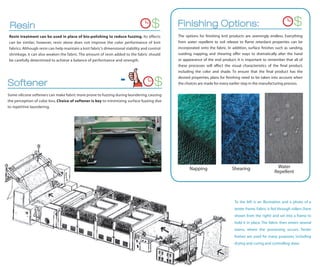
Resin                                                                               $        Finishing Options:                                                     $
Resin treatment can be used in place of bio-polishing to reduce fuzzing. Its effects          The options for finishing knit products are seemingly endless. Everything
can be similar; however, resin alone does not improve the color performance of knit           from water repellent to soil release to flame retardant properties can be
fabrics. Although resin can help maintain a knit fabric’s dimensional stability and control   incorporated onto the fabric. In addition, surface finishes such as sanding,
shrinkage, it can also weaken the fabric. The amount of resin added to the fabric should      sueding, napping, and shearing offer ways to dramatically alter the hand
be carefully determined to achieve a balance of performance and strength.                     or appearance of the end product. It is important to remember that all of
                                                                                              these processes will affect the visual characteristics of the final product,
                                                                                              including the color and shade. To ensure that the final product has the


Softener                                                           -                   $
                                                                                              desired properties, plans for finishing need to be taken into account when
                                                                                              the choices are made for every earlier step in the manufacturing process.

Some silicone softeners can make fabric more prone to fuzzing during laundering, causing
the perception of color loss. Choice of softener is key to minimizing surface fuzzing due
to repetitive laundering.


                                                                                                    Napping                   Shearing                   Water
                                                                                                                                                        Repellent


                                                                                                                               To the left is an illustration and a photo of a
                                                                                                                               tenter frame. Fabric is fed through rollers (here
                                                                                                                               shown from the right) and set into a frame to
                                                                                                                               hold it in place. The fabric then enters several
                                                                                                                               ovens, where the processing occurs. Tenter
                                                                                                                               frames are used for many purposes, including
                                                                                                                               drying and curing and controlling skew.
Consumer Care
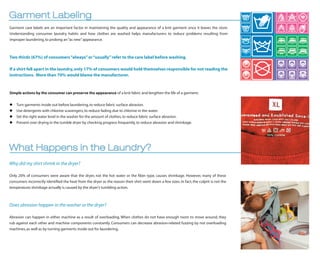
Garment Labeling
Garment care labels are an important factor in maintaining the quality and appearance of a knit garment once it leaves the store.
Understanding consumer laundry habits and how clothes are washed helps manufacturers to reduce problems resulting from
improper laundering, to prolong an “as new” appearance.


Two thirds (67%) of consumers “always” or “usually” refer to the care label before washing.

If a shirt fell apart in the laundry, only 17% of consumers would hold themselves responsible for not reading the
instructions. More than 70% would blame the manufacturer.


Simple actions by the consumer can preserve the appearance of a knit fabric and lengthen the life of a garment:


   Turn garments inside out before laundering, to reduce fabric surface abrasion.
   Use detergents with chlorine scavengers, to reduce fading due to chlorine in the water.
   Set the right water level in the washer for the amount of clothes, to reduce fabric surface abrasion.
   Prevent over drying in the tumble dryer by checking progress frequently, to reduce abrasion and shrinkage.


What Happens in the Laundry?
Why did my shirt shrink in the dryer?

Only 20% of consumers were aware that the dryer, not the hot water or the fiber type, causes shrinkage. However, many of these
consumers incorrectly identified the heat from the dryer as the reason their shirt went down a few sizes. In fact, the culprit is not the
temperature; shrinkage actually is caused by the dryer’s tumbling action.


Does abrasion happen in the washer or the dryer?

Abrasion can happen in either machine as a result of overloading. When clothes do not have enough room to move around, they
rub against each other and machine components constantly. Consumers can decrease abrasion-related fuzzing by not overloading
machines, as well as by turning garments inside out for laundering.
Cotton Incorporated
                       World Headquarters
                           6 39 9 Wes to n Par k way
                               Car y, N C 27 51 3
                             Tel. (91 9) 67 8-2 22 0
                             Fax (91 9) 67 8-2 23 1
                             www.cottoninc.com

New York      Osaka       Shanghai          Hong Kong      Mexico City

Optimized Knits booket

  • 1.
    How to the ect 100% Knit Create P erf Cotton A Technical Guide to Improving Your Knit Products PRODUCE FIRST QUALITY KNITS REDUCE SURFACE FUZZING 100 Cot % INCREASE COLOR RETENTION ton CONTROL SHRINKAGE
  • 2.
    About 60% ofall garments sold at retail in the United States are knit products. In order to engineer the performance right your customers expect in a knit garment at the price they are willing to pay, it is important to make the decisions about each stage of the manufacturing process. Today’s customers have myriad choices in apparel, so they often show little brand loyalty, and if a purchase fails to meet their expectations , they are often willing to try something different. The consumer’s garment care practices can significantly affect the overall appearance and performance of a cotton knit garment. Improper care results in disruption of the fabric surface, causing the garment to lose its new appearance and to wear out prematurely. If a knit product has a tendency to fuzz easily or lose its color quickly, this only makes the problem worse. Consumers average 5 loads of laundry per week and expect to wash a dark garment 15 times before it fades.
  • 3.
    n 1 00%Cotto How to Create the Perfect Knit A Technical Guide to Improving Your Knit Products For over 25 years, Cotton Incorporated has conducted research examining the various cotton knit manufacturing processes and their effects on the performance and overall quality of the resulting consumer products. The quality of the final product is directly affected by decisions made about the manufacturing process with respect to fiber selection, yarn spinning systems, fabric construction, fabric preparation, and dyeing and finishing. Decisions about any of these manufacturing steps can give rise to problems downstream that may not be easily remedied, resulting in a less-than-optimal product. Such problems can be anticipated and prevented if you make well-informed decisions to engineer a product that meets both the retailer’s performance specifications and price point and the consumer’s expectation of quality. Savvy choices will result in a product that is a good value and performs well in terms of color retention, fabric appearance, and shrinkage. Armed with knowledge of the various manufacturing operations and how each step affects the next, your company can make better-informed decisions that will help you • save time and money at each manufacturing stage, by reducing costly mistakes and off-quality goods, • deliver a higher-quality product, resulting in fewer customer returns and greater consumer satisfaction, and • develop value-added products that garner higher margins.
  • 4.
    Type of Product Decision Chart for Production of Knit Garments Being Made? Fiber Yarn Murata Vortex Carding Drawing Selection Quality? Spinning Combing Open End Pique Spinning Type of Fabric to be Product Interlock Roving Knit? Color? Compact Ring Spinning Jersey Conventional Ring Spinning Scour Bleach Cost? Fabric Characteristics? Performance? Understanding the interactions between manufacturing stages, the influence of one step on another, and the trade-offs that can be made will increase both the profitability and quality of your knit products. Bio-Polish No Bio-Polish Cost? This guide will walk you through the manufacturing process, step by step. Each important decision, from Fabric Characteristics? choice of spinning system to dye selection to choice of finishing process(es), will be addressed in terms Performance? of the effect it has not only on the final product, but also on downstream manufacturing steps. Vats Reactives Directs Cotton Incorporated offers unmatched industry knowledge and expertise, based on decades of experience and a comprehensive understanding of every step of the knit manufacturing process. The information presented here provides a head start to creating a high-quality knit garment. However, to Cost? Fabric Characteristics? truly create the perfect 100% cotton knit for your company’s purposes, please consult one of our experts Performance? in any of the fields addressed in this guide. Our experts will discuss with you the particulars of your manufacturing process and tailor the answers to meet your specific needs. Chemical Mechanical Finishing Finishing
  • 5.
    Throughout this manualfour different symbols will be used to indicate probable outcomes for options at each step. Key Learnings from this Guide: Below are the definitions and parameters of each symbols.  The yarn spinning system can have a direct effect on fuzzing during home Processing Time: Processes with this symbol will require additional manufacturing time. laundering, though it has little effect on color performance itself. $ Cost: Processes with this symbol will require additional expense.  Bio-polishing is an option to control fabric fuzzing Hand of final knit garment: Processes with this symbol create a favorable hand to the end  Surface fuzz on knit fabrics can create product. the appearance of color loss. +/- Fabric Appearance after Consumer Laundering: A plus (+) denotes positive appearance  Colorfastness is significantly affected characteristics (less fuzzing and pilling, greater color retention) while a minus (-) indicates by dye selection, as well as consumer the fabric will show greater amounts of pilling and fuzzing, and less apparent color care, including detergent selection. retention. See photo below  Selection of dyestuffs is a critical + step; reactive dyes maintain their color strength and shade better than direct or sulfur dyes.  Resin finishing is an alternative to bio-polishing for control of fabric fuzzing. A visual fuzzing scale used to numerically rate  Softener selection influences surface appearance and color retention.  The overall sequence of manufacturing processes can affect fabrics after laundering color performance.  Consumer care practices can affect fabric surface appearance - It is important to note the above symbols are assigned to each alternative in relation to other options at that particular point in the manufacturing process, and are meant to be used strictly as a guideline in making decisions. The actual amount of increased time or cost will depend on the specific manufacturer.
  • 6.
    Fiber Processing and YarnSpinning Cotton fiber properties directly affect a knit garment’s quality, appearance, and performance. It is important to select cotton fiber with the appropriate properties for each specific end product. It also is important to choose the appropriate spinning system to produce cotton yarn that will yield the desired fabric characteristics. The three current spinning systems have different effects on the yarn structure and therefore on the final product. Sourcing companies must determine which combination of fiber and spinning system will result in a knit product with the desired key characteristics. Decisions made about yarn spinning will affect appearance, softness (which depends on yarn hairiness and twist), color retention, yarn strength for performance, and cost factors related to spinning.
  • 7.
    Ring Spinning Open End Spinning Vortex Spinning (Conventional & Compact) $$$ $ $$ Courtesy of Sussa Courtesy of Murata Conventional spun yarn Courtesy of M.J. Grimson shown on the left, compact spun yarn on the right in Courtesy of M.J. Grimson both photos Conventional ring spinning is the oldest production method used today, yet incorporates many of the Open-end rotor spinning has a production rate up latest technologies. It is also the most expensive and to ten times that of ring spinning. Open-end rotor time-intensive system, because of the roving step at spinning begins with sliver fed into a combing or Vortex spinning, a form of air-jet spinning, has the the beginning and the winding step at the end. This opening roller. This process separates the sliver highest production rate of all the spinning systems. system allows for the largest range of yarn counts into individual fibers, which are transferred into a It begins with sliver fed into a high-speed roller and is capable of spinning especially fine counts. rapidly spinning rotor where the sliver meets the and apron drafting system. An air vortex imparts Compact ring spinning differs from conventional tail of the feeder yarn. Twist is inserted into the twist to the leading fibers as the fibers leave the ring spinning by using suction in the bottom roller exposed yarn end. The yarn package is ready to front roller; the air wraps the leading fibers around to control the fiber in a more uniform manner. As a be used right off the machine. Open-end spinning the core fibers. Yarn packages are ready to use result, the fibers are more tightly condensed when produces a smaller range of yarn counts than ring right off the machine. exiting the front roller. (See the photo above right.) spinning. Yarn Characteristics Note: Ring spinning is used as a benchmark for comparison of spinning systems Conventional Compact Open End Vortex Ring Spinning Ring Spinning Spinning Spinning Strength Lower cost High production rate Strength Flexible yarn count High production rate Yarn evenness Low yarn hariness S and Z twist yarns Lowest yarn hariness Resistance to abrasion Less bulky yarn High yarn hariness Yarn evenness Strength Less soft fabric hand Fabric fuzzing Limited yarn counts Low yarn hariness Low production rate Soft fabric hand Less soft fabric hand Less soft fabric hand High cost Strength Critical system to Low production rate Z twist only operate
  • 8.
    Proper fabric constructionis essential to creating a well- engineered garment. Fabric construction must be engineered from the start of the manufacturing process, through selection of the right fiber, the appropriate yarn for the specific knitting machine, and the right stitch length. At the next step of the process, dyeing and finishing can either improve or impair the Fabric performance of any given fabric construction. To produce a knit fabric that delivers the best performance at the desired Construction cost, well-engineered construction must be combined with the appropriate dyeing and finishing processes. A knitting mill should have knowledgeable staff who can engineer the fabric to the performance specifications provided by the customer.
  • 9.
    Engineering Cotton Knits Cottonknit products must be engineered for performance. This means they must be planned, constructed, and managed correctly at each step of the knitting process. Many factors relate directly to the performance of cotton knits, including fiber selection, yarn type and knitting parameters. The most critical considerations in engineering a cotton knit are the con- struction variables and the length processing tensions. Construction variables: Factors relating to construction include fiber type, yarn type, machine gauge and diameter, stitch length, and type of stitch. This section focuses on the elements that are selected and controlled by the knitter. Yarn: Four main factors determine a yarn’s performance: size, type, twist multiple, and twist direction. The size of cotton yarn relates to its yield, width, and performance. Yarn size usually is measured by a cotton count system, which is an indirect numbering system; by the English cotton count system (Ne), the higher the yarn number, the smaller the yarn. Yarn type captures the spinning process used, how the yarn was assembled (e.g., single or plied), and whether it is a spun yarn or a filament yarn. Finally, yarn type and twist determine the hand, appearance, and strength of the fabric, and they are the main factors affecting skew or torque. TURNS PER INCH The shorter the stitch length: The longer the stitch length: TM (Twist Multiple) = √NE the less yarn in a stitch the more yarn in a stitch Machine Gauge: the tighter the stitch the looser the stitch The machine gauge or cut is determined by the number of needles and the diameter of the machine. When the less the length shrinkage the more the length shrinkage selecting a machine gauge, you are also selecting a range of yarn sizes. Only certain yarn counts can be used the more the width shrinkage the more the width shrinkage on each type of knitting machine, and this factor determines the types of knit products that can be produced the narrower the fabric the wider the fabric from a given machine. Generally, the higher the machine gauge, the finer the yarns that can be knitted. the heavier the fabric the lighter the fabric the firmer the hand the softer the hand Stitch Length: Stitch length is the amount of yarn in one stitch repeat, and course length refers to the amount of yarn used in one revolution of the knitting machine. Stitch length affects the weight, width, and shrinkage of the fabric. If the stitch is too short, excessive stress on the yarn and knitting elements can result in holes. If the stitch is too long, dropped stitches are more likely. It is important to determine the proper stitch length for the desired fabric properties. As shown in the chart to the right, short and long stitches affect the fabric’s performance in very different ways. A measurement related to stitch length is the tightness factor, a number that indicates the relative tightness of knitting, taking into account both the thickness of the yarn and the length of the loops. The tightness factor is important because when this number is out of range, the machine can operate at lower efficiency and produce a fabric with defects or a harsher hand. In addition, knitting costs can be higher, because higher-quality yarn is needed than for the same type of fabric knit with a lower tightness factor. English Metric Suggested Tightness Factor Ranges 9.567 √TEX TF (Tightness Factor) = Normal Limits L in √NE L cm Single 14-18 12-20 Type of stitch: Interlock 10-14 8-16 Three basic stitches are available to a knitter: jersey, tuck, and float.These three stitches 1X1 Rib 14-18 12-20 are combined to create a multitude of design and performance characteristics in Single Pique 14-18 12-20 knit fabrics. Illustrations of these stitches can be seen to the far right. Six-Thread Pique 14-18 12-20
  • 10.
  • 11.
    Controlling Shrinkage In today’scompetitive markets, where high quality is expected at a low price, apparel companies are demanding low shrinkage. Furthermore, shrinkage must be consistent from garment to garment in the same style and fabric construction. The term “shrinkage” is commonly used to mean any dimensional change in a fabric or garment - either shrinkage or growth - caused by the application of force or a change in environment. For a cotton garment, shrinkage characteristics affect parameters such as seam puckering, torquing, and overall garment fit. Shrinkage during the manufacturing process is caused by two types of factors: those relating to the construction of the fabric or garment and those relating to how the fabric or garment is processed. Construction Shrinkage: Dimensional changes during construction occur as a result of such parameters as fiber, yarn, machine gauge, total number of needles, stitch or course length, and type of stitch. This type of shrinkage is controlled by careful selection of construction parameters to meet fabric specifications. Processing Shrinkage: Dimensional changes during processing can occur during any dyeing or finishing step (whether chemical or mechanical) and usually affect both the length and width of the fabric. Keys to reducing shrinkage and improving fabric performance are processing the fabric with minimal tension and using compacting or relaxed drying steps. Various wet processing techniques have different effects on shrinkage. In general, batch processing (in a jet dyeing machine) applies less linear tension on the fabric than continuous processing. Processes such as napping, sanding, and merceriza- tion apply high tension, while others such as relaxed drying apply low tension. Weft knits can be processed either open width or in tubular form. Each process applies tension in different ways, and different processes used on the same greige and dyed fabric will result in different performance. Resin treatment also has a Width stretched huge effect on both fabric strength and shrinkage. Above and right are illustrations of a regular Relaxed Drying Relaxed stitch fabric and fabrics that have been stretched. Length stretched and Compacting Relaxed drying and compacting are two methods used for shrinkage control in knit fabrics. On the opposite page is a photo of a compacting machine. Below is an illustration of the relaxed drying process and a photo of the actual drying machine. In this illustration, fabric is fed in from the left into the dryer where it is dried with slack in the fabric to allow it to return to its pre-engineered shape.
  • 12.
    Fabric Preparation In the preparationstage, the greige cotton fabric is scoured and/or bleached to remove impurities, thus increasing its whiteness and absorbency. This step prepares the fabric to receive dye or other wet processes. One additional step that can be performed before dyeing, to ensure an end product free of surface fuzz, is bio-polishing. Bio-polishing is a cellulase enzyme treatment that removes cotton fibers protruding from the yarn or fabric surface to create a less hairy knit fabric with clear stitch definition. Bio-polishing is one way to clean up the surface of a fabric made of lower- quality yarn, but it should not be considered a cure-all for poor-quality, excessively hairy yarn. Courtesy of Carolina Cotton Works, Inc. The photo to the right shows a Jemco Bleaching machine
  • 13.
    No Bio-Polish - With Bio-Polish + $ Fabrics not treated with cellulase enzymes tend to have more surface Bio-polishing can reduce fabric surface disruption on a garment fuzzing after 20 home launderings. during home laundering. Applied correctly, it can impart an “as new” appearance that is maintained for the life of the garment. The However, if fabric is to be finished with a resin treatment, bio-polishing combination of bio-polishing and a resin finish was most effective in may not be necessary, because the resin will inhibit fuzzing during home reducing shade change after multiple launderings. However, using laundering and tumble drying. Choosing a less hairy yarn also could both bio-polishing and resin adds an extra bath, which translates to eliminate the need for bio-polishing. extra processing time and cost. The photos show non-enzyme treated (below) and enzyme treated (right) knit fabrics after laundering, as well as a close up of the fibers. How are fabrics bio-polished? Manufacturers use a bath or series of baths to bio-polish fabrics. Depending on other factors in the manufacturing process, this step can be done before or after dyeing. Bio-polishing parameters must be strictly controlled to avoid damage to the fabric as a result of the process. Processing time, temperature, pH, and the amount of enzyme in the bath must all be coordinated to achieve the desired result. If these factors are not at the correct levels, the fabric may have excessive loss of weight and strength.
  • 14.
    Dye Selection Fabric appearanceand color retention are significantly affected by dye selection. It is essential to select dyes that have the right fastness properties for the desired end product. Within a class of dyes, quality and price can vary. Use of high-quality dyes, from reputable suppliers, will improve fastness. It is important to understand the different types of dyestuffs available for cotton and to understand the trade-offs between performance and cost. Decisions made at this stage directly affect the garment’s colorfastness when laundered by the consumer. Another important factor is the process used to dye the fabric. Knits fabrics are most commonly jet dyed in sealed vessels. Jet dyeing can be used with various dye classes. In the dyeing process, it is essential to avoid excessive abrasion of the fabric surface, which will affect the appearance of the end product.
  • 15.
    Choosing a Dye Dyeselection for cotton knits is an important part of the manufacturing process. As illustrated below, each dye class has both advantages and disadvantages. It is necessary to understand these differences in order to select the dye that is best for your product. Shade Application Wash Light Crock Dye Class Brightness Time Fastness Fastness Fastness Reactive +++ +++ ++ ++ Direct ++ + +++ ++ + +++ +++ ++ Vat Sulfur + ++ + + Characteristics To achieve a quality end product, dyes should have:  Good cold water bleed characteristics  Good colorfastness to levels of chlorine in municipal systems  Shading components with good performance properties  Durability to multiple home launderings Courtesy of Gaston County Dyeing Machine Company Process In jet dyeing machines, both the fabric and dye liquor are moved simultaneously. Fabric is moved through a venturi tube, and dye is pumped through the tube as the fabric moves by. The photo to the right shows unloading of the machine after a dyeing cycle. Benefits of using a jet dyeing process: The greatest benefit is the versatility of being able to use the same machine to bleach, enzyme treat, and dye. In addition, jet dyeing uses a low liquor ratio; using less water saves on energy for heating the water and reduces the amount of waste water that must be treated and disposed of. New machines can use a ratio of water to dye as low as 5:1.
  • 16.
    Finishing Although the finishingof a knit fabric can make or break the final product quality, the other steps in the manufacturing process can have just as great an effect. In determining how to finish a product, it is essential to understand that decisions in the manufacturing process are cumulative. Finishing is not a cure-all, and it cannot overcome limitations resulting from earlier steps in the process. In fact, finishing can even have counterproductive effects if the manufacturing process has not been thought through all the way to the end. Engineering of the product should start at the end of the manufacturing process and work backwards. Identifying and understanding the specific properties desired in the final product will allow you to make better-informed decisions for each stage of the process, ensuring that the finished product has the characteristics you intended.
  • 17.
    Resin $ Finishing Options: $ Resin treatment can be used in place of bio-polishing to reduce fuzzing. Its effects The options for finishing knit products are seemingly endless. Everything can be similar; however, resin alone does not improve the color performance of knit from water repellent to soil release to flame retardant properties can be fabrics. Although resin can help maintain a knit fabric’s dimensional stability and control incorporated onto the fabric. In addition, surface finishes such as sanding, shrinkage, it can also weaken the fabric. The amount of resin added to the fabric should sueding, napping, and shearing offer ways to dramatically alter the hand be carefully determined to achieve a balance of performance and strength. or appearance of the end product. It is important to remember that all of these processes will affect the visual characteristics of the final product, including the color and shade. To ensure that the final product has the Softener - $ desired properties, plans for finishing need to be taken into account when the choices are made for every earlier step in the manufacturing process. Some silicone softeners can make fabric more prone to fuzzing during laundering, causing the perception of color loss. Choice of softener is key to minimizing surface fuzzing due to repetitive laundering. Napping Shearing Water Repellent To the left is an illustration and a photo of a tenter frame. Fabric is fed through rollers (here shown from the right) and set into a frame to hold it in place. The fabric then enters several ovens, where the processing occurs. Tenter frames are used for many purposes, including drying and curing and controlling skew.
  • 18.
  • 19.
    Garment Labeling Garment carelabels are an important factor in maintaining the quality and appearance of a knit garment once it leaves the store. Understanding consumer laundry habits and how clothes are washed helps manufacturers to reduce problems resulting from improper laundering, to prolong an “as new” appearance. Two thirds (67%) of consumers “always” or “usually” refer to the care label before washing. If a shirt fell apart in the laundry, only 17% of consumers would hold themselves responsible for not reading the instructions. More than 70% would blame the manufacturer. Simple actions by the consumer can preserve the appearance of a knit fabric and lengthen the life of a garment:  Turn garments inside out before laundering, to reduce fabric surface abrasion.  Use detergents with chlorine scavengers, to reduce fading due to chlorine in the water.  Set the right water level in the washer for the amount of clothes, to reduce fabric surface abrasion.  Prevent over drying in the tumble dryer by checking progress frequently, to reduce abrasion and shrinkage. What Happens in the Laundry? Why did my shirt shrink in the dryer? Only 20% of consumers were aware that the dryer, not the hot water or the fiber type, causes shrinkage. However, many of these consumers incorrectly identified the heat from the dryer as the reason their shirt went down a few sizes. In fact, the culprit is not the temperature; shrinkage actually is caused by the dryer’s tumbling action. Does abrasion happen in the washer or the dryer? Abrasion can happen in either machine as a result of overloading. When clothes do not have enough room to move around, they rub against each other and machine components constantly. Consumers can decrease abrasion-related fuzzing by not overloading machines, as well as by turning garments inside out for laundering.
  • 20.
    Cotton Incorporated World Headquarters 6 39 9 Wes to n Par k way Car y, N C 27 51 3 Tel. (91 9) 67 8-2 22 0 Fax (91 9) 67 8-2 23 1 www.cottoninc.com New York  Osaka  Shanghai  Hong Kong  Mexico City