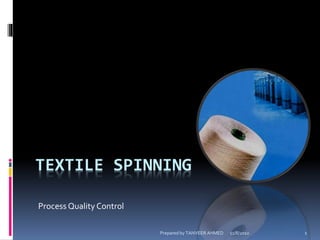
TEXTILE SPINNING
Process Quality Control
11/8/2010 1Prepared by TANVEER AHMED
TEXTILE SPINNING
The process or processes used in the production of single
yarns or of fabrics generated directly from polymer.
1. Yarn from Staple Fiber:
The formation of a yarn by a combination of drawing
or drafting and twisting prepared strands of fibers, such
as roving.
2. FilamentYarn:
In the spinning of manufactured filaments, fiber-forming
substances in the plastic or molten state, or in solution,
are forced through the fine orifices in a metallic plate
called a spinneret, or jet, at a controlled rate.The
solidified filaments are drawn-off by rotating rolls, or
godets, and wound onto bobbins or pirns.There are
several methods of spinning manufactured. Dry, Gel,
Wet, Melt, Reaction and Phase Separation Spinning.
11/8/2010 2Prepared by TANVEER AHMED
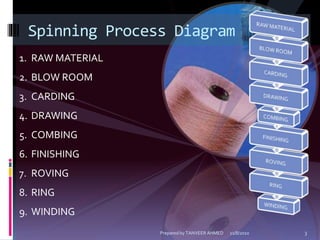
Spinning Process Diagram
1. RAW MATERIAL
2. BLOW ROOM
3. CARDING
4. DRAWING
5. COMBING
6. FINISHING
7. ROVING
8. RING
9. WINDING
11/8/2010 3Prepared by TANVEER AHMED
Quality of raw material can be defined in various terms, as we studies Garvin
categories quality into various terms.
1. Transcendent (product is superior to all competing products in every
way possible.)
2. Product based
3. User based
4. Manufacturing based
5. Value based
Quality Of Textile RAW MATERIAL
11/8/2010 4Prepared by TANVEER AHMED
Garvin Eight attributes for quality also can implies in textile
1. Performance of Material / Product / Process
2. Features
3. Reliability
4. Conformance
5. Durability
6. Serviceability
7. Aesthetic
8. Perceived quality
Quality Of Textile RAW MATERIAL
11/8/2010 5Prepared by TANVEER AHMED
Quality Of Textile RAW MATERIAL
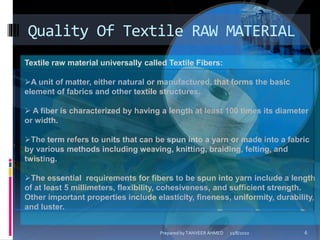
Textile raw material universally called Textile Fibers:
A unit of matter, either natural or manufactured, that forms the basic
element of fabrics and other textile structures.
 A fiber is characterized by having a length at least 100 times its diameter
or width.
The term refers to units that can be spun into a yarn or made into a fabric
by various methods including weaving, knitting, braiding, felting, and
twisting.
The essential requirements for fibers to be spun into yarn include a length
of at least 5 millimeters, flexibility, cohesiveness, and sufficient strength.
Other important properties include elasticity, fineness, uniformity, durability,
and luster.
11/8/2010 6Prepared by TANVEER AHMED
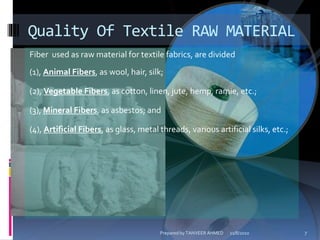
Fiber used as raw material for textile fabrics, are divided
(1), Animal Fibers, as wool, hair, silk;
(2), Vegetable Fibers, as cotton, linen, jute, hemp, ramie, etc.;
(3), Mineral Fibers, as asbestos; and
(4), Artificial Fibers, as glass, metal threads, various artificial silks, etc.;
Quality Of Textile RAW MATERIAL
11/8/2010 7Prepared by TANVEER AHMED
Quality control and Quality assurance for textile evaluated throughTesting
Process.
TEXTILETESTINGCAN BE DIVIDED INTO:
1- CHEMICALTESTING
2- PHYSICALTESTING
The textile engineer or technologist in the quality of a product by doing:
 In –Process of FinalVerification
 Visual Inspection
 Hand Appraisal
 Laboratory Testing and Quality Control
For some tests, internationally recognized standards exist, such as :
 ASTM
 ISO
 ANSI
 AATCC etc.
Quality Of Textile RAW MATERIAL
11/8/2010 8Prepared by TANVEER AHMED
TEXTILE FiberTesting:
100% cotton samples in the form of bale or opened and cleaned material
(card mat).
Measurements
Micronaire
• Maturity Index
• UHML – Upper Half Mean Length
• UI – Uniformity Index
• SFI – Short Fiber Index
• Fiber Strength in g/Tex
• Elongation
• Moisture Content
• Color (Reflectance Rd,Yellowness +b) & Color Grade (USDA Upland, Pima, or
regional
customized color chart)
•Trash (% Area,Trash Count) &Trash Grade (USDA)
Quality Of Textile RAW MATERIAL
11/8/2010 9Prepared by TANVEER AHMED
TEXTILE FiberTesting:
100% cotton samples in the form of bale or opened and cleaned material
(card mat).
Measurements
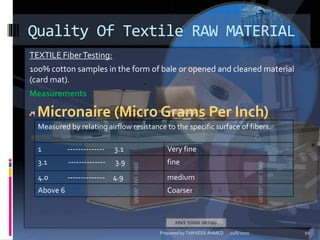
Micronaire (Micro Grams Per Inch)
Quality Of Textile RAW MATERIAL
Measured by relating airflow resistance to the specific surface of fibers.
1 -------------- 3.1 Very fine
3.1 -------------- 3.9 fine
4.0 -------------- 4.9 medium
Above 6 Coarser
11/8/2010 10Prepared by TANVEER AHMED
TEXTILE FiberTesting:
100% cotton samples in the form of bale or opened and cleaned material
(card mat).
Measurements
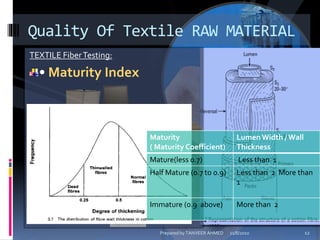
• Maturity Index
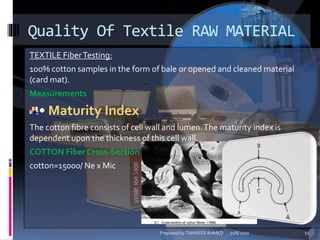
The cotton fibre consists of cell wall and lumen.The maturity index is
dependent upon the thickness of this cell wall.
COTTON Fiber Cross-Section
cotton=15000/ Ne x Mic
Quality Of Textile RAW MATERIAL
11/8/2010 11Prepared by TANVEER AHMED
TEXTILE FiberTesting:
• Maturity Index
Quality Of Textile RAW MATERIAL
Maturity
( Maturity Coefficient)
LumenWidth / Wall
Thickness
Mature(less 0.7) Less than 1
Half Mature (0.7 to 0.9) Less than 2 More than
1
Immature (0.9 above) More than 2
11/8/2010 12Prepared by TANVEER AHMED
TEXTILE FiberTesting:
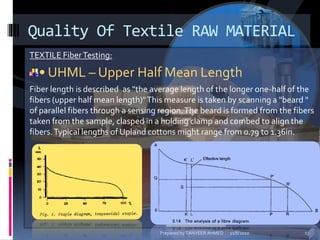
• UHML – Upper Half Mean Length
Fiber length is described as "the average length of the longer one-half of the
fibers (upper half mean length)"This measure is taken by scanning a "beard "
of parallel fibers through a sensing region.The beard is formed from the fibers
taken from the sample, clasped in a holding clamp and combed to align the
fibers.Typical lengths of Upland cottons might range from 0.79 to 1.36in.
Quality Of Textile RAW MATERIAL
11/8/2010 13Prepared by TANVEER AHMED
TEXTILE FiberTesting:
• UHML – Upper Half Mean Length
Quality Of Textile RAW MATERIAL
11/8/2010 14Prepared by TANVEER AHMED
TEXTILE FiberTesting:
• UI – Uniformity Index
Length uniformity or uniformity ratio is determined as " a ratio between
the mean length and the upper half mean length of the fibers and is
expressed as a percentage“
with the Fibrogram.The span lengths at given percentages of fibres are
usually measured; the 2.5% span length is considered to correlate with
the classer's staple length. From the 50% span length and the 2.5% span
length.
a uniformity index can be calculated:
Quality Of Textile RAW MATERIAL
LENGTH
UNIFORMITY
UNIFORMITY
INDEX [%]
Very High >85
High 83-85
Intermediate 80-82
Low 77-79
Very Low <77
11/8/2010 15Prepared by TANVEER AHMED
QUALITY OF BLOW-ROOM
11/8/2010 16Prepared by TANVEER AHMED
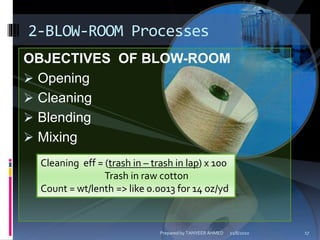
OBJECTIVES OF BLOW-ROOM
 Opening
 Cleaning
 Blending
 Mixing
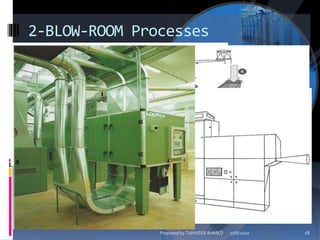
2-BLOW-ROOM Processes
Cleaning eff = (trash in – trash in lap) x 100
Trash in raw cotton
Count = wt/lenth => like 0.0013 for 14 oz/yd
11/8/2010 17Prepared by TANVEER AHMED
2-BLOW-ROOM Processes
11/8/2010 18Prepared by TANVEER AHMED
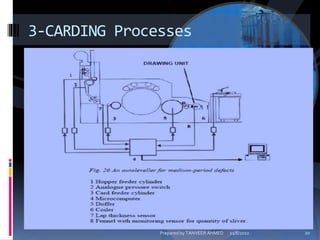
3-CARDING Processes
11/8/2010 19Prepared by TANVEER AHMED
3-CARDING Processes
11/8/2010 20Prepared by TANVEER AHMED
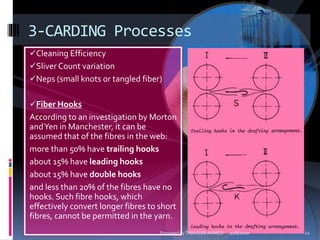
3-CARDING Processes
Cleaning Efficiency
Sliver Count variation
Neps (small knots or tangled fiber)
Fiber Hooks
According to an investigation by Morton
andYen in Manchester, it can be
assumed that of the fibres in the web:
more than 50% have trailing hooks
about 15% have leading hooks
about 15% have double hooks
and less than 20% of the fibres have no
hooks. Such fibre hooks, which
effectively convert longer fibres to short
fibres, cannot be permitted in the yarn.
11/8/2010 21Prepared by TANVEER AHMED
3-CARDING Processes
Reversal of the dispositions of hooks between the card and the comber.
C, card; D, sliver lap machine; E, ribbon lap machine; F, comber.
Reversal of the dispositions of hooks between the card and the ring spinning machine.
H, roving frame
C, card;
GI, drawframe GIl, drawframe II
H, roving frame
R, ring spinning machine
11/8/2010 22Prepared by TANVEER AHMED
DRAWING PROCESSES
11/8/2010 23Prepared by TANVEER AHMED
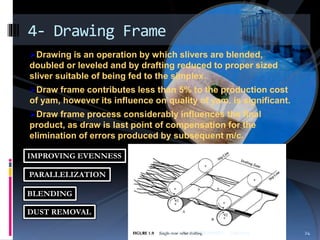
Drawing is an operation by which slivers are blended,
doubled or leveled and by drafting reduced to proper sized
sliver suitable of being fed to the simplex.
Draw frame contributes less than 5% to the production cost
of yam, however its influence on quality of yam. is significant.
Draw frame process considerably influences the final
product, as draw is last point of compensation for the
elimination of errors produced by subsequent m/c.
4- Drawing Frame
IMPROVING EVENNESS
PARALLELIZATION
BLENDING
DUST REMOVAL
11/8/2010 24Prepared by TANVEER AHMED
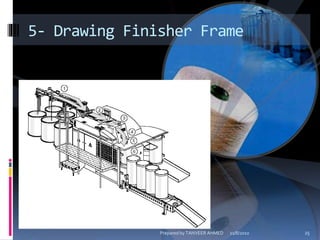
5- Drawing Finisher Frame
11/8/2010 25Prepared by TANVEER AHMED
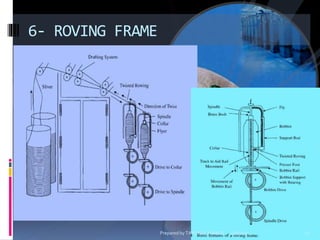
6- ROVING FRAME
A roving is a continuous fibrous strand drafted from a sliver
and given cohesion by either inserting a small amount of twist
or compacting the fibers with an oscillating apron. It is drafted
and twisted to be spun into a yarn
FL-16,
FL-100
DRAFT RANGE = 7TO 8
11/8/2010 26Prepared by TANVEER AHMED
.
6- ROVING FRAME
11/8/2010 27Prepared by TANVEER AHMED
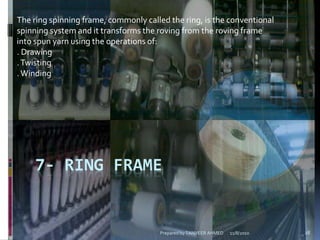
7- RING FRAME
The ring spinning frame, commonly called the ring, is the conventional
spinning system and it transforms the roving from the roving frame
into spun yarn using the operations of:
. Drawing
.Twisting
.Winding
11/8/2010 28Prepared by TANVEER AHMED
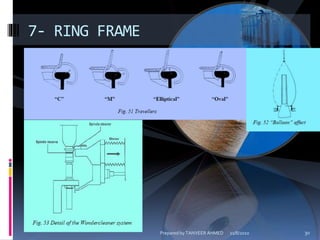
7- RING FRAME
Deviation of
count
Variation of
strength
Count variation Elongation
Twist variation Remaining
disturbing thick
and thin places
Direction of yarn
twist
Remaining
foreign fibers
Evenness
11/8/2010 29Prepared by TANVEER AHMED
7- RING FRAME
11/8/2010 30Prepared by TANVEER AHMED

Textile spinning

  • 1.
    TEXTILE SPINNING Process QualityControl 11/8/2010 1Prepared by TANVEER AHMED
  • 2.
    TEXTILE SPINNING The processor processes used in the production of single yarns or of fabrics generated directly from polymer. 1. Yarn from Staple Fiber: The formation of a yarn by a combination of drawing or drafting and twisting prepared strands of fibers, such as roving. 2. FilamentYarn: In the spinning of manufactured filaments, fiber-forming substances in the plastic or molten state, or in solution, are forced through the fine orifices in a metallic plate called a spinneret, or jet, at a controlled rate.The solidified filaments are drawn-off by rotating rolls, or godets, and wound onto bobbins or pirns.There are several methods of spinning manufactured. Dry, Gel, Wet, Melt, Reaction and Phase Separation Spinning. 11/8/2010 2Prepared by TANVEER AHMED
  • 3.
    Spinning Process Diagram 1.RAW MATERIAL 2. BLOW ROOM 3. CARDING 4. DRAWING 5. COMBING 6. FINISHING 7. ROVING 8. RING 9. WINDING 11/8/2010 3Prepared by TANVEER AHMED
  • 4.
    Quality of rawmaterial can be defined in various terms, as we studies Garvin categories quality into various terms. 1. Transcendent (product is superior to all competing products in every way possible.) 2. Product based 3. User based 4. Manufacturing based 5. Value based Quality Of Textile RAW MATERIAL 11/8/2010 4Prepared by TANVEER AHMED
  • 5.
    Garvin Eight attributesfor quality also can implies in textile 1. Performance of Material / Product / Process 2. Features 3. Reliability 4. Conformance 5. Durability 6. Serviceability 7. Aesthetic 8. Perceived quality Quality Of Textile RAW MATERIAL 11/8/2010 5Prepared by TANVEER AHMED
  • 6.
    Quality Of TextileRAW MATERIAL Textile raw material universally called Textile Fibers: A unit of matter, either natural or manufactured, that forms the basic element of fabrics and other textile structures.  A fiber is characterized by having a length at least 100 times its diameter or width. The term refers to units that can be spun into a yarn or made into a fabric by various methods including weaving, knitting, braiding, felting, and twisting. The essential requirements for fibers to be spun into yarn include a length of at least 5 millimeters, flexibility, cohesiveness, and sufficient strength. Other important properties include elasticity, fineness, uniformity, durability, and luster. 11/8/2010 6Prepared by TANVEER AHMED
  • 7.
    Fiber used asraw material for textile fabrics, are divided (1), Animal Fibers, as wool, hair, silk; (2), Vegetable Fibers, as cotton, linen, jute, hemp, ramie, etc.; (3), Mineral Fibers, as asbestos; and (4), Artificial Fibers, as glass, metal threads, various artificial silks, etc.; Quality Of Textile RAW MATERIAL 11/8/2010 7Prepared by TANVEER AHMED
  • 8.
    Quality control andQuality assurance for textile evaluated throughTesting Process. TEXTILETESTINGCAN BE DIVIDED INTO: 1- CHEMICALTESTING 2- PHYSICALTESTING The textile engineer or technologist in the quality of a product by doing:  In –Process of FinalVerification  Visual Inspection  Hand Appraisal  Laboratory Testing and Quality Control For some tests, internationally recognized standards exist, such as :  ASTM  ISO  ANSI  AATCC etc. Quality Of Textile RAW MATERIAL 11/8/2010 8Prepared by TANVEER AHMED
  • 9.
    TEXTILE FiberTesting: 100% cottonsamples in the form of bale or opened and cleaned material (card mat). Measurements Micronaire • Maturity Index • UHML – Upper Half Mean Length • UI – Uniformity Index • SFI – Short Fiber Index • Fiber Strength in g/Tex • Elongation • Moisture Content • Color (Reflectance Rd,Yellowness +b) & Color Grade (USDA Upland, Pima, or regional customized color chart) •Trash (% Area,Trash Count) &Trash Grade (USDA) Quality Of Textile RAW MATERIAL 11/8/2010 9Prepared by TANVEER AHMED
  • 10.
    TEXTILE FiberTesting: 100% cottonsamples in the form of bale or opened and cleaned material (card mat). Measurements Micronaire (Micro Grams Per Inch) Quality Of Textile RAW MATERIAL Measured by relating airflow resistance to the specific surface of fibers. 1 -------------- 3.1 Very fine 3.1 -------------- 3.9 fine 4.0 -------------- 4.9 medium Above 6 Coarser 11/8/2010 10Prepared by TANVEER AHMED
  • 11.
    TEXTILE FiberTesting: 100% cottonsamples in the form of bale or opened and cleaned material (card mat). Measurements • Maturity Index The cotton fibre consists of cell wall and lumen.The maturity index is dependent upon the thickness of this cell wall. COTTON Fiber Cross-Section cotton=15000/ Ne x Mic Quality Of Textile RAW MATERIAL 11/8/2010 11Prepared by TANVEER AHMED
  • 12.
    TEXTILE FiberTesting: • MaturityIndex Quality Of Textile RAW MATERIAL Maturity ( Maturity Coefficient) LumenWidth / Wall Thickness Mature(less 0.7) Less than 1 Half Mature (0.7 to 0.9) Less than 2 More than 1 Immature (0.9 above) More than 2 11/8/2010 12Prepared by TANVEER AHMED
  • 13.
    TEXTILE FiberTesting: • UHML– Upper Half Mean Length Fiber length is described as "the average length of the longer one-half of the fibers (upper half mean length)"This measure is taken by scanning a "beard " of parallel fibers through a sensing region.The beard is formed from the fibers taken from the sample, clasped in a holding clamp and combed to align the fibers.Typical lengths of Upland cottons might range from 0.79 to 1.36in. Quality Of Textile RAW MATERIAL 11/8/2010 13Prepared by TANVEER AHMED
  • 14.
    TEXTILE FiberTesting: • UHML– Upper Half Mean Length Quality Of Textile RAW MATERIAL 11/8/2010 14Prepared by TANVEER AHMED
  • 15.
    TEXTILE FiberTesting: • UI– Uniformity Index Length uniformity or uniformity ratio is determined as " a ratio between the mean length and the upper half mean length of the fibers and is expressed as a percentage“ with the Fibrogram.The span lengths at given percentages of fibres are usually measured; the 2.5% span length is considered to correlate with the classer's staple length. From the 50% span length and the 2.5% span length. a uniformity index can be calculated: Quality Of Textile RAW MATERIAL LENGTH UNIFORMITY UNIFORMITY INDEX [%] Very High >85 High 83-85 Intermediate 80-82 Low 77-79 Very Low <77 11/8/2010 15Prepared by TANVEER AHMED
  • 16.
    QUALITY OF BLOW-ROOM 11/8/201016Prepared by TANVEER AHMED
  • 17.
    OBJECTIVES OF BLOW-ROOM Opening  Cleaning  Blending  Mixing 2-BLOW-ROOM Processes Cleaning eff = (trash in – trash in lap) x 100 Trash in raw cotton Count = wt/lenth => like 0.0013 for 14 oz/yd 11/8/2010 17Prepared by TANVEER AHMED
  • 18.
  • 19.
  • 20.
  • 21.
    3-CARDING Processes Cleaning Efficiency SliverCount variation Neps (small knots or tangled fiber) Fiber Hooks According to an investigation by Morton andYen in Manchester, it can be assumed that of the fibres in the web: more than 50% have trailing hooks about 15% have leading hooks about 15% have double hooks and less than 20% of the fibres have no hooks. Such fibre hooks, which effectively convert longer fibres to short fibres, cannot be permitted in the yarn. 11/8/2010 21Prepared by TANVEER AHMED
  • 22.
    3-CARDING Processes Reversal ofthe dispositions of hooks between the card and the comber. C, card; D, sliver lap machine; E, ribbon lap machine; F, comber. Reversal of the dispositions of hooks between the card and the ring spinning machine. H, roving frame C, card; GI, drawframe GIl, drawframe II H, roving frame R, ring spinning machine 11/8/2010 22Prepared by TANVEER AHMED
  • 23.
  • 24.
    Drawing is anoperation by which slivers are blended, doubled or leveled and by drafting reduced to proper sized sliver suitable of being fed to the simplex. Draw frame contributes less than 5% to the production cost of yam, however its influence on quality of yam. is significant. Draw frame process considerably influences the final product, as draw is last point of compensation for the elimination of errors produced by subsequent m/c. 4- Drawing Frame IMPROVING EVENNESS PARALLELIZATION BLENDING DUST REMOVAL 11/8/2010 24Prepared by TANVEER AHMED
  • 25.
    5- Drawing FinisherFrame 11/8/2010 25Prepared by TANVEER AHMED
  • 26.
    6- ROVING FRAME Aroving is a continuous fibrous strand drafted from a sliver and given cohesion by either inserting a small amount of twist or compacting the fibers with an oscillating apron. It is drafted and twisted to be spun into a yarn FL-16, FL-100 DRAFT RANGE = 7TO 8 11/8/2010 26Prepared by TANVEER AHMED
  • 27.
    . 6- ROVING FRAME 11/8/201027Prepared by TANVEER AHMED
  • 28.
    7- RING FRAME Thering spinning frame, commonly called the ring, is the conventional spinning system and it transforms the roving from the roving frame into spun yarn using the operations of: . Drawing .Twisting .Winding 11/8/2010 28Prepared by TANVEER AHMED
  • 29.
    7- RING FRAME Deviationof count Variation of strength Count variation Elongation Twist variation Remaining disturbing thick and thin places Direction of yarn twist Remaining foreign fibers Evenness 11/8/2010 29Prepared by TANVEER AHMED
  • 30.
    7- RING FRAME 11/8/201030Prepared by TANVEER AHMED