Presentation by
Dr. S. Aishwariya,
INSPIRE FELLOW (DST) & Assistant Professor
Dept. of Textiles and Clothing
Avinashilingam University for Women, Coimbatore
Spinning and its types
Introduction
Ring spinning
Open end or Rotor spinning
Advance spinning system
1. COMPACT SPINNING
2. AIR JET SPINNING
3. VORTEX SPINNING
4. FRICTION SPINNING
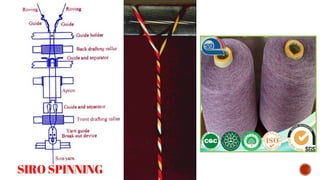
5. SIRO SPINNING
 Spinning – technique to convert short
staple fibers to continuous filament
called yarn by adding twisting and
winding
 Spinning Process - as in picture
 Types
 Ring spinning
 Open end/ rotor spinning
 Air jet spinning
 Friction spun
 Core spun
 Siro spun
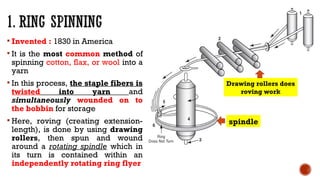
 Invented : 1830 in America
 It is the most common method of
spinning cotton, flax, or wool into a
yarn
 In this process, the staple fibers is
twisted into yarn and
simultaneously wounded on to
the bobbin for storage
 Here, roving (creating extension-
length), is done by using drawing
rollers, then spun and wound
around a rotating spindle which in
its turn is contained within an
independently rotating ring flyer
spindle
Drawing rollers does
roving work
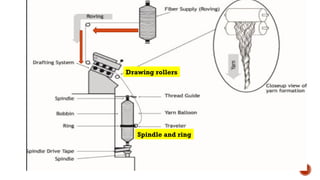
Drawing rollers
Spindle and ring
Any natural fiber can be spun in ring spinning
Any variation in twist, count, strength and density can be made.
Thus making it extremely popular yarn making technique
The fine fibres are tightly twisted together in ring spinning, which
results in stronger, cable-like yarn.
Ring spun yarns yield a strong and more durable fabric.
Thus ring spun yarns have superior yarn quality and extremely
versatile yarn.
Low cost of labour is one more merit
Machine generates more heat & low production Rate - DEMERITS
Invented in 1963 in Czechoslovakia
Other names OE, rotor, break spinning
Open end spinning is a technique that is
used to make yarns without using a
spindle (unlike ring spinning)
Process:
In this the sliver is separated into single
fibers and brought into the region using
jet of air, and further twisting and
winding is done
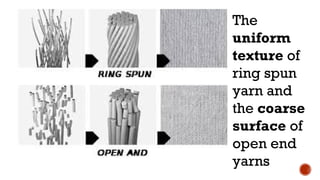
The
uniform
texture of
ring spun
yarn and
the coarse
surface of
open end
yarns
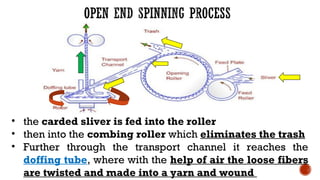
• the carded sliver is fed into the roller
• then into the combing roller which eliminates the trash
• Further through the transport channel it reaches the
doffing tube, where with the help of air the loose fibers
are twisted and made into a yarn and wound
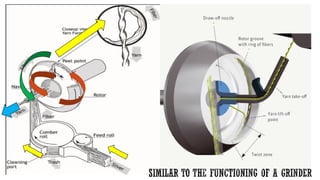
Principle: The working mechanism of OES resembles that of
a washing machine/ domestic wet grinder used in a kitchen
Where when one set of item is tried to pull out, it will be
pulled back by the motor inside due to the kind of pressure it
creates.
The sliver is passed into the rotor, where it is spun and the
yarn comes out which is wrapped on a bobbin
 Properties: Open end spinning result
in rough fabrics since there is no
proper mechanism involved in making
the yarn but just the fibers are blown
together which results in a bound
thick yarn.
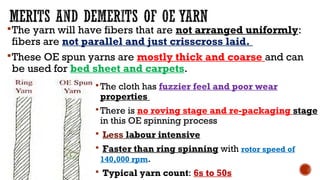
The yarn will have fibers that are not arranged uniformly:
fibers are not parallel and just crisscross laid.
These OE spun yarns are mostly thick and coarse and can
be used for bed sheet and carpets.
The cloth has fuzzier feel and poor wear
properties
There is no roving stage and re-packaging stage
in this OE spinning process
 Less labour intensive
 Faster than ring spinning with rotor speed of
140,000 rpm.
 Typical yarn count: 6s to 50s
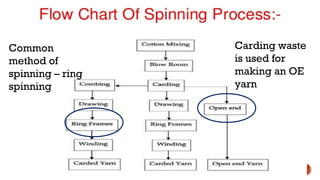
Carding waste
is used for
making an OE
yarn
Common
method of
spinning – ring
spinning
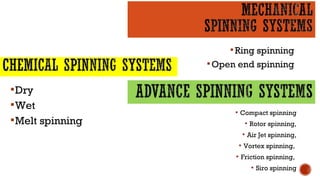
 Compact spinning
 Rotor spinning,
 Air Jet spinning,
 Vortex spinning,
 Friction spinning,
 Siro spinning
Ring spinning
Open end spinning
Dry
Wet
Melt spinning
ADVANCE SPINNING SYSTEMS – USES A FORM OF ENERGY
3. COMPACT SPINNING
4. AIR JET SPINNING
5. VORTEX SPINNING
6. FRICTION SPINNING
7. SIRO SPINNING
Spinning system began with
mule spinning (wool),
cap spinning and flyer
spinning to
ring spinning, rotor spinning
and air-jet spinning shows an
ultimate ways to produce
yarn
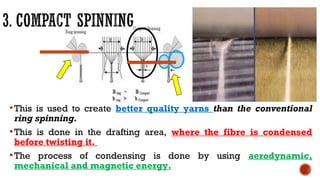
This is used to create better quality yarns than the conventional
ring spinning.
This is done in the drafting area, where the fibre is condensed
before twisting it.
The process of condensing is done by using aerodynamic,
mechanical and magnetic energy.
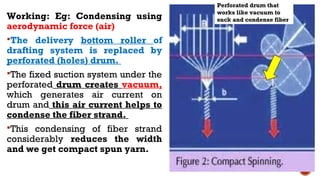
Working: Eg: Condensing using
aerodynamic force (air)
The delivery bottom roller of
drafting system is replaced by
perforated (holes) drum.
The fixed suction system under the
perforated drum creates vacuum,
which generates air current on
drum and this air current helps to
condense the fiber strand.
This condensing of fiber strand
considerably reduces the width
and we get compact spun yarn.
Perforated drum that
works like vacuum to
suck and condense fiber
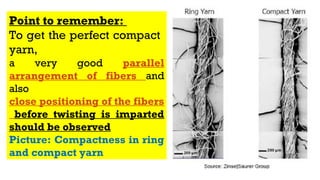
Point to remember:
To get the perfect compact
yarn,
a very good parallel
arrangement of fibers and
also
close positioning of the fibers
before twisting is imparted
should be observed
Picture: Compactness in ring
and compact yarn
Advantages of Compact Spinning
 Improvement in tensile (strength) properties
 Reduced hairiness as well as improved regularity
 Less dust: As maximum number of fibers are integrated into yarn body during
spinning
 Better utilization of fibers – less fly in spinning mill – clean atmosphere -
EFFICIENT PRODUCTION
 Faster and efficient production
 Better character of yarn – high price
 Singeing – not needed for compact yarns
(SINGEING is a process of subjecting yarn to flame, where short fibres are burnt
away- resulting in a smoothen yarn)
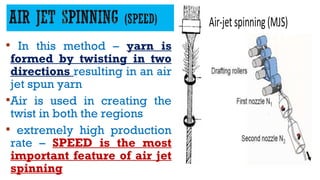
 In this method – yarn is
formed by twisting in two
directions resulting in an air
jet spun yarn
Air is used in creating the
twist in both the regions
 extremely high production
rate – SPEED is the most
important feature of air jet
spinning
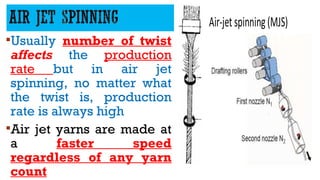
Usually number of twist
affects the production
rate but in air jet
spinning, no matter what
the twist is, production
rate is always high
Air jet yarns are made at
a faster speed
regardless of any yarn
count
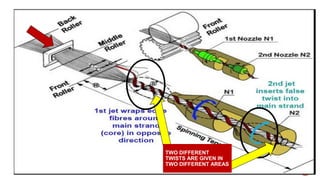
TWO DIFFERENT
TWISTS ARE GIVEN IN
TWO DIFFERENT AREAS
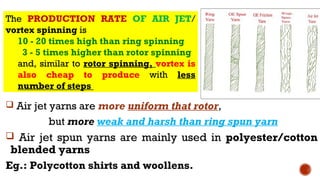
 Air jet yarns are more uniform that rotor,
but more weak and harsh than ring spun yarn
 Air jet spun yarns are mainly used in polyester/cotton
blended yarns
Eg.: Polycotton shirts and woollens.
The PRODUCTION RATE OF AIR JET/
vortex spinning is
10 - 20 times high than ring spinning
3 - 5 times higher than rotor spinning
and, similar to rotor spinning, vortex is
also cheap to produce with less
number of steps
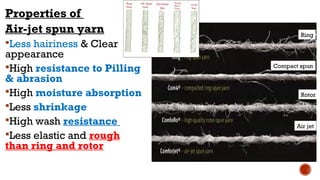
Properties of
Air-jet spun yarn
Less hairiness & Clear
appearance
High resistance to Pilling
& abrasion
High moisture absorption
Less shrinkage
High wash resistance
Less elastic and rough
than ring and rotor
Ring
Compact spun
Rotor
Air jet
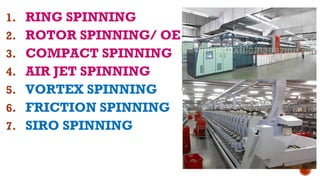
1. RING SPINNING
2. ROTOR SPINNING/ OE
3. COMPACT SPINNING
4. AIR JET SPINNING
5. VORTEX SPINNING
6. FRICTION SPINNING
7. SIRO SPINNING
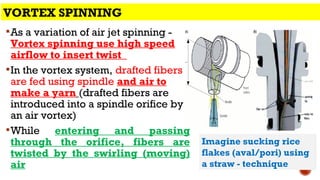
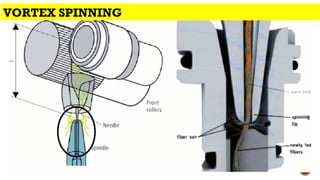
As a variation of air jet spinning -
Vortex spinning use high speed
airflow to insert twist
In the vortex system, drafted fibers
are fed using spindle and air to
make a yarn (drafted fibers are
introduced into a spindle orifice by
an air vortex)
While entering and passing
through the orifice, fibers are
twisted by the swirling (moving)
air
VORTEX SPINNING
Imagine sucking rice
flakes (aval/pori) using
a straw - technique
VORTEX SPINNING
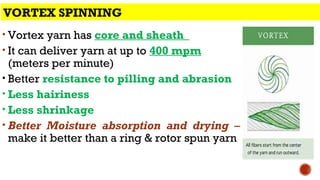
• Vortex yarn has core and sheath
• It can deliver yarn at up to 400 mpm
(meters per minute)
• Better resistance to pilling and abrasion
• Less hairiness
• Less shrinkage
• Better Moisture absorption and drying –
make it better than a ring & rotor spun yarn
VORTEX SPINNING
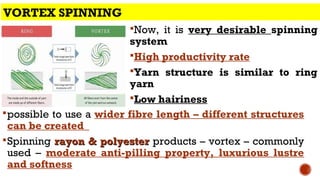
possible to use a wider fibre length – different structures
can be created
Spinning rayon & polyesterrayon & polyester products – vortex – commonly
used – moderate anti-pilling property, luxurious lustre
and softness
Now, it is very desirable spinning
system
High productivity rate
Yarn structure is similar to ring
yarn
Low hairiness
VORTEX SPINNING
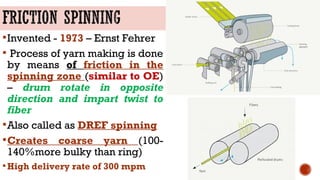
Invented - 1973 – Ernst Fehrer
 Process of yarn making is done
by means of friction in the
spinning zone (similar to OE)
– drum rotate in opposite
direction and impart twist to
fiber
Also called as DREF spinning
Creates coarse yarn (100-
140%more bulky than ring)
High delivery rate of 300 mpm
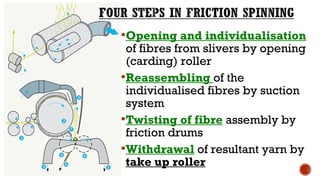
Opening and individualisation
of fibres from slivers by opening
(carding) roller
Reassembling of the
individualised fibres by suction
system
Twisting of fibre assembly by
friction drums
Withdrawal of resultant yarn by
take up roller
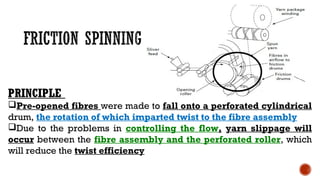
PRINCIPLE
Pre-opened fibres were made to fall onto a perforated cylindrical
drum, the rotation of which imparted twist to the fibre assembly
Due to the problems in controlling the flow, yarn slippage will
occur between the fibre assembly and the perforated roller, which
will reduce the twist efficiency
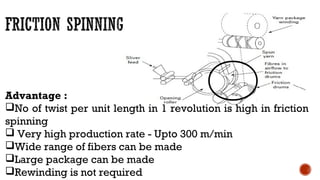
Advantage :
No of twist per unit length in 1 revolution is high in friction
spinning
 Very high production rate - Upto 300 m/min
Wide range of fibers can be made
Large package can be made
Rewinding is not required
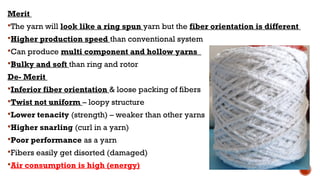
Merit
The yarn will look like a ring spun yarn but the fiber orientation is different
Higher production speed than conventional system
Can produce multi component and hollow yarns
Bulky and soft than ring and rotor
De- Merit
Inferior fiber orientation & loose packing of fibers
Twist not uniform – loopy structure
Lower tenacity (strength) – weaker than other yarns
Higher snarling (curl in a yarn)
Poor performance as a yarn
Fibers easily get disorted (damaged)
Air consumption is high (energy)
APPLICATION OFAPPLICATION OF
FRICTION SPUN YARNSFRICTION SPUN YARNS
Blankets, carpet, cleaning rags and mops from cotton waste
fancy yarns for interior decoration and domestic textiles
shoes, ropes and cables
filter cartridges for liquid filtration
leisure wear, pullovers, suits and outer wear fabrics.
heavy protective industrial fabrics such as heavy flame retardant
fabrics, conveyor belts, clutch and brake linings for the automobile
industry,
packing materials,
gaskets and other asbestos substitutes,
recycling of selvedge wastes from the weaving sector,
aramid- fibre yarns used in fire protection clothing,
bullet proof vests insulators etc.
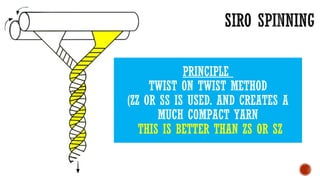
PRINCIPLE
TWIST ON TWIST METHOD
(ZZ OR SS IS USED. AND CREATES A
MUCH COMPACT YARN
THIS IS BETTER THAN ZS OR SZ
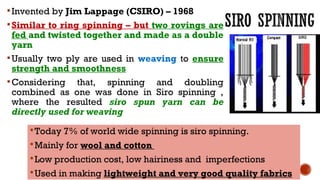
Invented by Jim Lappage (CSIRO) – 1968
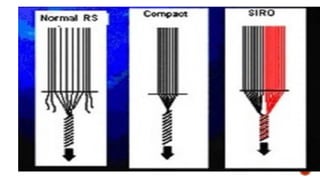
Similar to ring spinning – but two rovings are
fed and twisted together and made as a double
yarn
Usually two ply are used in weaving to ensure
strength and smoothness
Considering that, spinning and doubling
combined as one was done in Siro spinning ,
where the resulted siro spun yarn can be
directly used for weaving
Today 7% of world wide spinning is siro spinning.
Mainly for wool and cotton
Low production cost, low hairiness and imperfections
Used in making lightweight and very good quality fabrics
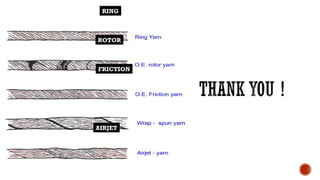
RINGRING
ROTORROTOR
FRICTIONFRICTION
AIRJETAIRJET