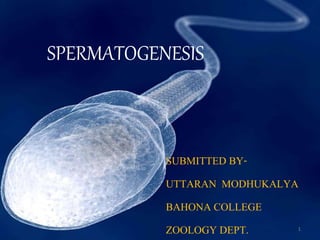
SPERMATOGENESIS
SUBMITTED BY-
UTTARAN MODHUKALYA
BAHONA COLLEGE
ZOOLOGY DEPT. 1
CONTENTS
DEFINATION
PROCESS OF SPERMATOGENESIS
STRUCTURE OF SPERM
HORMONAL CONTROL IN
SPERMATOGENESIS
CONCLUSION
2
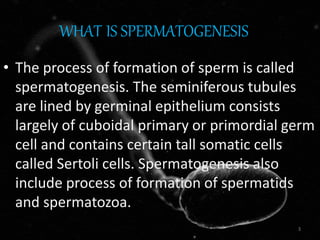
WHAT IS SPERMATOGENESIS ?
• The process of formation of sperm is called
spermatogenesis. The seminiferous tubules
are lined by germinal epithelium consists
largely of cuboidal primary or primordial germ
cell and contains certain tall somatic cells
called Sertoli cells. Spermatogenesis also
include process of formation of spermatids
and spermatozoa.
3
PROCESS OF SPERMATOGENESIS
 Formation of spermatids
A. Multiplication Phase
B. Growth Phase
C. Maturation Phase
Spermiogenesis
4
FORMATION OF SPERMATIDS
• The premordial germ cell of testes forms spermatids.
It has three phase
• A. Multiplication Phase :-The primary germ cell that
present in the seminiferous tubule form
spermatogonia (2n) by mitotic division .
• B. Growth Phase :- The spermatogonia increase in size
by accumulation of nuclear material and attain
maturity ,called as primary spermatocytes(2n).
• C. Maturation Phase :- Here two maturation division
occurs. Firstly, primary spermatocytes form secondary
spermatocytes (n) by reduction division of meiotic-I .
Again secondary spermatocytes form spermatids(n)
by meiotic –II . 5
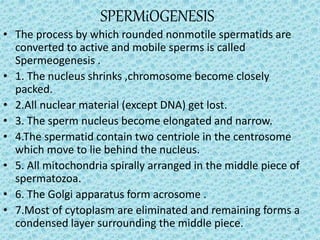
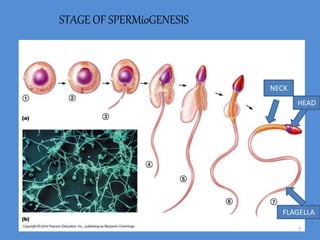
SPERMiOGENESIS
• The process by which rounded nonmotile spermatids are
converted to active and mobile sperms is called
Spermeogenesis .
• 1. The nucleus shrinks ,chromosome become closely
packed.
• 2.All nuclear material (except DNA) get lost.
• 3. The sperm nucleus become elongated and narrow.
• 4.The spermatid contain two centriole in the centrosome
which move to lie behind the nucleus.
• 5. All mitochondria spirally arranged in the middle piece of
spermatozoa.
• 6. The Golgi apparatus form acrosome .
• 7.Most of cytoplasm are eliminated and remaining forms a
condensed layer surrounding the middle piece. 6
STAGE OF SPERMioGENESIS
NECK
HEAD
FLAGELLA
7
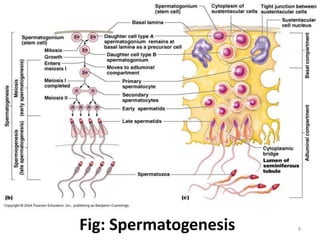
Fig: Spermatogenesis 8
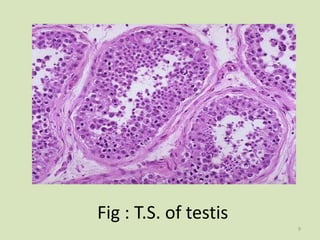
Fig : T.S. of testis
9
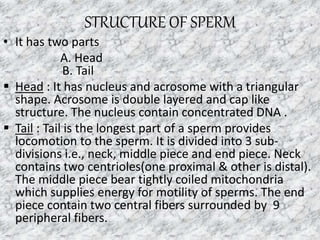
STRUCTURE OF SPERM
• It has two parts
A. Head
B. Tail
 Head : It has nucleus and acrosome with a triangular
shape. Acrosome is double layered and cap like
structure. The nucleus contain concentrated DNA .
 Tail : Tail is the longest part of a sperm provides
locomotion to the sperm. It is divided into 3 sub-
divisions i.e., neck, middle piece and end piece. Neck
contains two centrioles(one proximal & other is distal).
The middle piece bear tightly coiled mitochondria
which supplies energy for motility of sperms. The end
piece contain two central fibers surrounded by 9
peripheral fibers.
10
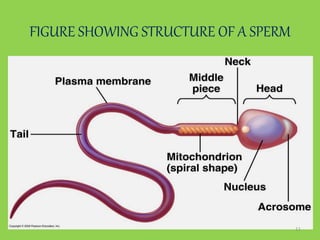
FIGURE SHOWING STRUCTURE OF A SPERM
11
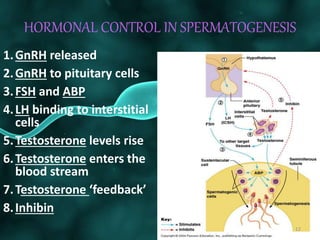
HORMONAL CONTROL IN SPERMATOGENESIS
1.GnRH released
2.GnRH to pituitary cells
3.FSH and ABP
4.LH binding to interstitial
cells
5.Testosterone levels rise
6.Testosterone enters the
blood stream
7.Testosterone ‘feedback’
8.Inhibin
12
CONCLUSION
• During spermatogenesis, one spermatogonium
produces four sperms. The sperms have half
number o chromosomes. After fertilization, the
diploid chromosome number is restored in the
zygote. It maintains the chromosome number of
the species. During meiosis-I crossing over takes
place which brings about variation.
Spermatogenesis occurs in various organisms.
Thus it supports the evidence of the basic
relationships of the organism.
13
THANK YOU
14

Spermatogenesis presented by Uttaran Modhukalya

  • 1.
  • 2.
    CONTENTS DEFINATION PROCESS OF SPERMATOGENESIS STRUCTUREOF SPERM HORMONAL CONTROL IN SPERMATOGENESIS CONCLUSION 2
  • 3.
    WHAT IS SPERMATOGENESIS? • The process of formation of sperm is called spermatogenesis. The seminiferous tubules are lined by germinal epithelium consists largely of cuboidal primary or primordial germ cell and contains certain tall somatic cells called Sertoli cells. Spermatogenesis also include process of formation of spermatids and spermatozoa. 3
  • 4.
    PROCESS OF SPERMATOGENESIS Formation of spermatids A. Multiplication Phase B. Growth Phase C. Maturation Phase Spermiogenesis 4
  • 5.
    FORMATION OF SPERMATIDS •The premordial germ cell of testes forms spermatids. It has three phase • A. Multiplication Phase :-The primary germ cell that present in the seminiferous tubule form spermatogonia (2n) by mitotic division . • B. Growth Phase :- The spermatogonia increase in size by accumulation of nuclear material and attain maturity ,called as primary spermatocytes(2n). • C. Maturation Phase :- Here two maturation division occurs. Firstly, primary spermatocytes form secondary spermatocytes (n) by reduction division of meiotic-I . Again secondary spermatocytes form spermatids(n) by meiotic –II . 5
  • 6.
    SPERMiOGENESIS • The processby which rounded nonmotile spermatids are converted to active and mobile sperms is called Spermeogenesis . • 1. The nucleus shrinks ,chromosome become closely packed. • 2.All nuclear material (except DNA) get lost. • 3. The sperm nucleus become elongated and narrow. • 4.The spermatid contain two centriole in the centrosome which move to lie behind the nucleus. • 5. All mitochondria spirally arranged in the middle piece of spermatozoa. • 6. The Golgi apparatus form acrosome . • 7.Most of cytoplasm are eliminated and remaining forms a condensed layer surrounding the middle piece. 6
  • 7.
  • 8.
  • 9.
    Fig : T.S.of testis 9
  • 10.
    STRUCTURE OF SPERM •It has two parts A. Head B. Tail  Head : It has nucleus and acrosome with a triangular shape. Acrosome is double layered and cap like structure. The nucleus contain concentrated DNA .  Tail : Tail is the longest part of a sperm provides locomotion to the sperm. It is divided into 3 sub- divisions i.e., neck, middle piece and end piece. Neck contains two centrioles(one proximal & other is distal). The middle piece bear tightly coiled mitochondria which supplies energy for motility of sperms. The end piece contain two central fibers surrounded by 9 peripheral fibers. 10
  • 11.
  • 12.
    HORMONAL CONTROL INSPERMATOGENESIS 1.GnRH released 2.GnRH to pituitary cells 3.FSH and ABP 4.LH binding to interstitial cells 5.Testosterone levels rise 6.Testosterone enters the blood stream 7.Testosterone ‘feedback’ 8.Inhibin 12
  • 13.
    CONCLUSION • During spermatogenesis,one spermatogonium produces four sperms. The sperms have half number o chromosomes. After fertilization, the diploid chromosome number is restored in the zygote. It maintains the chromosome number of the species. During meiosis-I crossing over takes place which brings about variation. Spermatogenesis occurs in various organisms. Thus it supports the evidence of the basic relationships of the organism. 13
  • 14.