Muslima P. Liwlaug
MIB 1
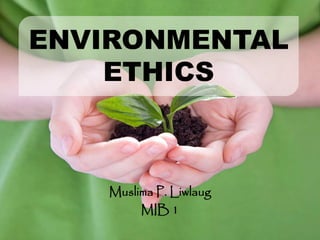
ENVIRONMENTAL
ETHICS
Environmental Ethics
 Ethics = the study of good and bad, right and wrong
 Ethical standards = criteria that help differentiate
right from wrong
 Environmental ethics = the study of ethical
questions regarding human interactions with the
environment
Questions
There are many ethical decisions that human beings make
with respect to the environment:
 Should we continue to clear cut forests for the sake of
human consumption?
 Why should we continue to propagate our species, and life
itself?
 Should we continue to make gasoline powered vehicles?
 What environmental obligations do we need to keep for
future generations?
 Is it right for humans to knowingly cause the extinction of a
species for the convenience of humanity?
 How should we best use and conserve the space
environment to secure and expand life?
Environmental Ethics
 part of environmental philosophy which considers
extending the traditional boundaries of ethics from
solely including humans to including the non-human
world
 it exerts influence on a large range of disciplines
including environmental law, environmental
sociology, ecotheology, ecological
economics, ecology and environmental geography
Early Environmental Ethics
• The roots of environmental ethics are ancient.
• The modern urge for environmental protection grew
with problems spawned by the industrial revolution.
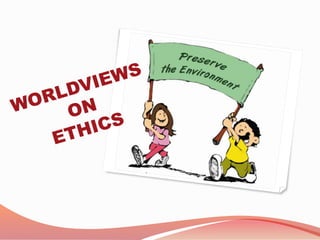
Worldviews on Ethics
 morality is one of those issues which every worldview
addresses, but which has no empirical basis for its
answers
 every worldview has an approach to figuring out what
should be considered right and wrong, but the basis for
understanding it does not come from any kind of
empirically provable foundation (based on the
assumptions of the worldview itself)
Environmental worldviews are how
• people think
• the world works,
• where they fit,
• and ethics
What are worldviews
 it refers to our personal feelings about issues regarding
the environment
 this includes our perspective on how the earth and its’
resources should be used
 it is heavily influenced by the fundamental vision of
reality we hold, the collection of values, perceptions
and practices that organizes our lives
Environmental worldviews can be
• human-centered
• earth-centered
• or some combination of both
Basic beliefs of Human-Centered
Worldview
 We are the planet’s most important species and also in
charge of the rest of nature
 The earth has an unlimited supply of resources even if
there are shortages, we can find substitutes
 We can solve environmental problems with our
technology
 Our success on earth depends upon how well we can
understand, control and manage earth’s life-
supporting systems
 The potential for economic growth is limitless and
more economic growth is always good
Limits of Human-Centered Views
 We do not have enough knowledge about the earth to
become its managers
 We are not aware of the total number of species on earth
much less the roles the species play in maintaining
ecosystems
 Free-market system won’t save the earth because profit
maximization takes precedence over loses of earth’s
capital
 Human-centered views focus on short-term economic
benefits regardless of environmental consequences
 Spaceship view won’t because human constructs of the
earth are often over simplified
Life and Earth-centered
Environmental Views
 These viewpoints see an intrinsic value in all forms of
life, irrespective of their potential or actual uses for
humans
 Nature exists not only for humans but for all the earth’s
species
Factors that influence our
worldviews
 Beliefs and practices of our family and the society
 Personal experiences
 Education
Nature must be experienced
directly to complete environmental
education.
Dominant Worldviews
Expansionist
Worldview
Ecological
Worldview
Sustainable
Development
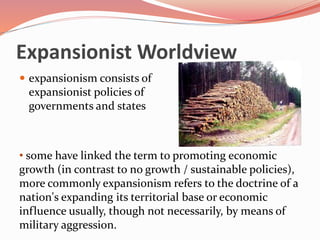
Expansionist Worldview
 expansionism consists of
expansionist policies of
governments and states
• some have linked the term to promoting economic
growth (in contrast to no growth / sustainable policies),
more commonly expansionism refers to the doctrine of a
nation's expanding its territorial base or economic
influence usually, though not necessarily, by means of
military aggression.
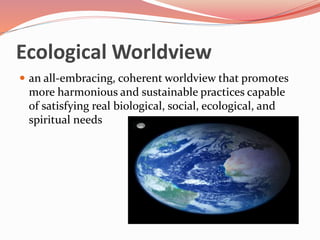
Ecological Worldview
 an all-embracing, coherent worldview that promotes
more harmonious and sustainable practices capable
of satisfying real biological, social, ecological, and
spiritual needs
Sustainable Development
 development can be achieved without compromising
the environment
 incorporates parts of the two worldviews
Ethical Perspective
1. Anthropocentric
2. Stewardship
3. Biocentric
4. Animal Rights
5. Ecocentric
6. Ecofeminism
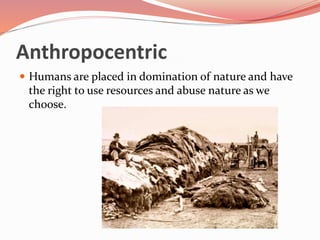
Anthropocentric
 Humans are placed in domination of nature and have
the right to use resources and abuse nature as we
choose.
Stewardship
 Humans have the responsibility to manage and care for
nature. Humans and non-human forces must act
together in order to sustain life.
 Humans are part of nature rather than masters.
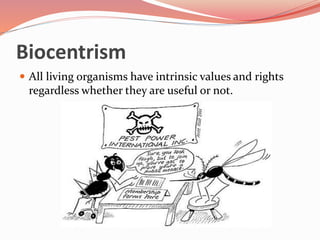
Biocentrism
 All living organisms have intrinsic values and rights
regardless whether they are useful or not.
Animal Rights
 Each individual organism is of
value not the group
Ecocentric
 Based on the view that oneself should do everything
what support’s one’s own interest and profit
 The whole is more important than its individual
parts
 Only oneself has an intrinsic value
 Other human and nature have instrumental value
 Any action is based on one’s personal wealth
Ecofeminism
 A pluralistic, nonhierarchical relationship philosophy
that suggest that humans could reconceive themselves
to nature in a non-dominating way.
Where do you
stand?
Environmental Justice
 Civil rights with environmental protection to
demand a safe, healthy, life-giving environment for
everyone.
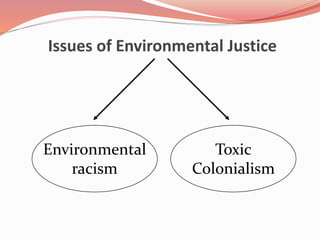
Issues of Environmental Justice
Environmental
racism
Toxic
Colonialism
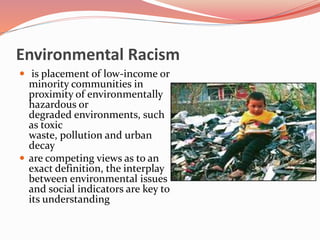
Environmental Racism
 is placement of low-income or
minority communities in
proximity of environmentally
hazardous or
degraded environments, such
as toxic
waste, pollution and urban
decay
 are competing views as to an
exact definition, the interplay
between environmental issues
and social indicators are key to
its understanding
Toxic Colonialism
 refers to the use of
underdeveloped states as
inexpensive alternatives for
the export or disposal of
hazardous waste pollution
by developed states
“People have a right to what they produce
themselves, but man has another right,
declared by the fact of his existence—the right
to use of so much of the free gifts of nature as
may be necessary to supply all the wants of
that existence, and which he may use with
interference with the equal rights of anyone
else; and to this he has title against all the
world.”
Henry George, Progress and Poverty, 1874
The End.

Environmental ethics

  • 2.
    Muslima P. Liwlaug MIB1 ENVIRONMENTAL ETHICS
  • 3.
    Environmental Ethics  Ethics= the study of good and bad, right and wrong  Ethical standards = criteria that help differentiate right from wrong  Environmental ethics = the study of ethical questions regarding human interactions with the environment
  • 4.
    Questions There are manyethical decisions that human beings make with respect to the environment:  Should we continue to clear cut forests for the sake of human consumption?  Why should we continue to propagate our species, and life itself?  Should we continue to make gasoline powered vehicles?  What environmental obligations do we need to keep for future generations?  Is it right for humans to knowingly cause the extinction of a species for the convenience of humanity?  How should we best use and conserve the space environment to secure and expand life?
  • 5.
    Environmental Ethics  partof environmental philosophy which considers extending the traditional boundaries of ethics from solely including humans to including the non-human world  it exerts influence on a large range of disciplines including environmental law, environmental sociology, ecotheology, ecological economics, ecology and environmental geography
  • 6.
    Early Environmental Ethics •The roots of environmental ethics are ancient. • The modern urge for environmental protection grew with problems spawned by the industrial revolution.
  • 8.
    Worldviews on Ethics morality is one of those issues which every worldview addresses, but which has no empirical basis for its answers  every worldview has an approach to figuring out what should be considered right and wrong, but the basis for understanding it does not come from any kind of empirically provable foundation (based on the assumptions of the worldview itself)
  • 9.
    Environmental worldviews arehow • people think • the world works, • where they fit, • and ethics
  • 10.
    What are worldviews it refers to our personal feelings about issues regarding the environment  this includes our perspective on how the earth and its’ resources should be used  it is heavily influenced by the fundamental vision of reality we hold, the collection of values, perceptions and practices that organizes our lives Environmental worldviews can be • human-centered • earth-centered • or some combination of both
  • 11.
    Basic beliefs ofHuman-Centered Worldview  We are the planet’s most important species and also in charge of the rest of nature  The earth has an unlimited supply of resources even if there are shortages, we can find substitutes  We can solve environmental problems with our technology  Our success on earth depends upon how well we can understand, control and manage earth’s life- supporting systems  The potential for economic growth is limitless and more economic growth is always good
  • 12.
    Limits of Human-CenteredViews  We do not have enough knowledge about the earth to become its managers  We are not aware of the total number of species on earth much less the roles the species play in maintaining ecosystems  Free-market system won’t save the earth because profit maximization takes precedence over loses of earth’s capital  Human-centered views focus on short-term economic benefits regardless of environmental consequences  Spaceship view won’t because human constructs of the earth are often over simplified
  • 13.
    Life and Earth-centered EnvironmentalViews  These viewpoints see an intrinsic value in all forms of life, irrespective of their potential or actual uses for humans  Nature exists not only for humans but for all the earth’s species
  • 14.
    Factors that influenceour worldviews  Beliefs and practices of our family and the society  Personal experiences  Education Nature must be experienced directly to complete environmental education.
  • 15.
  • 16.
    Expansionist Worldview  expansionismconsists of expansionist policies of governments and states • some have linked the term to promoting economic growth (in contrast to no growth / sustainable policies), more commonly expansionism refers to the doctrine of a nation's expanding its territorial base or economic influence usually, though not necessarily, by means of military aggression.
  • 17.
    Ecological Worldview  anall-embracing, coherent worldview that promotes more harmonious and sustainable practices capable of satisfying real biological, social, ecological, and spiritual needs
  • 18.
    Sustainable Development  developmentcan be achieved without compromising the environment  incorporates parts of the two worldviews
  • 19.
    Ethical Perspective 1. Anthropocentric 2.Stewardship 3. Biocentric 4. Animal Rights 5. Ecocentric 6. Ecofeminism
  • 20.
    Anthropocentric  Humans areplaced in domination of nature and have the right to use resources and abuse nature as we choose.
  • 21.
    Stewardship  Humans havethe responsibility to manage and care for nature. Humans and non-human forces must act together in order to sustain life.  Humans are part of nature rather than masters.
  • 22.
    Biocentrism  All livingorganisms have intrinsic values and rights regardless whether they are useful or not.
  • 23.
    Animal Rights  Eachindividual organism is of value not the group
  • 24.
    Ecocentric  Based onthe view that oneself should do everything what support’s one’s own interest and profit  The whole is more important than its individual parts  Only oneself has an intrinsic value  Other human and nature have instrumental value  Any action is based on one’s personal wealth
  • 25.
    Ecofeminism  A pluralistic,nonhierarchical relationship philosophy that suggest that humans could reconceive themselves to nature in a non-dominating way.
  • 27.
  • 28.
    Environmental Justice  Civilrights with environmental protection to demand a safe, healthy, life-giving environment for everyone.
  • 29.
    Issues of EnvironmentalJustice Environmental racism Toxic Colonialism
  • 30.
    Environmental Racism  isplacement of low-income or minority communities in proximity of environmentally hazardous or degraded environments, such as toxic waste, pollution and urban decay  are competing views as to an exact definition, the interplay between environmental issues and social indicators are key to its understanding
  • 31.
    Toxic Colonialism  refersto the use of underdeveloped states as inexpensive alternatives for the export or disposal of hazardous waste pollution by developed states
  • 32.
    “People have aright to what they produce themselves, but man has another right, declared by the fact of his existence—the right to use of so much of the free gifts of nature as may be necessary to supply all the wants of that existence, and which he may use with interference with the equal rights of anyone else; and to this he has title against all the world.” Henry George, Progress and Poverty, 1874
  • 33.