Systematics, then, is no less
than understanding the history of
all life.
-Diana Lipscomb, 1998
CLADISTICS
LIWALUG, MUSLIMA P.
MIB1
 Method that groups
organisms that share
derived characteristics
 The value or form of a
feature is referred to as a
character state
 Relationships are portrayed
in straight line diagrams
Phylogenetic Systematics
HOMOLOGY
• traits have common
ancestry
• may/may not share
function
• may/may not look alike
HOMOPLASY
• traits are similar
because of
convergent
evolution
ANALOGY
• traits with common
function
• may/may not share
ancestry
• may/may not look
alike
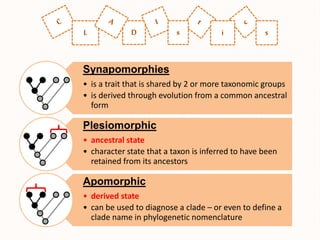
Synapomorphies
• is a trait that is shared by 2 or more taxonomic groups
• is derived through evolution from a common ancestral
form
Plesiomorphic
• ancestral state
• character state that a taxon is inferred to have been
retained from its ancestors
Apomorphic
• derived state
• can be used to diagnose a clade – or even to define a
clade name in phylogenetic nomenclature
Cladistic Analysis
by Willi Hennig (1966)
 is to determine which character states are
primitive and which are derived based on
common ancestry
Principles
Parsimony – states that any hypothesis that
requires fewer assumptions is a more
defendable hypothesis
Occam’s Razor - one should not make more
assumptions than the minimum needed to
explain anything
A B
Cladogram
is an evolutionary tree which shows evolutionary
relationships by showing points at which lineages
diverged from common ancestral forms
is constructed such that the number of changes
from one character state to the next is minimized
is interpreted as that which requires the fewest
evolutionary changes in the taxa involved
Clade
 a group of two or more taxa that includes
both their common ancestor and all their
descendants
FOUR LIMBS WITH DIGITS
Tetrapoda clade1
Amniota clade2
Reptilia clade3
Diapsida clade4
Archosauria clade5
EMBRYO PROTECTED BY AMNIOTIC FLUID
OPENING IN THE SIDE OF THE SKULL
SKULL OPENINGS IN FRONT OF THE EYE &
IN THE JAW
FEATHERS & TOOTHLESS
BEAKS.
SKULL OPENINGS BEHIND THE EYE
DERIVED CHARACTER
Node - a branch points based on
homologous, shared derived traits
Root - the common ancestor of all taxa
Branch - defines the relationship between
the taxa in terms of descent and ancestry
Branch length (scaled trees only) - represents
the number of changes that have occurred in
the branch
Species A
Species E
Species D
Species C
Species B
Root
Branch
CladeNode
Cladistic Methodology
more
primitive
more
derived
Terminal taxa
X
Y
Z
Leopard
Turtle
Salamander
Tuna
Outgroup Comparison
If the taxon that is not a member of the group
of organisms being classified has a character
state that is the same as some of the
organisms in the group then the character can
be considered plesiomorphic
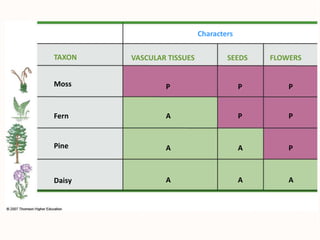
P P P
P P
P
A
A
A
A
A A
Characters
TAXON
Moss
Fern
Pine
Daisy
VASCULAR TISSUES SEEDS FLOWERS
P
A
A
A A A
A
P P
P
P
P
Moss
(a) All of the plant groups shown here except mosses
have vascular
Pine
Daisy
Fern
Node
1
Common plant
ancestor
Common ancestor
with vascular tissues
Moss
Pine
Daisy
Fern
Node
1
Common plant
ancestor
Common ancestor
with vascular tissues
Node
2
(b) Seeds are a shared character for all plant groups
shown here except mosses and ferns.
Moss
Pine
Daisy
Fern
Node
1
Common plant
ancestor
Common ancestor
with vascular tissues
Node
2
Node
3
Common
seed-
producing
ancestor
(c) Of the plant groups shown here, only the daisy
produces flowers.
Cladogram
Phyletic Group of Taxa
MONOPHYLETIC GROUP
Contains an ancestor and all of its
descendants - defined by > 1 shared,
derived traits.
POLYPHYLETIC GROUP
Does not include common ancestor
group. Common ancestor is placed
elsewhere
PARAPHYLETIC GROUP
Includes common ancestor but not all
of its descendants. Define by what it
lacks.
WHY DO CLASSIFICATION SCHEMES CHANGE?
New Data
Rise of new technologies give new sources
of character information
New taxa
As previously unknown species are
discovered, classifications will also need to
be revised to reflect their placement
 Cladistics - Systematics

Cladistics - Systematics

  • 2.
    Systematics, then, isno less than understanding the history of all life. -Diana Lipscomb, 1998
  • 3.
  • 4.
     Method thatgroups organisms that share derived characteristics  The value or form of a feature is referred to as a character state  Relationships are portrayed in straight line diagrams Phylogenetic Systematics
  • 5.
    HOMOLOGY • traits havecommon ancestry • may/may not share function • may/may not look alike HOMOPLASY • traits are similar because of convergent evolution ANALOGY • traits with common function • may/may not share ancestry • may/may not look alike
  • 6.
    Synapomorphies • is atrait that is shared by 2 or more taxonomic groups • is derived through evolution from a common ancestral form Plesiomorphic • ancestral state • character state that a taxon is inferred to have been retained from its ancestors Apomorphic • derived state • can be used to diagnose a clade – or even to define a clade name in phylogenetic nomenclature
  • 7.
    Cladistic Analysis by WilliHennig (1966)  is to determine which character states are primitive and which are derived based on common ancestry
  • 8.
    Principles Parsimony – statesthat any hypothesis that requires fewer assumptions is a more defendable hypothesis Occam’s Razor - one should not make more assumptions than the minimum needed to explain anything
  • 9.
  • 11.
    Cladogram is an evolutionarytree which shows evolutionary relationships by showing points at which lineages diverged from common ancestral forms is constructed such that the number of changes from one character state to the next is minimized is interpreted as that which requires the fewest evolutionary changes in the taxa involved
  • 12.
    Clade  a groupof two or more taxa that includes both their common ancestor and all their descendants
  • 13.
    FOUR LIMBS WITHDIGITS Tetrapoda clade1 Amniota clade2 Reptilia clade3 Diapsida clade4 Archosauria clade5 EMBRYO PROTECTED BY AMNIOTIC FLUID OPENING IN THE SIDE OF THE SKULL SKULL OPENINGS IN FRONT OF THE EYE & IN THE JAW FEATHERS & TOOTHLESS BEAKS. SKULL OPENINGS BEHIND THE EYE DERIVED CHARACTER
  • 14.
    Node - abranch points based on homologous, shared derived traits Root - the common ancestor of all taxa Branch - defines the relationship between the taxa in terms of descent and ancestry Branch length (scaled trees only) - represents the number of changes that have occurred in the branch
  • 15.
    Species A Species E SpeciesD Species C Species B Root Branch CladeNode
  • 16.
  • 17.
    Outgroup Comparison If thetaxon that is not a member of the group of organisms being classified has a character state that is the same as some of the organisms in the group then the character can be considered plesiomorphic
  • 18.
    P P P PP P A A A A A A
  • 19.
  • 20.
    Moss (a) All ofthe plant groups shown here except mosses have vascular Pine Daisy Fern Node 1 Common plant ancestor Common ancestor with vascular tissues
  • 21.
    Moss Pine Daisy Fern Node 1 Common plant ancestor Common ancestor withvascular tissues Node 2 (b) Seeds are a shared character for all plant groups shown here except mosses and ferns.
  • 22.
    Moss Pine Daisy Fern Node 1 Common plant ancestor Common ancestor withvascular tissues Node 2 Node 3 Common seed- producing ancestor (c) Of the plant groups shown here, only the daisy produces flowers.
  • 24.
  • 26.
    Phyletic Group ofTaxa MONOPHYLETIC GROUP Contains an ancestor and all of its descendants - defined by > 1 shared, derived traits. POLYPHYLETIC GROUP Does not include common ancestor group. Common ancestor is placed elsewhere PARAPHYLETIC GROUP Includes common ancestor but not all of its descendants. Define by what it lacks.
  • 28.
    WHY DO CLASSIFICATIONSCHEMES CHANGE? New Data Rise of new technologies give new sources of character information New taxa As previously unknown species are discovered, classifications will also need to be revised to reflect their placement