Gametogenesis
DR. AKPAN
GENERAL EMBROYOLOGY
Gametogenesis
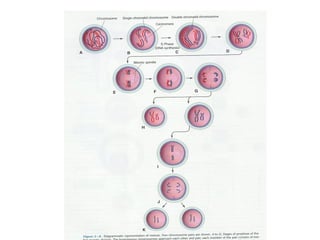
The creation of highly specialized sex cells through a process called MEIOSIS
MEIOSIS
•The process where one diploid germ cells divides
in order to create either 1 or 4 haploid cells ( 23
chromosomes).
Gametogenesis
means formation of gametes (Sperm & Ova).
Spermatogenesis
Means formation of sperm ; male gametes.
Oogenesis
Means formation of ovum ; female gametes.
Sperm and ovum are highly specialized sex cells.
Both types possess three main phases:
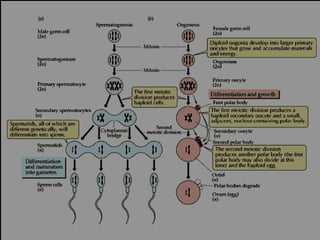
1. Period of multiplication: The primordial germ cells
multiply by mitotic cell division giving rise to oogonia in
case of females and spermatogonia in case of males.
2. Period of growth: During these phase both oogonia
(female gamete) and spermatogonia (male gamete)
grow into primary oocyte or primary spermatocyte.
1. Period of maturation: In case of female, the
primary oocyte undergoes two meiotic cell
division, the first gives rise to secondary oocyte
and primary polar body. The secondary
undergoes second meiotic division giving rise to
mature ova and secondary polar body (mature
ova leach oogonia).
In case of male, each primary spermatocyte
divides meiotically into secondary spermatocytes
and intern to spermatid (4 spermatid l each
primary spermatocyte).
Male Genital System
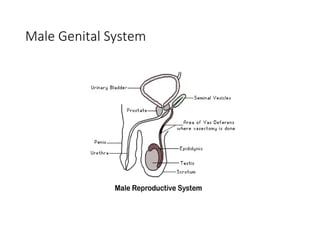
Overview of Gross Anatomy of Male Reproductive System:
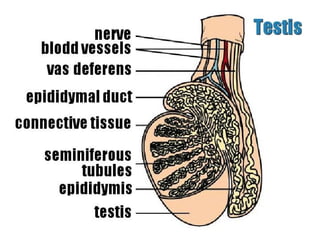
• Testis
• Male sex gland, Located in the Scrotum.
• Produce Sperm and Androgens.
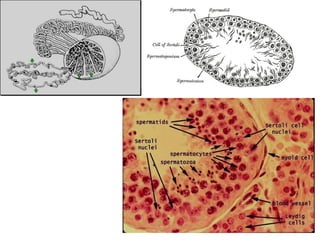
• Have also the interstitial cells (leydeg cells) that produce male sex hormone (testosterone)
• Seminiferous tubules is the structural unit of testes., it have the developmental phases of
sperms in addition to Sertoli cells.
• Epididymis
• Sperm Storage
• Complete of sperm maturation.
• Vas Deferens
• Duct that transports the Sperm from the Scrotum to the
Prostate Gland
• Seminal Vessicle
• Secrets Fluid, rich in Fructose, to Semen
• Prostate Gland (Ejaculatory Duct)
•Contributes Milky Alkaline Fluid that assists
Sperm Activation
• Cowpers Gland [Bilbourethral Gland]
•Contributes Mucus to Semen
• Urethra (Penis)
•Organ of Copulation
Sertoli Cells
•At all stages of differentiation, the spermatogenic cells
are in close contact with Sertoli cells which are
provide structural and metabolic support to the
developing sperm cells.
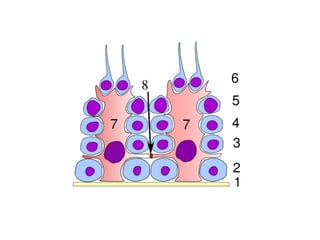
•A single Sertoli cell extends from the basement
membrane to the lumen of the seminiferous tubule.
•Sertoli cells serve a number of functions during
spermatogenesis like providing the cells with
nourishment and molecular signals. , they support the
developing gametes in the following ways:
1. Maintain the environment necessary for
development and maturation via the
blood-testis barrier .
2. Secrete substances initiating meiosis.
3. Secrete supporting testicular fluid .
4. Secrete androgen-binding protein, which
concentrates testosterone in close proximity to the
developing gametes.
5. Secrete hormones effecting pituitary gland control
of spermatogenesis, particularly the polypeptide
hormone, inhibin .
6. Phagocytose residual cytoplasm left over from
spermiogenesis.
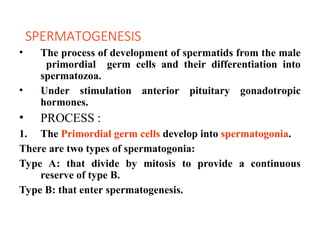
SPERMATOGENESIS
• The process of development of spermatids from the male
primordial germ cells and their differentiation into
spermatozoa.
• Under stimulation anterior pituitary gonadotropic
hormones.
• PROCESS :
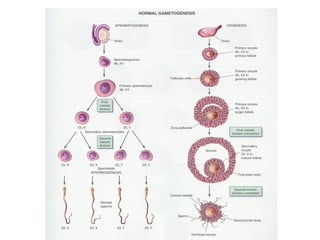
1. The Primordial germ cells develop into spermatogonia.
There are two types of spermatogonia:
Type A: that divide by mitosis to provide a continuous
reserve of type B.
Type B: that enter spermatogenesis.
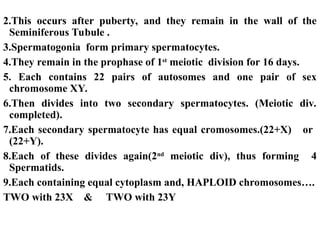
2.This occurs after puberty, and they remain in the wall of the
Seminiferous Tubule .
3.Spermatogonia form primary spermatocytes.
4.They remain in the prophase of 1st
meiotic division for 16 days.
5. Each contains 22 pairs of autosomes and one pair of sex
chromosome XY.
6.Then divides into two secondary spermatocytes. (Meiotic div.
completed).
7.Each secondary spermatocyte has equal cromosomes.(22+X) or
(22+Y).
8.Each of these divides again(2nd
meiotic div), thus forming 4
Spermatids.
9.Each containing equal cytoplasm and, HAPLOID chromosomes….
TWO with 23X & TWO with 23Y
Spermiation
•The mature spermatozoa released from the protective
Sertoli cells into the lumen of the seminiferous tubule
and a process called spermiation then takes place,
which removes the remaining unnecessary cytoplasm
and organelles.
•The resulting spermatozoa are now mature but lack
motility, rendering them sterile. The non-motile
spermatozoa are transported to the epididymis in
testicular fluid secreted by the Sertoli cells with the aid
of peristaltic contraction.
• In the epididymis they acquire motility and become
capable of fertilization. However, transport of the
mature spermatozoa through the remainder of the
male reproductive system is achieved via muscle
contraction rather than the spermatozoon's recently
acquired motility.
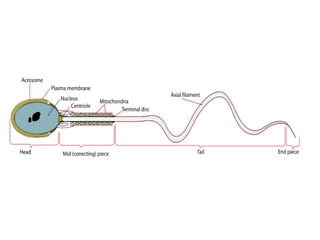
Structure Of The Sperm
The Head
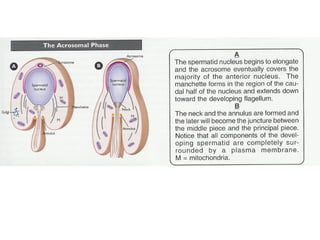
• has two important features.
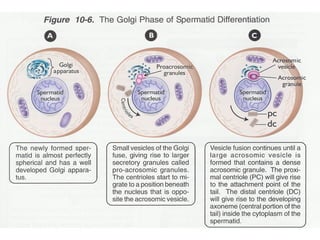
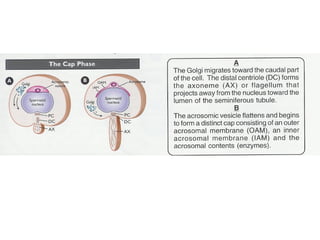
1.The acrosome (derived from Golgi apparatus) contains
hydrolytic enzymes which are released when the sperm
reaches an ovum. These enzymes digest the outer membrane
of the egg (proteins and complex sugars) , allowing
penetration of the sperm.
2.The nucleus (haploid) contains a single set of chromosomes
derived from the male. This will include either an 'X' or 'Y'
chromosome, because of the way the XY separate during
meiosis.
In many species, a region of globular actin molecules lies
between 1&2 that used to extend a finger-like process
during early stages of Fertilization.
The Middle Section
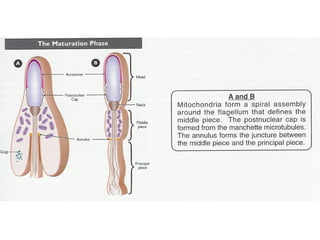
• behind the head, contains numerous mitochondria.
These respire sugars in the semen to generate ATP
in order to provide the energy for movement of the
tail.
The Tail
• (Flagellum) contains microfilaments running the
length of the tail (arranged in the usual 9 + 2
system seen in Eukaryotic organisms). Rhythmic
contraction of the filaments causes the tail to wave
and move against the fluid environment, providing
forward motion.
Abnormalities of sperms
1. Morphological Abnormalities:
• The head & tail may be abnormal, they may be:
a) giants.
b) Dwarfs.
c) Joined in head or in tail.
• Lack motility and don’t fertilize the egg.
2. Numerical Abnormalities:
• Oligospermia: few number of sperms in semen.
• Aspermia: no sperms at all in semen.
• Necrospermia: sperms found dead.
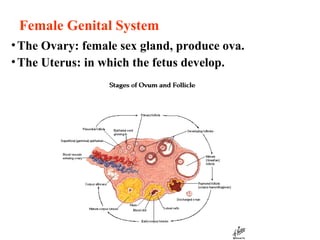
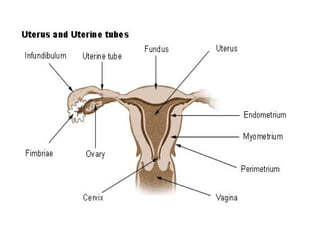
Female Genital System
•The Ovary: female sex gland, produce ova.
•The Uterus: in which the fetus develop.
Oogenesis
•Formation of female gametes, it means
differentiation of female primordial germ cell
(oogonium) into mature ovum.
•Period of multiplication : in which oogonia(2N)
increased in the ovary through mitotic division.
•Period of growth : oogonia (2N) grow to primary
oocytes (2N).
•Period of maturation : primary oocytes (2N) enter
meioses Ι to produce secondary oocytes (N) & first
polar body (N).
•Then, complete the second meioses to form mature
ova (N) and 3 polar bodies.
Oogenesis
• A normal baby girl had about 2 million
primary oocytes in her ovaries.
• By 7 years old about 300,000 remain, her
body reabsorbed the rest.
• Only about 400 to 500 oocytes will be
released during her reproductive years.
• Penetration of the sperm induces the
secondary oocyte and the first polar body
to complete meiosis II.
DIFFERENCES
• SPERMATOGENESIS
• COMPLETES TWO MEIOTIC
DIVISIONS
• CREATES FOUR EQUAL
HAPLOID SPERMS
• OOGENESIS
• STOPS AT PROPHASE OF THE
MEIOTIC DIVISION UNTIL
OVULATION,
• AT THE TIME OF OVULATION,
THE OOCYTE GOES TO
METAPHASE OF SECOND
MEIOSIS.
• IF NOT FERTLIZED, EGG
DEGENERATES
• CREATES 1 OOCYTE AND 3
POLAR BODIES
Thank you for your time.
Questions?

3. Embryology : Gametogenesis Gametogenesis .ppt

  • 1.
  • 2.
    Gametogenesis The creation ofhighly specialized sex cells through a process called MEIOSIS
  • 3.
    MEIOSIS •The process whereone diploid germ cells divides in order to create either 1 or 4 haploid cells ( 23 chromosomes).
  • 5.
    Gametogenesis means formation ofgametes (Sperm & Ova). Spermatogenesis Means formation of sperm ; male gametes. Oogenesis Means formation of ovum ; female gametes. Sperm and ovum are highly specialized sex cells. Both types possess three main phases: 1. Period of multiplication: The primordial germ cells multiply by mitotic cell division giving rise to oogonia in case of females and spermatogonia in case of males. 2. Period of growth: During these phase both oogonia (female gamete) and spermatogonia (male gamete) grow into primary oocyte or primary spermatocyte.
  • 6.
    1. Period ofmaturation: In case of female, the primary oocyte undergoes two meiotic cell division, the first gives rise to secondary oocyte and primary polar body. The secondary undergoes second meiotic division giving rise to mature ova and secondary polar body (mature ova leach oogonia). In case of male, each primary spermatocyte divides meiotically into secondary spermatocytes and intern to spermatid (4 spermatid l each primary spermatocyte).
  • 10.
  • 11.
    Overview of GrossAnatomy of Male Reproductive System: • Testis • Male sex gland, Located in the Scrotum. • Produce Sperm and Androgens. • Have also the interstitial cells (leydeg cells) that produce male sex hormone (testosterone) • Seminiferous tubules is the structural unit of testes., it have the developmental phases of sperms in addition to Sertoli cells. • Epididymis • Sperm Storage • Complete of sperm maturation. • Vas Deferens • Duct that transports the Sperm from the Scrotum to the Prostate Gland • Seminal Vessicle • Secrets Fluid, rich in Fructose, to Semen
  • 12.
    • Prostate Gland(Ejaculatory Duct) •Contributes Milky Alkaline Fluid that assists Sperm Activation • Cowpers Gland [Bilbourethral Gland] •Contributes Mucus to Semen • Urethra (Penis) •Organ of Copulation
  • 15.
    Sertoli Cells •At allstages of differentiation, the spermatogenic cells are in close contact with Sertoli cells which are provide structural and metabolic support to the developing sperm cells. •A single Sertoli cell extends from the basement membrane to the lumen of the seminiferous tubule. •Sertoli cells serve a number of functions during spermatogenesis like providing the cells with nourishment and molecular signals. , they support the developing gametes in the following ways:
  • 16.
    1. Maintain theenvironment necessary for development and maturation via the blood-testis barrier . 2. Secrete substances initiating meiosis. 3. Secrete supporting testicular fluid . 4. Secrete androgen-binding protein, which concentrates testosterone in close proximity to the developing gametes. 5. Secrete hormones effecting pituitary gland control of spermatogenesis, particularly the polypeptide hormone, inhibin . 6. Phagocytose residual cytoplasm left over from spermiogenesis.
  • 18.
    SPERMATOGENESIS • The processof development of spermatids from the male primordial germ cells and their differentiation into spermatozoa. • Under stimulation anterior pituitary gonadotropic hormones. • PROCESS : 1. The Primordial germ cells develop into spermatogonia. There are two types of spermatogonia: Type A: that divide by mitosis to provide a continuous reserve of type B. Type B: that enter spermatogenesis.
  • 19.
    2.This occurs afterpuberty, and they remain in the wall of the Seminiferous Tubule . 3.Spermatogonia form primary spermatocytes. 4.They remain in the prophase of 1st meiotic division for 16 days. 5. Each contains 22 pairs of autosomes and one pair of sex chromosome XY. 6.Then divides into two secondary spermatocytes. (Meiotic div. completed). 7.Each secondary spermatocyte has equal cromosomes.(22+X) or (22+Y). 8.Each of these divides again(2nd meiotic div), thus forming 4 Spermatids. 9.Each containing equal cytoplasm and, HAPLOID chromosomes…. TWO with 23X & TWO with 23Y
  • 24.
    Spermiation •The mature spermatozoareleased from the protective Sertoli cells into the lumen of the seminiferous tubule and a process called spermiation then takes place, which removes the remaining unnecessary cytoplasm and organelles. •The resulting spermatozoa are now mature but lack motility, rendering them sterile. The non-motile spermatozoa are transported to the epididymis in testicular fluid secreted by the Sertoli cells with the aid of peristaltic contraction. • In the epididymis they acquire motility and become capable of fertilization. However, transport of the mature spermatozoa through the remainder of the male reproductive system is achieved via muscle contraction rather than the spermatozoon's recently acquired motility.
  • 25.
    Structure Of TheSperm The Head • has two important features. 1.The acrosome (derived from Golgi apparatus) contains hydrolytic enzymes which are released when the sperm reaches an ovum. These enzymes digest the outer membrane of the egg (proteins and complex sugars) , allowing penetration of the sperm. 2.The nucleus (haploid) contains a single set of chromosomes derived from the male. This will include either an 'X' or 'Y' chromosome, because of the way the XY separate during meiosis. In many species, a region of globular actin molecules lies between 1&2 that used to extend a finger-like process during early stages of Fertilization.
  • 26.
    The Middle Section •behind the head, contains numerous mitochondria. These respire sugars in the semen to generate ATP in order to provide the energy for movement of the tail. The Tail • (Flagellum) contains microfilaments running the length of the tail (arranged in the usual 9 + 2 system seen in Eukaryotic organisms). Rhythmic contraction of the filaments causes the tail to wave and move against the fluid environment, providing forward motion.
  • 28.
    Abnormalities of sperms 1.Morphological Abnormalities: • The head & tail may be abnormal, they may be: a) giants. b) Dwarfs. c) Joined in head or in tail. • Lack motility and don’t fertilize the egg. 2. Numerical Abnormalities: • Oligospermia: few number of sperms in semen. • Aspermia: no sperms at all in semen. • Necrospermia: sperms found dead.
  • 29.
    Female Genital System •TheOvary: female sex gland, produce ova. •The Uterus: in which the fetus develop.
  • 31.
    Oogenesis •Formation of femalegametes, it means differentiation of female primordial germ cell (oogonium) into mature ovum. •Period of multiplication : in which oogonia(2N) increased in the ovary through mitotic division. •Period of growth : oogonia (2N) grow to primary oocytes (2N). •Period of maturation : primary oocytes (2N) enter meioses Ι to produce secondary oocytes (N) & first polar body (N). •Then, complete the second meioses to form mature ova (N) and 3 polar bodies.
  • 32.
    Oogenesis • A normalbaby girl had about 2 million primary oocytes in her ovaries. • By 7 years old about 300,000 remain, her body reabsorbed the rest. • Only about 400 to 500 oocytes will be released during her reproductive years. • Penetration of the sperm induces the secondary oocyte and the first polar body to complete meiosis II.
  • 33.
    DIFFERENCES • SPERMATOGENESIS • COMPLETESTWO MEIOTIC DIVISIONS • CREATES FOUR EQUAL HAPLOID SPERMS • OOGENESIS • STOPS AT PROPHASE OF THE MEIOTIC DIVISION UNTIL OVULATION, • AT THE TIME OF OVULATION, THE OOCYTE GOES TO METAPHASE OF SECOND MEIOSIS. • IF NOT FERTLIZED, EGG DEGENERATES • CREATES 1 OOCYTE AND 3 POLAR BODIES
  • 34.
    Thank you foryour time. Questions?