SPERMATOGENESIS
WHAT IS SPERMATOGENESIS?
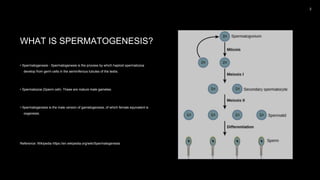
• Spermatogenesis - Spermatogenesis is the process by which haploid spermatozoa
develop from germ cells in the seminiferous tubules of the testis.
• Spermatozoa (Sperm cell)- These are mature male gametes.
• Spermatogenesis is the male version of gametogenesis, of which female equivalent is
oogenesis.
Reference: Wikipedia https://en.wikipedia.org/wiki/Spermatogenesis
• Spermatogenesis is highly dependent optimal conditions for the process to occur correctly. Ex : temperature 1°- 8°C lower than normal body temperature of 37°C.
• Starts at puberty and usually continues uninterrupted until death, although slight decrease can be discerned in the quantity of produced sperm with increase in age.
• Importance of sperm – sperm is the counterpart to female gametes, the oocyte , during conception to produce zygote.
• Duration - The entire process approximately 74 days (according to tritium labelled biopsies) and approximately 120 days (according to DNA clock measurements).
• Testis produce around 200 to 300 million spermatozoa daily. However, only half or 100 million of these become viable.
Reference : Wikipedia https://en.wikipedia.org/wiki/Spermatogenesis
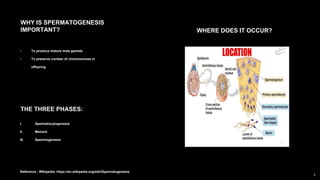
WHY IS SPERMATOGENESIS
IMPORTANT? WHERE DOES IT OCCUR?
THE THREE PHASES:
• To produce mature male gamete
• To preserve number of chromosomes in
offspring
I. Spermatocytogenesis
II. Meiosis
III. Spermiogenesis
Reference : Wikipedia. https://en.wikipedia.org/wiki/Spermatogenesis
Reference : https://dev.biologists.org/content/135/13/2207.figures-only
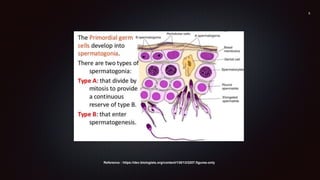
• It is the male form of gametocytogenesis and involve stem cells dividing to replace themselves.
• Gametocytogenesis: creation of gametocytes by mitotic division of gametogonia.
• The stem cells involved are called spermatogonia.
PHASE I: SPERMATOCYTOGENESIS
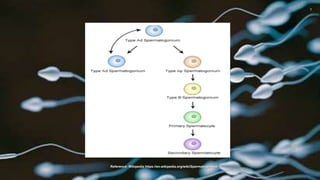
Three functionally separate spermatogonial cell types are recognized on basis of appearance of the nuclei:
1. Type Ad (dark)
2. Type Ap spermatogonia (pale)
3. Type B spermatogonia
Reference : Smith, D.J. (2009). "Human sperm accumulation near surfaces: a simulation study" (PDF). Journal of Fluid Mechanics. 621: 295. Bibcode:2009JFM...621..289S. doi:10.1017/S0022112008004
Yves (March 1966). "Renewal of spermatogonia in man". American Journal of Anatomy. 118 (2): 509–524. doi:10.1002/aja.100118953. Retrieved 20 May 2012.
Reference: Wikipedia https://en.wikipedia.org/wiki/Spermatogonium
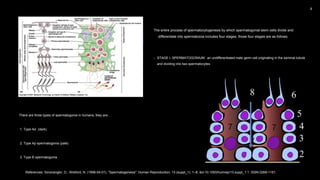
The entire process of spermatocytogenesis by which spermatogonial stem cells divide and
differentiate into spermatozoa includes four stages, those four stages are as follows:
• STAGE I, SPERMATOGONIUM: an undifferentiated male germ cell originating in the seminal tubule
and dividing into two spermatocytes.
There are three types of spermatogonia in humans, they are;
1. Type Ad (dark)
2. Type Ap spermatogonia (pale)
3. Type B spermatogonia
References: Simorangkir, D.; Wreford, N. (1998-04-01). "Spermatogenesis". Human Reproduction. 13 (suppl_1): 1–8. doi:10.1093/humrep/13.suppl_1.1. ISSN 0268-1161.
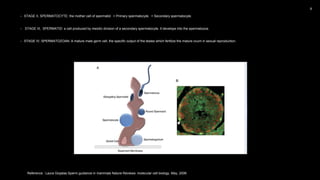
• STAGE II, SPERMATOCYTE: the mother cell of spermatid. > Primary spermatocyte. > Secondary spermatocyte.
• STAGE III, SPERMATID: a cell produced by meiotic division of a secondary spermatocyte. It develops into the spermatozoa.
• STAGE IV, SPERMATOZOAN: A mature male germ cell, the specific output of the testes which fertilize the mature ovum in sexual reproduction.
Reference : Laura Giojalas.Sperm guidance in mammals Nature Reviews: molecular cell biology. May, 2006
• The primitive sex cell appear earliest in 4th week of intra uterine life in the wall of yolk sac as primordial germ cell.
• At puberty the germ cell awaken and start the actual process of spermatogenesis.
• Spermatogonia are germ line cells. They are diploid (2n).
• One of these spermatogonia undergoes meiosis and is called primary spermatocyte.
• The primary spermatocyte undergoes meiosis I to produce secondary spermatocyte.
Reference : Yves (March 1966). "Renewal of spermatogonia in man". American Journal of Anatomy. 118 (2): 509–524. doi:10.1002/aja.100118953. Retrieved 20 May 2012.
PHASE II : MEIOSIS
• This is the creation of spermatids from secondary spermatocytes.
• Secondary spermatocytes produces earlier rapidly enter meiosis II and divide to
produce haploid spermatids.
• The brevity of this stage means that secondary spermatocytes are rarely seen in
histological studies.
• Occurs after puberty
Reference : Wikipedia https://en.wikipedia.org/wiki/Spermatogenesis#Spermatidogenesis
• Primary spermatocytes remain in the prophase of 1st meiotic division for 16 days.
• Each contains 22 pairs of autosomes and one pair of sex chromosome XY.
• Each secondary spermatocyte has equal chromosomes (22+X) or (22=Y).
• Each of these divides again thus forming four spermatids.
Reference : http://www.uwyo.edu/wjm/repro/spermat.htm
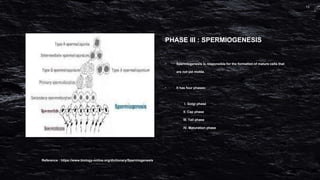
PHASE III : SPERMIOGENESIS
• Spermiogenesis is responsible for the formation of mature cells that
are not yet motile.
• It has four phases:
I. Golgi phase
II. Cap phase
III. Tail phase
IV. Maturation phase
Reference : https://www.biology-online.org/dictionary/Spermiogenesis
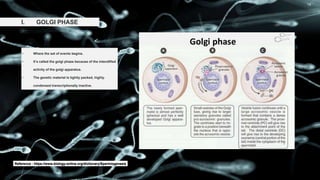
I. GOLGI PHASE
• Where the set of events begins.
• It’s called the golgi phase because of the intendified
activity of the golgi apparatus.
• The genetic material is tightly packed, highly.
condensed transcriptionally inactive.
Reference : https://www.biology-online.org/dictionary/Spermiogenesis
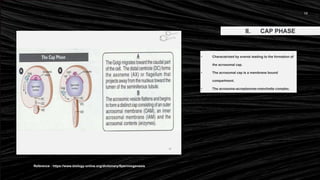
II. CAP PHASE
• Characterized by events leading to the formation of
the acrosomal cap.
• The acrosomal cap is a membrane bound
compartment.
• The acrosome-acroplaxome-manchette complex.
Reference : https://www.biology-online.org/dictionary/Spermiogenesis
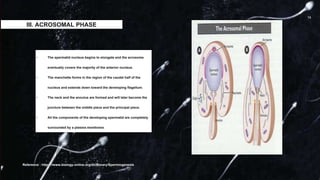
III. ACROSOMAL PHASE
• The spermatid nucleus begins to elongate and the acrosome
eventually covers the majority of the anterior nucleus.
• The manchette forms in the region of the caudal half of the
nucleus and extends down toward the developing flagellum.
• The neck and the annulus are formed and will later become the
juncture between the middle piece and the principal piece.
• All the components of the developing spermatid are completely
surrounded by a plasma membrane.
Reference : https://www.biology-online.org/dictionary/Spermiogenesis
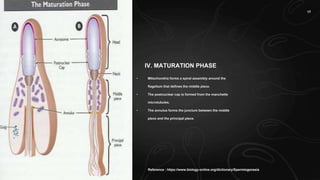
IV. MATURATION PHASE
• Mitochondria forms a spiral assembly around the
flagellum that defines the middle piece.
• The postnuclear cap is formed from the manchette
microtubules.
• The annulus forms the juncture between the middle
piece and the principal piece.
Reference : https://www.biology-online.org/dictionary/Spermiogenesis
17
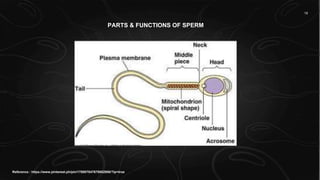
PARTS & FUNCTIONS OF SPERM
Reference : https://www.pinterest.ph/pin/178807047678002950/?lp=true
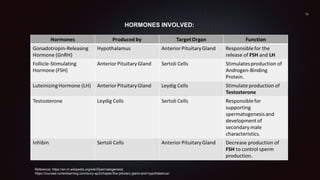
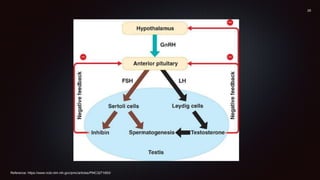
HORMONES INVOLVED:
Reference: https://en.m.wikipedia.org/wiki/Spermatogenesis
https://courses.lumenlearning.com/suny-ap2/chapter/the-pituitary-gland-and-hypothalamus/
Reference: https://www.ncbi.nlm.nih.gov/pmc/articles/PMC3271653/
21

Spermatogenesis genetics

  • 1.
  • 2.
    WHAT IS SPERMATOGENESIS? •Spermatogenesis - Spermatogenesis is the process by which haploid spermatozoa develop from germ cells in the seminiferous tubules of the testis. • Spermatozoa (Sperm cell)- These are mature male gametes. • Spermatogenesis is the male version of gametogenesis, of which female equivalent is oogenesis. Reference: Wikipedia https://en.wikipedia.org/wiki/Spermatogenesis
  • 3.
    • Spermatogenesis ishighly dependent optimal conditions for the process to occur correctly. Ex : temperature 1°- 8°C lower than normal body temperature of 37°C. • Starts at puberty and usually continues uninterrupted until death, although slight decrease can be discerned in the quantity of produced sperm with increase in age. • Importance of sperm – sperm is the counterpart to female gametes, the oocyte , during conception to produce zygote. • Duration - The entire process approximately 74 days (according to tritium labelled biopsies) and approximately 120 days (according to DNA clock measurements). • Testis produce around 200 to 300 million spermatozoa daily. However, only half or 100 million of these become viable. Reference : Wikipedia https://en.wikipedia.org/wiki/Spermatogenesis
  • 4.
    WHY IS SPERMATOGENESIS IMPORTANT?WHERE DOES IT OCCUR? THE THREE PHASES: • To produce mature male gamete • To preserve number of chromosomes in offspring I. Spermatocytogenesis II. Meiosis III. Spermiogenesis Reference : Wikipedia. https://en.wikipedia.org/wiki/Spermatogenesis
  • 5.
  • 6.
    • It isthe male form of gametocytogenesis and involve stem cells dividing to replace themselves. • Gametocytogenesis: creation of gametocytes by mitotic division of gametogonia. • The stem cells involved are called spermatogonia. PHASE I: SPERMATOCYTOGENESIS Three functionally separate spermatogonial cell types are recognized on basis of appearance of the nuclei: 1. Type Ad (dark) 2. Type Ap spermatogonia (pale) 3. Type B spermatogonia Reference : Smith, D.J. (2009). "Human sperm accumulation near surfaces: a simulation study" (PDF). Journal of Fluid Mechanics. 621: 295. Bibcode:2009JFM...621..289S. doi:10.1017/S0022112008004 Yves (March 1966). "Renewal of spermatogonia in man". American Journal of Anatomy. 118 (2): 509–524. doi:10.1002/aja.100118953. Retrieved 20 May 2012.
  • 7.
  • 8.
    The entire processof spermatocytogenesis by which spermatogonial stem cells divide and differentiate into spermatozoa includes four stages, those four stages are as follows: • STAGE I, SPERMATOGONIUM: an undifferentiated male germ cell originating in the seminal tubule and dividing into two spermatocytes. There are three types of spermatogonia in humans, they are; 1. Type Ad (dark) 2. Type Ap spermatogonia (pale) 3. Type B spermatogonia References: Simorangkir, D.; Wreford, N. (1998-04-01). "Spermatogenesis". Human Reproduction. 13 (suppl_1): 1–8. doi:10.1093/humrep/13.suppl_1.1. ISSN 0268-1161.
  • 9.
    • STAGE II,SPERMATOCYTE: the mother cell of spermatid. > Primary spermatocyte. > Secondary spermatocyte. • STAGE III, SPERMATID: a cell produced by meiotic division of a secondary spermatocyte. It develops into the spermatozoa. • STAGE IV, SPERMATOZOAN: A mature male germ cell, the specific output of the testes which fertilize the mature ovum in sexual reproduction. Reference : Laura Giojalas.Sperm guidance in mammals Nature Reviews: molecular cell biology. May, 2006
  • 10.
    • The primitivesex cell appear earliest in 4th week of intra uterine life in the wall of yolk sac as primordial germ cell. • At puberty the germ cell awaken and start the actual process of spermatogenesis. • Spermatogonia are germ line cells. They are diploid (2n). • One of these spermatogonia undergoes meiosis and is called primary spermatocyte. • The primary spermatocyte undergoes meiosis I to produce secondary spermatocyte. Reference : Yves (March 1966). "Renewal of spermatogonia in man". American Journal of Anatomy. 118 (2): 509–524. doi:10.1002/aja.100118953. Retrieved 20 May 2012.
  • 11.
    PHASE II :MEIOSIS • This is the creation of spermatids from secondary spermatocytes. • Secondary spermatocytes produces earlier rapidly enter meiosis II and divide to produce haploid spermatids. • The brevity of this stage means that secondary spermatocytes are rarely seen in histological studies. • Occurs after puberty Reference : Wikipedia https://en.wikipedia.org/wiki/Spermatogenesis#Spermatidogenesis
  • 12.
    • Primary spermatocytesremain in the prophase of 1st meiotic division for 16 days. • Each contains 22 pairs of autosomes and one pair of sex chromosome XY. • Each secondary spermatocyte has equal chromosomes (22+X) or (22=Y). • Each of these divides again thus forming four spermatids. Reference : http://www.uwyo.edu/wjm/repro/spermat.htm
  • 13.
    PHASE III :SPERMIOGENESIS • Spermiogenesis is responsible for the formation of mature cells that are not yet motile. • It has four phases: I. Golgi phase II. Cap phase III. Tail phase IV. Maturation phase Reference : https://www.biology-online.org/dictionary/Spermiogenesis
  • 14.
    I. GOLGI PHASE •Where the set of events begins. • It’s called the golgi phase because of the intendified activity of the golgi apparatus. • The genetic material is tightly packed, highly. condensed transcriptionally inactive. Reference : https://www.biology-online.org/dictionary/Spermiogenesis
  • 15.
    II. CAP PHASE •Characterized by events leading to the formation of the acrosomal cap. • The acrosomal cap is a membrane bound compartment. • The acrosome-acroplaxome-manchette complex. Reference : https://www.biology-online.org/dictionary/Spermiogenesis
  • 16.
    III. ACROSOMAL PHASE •The spermatid nucleus begins to elongate and the acrosome eventually covers the majority of the anterior nucleus. • The manchette forms in the region of the caudal half of the nucleus and extends down toward the developing flagellum. • The neck and the annulus are formed and will later become the juncture between the middle piece and the principal piece. • All the components of the developing spermatid are completely surrounded by a plasma membrane. Reference : https://www.biology-online.org/dictionary/Spermiogenesis
  • 17.
    IV. MATURATION PHASE •Mitochondria forms a spiral assembly around the flagellum that defines the middle piece. • The postnuclear cap is formed from the manchette microtubules. • The annulus forms the juncture between the middle piece and the principal piece. Reference : https://www.biology-online.org/dictionary/Spermiogenesis 17
  • 18.
    PARTS & FUNCTIONSOF SPERM Reference : https://www.pinterest.ph/pin/178807047678002950/?lp=true
  • 19.
  • 20.
  • 21.