“V/f Speed Control of Three Phase Induction
Motor by using Space Vector Modulation”
Presented By
Mr. Jamadar A. L.
1/36
 Introduction
 Aims and Objectives
 Different Types of PWM Techniques
 Speed Controlling Methods of Induction Motor
 Space Vector Pulse Width Modulation Technique
 Hardware Implementation
 Software Implementation
 Result
 Conclusion
 References
Outline of Presentation
2/36
Introduction
 The control of electric power
 Three major requirements and limitations of three phase
inverter
 Three phase inverter operated with space vector modulation
(SVM) Technique has
 Utilization of DC link voltage and output voltage
 Efficiency
3/36
Aims and Objectives
 The aim of this project is to develop a simulation and prototype
model of V/f Speed Control Of Three Phase Induction Motor
By Using Space Vector Modulation
 The most essential Objectives are as follows.
1. To evaluate conventional experimental technique from the
point of views in Industrial Surroundings.
2. To develop necessary interface & hardware so as to
accumulate variety of test & measurement procedure.
4/36
Different Types Of PWM Techniques
 The most common method
 Different forms of modulation:
 Trapezoidal modulation
 Staircase modulation
 Stepped modulation
 Third harmonic injected PWM
 Space Vector Modulation (Present work)
 Disadvantage of modulation as compare to SVM
5/36
Speed Controlling Methods Of
Induction Motor
 The induction motor fulfils the requirement of substantially
constant speed drive. Many motor applications require multiple
speeds or adjustable speed ranges. To achieve these
requirements the following techniques are used.
1. Rotor resistance control.
2. Stator voltage control.
3. Variable f, constant V control.
4. V/F control.
5. Slip energy recovery scheme.
6/36
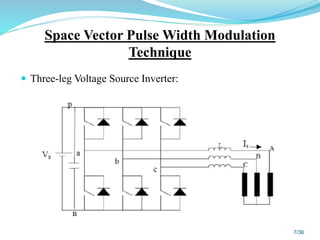
Space Vector Pulse Width Modulation
Technique
 Three-leg Voltage Source Inverter:
7/36
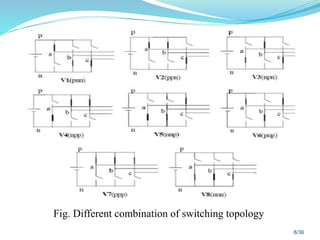
Fig. Different combination of switching topology
8/36
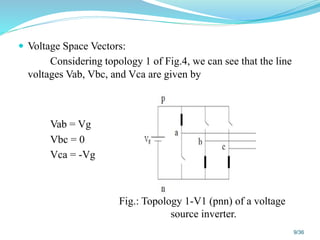
 Voltage Space Vectors:
Considering topology 1 of Fig.4, we can see that the line
voltages Vab, Vbc, and Vca are given by
Vab = Vg
Vbc = 0
Vca = -Vg
Fig.: Topology 1-V1 (pnn) of a voltage
source inverter.
9/36
Fig.: Representation of
topology 1 in the αβ plane.
Fig.: Non-zero voltage vectors in
the αβ plane.
10/36
 Considering the last two topologies of Fig. 4 which are
repeated in Fig.8 for the sake of convenience we see that the
output line voltages generated by this topology are given by,
Vab = 0
Vbc = 0
Vca = 0
Fig.: Zero output voltage topologies
11/36
Fig.: Representation of the zero voltage vectors in the αβ plane
12/36
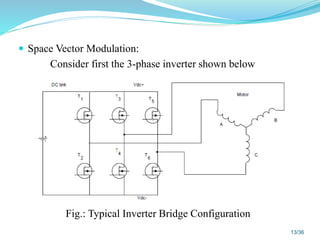
 Space Vector Modulation:
Consider first the 3-phase inverter shown below
Fig.: Typical Inverter Bridge Configuration
13/36
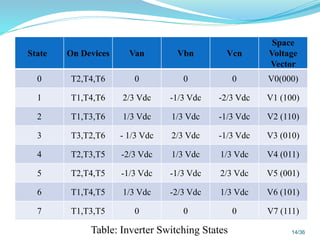
State On Devices Van Vbn Vcn
Space
Voltage
Vector
0 T2,T4,T6 0 0 0 V0(000)
1 T1,T4,T6 2/3 Vdc -1/3 Vdc -2/3 Vdc V1 (100)
2 T1,T3,T6 1/3 Vdc 1/3 Vdc -1/3 Vdc V2 (110)
3 T3,T2,T6 - 1/3 Vdc 2/3 Vdc -1/3 Vdc V3 (010)
4 T2,T3,T5 -2/3 Vdc 1/3 Vdc 1/3 Vdc V4 (011)
5 T2,T4,T5 -1/3 Vdc -1/3 Vdc 2/3 Vdc V5 (001)
6 T1,T4,T5 1/3 Vdc -2/3 Vdc 1/3 Vdc V6 (101)
7 T1,T3,T5 0 0 0 V7 (111)
Table: Inverter Switching States 14/36
 Reference Vector:
15/36
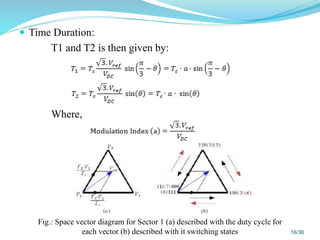
 Time Duration:
T1 and T2 is then given by:
Where,
Fig.: Space vector diagram for Sector 1 (a) described with the duty cycle for
each vector (b) described with it switching states 16/36
Switching States Corresponding Voltage Vectors
a b c Vector Magnitude Angle
0 0 0 V0
0 0
1 1 1 V7
1 0 0 V1 (2/3) 𝑉Dc 0
1 1 0 V2 (2/3) 𝑉DC π/3
0 1 0 V3 (2/3) 𝑉DC 2π/3
0 1 1 V4 (2/3) 𝑉DC π
0 0 1 V5 (2/3) 𝑉DC 4π/3
1 0 1 V6 (2/3) 𝑉DC 5π/3
Table: All switching states and its corresponding voltage vectors
17/36
Sector
Duration times
T1 T2 T0
1 𝑇𝑐∙𝑎∙𝑠𝑖𝑛 (𝜋/3−𝜃) 𝑇𝑐∙𝑎∙ 𝑠𝑖𝑛 (𝜃) 𝑇𝑐−𝑇1−𝑇2
2 𝑇𝑐∙𝑎∙𝑠𝑖𝑛 (2𝜋/3−𝜃) 𝑇𝑐∙𝑎∙ 𝑠𝑖𝑛 (𝜃−𝜋/3) 𝑇𝑐−𝑇1−𝑇2
3 𝑇𝑐∙𝑎∙𝑠𝑖𝑛 (𝜋−𝜃) 𝑇𝑐∙𝑎∙ 𝑠𝑖𝑛 (𝜃−2𝜋/3) 𝑇𝑐−𝑇1−𝑇2
4 𝑇𝑐∙𝑎∙𝑠𝑖𝑛 (4𝜋/3−𝜃) 𝑇𝑐∙𝑎∙ 𝑠𝑖𝑛 (𝜃−𝜋) Tc−T1−T2
5 Tc∙a∙sin (5π/3−θ) Tc∙a∙ sin (θ−4π/3) Tc−T1−T2
6 Tc∙a∙sin (2π−θ) Tc∙a∙ sin (θ−5π/3) Tc−T1−T2
18/36
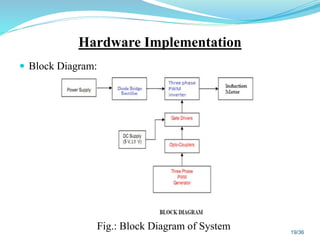
Hardware Implementation
 Block Diagram:
Fig.: Block Diagram of System 19/36
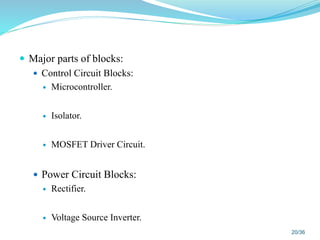
 Major parts of blocks:
 Control Circuit Blocks:
 Microcontroller.
 Isolator.
 MOSFET Driver Circuit.
 Power Circuit Blocks:
 Rectifier.
 Voltage Source Inverter.
20/36
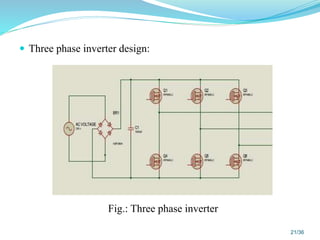
 Three phase inverter design:
Fig.: Three phase inverter
21/36
Fig.: Hardware of Inverter
22/36
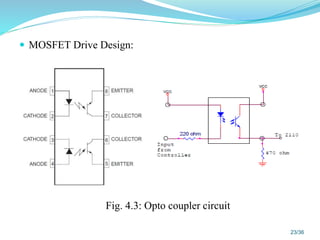
 MOSFET Drive Design:
Fig. 4.3: Opto coupler circuit
23/36
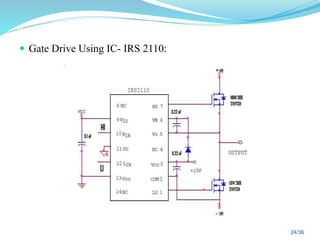
 Gate Drive Using IC- IRS 2110:
24/36
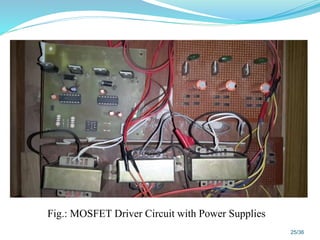
Fig.: MOSFET Driver Circuit with Power Supplies
25/36
 Microcontroller AT89C51:
 Features:
1. Compatible with MCS-51™ Products
2. Fully Static Operation: 0 Hz to 24 MHz
3. Three-level Program Memory Lock
4. 128 x 8-bit Internal RAM
5. 32 Programmable I/O Lines
6. Two 16-bit Timer/Counters
7. Six Interrupt Sources
8. Programmable Serial Channel
9. Low-power Idle and Power-down Modes
26/36
Fig.: Hardware of Microcontroller Circuit
27/36
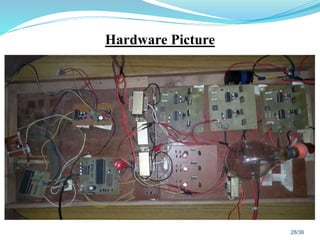
Hardware Picture
28/36
Software Implementation
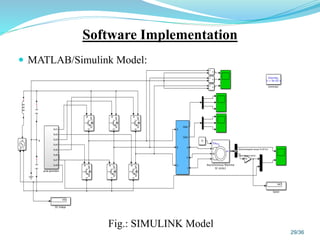
 MATLAB/Simulink Model:
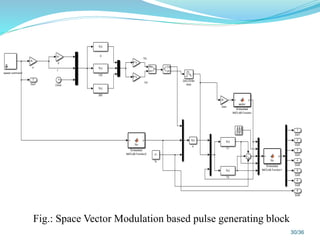
Fig.: SIMULINK Model
29/36
Fig.: Space Vector Modulation based pulse generating block
30/36
Result
Fig.: Stator Line Voltages
31/36
Fig.: Stator Phase Voltages
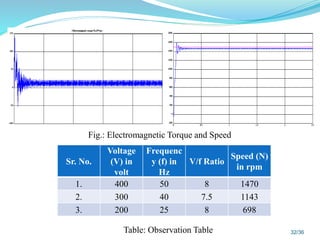
Fig.: Electromagnetic Torque and Speed
Sr. No.
Voltage
(V) in
volt
Frequenc
y (f) in
Hz
V/f Ratio
Speed (N)
in rpm
1. 400 50 8 1470
2. 300 40 7.5 1143
3. 200 25 8 698
Table: Observation Table 32/36
Conclusion
 This project is presented to employing the inverter using space
vector pulse width modulation (SVPWM) to drive three phase
induction motor and controlling the speed of induction motor.
 Speed control of three phase induction motor using space
vector pulse width modulation technique (SVPWM) is
simulated by MATLAB. As we observe that controlling the
speed of three phase induction motor by using space vector
pulse width modulation is easy to operate.
 As three phase voltage decreases which is applied to the stator
of induction motor then the frequency also decreases in same
manner to maintain constant V/f ratio. The motor speed varies
as voltage and frequency varies but V/f ratio remains constant.
33/36
References
[1] Programable laboratory invertor and space vector pwmIng. Pavel GAJDŮŠEK, Doctoral
Degree Programme (2) Dept. of Electrical Power Engineering, FEEC, VUT E-mail:
xgajdu02@stud.feec.vutbr.cz Supervised by: Prof. Jiří Skalický
[2] SVPWM Based Speed Control of Induction Motor Drive with Using V/F Control Based 3-
Level Inverter 1Srinivasa Rao Maturu* and 2Avinash Vujji VSRD-IJEECE, Vol. 2 (7), 2012,
421-437.
[3] A Space Vector Modulation Control Algorithm for VSI Multi-Level Converters A. Cataliotti, F.
Genduso, G. Ricco Galluzzo Dipartimento di Ingegneria eletrica Università degli Studi di
Palermo: acataliotti@ieee.org; genduso@diepa.unipa.it; ricco@diepa.unipa.it
[4] Modelling and simulation of a multilevel inverter using space vector modulation technique
ayse kocalmis1 sed at sünter
[5] IEEE transactions on industrial electronics, vol. 57, no. 7, july 2010 2473 Conventional Space-
Vector Modulation Techniques Versus the Single-Phase Modulator for Multilevel Converters
[6] Optimised Space Vector Switching Sequences for Multilevel Inverters B. P. McGrath*, D.G.
Holmes* and T. A. Lipo**
[7] 2 Space vector modulation for three-leg voltage source inverters
[8] IEEE transactions on industrial electronics, vol. 49, no. 1, February 2002 Relationship between
Space-Vector Modulation and Three-Phase Carrier-Based PWM: A Comprehensive Analysis
Keliang Zhou and Danwei Wang, Member, IEEE
34/36
[9] Comparison between two modulation techniques for three phase inverters from a hardware
implementation point of view by bogdan alecsa ∗ and alexandru onea
[10]IECON'01: The 27th Annual Conference of the IEEE Industrial Electronics Society space
vector modulation – An Introduction = Tutorial at IECON2001 = Dorin O. Neacsu
Correspondence Address: Satcon Corporation, 161 First Street, Cambridge, MA 02142, Email
neacsu@earthlink.com
[11]5th International Advanced Technologies Symposium (IATS’09), May 13-15, 2009, Karabuk,
Turkey © IATS’09, Karabük University, Karabük, Turkey Three-dimensional space-vector
modulation algorithm for all types of multilevel converters using abc coordinate
[12]Multilevel Multiphase Space Vector PWM Algorithm Applied to Three-Phase Converters O´
scar Lo´pez, Jacobo A´ lvarez, Jesu´s Doval-Gandoy, Francisco Freijedo, Andre´s Nogueiras
and Carlos M. Pen˜alver Electronics Technology Department University of Vigo
[13]G.Sambasiva Rao et al. / International Journal of Engineering Science and Technology
(IJEST) A comprehensive analysis of space vector pwm technique based on placement of zero-
space vector g.sambasiva rao
[14]Harmonic Effects of Space Vector Modulation on Induction Motor Performance Jennifer
Vining Dept. of Electrical and Computer Engineering 1415 Engineering Drive Madison, WI
53706
[15]National Power Electronics Conference 2010 Novel Switching Sequences for a Space Vector
Modulated Three-Level Inverter
35/36
36/36

Speed control of IM using Space Vector Modulation

  • 1.
    “V/f Speed Controlof Three Phase Induction Motor by using Space Vector Modulation” Presented By Mr. Jamadar A. L. 1/36
  • 2.
     Introduction  Aimsand Objectives  Different Types of PWM Techniques  Speed Controlling Methods of Induction Motor  Space Vector Pulse Width Modulation Technique  Hardware Implementation  Software Implementation  Result  Conclusion  References Outline of Presentation 2/36
  • 3.
    Introduction  The controlof electric power  Three major requirements and limitations of three phase inverter  Three phase inverter operated with space vector modulation (SVM) Technique has  Utilization of DC link voltage and output voltage  Efficiency 3/36
  • 4.
    Aims and Objectives The aim of this project is to develop a simulation and prototype model of V/f Speed Control Of Three Phase Induction Motor By Using Space Vector Modulation  The most essential Objectives are as follows. 1. To evaluate conventional experimental technique from the point of views in Industrial Surroundings. 2. To develop necessary interface & hardware so as to accumulate variety of test & measurement procedure. 4/36
  • 5.
    Different Types OfPWM Techniques  The most common method  Different forms of modulation:  Trapezoidal modulation  Staircase modulation  Stepped modulation  Third harmonic injected PWM  Space Vector Modulation (Present work)  Disadvantage of modulation as compare to SVM 5/36
  • 6.
    Speed Controlling MethodsOf Induction Motor  The induction motor fulfils the requirement of substantially constant speed drive. Many motor applications require multiple speeds or adjustable speed ranges. To achieve these requirements the following techniques are used. 1. Rotor resistance control. 2. Stator voltage control. 3. Variable f, constant V control. 4. V/F control. 5. Slip energy recovery scheme. 6/36
  • 7.
    Space Vector PulseWidth Modulation Technique  Three-leg Voltage Source Inverter: 7/36
  • 8.
    Fig. Different combinationof switching topology 8/36
  • 9.
     Voltage SpaceVectors: Considering topology 1 of Fig.4, we can see that the line voltages Vab, Vbc, and Vca are given by Vab = Vg Vbc = 0 Vca = -Vg Fig.: Topology 1-V1 (pnn) of a voltage source inverter. 9/36
  • 10.
    Fig.: Representation of topology1 in the αβ plane. Fig.: Non-zero voltage vectors in the αβ plane. 10/36
  • 11.
     Considering thelast two topologies of Fig. 4 which are repeated in Fig.8 for the sake of convenience we see that the output line voltages generated by this topology are given by, Vab = 0 Vbc = 0 Vca = 0 Fig.: Zero output voltage topologies 11/36
  • 12.
    Fig.: Representation ofthe zero voltage vectors in the αβ plane 12/36
  • 13.
     Space VectorModulation: Consider first the 3-phase inverter shown below Fig.: Typical Inverter Bridge Configuration 13/36
  • 14.
    State On DevicesVan Vbn Vcn Space Voltage Vector 0 T2,T4,T6 0 0 0 V0(000) 1 T1,T4,T6 2/3 Vdc -1/3 Vdc -2/3 Vdc V1 (100) 2 T1,T3,T6 1/3 Vdc 1/3 Vdc -1/3 Vdc V2 (110) 3 T3,T2,T6 - 1/3 Vdc 2/3 Vdc -1/3 Vdc V3 (010) 4 T2,T3,T5 -2/3 Vdc 1/3 Vdc 1/3 Vdc V4 (011) 5 T2,T4,T5 -1/3 Vdc -1/3 Vdc 2/3 Vdc V5 (001) 6 T1,T4,T5 1/3 Vdc -2/3 Vdc 1/3 Vdc V6 (101) 7 T1,T3,T5 0 0 0 V7 (111) Table: Inverter Switching States 14/36
  • 15.
  • 16.
     Time Duration: T1and T2 is then given by: Where, Fig.: Space vector diagram for Sector 1 (a) described with the duty cycle for each vector (b) described with it switching states 16/36
  • 17.
    Switching States CorrespondingVoltage Vectors a b c Vector Magnitude Angle 0 0 0 V0 0 0 1 1 1 V7 1 0 0 V1 (2/3) 𝑉Dc 0 1 1 0 V2 (2/3) 𝑉DC π/3 0 1 0 V3 (2/3) 𝑉DC 2π/3 0 1 1 V4 (2/3) 𝑉DC π 0 0 1 V5 (2/3) 𝑉DC 4π/3 1 0 1 V6 (2/3) 𝑉DC 5π/3 Table: All switching states and its corresponding voltage vectors 17/36
  • 18.
    Sector Duration times T1 T2T0 1 𝑇𝑐∙𝑎∙𝑠𝑖𝑛 (𝜋/3−𝜃) 𝑇𝑐∙𝑎∙ 𝑠𝑖𝑛 (𝜃) 𝑇𝑐−𝑇1−𝑇2 2 𝑇𝑐∙𝑎∙𝑠𝑖𝑛 (2𝜋/3−𝜃) 𝑇𝑐∙𝑎∙ 𝑠𝑖𝑛 (𝜃−𝜋/3) 𝑇𝑐−𝑇1−𝑇2 3 𝑇𝑐∙𝑎∙𝑠𝑖𝑛 (𝜋−𝜃) 𝑇𝑐∙𝑎∙ 𝑠𝑖𝑛 (𝜃−2𝜋/3) 𝑇𝑐−𝑇1−𝑇2 4 𝑇𝑐∙𝑎∙𝑠𝑖𝑛 (4𝜋/3−𝜃) 𝑇𝑐∙𝑎∙ 𝑠𝑖𝑛 (𝜃−𝜋) Tc−T1−T2 5 Tc∙a∙sin (5π/3−θ) Tc∙a∙ sin (θ−4π/3) Tc−T1−T2 6 Tc∙a∙sin (2π−θ) Tc∙a∙ sin (θ−5π/3) Tc−T1−T2 18/36
  • 19.
    Hardware Implementation  BlockDiagram: Fig.: Block Diagram of System 19/36
  • 20.
     Major partsof blocks:  Control Circuit Blocks:  Microcontroller.  Isolator.  MOSFET Driver Circuit.  Power Circuit Blocks:  Rectifier.  Voltage Source Inverter. 20/36
  • 21.
     Three phaseinverter design: Fig.: Three phase inverter 21/36
  • 22.
    Fig.: Hardware ofInverter 22/36
  • 23.
     MOSFET DriveDesign: Fig. 4.3: Opto coupler circuit 23/36
  • 24.
     Gate DriveUsing IC- IRS 2110: 24/36
  • 25.
    Fig.: MOSFET DriverCircuit with Power Supplies 25/36
  • 26.
     Microcontroller AT89C51: Features: 1. Compatible with MCS-51™ Products 2. Fully Static Operation: 0 Hz to 24 MHz 3. Three-level Program Memory Lock 4. 128 x 8-bit Internal RAM 5. 32 Programmable I/O Lines 6. Two 16-bit Timer/Counters 7. Six Interrupt Sources 8. Programmable Serial Channel 9. Low-power Idle and Power-down Modes 26/36
  • 27.
    Fig.: Hardware ofMicrocontroller Circuit 27/36
  • 28.
  • 29.
    Software Implementation  MATLAB/SimulinkModel: Fig.: SIMULINK Model 29/36
  • 30.
    Fig.: Space VectorModulation based pulse generating block 30/36
  • 31.
    Result Fig.: Stator LineVoltages 31/36 Fig.: Stator Phase Voltages
  • 32.
    Fig.: Electromagnetic Torqueand Speed Sr. No. Voltage (V) in volt Frequenc y (f) in Hz V/f Ratio Speed (N) in rpm 1. 400 50 8 1470 2. 300 40 7.5 1143 3. 200 25 8 698 Table: Observation Table 32/36
  • 33.
    Conclusion  This projectis presented to employing the inverter using space vector pulse width modulation (SVPWM) to drive three phase induction motor and controlling the speed of induction motor.  Speed control of three phase induction motor using space vector pulse width modulation technique (SVPWM) is simulated by MATLAB. As we observe that controlling the speed of three phase induction motor by using space vector pulse width modulation is easy to operate.  As three phase voltage decreases which is applied to the stator of induction motor then the frequency also decreases in same manner to maintain constant V/f ratio. The motor speed varies as voltage and frequency varies but V/f ratio remains constant. 33/36
  • 34.
    References [1] Programable laboratoryinvertor and space vector pwmIng. Pavel GAJDŮŠEK, Doctoral Degree Programme (2) Dept. of Electrical Power Engineering, FEEC, VUT E-mail: xgajdu02@stud.feec.vutbr.cz Supervised by: Prof. Jiří Skalický [2] SVPWM Based Speed Control of Induction Motor Drive with Using V/F Control Based 3- Level Inverter 1Srinivasa Rao Maturu* and 2Avinash Vujji VSRD-IJEECE, Vol. 2 (7), 2012, 421-437. [3] A Space Vector Modulation Control Algorithm for VSI Multi-Level Converters A. Cataliotti, F. Genduso, G. Ricco Galluzzo Dipartimento di Ingegneria eletrica Università degli Studi di Palermo: acataliotti@ieee.org; genduso@diepa.unipa.it; ricco@diepa.unipa.it [4] Modelling and simulation of a multilevel inverter using space vector modulation technique ayse kocalmis1 sed at sünter [5] IEEE transactions on industrial electronics, vol. 57, no. 7, july 2010 2473 Conventional Space- Vector Modulation Techniques Versus the Single-Phase Modulator for Multilevel Converters [6] Optimised Space Vector Switching Sequences for Multilevel Inverters B. P. McGrath*, D.G. Holmes* and T. A. Lipo** [7] 2 Space vector modulation for three-leg voltage source inverters [8] IEEE transactions on industrial electronics, vol. 49, no. 1, February 2002 Relationship between Space-Vector Modulation and Three-Phase Carrier-Based PWM: A Comprehensive Analysis Keliang Zhou and Danwei Wang, Member, IEEE 34/36
  • 35.
    [9] Comparison betweentwo modulation techniques for three phase inverters from a hardware implementation point of view by bogdan alecsa ∗ and alexandru onea [10]IECON'01: The 27th Annual Conference of the IEEE Industrial Electronics Society space vector modulation – An Introduction = Tutorial at IECON2001 = Dorin O. Neacsu Correspondence Address: Satcon Corporation, 161 First Street, Cambridge, MA 02142, Email neacsu@earthlink.com [11]5th International Advanced Technologies Symposium (IATS’09), May 13-15, 2009, Karabuk, Turkey © IATS’09, Karabük University, Karabük, Turkey Three-dimensional space-vector modulation algorithm for all types of multilevel converters using abc coordinate [12]Multilevel Multiphase Space Vector PWM Algorithm Applied to Three-Phase Converters O´ scar Lo´pez, Jacobo A´ lvarez, Jesu´s Doval-Gandoy, Francisco Freijedo, Andre´s Nogueiras and Carlos M. Pen˜alver Electronics Technology Department University of Vigo [13]G.Sambasiva Rao et al. / International Journal of Engineering Science and Technology (IJEST) A comprehensive analysis of space vector pwm technique based on placement of zero- space vector g.sambasiva rao [14]Harmonic Effects of Space Vector Modulation on Induction Motor Performance Jennifer Vining Dept. of Electrical and Computer Engineering 1415 Engineering Drive Madison, WI 53706 [15]National Power Electronics Conference 2010 Novel Switching Sequences for a Space Vector Modulated Three-Level Inverter 35/36
  • 36.