SPACE VECTOR MODULATION FOR TWO LEG INVERTERS PRESENTED  By SUDHAKAR AKKI Reg.No:1610910044 UNDER THE GUIDANCE OF Mr. NALINKANT MOHANTY ASST.PROF( Sr.G )
INTRODUCTION Semiconductor switches mainly determine the overall price of power converters. The main objective of this project is to prove 2leg inverters are the best option for low power  applications for getting the good performance. Two leg inverter produces the square wave or quasi-square wave. but low power applications allow the two  leg inverter output. In many industrial applications, it is often required to vary the output voltage of  the  inverter due to the following reasons To cope with the dc I/p voltage. To regulate the voltage of  inverters To satisfy the constant voltage & frequency for control requirement.
Pulse-Width Modulated For VSI Disadvantages of PWM semiconductor devices must have low turn-on and turn-off times. so, they are very expansive Reduction of available voltage Increase of switching losses due to high PWM frequency Control of inverter output voltage with out any additional components Reduction of  lower harmonics The most common PWM approach is  sinusoidal PWM . In this method a  triangular wave is compared to a sinusoidal wave of the desired frequency and the relative levels of the two waves is used to control the switching of devices in each phase leg of the inverter. Objective of PWM
Space vector modulation In sinusoidal PWM, the inverter can be thought of as three separate push-pull driver stages, which create each phase waveform independently.  SVM, however treats the inverter as a single unit The space vector method is a d,q model PWM approach Modulation index is high SVM produces 15% higher then the sinusoidal PWM in output voltages Simple, inherently digital calculation of the switching times. SVPWM has been gaining more attention in the industry.
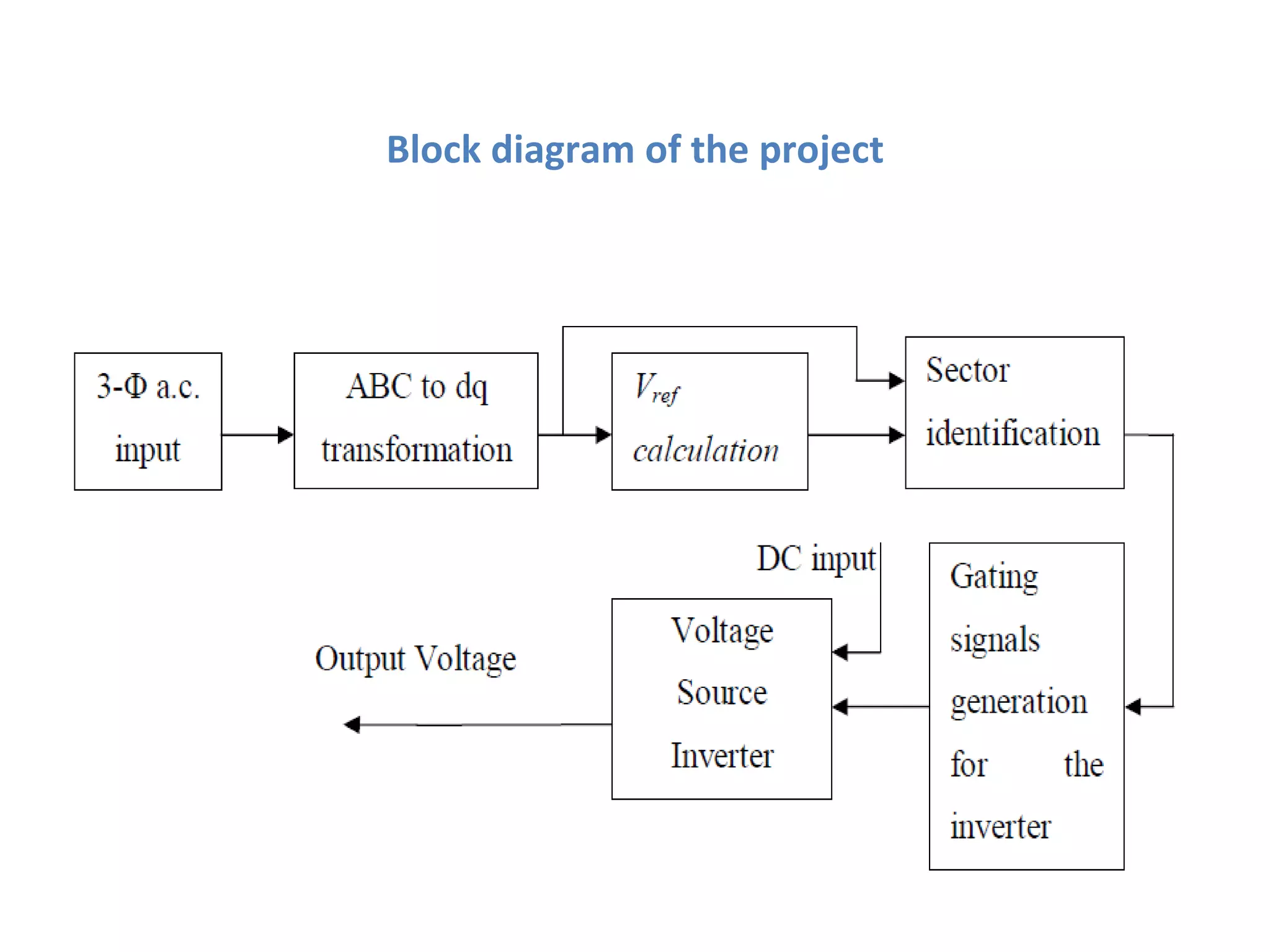
Block diagram of the project
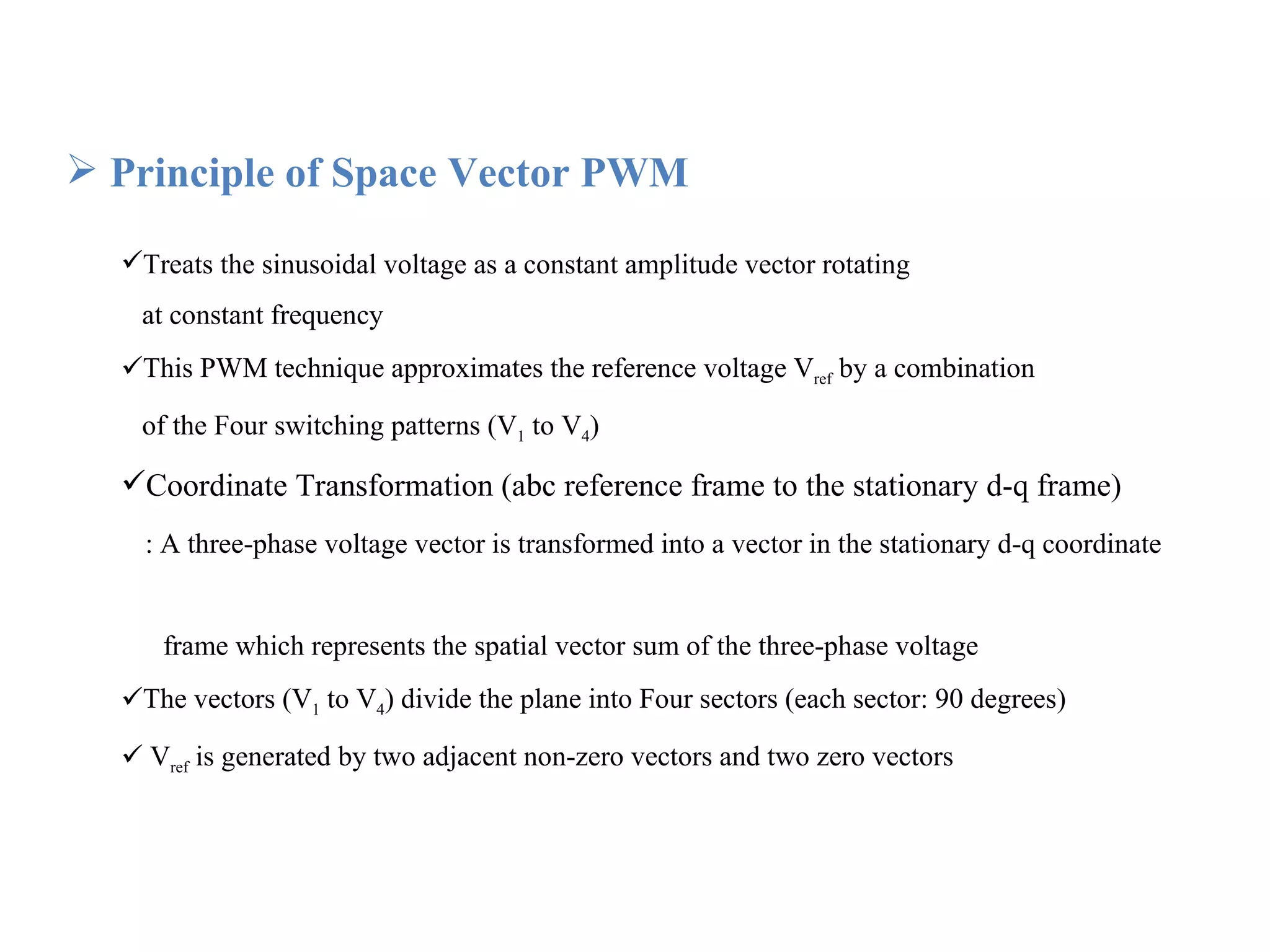
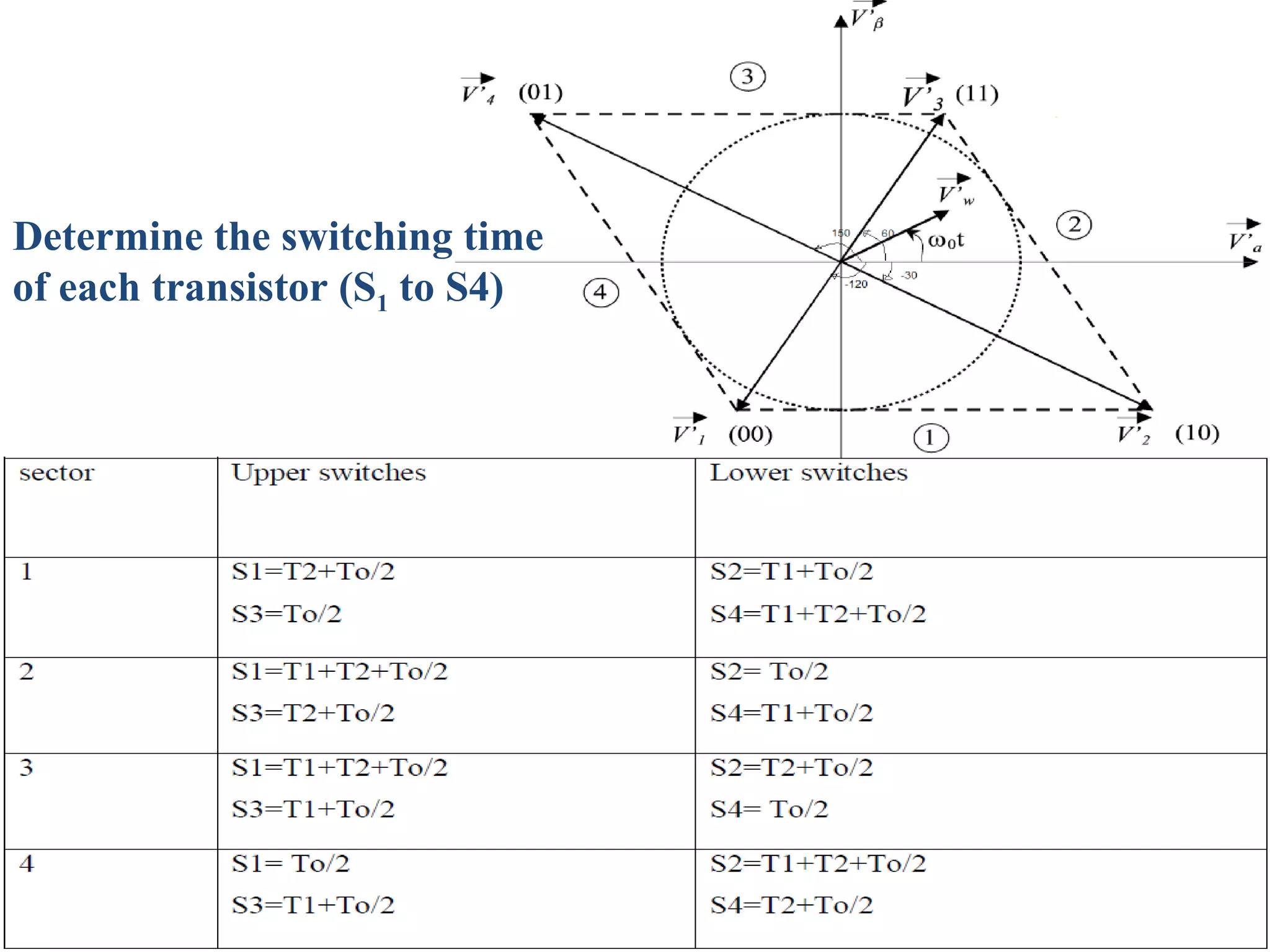
Principle of Space Vector PWM Treats the sinusoidal voltage as a constant amplitude vector rotating  at constant frequency This PWM technique approximates the reference voltage V ref  by a combination  of the Four switching patterns (V 1  to V 4 ) Coordinate Transformation (abc reference frame to the stationary d-q frame)  : A three-phase voltage vector is transformed into a vector in the stationary d-q coordinate  frame which represents the spatial vector sum of the three-phase voltage The vectors (V 1  to V 4 ) divide the plane into Four sectors (each sector: 90 degrees) V ref  is generated by two adjacent non-zero vectors and two zero vectors
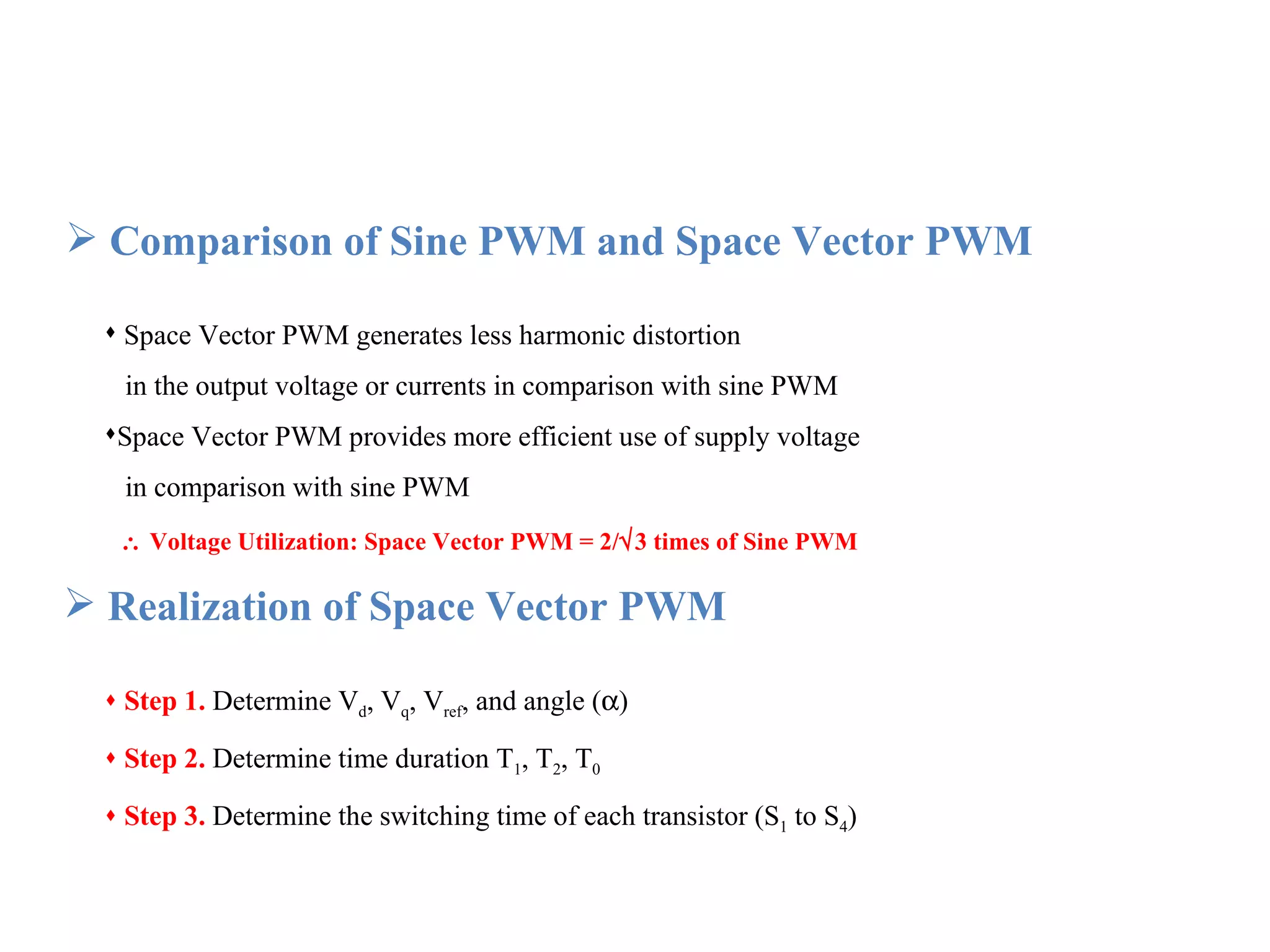
Comparison of Sine PWM and Space Vector PWM Space Vector PWM generates less harmonic distortion  in the output voltage or currents in comparison with sine PWM Space Vector PWM provides more efficient use of supply voltage  in comparison with sine PWM    Voltage Utilization: Space Vector PWM = 2/  3 times of Sine PWM Realization of Space Vector PWM Step 1.   Determine V d , V q , V ref , and angle (  ) Step 2.   Determine time duration T 1 , T 2 , T 0 Step 3.   Determine the switching time of each transistor (S 1  to S 4 )
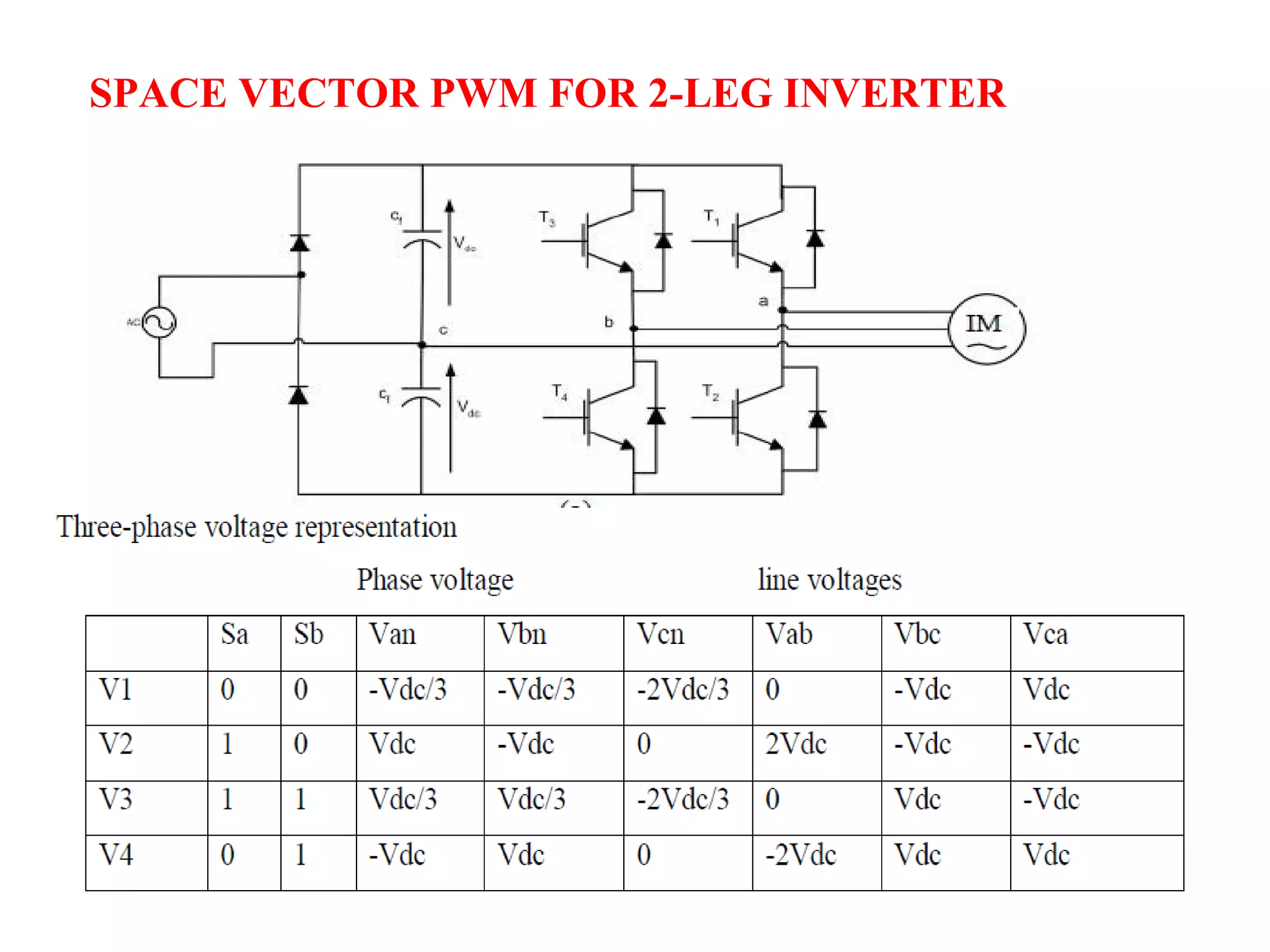
SPACE VECTOR PWM FOR 2-LEG INVERTER
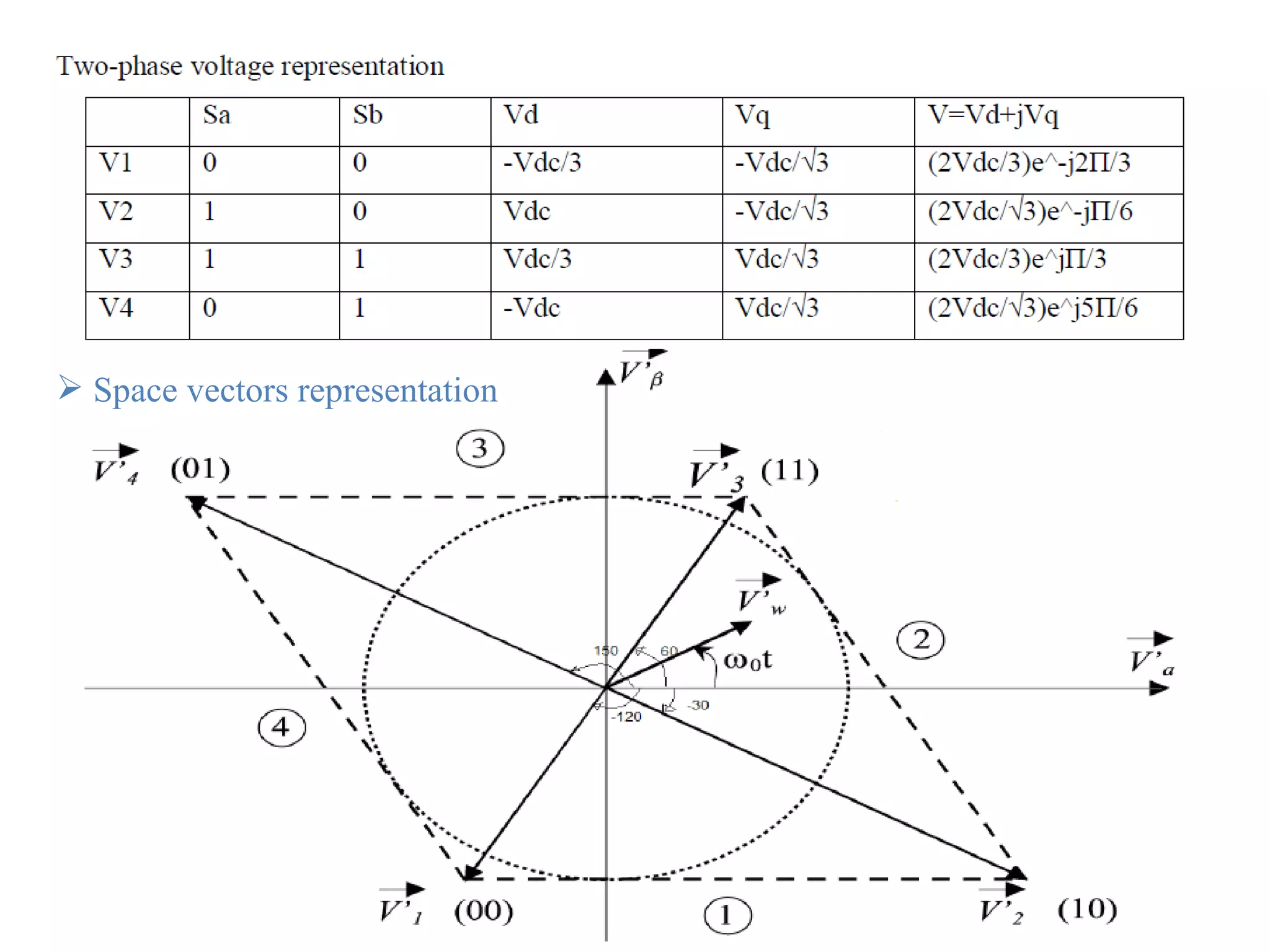
Space vectors representation
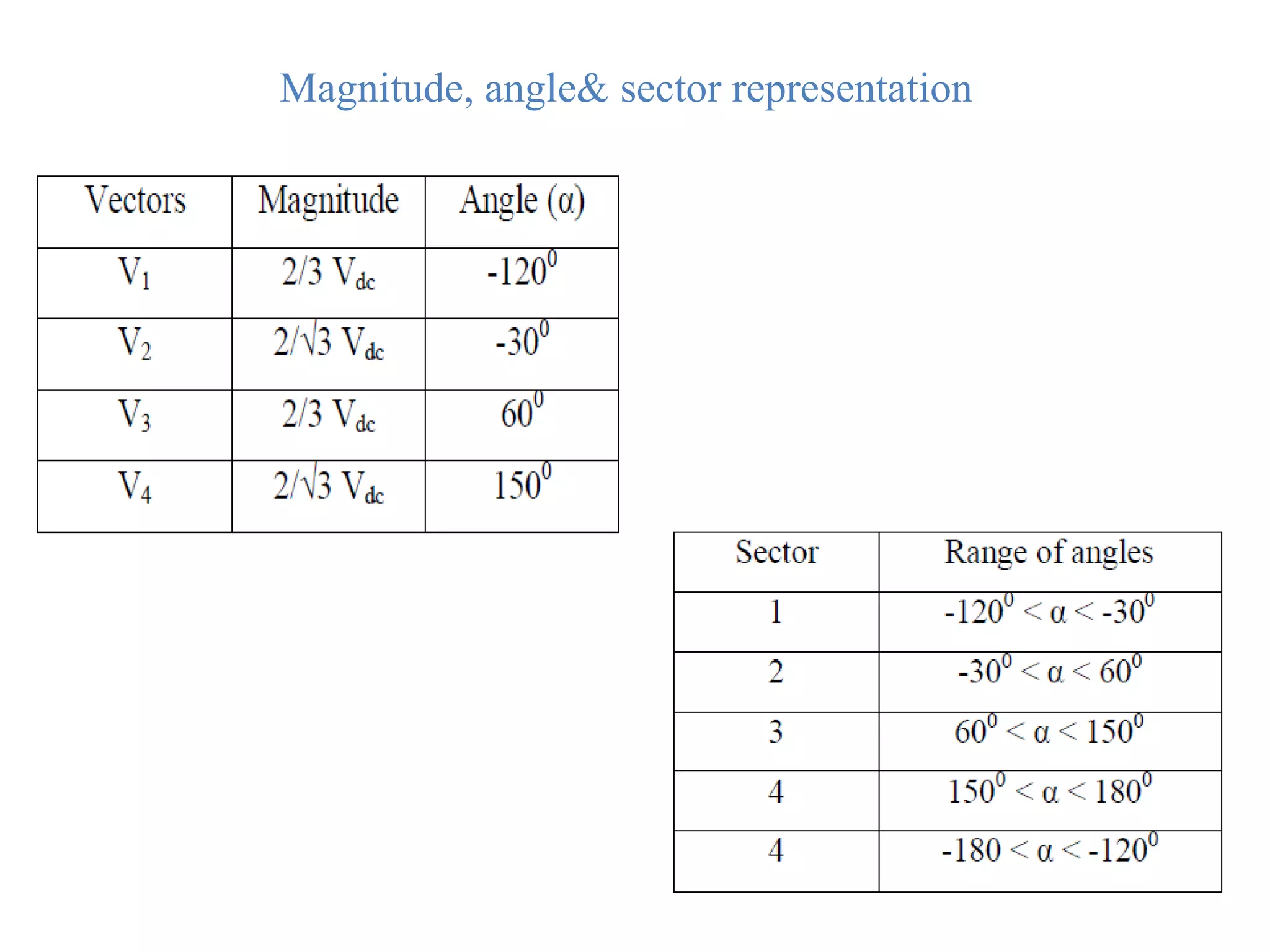
Magnitude, angle& sector representation
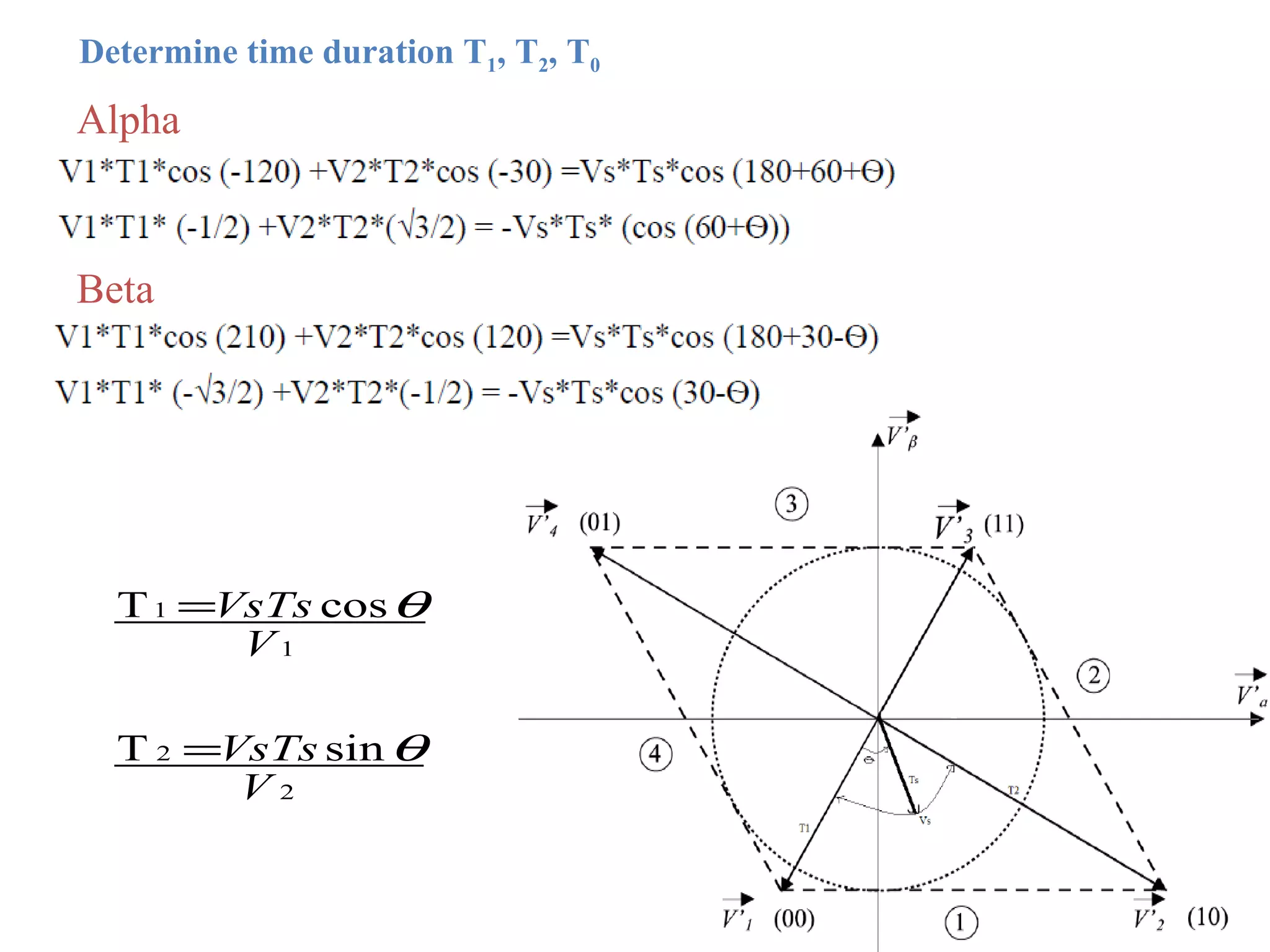
Alpha Beta Determine time duration T 1 , T 2 , T 0
 
Determine the switching time of each transistor (S 1  to S4)
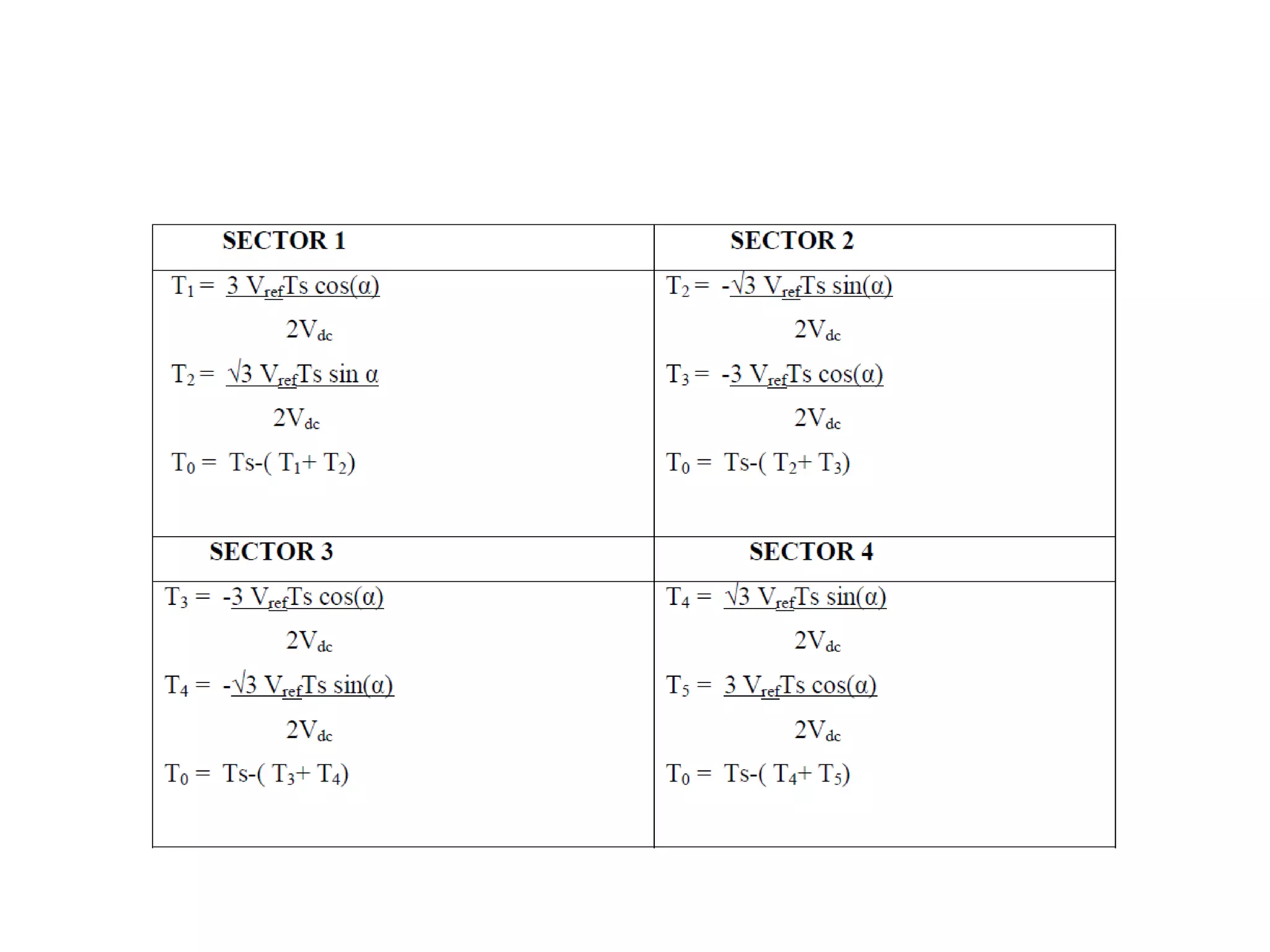
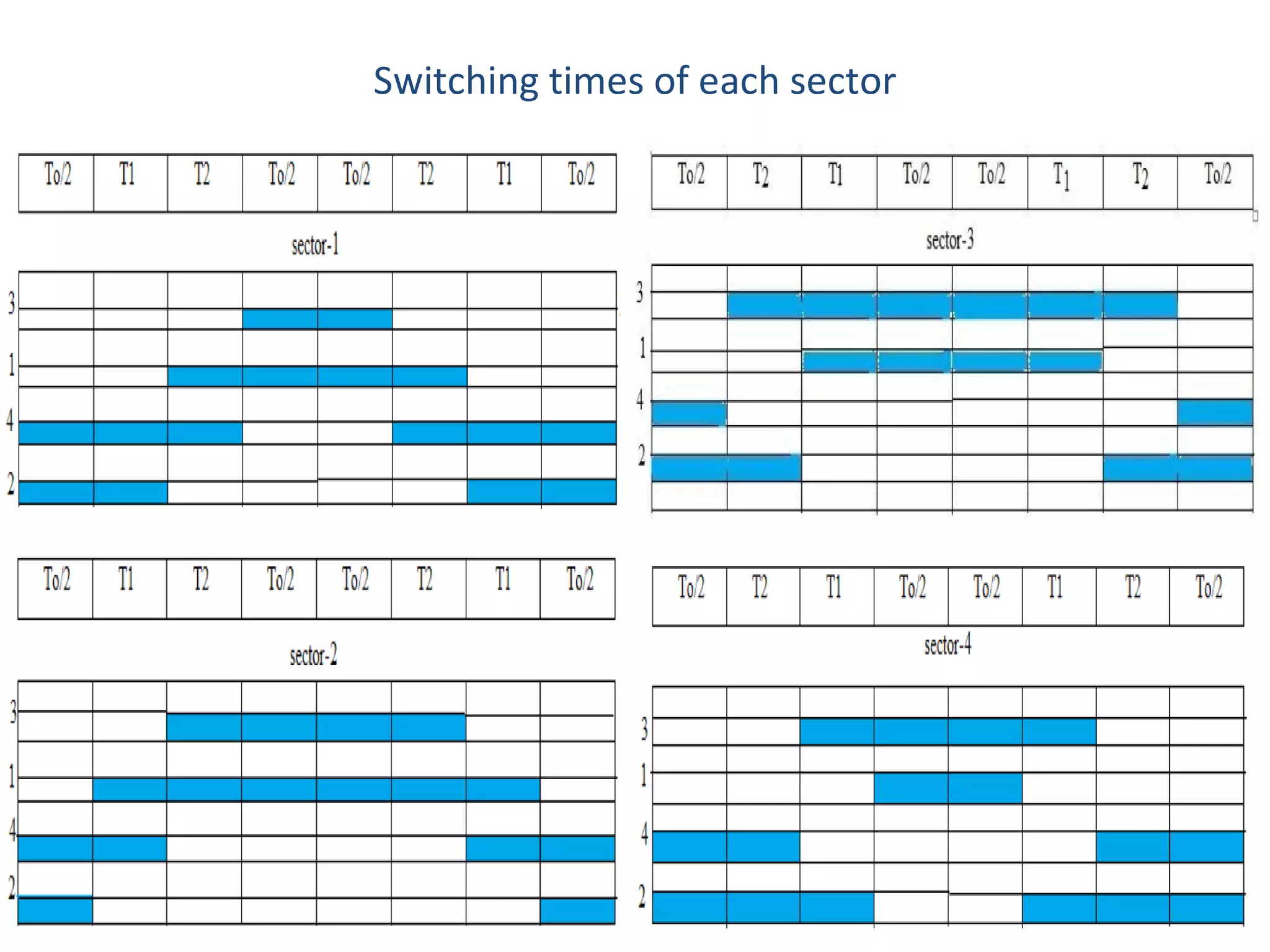
Switching times of each sector
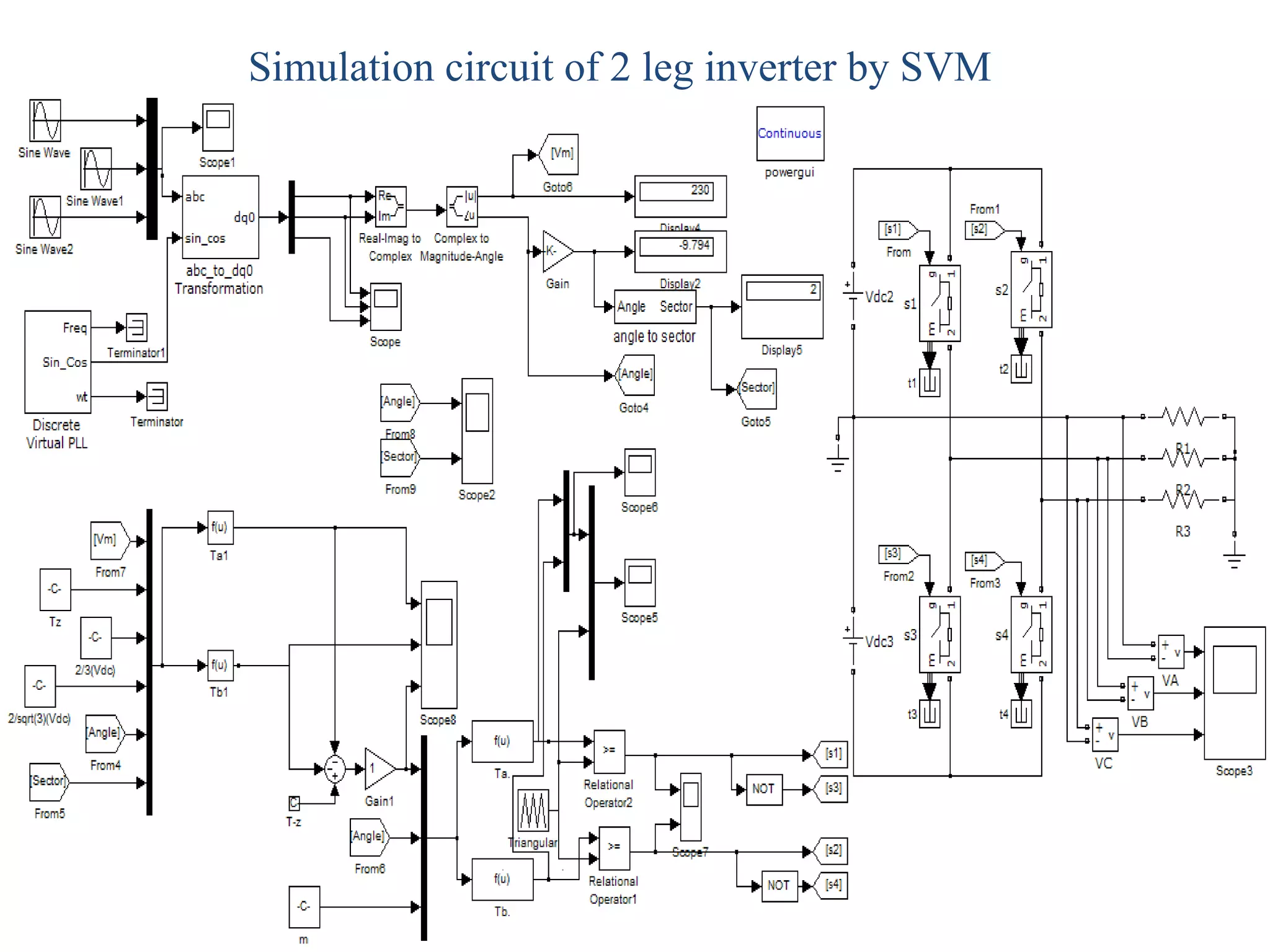
Simulation circuit of 2 leg inverter by SVM
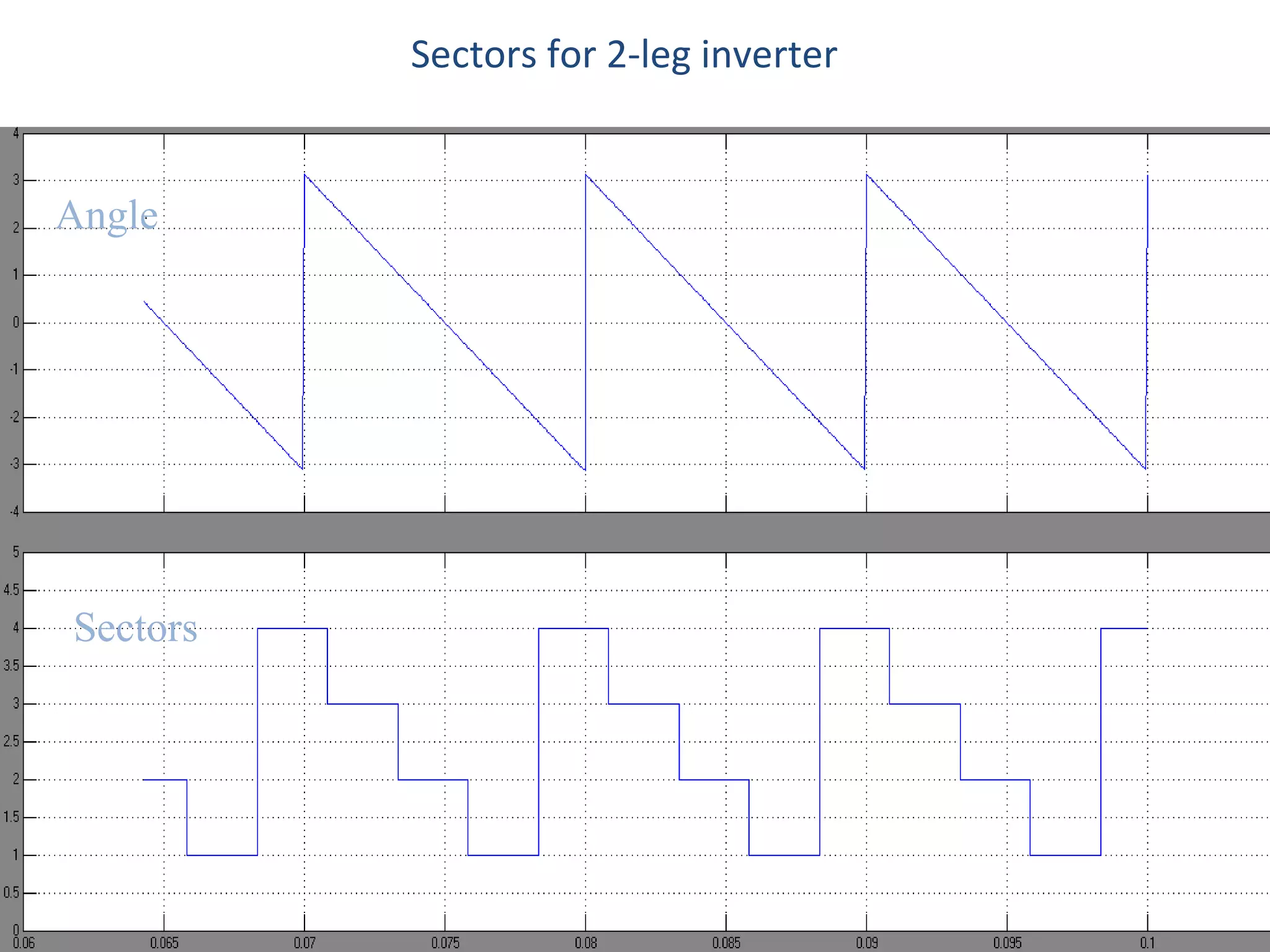
Sectors for 2-leg inverter Angle Sectors
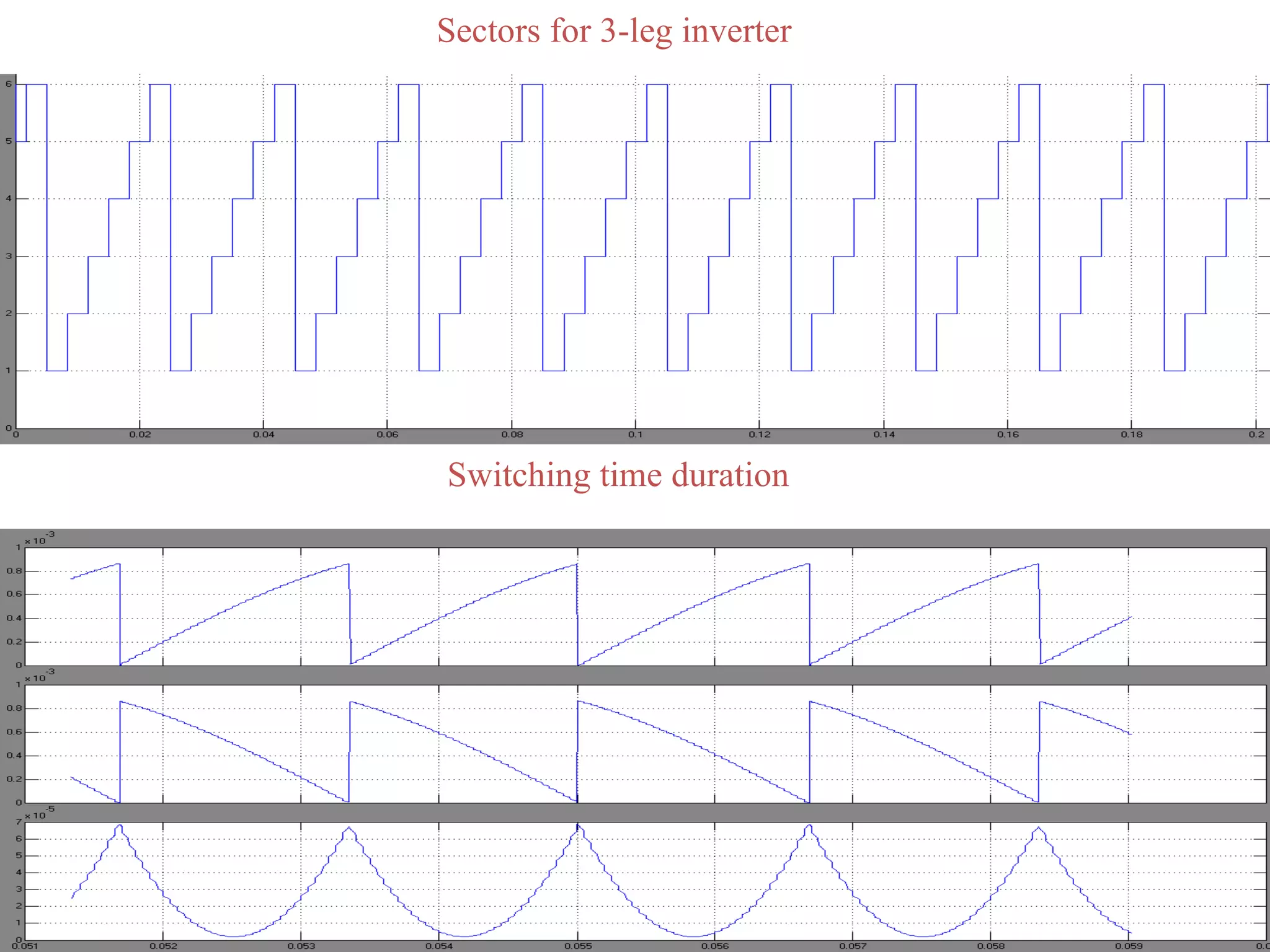
Sectors for 3-leg inverter Switching time duration
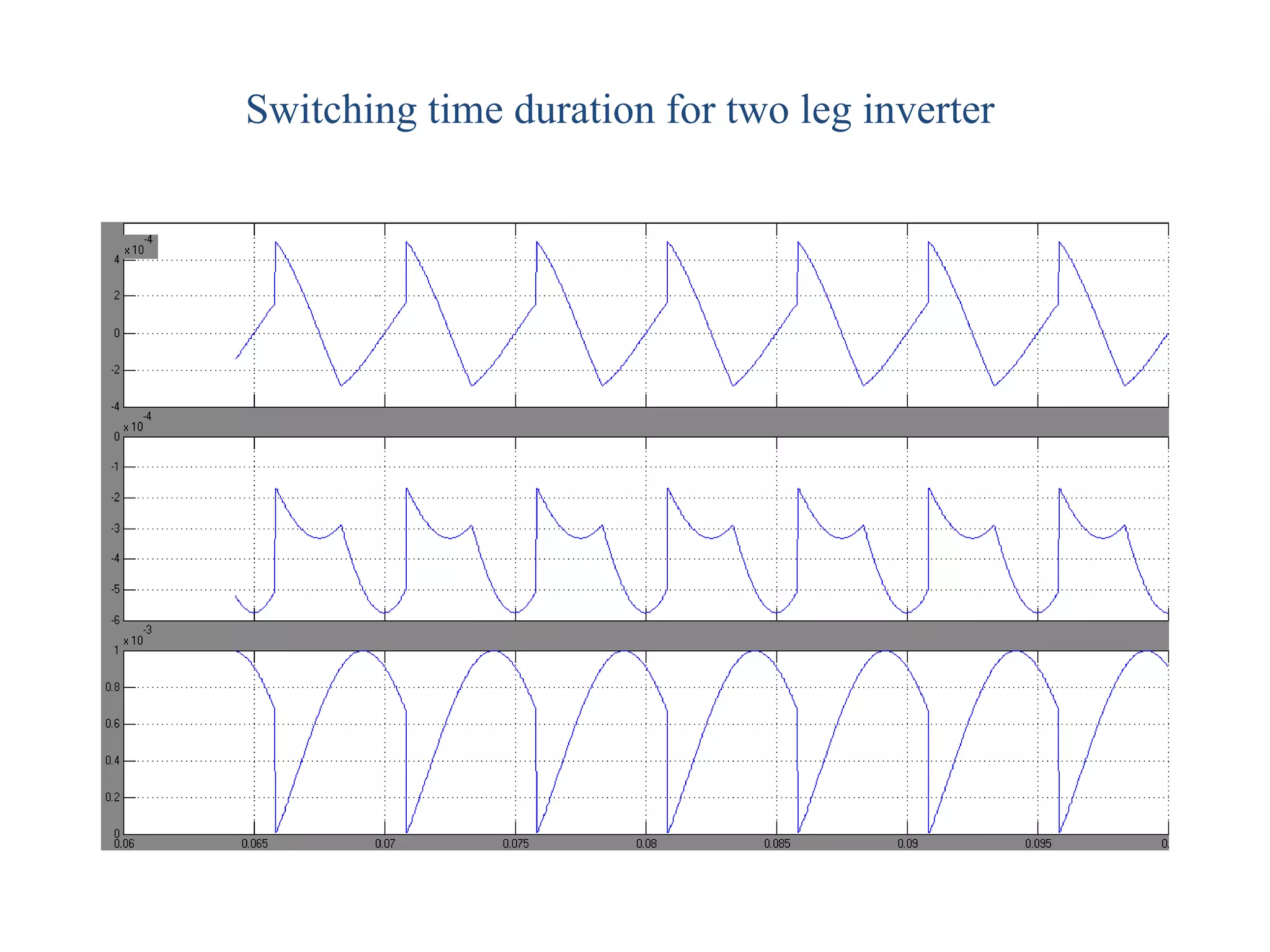
Switching time duration for two leg inverter
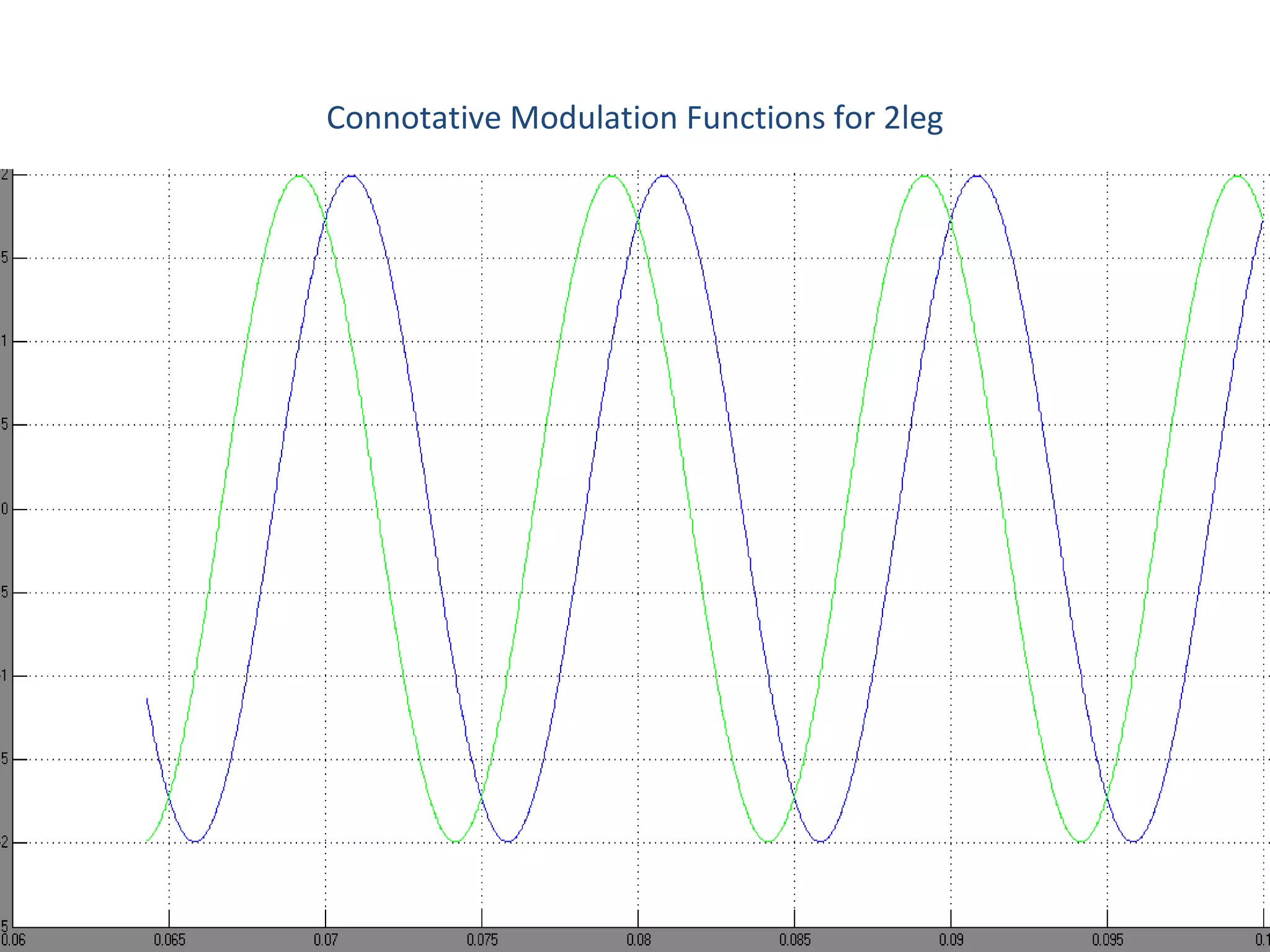
Connotative Modulation Functions for 2leg
Connotative Modulation Functions for 3 leg Phase voltages of 3-leg inverters
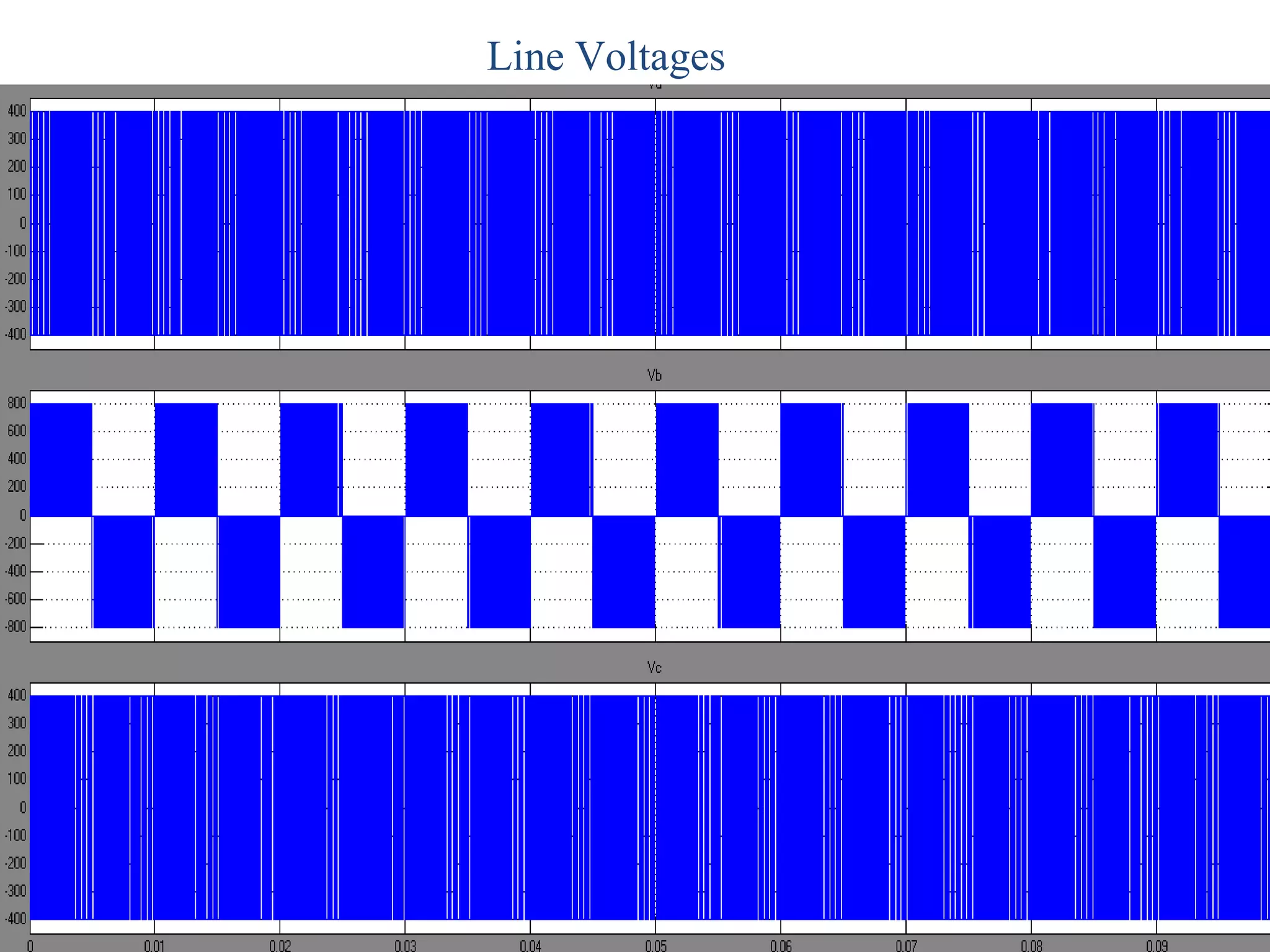
Line Voltages
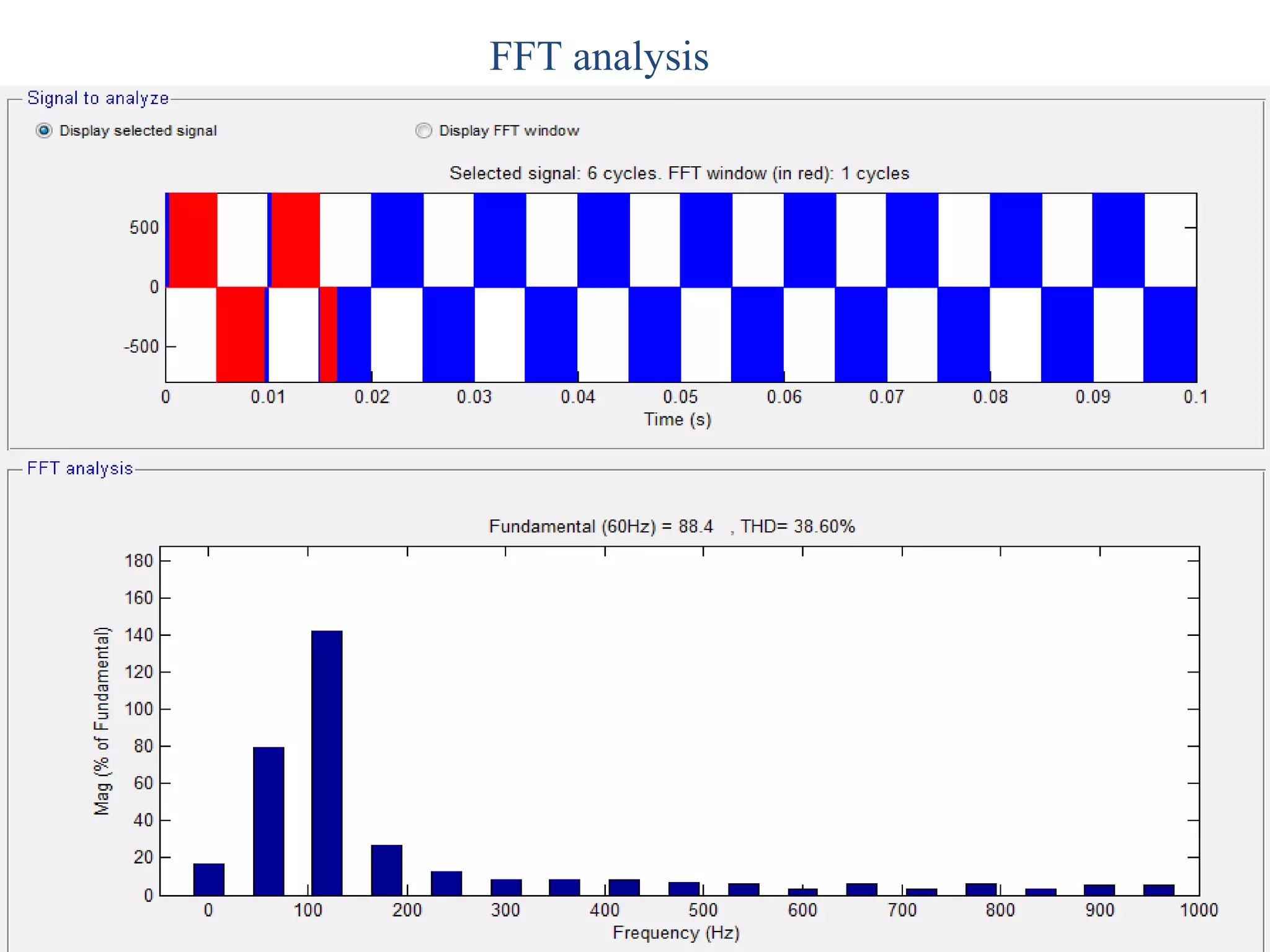
Switching time duration for two leg inverter with un-equal vector magnitudes…. FFT analysis
CONCLUSION In this dissertation work, it is shown that two-leg inverters are the best option for high performance low power applications. It can be resolved by comparing the no of semiconductor switches usage in 2-leg and 3-leg inverters and moreover two leg inverters allow the asymmetrical voltages To enable this, space vector pulse width modulation (SVPWM) technique for two-leg and three-leg inverters is presented.
BIBLIOGRAPHY [1]. Hind Djeghloud and Hocine Benalla, “Space Vector Pulse Width Modulation Applied to The Three-Level Voltage Inverter”, 5th International Conference on Technology and Automation ICTA’05, Thessaloniki, Greece, Oct 2010. [2]. Jin-woo Jung, “Space Vector PWM Inverter”, The Ohio State University, February, 2008. [3]. Jae Hyeong Seo; Chang Ho Choi; Dong Seok Hyun, “A New Simplified space-Vector PWM Method for Three-Level Inverters”, IEEE Transactions on Power Electronics,  Volume 16, Issue 4, Jul 2010, Pages 545 - 550 [4]. Muhammad H.Rashid “Power Electronics Circuits, devices, and Applications”, Prentice-Hall of India Private Limited, Third Edition, 2004. [5]. “the adaptive space vector pwm for four switch three phase inverter fed induction motor with dc – link voltage imbalance” by Hong Hee Lee*, Phan Quoc Dzung**, Le Dinh Khoa**, Le Minh Phuong**, Huynh Tan Thanh***School of Electrical Engineering, University of Ulsan Ulsan, Korea. [6]. P.S.Bimbhra, “Power Electronics”, Khanna publications. [7]. Overview of MATLAB Simulink Http://www.mathworks.com/products/simulink/description/overview.shtml
THANK YOU

space vector PWM for 2 leg inverter

  • 1.
    SPACE VECTOR MODULATIONFOR TWO LEG INVERTERS PRESENTED By SUDHAKAR AKKI Reg.No:1610910044 UNDER THE GUIDANCE OF Mr. NALINKANT MOHANTY ASST.PROF( Sr.G )
  • 2.
    INTRODUCTION Semiconductor switchesmainly determine the overall price of power converters. The main objective of this project is to prove 2leg inverters are the best option for low power applications for getting the good performance. Two leg inverter produces the square wave or quasi-square wave. but low power applications allow the two leg inverter output. In many industrial applications, it is often required to vary the output voltage of the inverter due to the following reasons To cope with the dc I/p voltage. To regulate the voltage of inverters To satisfy the constant voltage & frequency for control requirement.
  • 3.
    Pulse-Width Modulated ForVSI Disadvantages of PWM semiconductor devices must have low turn-on and turn-off times. so, they are very expansive Reduction of available voltage Increase of switching losses due to high PWM frequency Control of inverter output voltage with out any additional components Reduction of lower harmonics The most common PWM approach is sinusoidal PWM . In this method a triangular wave is compared to a sinusoidal wave of the desired frequency and the relative levels of the two waves is used to control the switching of devices in each phase leg of the inverter. Objective of PWM
  • 4.
    Space vector modulationIn sinusoidal PWM, the inverter can be thought of as three separate push-pull driver stages, which create each phase waveform independently. SVM, however treats the inverter as a single unit The space vector method is a d,q model PWM approach Modulation index is high SVM produces 15% higher then the sinusoidal PWM in output voltages Simple, inherently digital calculation of the switching times. SVPWM has been gaining more attention in the industry.
  • 5.
    Block diagram ofthe project
  • 6.
    Principle of SpaceVector PWM Treats the sinusoidal voltage as a constant amplitude vector rotating at constant frequency This PWM technique approximates the reference voltage V ref by a combination of the Four switching patterns (V 1 to V 4 ) Coordinate Transformation (abc reference frame to the stationary d-q frame) : A three-phase voltage vector is transformed into a vector in the stationary d-q coordinate frame which represents the spatial vector sum of the three-phase voltage The vectors (V 1 to V 4 ) divide the plane into Four sectors (each sector: 90 degrees) V ref is generated by two adjacent non-zero vectors and two zero vectors
  • 7.
    Comparison of SinePWM and Space Vector PWM Space Vector PWM generates less harmonic distortion in the output voltage or currents in comparison with sine PWM Space Vector PWM provides more efficient use of supply voltage in comparison with sine PWM  Voltage Utilization: Space Vector PWM = 2/  3 times of Sine PWM Realization of Space Vector PWM Step 1. Determine V d , V q , V ref , and angle (  ) Step 2. Determine time duration T 1 , T 2 , T 0 Step 3. Determine the switching time of each transistor (S 1 to S 4 )
  • 8.
    SPACE VECTOR PWMFOR 2-LEG INVERTER
  • 9.
  • 10.
  • 11.
    Alpha Beta Determinetime duration T 1 , T 2 , T 0
  • 12.
  • 13.
    Determine the switchingtime of each transistor (S 1 to S4)
  • 14.
    Switching times ofeach sector
  • 15.
    Simulation circuit of2 leg inverter by SVM
  • 16.
    Sectors for 2-leginverter Angle Sectors
  • 17.
    Sectors for 3-leginverter Switching time duration
  • 18.
    Switching time durationfor two leg inverter
  • 19.
  • 20.
    Connotative Modulation Functionsfor 3 leg Phase voltages of 3-leg inverters
  • 21.
  • 22.
    Switching time durationfor two leg inverter with un-equal vector magnitudes…. FFT analysis
  • 23.
    CONCLUSION In thisdissertation work, it is shown that two-leg inverters are the best option for high performance low power applications. It can be resolved by comparing the no of semiconductor switches usage in 2-leg and 3-leg inverters and moreover two leg inverters allow the asymmetrical voltages To enable this, space vector pulse width modulation (SVPWM) technique for two-leg and three-leg inverters is presented.
  • 24.
    BIBLIOGRAPHY [1]. HindDjeghloud and Hocine Benalla, “Space Vector Pulse Width Modulation Applied to The Three-Level Voltage Inverter”, 5th International Conference on Technology and Automation ICTA’05, Thessaloniki, Greece, Oct 2010. [2]. Jin-woo Jung, “Space Vector PWM Inverter”, The Ohio State University, February, 2008. [3]. Jae Hyeong Seo; Chang Ho Choi; Dong Seok Hyun, “A New Simplified space-Vector PWM Method for Three-Level Inverters”, IEEE Transactions on Power Electronics, Volume 16, Issue 4, Jul 2010, Pages 545 - 550 [4]. Muhammad H.Rashid “Power Electronics Circuits, devices, and Applications”, Prentice-Hall of India Private Limited, Third Edition, 2004. [5]. “the adaptive space vector pwm for four switch three phase inverter fed induction motor with dc – link voltage imbalance” by Hong Hee Lee*, Phan Quoc Dzung**, Le Dinh Khoa**, Le Minh Phuong**, Huynh Tan Thanh***School of Electrical Engineering, University of Ulsan Ulsan, Korea. [6]. P.S.Bimbhra, “Power Electronics”, Khanna publications. [7]. Overview of MATLAB Simulink Http://www.mathworks.com/products/simulink/description/overview.shtml
  • 25.

Editor's Notes

  • #9 SVM treats the inverter as a single unit. Can be represented in a two dimensional space. There are 4 possible states for the inverter.
  • #10 4 active vectors occupy 4 vertices of the (Parallelogram)Rhombus If phase voltages are sinusoidal, the locus of Vs is a circular
  • #12 If the space vector lies in b/w any two active vectors, Then these 2 active vectors and zero vectors are used to synthesize the Vs Vs* is making an angle 0<teta<90 Volt-sec balance condition gives (incremental flux)=Vs*Tc=V1T1+V2T2+VzTz
  • #15 Can be distributed in the beginning and the end of Tc at a time, only one switch should be switched.
  • #16 Switching losses are increased Amplitude of higher order harmonics are increased The fundamental component of output voltage is less PWM method is unable to make full use of the inverters supply voltage and asymmetrical nature of switching characteristics , produce the high harmonic distortion in the supply.