DYNAMICS OF ELECTRICAL
DRIVES
Prof. S. Y.
Gadgune
FUNDAMENTAL TORQUE EQUATION
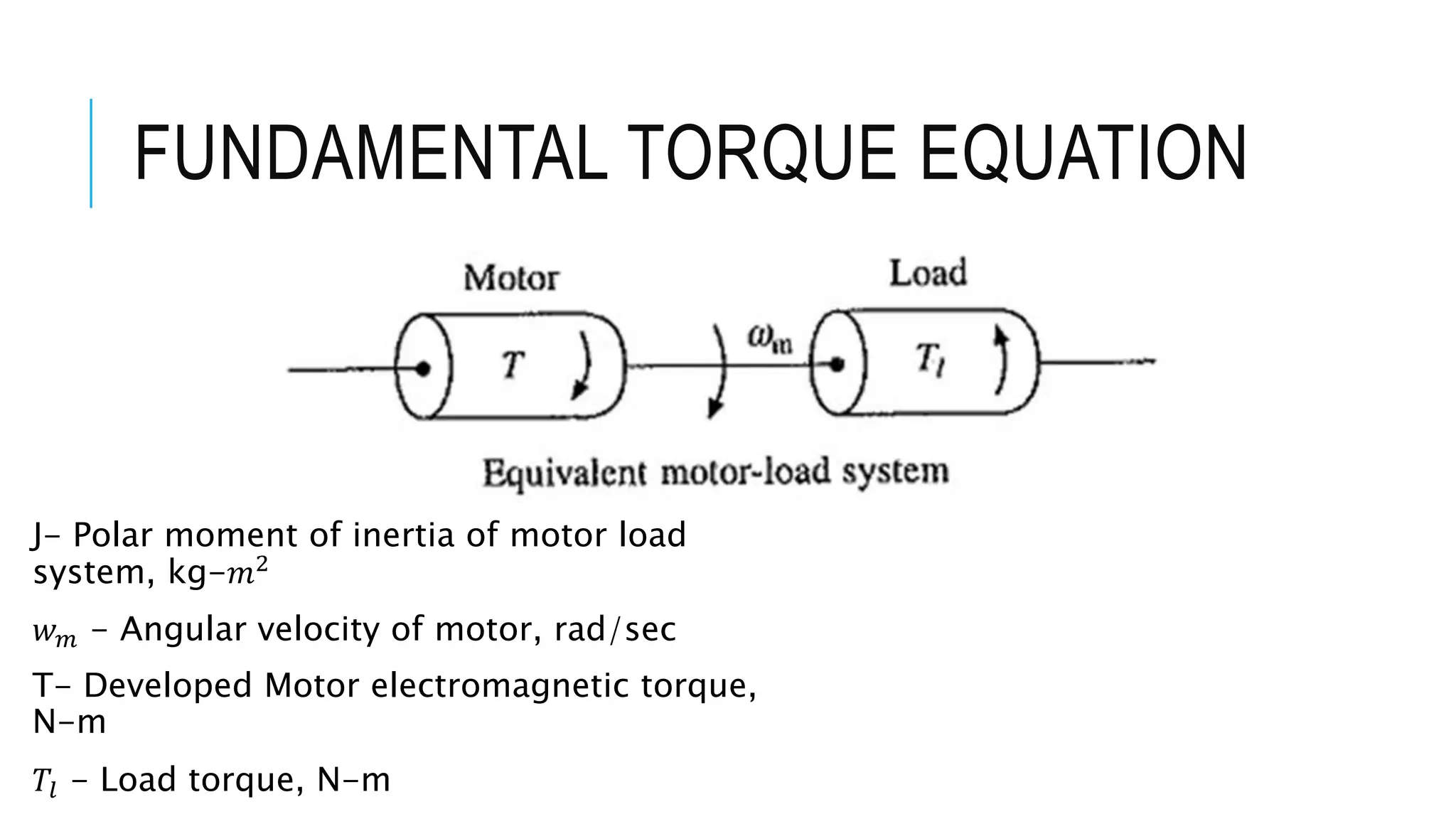
J- Polar moment of inertia of motor load
system, kg-𝑚2
𝑤 𝑚 - Angular velocity of motor, rad/sec
T- Developed Motor electromagnetic torque,
N-m
𝑇𝑙 - Load torque, N-m
FUNDAMENTAL TORQUE EQUATION
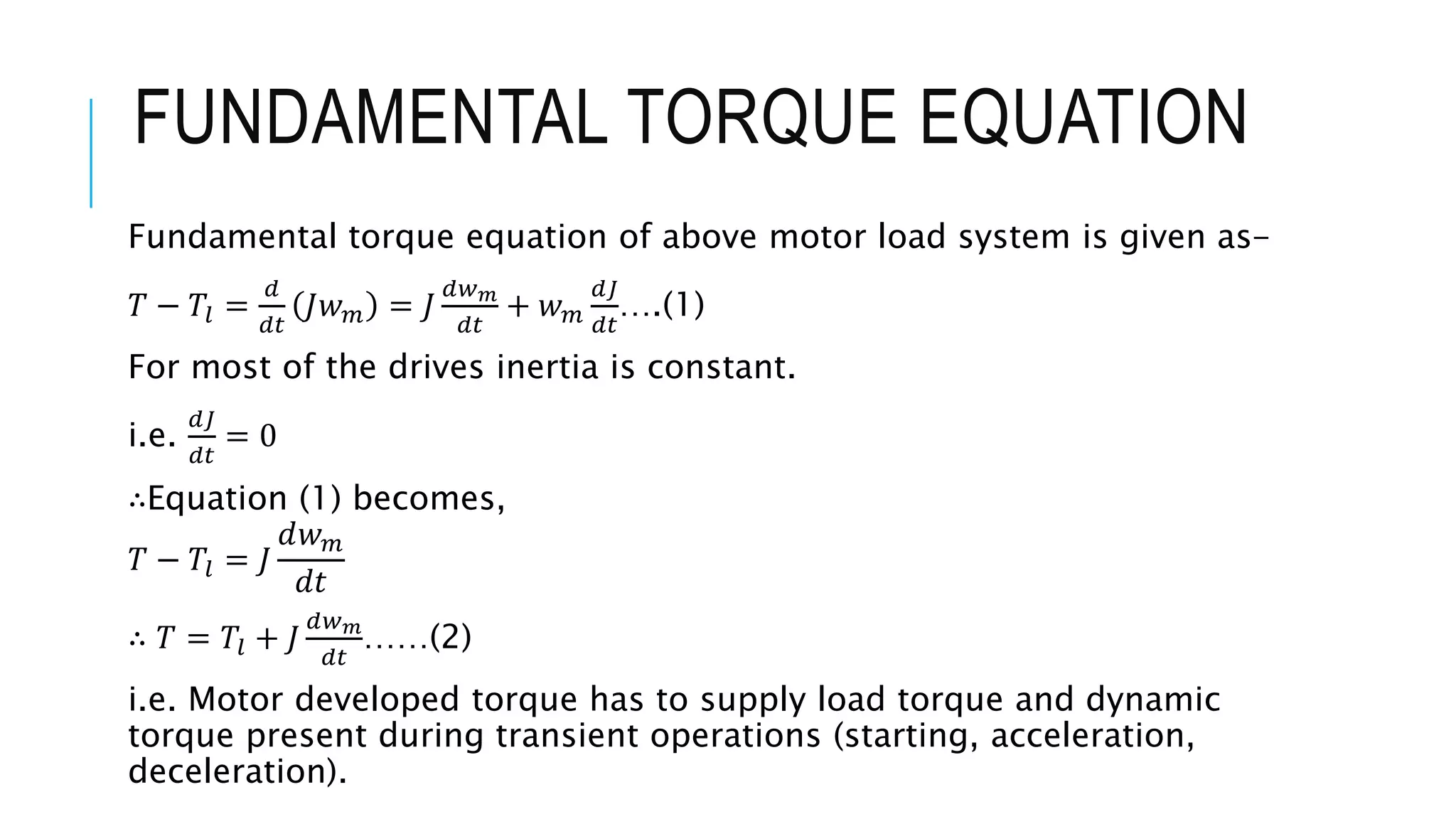
Fundamental torque equation of above motor load system is given as-
𝑇 − 𝑇𝑙 =
𝑑
𝑑𝑡
𝐽𝑤 𝑚 = 𝐽
𝑑𝑤 𝑚
𝑑𝑡
+ 𝑤 𝑚
𝑑𝐽
𝑑𝑡
….(1)
For most of the drives inertia is constant.
i.e.
𝑑𝐽
𝑑𝑡
= 0
∴Equation (1) becomes,
𝑇 − 𝑇𝑙 = 𝐽
𝑑𝑤 𝑚
𝑑𝑡
∴ 𝑇 = 𝑇𝑙 + 𝐽
𝑑𝑤 𝑚
𝑑𝑡
……(2)
i.e. Motor developed torque has to supply load torque and dynamic
torque present during transient operations (starting, acceleration,
deceleration).
MULTI-QUADRANT OPERATION OF
DRIVES
Sign Convention
Speed : Motor Speed is considered to be positive, if it is rotating in
forward direction. If we consider a particular direction of rotation as
forward (or +ve), then rotation in opposite direction will be Reverse
direction (-ve). In applications involving up and down motion, the
direction of rotation of motor causing upward motion will be the
forward.
Torque : In case of forward motion, if the motor torque causes it to
accelerate, then it will be positive torque. The load torque operates in
opposite direction that of the motor torque.
MULTI-QUADRANT OPERATION OF
DRIVES
Modes of Operation
Motoring- Electrical energy is converted into mechanical energy. i.e.
power flows from supply to motor.
Braking- Motor works as generator converting mechanical energy
into electrical energy. i.e. power flows from motor to supply.
MULTI-QUADRANT OPERATION OF
DRIVES
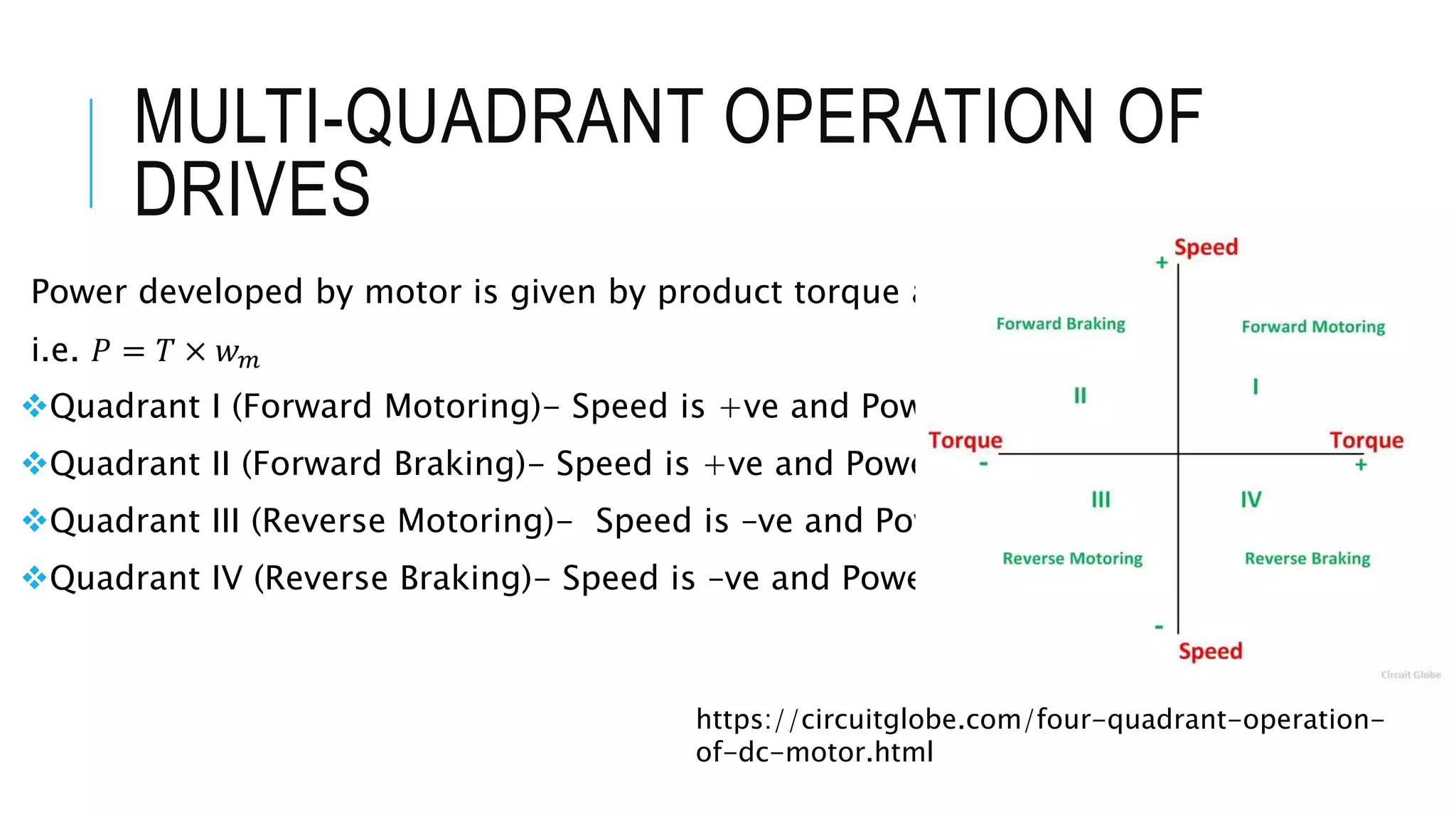
Power developed by motor is given by product torque and speed.
i.e. 𝑃 = 𝑇 × 𝑤 𝑚
Quadrant I (Forward Motoring)- Speed is +ve and Power is +ve
Quadrant II (Forward Braking)- Speed is +ve and Power is –ve
Quadrant III (Reverse Motoring)- Speed is –ve and Power is +ve
Quadrant IV (Reverse Braking)- Speed is –ve and Power is -ve
https://circuitglobe.com/four-quadrant-operation-
of-dc-motor.html
MULTI-QUADRANT OPERATION OF
DRIVES
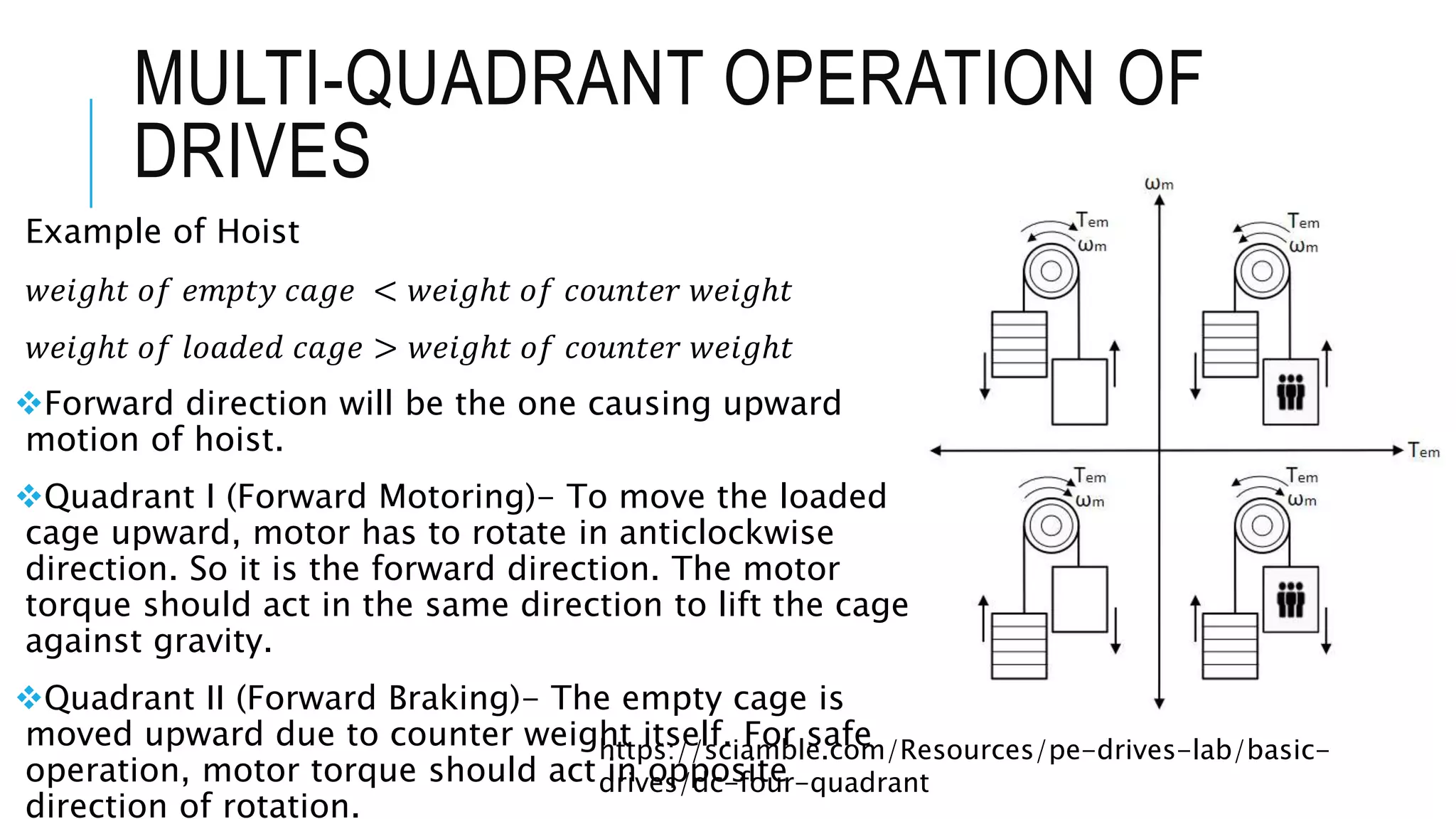
Example of Hoist
𝑤𝑒𝑖𝑔ℎ𝑡 𝑜𝑓 𝑒𝑚𝑝𝑡𝑦 𝑐𝑎𝑔𝑒 < 𝑤𝑒𝑖𝑔ℎ𝑡 𝑜𝑓 𝑐𝑜𝑢𝑛𝑡𝑒𝑟 𝑤𝑒𝑖𝑔ℎ𝑡
𝑤𝑒𝑖𝑔ℎ𝑡 𝑜𝑓 𝑙𝑜𝑎𝑑𝑒𝑑 𝑐𝑎𝑔𝑒 > 𝑤𝑒𝑖𝑔ℎ𝑡 𝑜𝑓 𝑐𝑜𝑢𝑛𝑡𝑒𝑟 𝑤𝑒𝑖𝑔ℎ𝑡
Forward direction will be the one causing upward
motion of hoist.
Quadrant I (Forward Motoring)- To move the loaded
cage upward, motor has to rotate in anticlockwise
direction. So it is the forward direction. The motor
torque should act in the same direction to lift the cage
against gravity.
Quadrant II (Forward Braking)- The empty cage is
moved upward due to counter weight itself. For safe
operation, motor torque should act in opposite
direction of rotation.
https://sciamble.com/Resources/pe-drives-lab/basic-
drives/dc-four-quadrant
MULTI-QUADRANT OPERATION OF
DRIVES
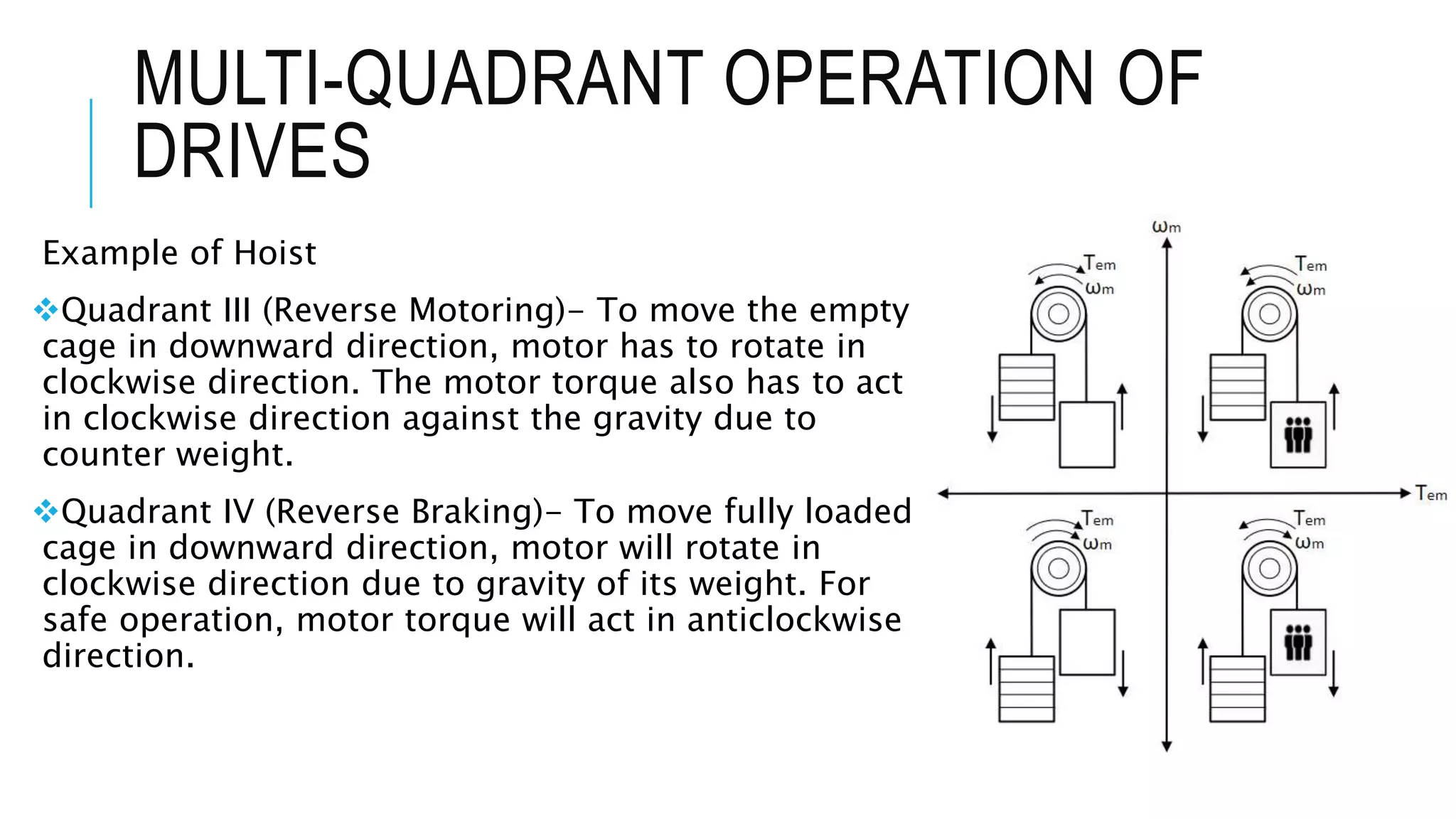
Example of Hoist
Quadrant III (Reverse Motoring)- To move the empty
cage in downward direction, motor has to rotate in
clockwise direction. The motor torque also has to act
in clockwise direction against the gravity due to
counter weight.
Quadrant IV (Reverse Braking)- To move fully loaded
cage in downward direction, motor will rotate in
clockwise direction due to gravity of its weight. For
safe operation, motor torque will act in anticlockwise
direction.
REFERENCES
 G. K. Dubey, “Fundamentals of Electrical Drives”, Second Edition,
Narosa Publishing House
Dynamics of Electrical Drives

Dynamics of Electrical Drives

  • 1.
  • 2.
    FUNDAMENTAL TORQUE EQUATION J-Polar moment of inertia of motor load system, kg-𝑚2 𝑤 𝑚 - Angular velocity of motor, rad/sec T- Developed Motor electromagnetic torque, N-m 𝑇𝑙 - Load torque, N-m
  • 3.
    FUNDAMENTAL TORQUE EQUATION Fundamentaltorque equation of above motor load system is given as- 𝑇 − 𝑇𝑙 = 𝑑 𝑑𝑡 𝐽𝑤 𝑚 = 𝐽 𝑑𝑤 𝑚 𝑑𝑡 + 𝑤 𝑚 𝑑𝐽 𝑑𝑡 ….(1) For most of the drives inertia is constant. i.e. 𝑑𝐽 𝑑𝑡 = 0 ∴Equation (1) becomes, 𝑇 − 𝑇𝑙 = 𝐽 𝑑𝑤 𝑚 𝑑𝑡 ∴ 𝑇 = 𝑇𝑙 + 𝐽 𝑑𝑤 𝑚 𝑑𝑡 ……(2) i.e. Motor developed torque has to supply load torque and dynamic torque present during transient operations (starting, acceleration, deceleration).
  • 4.
    MULTI-QUADRANT OPERATION OF DRIVES SignConvention Speed : Motor Speed is considered to be positive, if it is rotating in forward direction. If we consider a particular direction of rotation as forward (or +ve), then rotation in opposite direction will be Reverse direction (-ve). In applications involving up and down motion, the direction of rotation of motor causing upward motion will be the forward. Torque : In case of forward motion, if the motor torque causes it to accelerate, then it will be positive torque. The load torque operates in opposite direction that of the motor torque.
  • 5.
    MULTI-QUADRANT OPERATION OF DRIVES Modesof Operation Motoring- Electrical energy is converted into mechanical energy. i.e. power flows from supply to motor. Braking- Motor works as generator converting mechanical energy into electrical energy. i.e. power flows from motor to supply.
  • 6.
    MULTI-QUADRANT OPERATION OF DRIVES Powerdeveloped by motor is given by product torque and speed. i.e. 𝑃 = 𝑇 × 𝑤 𝑚 Quadrant I (Forward Motoring)- Speed is +ve and Power is +ve Quadrant II (Forward Braking)- Speed is +ve and Power is –ve Quadrant III (Reverse Motoring)- Speed is –ve and Power is +ve Quadrant IV (Reverse Braking)- Speed is –ve and Power is -ve https://circuitglobe.com/four-quadrant-operation- of-dc-motor.html
  • 7.
    MULTI-QUADRANT OPERATION OF DRIVES Exampleof Hoist 𝑤𝑒𝑖𝑔ℎ𝑡 𝑜𝑓 𝑒𝑚𝑝𝑡𝑦 𝑐𝑎𝑔𝑒 < 𝑤𝑒𝑖𝑔ℎ𝑡 𝑜𝑓 𝑐𝑜𝑢𝑛𝑡𝑒𝑟 𝑤𝑒𝑖𝑔ℎ𝑡 𝑤𝑒𝑖𝑔ℎ𝑡 𝑜𝑓 𝑙𝑜𝑎𝑑𝑒𝑑 𝑐𝑎𝑔𝑒 > 𝑤𝑒𝑖𝑔ℎ𝑡 𝑜𝑓 𝑐𝑜𝑢𝑛𝑡𝑒𝑟 𝑤𝑒𝑖𝑔ℎ𝑡 Forward direction will be the one causing upward motion of hoist. Quadrant I (Forward Motoring)- To move the loaded cage upward, motor has to rotate in anticlockwise direction. So it is the forward direction. The motor torque should act in the same direction to lift the cage against gravity. Quadrant II (Forward Braking)- The empty cage is moved upward due to counter weight itself. For safe operation, motor torque should act in opposite direction of rotation. https://sciamble.com/Resources/pe-drives-lab/basic- drives/dc-four-quadrant
  • 8.
    MULTI-QUADRANT OPERATION OF DRIVES Exampleof Hoist Quadrant III (Reverse Motoring)- To move the empty cage in downward direction, motor has to rotate in clockwise direction. The motor torque also has to act in clockwise direction against the gravity due to counter weight. Quadrant IV (Reverse Braking)- To move fully loaded cage in downward direction, motor will rotate in clockwise direction due to gravity of its weight. For safe operation, motor torque will act in anticlockwise direction.
  • 9.
    REFERENCES  G. K.Dubey, “Fundamentals of Electrical Drives”, Second Edition, Narosa Publishing House