ELECTRICAL ENGINEERING
MATERIALS
MR. ASIF L. JAMADAR
BONDING IN SOLIDS
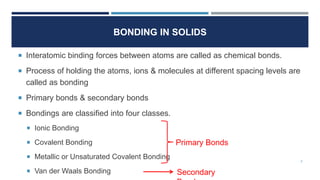
 Interatomic binding forces between atoms are called as chemical bonds.
 Process of holding the atoms, ions & molecules at different spacing levels are
called as bonding
 Primary bonds & secondary bonds
 Bondings are classified into four classes.
 Ionic Bonding
 Covalent Bonding
 Metallic or Unsaturated Covalent Bonding
 Van der Waals Bonding
2
Primary Bonds
Secondary
IONIC BOND
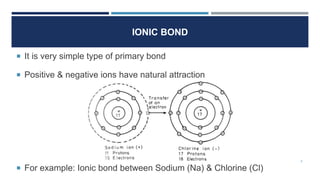
 It is very simple type of primary bond
 Positive & negative ions have natural attraction
 For example: Ionic bond between Sodium (Na) & Chlorine (Cl)
3
COVALENT BOND
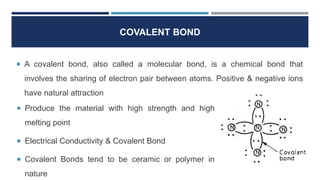
 A covalent bond, also called a molecular bond, is a chemical bond that
involves the sharing of electron pair between atoms. Positive & negative ions
have natural attraction
4
 Produce the material with high strength and high
melting point
 Electrical Conductivity & Covalent Bond
 Covalent Bonds tend to be ceramic or polymer in
nature
METALLIC BOND
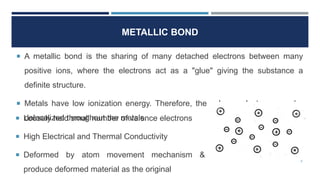
 A metallic bond is the sharing of many detached electrons between many
positive ions, where the electrons act as a "glue" giving the substance a
definite structure.
 Metals have low ionization energy. Therefore, the valence electrons can be
delocalized throughout the metals.
5
 Loosely held small number of valence electrons
 High Electrical and Thermal Conductivity
 Deformed by atom movement mechanism &
produce deformed material as the original
THANK
YOU
6

Electrical Engineering Material-IV

  • 1.
  • 2.
    BONDING IN SOLIDS Interatomic binding forces between atoms are called as chemical bonds.  Process of holding the atoms, ions & molecules at different spacing levels are called as bonding  Primary bonds & secondary bonds  Bondings are classified into four classes.  Ionic Bonding  Covalent Bonding  Metallic or Unsaturated Covalent Bonding  Van der Waals Bonding 2 Primary Bonds Secondary
  • 3.
    IONIC BOND  Itis very simple type of primary bond  Positive & negative ions have natural attraction  For example: Ionic bond between Sodium (Na) & Chlorine (Cl) 3
  • 4.
    COVALENT BOND  Acovalent bond, also called a molecular bond, is a chemical bond that involves the sharing of electron pair between atoms. Positive & negative ions have natural attraction 4  Produce the material with high strength and high melting point  Electrical Conductivity & Covalent Bond  Covalent Bonds tend to be ceramic or polymer in nature
  • 5.
    METALLIC BOND  Ametallic bond is the sharing of many detached electrons between many positive ions, where the electrons act as a "glue" giving the substance a definite structure.  Metals have low ionization energy. Therefore, the valence electrons can be delocalized throughout the metals. 5  Loosely held small number of valence electrons  High Electrical and Thermal Conductivity  Deformed by atom movement mechanism & produce deformed material as the original
  • 6.