EQUIVALENT CIRCUIT AND
POWER EQUATION OF
SYNCHRONOUS MOTOR
Lecture Notes by Dr.R.M.Larik 1
2
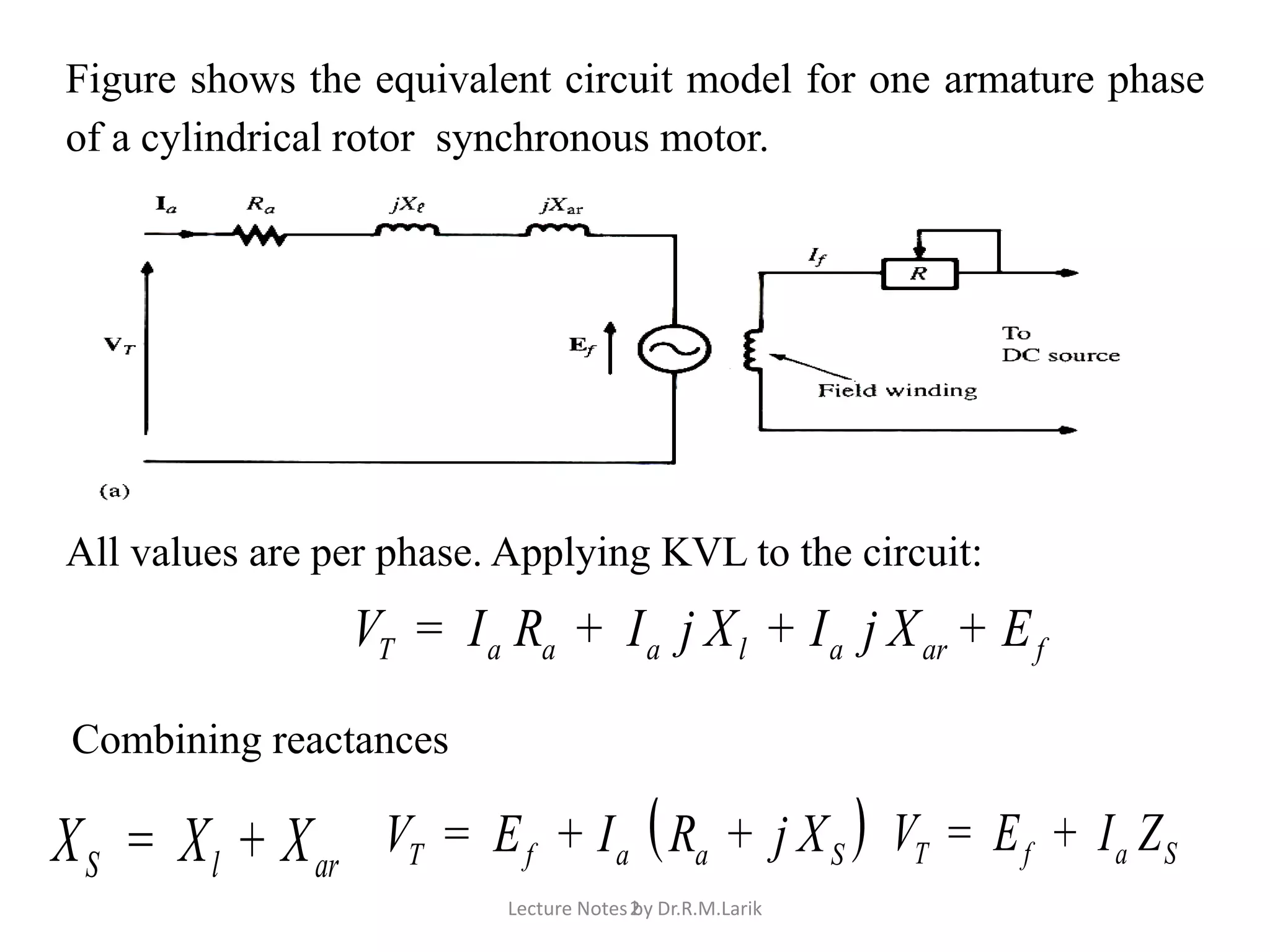
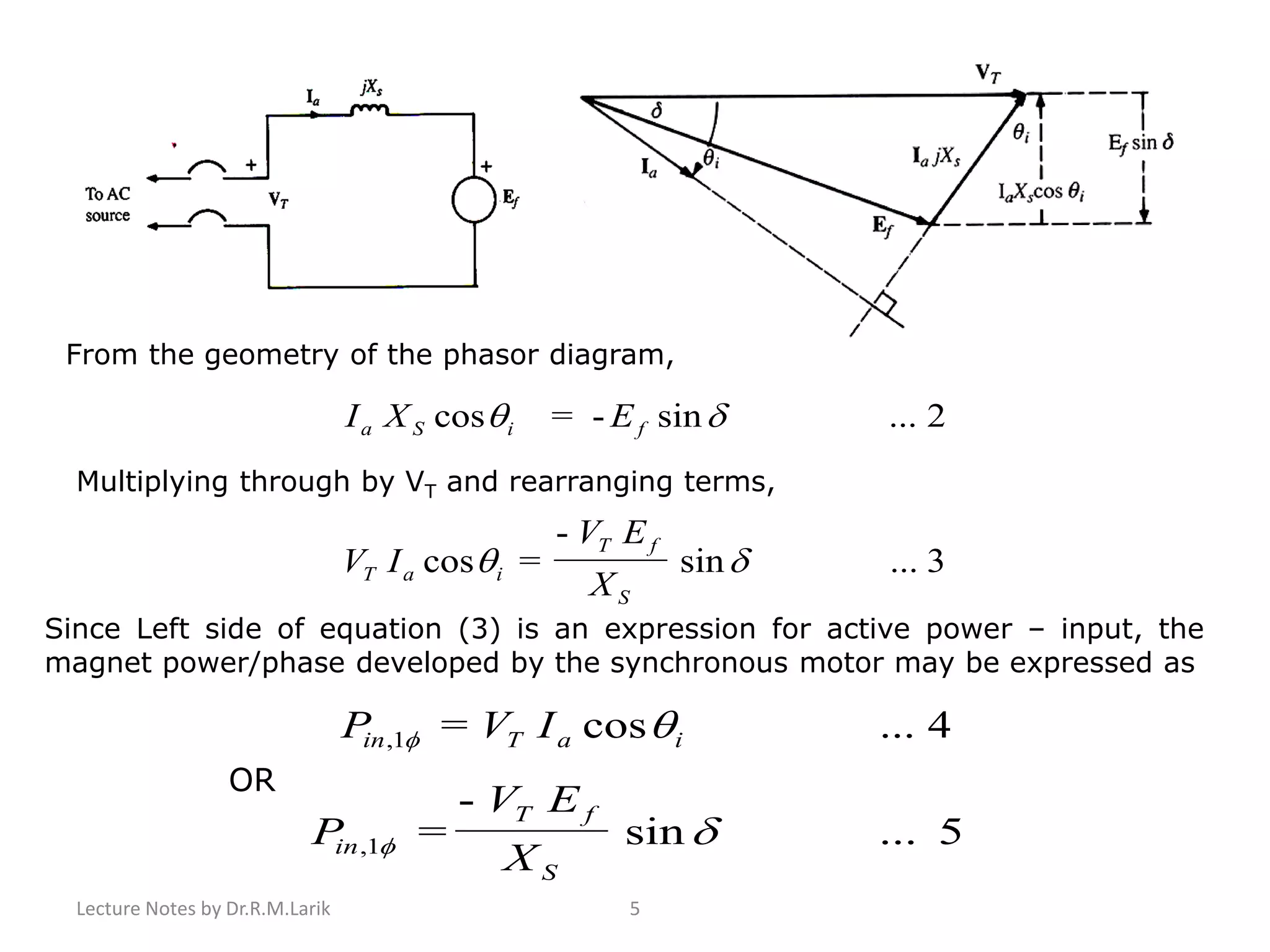
Figure shows the equivalent circuit model for one armature phase
of a cylindrical rotor synchronous motor.
All values are per phase. Applying KVL to the circuit:
faralaaaT EXjIXjIRIV +++=
Combining reactances
arlS XXX += ( )SaafT XjRIEV ++= SafT ZIEV +=
Lecture Notes by Dr.R.M.Larik
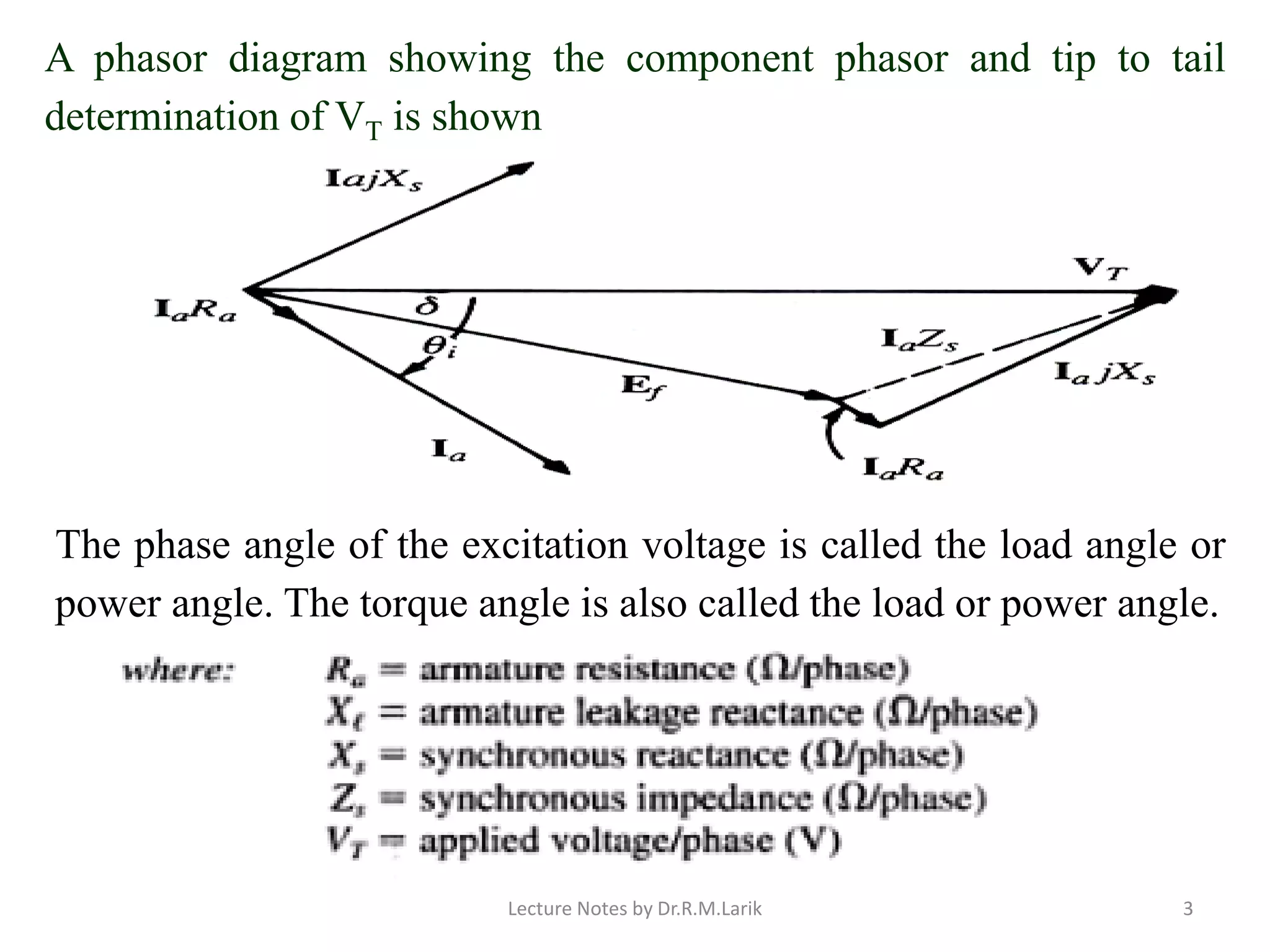
A phasor diagram showing the component phasor and tip to tail
determination of VT is shown
The phase angle of the excitation voltage is called the load angle or
power angle. The torque angle is also called the load or power angle.
Lecture Notes by Dr.R.M.Larik 3
Lecture Notes by Dr.R.M.Larik 4
SYNCHRONOUS MOTOR POWER EQUATION
(MAGNET POWER)
Except for very small machines, Ra of synchronous motor is relatively
small and neglected; therefore the terminal voltage can be
approximated as
1...+= SafT XjIEV
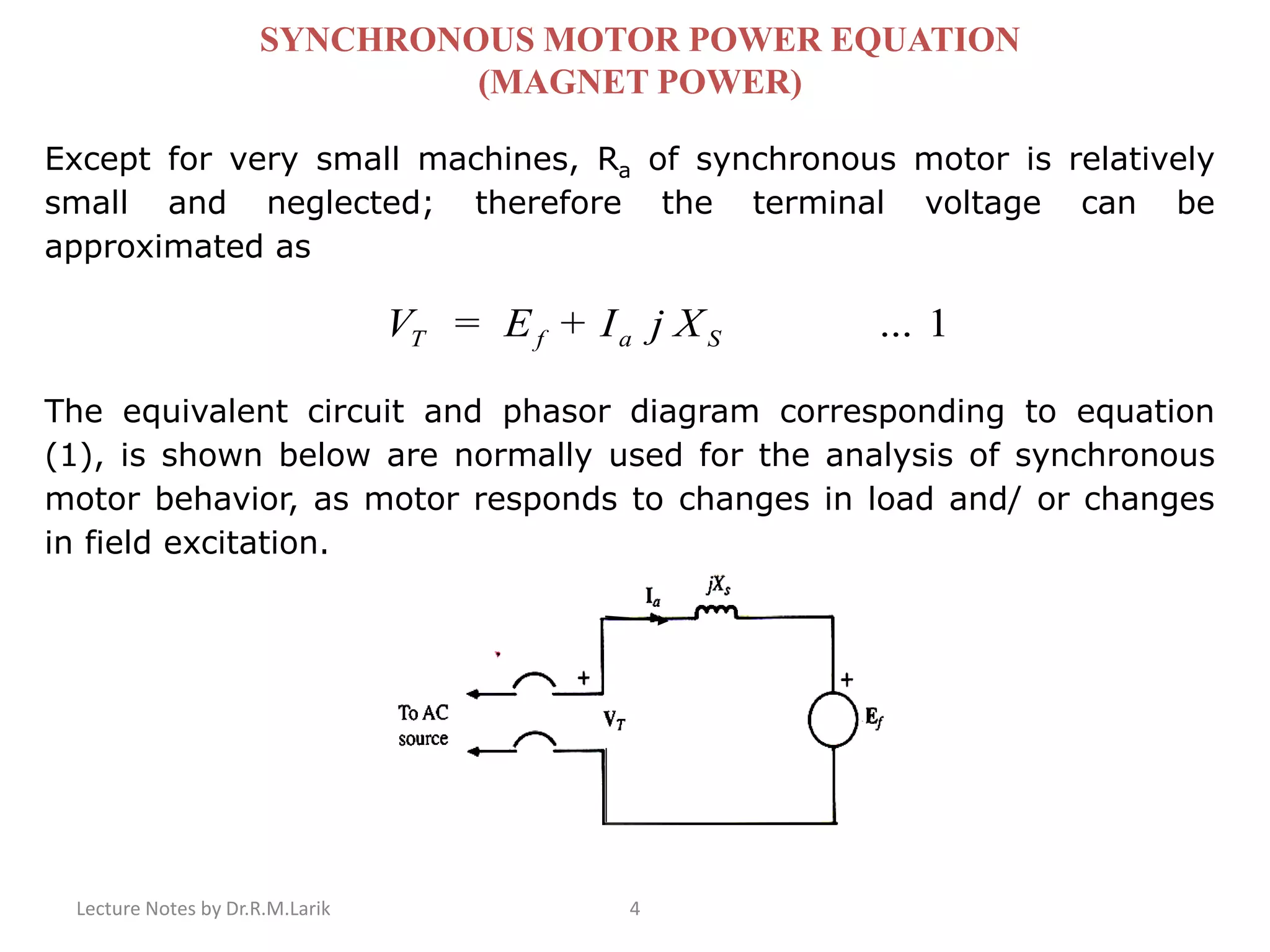
The equivalent circuit and phasor diagram corresponding to equation
(1), is shown below are normally used for the analysis of synchronous
motor behavior, as motor responds to changes in load and/ or changes
in field excitation.
Lecture Notes by Dr.R.M.Larik 5
From the geometry of the phasor diagram,
2...sin-=cos  fiSa EXI
Multiplying through by VT and rearranging terms,
3...sin
-
=cos 
S
fT
iaT
X
EV
IV
Since Left side of equation (3) is an expression for active power – input, the
magnet power/phase developed by the synchronous motor may be expressed as
4...cos=1, iaTin IVP 
5...sin
-
=1, 
S
fT
in
X
EV
P
OR
Mehran University
Of Engineering & Technology,
SZAB Khairpur Mirs Campus
ENGR. AHSANULLAH MEMON
LECTURER
DEPARTMENT OF ELECTRICAL ENGINEERING MUCET KHAIRPUR MIRS
SHAFT LOAD, POWER ANGLE & DEVELOPED
SHAFT LOAD,POWER ANGLE AND
DEVELOPED TORQUE
Lecture Notes by Dr.R.M.Larik 6
SHAFT LOAD AND POWER ANGLE
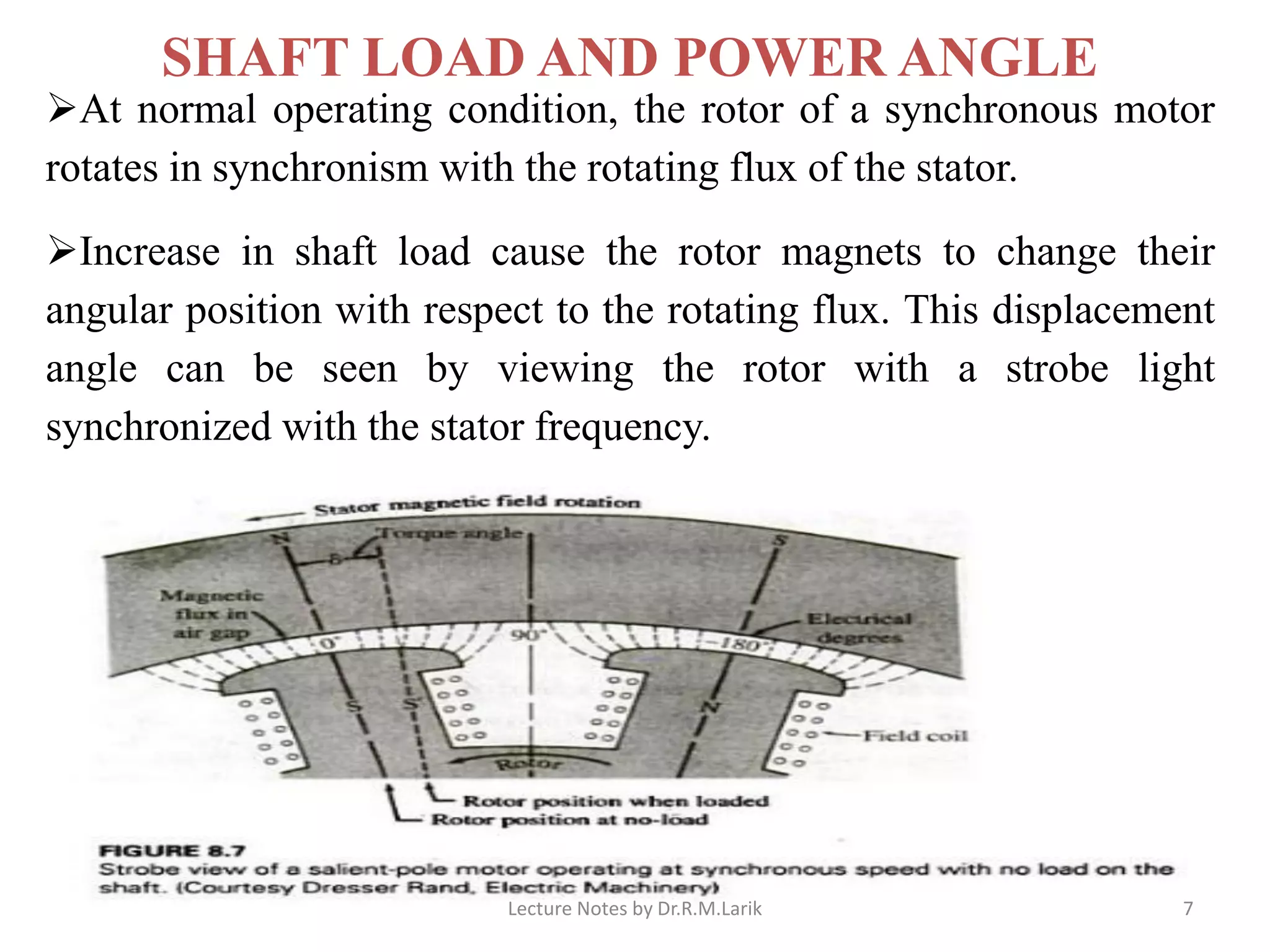
➢At normal operating condition, the rotor of a synchronous motor
rotates in synchronism with the rotating flux of the stator.
➢Increase in shaft load cause the rotor magnets to change their
angular position with respect to the rotating flux. This displacement
angle can be seen by viewing the rotor with a strobe light
synchronized with the stator frequency.
Lecture Notes by Dr.R.M.Larik 7
➢As the machine is loaded, the rotor changes its relative position with
respect to the rotating flux of the stator, lagging behind it by angle δ .
➢Angle δ, expressed in electrical degrees, is called the power angle, load
angle, or torque angle.
➢A synchronous motor operates at the same average speed for all values of
load from no-load to its peak load.
➢When the load on a synchronous motor is increased, the motor slows
down just enough to allow the rotor to change its angular position in
relation to the rotating flux of the stator, and then goes back to synchronous
speed. [???]
➢Similarly, when the load is removed, it accelerates just enough to cause
the rotor to decrease its angle of lag in relation to the rotating flux, and then
goes back to synchronous speed.
➢When the peak load that the machine can handle is exceeded, the rotor
pulls out of synchronism. Lecture Notes by Dr.R.M.Larik 8
9
DEVELOPED TORQUE
The torque developed by all synchronous motors has two components:
1. The Reluctance Torque Component:
It is due to the normal characteristics of magnetic materials in a
magnetic field to align themselves so that the reluctance of the
magnetic circuit becomes minimum
2. The magnetic torque component:
It is due to the magnetic attraction between the field poles on the
rotor and the corresponding opposite poles of the rotating stator
flux.
Lecture Notes by Dr.R.M.Larik
Mehran University
Of Engineering & Technology,
SZAB Khairpur Mirs Campus
ENGR. AHSANULLAH MEMON
LECTURER
DEPARTMENT OF ELECTRICAL ENGINEERING MUCET KHAIRPUR MIRS
EFFECT OF CHANGES IN SHAFT
LOAD ON ARMATURE CURRENT,
POWER ANGLE, AND POWER
FACTOR
Lecture Notes by Dr.R.M.Larik 10
EFFECTS OF CHANGES IN SHAFT LOAD (Synch
Motor)
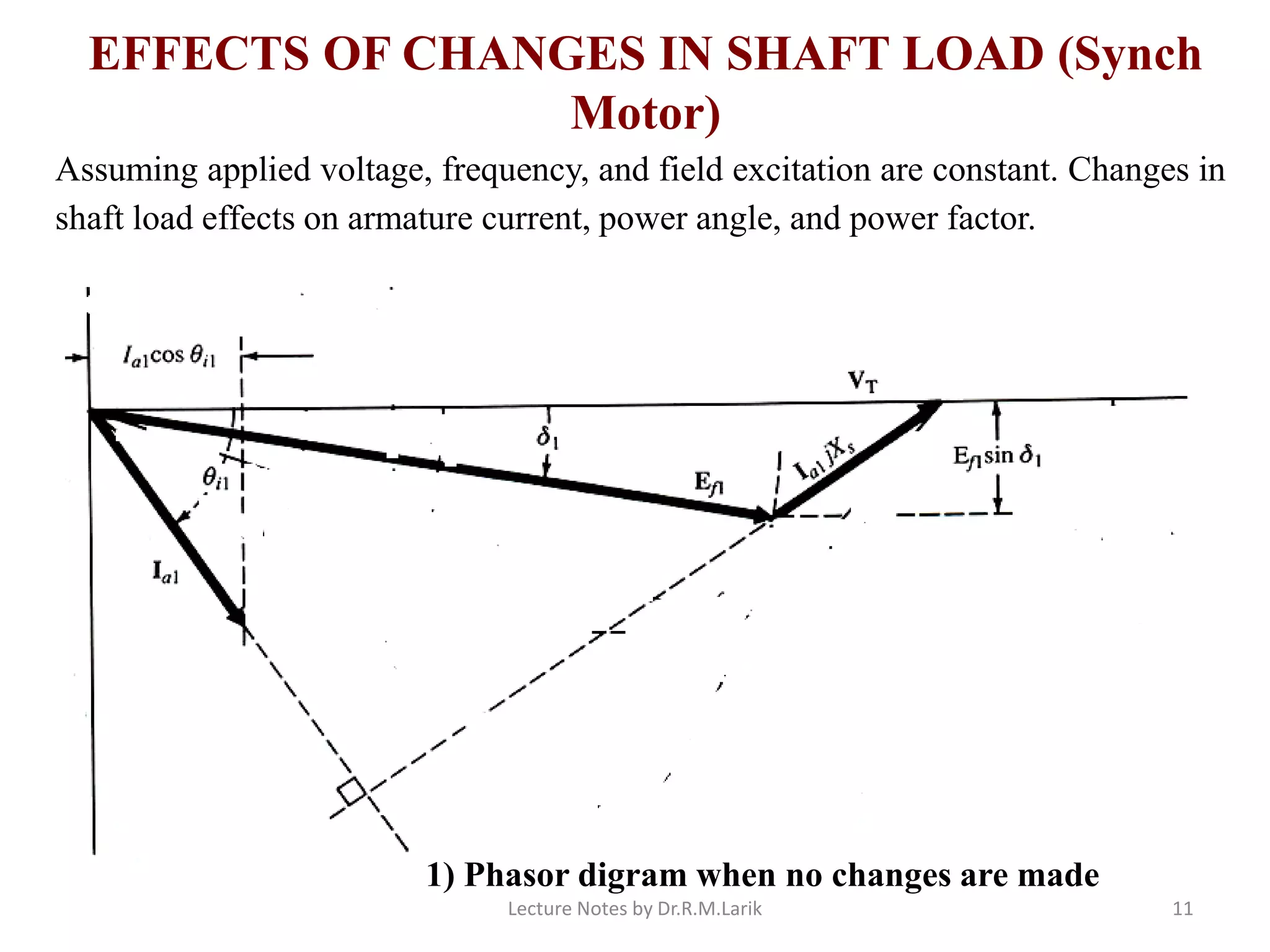
Assuming applied voltage, frequency, and field excitation are constant. Changes in
shaft load effects on armature current, power angle, and power factor.
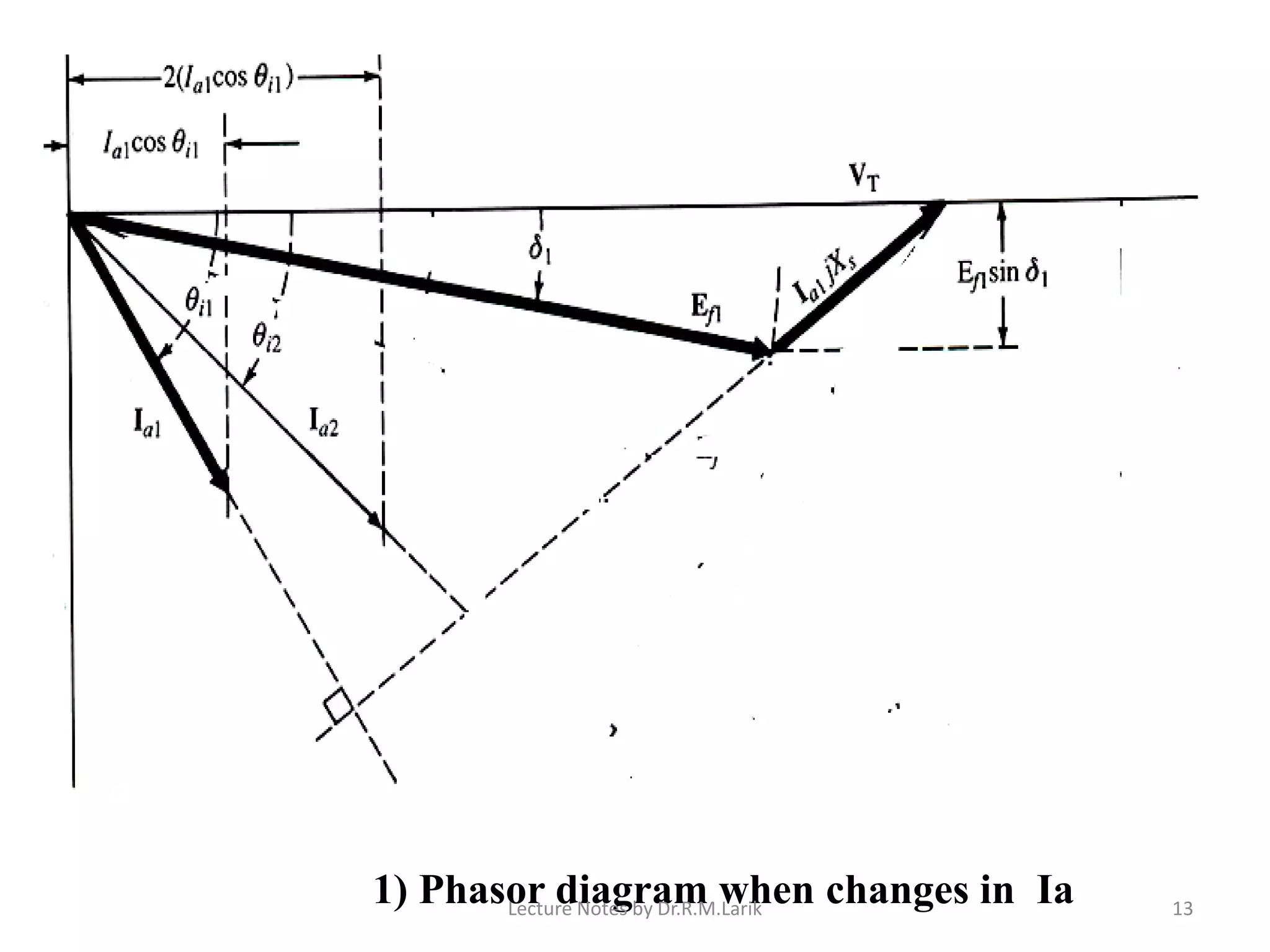
1) Phasor digram when no changes are made
Lecture Notes by Dr.R.M.Larik 11
ilaodshaft ↓↑ Resulting an increase in power factor
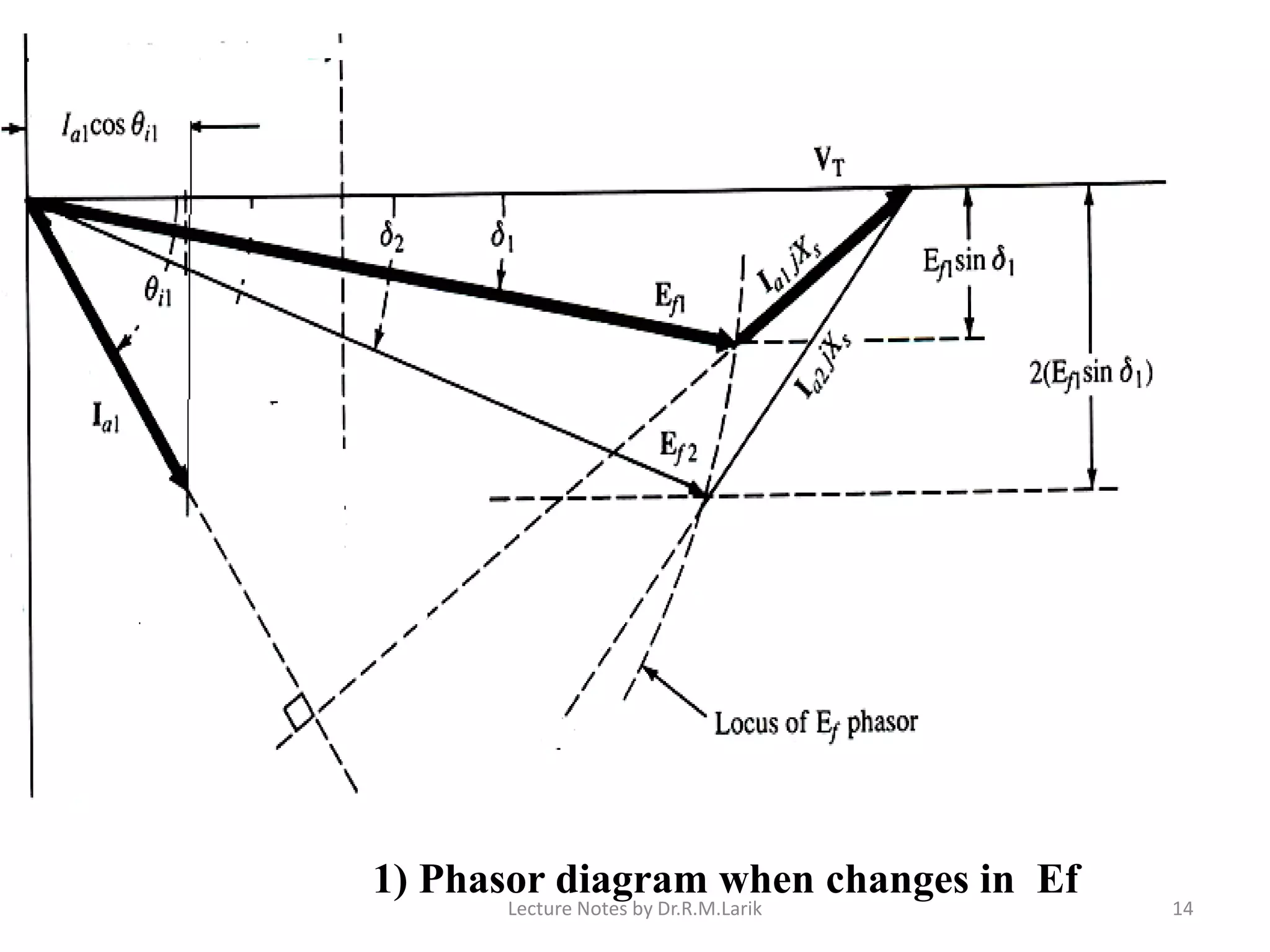
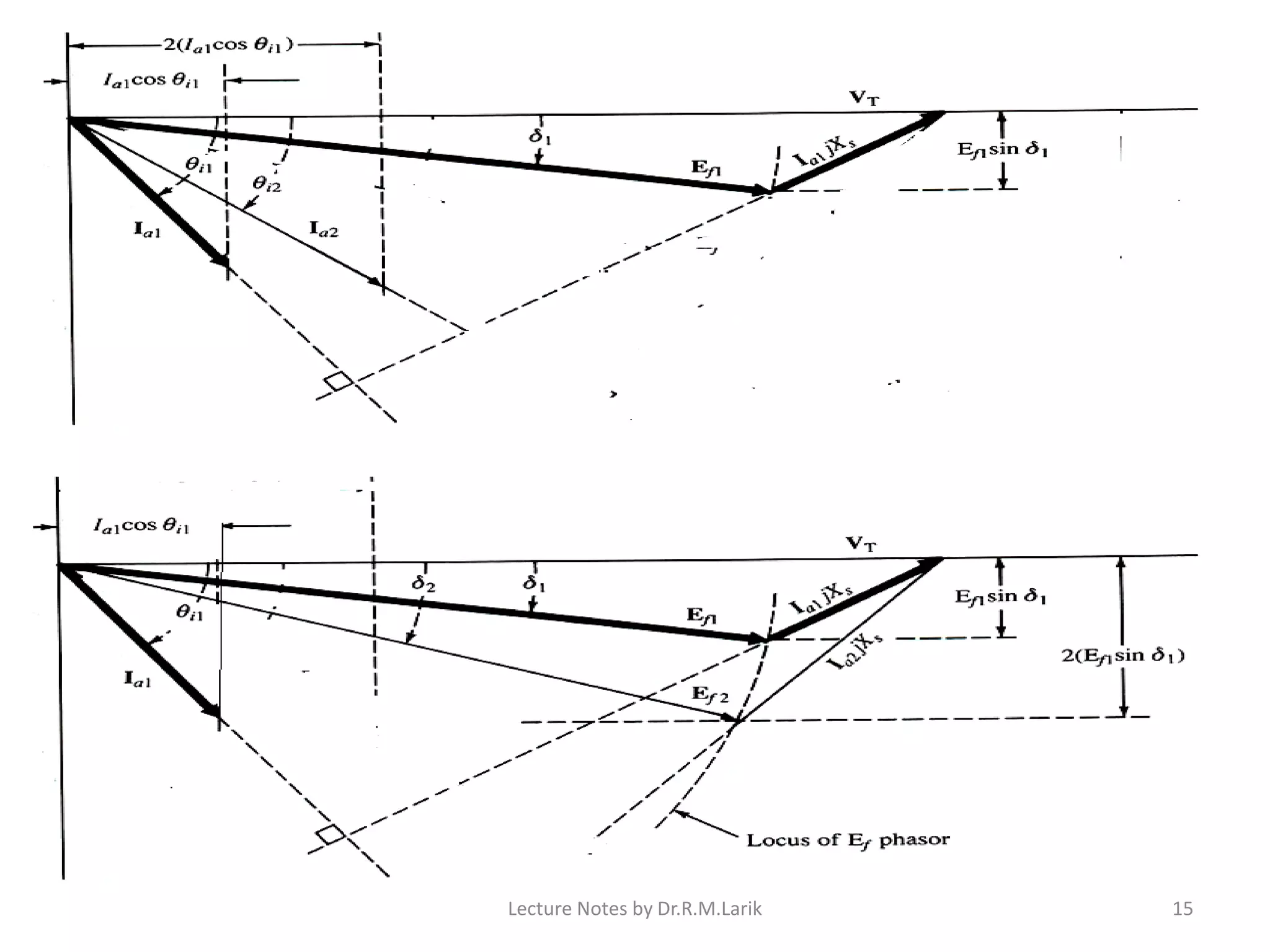
➢ VT, Ef1, Ia1, and δ1 are the initial load conditions.
➢ Ef2, Ia2, and δ2 indicate the new steady – state conditions that
correspond to doubling the shaft load.
➢ Doubling the shaft load, doubles both
 sincos fia EAndI
If the excitation is not changed, increasing the shaft load causes the locus
of Ef phasor to a circular arc, increasing its phase angle with increasing
shaft load. It should be noted that:
During increase on motor loading, the average speed of the machine does
not change, until a point is reached at which a further increase in δ fails to
cause a corresponding increase in motor torque, and rotor pulls out of
synchronism.
Lecture Notes by Dr.R.M.Larik 12
1) Phasor diagram when changes in IaLecture Notes by Dr.R.M.Larik 13
1) Phasor diagram when changes in Ef
Lecture Notes by Dr.R.M.Larik 14
Lecture Notes by Dr.R.M.Larik 15
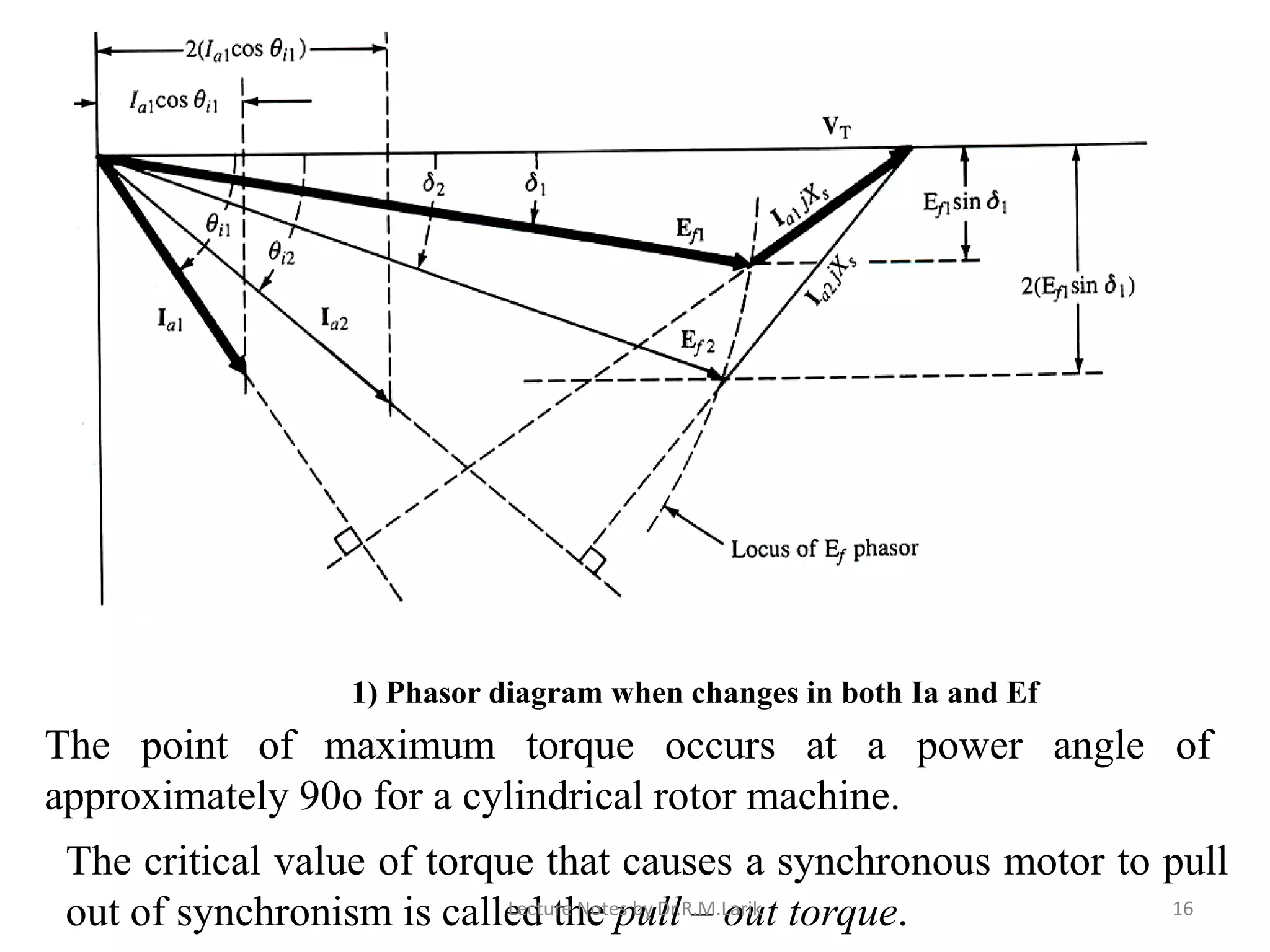
The point of maximum torque occurs at a power angle of
approximately 90o for a cylindrical rotor machine.
The critical value of torque that causes a synchronous motor to pull
out of synchronism is called the pull – out torque.
1) Phasor diagram when changes in both Ia and Ef
Lecture Notes by Dr.R.M.Larik 16
Mehran University
Of Engineering & Technology,
SZAB Khairpur Mirs Campus
ENGR. AHSANULLAH MEMON
LECTURER
DEPARTMENT OF ELECTRICAL ENGINEERING MUCET KHAIRPUR MIRS
EFFECT OF CHANGES IN FIELD
EXCITATION ON SYNCH
MOTOR PERFORMANCE
Lecture Notes by Dr.R.M.Larik 17
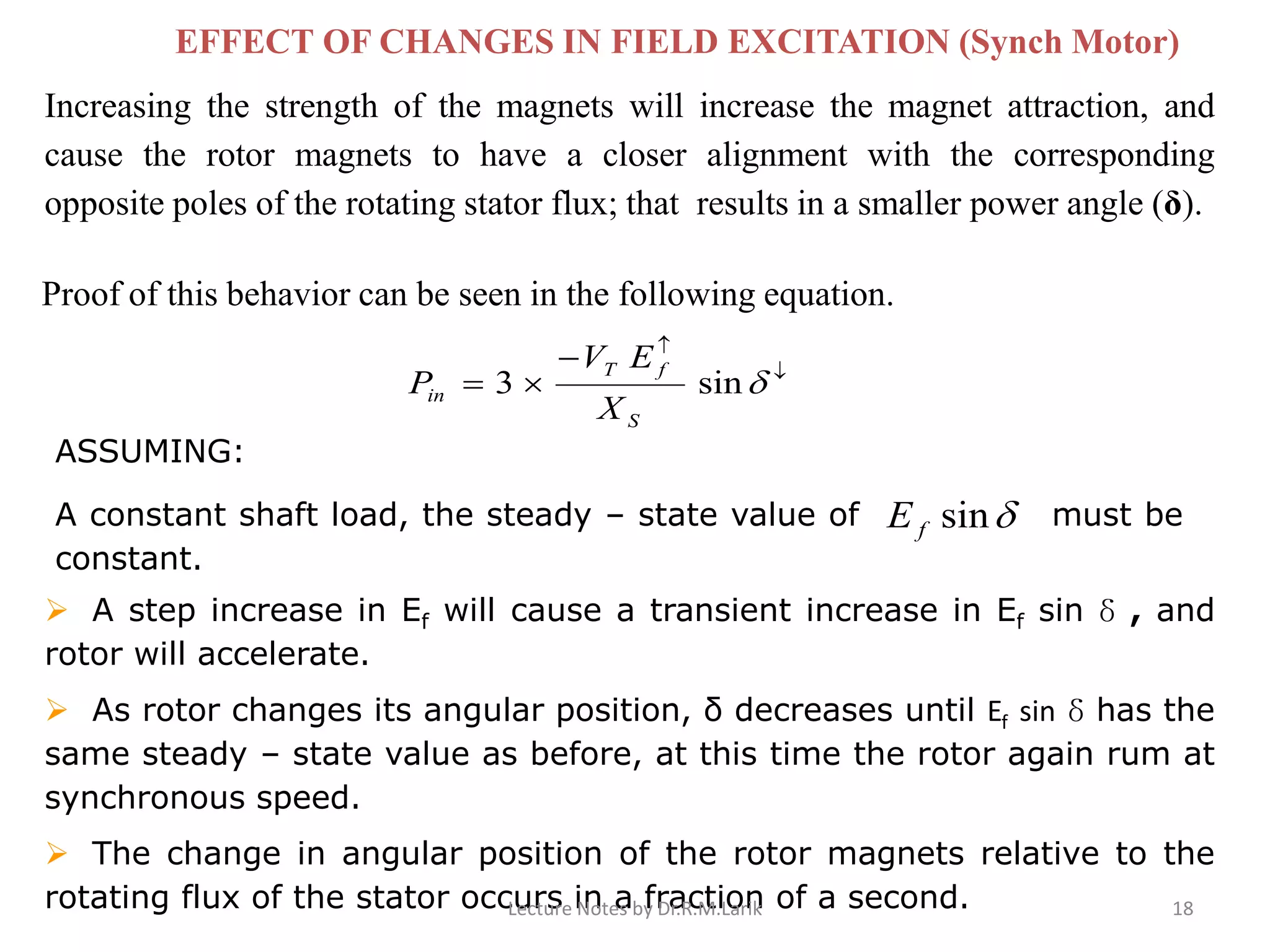
Increasing the strength of the magnets will increase the magnet attraction, and
cause the rotor magnets to have a closer alignment with the corresponding
opposite poles of the rotating stator flux; that results in a smaller power angle (δ).
EFFECT OF CHANGES IN FIELD EXCITATION (Synch Motor)
Proof of this behavior can be seen in the following equation.
ASSUMING:
A constant shaft load, the steady – state value of must be
constant.


−
= sin3
S
fT
in
X
EV
P
sinfE
➢ A step increase in Ef will cause a transient increase in Ef sin δ , and
rotor will accelerate.
➢ As rotor changes its angular position, δ decreases until Ef sin δ has the
same steady – state value as before, at this time the rotor again rum at
synchronous speed.
➢ The change in angular position of the rotor magnets relative to the
rotating flux of the stator occurs in a fraction of a second.Lecture Notes by Dr.R.M.Larik 18
Figure shows under excitation Ef<VT
Diagram when Ef<VT
Lecture Notes by Dr.R.M.Larik 19
Figure shows normal excitation Ef=VT
Diagram when Ef=VT
Lecture Notes by Dr.R.M.Larik 20
Figure shows over excitation Ef>VT
Diagram when Ef>VT
Lecture Notes by Dr.R.M.Larik 21
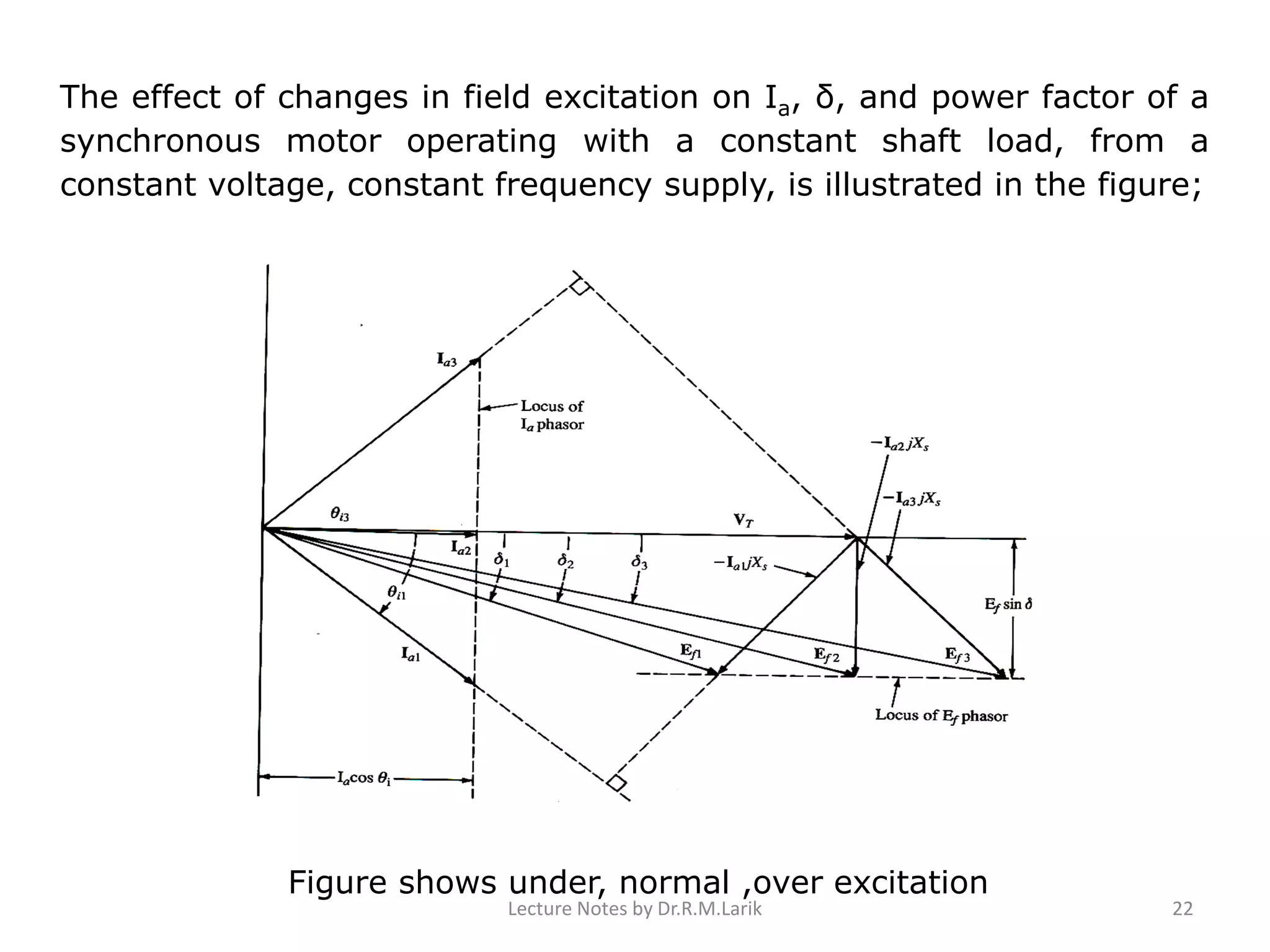
The effect of changes in field excitation on Ia, δ, and power factor of a
synchronous motor operating with a constant shaft load, from a
constant voltage, constant frequency supply, is illustrated in the figure;
Figure shows under, normal ,over excitation
Lecture Notes by Dr.R.M.Larik 22
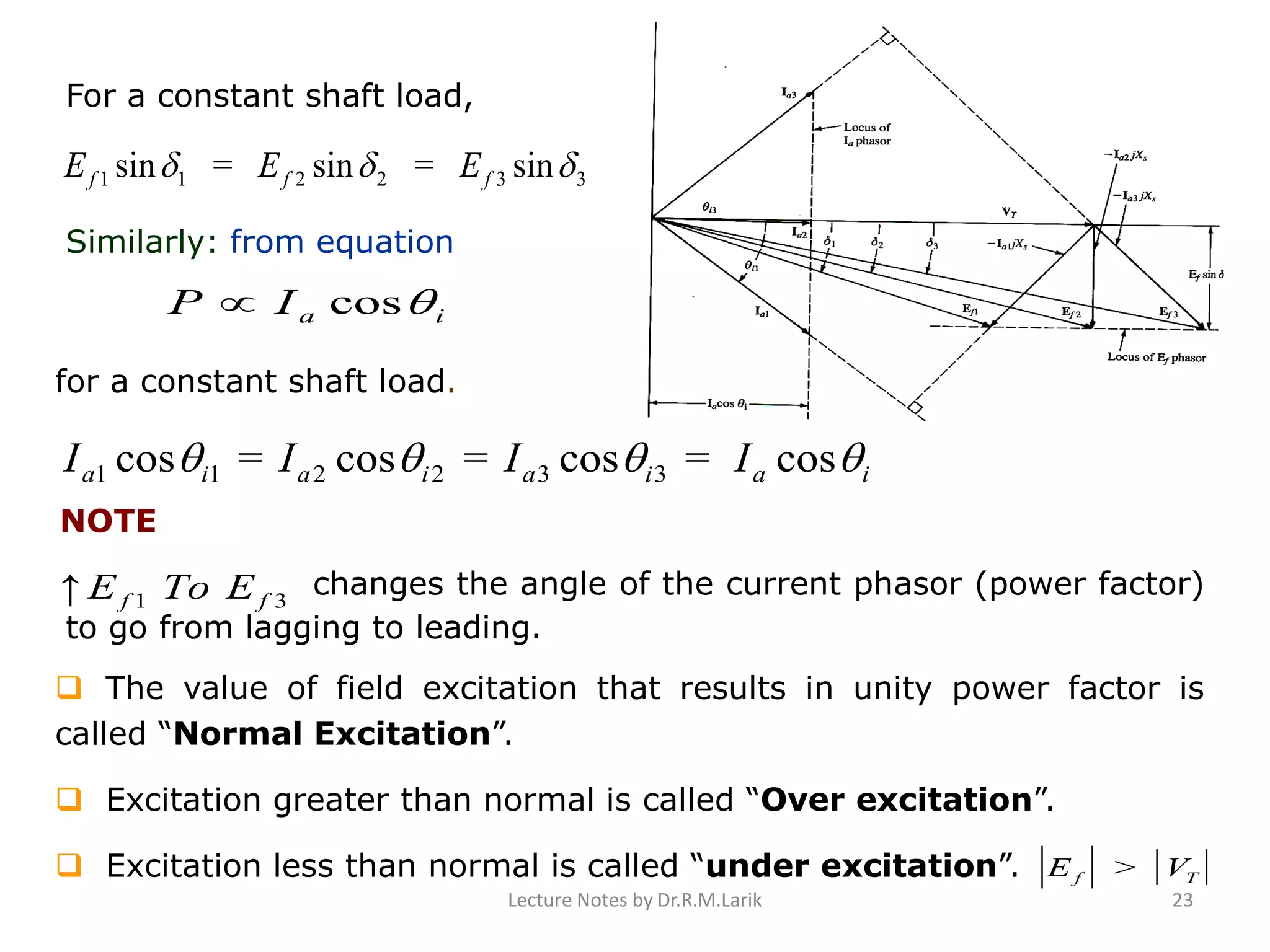
For a constant shaft load,
332211 sin=sin=sin  fff EEE
Similarly: from equation
iaIP cos
for a constant shaft load.
iaiaiaia IIII  cos=cos=cos=cos 332211
NOTE
changes the angle of the current phasor (power factor)
to go from lagging to leading.
❑ The value of field excitation that results in unity power factor is
called “Normal Excitation”.
❑ Excitation greater than normal is called “Over excitation”.
❑ Excitation less than normal is called “under excitation”. Tf VE >
31↑ ff EToE
Lecture Notes by Dr.R.M.Larik 23

Synhronous motor equivalent circuit

  • 1.
    EQUIVALENT CIRCUIT AND POWEREQUATION OF SYNCHRONOUS MOTOR Lecture Notes by Dr.R.M.Larik 1
  • 2.
    2 Figure shows theequivalent circuit model for one armature phase of a cylindrical rotor synchronous motor. All values are per phase. Applying KVL to the circuit: faralaaaT EXjIXjIRIV +++= Combining reactances arlS XXX += ( )SaafT XjRIEV ++= SafT ZIEV += Lecture Notes by Dr.R.M.Larik
  • 3.
    A phasor diagramshowing the component phasor and tip to tail determination of VT is shown The phase angle of the excitation voltage is called the load angle or power angle. The torque angle is also called the load or power angle. Lecture Notes by Dr.R.M.Larik 3
  • 4.
    Lecture Notes byDr.R.M.Larik 4 SYNCHRONOUS MOTOR POWER EQUATION (MAGNET POWER) Except for very small machines, Ra of synchronous motor is relatively small and neglected; therefore the terminal voltage can be approximated as 1...+= SafT XjIEV The equivalent circuit and phasor diagram corresponding to equation (1), is shown below are normally used for the analysis of synchronous motor behavior, as motor responds to changes in load and/ or changes in field excitation.
  • 5.
    Lecture Notes byDr.R.M.Larik 5 From the geometry of the phasor diagram, 2...sin-=cos  fiSa EXI Multiplying through by VT and rearranging terms, 3...sin - =cos  S fT iaT X EV IV Since Left side of equation (3) is an expression for active power – input, the magnet power/phase developed by the synchronous motor may be expressed as 4...cos=1, iaTin IVP  5...sin - =1,  S fT in X EV P OR
  • 6.
    Mehran University Of Engineering& Technology, SZAB Khairpur Mirs Campus ENGR. AHSANULLAH MEMON LECTURER DEPARTMENT OF ELECTRICAL ENGINEERING MUCET KHAIRPUR MIRS SHAFT LOAD, POWER ANGLE & DEVELOPED SHAFT LOAD,POWER ANGLE AND DEVELOPED TORQUE Lecture Notes by Dr.R.M.Larik 6
  • 7.
    SHAFT LOAD ANDPOWER ANGLE ➢At normal operating condition, the rotor of a synchronous motor rotates in synchronism with the rotating flux of the stator. ➢Increase in shaft load cause the rotor magnets to change their angular position with respect to the rotating flux. This displacement angle can be seen by viewing the rotor with a strobe light synchronized with the stator frequency. Lecture Notes by Dr.R.M.Larik 7
  • 8.
    ➢As the machineis loaded, the rotor changes its relative position with respect to the rotating flux of the stator, lagging behind it by angle δ . ➢Angle δ, expressed in electrical degrees, is called the power angle, load angle, or torque angle. ➢A synchronous motor operates at the same average speed for all values of load from no-load to its peak load. ➢When the load on a synchronous motor is increased, the motor slows down just enough to allow the rotor to change its angular position in relation to the rotating flux of the stator, and then goes back to synchronous speed. [???] ➢Similarly, when the load is removed, it accelerates just enough to cause the rotor to decrease its angle of lag in relation to the rotating flux, and then goes back to synchronous speed. ➢When the peak load that the machine can handle is exceeded, the rotor pulls out of synchronism. Lecture Notes by Dr.R.M.Larik 8
  • 9.
    9 DEVELOPED TORQUE The torquedeveloped by all synchronous motors has two components: 1. The Reluctance Torque Component: It is due to the normal characteristics of magnetic materials in a magnetic field to align themselves so that the reluctance of the magnetic circuit becomes minimum 2. The magnetic torque component: It is due to the magnetic attraction between the field poles on the rotor and the corresponding opposite poles of the rotating stator flux. Lecture Notes by Dr.R.M.Larik
  • 10.
    Mehran University Of Engineering& Technology, SZAB Khairpur Mirs Campus ENGR. AHSANULLAH MEMON LECTURER DEPARTMENT OF ELECTRICAL ENGINEERING MUCET KHAIRPUR MIRS EFFECT OF CHANGES IN SHAFT LOAD ON ARMATURE CURRENT, POWER ANGLE, AND POWER FACTOR Lecture Notes by Dr.R.M.Larik 10
  • 11.
    EFFECTS OF CHANGESIN SHAFT LOAD (Synch Motor) Assuming applied voltage, frequency, and field excitation are constant. Changes in shaft load effects on armature current, power angle, and power factor. 1) Phasor digram when no changes are made Lecture Notes by Dr.R.M.Larik 11
  • 12.
    ilaodshaft ↓↑ Resultingan increase in power factor ➢ VT, Ef1, Ia1, and δ1 are the initial load conditions. ➢ Ef2, Ia2, and δ2 indicate the new steady – state conditions that correspond to doubling the shaft load. ➢ Doubling the shaft load, doubles both  sincos fia EAndI If the excitation is not changed, increasing the shaft load causes the locus of Ef phasor to a circular arc, increasing its phase angle with increasing shaft load. It should be noted that: During increase on motor loading, the average speed of the machine does not change, until a point is reached at which a further increase in δ fails to cause a corresponding increase in motor torque, and rotor pulls out of synchronism. Lecture Notes by Dr.R.M.Larik 12
  • 13.
    1) Phasor diagramwhen changes in IaLecture Notes by Dr.R.M.Larik 13
  • 14.
    1) Phasor diagramwhen changes in Ef Lecture Notes by Dr.R.M.Larik 14
  • 15.
    Lecture Notes byDr.R.M.Larik 15
  • 16.
    The point ofmaximum torque occurs at a power angle of approximately 90o for a cylindrical rotor machine. The critical value of torque that causes a synchronous motor to pull out of synchronism is called the pull – out torque. 1) Phasor diagram when changes in both Ia and Ef Lecture Notes by Dr.R.M.Larik 16
  • 17.
    Mehran University Of Engineering& Technology, SZAB Khairpur Mirs Campus ENGR. AHSANULLAH MEMON LECTURER DEPARTMENT OF ELECTRICAL ENGINEERING MUCET KHAIRPUR MIRS EFFECT OF CHANGES IN FIELD EXCITATION ON SYNCH MOTOR PERFORMANCE Lecture Notes by Dr.R.M.Larik 17
  • 18.
    Increasing the strengthof the magnets will increase the magnet attraction, and cause the rotor magnets to have a closer alignment with the corresponding opposite poles of the rotating stator flux; that results in a smaller power angle (δ). EFFECT OF CHANGES IN FIELD EXCITATION (Synch Motor) Proof of this behavior can be seen in the following equation. ASSUMING: A constant shaft load, the steady – state value of must be constant.   − = sin3 S fT in X EV P sinfE ➢ A step increase in Ef will cause a transient increase in Ef sin δ , and rotor will accelerate. ➢ As rotor changes its angular position, δ decreases until Ef sin δ has the same steady – state value as before, at this time the rotor again rum at synchronous speed. ➢ The change in angular position of the rotor magnets relative to the rotating flux of the stator occurs in a fraction of a second.Lecture Notes by Dr.R.M.Larik 18
  • 19.
    Figure shows underexcitation Ef<VT Diagram when Ef<VT Lecture Notes by Dr.R.M.Larik 19
  • 20.
    Figure shows normalexcitation Ef=VT Diagram when Ef=VT Lecture Notes by Dr.R.M.Larik 20
  • 21.
    Figure shows overexcitation Ef>VT Diagram when Ef>VT Lecture Notes by Dr.R.M.Larik 21
  • 22.
    The effect ofchanges in field excitation on Ia, δ, and power factor of a synchronous motor operating with a constant shaft load, from a constant voltage, constant frequency supply, is illustrated in the figure; Figure shows under, normal ,over excitation Lecture Notes by Dr.R.M.Larik 22
  • 23.
    For a constantshaft load, 332211 sin=sin=sin  fff EEE Similarly: from equation iaIP cos for a constant shaft load. iaiaiaia IIII  cos=cos=cos=cos 332211 NOTE changes the angle of the current phasor (power factor) to go from lagging to leading. ❑ The value of field excitation that results in unity power factor is called “Normal Excitation”. ❑ Excitation greater than normal is called “Over excitation”. ❑ Excitation less than normal is called “under excitation”. Tf VE > 31↑ ff EToE Lecture Notes by Dr.R.M.Larik 23