Performance Analysis Of Induction Motor For Voltage Mode And Current
Mode Control
Merin Roy1, Dr. Jisha Kuruvilla2
1PG Scholar, Department of EEE, MACE, Kothamangalam, kerala, India
2Professor, Department of EEE, MACE, Kothamangalam, kerala, India
---------------------------------------------------------------------***---------------------------------------------------------------------
Abstract - At the present time, the vector control
Key Words: Space vector, Switching frequency, MATLAB,
dSPACE
1. INTRODUCTION
Principle Of Hysteresis Current Controller
International Research Journal of Engineering and Technology (IRJET) e-ISSN: 2395-0056
Volume: 09 Issue: 11 | Nov 2022 www.irjet.net p-ISSN: 2395-0072
technique is widespread used in high performance induction
motor drive. The performance of hysteresis controller and
SVPWM method in a vector controlled drive is designed. The
THD analysis of vector controlled drive is also analysed.
With hysteresis current controller, the Fast Fourier
transformer profile of the output voltage generated by the
VSI is similar to that of a space vector modulated VSI, by
maintaining nearly constant switching frequency.
Variations in machine parameters can contribute to change
in desired switching frequency. The proposed controller
assures that the VSI is switched in a pattern similar to SVM.
Space vector based and hysteresis current controlled VSI fed
IM drive is simulated using MATLAB R2017a.
Induction motor is widely used in the industries due to its
exclusive features such as high robustness, high
reliability and efficiency as well as low cost and
maintenance. This results to its increased demand in high
performance applications. Using the through vector
control method, the induction motor is able to be
controlled like a DC motor. The 3-phase stators and 3-
phase rotors are considered as two fundamental parts
of a 3-phase AC induction motor. When the 3-phase
stators are energized by the 3-phase AC power source,
current flow is generated in the stators. The magnetic
field synthesized by 3-phase stator current is always
rotating incessantly with the variation of the current.
This rotating magnetic field cuts the rotor and the
current generated in it interacts with the rotating
magnetic field and thus produces the magnetic torque
which makes the rotor rotate. The rotating speed of the
rotor n should be less than that of the rotating magnetic
field. Reverse rotating of the rotor will be realized by two
of the 3-phase power source positions exchanged.
The rotating direction of the rotating magnetic field is
consistent with the current phase and its speed is
proportional to the power source frequency f and
inversely proportional to the magnetic polar pair
number.
SVPWM is a modulation algorithm which translates phase
voltage (phase to neutral) references, coming from the
controller, into modulation times/duty-cycles to be applied
to the PWM peripheral. It is a general technique for any
three-phase load, although it has been developed for motor
control. For induction machines, the most common choices
for the direct axis is to align it to the rotor field (rotor FOC)
or to the stator field (stator FOC). SVPWM just does a lot of
sampling, calculating and wave form manipulation. SV means
space vector, as in space vector modulation. SVM basically
allows a 3-phase bridge PWM drive to supply about 15
percent higher peak voltage to a motor than the standard
sine-triangle modulation scheme by allowing the neutral
point of the motor to move away from the nominal 1/2 of the
supply rail. The Space Vector Pulse Width Modulation
(SVPWM) refers to a special switching sequence of the upper
three power devices of a three-phase voltage source
inverters (VSI) used in application such as AC induction and
permanent magnet synchronous motor drives. It is a more
sophisticated technique for generating sine wave that
provides a higher voltage to the motor with lower total
harmonic distortion. Space Vector PWM (SVPWM) method is
an advanced; computation intensive PWM method and
possibly the best techniques for variable frequency drive
application. SVPWM generates less harmonic distortion in
the output voltages and currents in the windings of the
motor load and provides a more efficient use of the DC
supply voltage in comparison with sinusoidal modulation
techniques. Since SVPWM provides a constant switching
frequency; the switching frequency can be adjusted easily.
The basic principle of SVPWM is based on the eight switch
combinations of three phase inverter. The switch
combinations can be represented as binary codes that
correspond to the top switches S1, S3 and S5 of the inverter.
Each switching circuit generates three independent pole
voltages Vao, Vbo and Vco.
2. PERFORMANCE ANALYSIS OF INDUCTION
MOTOR FOR VOLTAGE MODE AND CURRENT MODE
CONTROL
In hysteresis current control the actual current tracks the
command current within a hysteresis band. Spacevector
modulation (SVM) is an algorithm for the control of
© 2022, IRJET | Impact Factor value: 7.529 | ISO 9001:2008Certified Journal | Page 355
a combination of the two adjacent active switching
vectors and one or both of the zero vectors
3.DESIGN OF COMPONENTS
Clark transformation or αβγ transformation is a
mathematical transformation employed to simplify the
analysis of three-phase circuits. One very useful
application of the αβ transformation is the generation of
the reference signal used for space vector modulation
control of three-phase inverters.
Rotating Space Vector, U(t) is represented as
U(t)=(Ua+ Ube^(j(2/3)∗pi)+ Uce^((j(−2/3)∗pi)2/3 )
The voltage vector V1 is given by the
1 =
2𝑉dc
3
As shown in Figure 1, current control under hysteresis
band principle operation in generating the PWM
The general equation for voltage vector,
switching signals. The actual phase current is compared
to sinusoidal wave references current which are
produced by the control circuit. The upper switch (S1) is
2
𝑉𝑛 =
3
𝑉𝑑𝑐
∗ 𝑒 j(n−1)∗pi/3
turned off and the lower switch (S4) is turned on when
the actual current exceeds the higher band limit. As a
results, the output voltage changes from +0.5Vdc to -
0.5Vdc. The actual current start to decrease and drop
until it crosses the lower band limit. At this time, the
lower switch is turned off and the upper switch is
turned on. Then, the output voltage changes from -0.5
Vdc to +0.5 Vdc and the current starts to increase. This
process is then continuously repeated.
Principle Of SVPWM Based Induction Motor
Drive
A space vector is a sinusoidal voltage vector with
constant amplitude and rotating at constant frequency.
It is used for the creation of alternating current (AC)
waveforms; most commonly to drive 3 phase AC
powered motors at varying speeds from DC.
Figure 2 –abc to dq transformation
To implement space vector modulation, a reference
signal Vref is sampled with a frequency fs (Ts = 1/fs). The
reference signal may be generated from three separate
phase references using the αβ transform as shown in
Figure 2. The reference vector is then synthesized using
Three-phase VSI generates eight switching states which
include six active and two zero states. These vectors form
a hexagon which consisting of six sectors spanning 60
each. The reference vector which represents three-phase
sinusoidal voltage is generated using SVPWM by switching
between two nearest active vectors and zero vector.
Figure 3- Switching sectors of three phase inverter
To calculate the time of application of different vectors,
consider Figure3, depicting the position of differently
available space vectors and the reference vector in the first
sector. Table 1 shows the switching states correponding to
International Research Journal of Engineering and Technology (IRJET) e-ISSN: 2395-0056
Volume: 09 Issue: 11 | Nov 2022 www.irjet.net p-ISSN: 2395-0072
pulse-widthmodulation[1]. Space vector based
hysteresis controller for VSI fed IM drive is introduced.
Hysteresis current controller has a simple
implementation, fast transient response and direct
limitation of the peak current. Hysteresis current
control is relatively a simple method for PWM technique
with comparatively good current loop response.
𝑉
Figure 1 –Hysteresis current control
© 2022, IRJET | Impact Factor value: 7.529 | ISO 9001:2008Certified Journal | Page 356
Table 2 – Switching time in all sectors
space vector. The sinusoidal reference space vector form
a circular trajectory inside the hexagon. The largest
output voltage magnitude that can be achieved using
SVPWM is the radius of the largest circle that can be
inscribed within the hexagon. This circle is tangential to
the mid points of the lines joining the ends of the active
space vector.
International Research Journal of Engineering and Technology (IRJET) e-ISSN: 2395-0056
Volume: 09 Issue: 11 | Nov 2022 www.irjet.net p-ISSN: 2395-0072
Table 1-Switching states corresponding to Space Vector
Figure 4– Space vector sequences
Figure 4 shows the leg voltages and space vector
disposition for one switching period in sector I.
3. SIMULATION AND RESULTS
 SVPWM based controller
.
MATLAB is a high-performance language for technical
computing. It integrates computation, visualization, and
programming in an easy way to use environment where
problems and solutions are expressed in familiar
mathematical notation. SIMULINK is a software package
for modelling, simulating, and analysing dynamical
systems.
Simulation parameters for 1HP Induction Motor is given in
Table 3. Simulink model for vector controlled IM drive and
hysteresis controller is designed. Simulation is carried out
using 1HP induction motor with following parameters.
Table -3: Simulation parameters
Parameters Specification
Stator Resistance 0.087Ω
Stator Inductance 0.8mH
Rotor Resistance 1.157 Ω
Rotor Inductance 0.8mH
Mutual Inductance 34.7mH
Inertia 0.03Kg.𝑚2
Friction Factor 0.1Nms
Pole Pair 2
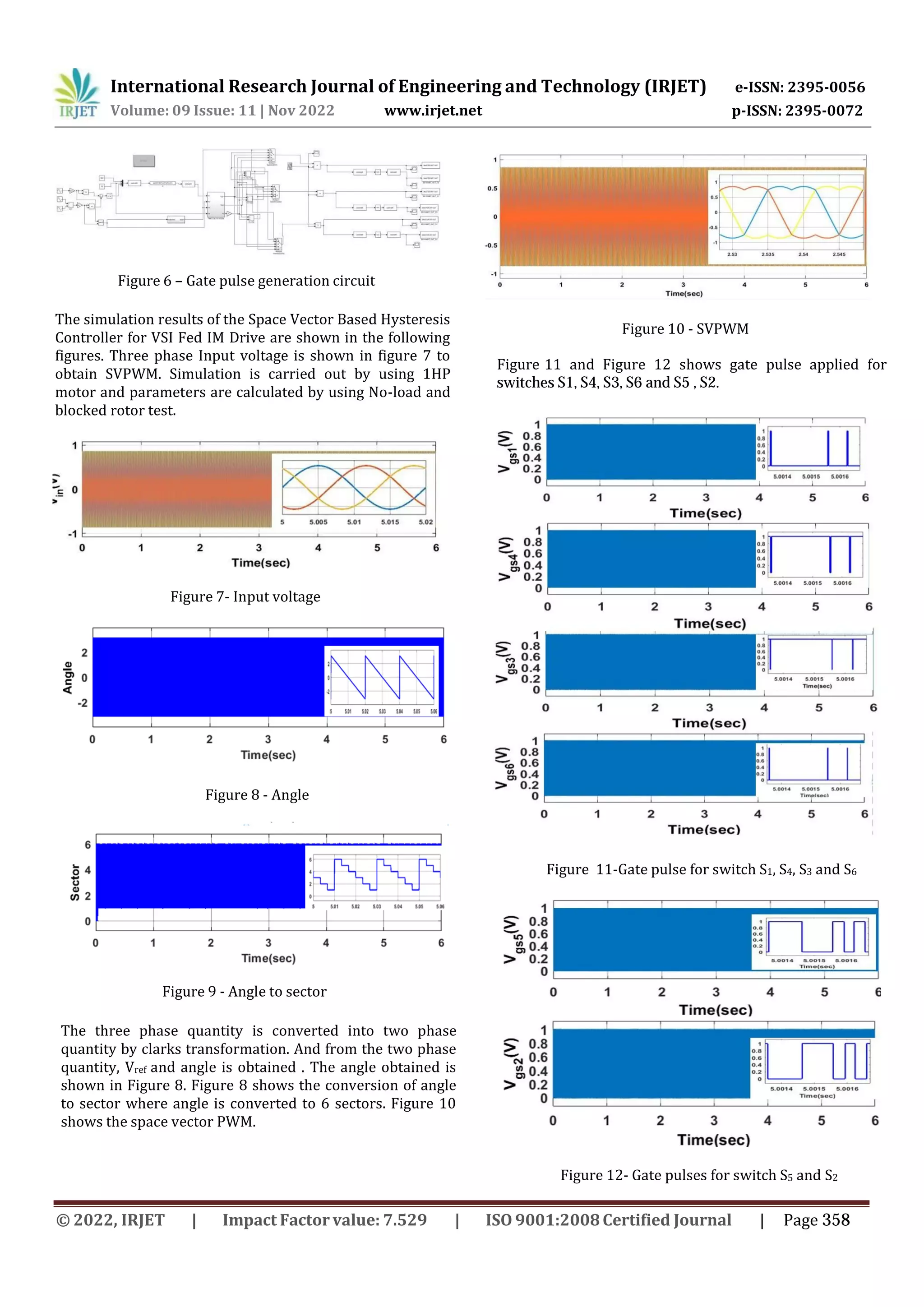
The Space Vector PWM for VSI Fed IM Drive is simulated in
MATLAB/SIMULINK by choosing the parameters listed in
Table 3 and the Simulink model is shown in Figure 5. The
gate pulse generation circuit is shown in figure 6. The gate
pulse is generated by converting the three phase quantity
into two phase quantity and then obtained Vref and angle.
From there time period for each leg is calculated and
compared to generate the pulses for each switches.
Fig 5 – Simulink mode lof SVPWM based IM Drive
© 2022, IRJET | Impact Factor value: 7.529 | ISO 9001:2008Certified Journal | Page 357
The simulation results of the Space Vector Based Hysteresis
Controller for VSI Fed IM Drive are shown in the following
figures. Three phase Input voltage is shown in figure 7 to
obtain SVPWM. Simulation is carried out by using 1HP
motor and parameters are calculated by using No-load and
blocked rotor test.
Figure 7- Input voltage
Figure 8 - Angle
Figure 9 - Angle to sector
The three phase quantity is converted into two phase
quantity by clarks transformation. And from the two phase
quantity, Vref and angle is obtained . The angle obtained is
shown in Figure 8. Figure 8 shows the conversion of angle
to sector where angle is converted to 6 sectors. Figure 10
shows the space vector PWM.
International Research Journal of Engineering and Technology (IRJET) e-ISSN: 2395-0056
Volume: 09 Issue: 11 | Nov 2022 www.irjet.net p-ISSN: 2395-0072
Figure 6 – Gate pulse generation circuit
Figure 10 - SVPWM
Figure 11 and Figure 12 shows gate pulse applied for
switches S1, S4, S3, S6 and S5 , S2.
Figure 11-Gate pulse for switch S1, S4, S3 and S6
Figure 12- Gate pulses for switch S5 and S2
© 2022, IRJET | Impact Factor value: 7.529 | ISO 9001:2008Certified Journal | Page 358
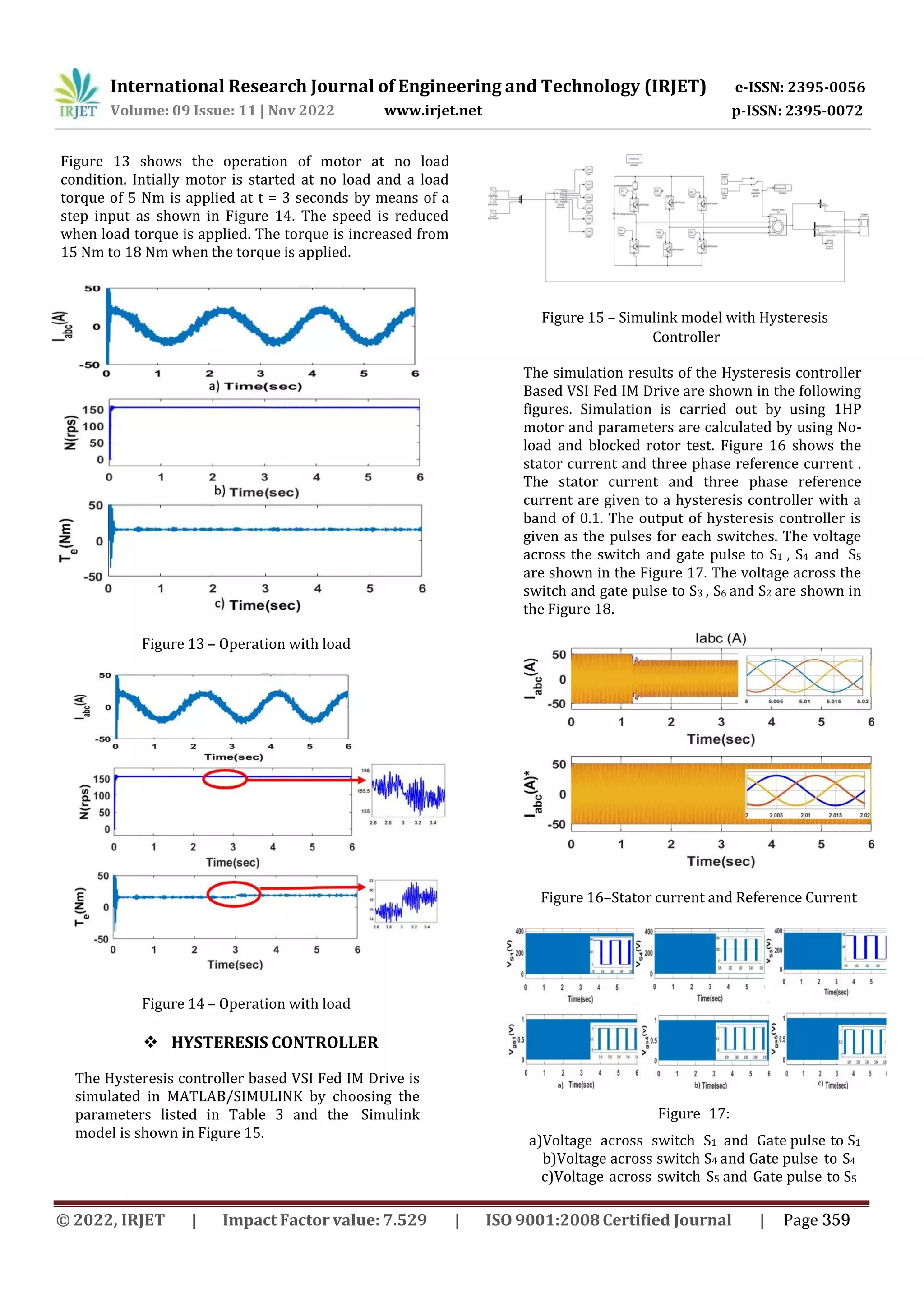
Figure 13 shows the operation of motor at no load
condition. Intially motor is started at no load and a load
torque of 5 Nm is applied at t = 3 seconds by means of a
step input as shown in Figure 14. The speed is reduced
when load torque is applied. The torque is increased from
15 Nm to 18 Nm when the torque is applied.
Figure 14 – Operation with load
 HYSTERESIS CONTROLLER
The Hysteresis controller based VSI Fed IM Drive is
simulated in MATLAB/SIMULINK by choosing the
parameters listed in Table 3 and the Simulink
model is shown in Figure 15.
Figure 15 – Simulink model with Hysteresis
Figure 13 – Operation with load
International Research Journal of Engineering and Technology (IRJET) e-ISSN: 2395-0056
Volume: 09 Issue: 11 | Nov 2022 www.irjet.net p-ISSN: 2395-0072
Controller
are shown in the Figure 17. The voltage across the
switch and gate pulse to S3 , S6 and S2 are shown in
the Figure 18.
The simulation results of the Hysteresis controller
Based VSI Fed IM Drive are shown in the following
figures. Simulation is carried out by using 1HP
motor and parameters are calculated by using No-
load and blocked rotor test. Figure 16 shows the
stator current and three phase reference current .
The stator current and three phase reference
current are given to a hysteresis controller with a
band of 0.1. The output of hysteresis controller is
given as the pulses for each switches. The voltage
across the switch and gate pulse to S1 , S4 and S5
Figure 16–Stator current and Reference Current
Figure 17:
a)Voltage across switch S1 and Gate pulse to S1
b)Voltage across switch S4 and Gate pulse to S4
c)Voltage across switch S5 and Gate pulse to S5
© 2022, IRJET | Impact Factor value: 7.529 | ISO 9001:2008Certified Journal | Page 359
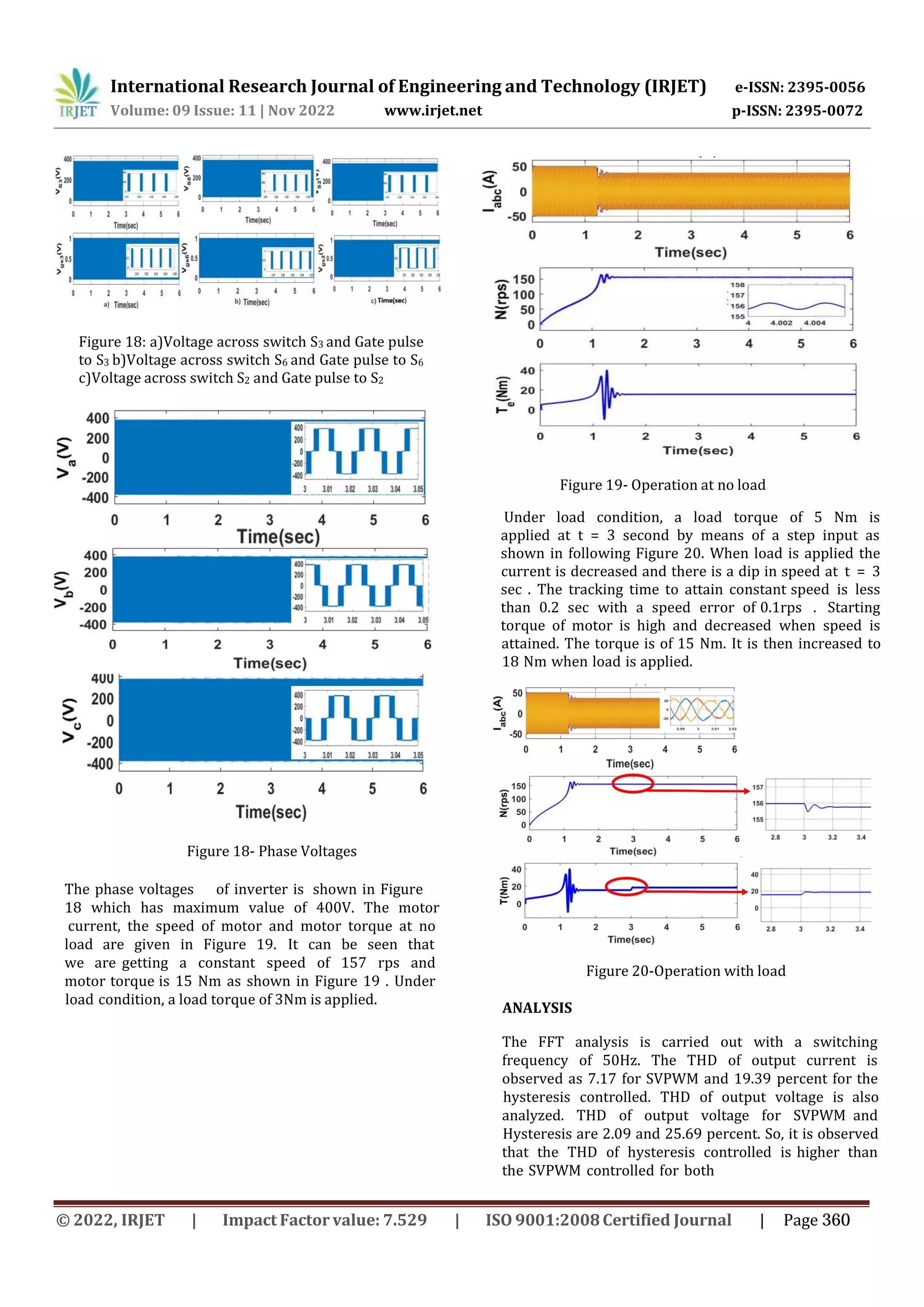
Figure 18: a)Voltage across switch S3 and Gate pulse
to S3 b)Voltage across switch S6 and Gate pulse to S6
c)Voltage across switch S2 and Gate pulse to S2
Figure 18- Phase Voltages
International Research Journal of Engineering and Technology (IRJET) e-ISSN: 2395-0056
Volume: 09 Issue: 11 | Nov 2022 www.irjet.net p-ISSN: 2395-0072
The phase voltages of inverter is shown in Figure
18 which has maximum value of 400V. The motor
current, the speed of motor and motor torque at no
load are given in Figure 19. It can be seen that
we are getting a constant speed of 157 rps and
motor torque is 15 Nm as shown in Figure 19 . Under
load condition, a load torque of 3Nm is applied.
Figure 20-Operation with load
Figure 19- Operation at no load
Under load condition, a load torque of 5 Nm is
applied at t = 3 second by means of a step input as
shown in following Figure 20. When load is applied the
current is decreased and there is a dip in speed at t = 3
sec . The tracking time to attain constant speed is less
than 0.2 sec with a speed error of 0.1rps . Starting
torque of motor is high and decreased when speed is
attained. The torque is of 15 Nm. It is then increased to
18 Nm when load is applied.
ANALYSIS
The FFT analysis is carried out with a switching
frequency of 50Hz. The THD of output current is
observed as 7.17 for SVPWM and 19.39 percent for the
hysteresis controlled. THD of output voltage is also
analyzed. THD of output voltage for SVPWM and
Hysteresis are 2.09 and 25.69 percent. So, it is observed
that the THD of hysteresis controlled is higher than
the SVPWM controlled for both
© 2022, IRJET | Impact Factor value: 7.529 | ISO 9001:2008Certified Journal | Page 360
Figure 22: THD of the output Voltage a) SVPWM
[[THD = 2.05 percent]] b) Hysteresis controller
[THD = 25.6 percent]
 Switching Pulse
Figure 23: Switching Pulses a)SVPWM b)
Hysteresis controller
Figure 21-THD of the output Current a) SVPWM
[THD = 7.17 percent] b) Hysteresis controller
[THD=19.3percent]
International Research Journal of Engineering and Technology (IRJET) e-ISSN: 2395-0056
Volume: 09 Issue: 11 | Nov 2022 www.irjet.net p-ISSN: 2395-0072
Table 4 shows the comparison between SVPWM and
Hysteresis controlled modulation technique. It is
observed that THD of output current and
switching pulses of SVPWM is less compared to
Hysteresis controlled.
 REAL TIME PULSE GENERATION
SIMULINK MODEL
Table4 -Comparison between SVPWM and
Hysteresis
4. EXPERIMENTAL SETUP WITH RESULT
With Real-Time Interface (RTI), you can easily run your
function models on the DS1104 R and D Controller
Board. You can configure all I/O graphically, insert the
blocks into a Simulink block diagram, and generate the
model code via Simulink Coder. The real-time model is
compiled, downloaded, and started automatically. This
reduces the implementation time to a minimum. The
experimental setup is shown below.
Figure 24 –Hardware Setup
Also observed the switching pulse of SVPWM and
hysteresis controlled for 0.0003 sec and analyzed
that switching pulse of hysteresis is more than that of
SVPWM controlled IM drive. There are 14
switching for a time period of 0.001 sec in SVPWM
method and for the same time period there are 44
switching for Hysteresis controlled.
© 2022, IRJET | Impact Factor value: 7.529 | ISO 9001:2008Certified Journal | Page 361
Figure 25 – Generation of switching Pulse
International Research Journal of Engineering and Technology (IRJET) e-ISSN: 2395-0056
Volume: 09 Issue: 11 | Nov 2022 www.irjet.net p-ISSN: 2395-0072
For making simulink model, a svpwm is compared with
repeating sequence and the output is given to master bit
out block. For 6 switches the output pins are given as
C0 to C5 and the output of pulse is taken from digital
I/O connector from dspace connector panel. Figure 24
shows the simulink Master bit out blocks. The switching
pulse of S1 and S4 (first leg), S3 and S6(of second leg ) , S5
and S2 (of third leg)is shown in Figure. Switch S1, S4 , S3,
S6 , S5 and S2 has a frequency of 3kHz.
shows the simulink model of Pulse Generation of
Switches using Master bit out blocks. The switching pulse
of S1 and S4 (first leg), S3 and S6(of second leg ) , S5 and S2
(of third leg)is shown in Figure 26:(a),(b),(c) respectively.
Switch S1, S4 , S3, S6 , S5 and S2 has a frequency of 3kHz.
Figure 26- Switching Pulses and dead time for
switches a)S1, S4 ,b) S3, S6 and c)S5 ,S2
The pulses for first leg that is for the switch 1 and 4
anddead time of 20 msec are shown in figure 26. The
pulses are 180 degree out of phase. The pulses to the
switch 3 and 6 and dead time of 20 msec are shown in
figure 26 (b) and The pulses to the switch 5 and 2 and
dead time of 20 msec are shown in figure 26 (c) . Figure 5.6
shows the current waveform. of motor for the three phases.
Motor current of phase A in open loop is shown in
Figure 27. The other two are 120 degree phase shifted as
shown in Figure 27 .
CONCLUSION
A Matlab/Simulink model is done to implement
SVPWM for three-phase VSI. The VSI model is based
on space vector representation. Current control is done
by hysteresis current controller. Vector control and
hysteresis control of induction motor drive is simulated.
Speed of motor was maintained constant at varying
load using SVPWM control. Studied the switching
frequency variation, losses for SVPWM and hysteresis
based IM drive. Analysed the total harmonic distortion
of output current, voltage and switching pulses for
both SVPWM and hysteresis controlled IM drive.
Hardware implementation is done with dSPACE ds1104
controller.
Figure 27 - Current waveform Ia, Ib and Ic
REFERENCES
[1] Sandeep Jayaprakasan, Ashok S., and Rijil
Ramchand,”Current Error Space Vector Based
Hysteresis Controller for VSI Fed PMSM Drive,
IEEE Trans. Power Electron., Vol. 35, No. 10,
October 2020.
[2] M. P. Kazmierkowski and L. Malesani, ”Current
control techniques for three-phase voltage-source
PWM converters: A survey”, in IEEE Trans. Ind.
Electron., vol. 45, no. 5, pp. 691703, Oct. 2000.
[3] P. Tekwani, R. Kanchan, and K. Gopakumar, ”Novel
current error space phasor based hysteresis
controller using parabolic bands for control of
switching frequency variations,” in IEEE
Transactions on Power Electronics,vol. 54, no.
5,Oct. 2007.
[4] R. Ramchand, K. Gopakumar, C. Patel, K.
Sivakumar, A. Das, and H. AbuRub,”Online
computation of hysteresis boundary for constant
switching frequency current-error space-vector-
© 2022, IRJET | Impact Factor value: 7.529 | ISO 9001:2008Certified Journal | Page 362
International Research Journal of Engineering and Technology (IRJET) e-ISSN: 2395-0056
Volume: 09 Issue: 11 | Nov 2022 www.irjet.net p-ISSN: 2395-0072
[5] Joseph Peter , Srikar Krishnatheeram and Rijil
Ramchand,”Novel Hysteresis Regulation Strategy
for a Two-level Inverter Fed Induction Motor
Drive to Achieve Nearly Constant Switching
Frequency,, IETE Journal of Research,, vol. 41, no.
1, pp. 9196, Feb. 1994., Aug. 2015.
[6] A. Consoli, S. Musumeci, A. Raciti, and A.
Testa,”Sensorless vector and speed control of
brushless motor drives, IEEE Trans. Ind. Electron.,
vol. 41, no. 1, pp. 9196, Feb. 1994., Aug. 2015.
2016.
[7] M. Baiju, K. Mohapatra, R. Kanchan, P. Tekwani,
and K. Gopaku mar A space phasor based current
hysteresis controller using adjacent inverter
voltage vectors with smooth transition to six step
op eration for a three phase voltage source
inverter, IEEE Trans. Power Electron.,vol. 15, no.
1, pp. 3647, 2005.
[8] Srikanthan Sridharan and Philip T. Krein, Fellow,
Minimization of System-Level Losses in VSI-Based
Induction Motor Drives: Offline Strategies, , IEEE
Transactions on Industry
based hys teresis controller for VSI fed IM drives,
IEEE Trans. Power Electron., vol. 27, no. 3,
pp. 15211529, Mar. 2012.
[9] V. M. Mistry, S.Waiker, K. Gopakumar, L.
Umanand, and V. Ranganathan,V. M. Mistry,
S.Waiker, K. Gopakumar, L. Umanand, and V.
Ranganathan, A multi axis space phasor based
current hysteresis controller for PWM
inverters, EPE J,, vol. 10, no. 1, pp. 1725, 2000.
© 2022, IRJET | Impact Factor value: 7.529 | ISO 9001:2008Certified Journal | Page 363

Performance Analysis Of Induction Motor For Voltage Mode And Current Mode Control

  • 1.
    Performance Analysis OfInduction Motor For Voltage Mode And Current Mode Control Merin Roy1, Dr. Jisha Kuruvilla2 1PG Scholar, Department of EEE, MACE, Kothamangalam, kerala, India 2Professor, Department of EEE, MACE, Kothamangalam, kerala, India ---------------------------------------------------------------------***--------------------------------------------------------------------- Abstract - At the present time, the vector control Key Words: Space vector, Switching frequency, MATLAB, dSPACE 1. INTRODUCTION Principle Of Hysteresis Current Controller International Research Journal of Engineering and Technology (IRJET) e-ISSN: 2395-0056 Volume: 09 Issue: 11 | Nov 2022 www.irjet.net p-ISSN: 2395-0072 technique is widespread used in high performance induction motor drive. The performance of hysteresis controller and SVPWM method in a vector controlled drive is designed. The THD analysis of vector controlled drive is also analysed. With hysteresis current controller, the Fast Fourier transformer profile of the output voltage generated by the VSI is similar to that of a space vector modulated VSI, by maintaining nearly constant switching frequency. Variations in machine parameters can contribute to change in desired switching frequency. The proposed controller assures that the VSI is switched in a pattern similar to SVM. Space vector based and hysteresis current controlled VSI fed IM drive is simulated using MATLAB R2017a. Induction motor is widely used in the industries due to its exclusive features such as high robustness, high reliability and efficiency as well as low cost and maintenance. This results to its increased demand in high performance applications. Using the through vector control method, the induction motor is able to be controlled like a DC motor. The 3-phase stators and 3- phase rotors are considered as two fundamental parts of a 3-phase AC induction motor. When the 3-phase stators are energized by the 3-phase AC power source, current flow is generated in the stators. The magnetic field synthesized by 3-phase stator current is always rotating incessantly with the variation of the current. This rotating magnetic field cuts the rotor and the current generated in it interacts with the rotating magnetic field and thus produces the magnetic torque which makes the rotor rotate. The rotating speed of the rotor n should be less than that of the rotating magnetic field. Reverse rotating of the rotor will be realized by two of the 3-phase power source positions exchanged. The rotating direction of the rotating magnetic field is consistent with the current phase and its speed is proportional to the power source frequency f and inversely proportional to the magnetic polar pair number. SVPWM is a modulation algorithm which translates phase voltage (phase to neutral) references, coming from the controller, into modulation times/duty-cycles to be applied to the PWM peripheral. It is a general technique for any three-phase load, although it has been developed for motor control. For induction machines, the most common choices for the direct axis is to align it to the rotor field (rotor FOC) or to the stator field (stator FOC). SVPWM just does a lot of sampling, calculating and wave form manipulation. SV means space vector, as in space vector modulation. SVM basically allows a 3-phase bridge PWM drive to supply about 15 percent higher peak voltage to a motor than the standard sine-triangle modulation scheme by allowing the neutral point of the motor to move away from the nominal 1/2 of the supply rail. The Space Vector Pulse Width Modulation (SVPWM) refers to a special switching sequence of the upper three power devices of a three-phase voltage source inverters (VSI) used in application such as AC induction and permanent magnet synchronous motor drives. It is a more sophisticated technique for generating sine wave that provides a higher voltage to the motor with lower total harmonic distortion. Space Vector PWM (SVPWM) method is an advanced; computation intensive PWM method and possibly the best techniques for variable frequency drive application. SVPWM generates less harmonic distortion in the output voltages and currents in the windings of the motor load and provides a more efficient use of the DC supply voltage in comparison with sinusoidal modulation techniques. Since SVPWM provides a constant switching frequency; the switching frequency can be adjusted easily. The basic principle of SVPWM is based on the eight switch combinations of three phase inverter. The switch combinations can be represented as binary codes that correspond to the top switches S1, S3 and S5 of the inverter. Each switching circuit generates three independent pole voltages Vao, Vbo and Vco. 2. PERFORMANCE ANALYSIS OF INDUCTION MOTOR FOR VOLTAGE MODE AND CURRENT MODE CONTROL In hysteresis current control the actual current tracks the command current within a hysteresis band. Spacevector modulation (SVM) is an algorithm for the control of © 2022, IRJET | Impact Factor value: 7.529 | ISO 9001:2008Certified Journal | Page 355
  • 2.
    a combination ofthe two adjacent active switching vectors and one or both of the zero vectors 3.DESIGN OF COMPONENTS Clark transformation or αβγ transformation is a mathematical transformation employed to simplify the analysis of three-phase circuits. One very useful application of the αβ transformation is the generation of the reference signal used for space vector modulation control of three-phase inverters. Rotating Space Vector, U(t) is represented as U(t)=(Ua+ Ube^(j(2/3)∗pi)+ Uce^((j(−2/3)∗pi)2/3 ) The voltage vector V1 is given by the 1 = 2𝑉dc 3 As shown in Figure 1, current control under hysteresis band principle operation in generating the PWM The general equation for voltage vector, switching signals. The actual phase current is compared to sinusoidal wave references current which are produced by the control circuit. The upper switch (S1) is 2 𝑉𝑛 = 3 𝑉𝑑𝑐 ∗ 𝑒 j(n−1)∗pi/3 turned off and the lower switch (S4) is turned on when the actual current exceeds the higher band limit. As a results, the output voltage changes from +0.5Vdc to - 0.5Vdc. The actual current start to decrease and drop until it crosses the lower band limit. At this time, the lower switch is turned off and the upper switch is turned on. Then, the output voltage changes from -0.5 Vdc to +0.5 Vdc and the current starts to increase. This process is then continuously repeated. Principle Of SVPWM Based Induction Motor Drive A space vector is a sinusoidal voltage vector with constant amplitude and rotating at constant frequency. It is used for the creation of alternating current (AC) waveforms; most commonly to drive 3 phase AC powered motors at varying speeds from DC. Figure 2 –abc to dq transformation To implement space vector modulation, a reference signal Vref is sampled with a frequency fs (Ts = 1/fs). The reference signal may be generated from three separate phase references using the αβ transform as shown in Figure 2. The reference vector is then synthesized using Three-phase VSI generates eight switching states which include six active and two zero states. These vectors form a hexagon which consisting of six sectors spanning 60 each. The reference vector which represents three-phase sinusoidal voltage is generated using SVPWM by switching between two nearest active vectors and zero vector. Figure 3- Switching sectors of three phase inverter To calculate the time of application of different vectors, consider Figure3, depicting the position of differently available space vectors and the reference vector in the first sector. Table 1 shows the switching states correponding to International Research Journal of Engineering and Technology (IRJET) e-ISSN: 2395-0056 Volume: 09 Issue: 11 | Nov 2022 www.irjet.net p-ISSN: 2395-0072 pulse-widthmodulation[1]. Space vector based hysteresis controller for VSI fed IM drive is introduced. Hysteresis current controller has a simple implementation, fast transient response and direct limitation of the peak current. Hysteresis current control is relatively a simple method for PWM technique with comparatively good current loop response. 𝑉 Figure 1 –Hysteresis current control © 2022, IRJET | Impact Factor value: 7.529 | ISO 9001:2008Certified Journal | Page 356
  • 3.
    Table 2 –Switching time in all sectors space vector. The sinusoidal reference space vector form a circular trajectory inside the hexagon. The largest output voltage magnitude that can be achieved using SVPWM is the radius of the largest circle that can be inscribed within the hexagon. This circle is tangential to the mid points of the lines joining the ends of the active space vector. International Research Journal of Engineering and Technology (IRJET) e-ISSN: 2395-0056 Volume: 09 Issue: 11 | Nov 2022 www.irjet.net p-ISSN: 2395-0072 Table 1-Switching states corresponding to Space Vector Figure 4– Space vector sequences Figure 4 shows the leg voltages and space vector disposition for one switching period in sector I. 3. SIMULATION AND RESULTS  SVPWM based controller . MATLAB is a high-performance language for technical computing. It integrates computation, visualization, and programming in an easy way to use environment where problems and solutions are expressed in familiar mathematical notation. SIMULINK is a software package for modelling, simulating, and analysing dynamical systems. Simulation parameters for 1HP Induction Motor is given in Table 3. Simulink model for vector controlled IM drive and hysteresis controller is designed. Simulation is carried out using 1HP induction motor with following parameters. Table -3: Simulation parameters Parameters Specification Stator Resistance 0.087Ω Stator Inductance 0.8mH Rotor Resistance 1.157 Ω Rotor Inductance 0.8mH Mutual Inductance 34.7mH Inertia 0.03Kg.𝑚2 Friction Factor 0.1Nms Pole Pair 2 The Space Vector PWM for VSI Fed IM Drive is simulated in MATLAB/SIMULINK by choosing the parameters listed in Table 3 and the Simulink model is shown in Figure 5. The gate pulse generation circuit is shown in figure 6. The gate pulse is generated by converting the three phase quantity into two phase quantity and then obtained Vref and angle. From there time period for each leg is calculated and compared to generate the pulses for each switches. Fig 5 – Simulink mode lof SVPWM based IM Drive © 2022, IRJET | Impact Factor value: 7.529 | ISO 9001:2008Certified Journal | Page 357
  • 4.
    The simulation resultsof the Space Vector Based Hysteresis Controller for VSI Fed IM Drive are shown in the following figures. Three phase Input voltage is shown in figure 7 to obtain SVPWM. Simulation is carried out by using 1HP motor and parameters are calculated by using No-load and blocked rotor test. Figure 7- Input voltage Figure 8 - Angle Figure 9 - Angle to sector The three phase quantity is converted into two phase quantity by clarks transformation. And from the two phase quantity, Vref and angle is obtained . The angle obtained is shown in Figure 8. Figure 8 shows the conversion of angle to sector where angle is converted to 6 sectors. Figure 10 shows the space vector PWM. International Research Journal of Engineering and Technology (IRJET) e-ISSN: 2395-0056 Volume: 09 Issue: 11 | Nov 2022 www.irjet.net p-ISSN: 2395-0072 Figure 6 – Gate pulse generation circuit Figure 10 - SVPWM Figure 11 and Figure 12 shows gate pulse applied for switches S1, S4, S3, S6 and S5 , S2. Figure 11-Gate pulse for switch S1, S4, S3 and S6 Figure 12- Gate pulses for switch S5 and S2 © 2022, IRJET | Impact Factor value: 7.529 | ISO 9001:2008Certified Journal | Page 358
  • 5.
    Figure 13 showsthe operation of motor at no load condition. Intially motor is started at no load and a load torque of 5 Nm is applied at t = 3 seconds by means of a step input as shown in Figure 14. The speed is reduced when load torque is applied. The torque is increased from 15 Nm to 18 Nm when the torque is applied. Figure 14 – Operation with load  HYSTERESIS CONTROLLER The Hysteresis controller based VSI Fed IM Drive is simulated in MATLAB/SIMULINK by choosing the parameters listed in Table 3 and the Simulink model is shown in Figure 15. Figure 15 – Simulink model with Hysteresis Figure 13 – Operation with load International Research Journal of Engineering and Technology (IRJET) e-ISSN: 2395-0056 Volume: 09 Issue: 11 | Nov 2022 www.irjet.net p-ISSN: 2395-0072 Controller are shown in the Figure 17. The voltage across the switch and gate pulse to S3 , S6 and S2 are shown in the Figure 18. The simulation results of the Hysteresis controller Based VSI Fed IM Drive are shown in the following figures. Simulation is carried out by using 1HP motor and parameters are calculated by using No- load and blocked rotor test. Figure 16 shows the stator current and three phase reference current . The stator current and three phase reference current are given to a hysteresis controller with a band of 0.1. The output of hysteresis controller is given as the pulses for each switches. The voltage across the switch and gate pulse to S1 , S4 and S5 Figure 16–Stator current and Reference Current Figure 17: a)Voltage across switch S1 and Gate pulse to S1 b)Voltage across switch S4 and Gate pulse to S4 c)Voltage across switch S5 and Gate pulse to S5 © 2022, IRJET | Impact Factor value: 7.529 | ISO 9001:2008Certified Journal | Page 359
  • 6.
    Figure 18: a)Voltageacross switch S3 and Gate pulse to S3 b)Voltage across switch S6 and Gate pulse to S6 c)Voltage across switch S2 and Gate pulse to S2 Figure 18- Phase Voltages International Research Journal of Engineering and Technology (IRJET) e-ISSN: 2395-0056 Volume: 09 Issue: 11 | Nov 2022 www.irjet.net p-ISSN: 2395-0072 The phase voltages of inverter is shown in Figure 18 which has maximum value of 400V. The motor current, the speed of motor and motor torque at no load are given in Figure 19. It can be seen that we are getting a constant speed of 157 rps and motor torque is 15 Nm as shown in Figure 19 . Under load condition, a load torque of 3Nm is applied. Figure 20-Operation with load Figure 19- Operation at no load Under load condition, a load torque of 5 Nm is applied at t = 3 second by means of a step input as shown in following Figure 20. When load is applied the current is decreased and there is a dip in speed at t = 3 sec . The tracking time to attain constant speed is less than 0.2 sec with a speed error of 0.1rps . Starting torque of motor is high and decreased when speed is attained. The torque is of 15 Nm. It is then increased to 18 Nm when load is applied. ANALYSIS The FFT analysis is carried out with a switching frequency of 50Hz. The THD of output current is observed as 7.17 for SVPWM and 19.39 percent for the hysteresis controlled. THD of output voltage is also analyzed. THD of output voltage for SVPWM and Hysteresis are 2.09 and 25.69 percent. So, it is observed that the THD of hysteresis controlled is higher than the SVPWM controlled for both © 2022, IRJET | Impact Factor value: 7.529 | ISO 9001:2008Certified Journal | Page 360
  • 7.
    Figure 22: THDof the output Voltage a) SVPWM [[THD = 2.05 percent]] b) Hysteresis controller [THD = 25.6 percent]  Switching Pulse Figure 23: Switching Pulses a)SVPWM b) Hysteresis controller Figure 21-THD of the output Current a) SVPWM [THD = 7.17 percent] b) Hysteresis controller [THD=19.3percent] International Research Journal of Engineering and Technology (IRJET) e-ISSN: 2395-0056 Volume: 09 Issue: 11 | Nov 2022 www.irjet.net p-ISSN: 2395-0072 Table 4 shows the comparison between SVPWM and Hysteresis controlled modulation technique. It is observed that THD of output current and switching pulses of SVPWM is less compared to Hysteresis controlled.  REAL TIME PULSE GENERATION SIMULINK MODEL Table4 -Comparison between SVPWM and Hysteresis 4. EXPERIMENTAL SETUP WITH RESULT With Real-Time Interface (RTI), you can easily run your function models on the DS1104 R and D Controller Board. You can configure all I/O graphically, insert the blocks into a Simulink block diagram, and generate the model code via Simulink Coder. The real-time model is compiled, downloaded, and started automatically. This reduces the implementation time to a minimum. The experimental setup is shown below. Figure 24 –Hardware Setup Also observed the switching pulse of SVPWM and hysteresis controlled for 0.0003 sec and analyzed that switching pulse of hysteresis is more than that of SVPWM controlled IM drive. There are 14 switching for a time period of 0.001 sec in SVPWM method and for the same time period there are 44 switching for Hysteresis controlled. © 2022, IRJET | Impact Factor value: 7.529 | ISO 9001:2008Certified Journal | Page 361
  • 8.
    Figure 25 –Generation of switching Pulse International Research Journal of Engineering and Technology (IRJET) e-ISSN: 2395-0056 Volume: 09 Issue: 11 | Nov 2022 www.irjet.net p-ISSN: 2395-0072 For making simulink model, a svpwm is compared with repeating sequence and the output is given to master bit out block. For 6 switches the output pins are given as C0 to C5 and the output of pulse is taken from digital I/O connector from dspace connector panel. Figure 24 shows the simulink Master bit out blocks. The switching pulse of S1 and S4 (first leg), S3 and S6(of second leg ) , S5 and S2 (of third leg)is shown in Figure. Switch S1, S4 , S3, S6 , S5 and S2 has a frequency of 3kHz. shows the simulink model of Pulse Generation of Switches using Master bit out blocks. The switching pulse of S1 and S4 (first leg), S3 and S6(of second leg ) , S5 and S2 (of third leg)is shown in Figure 26:(a),(b),(c) respectively. Switch S1, S4 , S3, S6 , S5 and S2 has a frequency of 3kHz. Figure 26- Switching Pulses and dead time for switches a)S1, S4 ,b) S3, S6 and c)S5 ,S2 The pulses for first leg that is for the switch 1 and 4 anddead time of 20 msec are shown in figure 26. The pulses are 180 degree out of phase. The pulses to the switch 3 and 6 and dead time of 20 msec are shown in figure 26 (b) and The pulses to the switch 5 and 2 and dead time of 20 msec are shown in figure 26 (c) . Figure 5.6 shows the current waveform. of motor for the three phases. Motor current of phase A in open loop is shown in Figure 27. The other two are 120 degree phase shifted as shown in Figure 27 . CONCLUSION A Matlab/Simulink model is done to implement SVPWM for three-phase VSI. The VSI model is based on space vector representation. Current control is done by hysteresis current controller. Vector control and hysteresis control of induction motor drive is simulated. Speed of motor was maintained constant at varying load using SVPWM control. Studied the switching frequency variation, losses for SVPWM and hysteresis based IM drive. Analysed the total harmonic distortion of output current, voltage and switching pulses for both SVPWM and hysteresis controlled IM drive. Hardware implementation is done with dSPACE ds1104 controller. Figure 27 - Current waveform Ia, Ib and Ic REFERENCES [1] Sandeep Jayaprakasan, Ashok S., and Rijil Ramchand,”Current Error Space Vector Based Hysteresis Controller for VSI Fed PMSM Drive, IEEE Trans. Power Electron., Vol. 35, No. 10, October 2020. [2] M. P. Kazmierkowski and L. Malesani, ”Current control techniques for three-phase voltage-source PWM converters: A survey”, in IEEE Trans. Ind. Electron., vol. 45, no. 5, pp. 691703, Oct. 2000. [3] P. Tekwani, R. Kanchan, and K. Gopakumar, ”Novel current error space phasor based hysteresis controller using parabolic bands for control of switching frequency variations,” in IEEE Transactions on Power Electronics,vol. 54, no. 5,Oct. 2007. [4] R. Ramchand, K. Gopakumar, C. Patel, K. Sivakumar, A. Das, and H. AbuRub,”Online computation of hysteresis boundary for constant switching frequency current-error space-vector- © 2022, IRJET | Impact Factor value: 7.529 | ISO 9001:2008Certified Journal | Page 362
  • 9.
    International Research Journalof Engineering and Technology (IRJET) e-ISSN: 2395-0056 Volume: 09 Issue: 11 | Nov 2022 www.irjet.net p-ISSN: 2395-0072 [5] Joseph Peter , Srikar Krishnatheeram and Rijil Ramchand,”Novel Hysteresis Regulation Strategy for a Two-level Inverter Fed Induction Motor Drive to Achieve Nearly Constant Switching Frequency,, IETE Journal of Research,, vol. 41, no. 1, pp. 9196, Feb. 1994., Aug. 2015. [6] A. Consoli, S. Musumeci, A. Raciti, and A. Testa,”Sensorless vector and speed control of brushless motor drives, IEEE Trans. Ind. Electron., vol. 41, no. 1, pp. 9196, Feb. 1994., Aug. 2015. 2016. [7] M. Baiju, K. Mohapatra, R. Kanchan, P. Tekwani, and K. Gopaku mar A space phasor based current hysteresis controller using adjacent inverter voltage vectors with smooth transition to six step op eration for a three phase voltage source inverter, IEEE Trans. Power Electron.,vol. 15, no. 1, pp. 3647, 2005. [8] Srikanthan Sridharan and Philip T. Krein, Fellow, Minimization of System-Level Losses in VSI-Based Induction Motor Drives: Offline Strategies, , IEEE Transactions on Industry based hys teresis controller for VSI fed IM drives, IEEE Trans. Power Electron., vol. 27, no. 3, pp. 15211529, Mar. 2012. [9] V. M. Mistry, S.Waiker, K. Gopakumar, L. Umanand, and V. Ranganathan,V. M. Mistry, S.Waiker, K. Gopakumar, L. Umanand, and V. Ranganathan, A multi axis space phasor based current hysteresis controller for PWM inverters, EPE J,, vol. 10, no. 1, pp. 1725, 2000. © 2022, IRJET | Impact Factor value: 7.529 | ISO 9001:2008Certified Journal | Page 363