ELECTRICAL ENGINEERING
MATERIALS: CONDUCTING &
SUPERCONDUCTING MATERIALS
MR. ASIF L. JAMADAR
FUSES
2
 What is the fuse?
 Rated carrying current of fuse
 Fusing Current
 Fusing Time
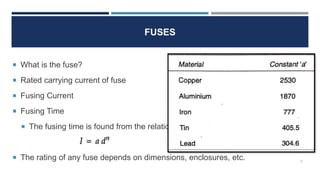
 The fusing time is found from the relation
 The rating of any fuse depends on dimensions, enclosures, etc.
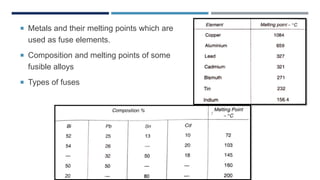
 Metals and their melting points which are
used as fuse elements.
 Composition and melting points of some
fusible alloys
 Types of fuses
RESISTORS
4
 Resistors are integral part of all electronic circuits and some electrical circuits
 The most widely used materials for precision resistors
 The material used for the potentiometers or transducers
 The materials used for strain guage used as transducers
 Resistance Thermometers
SOME APPLICATIONS OF CONDUCTING MATERIALS
5
 Conductors for Transmission Lines/Cables
 Conductors for Electrical Machines
 Transformers
 D.C. Machines
 Three Phase Induction Motor
 Synchronous Generators
THANK
YOU
6

Electrical Engineering Material Part-XIX

  • 1.
    ELECTRICAL ENGINEERING MATERIALS: CONDUCTING& SUPERCONDUCTING MATERIALS MR. ASIF L. JAMADAR
  • 2.
    FUSES 2  What isthe fuse?  Rated carrying current of fuse  Fusing Current  Fusing Time  The fusing time is found from the relation  The rating of any fuse depends on dimensions, enclosures, etc.
  • 3.
     Metals andtheir melting points which are used as fuse elements.  Composition and melting points of some fusible alloys  Types of fuses
  • 4.
    RESISTORS 4  Resistors areintegral part of all electronic circuits and some electrical circuits  The most widely used materials for precision resistors  The material used for the potentiometers or transducers  The materials used for strain guage used as transducers  Resistance Thermometers
  • 5.
    SOME APPLICATIONS OFCONDUCTING MATERIALS 5  Conductors for Transmission Lines/Cables  Conductors for Electrical Machines  Transformers  D.C. Machines  Three Phase Induction Motor  Synchronous Generators
  • 6.