1E C O L O G Y
DefinitionThe term ecology was coined in 1866 by the German biologist Ernst Haeckel, although it seems that Henry David Thoreau had already invented it in 1852The word is derived from the Greek Oikos=Household and logos= study, therefore “ecology means the study of the house hold2
Ecological ScienceIs the scientific study of the distribution and abundance of living organism and how the distribution and abundance are affected by interactions between the organism and their environment
The environment of an organism includes both physical properties, which can be described as the sum of local abiotic and biotic factors3
History of ecology Ecology is generally spoken of as a new science, having only become prominent in the second half of the 20th Century. Nonetheless, ecological thinking at some level has been around for a long time, and the principles of ecology have developed gradually. 4
One of the first ecologists may have been Aristotle or perhaps his student, Theophrastus, both of whom had interest in many species of animals. Theophrastus described interrelationships between animals and between animals and their environment as early as the 4th century BC5
18th and 19th century ~ Ecological murmursThe botanical geography and Alexander von Humboldt	Humboldt is often considered a father of ecology. He was the first to take on the study of the relationship between organisms and their environment. He exposed the existing relationships between observed plant species and climate, and described vegetation zones using latitude and altitude, a discipline now known as geobotany 6
Charles Darwin and Alfred Wallace Towards 1850 there was a breakthrough in the field with the publishing of the work of Charles Darwin on The Origin of Species: Ecology passed from a repetitive, mechanical model to a biological, organic, and hence evolutionary model 7
Alfred Russel Wallace, contemporary and competitor to Darwin, was first to propose a "geography" of animal species. Several authors recognized at the time that species were not independent of each other, and grouped them into plant species, animal species, and later into communities of living beings or biocoenosis. This term was coined in 1877 by Karl Möbius.8
Early 20th century ~ Expansion of ecological thought Austrian geologist Eduard Suess proposed the term biosphere in 1875. Suess proposed the name biosphere for the conditions promoting life, such as those found on Earth, which includes flora, fauna, minerals, matter cycles, etcetera 9
In the 1920s Vladimir I. Vernadsky, a Russian geologist who had defected to France, detailed the idea of the biosphere in his work "The biosphere" (1926), and described the fundamental principles of the biogeochemical cycles. He thus redefined the biosphere as the sum of all ecosystems.10
First ecological damages were reported in the 18th century, as the multiplication of colonies caused deforestation. Since the 19th century, with the industrial revolution, more and more pressing concerns have grown about the impact of human activity on the environment. The term ecologist has been in use since the end of the 19th century.11
The ecosystem: Arthur TansleyOver the 19th century, botanical geography and zoogeography combined to form the basis of biogeography. This science, which deals with habitats of species, seeks to explain the reasons for the presence of certain species in a given location.**Over the 19th century.Combined2 disciplines to form the bases of biogeography (geography and zoogeography)12
It was in 1935 that Arthur Tansley, the British ecologist, coined the term ecosystem, the interactive system established between the biocoenosis (the group of living creatures), and their biotope, the environment in which they live. Ecology thus became the science of ecosystems.13
Ecological Succession - Henry C. CowlesAt the turn of the 20th century, Henry C. Cowles was one of the founders of the emerging study of "dynamic ecology", through his study of ecological succession at the Indiana Dunes, sand dunes at the southern end of Lake Michigan. Here Cowles found evidence of ecological succession in the vegetation and the soil with relation to age. Ecological succession is the process by which a natural community moves from a simpler level of organization to a more complex community14
Modern ecological theory and researchEcology's influence in the social sciences and humanities15
Human ecologyIn recent years human ecology has been a topic that has interested organizational researchers. Hannan and Freeman (Population Ecology of Organizations (1977), American Journal of Sociology) argue that organizations do not only adapt to an environment. Instead it is also the environment that selects or rejects populations of organizations. 16
In any given environment (in equilibrium) there will only be one form of organization (isomorphism). Organizational ecology has been a prominent theory in accounting for diversities of organizations and their changing composition over time.17
James Lovelock and the Gaia hypothesis The Gaia theory, proposed by James Lovelock, in his work Gaia: A New Look at Life on Earth, advanced the view that the Earth should be regarded as a single living macro-organism. In particular, it argued that the ensemble of living organisms has jointly evolved an ability to control the global environment 18
PollutantsAre substances which directly or indirectly damage humans or the environment.
 Many of the compounds which are dangerous to the environment can also be harmful to humans in the long-term range and come from mineral and fossil sources or are produced by humans itself.19
Pollutants ClassificationOutdoor PollutantsIndoor Pollutants20
Outdoor PollutantsAir pollutants are classified as either gases or particulates. Tiny solids suspended in the atmosphere are called PARTICULATES21
Common particulatesAshDustSoot22
Gaseous PollutantsOxidesPhotochemical Smog (O3 , NO2)Chlorofluorocarbons (CFCs)23
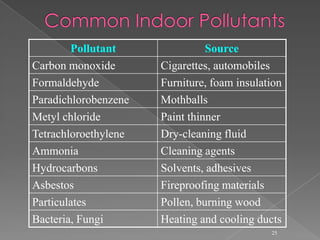
Indoor PollutantsIndoor air is not always cleaner than outdoor air. Air inside buildings often contains high levels of pollutants.
Several factors are responsible for high levels of indoor air pollutants

Ecology

  • 1.
    1E C OL O G Y
  • 2.
    DefinitionThe term ecologywas coined in 1866 by the German biologist Ernst Haeckel, although it seems that Henry David Thoreau had already invented it in 1852The word is derived from the Greek Oikos=Household and logos= study, therefore “ecology means the study of the house hold2
  • 3.
    Ecological ScienceIs thescientific study of the distribution and abundance of living organism and how the distribution and abundance are affected by interactions between the organism and their environment
  • 4.
    The environment ofan organism includes both physical properties, which can be described as the sum of local abiotic and biotic factors3
  • 5.
    History of ecologyEcology is generally spoken of as a new science, having only become prominent in the second half of the 20th Century. Nonetheless, ecological thinking at some level has been around for a long time, and the principles of ecology have developed gradually. 4
  • 6.
    One of thefirst ecologists may have been Aristotle or perhaps his student, Theophrastus, both of whom had interest in many species of animals. Theophrastus described interrelationships between animals and between animals and their environment as early as the 4th century BC5
  • 7.
    18th and 19thcentury ~ Ecological murmursThe botanical geography and Alexander von Humboldt Humboldt is often considered a father of ecology. He was the first to take on the study of the relationship between organisms and their environment. He exposed the existing relationships between observed plant species and climate, and described vegetation zones using latitude and altitude, a discipline now known as geobotany 6
  • 8.
    Charles Darwin andAlfred Wallace Towards 1850 there was a breakthrough in the field with the publishing of the work of Charles Darwin on The Origin of Species: Ecology passed from a repetitive, mechanical model to a biological, organic, and hence evolutionary model 7
  • 9.
    Alfred Russel Wallace,contemporary and competitor to Darwin, was first to propose a "geography" of animal species. Several authors recognized at the time that species were not independent of each other, and grouped them into plant species, animal species, and later into communities of living beings or biocoenosis. This term was coined in 1877 by Karl Möbius.8
  • 10.
    Early 20th century~ Expansion of ecological thought Austrian geologist Eduard Suess proposed the term biosphere in 1875. Suess proposed the name biosphere for the conditions promoting life, such as those found on Earth, which includes flora, fauna, minerals, matter cycles, etcetera 9
  • 11.
    In the 1920sVladimir I. Vernadsky, a Russian geologist who had defected to France, detailed the idea of the biosphere in his work "The biosphere" (1926), and described the fundamental principles of the biogeochemical cycles. He thus redefined the biosphere as the sum of all ecosystems.10
  • 12.
    First ecological damageswere reported in the 18th century, as the multiplication of colonies caused deforestation. Since the 19th century, with the industrial revolution, more and more pressing concerns have grown about the impact of human activity on the environment. The term ecologist has been in use since the end of the 19th century.11
  • 13.
    The ecosystem: ArthurTansleyOver the 19th century, botanical geography and zoogeography combined to form the basis of biogeography. This science, which deals with habitats of species, seeks to explain the reasons for the presence of certain species in a given location.**Over the 19th century.Combined2 disciplines to form the bases of biogeography (geography and zoogeography)12
  • 14.
    It was in1935 that Arthur Tansley, the British ecologist, coined the term ecosystem, the interactive system established between the biocoenosis (the group of living creatures), and their biotope, the environment in which they live. Ecology thus became the science of ecosystems.13
  • 15.
    Ecological Succession -Henry C. CowlesAt the turn of the 20th century, Henry C. Cowles was one of the founders of the emerging study of "dynamic ecology", through his study of ecological succession at the Indiana Dunes, sand dunes at the southern end of Lake Michigan. Here Cowles found evidence of ecological succession in the vegetation and the soil with relation to age. Ecological succession is the process by which a natural community moves from a simpler level of organization to a more complex community14
  • 16.
    Modern ecological theoryand researchEcology's influence in the social sciences and humanities15
  • 17.
    Human ecologyIn recentyears human ecology has been a topic that has interested organizational researchers. Hannan and Freeman (Population Ecology of Organizations (1977), American Journal of Sociology) argue that organizations do not only adapt to an environment. Instead it is also the environment that selects or rejects populations of organizations. 16
  • 18.
    In any givenenvironment (in equilibrium) there will only be one form of organization (isomorphism). Organizational ecology has been a prominent theory in accounting for diversities of organizations and their changing composition over time.17
  • 19.
    James Lovelock andthe Gaia hypothesis The Gaia theory, proposed by James Lovelock, in his work Gaia: A New Look at Life on Earth, advanced the view that the Earth should be regarded as a single living macro-organism. In particular, it argued that the ensemble of living organisms has jointly evolved an ability to control the global environment 18
  • 20.
    PollutantsAre substances whichdirectly or indirectly damage humans or the environment.
  • 21.
    Many ofthe compounds which are dangerous to the environment can also be harmful to humans in the long-term range and come from mineral and fossil sources or are produced by humans itself.19
  • 22.
  • 23.
    Outdoor PollutantsAir pollutantsare classified as either gases or particulates. Tiny solids suspended in the atmosphere are called PARTICULATES21
  • 24.
  • 25.
    Gaseous PollutantsOxidesPhotochemical Smog(O3 , NO2)Chlorofluorocarbons (CFCs)23
  • 26.
    Indoor PollutantsIndoor airis not always cleaner than outdoor air. Air inside buildings often contains high levels of pollutants.
  • 27.
    Several factors areresponsible for high levels of indoor air pollutants