By : Takeen Khurshid
Submitted To: Dr Sonia Khanna
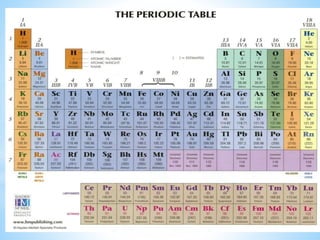
d-block elements:
The elements of periodic table belonging
to group 3 to 12 are known as d-Block
elements. because in these elements last
electron enters in d sub shell or d orbital .
The d -block elements lie in between s- and
p-block elements in the long form of
periodic table
Definition of d-block elements
A transition element is defined as the
one which has incompletely filled d
orbitals in its ground state or in any
one of its oxidation states. i.e.
A transition element should have
partially filled (n-1) d orbital.
Transition Elements
Group 7 Presentation
All d block elements are not transition
elements but all transition elements are d-
block elements
All d block elements are not transition
elements because d block elements like
Zinc have full d10 configuration in their
ground state as well as in their common
oxidation state which is not according to
definition of transition elements.
How are d - Block Elements &
Transition elements different?
GENERAL PROPERTIES OF D-BLOCK ELEMENTS
 ATOMIC & IONIC SIZE
 IONIZATION ENTHALPY
 OXIDATION STATES OF D-BLOCK ELEMENTS
 COLORED IONS
 CATALYTIC PROPERTIES
 MAGNETIC PROPERTIES
 FORMATION OF COMPLEX COMPOUNDS
 FORMATION OF INTERSTITIAL COMPOUNDS
GENERAL PROPERTIES OF D-BLOCK ELEMENTS
 ATOMIC & IONIC SIZE
 IONIZATION ENTHALPY
 OXIDATION STATES OF D-BLOCK ELEMENTS
 COLORED IONS
 CATALYTIC PROPERTIES
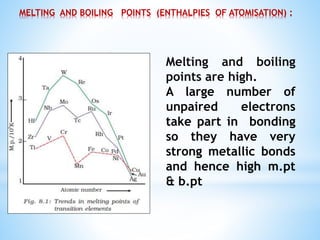
MELTING AND BOILING POINTS (ENTHALPIES OF ATOMISATION) :
Melting and boiling
points are high.
A large number of
unpaired electrons
take part in bonding
so they have very
strong metallic bonds
and hence high m.pt
& b.pt
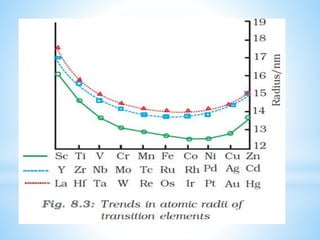
ATOMIC & IONIC SIZE
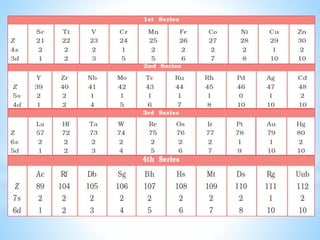
 Along the rows nuclear charge increases but
the penultimate d-sub shell has poor shielding
effect so atomic and ionic size remain almost
same .
 The radii of the third (5d) series are
virtually the same as those of the
corresponding members of the second
series.
 This phenomenon is associated with the
intervention of the 4f orbital, the filling of
4f before 5d orbital results in a regular
decrease in atomic radii called Lanthanoid
contraction which essentially compensates
for the expected increase in atomic size with
increasing atomic number.
 The net result of the lanthanoid contraction
is that the second and the third d series
exhibit similar radii (e.g., Zr 160 pm, Hf 159
pm)
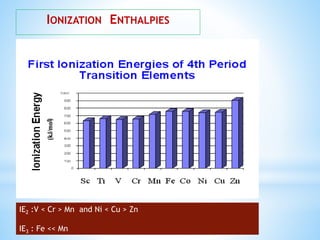
IONIZATION ENTHALPIES
IE2 :V < Cr > Mn and Ni < Cu > Zn
IE3 : Fe << Mn
 Due to an increase in nuclear charge which
accompanies the filling of the inner
d- orbitals , there is an increase in ionization
enthalpy along each series of the transition
elements from left to right.
 However, many small variations occur.
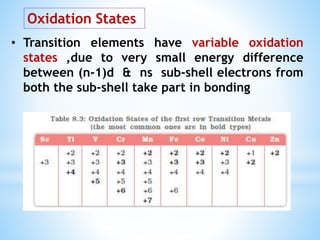
• Transition elements have variable oxidation
states ,due to very small energy difference
between (n-1)d & ns sub-shell electrons from
both the sub-shell take part in bonding
Oxidation States
•Low oxidation states are found when a complex
compound has ligands capable of π-acceptor character
in addition to the σ-bonding.
*For example, in Ni(CO)4 and Fe(CO)5, the oxidation
state of nickel and iron is zero.
• The elements which give the greatest number of
oxidation states occur in or near the middle of the
series. Manganese, for example, exhibits all the
oxidation states from +2 to +7.
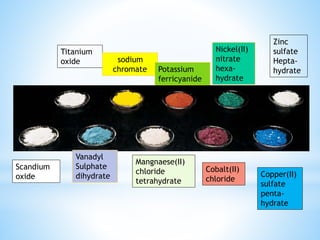
Most of the transition metal compounds (ionic
as well as covalent) are colored both in solid
state & in aqueous state.
Generally the elements/ions having unpaired
electrons produce colored compound.
COLOURED IONS
Scandium
oxide
Vanadyl
Sulphate
dihydrate
Titanium
oxide sodium
chromate Potassium
ferricyanide
Nickel(II)
nitrate
hexa-
hydrate
Zinc
sulfate
Hepta-
hydrate
Mangnaese(II)
chloride
tetrahydrate
Cobalt(II)
chloride
Copper(II)
sulfate
penta-
hydrate
ES
GS
eg
t2g
hv
eg
t2g
Do
ES
GS
complex in electronic
Ground State (GS)
d-d
transition
complex in
electronic
excited state
(ES)
CATALYTIC PROPERTIES
Vanadium(V) oxide,V2O5 (in Contact Process)
Finely divided iron (in Haber’s Process)
Nickel (in Catalytic Hydrogenation)
Cobalt (Synthesis of gasoline)
 This property is due to-
 Presence of unpaired electrons in their
incomplete d orbitals.
 Variable oxidation state of transition metals.
 In most cases , provide large surface area with
free valancy.
D block-elements

D block-elements

  • 1.
    By : TakeenKhurshid Submitted To: Dr Sonia Khanna
  • 3.
    d-block elements: The elementsof periodic table belonging to group 3 to 12 are known as d-Block elements. because in these elements last electron enters in d sub shell or d orbital . The d -block elements lie in between s- and p-block elements in the long form of periodic table Definition of d-block elements
  • 5.
    A transition elementis defined as the one which has incompletely filled d orbitals in its ground state or in any one of its oxidation states. i.e. A transition element should have partially filled (n-1) d orbital. Transition Elements
  • 6.
  • 8.
    All d blockelements are not transition elements but all transition elements are d- block elements All d block elements are not transition elements because d block elements like Zinc have full d10 configuration in their ground state as well as in their common oxidation state which is not according to definition of transition elements. How are d - Block Elements & Transition elements different?
  • 9.
    GENERAL PROPERTIES OFD-BLOCK ELEMENTS  ATOMIC & IONIC SIZE  IONIZATION ENTHALPY  OXIDATION STATES OF D-BLOCK ELEMENTS  COLORED IONS  CATALYTIC PROPERTIES  MAGNETIC PROPERTIES  FORMATION OF COMPLEX COMPOUNDS  FORMATION OF INTERSTITIAL COMPOUNDS
  • 10.
    GENERAL PROPERTIES OFD-BLOCK ELEMENTS  ATOMIC & IONIC SIZE  IONIZATION ENTHALPY  OXIDATION STATES OF D-BLOCK ELEMENTS  COLORED IONS  CATALYTIC PROPERTIES
  • 11.
    MELTING AND BOILINGPOINTS (ENTHALPIES OF ATOMISATION) : Melting and boiling points are high. A large number of unpaired electrons take part in bonding so they have very strong metallic bonds and hence high m.pt & b.pt
  • 12.
  • 14.
     Along therows nuclear charge increases but the penultimate d-sub shell has poor shielding effect so atomic and ionic size remain almost same .  The radii of the third (5d) series are virtually the same as those of the corresponding members of the second series.
  • 15.
     This phenomenonis associated with the intervention of the 4f orbital, the filling of 4f before 5d orbital results in a regular decrease in atomic radii called Lanthanoid contraction which essentially compensates for the expected increase in atomic size with increasing atomic number.  The net result of the lanthanoid contraction is that the second and the third d series exhibit similar radii (e.g., Zr 160 pm, Hf 159 pm)
  • 16.
    IONIZATION ENTHALPIES IE2 :V< Cr > Mn and Ni < Cu > Zn IE3 : Fe << Mn
  • 17.
     Due toan increase in nuclear charge which accompanies the filling of the inner d- orbitals , there is an increase in ionization enthalpy along each series of the transition elements from left to right.  However, many small variations occur.
  • 18.
    • Transition elementshave variable oxidation states ,due to very small energy difference between (n-1)d & ns sub-shell electrons from both the sub-shell take part in bonding Oxidation States
  • 19.
    •Low oxidation statesare found when a complex compound has ligands capable of π-acceptor character in addition to the σ-bonding. *For example, in Ni(CO)4 and Fe(CO)5, the oxidation state of nickel and iron is zero. • The elements which give the greatest number of oxidation states occur in or near the middle of the series. Manganese, for example, exhibits all the oxidation states from +2 to +7.
  • 20.
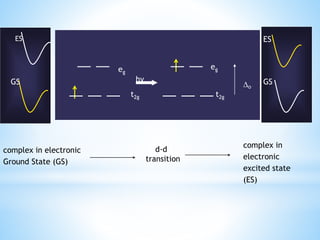
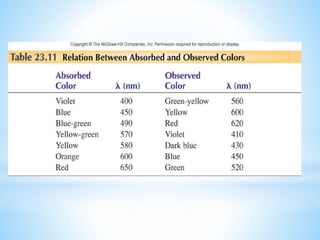
    Most of thetransition metal compounds (ionic as well as covalent) are colored both in solid state & in aqueous state. Generally the elements/ions having unpaired electrons produce colored compound. COLOURED IONS
  • 21.
  • 22.
    ES GS eg t2g hv eg t2g Do ES GS complex in electronic GroundState (GS) d-d transition complex in electronic excited state (ES)
  • 25.
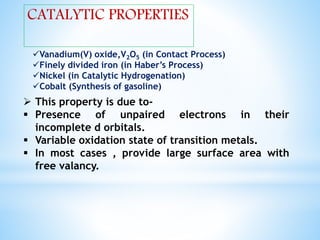
    CATALYTIC PROPERTIES Vanadium(V) oxide,V2O5(in Contact Process) Finely divided iron (in Haber’s Process) Nickel (in Catalytic Hydrogenation) Cobalt (Synthesis of gasoline)  This property is due to-  Presence of unpaired electrons in their incomplete d orbitals.  Variable oxidation state of transition metals.  In most cases , provide large surface area with free valancy.

Editor's Notes

  • #18 The ionization energy (IE) is qualitatively defined as the amount of energy required to remove the most loosely bound electron of an isolated gaseous atom to form a cation.