This document discusses different models of the atom, including Bohr's model, the quantum mechanical model, and atomic orbitals. It describes key aspects of each model, such as electrons occupying specific energy levels in Bohr's model and the probabilistic nature of electron location in the quantum mechanical model. It also explains atomic orbitals in more detail, defining principal and other quantum numbers that describe orbital shape and electron location probability. Diagrams are provided to illustrate orbital shapes like s, p, d, and f orbitals.
This slide introduces Chapter 5, which focuses on models of the atom.
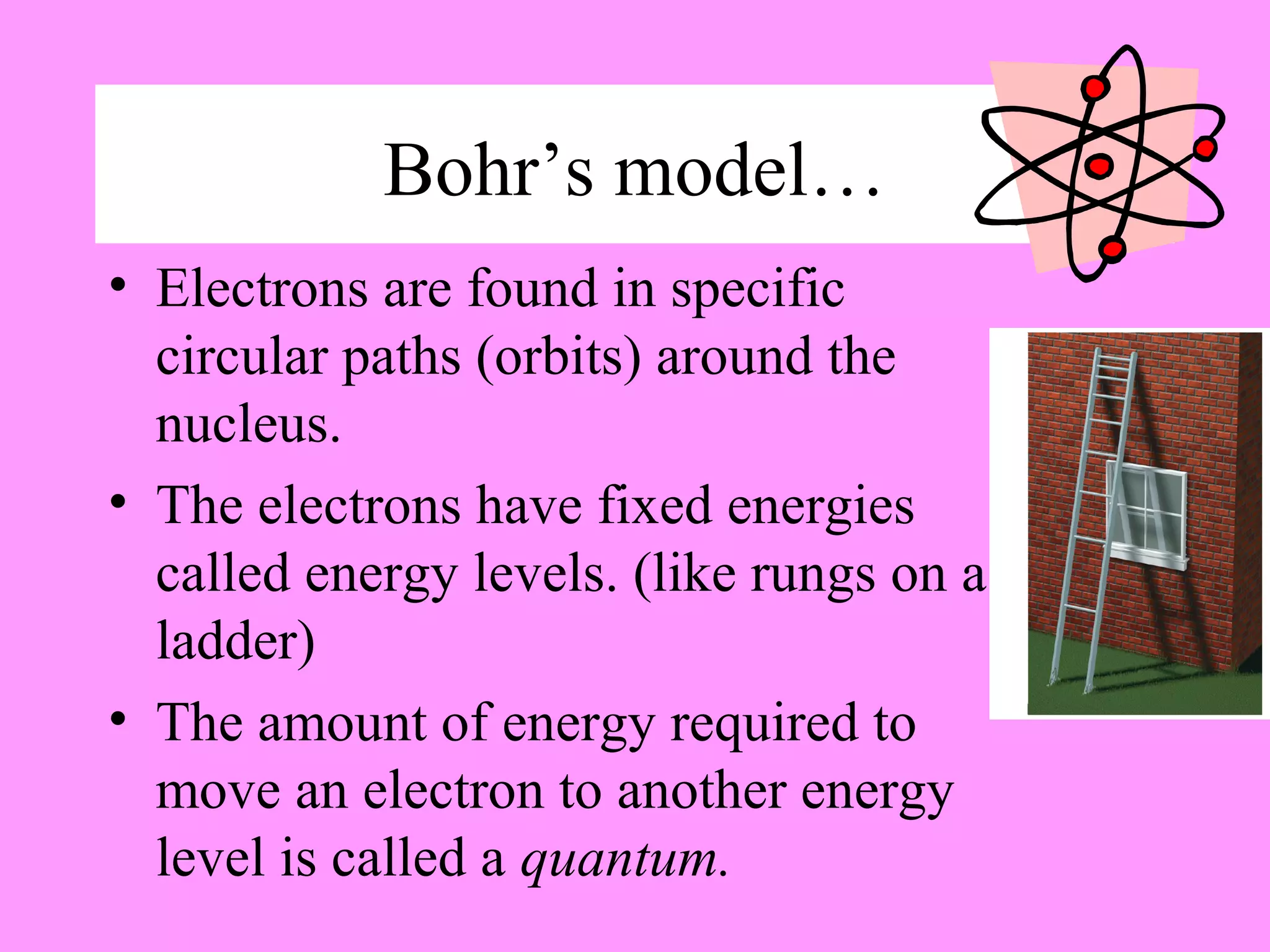
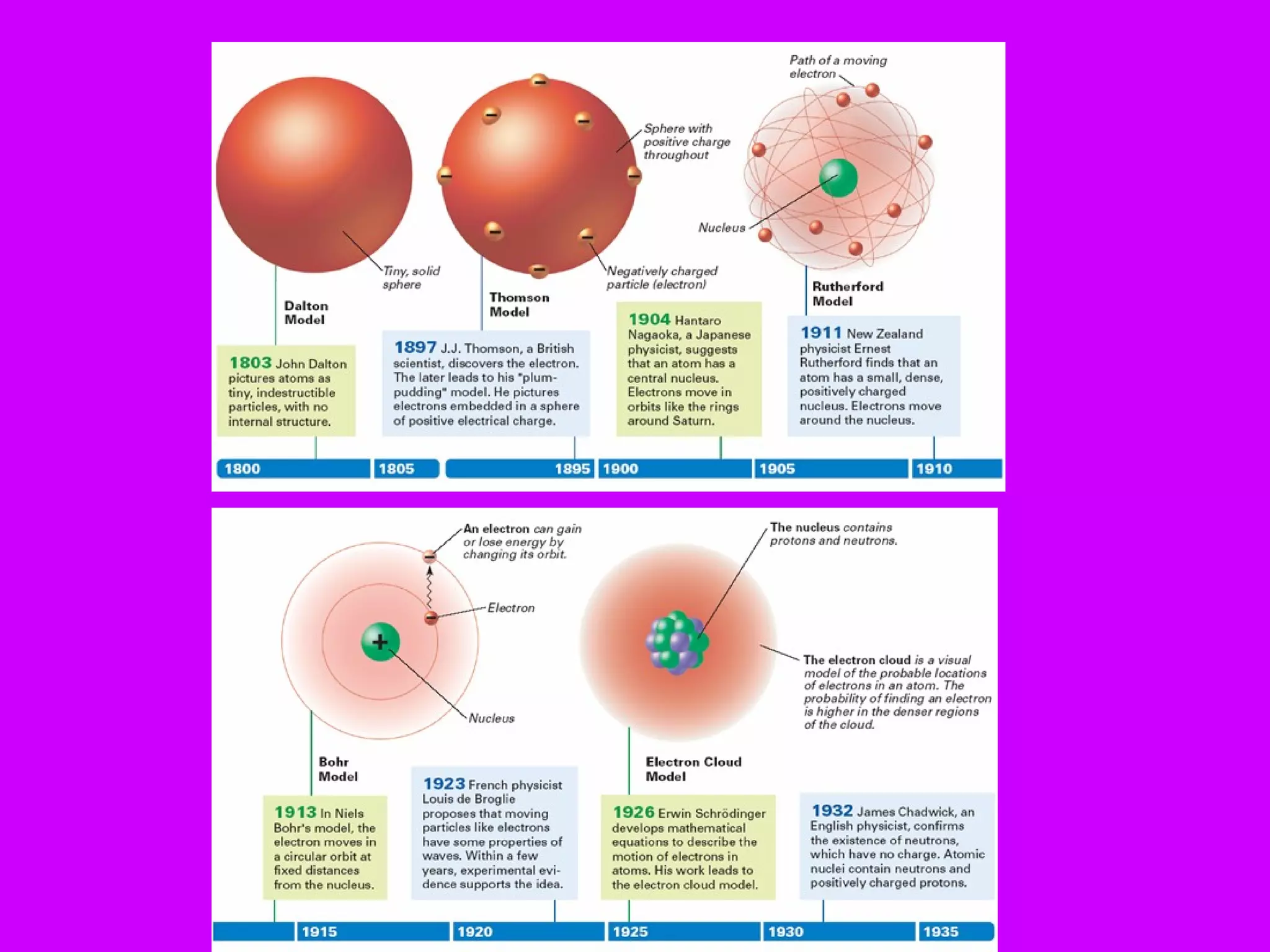
Describes Bohr’s model: electrons in fixed orbits with quantized energy levels; energy to move levels called quantum.
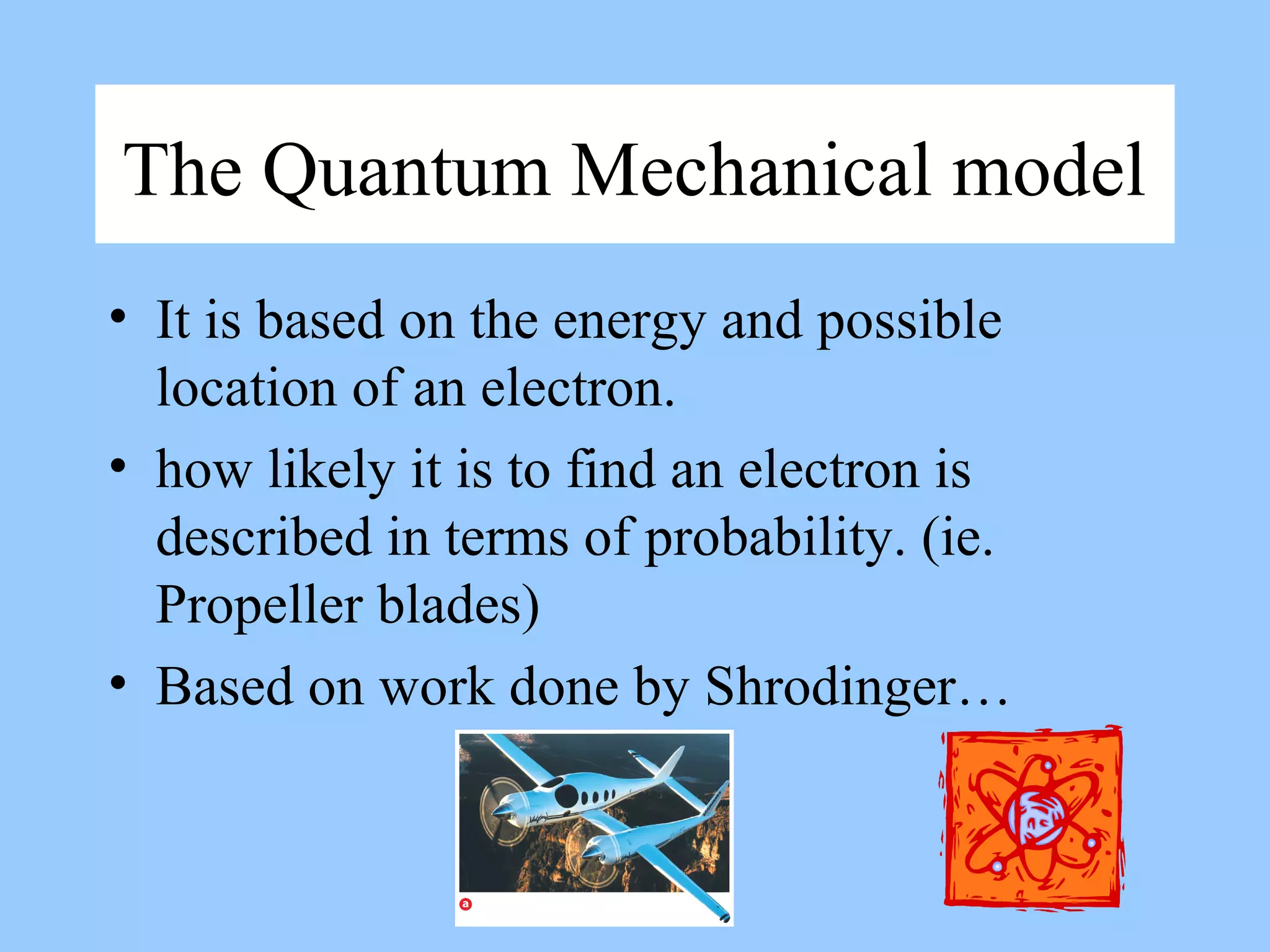
Introduces Quantum Mechanical model focusing on electron energy and probability for finding electrons.
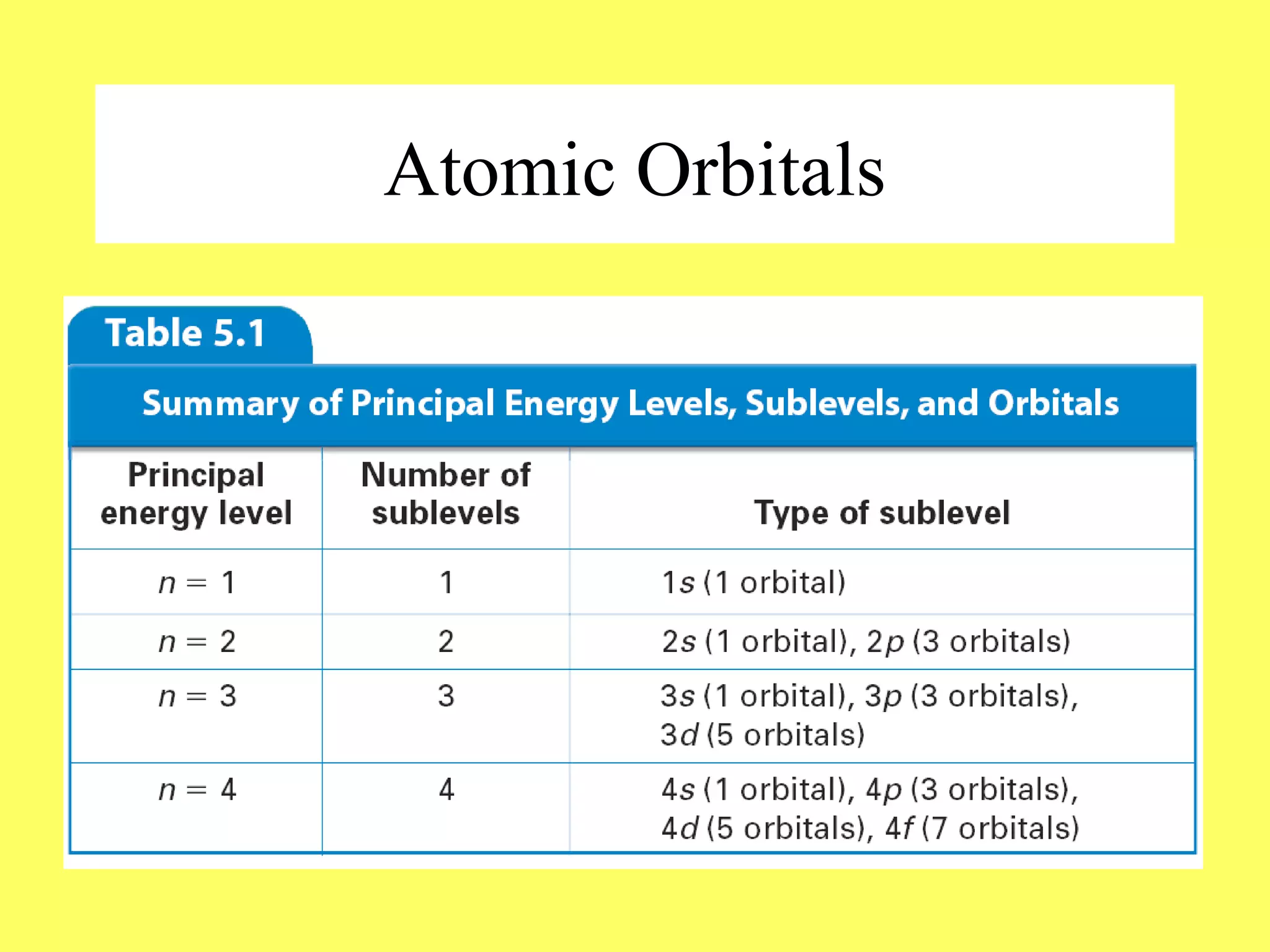
Explains atomic orbitals and energy levels characterized by principal quantum numbers (n) with distinct shapes.
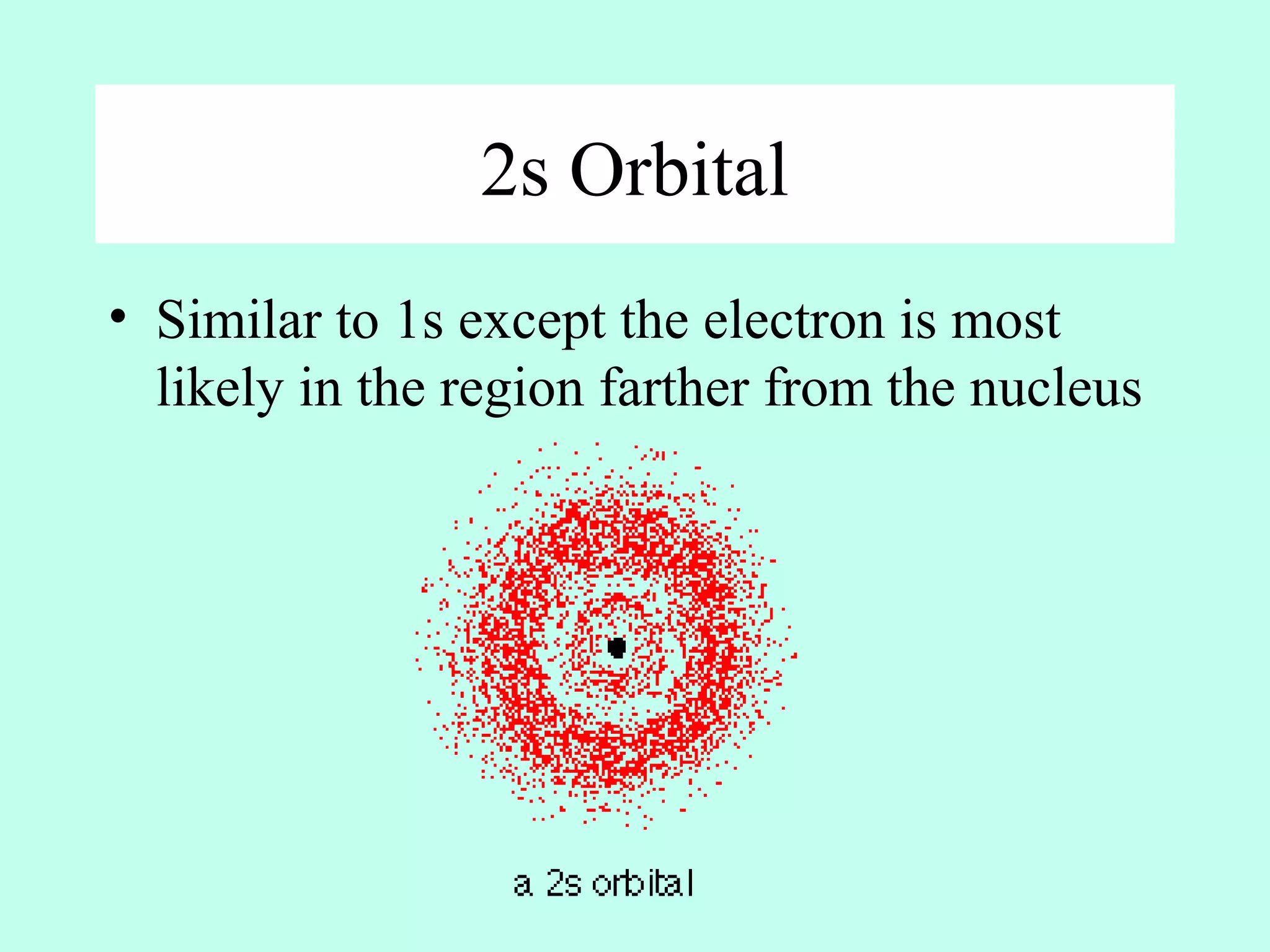
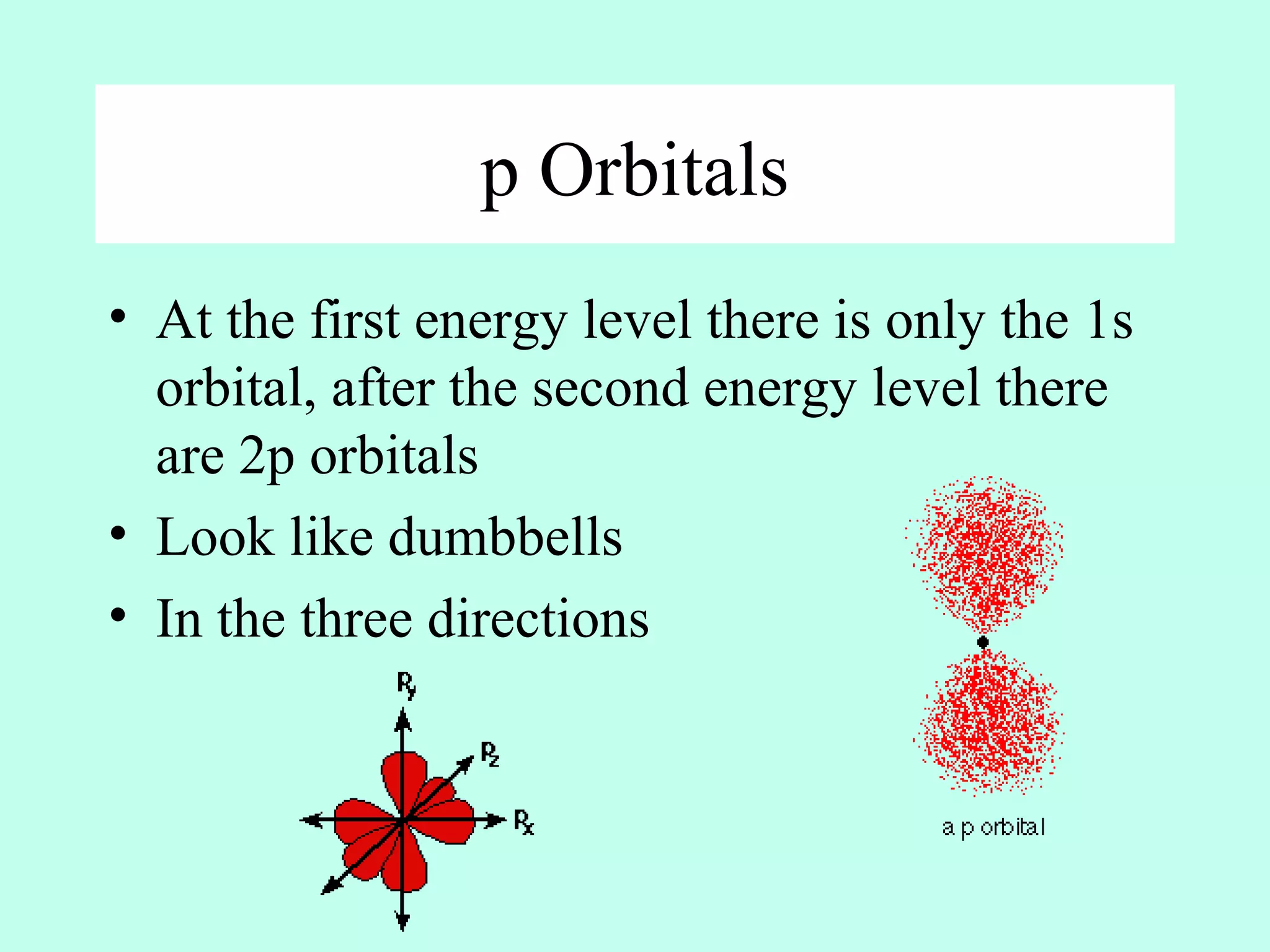
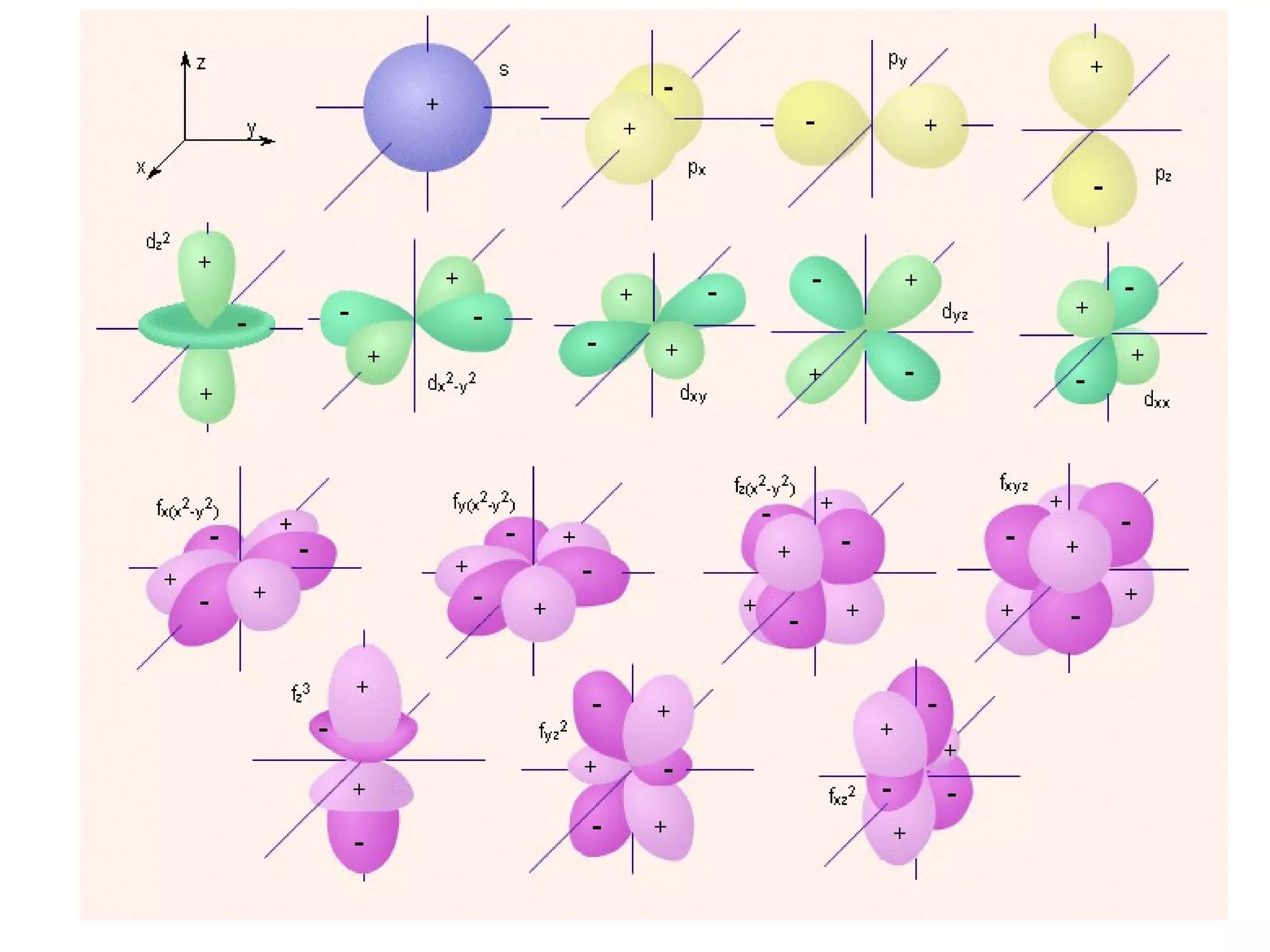
Slides detail shapes (1s, 2s, p) of atomic orbitals, with 1s as a sphere and p orbitals resembling dumbbells.
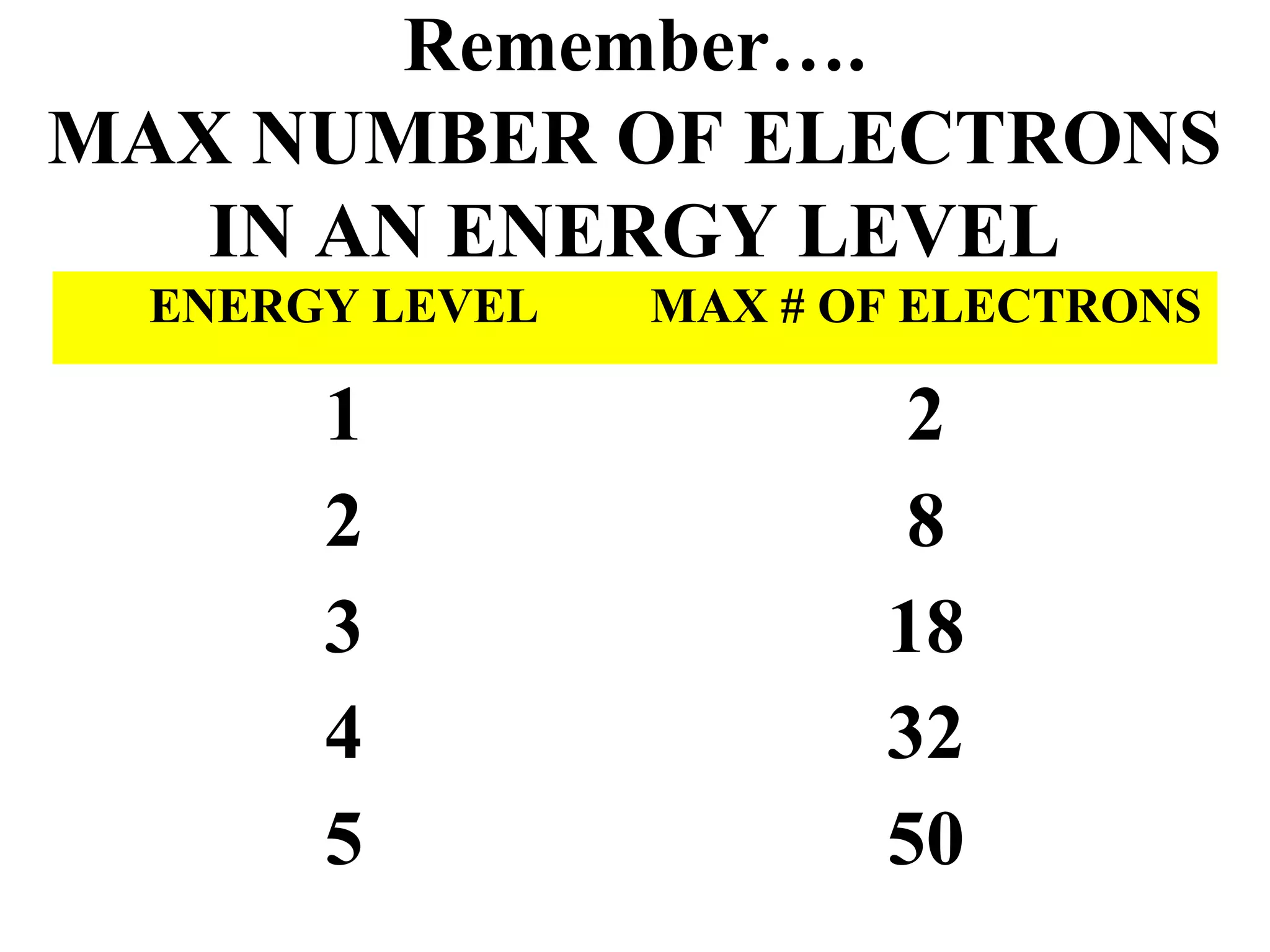
Lists maximum number of electrons for energy levels: 1 (2), 2 (8), 3 (18), 4 (32), and 5 (50).
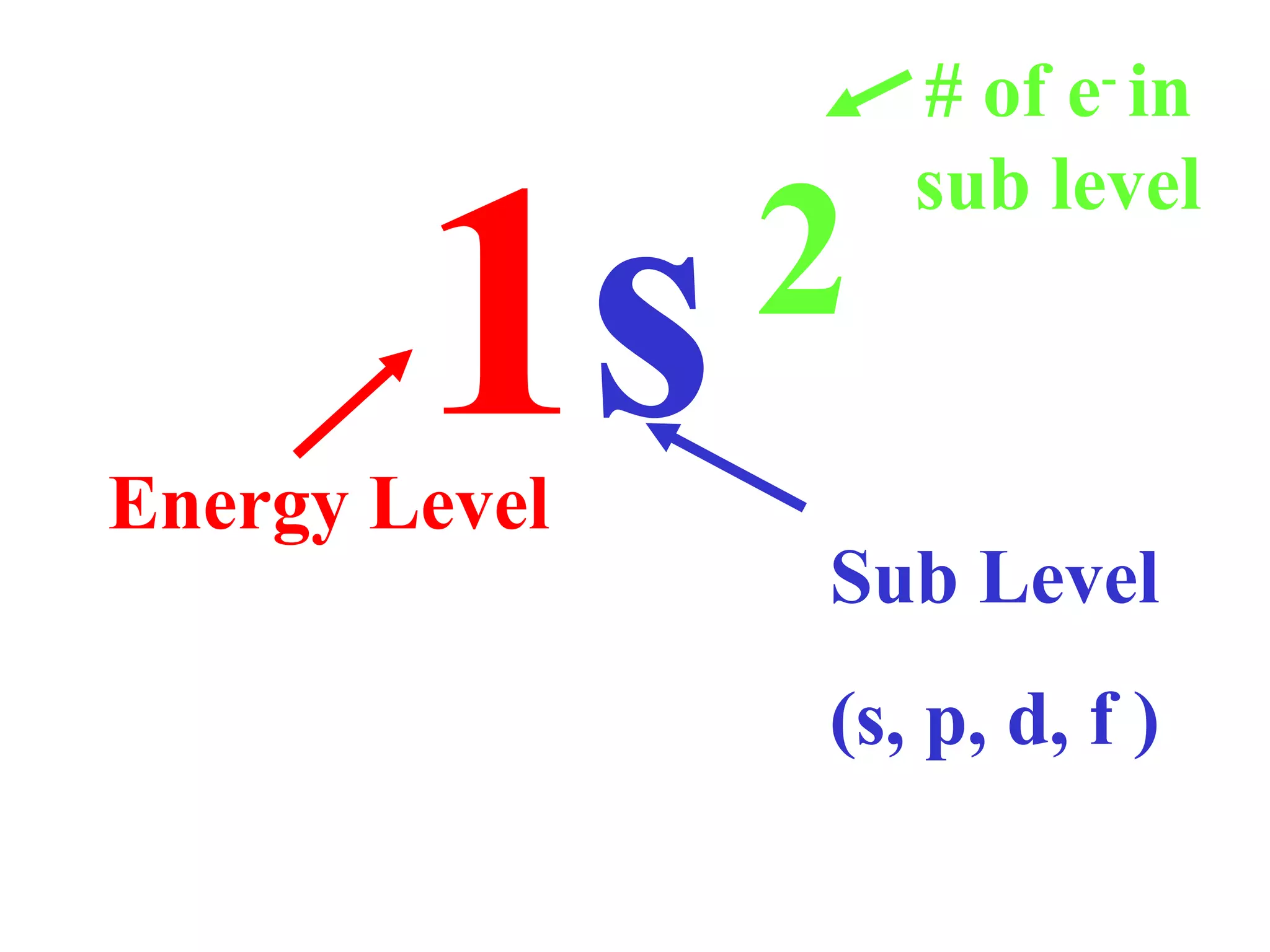
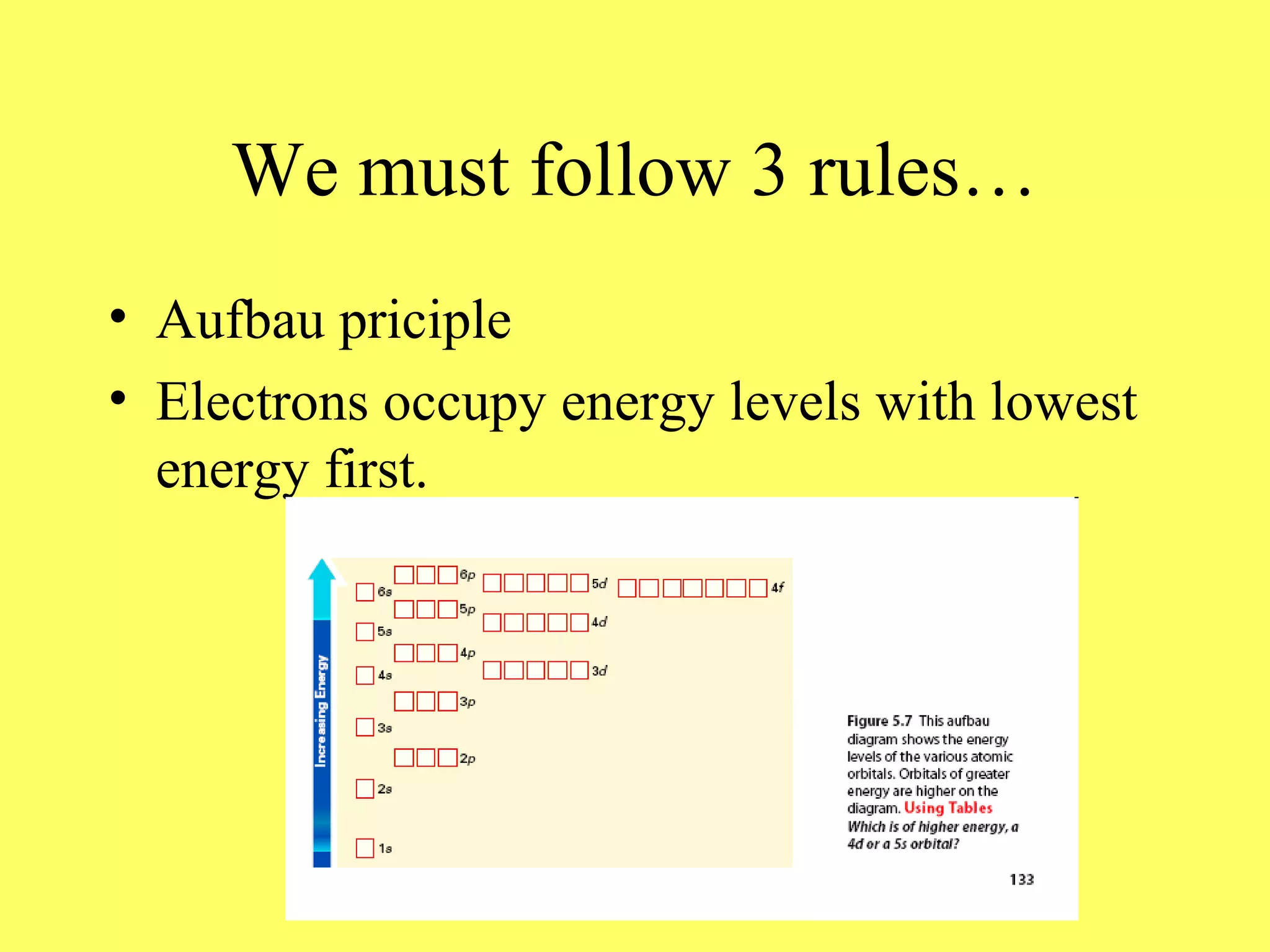
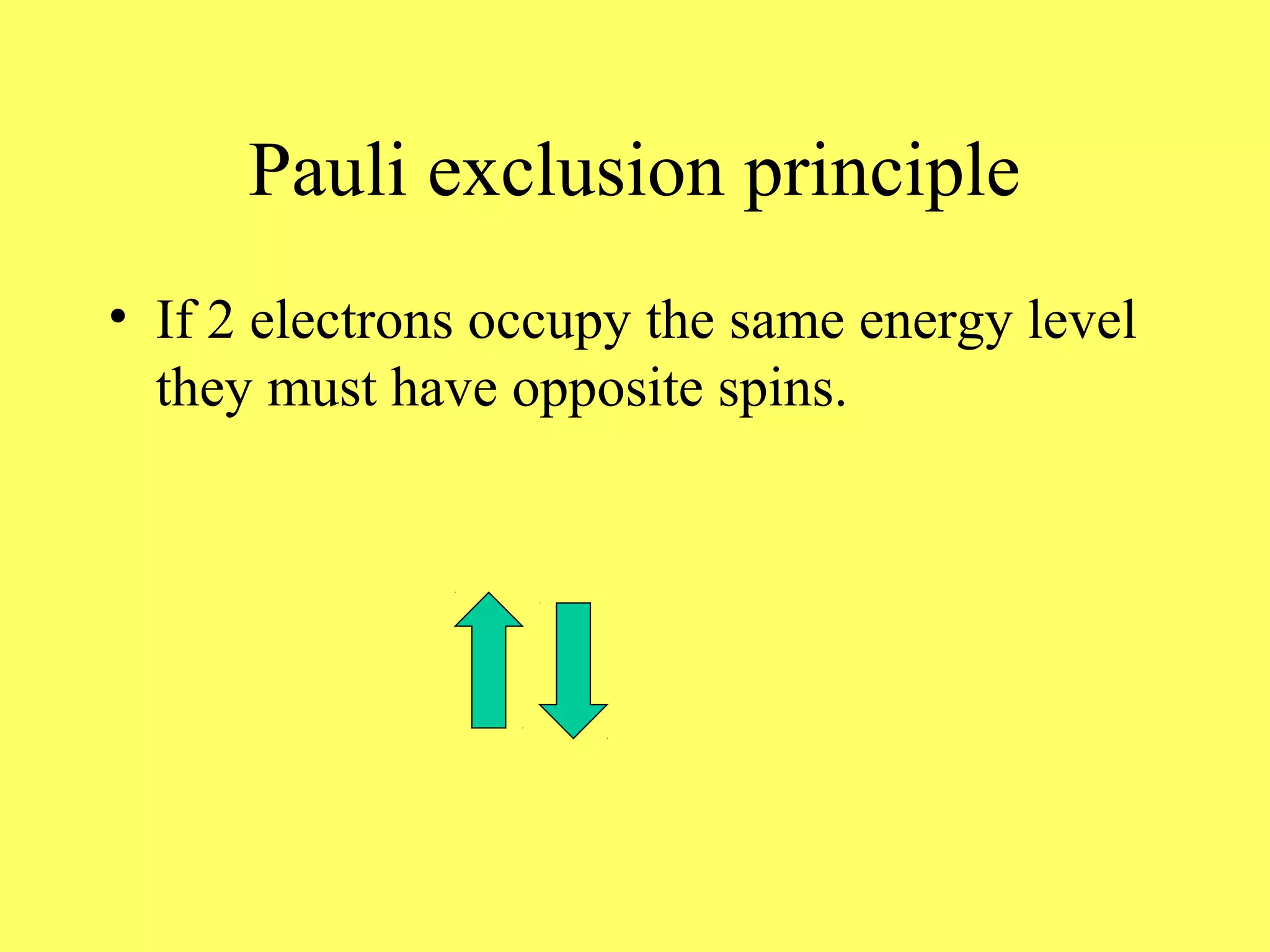
Introduces electron configuration, rules for filling (Aufbau principle, Pauli exclusion, Hund’s rule), and periodic table connection. Encourages practice in electron configurations using filling diagrams, with Boron example as a reference.
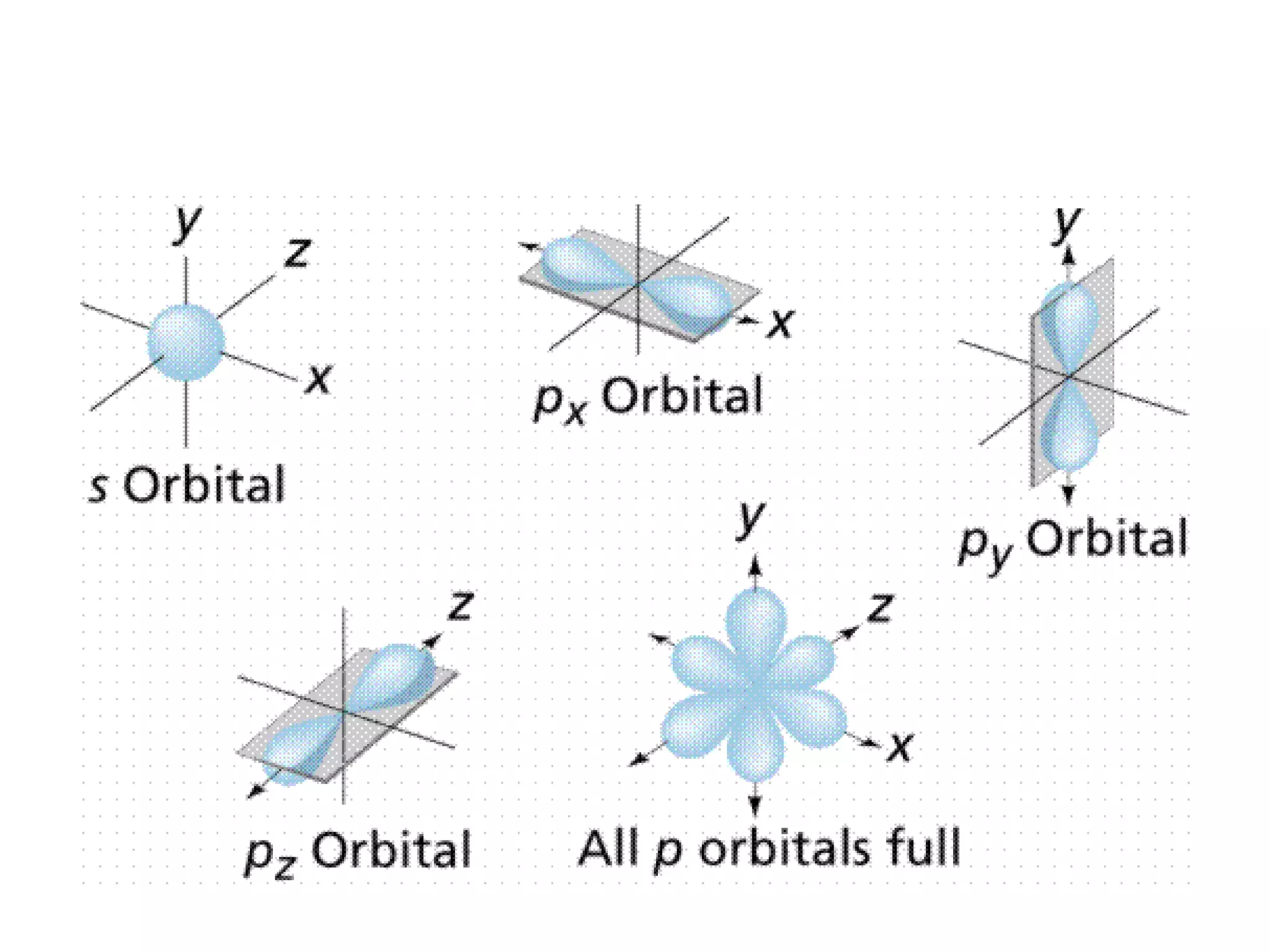
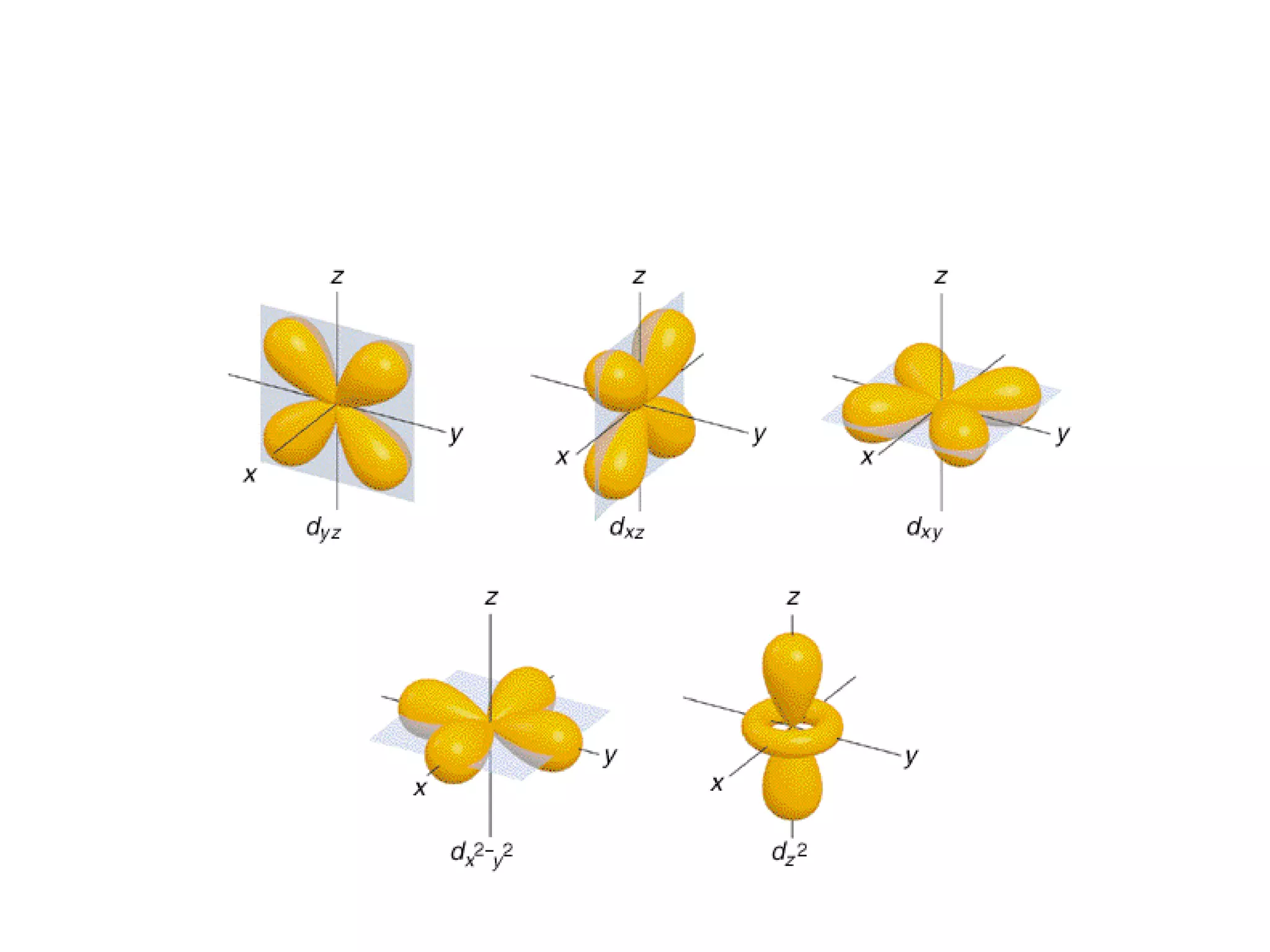
Summarizes characteristics of p and d orbitals: p has 3 orientations; d resembles clover with 2 dumbell shapes.
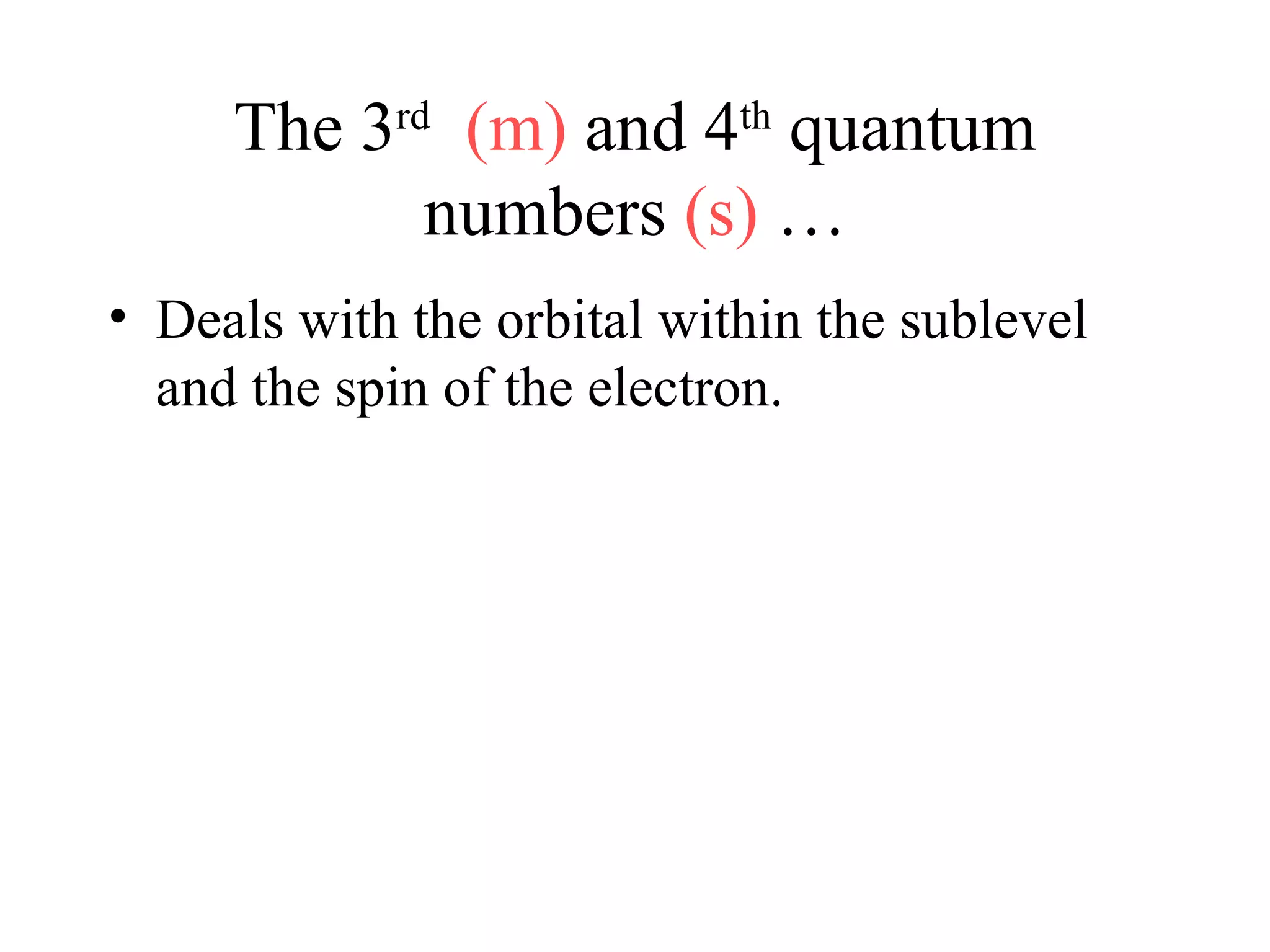
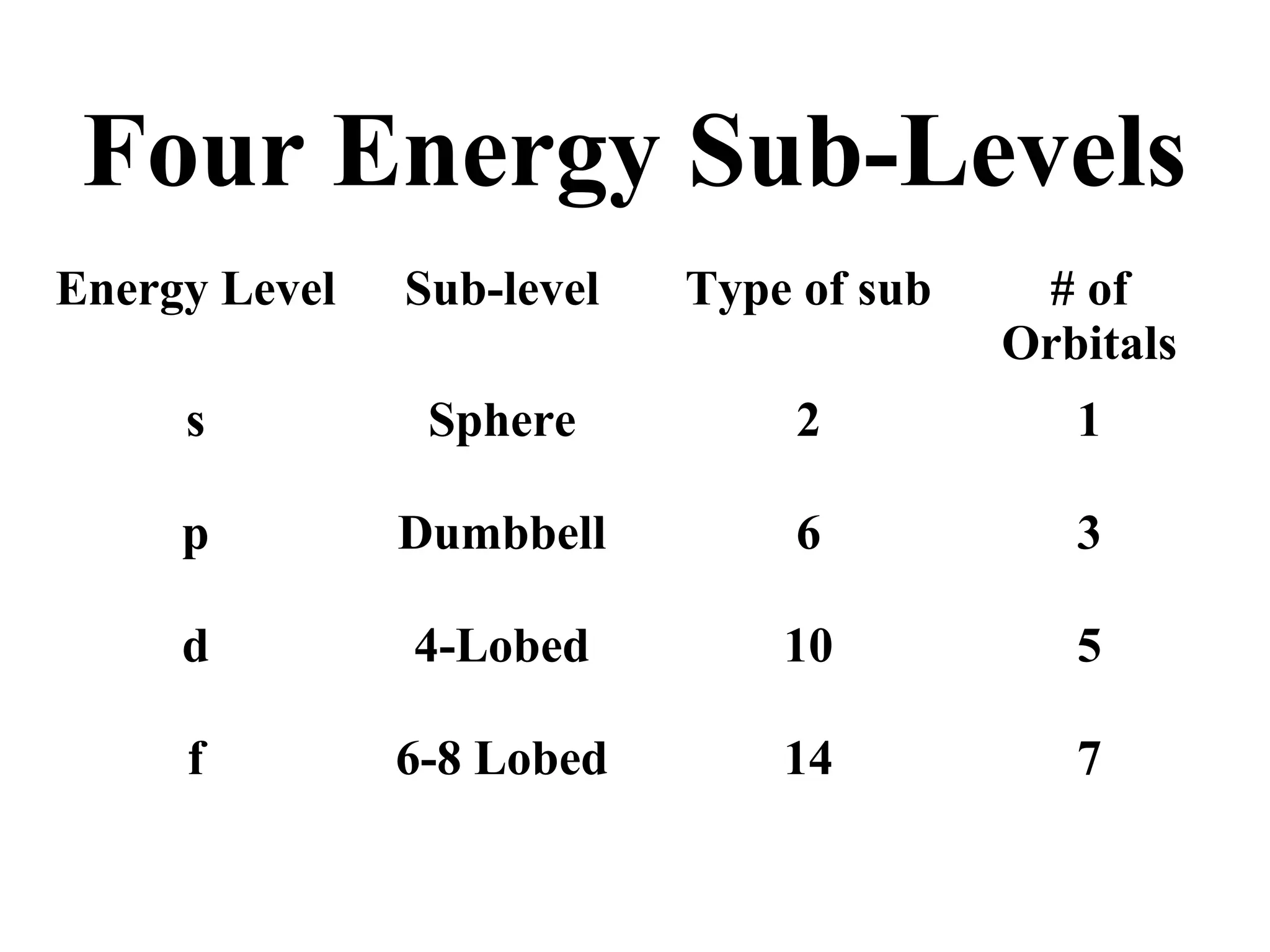
Details four quantum numbers: 1st (energy level), 2nd (shape), and 3rd/4th (orbital position and spin), with sub-levels sizes.
Bohr’s model…
• Electronsare found in specific
circular paths (orbits) around the
nucleus.
• The electrons have fixed energies
called energy levels. (like rungs on a
ladder)
• The amount of energy required to
move an electron to another energy
level is called a quantum.
3.
The Quantum Mechanicalmodel
• It is based on the energy and possible
location of an electron.
• how likely it is to find an electron is
described in terms of probability. (ie.
Propeller blades)
• Based on work done by Shrodinger…
5.
Atomic Orbitals
• Theenergy levels of electrons are labeled
by principal quantum numbers (n)
• Each energy sublevel corresponds to an
orbital of a different shape, which describes
where the electron is likely to be found.
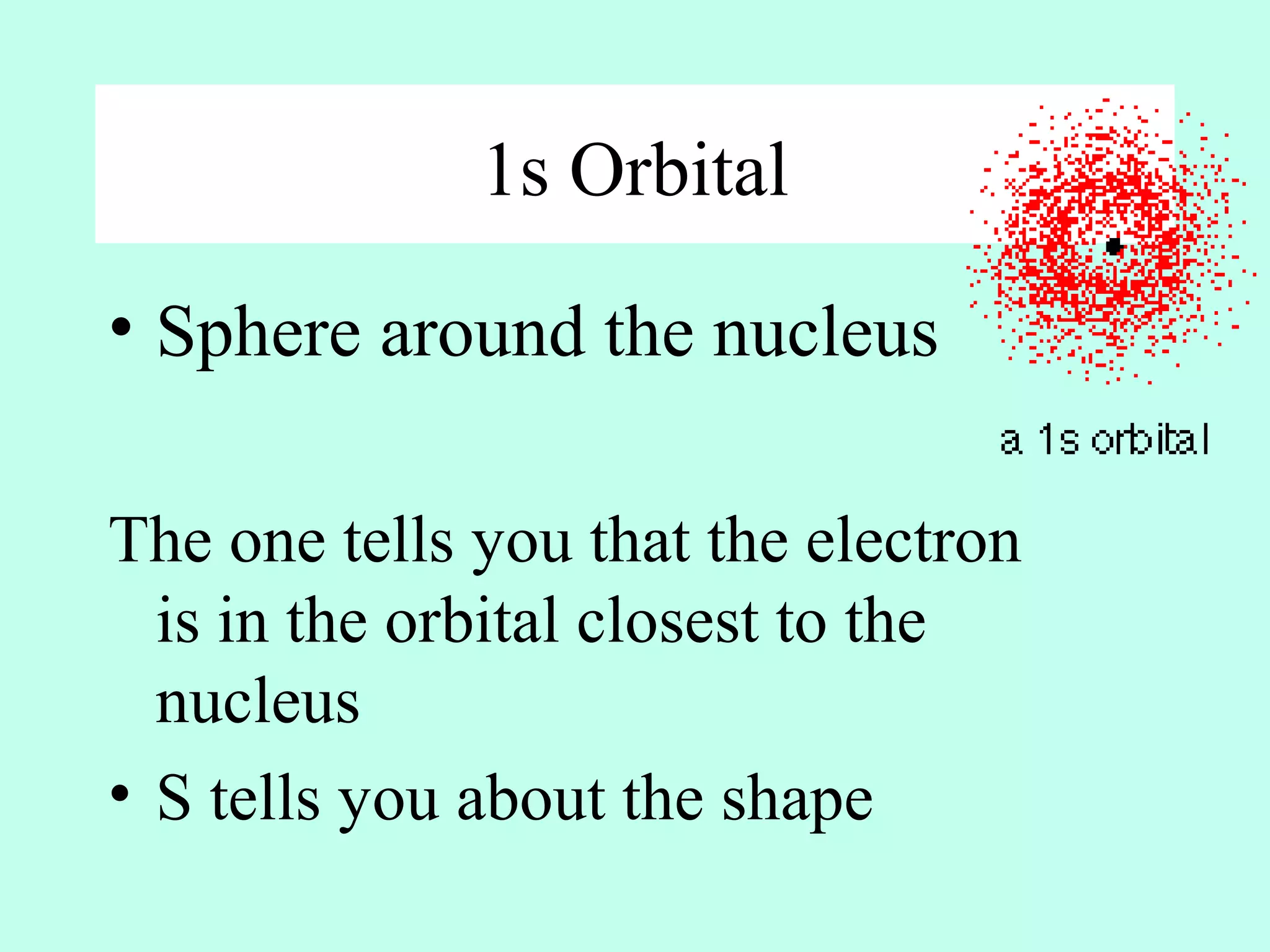
1s Orbital
• Spherearound the nucleus
The one tells you that the electron
is in the orbital closest to the
nucleus
• S tells you about the shape
9.
2s Orbital
• Similarto 1s except the electron is most
likely in the region farther from the nucleus
10.
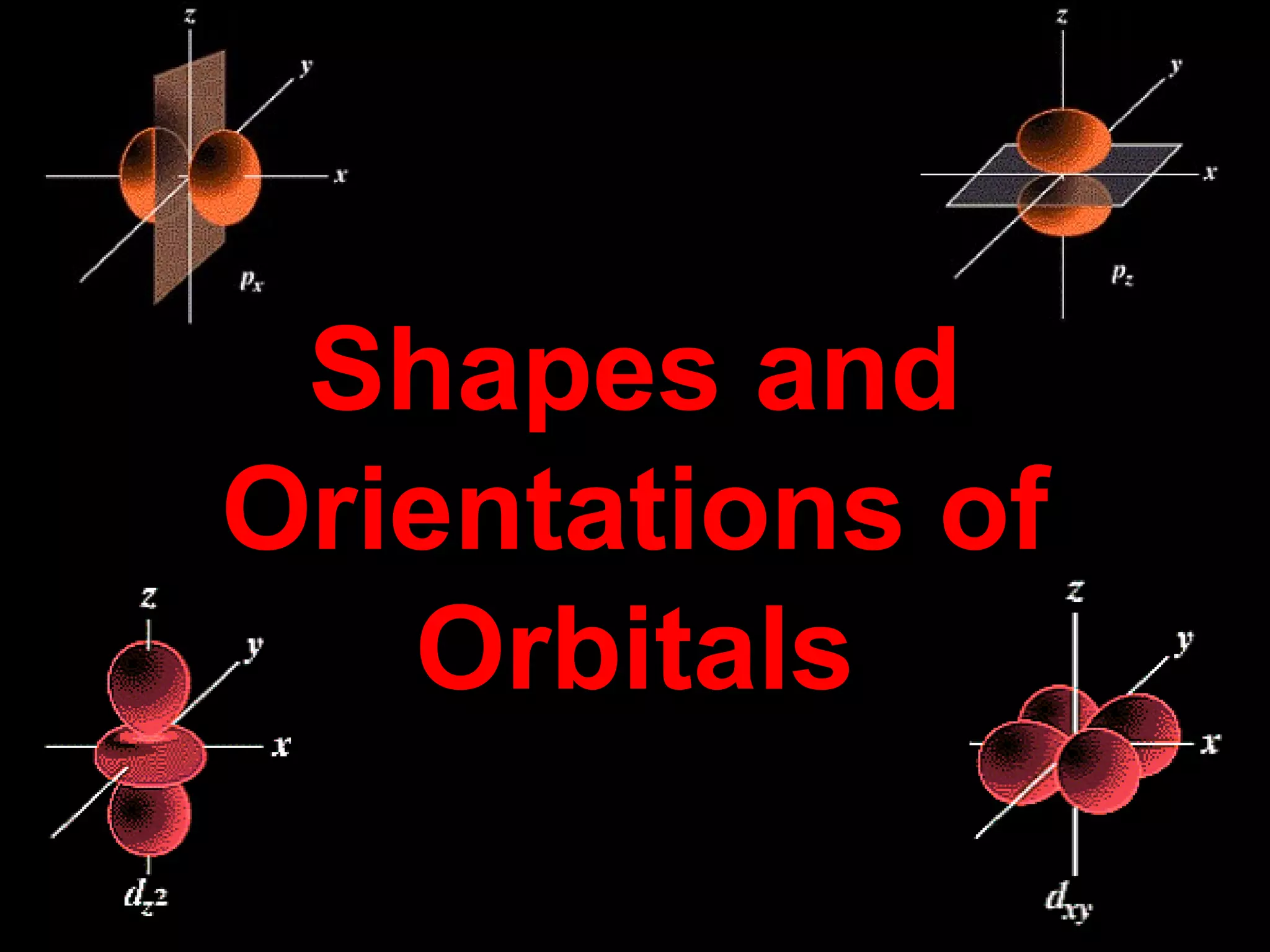
p Orbitals
• Atthe first energy level there is only the 1s
orbital, after the second energy level there
are 2p orbitals
• Look like dumbbells
• In the three directions
14.
Remember….
MAX NUMBER OFELECTRONS
IN AN ENERGY LEVEL
ENERGY LEVEL MAX # OF ELECTRONS
1 2
2 8
3 18
4 32
5 50
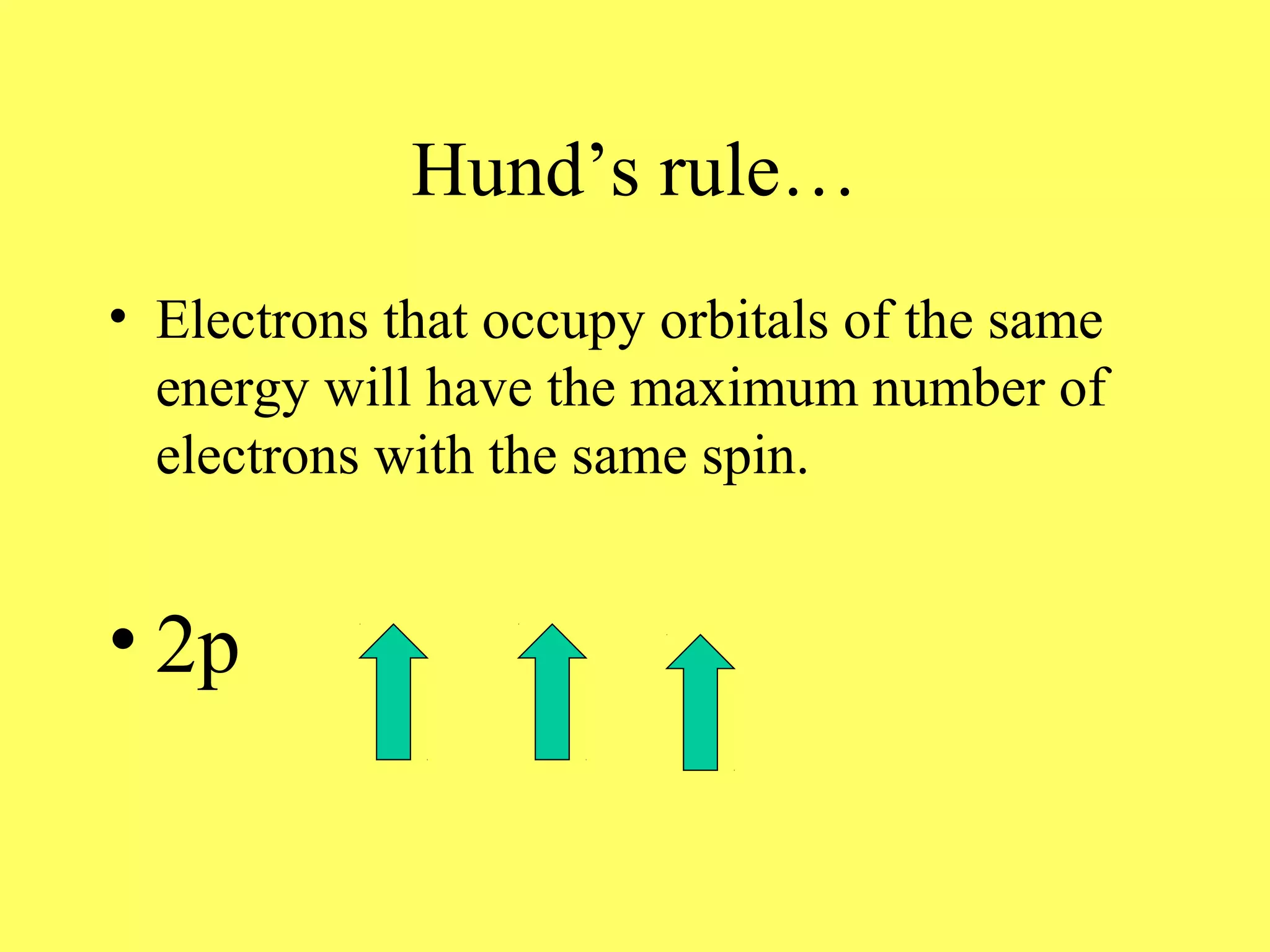
Hund’s rule…
• Electronsthat occupy orbitals of the same
energy will have the maximum number of
electrons with the same spin.
• 2p
20.
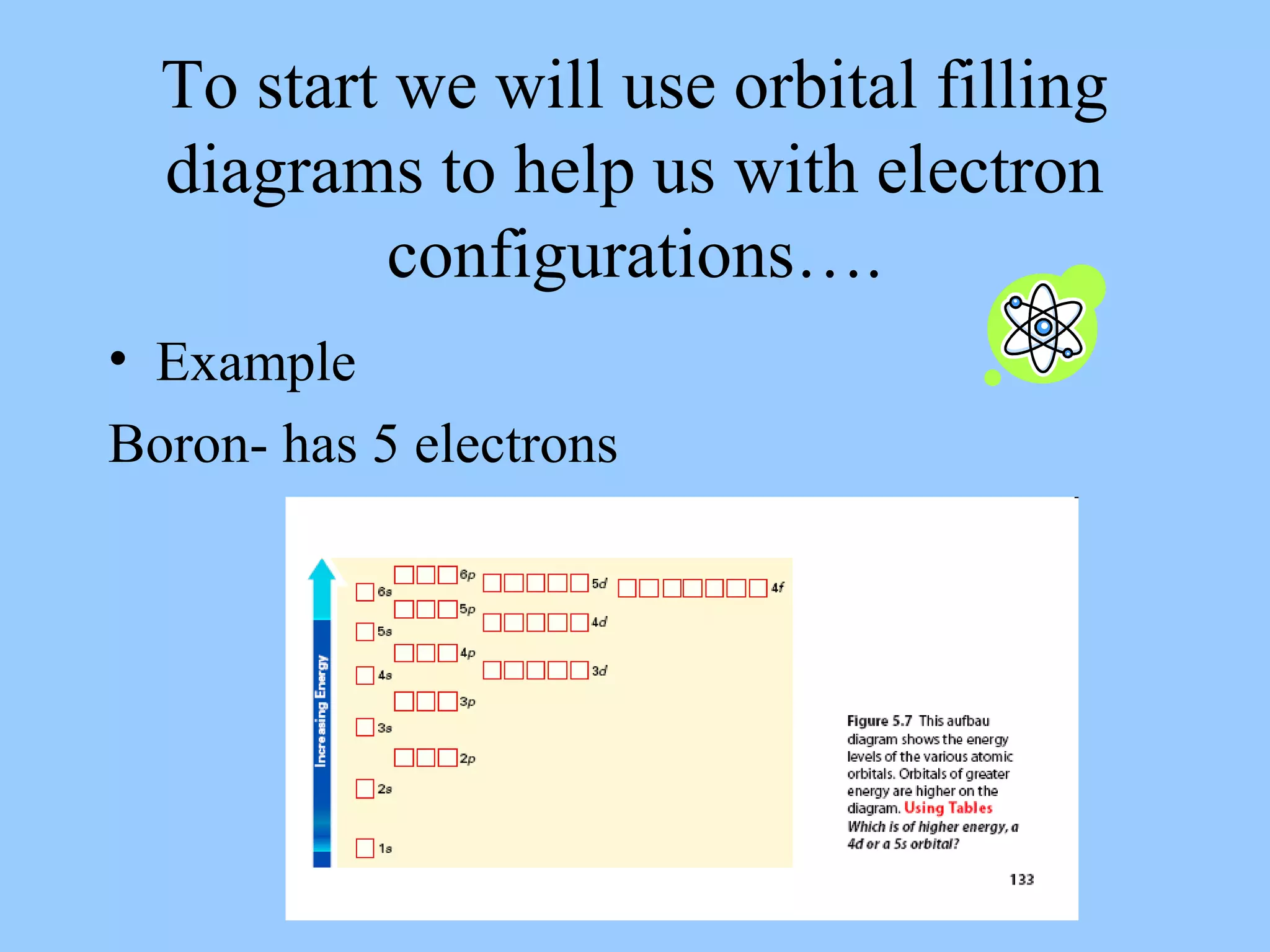
To start wewill use orbital filling
diagrams to help us with electron
configurations….
• Example
Boron- has 5 electrons
21.
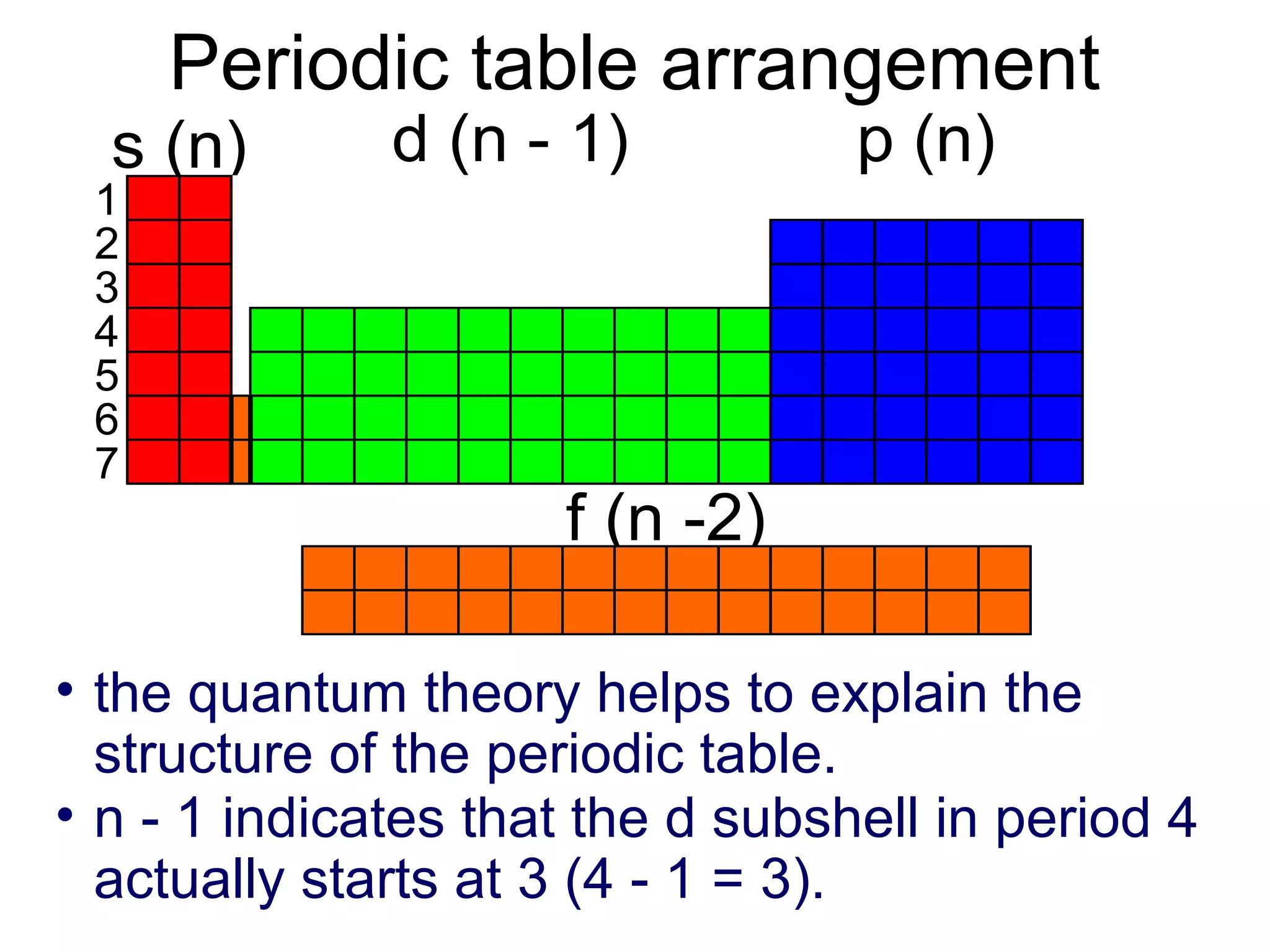
Periodic table arrangement
•the quantum theory helps to explain the
structure of the periodic table.
• n - 1 indicates that the d subshell in period 4
actually starts at 3 (4 - 1 = 3).
s (n) d (n - 1) p (n)
1
2
3
4
5
6
7
f (n -2)
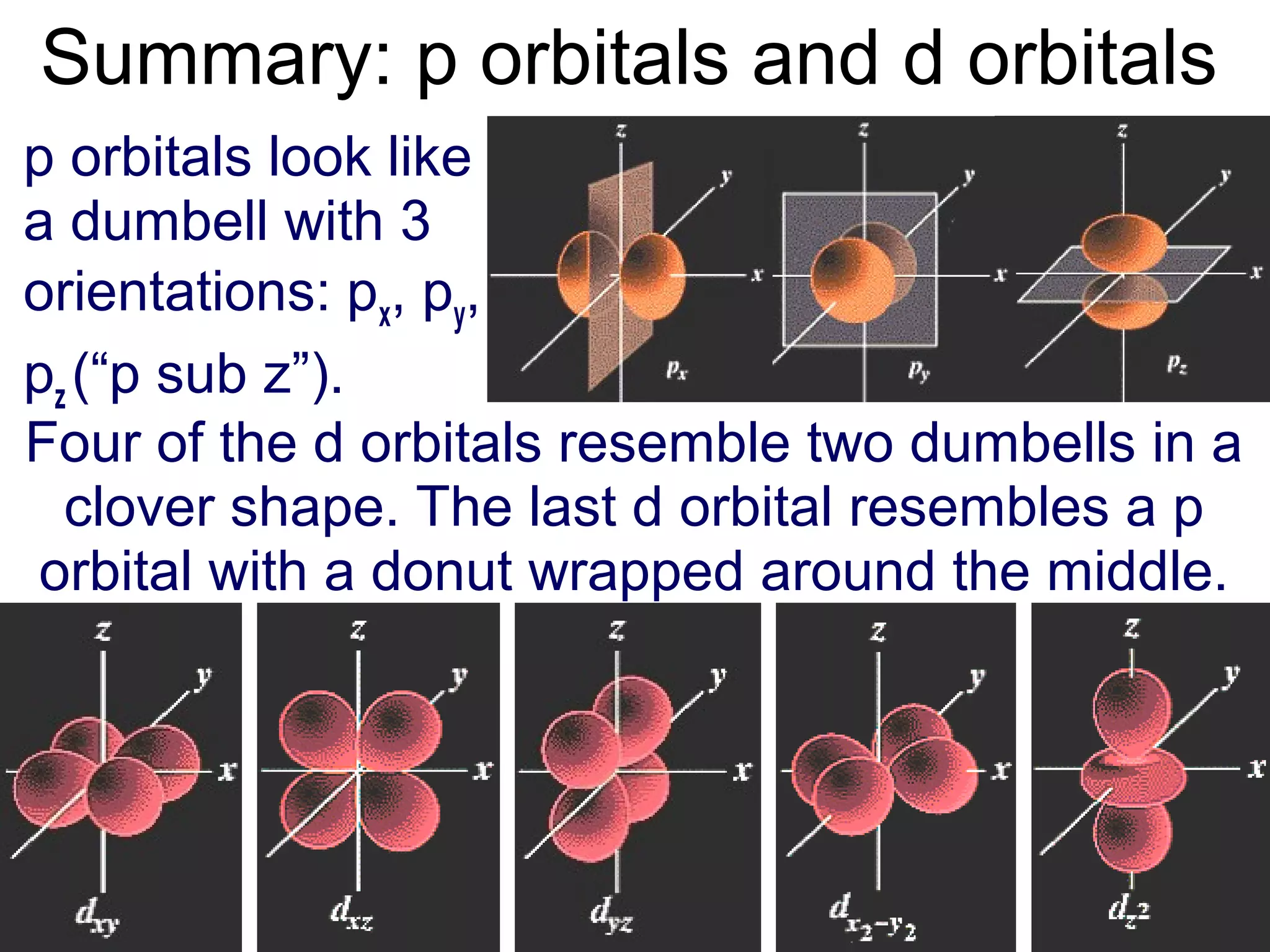
Summary: p orbitalsand d orbitals
p orbitals look like
a dumbell with 3
orientations: px, py,
pz (“p sub z”).
Four of the d orbitals resemble two dumbells in a
clover shape. The last d orbital resembles a p
orbital with a donut wrapped around the middle.