Molecular orbital theory (MOT)
Assumption
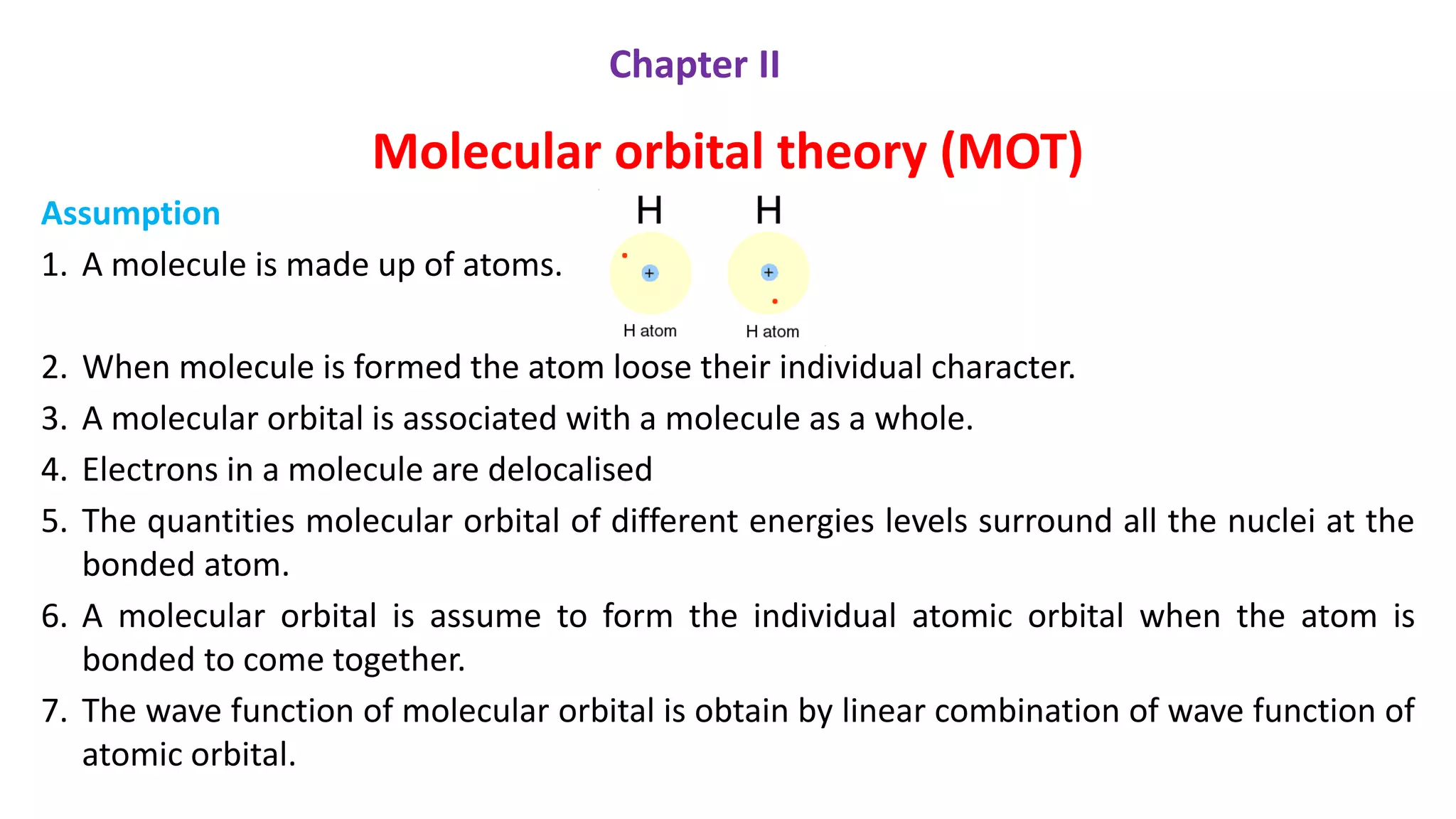
1. A molecule is made up of atoms.
2. When molecule is formed the atom loose their individual character.
3. A molecular orbital is associated with a molecule as a whole.
4. Electrons in a molecule are delocalised
5. The quantities molecular orbital of different energies levels surround all the nuclei at the
bonded atom.
6. A molecular orbital is assume to form the individual atomic orbital when the atom is
bonded to come together.
7. The wave function of molecular orbital is obtain by linear combination of wave function of
atomic orbital.
Chapter II
Electron density: Bonding and anti-bonding molecular orbitals show different patterns
of electron distribution. In general, it may be stated that
(a) Bonding orbitals are responsible for an increase in electron density between the
nuclei.
(b) Anti-bonding orbitals reduce electron density between the nuclei and have nodes.
(c) The inner shells are so highly attracted by the nucleus that they suffer contraction
and become almost spherical in shape instead of oval. Their overlap is very insignificant
and they are, therefore, ignored in drawing up the electron configuration of the
molecules.
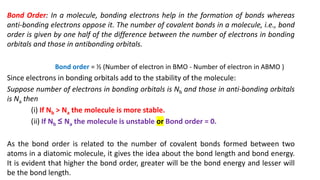
Bond Order: In a molecule, bonding electrons help in the formation of bonds whereas
anti-bonding electrons oppose it. The number of covalent bonds in a molecule, i.e., bond
order is given by one half of the difference between the number of electrons in bonding
orbitals and those in antibonding orbitals.
Bond order = ½ (Number of electron in BMO - Number of electron in ABMO )
Since electrons in bonding orbitals add to the stability of the molecule:
Suppose number of electrons in bonding orbitals is Nb and those in anti-bonding orbitals
is Na then
(i) If Nb > Na the molecule is more stable.
(ii) If Nb ≤ Na the molecule is unstable or Bond order = 0.
As the bond order is related to the number of covalent bonds formed between two
atoms in a diatomic molecule, it gives the idea about the bond length and bond energy.
It is evident that higher the bond order, greater will be the bond energy and lesser will
be the bond length.
For a molecule, there are two possibilities:
Diamagnetic: All electrons are paired.
Paramagnetic: Unpaired electrons are present.
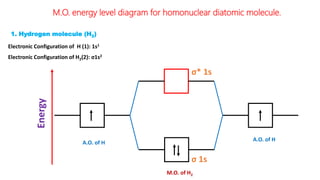
M.O. energy level diagram for homonuclear diatomic molecule.
1. Hydrogen molecule (H2)
Electronic Configuration of H (1): 1s1
Electronic Configuration of H2(2): σ1s2
Energy
A.O. of H
A.O. of H
M.O. of H2
σ* 1s
σ 1s
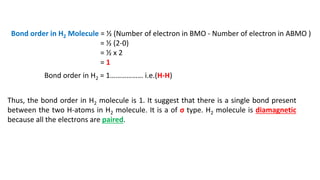
Bond order in H2 Molecule = ½ (Number of electron in BMO - Number of electron in ABMO )
= ½ (2-0)
= ½ x 2
= 1
Bond order in H2 = 1……………… i.e.(H-H)
Thus, the bond order in H2 molecule is 1. It suggest that there is a single bond present
between the two H-atoms in H2 molecule. It is a of σ type. H2 molecule is diamagnetic
because all the electrons are paired.
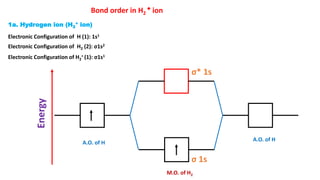
1a. Hydrogen ion (H2
+ ion)
Electronic Configuration of H2 (2): σ1s2
Electronic Configuration of H2
+ (1): σ1s1
Energy
A.O. of H
A.O. of H
M.O. of H2
σ* 1s
σ 1s
Electronic Configuration of H (1): 1s1
Bond order in H2
+ ion
Bond order in H2
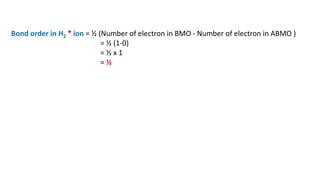
+ ion = ½ (Number of electron in BMO - Number of electron in ABMO )
= ½ (1-0)
= ½ x 1
= ½
M.O. energy level diagram for homonuclear diatomic molecule.
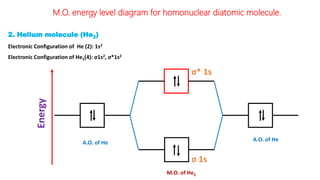
2. Helium molecule (He2)
Electronic Configuration of He (2): 1s2
Electronic Configuration of He2(4): σ1s2, σ*1s2
Energy
A.O. of He
A.O. of He
M.O. of He2
σ* 1s
σ 1s
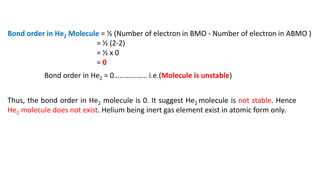
Bond order in He2 Molecule = ½ (Number of electron in BMO - Number of electron in ABMO )
= ½ (2-2)
= ½ x 0
= 0
Bond order in He2 = 0……………… i.e.(Molecule is unstable)
Thus, the bond order in He2 molecule is 0. It suggest He2 molecule is not stable. Hence
He2 molecule does not exist. Helium being inert gas element exist in atomic form only.
M.O. energy level diagram for homonuclear diatomic molecule.
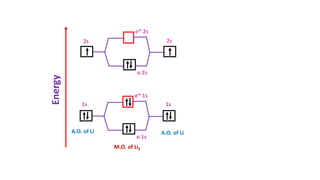
3. Lithium molecule (Li2)
Electronic Configuration of Li (3): 1s2, 2s1
Electronic Configuration of Li2(6): σ1s2, σ*1s2, σ2s2
Energy
A.O. of Li A.O. of Li
M.O. of Li2
σ 1s
σ* 1s
σ 2s
σ* 2s
1s 1s
2s 2s
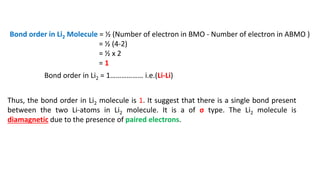
Bond order in Li2 Molecule = ½ (Number of electron in BMO - Number of electron in ABMO )
= ½ (4-2)
= ½ x 2
= 1
Bond order in Li2 = 1……………… i.e.(Li-Li)
Thus, the bond order in Li2 molecule is 1. It suggest that there is a single bond present
between the two Li-atoms in Li2 molecule. It is a of σ type. The Li2 molecule is
diamagnetic due to the presence of paired electrons.
M.O. energy level diagram for homonuclear diatomic molecule.
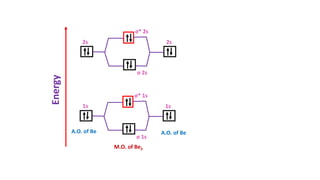
4. Beryllium molecule (Be2)
Electronic Configuration of Be (4): 1s2, 2s2
Electronic Configuration of Be2(8): σ1s2, σ*1s2, σ2s2, σ*2s2
Energy
A.O. of Be A.O. of Be
M.O. of Be2
σ 1s
σ* 1s
σ 2s
σ* 2s
1s 1s
2s
2s
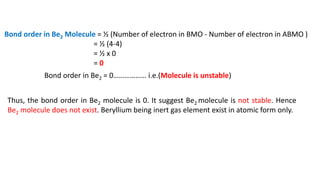
Bond order in Be2 Molecule = ½ (Number of electron in BMO - Number of electron in ABMO )
= ½ (4-4)
= ½ x 0
= 0
Bond order in Be2 = 0……………… i.e.(Molecule is unstable)
Thus, the bond order in Be2 molecule is 0. It suggest Be2 molecule is not stable. Hence
Be2 molecule does not exist. Beryllium being inert gas element exist in atomic form only.
M.O. energy level diagram for homonuclear diatomic molecule.
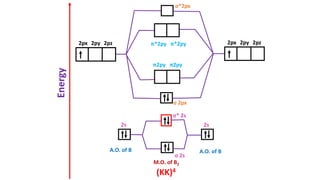
5. Boron molecule (B2)
Electronic Configuration of B (5): 1s2,2s2,2px1
Electronic Configuration of B2(10): σ1s2, σ*1s2, σ2s2, σ*2s2, σ2px2
Or
KK4, σ2s2, σ*2s2, σ2px2
Energy
A.O. of B A.O. of B
M.O. of B2
σ 2s
σ* 2s
2s 2s
2px 2py 2pz 2px 2py 2pz
σ*2px
π*2py π*2py
σ 2px
π2py π2py
(KK)4
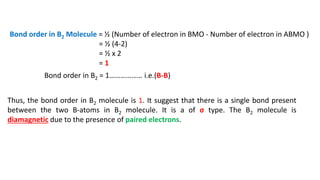
Bond order in B2 Molecule = ½ (Number of electron in BMO - Number of electron in ABMO )
= ½ (4-2)
= ½ x 2
= 1
Bond order in B2 = 1……………… i.e.(B-B)
Thus, the bond order in B2 molecule is 1. It suggest that there is a single bond present
between the two B-atoms in B2 molecule. It is a of σ type. The B2 molecule is
diamagnetic due to the presence of paired electrons.
M.O. energy level diagram for homonuclear diatomic molecule.
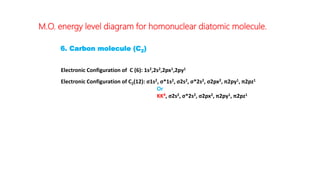
6. Carbon molecule (C2)
Electronic Configuration of C (6): 1s2,2s2,2px1,2py1
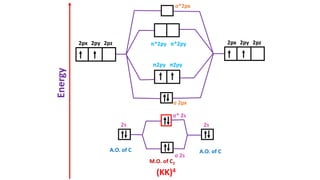
Electronic Configuration of C2(12): σ1s2, σ*1s2, σ2s2, σ*2s2, σ2px2, π2py1, π2pz1
Or
KK4, σ2s2, σ*2s2, σ2px2, π2py1, π2pz1
Energy
A.O. of C A.O. of C
M.O. of C2
σ 2s
σ* 2s
2s 2s
2px 2py 2pz 2px 2py 2pz
σ*2px
π*2py π*2py
σ 2px
π2py π2py
(KK)4
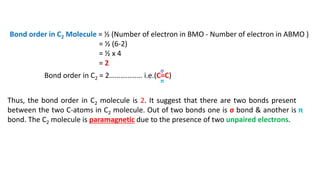
Bond order in C2 Molecule = ½ (Number of electron in BMO - Number of electron in ABMO )
= ½ (6-2)
= ½ x 4
= 2
Bond order in C2 = 2……………… i.e.(C=C)
Thus, the bond order in C2 molecule is 2. It suggest that there are two bonds present
between the two C-atoms in C2 molecule. Out of two bonds one is σ bond & another is
bond. The C2 molecule is paramagnetic due to the presence of two unpaired electrons.
σ
π
π
M.O. energy level diagram for homonuclear diatomic molecule.
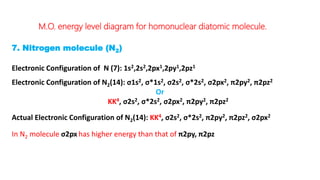
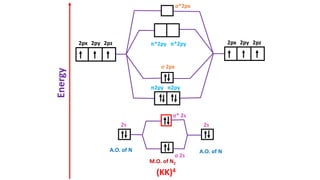
7. Nitrogen molecule (N2)
Electronic Configuration of N (7): 1s2,2s2,2px1,2py1,2pz1
Electronic Configuration of N2(14): σ1s2, σ*1s2, σ2s2, σ*2s2, σ2px2, π2py2, π2pz2
Or
KK4, σ2s2, σ*2s2, σ2px2, π2py2, π2pz2
Actual Electronic Configuration of N2(14): KK4, σ2s2, σ*2s2, π2py2, π2pz2, σ2px2
In N2 molecule σ2px has higher energy than that of π2py, π2pz
Energy
A.O. of N A.O. of N
M.O. of N2
σ 2s
σ* 2s
2s 2s
2px 2py 2pz 2px 2py 2pz
σ*2px
π*2py π*2py
σ 2px
π2py π2py
(KK)4
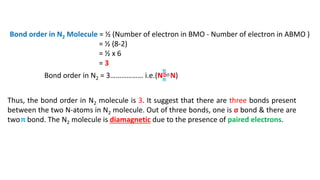
Bond order in N2 Molecule = ½ (Number of electron in BMO - Number of electron in ABMO )
= ½ (8-2)
= ½ x 6
= 3
Thus, the bond order in N2 molecule is 3. It suggest that there are three bonds present
between the two N-atoms in N2 molecule. Out of three bonds, one is σ bond & there are
two bond. The N2 molecule is diamagnetic due to the presence of paired electrons.
Bond order in N2 = 3……………… i.e.(N= N)
σ
π
π
π
M.O. energy level diagram for homonuclear diatomic molecule.
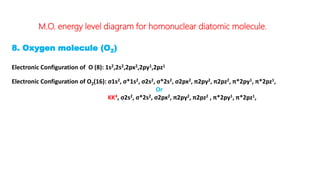
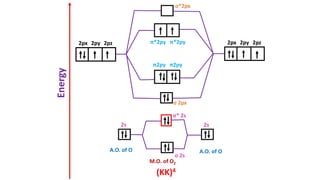
8. Oxygen molecule (O2)
Electronic Configuration of O (8): 1s2,2s2,2px2,2py1,2pz1
Electronic Configuration of O2(16): σ1s2, σ*1s2, σ2s2, σ*2s2, σ2px2, π2py2, π2pz2, π*2py1, π*2pz1,
Or
KK4, σ2s2, σ*2s2, σ2px2, π2py2, π2pz2 , π*2py1, π*2pz1,
Energy
A.O. of O A.O. of O
M.O. of O2
σ 2s
σ* 2s
2s 2s
2px 2py 2pz 2px 2py 2pz
σ*2px
π*2py π*2py
σ 2px
π2py π2py
(KK)4
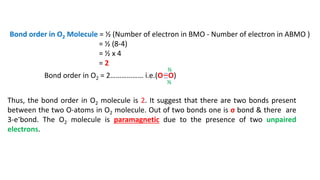
Bond order in O2 Molecule = ½ (Number of electron in BMO - Number of electron in ABMO )
= ½ (8-4)
= ½ x 4
= 2
Bond order in O2 = 2……………… i.e.(O O)
Thus, the bond order in O2 molecule is 2. It suggest that there are two bonds present
between the two O-atoms in O2 molecule. Out of two bonds one is σ bond & there are
3-e-bond. The O2 molecule is paramagnetic due to the presence of two unpaired
electrons.
…
…
½
½
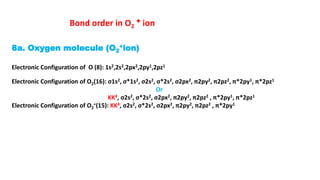
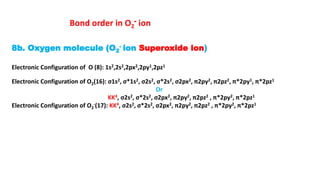
8a. Oxygen molecule (O2
+ion)
Electronic Configuration of O (8): 1s2,2s2,2px2,2py1,2pz1
Electronic Configuration of O2(16): σ1s2, σ*1s2, σ2s2, σ*2s2, σ2px2, π2py2, π2pz2, π*2py1, π*2pz1
Or
KK4, σ2s2, σ*2s2, σ2px2, π2py2, π2pz2 , π*2py1, π*2pz1
Electronic Configuration of O2
+(15): KK4, σ2s2, σ*2s2, σ2px2, π2py2, π2pz2 , π*2py1
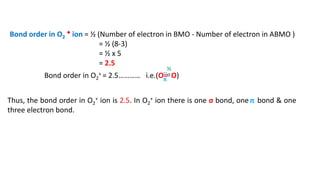
Bond order in O2
+ ion
Bond order in O2
+ ion = ½ (Number of electron in BMO - Number of electron in ABMO )
= ½ (8-3)
= ½ x 5
= 2.5
Bond order in O2
+ = 2.5………… i.e.(O= O)
Thus, the bond order in O2
+ ion is 2.5. In O2
+ ion there is one σ bond, one bond & one
three electron bond.
…
π
½
σ
π
8b. Oxygen molecule (O2
- ion Superoxide ion)
Electronic Configuration of O (8): 1s2,2s2,2px2,2py1,2pz1
Electronic Configuration of O2(16): σ1s2, σ*1s2, σ2s2, σ*2s2, σ2px2, π2py2, π2pz2, π*2py1, π*2pz1
Or
KK4, σ2s2, σ*2s2, σ2px2, π2py2, π2pz2 , π*2py2, π*2pz1
Electronic Configuration of O2
-(17): KK4, σ2s2, σ*2s2, σ2px2, π2py2, π2pz2 , π*2py2, π*2pz1
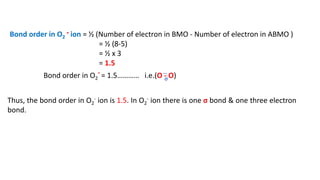
Bond order in O2
- ion
Bond order in O2
- ion = ½ (Number of electron in BMO - Number of electron in ABMO )
= ½ (8-5)
= ½ x 3
= 1.5
Bond order in O2
- = 1.5………… i.e.(O - O)
Thus, the bond order in O2
- ion is 1.5. In O2
- ion there is one σ bond & one three electron
bond.
…
σ
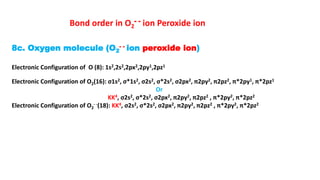
8c. Oxygen molecule (O2
- - ion peroxide ion)
Electronic Configuration of O (8): 1s2,2s2,2px2,2py1,2pz1
Electronic Configuration of O2(16): σ1s2, σ*1s2, σ2s2, σ*2s2, σ2px2, π2py2, π2pz2, π*2py1, π*2pz1
Or
KK4, σ2s2, σ*2s2, σ2px2, π2py2, π2pz2 , π*2py2, π*2pz2
Electronic Configuration of O2
- -(18): KK4, σ2s2, σ*2s2, σ2px2, π2py2, π2pz2 , π*2py2, π*2pz2
Bond order in O2
- - ion Peroxide ion
Bond order in O2
- ion = ½ (Number of electron in BMO - Number of electron in ABMO )
= ½ (8-6)
= ½ x 2
= 1
Bond order in O2
- - = 1………… i.e.(O - O)
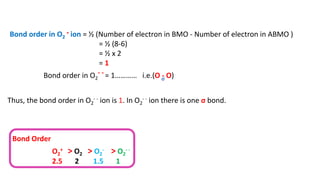
Thus, the bond order in O2
- - ion is 1. In O2
- - ion there is one σ bond.
σ
Bond Order
O2
+ > O2 > O2
- > O2
- -
2.5 2 1.5 1
M.O. energy level diagram for homonuclear diatomic molecule.
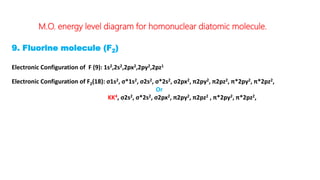
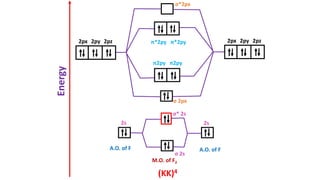
9. Fluorine molecule (F2)
Electronic Configuration of F (9): 1s2,2s2,2px2,2py2,2pz1
Electronic Configuration of F2(18): σ1s2, σ*1s2, σ2s2, σ*2s2, σ2px2, π2py2, π2pz2, π*2py2, π*2pz2,
Or
KK4, σ2s2, σ*2s2, σ2px2, π2py2, π2pz2 , π*2py2, π*2pz2,
Energy
A.O. of F A.O. of F
M.O. of F2
σ 2s
σ* 2s
2s 2s
2px 2py 2pz 2px 2py 2pz
σ*2px
π*2py π*2py
σ 2px
π2py π2py
(KK)4
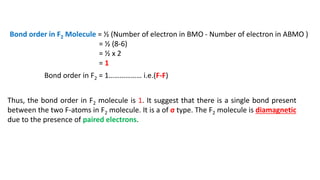
Bond order in F2 Molecule = ½ (Number of electron in BMO - Number of electron in ABMO )
= ½ (8-6)
= ½ x 2
= 1
Bond order in F2 = 1……………… i.e.(F-F)
Thus, the bond order in F2 molecule is 1. It suggest that there is a single bond present
between the two F-atoms in F2 molecule. It is a of σ type. The F2 molecule is diamagnetic
due to the presence of paired electrons.
M.O. energy level diagram for homonuclear diatomic molecule.
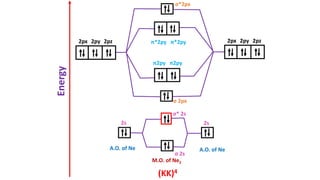
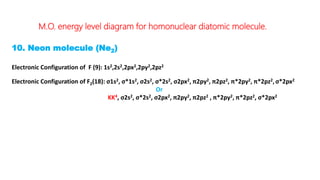
10. Neon molecule (Ne2)
Electronic Configuration of F (9): 1s2,2s2,2px2,2py2,2pz2
Electronic Configuration of F2(18): σ1s2, σ*1s2, σ2s2, σ*2s2, σ2px2, π2py2, π2pz2, π*2py2, π*2pz2,σ*2px2
Or
KK4, σ2s2, σ*2s2, σ2px2, π2py2, π2pz2 , π*2py2, π*2pz2, σ*2px2
Energy
A.O. of Ne A.O. of Ne
M.O. of Ne2
σ 2s
σ* 2s
2s 2s
2px 2py 2pz 2px 2py 2pz
σ*2px
π*2py π*2py
σ 2px
π2py π2py
(KK)4
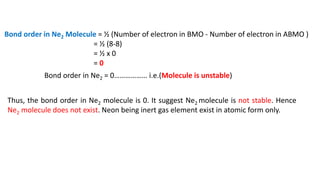
Bond order in Ne2 Molecule = ½ (Number of electron in BMO - Number of electron in ABMO )
= ½ (8-8)
= ½ x 0
= 0
Bond order in Ne2 = 0……………… i.e.(Molecule is unstable)
Thus, the bond order in Ne2 molecule is 0. It suggest Ne2 molecule is not stable. Hence
Ne2 molecule does not exist. Neon being inert gas element exist in atomic form only.

Molecular Orbital Theory

  • 1.
    Molecular orbital theory(MOT) Assumption 1. A molecule is made up of atoms. 2. When molecule is formed the atom loose their individual character. 3. A molecular orbital is associated with a molecule as a whole. 4. Electrons in a molecule are delocalised 5. The quantities molecular orbital of different energies levels surround all the nuclei at the bonded atom. 6. A molecular orbital is assume to form the individual atomic orbital when the atom is bonded to come together. 7. The wave function of molecular orbital is obtain by linear combination of wave function of atomic orbital. Chapter II
  • 2.
    Electron density: Bondingand anti-bonding molecular orbitals show different patterns of electron distribution. In general, it may be stated that (a) Bonding orbitals are responsible for an increase in electron density between the nuclei. (b) Anti-bonding orbitals reduce electron density between the nuclei and have nodes. (c) The inner shells are so highly attracted by the nucleus that they suffer contraction and become almost spherical in shape instead of oval. Their overlap is very insignificant and they are, therefore, ignored in drawing up the electron configuration of the molecules.
  • 3.
    Bond Order: Ina molecule, bonding electrons help in the formation of bonds whereas anti-bonding electrons oppose it. The number of covalent bonds in a molecule, i.e., bond order is given by one half of the difference between the number of electrons in bonding orbitals and those in antibonding orbitals. Bond order = ½ (Number of electron in BMO - Number of electron in ABMO ) Since electrons in bonding orbitals add to the stability of the molecule: Suppose number of electrons in bonding orbitals is Nb and those in anti-bonding orbitals is Na then (i) If Nb > Na the molecule is more stable. (ii) If Nb ≤ Na the molecule is unstable or Bond order = 0. As the bond order is related to the number of covalent bonds formed between two atoms in a diatomic molecule, it gives the idea about the bond length and bond energy. It is evident that higher the bond order, greater will be the bond energy and lesser will be the bond length.
  • 4.
    For a molecule,there are two possibilities: Diamagnetic: All electrons are paired. Paramagnetic: Unpaired electrons are present.
  • 5.
    M.O. energy leveldiagram for homonuclear diatomic molecule. 1. Hydrogen molecule (H2) Electronic Configuration of H (1): 1s1 Electronic Configuration of H2(2): σ1s2 Energy A.O. of H A.O. of H M.O. of H2 σ* 1s σ 1s
  • 6.
    Bond order inH2 Molecule = ½ (Number of electron in BMO - Number of electron in ABMO ) = ½ (2-0) = ½ x 2 = 1 Bond order in H2 = 1……………… i.e.(H-H) Thus, the bond order in H2 molecule is 1. It suggest that there is a single bond present between the two H-atoms in H2 molecule. It is a of σ type. H2 molecule is diamagnetic because all the electrons are paired.
  • 7.
    1a. Hydrogen ion(H2 + ion) Electronic Configuration of H2 (2): σ1s2 Electronic Configuration of H2 + (1): σ1s1 Energy A.O. of H A.O. of H M.O. of H2 σ* 1s σ 1s Electronic Configuration of H (1): 1s1 Bond order in H2 + ion
  • 8.
    Bond order inH2 + ion = ½ (Number of electron in BMO - Number of electron in ABMO ) = ½ (1-0) = ½ x 1 = ½
  • 9.
    M.O. energy leveldiagram for homonuclear diatomic molecule. 2. Helium molecule (He2) Electronic Configuration of He (2): 1s2 Electronic Configuration of He2(4): σ1s2, σ*1s2 Energy A.O. of He A.O. of He M.O. of He2 σ* 1s σ 1s
  • 10.
    Bond order inHe2 Molecule = ½ (Number of electron in BMO - Number of electron in ABMO ) = ½ (2-2) = ½ x 0 = 0 Bond order in He2 = 0……………… i.e.(Molecule is unstable) Thus, the bond order in He2 molecule is 0. It suggest He2 molecule is not stable. Hence He2 molecule does not exist. Helium being inert gas element exist in atomic form only.
  • 11.
    M.O. energy leveldiagram for homonuclear diatomic molecule. 3. Lithium molecule (Li2) Electronic Configuration of Li (3): 1s2, 2s1 Electronic Configuration of Li2(6): σ1s2, σ*1s2, σ2s2
  • 12.
    Energy A.O. of LiA.O. of Li M.O. of Li2 σ 1s σ* 1s σ 2s σ* 2s 1s 1s 2s 2s
  • 13.
    Bond order inLi2 Molecule = ½ (Number of electron in BMO - Number of electron in ABMO ) = ½ (4-2) = ½ x 2 = 1 Bond order in Li2 = 1……………… i.e.(Li-Li) Thus, the bond order in Li2 molecule is 1. It suggest that there is a single bond present between the two Li-atoms in Li2 molecule. It is a of σ type. The Li2 molecule is diamagnetic due to the presence of paired electrons.
  • 14.
    M.O. energy leveldiagram for homonuclear diatomic molecule. 4. Beryllium molecule (Be2) Electronic Configuration of Be (4): 1s2, 2s2 Electronic Configuration of Be2(8): σ1s2, σ*1s2, σ2s2, σ*2s2
  • 15.
    Energy A.O. of BeA.O. of Be M.O. of Be2 σ 1s σ* 1s σ 2s σ* 2s 1s 1s 2s 2s
  • 16.
    Bond order inBe2 Molecule = ½ (Number of electron in BMO - Number of electron in ABMO ) = ½ (4-4) = ½ x 0 = 0 Bond order in Be2 = 0……………… i.e.(Molecule is unstable) Thus, the bond order in Be2 molecule is 0. It suggest Be2 molecule is not stable. Hence Be2 molecule does not exist. Beryllium being inert gas element exist in atomic form only.
  • 17.
    M.O. energy leveldiagram for homonuclear diatomic molecule. 5. Boron molecule (B2) Electronic Configuration of B (5): 1s2,2s2,2px1 Electronic Configuration of B2(10): σ1s2, σ*1s2, σ2s2, σ*2s2, σ2px2 Or KK4, σ2s2, σ*2s2, σ2px2
  • 18.
    Energy A.O. of BA.O. of B M.O. of B2 σ 2s σ* 2s 2s 2s 2px 2py 2pz 2px 2py 2pz σ*2px π*2py π*2py σ 2px π2py π2py (KK)4
  • 19.
    Bond order inB2 Molecule = ½ (Number of electron in BMO - Number of electron in ABMO ) = ½ (4-2) = ½ x 2 = 1 Bond order in B2 = 1……………… i.e.(B-B) Thus, the bond order in B2 molecule is 1. It suggest that there is a single bond present between the two B-atoms in B2 molecule. It is a of σ type. The B2 molecule is diamagnetic due to the presence of paired electrons.
  • 20.
    M.O. energy leveldiagram for homonuclear diatomic molecule. 6. Carbon molecule (C2) Electronic Configuration of C (6): 1s2,2s2,2px1,2py1 Electronic Configuration of C2(12): σ1s2, σ*1s2, σ2s2, σ*2s2, σ2px2, π2py1, π2pz1 Or KK4, σ2s2, σ*2s2, σ2px2, π2py1, π2pz1
  • 21.
    Energy A.O. of CA.O. of C M.O. of C2 σ 2s σ* 2s 2s 2s 2px 2py 2pz 2px 2py 2pz σ*2px π*2py π*2py σ 2px π2py π2py (KK)4
  • 22.
    Bond order inC2 Molecule = ½ (Number of electron in BMO - Number of electron in ABMO ) = ½ (6-2) = ½ x 4 = 2 Bond order in C2 = 2……………… i.e.(C=C) Thus, the bond order in C2 molecule is 2. It suggest that there are two bonds present between the two C-atoms in C2 molecule. Out of two bonds one is σ bond & another is bond. The C2 molecule is paramagnetic due to the presence of two unpaired electrons. σ π π
  • 23.
    M.O. energy leveldiagram for homonuclear diatomic molecule. 7. Nitrogen molecule (N2) Electronic Configuration of N (7): 1s2,2s2,2px1,2py1,2pz1 Electronic Configuration of N2(14): σ1s2, σ*1s2, σ2s2, σ*2s2, σ2px2, π2py2, π2pz2 Or KK4, σ2s2, σ*2s2, σ2px2, π2py2, π2pz2 Actual Electronic Configuration of N2(14): KK4, σ2s2, σ*2s2, π2py2, π2pz2, σ2px2 In N2 molecule σ2px has higher energy than that of π2py, π2pz
  • 24.
    Energy A.O. of NA.O. of N M.O. of N2 σ 2s σ* 2s 2s 2s 2px 2py 2pz 2px 2py 2pz σ*2px π*2py π*2py σ 2px π2py π2py (KK)4
  • 25.
    Bond order inN2 Molecule = ½ (Number of electron in BMO - Number of electron in ABMO ) = ½ (8-2) = ½ x 6 = 3 Thus, the bond order in N2 molecule is 3. It suggest that there are three bonds present between the two N-atoms in N2 molecule. Out of three bonds, one is σ bond & there are two bond. The N2 molecule is diamagnetic due to the presence of paired electrons. Bond order in N2 = 3……………… i.e.(N= N) σ π π π
  • 26.
    M.O. energy leveldiagram for homonuclear diatomic molecule. 8. Oxygen molecule (O2) Electronic Configuration of O (8): 1s2,2s2,2px2,2py1,2pz1 Electronic Configuration of O2(16): σ1s2, σ*1s2, σ2s2, σ*2s2, σ2px2, π2py2, π2pz2, π*2py1, π*2pz1, Or KK4, σ2s2, σ*2s2, σ2px2, π2py2, π2pz2 , π*2py1, π*2pz1,
  • 27.
    Energy A.O. of OA.O. of O M.O. of O2 σ 2s σ* 2s 2s 2s 2px 2py 2pz 2px 2py 2pz σ*2px π*2py π*2py σ 2px π2py π2py (KK)4
  • 28.
    Bond order inO2 Molecule = ½ (Number of electron in BMO - Number of electron in ABMO ) = ½ (8-4) = ½ x 4 = 2 Bond order in O2 = 2……………… i.e.(O O) Thus, the bond order in O2 molecule is 2. It suggest that there are two bonds present between the two O-atoms in O2 molecule. Out of two bonds one is σ bond & there are 3-e-bond. The O2 molecule is paramagnetic due to the presence of two unpaired electrons. … … ½ ½
  • 29.
    8a. Oxygen molecule(O2 +ion) Electronic Configuration of O (8): 1s2,2s2,2px2,2py1,2pz1 Electronic Configuration of O2(16): σ1s2, σ*1s2, σ2s2, σ*2s2, σ2px2, π2py2, π2pz2, π*2py1, π*2pz1 Or KK4, σ2s2, σ*2s2, σ2px2, π2py2, π2pz2 , π*2py1, π*2pz1 Electronic Configuration of O2 +(15): KK4, σ2s2, σ*2s2, σ2px2, π2py2, π2pz2 , π*2py1 Bond order in O2 + ion
  • 30.
    Bond order inO2 + ion = ½ (Number of electron in BMO - Number of electron in ABMO ) = ½ (8-3) = ½ x 5 = 2.5 Bond order in O2 + = 2.5………… i.e.(O= O) Thus, the bond order in O2 + ion is 2.5. In O2 + ion there is one σ bond, one bond & one three electron bond. … π ½ σ π
  • 31.
    8b. Oxygen molecule(O2 - ion Superoxide ion) Electronic Configuration of O (8): 1s2,2s2,2px2,2py1,2pz1 Electronic Configuration of O2(16): σ1s2, σ*1s2, σ2s2, σ*2s2, σ2px2, π2py2, π2pz2, π*2py1, π*2pz1 Or KK4, σ2s2, σ*2s2, σ2px2, π2py2, π2pz2 , π*2py2, π*2pz1 Electronic Configuration of O2 -(17): KK4, σ2s2, σ*2s2, σ2px2, π2py2, π2pz2 , π*2py2, π*2pz1 Bond order in O2 - ion
  • 32.
    Bond order inO2 - ion = ½ (Number of electron in BMO - Number of electron in ABMO ) = ½ (8-5) = ½ x 3 = 1.5 Bond order in O2 - = 1.5………… i.e.(O - O) Thus, the bond order in O2 - ion is 1.5. In O2 - ion there is one σ bond & one three electron bond. … σ
  • 33.
    8c. Oxygen molecule(O2 - - ion peroxide ion) Electronic Configuration of O (8): 1s2,2s2,2px2,2py1,2pz1 Electronic Configuration of O2(16): σ1s2, σ*1s2, σ2s2, σ*2s2, σ2px2, π2py2, π2pz2, π*2py1, π*2pz1 Or KK4, σ2s2, σ*2s2, σ2px2, π2py2, π2pz2 , π*2py2, π*2pz2 Electronic Configuration of O2 - -(18): KK4, σ2s2, σ*2s2, σ2px2, π2py2, π2pz2 , π*2py2, π*2pz2 Bond order in O2 - - ion Peroxide ion
  • 34.
    Bond order inO2 - ion = ½ (Number of electron in BMO - Number of electron in ABMO ) = ½ (8-6) = ½ x 2 = 1 Bond order in O2 - - = 1………… i.e.(O - O) Thus, the bond order in O2 - - ion is 1. In O2 - - ion there is one σ bond. σ Bond Order O2 + > O2 > O2 - > O2 - - 2.5 2 1.5 1
  • 35.
    M.O. energy leveldiagram for homonuclear diatomic molecule. 9. Fluorine molecule (F2) Electronic Configuration of F (9): 1s2,2s2,2px2,2py2,2pz1 Electronic Configuration of F2(18): σ1s2, σ*1s2, σ2s2, σ*2s2, σ2px2, π2py2, π2pz2, π*2py2, π*2pz2, Or KK4, σ2s2, σ*2s2, σ2px2, π2py2, π2pz2 , π*2py2, π*2pz2,
  • 36.
    Energy A.O. of FA.O. of F M.O. of F2 σ 2s σ* 2s 2s 2s 2px 2py 2pz 2px 2py 2pz σ*2px π*2py π*2py σ 2px π2py π2py (KK)4
  • 37.
    Bond order inF2 Molecule = ½ (Number of electron in BMO - Number of electron in ABMO ) = ½ (8-6) = ½ x 2 = 1 Bond order in F2 = 1……………… i.e.(F-F) Thus, the bond order in F2 molecule is 1. It suggest that there is a single bond present between the two F-atoms in F2 molecule. It is a of σ type. The F2 molecule is diamagnetic due to the presence of paired electrons.
  • 38.
    M.O. energy leveldiagram for homonuclear diatomic molecule. 10. Neon molecule (Ne2) Electronic Configuration of F (9): 1s2,2s2,2px2,2py2,2pz2 Electronic Configuration of F2(18): σ1s2, σ*1s2, σ2s2, σ*2s2, σ2px2, π2py2, π2pz2, π*2py2, π*2pz2,σ*2px2 Or KK4, σ2s2, σ*2s2, σ2px2, π2py2, π2pz2 , π*2py2, π*2pz2, σ*2px2
  • 39.
    Energy A.O. of NeA.O. of Ne M.O. of Ne2 σ 2s σ* 2s 2s 2s 2px 2py 2pz 2px 2py 2pz σ*2px π*2py π*2py σ 2px π2py π2py (KK)4
  • 40.
    Bond order inNe2 Molecule = ½ (Number of electron in BMO - Number of electron in ABMO ) = ½ (8-8) = ½ x 0 = 0 Bond order in Ne2 = 0……………… i.e.(Molecule is unstable) Thus, the bond order in Ne2 molecule is 0. It suggest Ne2 molecule is not stable. Hence Ne2 molecule does not exist. Neon being inert gas element exist in atomic form only.