The Periodic Table
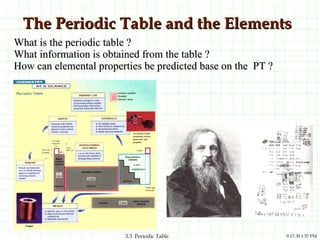
The Periodic Table and the Elements What is the periodic table ? What information is obtained from the table ? How can elemental properties be predicted base on the  PT ?
Dmitri Mendeleev  (1869) In 1869 Mendeleev and Lothar Meyer (Germany) published nearly identical classification  schemes for elements known to date.  The periodic table is base on the similarity of properties and reactivities exhibited by certain elements.  Later, Henri Moseley ( England,1887-1915) established that each elements has a unique atomic number, which is how the current periodic table is organized. http://www.chem.msu.su/eng/misc/mendeleev/welcome.html
Reading the Periodic Table:  Classification Nonmetals, Metals, Metalloids, Noble gases
Families of the Periodic Table Notable families of the Periodic Table and some important members: Alkali Alkaline (earth) Transition Metals Noble Gas Halogen Chalcogens
Periodic Table   e -  configuration from the periodic periodic table B 2p 1 H 1s 1 Li 2s 1 Na 3s 1 K 4s 1 Rb 5s 1 Cs 6s 1 Fr 7s 1 Be 2s 2 Mg 3s 2 Ca 4s 2 Sr 5s 2 Ba 6s 2 Ra 7s 2 Sc 3d 1 Ti 3d 2 V 3d 3 Cr 4s 1 3d 5 Mn 3d 5 Fe 3d 6 Co 3d 7 Ni 3d 8 Zn 3d 10 Cu 4s 1 3d 10 B 2p 1 C 2p 2 N 2p 3 O 2p 4 F 2p 5 Ne 2p 6 He 1s 2 Al 3p 1 Ga 4p 1 In 5p 1 Tl 6p 1 Si 3p 2 Ge 4p 2 Sn 5p 2 Pb 6p 2 P 3p 3 As 4p 3 Sb 5p 3 Bi 6p 3 S 3p 4 Se 4p 4 Te 5p 4 Po 6p 4 Cl 3p 5 Be 4p 5 I 5p 5 At 6p 5 Ar 3p 6 Kr 4p 6 Xe 5p 6 Rn 6p 6 Y 4d 1 La 5d 1 Ac 6d 1 Cd 4d 10 Hg 5d 10 Ag 5s 1 4d 10 Au 6s 1 5d 10 Zr 4d 2 Hf 5d 2 Rf 6d 2 Nb 4d 3 Ta 5d 3 Db 6d 3 Mo 5s 1 4d 5 W 6s 1 5d 5 Sg 7s 1 6d 5 Tc 4d 5 Re 5d 5 Bh 6d 5 Ru 4d 6 Os 5d 6 Hs 6d 6 Rh 4d 7 Ir 5d 7 Mt 6d 7 Ni 4d 8 Ni 5d 8
Periodic Table: electron behavior The periodic table can be classified :
THE PERIODIC TABLE
2. Trend in  Atomic Radius Atomic Radius:  The atomic radius of an  element  is a measure of the size of its atoms, usually the distance from the  nucleus  to the boundary of the surrounding cloud of  electrons
3. Trend in  Ionization Energy Ionization energy:  The energy required to remove the valence electron from an atomic specie.
4. Trend in  Electron Affinity Electron affinity is a measure of the energy that is released when an atom acquires an electron. We say that the more energy is released, the more readily the atom becomes an anion.
ELECTRONEGATIVITY
Summary of Trend

Ppt periodic trends

  • 1.
  • 2.
    The Periodic Tableand the Elements What is the periodic table ? What information is obtained from the table ? How can elemental properties be predicted base on the PT ?
  • 3.
    Dmitri Mendeleev (1869) In 1869 Mendeleev and Lothar Meyer (Germany) published nearly identical classification schemes for elements known to date. The periodic table is base on the similarity of properties and reactivities exhibited by certain elements. Later, Henri Moseley ( England,1887-1915) established that each elements has a unique atomic number, which is how the current periodic table is organized. http://www.chem.msu.su/eng/misc/mendeleev/welcome.html
  • 4.
    Reading the PeriodicTable: Classification Nonmetals, Metals, Metalloids, Noble gases
  • 5.
    Families of thePeriodic Table Notable families of the Periodic Table and some important members: Alkali Alkaline (earth) Transition Metals Noble Gas Halogen Chalcogens
  • 6.
    Periodic Table e - configuration from the periodic periodic table B 2p 1 H 1s 1 Li 2s 1 Na 3s 1 K 4s 1 Rb 5s 1 Cs 6s 1 Fr 7s 1 Be 2s 2 Mg 3s 2 Ca 4s 2 Sr 5s 2 Ba 6s 2 Ra 7s 2 Sc 3d 1 Ti 3d 2 V 3d 3 Cr 4s 1 3d 5 Mn 3d 5 Fe 3d 6 Co 3d 7 Ni 3d 8 Zn 3d 10 Cu 4s 1 3d 10 B 2p 1 C 2p 2 N 2p 3 O 2p 4 F 2p 5 Ne 2p 6 He 1s 2 Al 3p 1 Ga 4p 1 In 5p 1 Tl 6p 1 Si 3p 2 Ge 4p 2 Sn 5p 2 Pb 6p 2 P 3p 3 As 4p 3 Sb 5p 3 Bi 6p 3 S 3p 4 Se 4p 4 Te 5p 4 Po 6p 4 Cl 3p 5 Be 4p 5 I 5p 5 At 6p 5 Ar 3p 6 Kr 4p 6 Xe 5p 6 Rn 6p 6 Y 4d 1 La 5d 1 Ac 6d 1 Cd 4d 10 Hg 5d 10 Ag 5s 1 4d 10 Au 6s 1 5d 10 Zr 4d 2 Hf 5d 2 Rf 6d 2 Nb 4d 3 Ta 5d 3 Db 6d 3 Mo 5s 1 4d 5 W 6s 1 5d 5 Sg 7s 1 6d 5 Tc 4d 5 Re 5d 5 Bh 6d 5 Ru 4d 6 Os 5d 6 Hs 6d 6 Rh 4d 7 Ir 5d 7 Mt 6d 7 Ni 4d 8 Ni 5d 8
  • 7.
    Periodic Table: electronbehavior The periodic table can be classified :
  • 8.
  • 9.
    2. Trend in Atomic Radius Atomic Radius: The atomic radius of an element is a measure of the size of its atoms, usually the distance from the nucleus to the boundary of the surrounding cloud of electrons
  • 10.
    3. Trend in Ionization Energy Ionization energy: The energy required to remove the valence electron from an atomic specie.
  • 11.
    4. Trend in Electron Affinity Electron affinity is a measure of the energy that is released when an atom acquires an electron. We say that the more energy is released, the more readily the atom becomes an anion.
  • 12.
  • 13.