Digestion
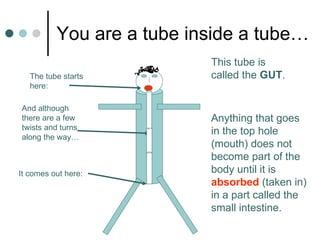
You are a tube inside a tube… And although there are a few twists and turns along the way… It comes out here: Anything that goes in the top hole (mouth) does not become part of the body until it is  absorbed  (taken in) in a part called the small intestine.  This tube is called the  GUT . The tube starts here:
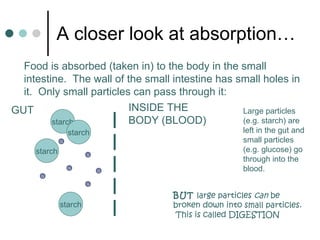
A closer look at absorption… Food is absorbed (taken in) to the body in the small intestine.  The wall of the small intestine has small holes in it.  Only small particles can pass through it: starch starch starch starch G G G GUT INSIDE THE BODY (BLOOD) Large particles (e.g. starch) are left in the gut and small particles (e.g. glucose) go through into the blood. G G G BUT  large particles  can  be broken down into small particles.  This is called DIGESTION
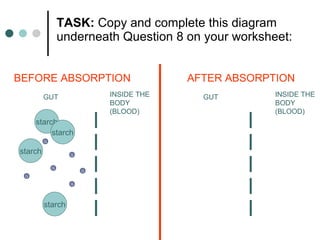
TASK:  Copy and complete this diagram underneath Question 8 on your worksheet: starch starch starch starch G G G GUT INSIDE THE BODY (BLOOD) G G G BEFORE ABSORPTION GUT INSIDE THE BODY (BLOOD) AFTER ABSORPTION
What is the gut? The gut is a coiled tube where food is broken down (digested) and absorbed into the body. Any waste food is passed out of the body through the anus.
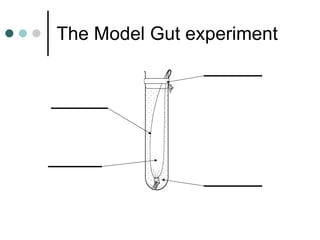
Proof! We can demonstrate the need for digestion using a model gut. Visking Tubing  has the same small holes in it. If we put a mixture of starch and glucose into it, which one will go through the holes?
The Model Gut experiment
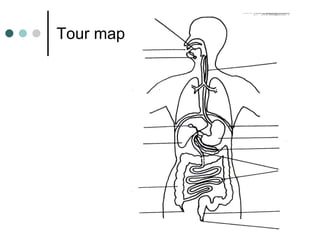
A journey through the gut For the rest of this topic we will be taking a trip through the gut from the starting hole (mouth) to the ending hole (anus). What are the parts of the gut? What will we see on the way?!
Tour map
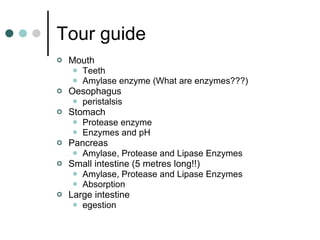
Tour guide Mouth  Teeth Amylase enzyme (What are enzymes???) Oesophagus  peristalsis Stomach  Protease enzyme Enzymes and pH Pancreas Amylase, Protease and Lipase Enzymes Small intestine (5 metres long!!) Amylase, Protease and Lipase Enzymes Absorption Large intestine  egestion
Tour guide Mouth  Teeth Amylase enzyme (What are enzymes???) Oesophagus  peristalsis Stomach  Protease enzyme Enzymes and pH Pancreas Amylase, Protease and Lipase Enzymes Small intestine  Amylase, Protease and Lipase Enzymes Absorption Large intestine  egestion
Teeth Teeth are needed to tear, rip and chew food to physically break it into smaller pieces. Let’s look at the internal structure of teeth.  You will need to cut up a copy of Worksheet 1 now.
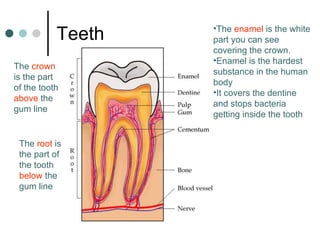
Teeth The  crown  is the part of the tooth  above  the gum line The  root  is the part of the tooth  below  the gum line The  enamel  is the white part you can see covering the crown. Enamel is the hardest substance in the human body It covers the dentine and stops bacteria getting inside the tooth
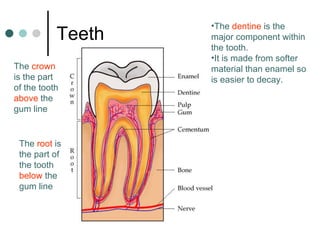
Teeth The  crown  is the part of the tooth  above  the gum line The  root  is the part of the tooth  below  the gum line The  dentine  is the major component within the tooth.  It is made from softer material than enamel so is easier to decay.
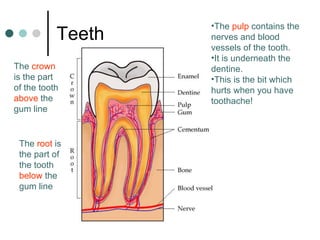
Teeth The  crown  is the part of the tooth  above  the gum line The  root  is the part of the tooth  below  the gum line The  pulp  contains the nerves and blood vessels of the tooth.  It is underneath the dentine. This is the bit which hurts when you have toothache!
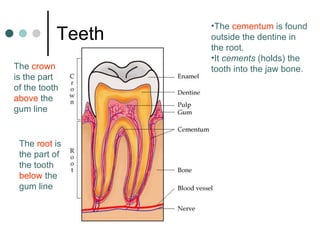
Teeth The  crown  is the part of the tooth  above  the gum line The  root  is the part of the tooth  below  the gum line The  cementum  is found outside the dentine in the root. It  cements  (holds) the tooth into the jaw bone.
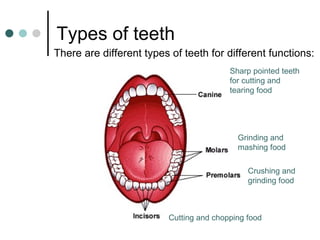
Types of teeth There are different types of teeth for different functions: Cutting and chopping food Sharp pointed teeth for cutting and tearing food Crushing and grinding food Grinding and mashing food
Experiment Get a mirror and look at your own teeth. Can you identify your incisors, canines, pre molars and molars?
Experiment A dentist would write your dental records as I: 2/2  C:1/1  PM:2/2  M:3/3 What do you think this means? What is  your  dental record? If you do not have a full set of teeth, can you explain why some teeth are missing?
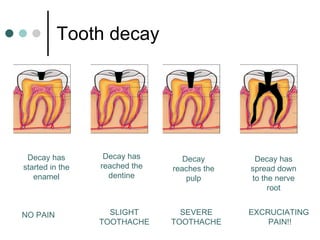
Tooth decay What do you think causes tooth decay? Saliva is normally slightly alkaline.  When we eat, bacteria in our mouth feed on sugar and turn it into acid.  The sugar starts to attack the enamel and wear it away.
Tooth decay Decay has started in the enamel NO PAIN Decay has reached the dentine SLIGHT TOOTHACHE Decay reaches the pulp SEVERE TOOTHACHE Decay has spread down to the nerve root EXCRUCIATING  PAIN!!
Preventing Tooth Decay How can we prevent tooth decay? How well do you brush your teeth?! What sort of foods should you avoid? Design a poster for a Year 7 student explaining what causes tooth decay and how to avoid it.
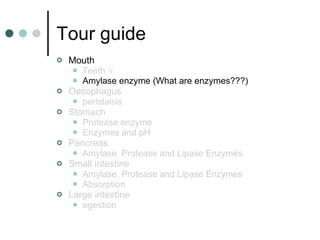
Tour guide Mouth  Teeth  √ Amylase enzyme (What are enzymes???) Oesophagus  peristalsis Stomach  Protease enzyme Enzymes and pH Pancreas Amylase, Protease and Lipase Enzymes Small intestine  Amylase, Protease and Lipase Enzymes Absorption Large intestine  egestion
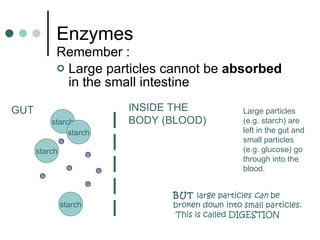
Enzymes Remember : Large particles cannot be  absorbed  in the small intestine starch starch starch starch G G G GUT INSIDE THE BODY (BLOOD) Large particles (e.g. starch) are left in the gut and small particles (e.g. glucose) go through into the blood. G G G BUT  large particles  can  be broken down into small particles.  This is called DIGESTION
Enzymes They need to be broken down  chemically  by ENZYMES. Enzymes are biological catalysts.  They speed up chemical reactions in the body.  Digestive enzymes speed up the breaking down process by holding the substrate (the large particle to be broken down) in place
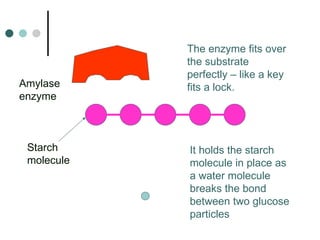
The enzyme fits over the substrate perfectly – like a key fits a lock. It holds the starch molecule in place as a water molecule breaks the bond between two glucose particles Starch molecule Amylase enzyme
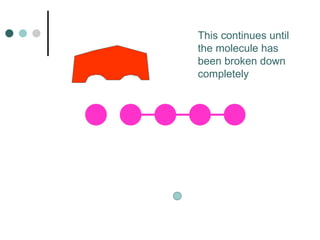
This continues until the molecule has been broken down completely
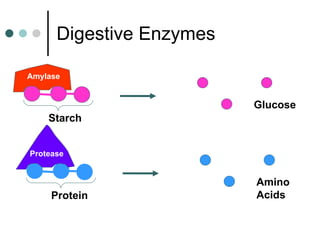
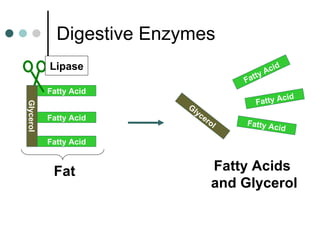
Digestive Enzymes There are 3 main types of digestive enzymes: Amylase  breaks  starch  down into  glucose . Protease  breaks  protein  down into  amino acids . Lipase  breaks fats down into  fatty acids  and  glycerol
Digestive Enzymes Starch Glucose Protein Amino Acids Amylase Protease
Digestive Enzymes Glycerol Fatty Acid Fatty Acid Fatty Acid Glycerol Fatty Acid Fatty Acid Fatty Acid Lipase Fat Fatty Acids  and Glycerol
What factors affect the rate of reaction of enzymes How do you think you can speed up the rate of an enzymic reaction? (Hint: It’s the same as any other reaction!)
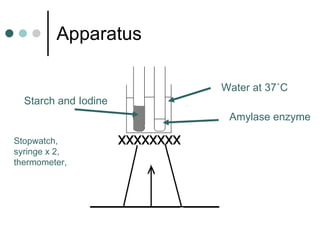
Amylase and Starch Investigation Amylase enzyme breaks down starch into glucose. Iodine is the test for starch.  If starch is present, iodine turns blue/black. Watch the demonstration of the experiment then answer the questions on your sheet.
Apparatus Starch and Iodine Amylase enzyme Water at 37 ˚ C Stopwatch, syringe x 2, thermometer,
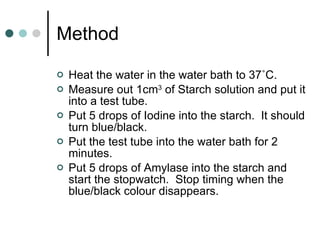
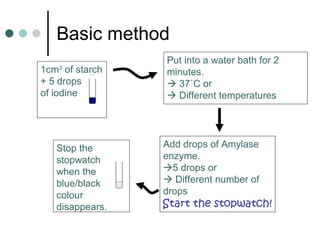
Method Heat the water in the water bath to 37 ˚C. Measure out 1cm 3  of Starch solution and put it into a test tube. Put 5 drops of Iodine into the starch.  It should turn blue/black. Put the test tube into the water bath for 2 minutes. Put 5 drops of Amylase into the starch and start the stopwatch.  Stop timing when the blue/black colour disappears.
Results It took _____ seconds for the Iodine and starch solution to turn colourless.
Conclusion When the starch has been digested into glucose by the amylase the blue/black colour disappears.  It took _____ seconds for the amylase to digest the starch.
Task Design an experiment to investigate how to speed up the digestion of starch by amylase. Use the basic method in your worksheets but add detail to it. Carry out your investigation safely!
Basic method Put into a water bath for 2 minutes.    37˚C or    Different temperatures Add drops of Amylase enzyme.  5 drops or    Different number of drops Start the stopwatch! 1cm 3  of starch  + 5 drops  of iodine Stop the stopwatch when the blue/black colour disappears.
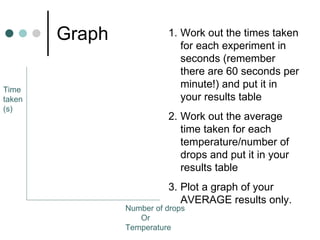
Graph  Number of drops Or Temperature Time taken (s) Work out the times taken for each experiment in seconds (remember there are 60 seconds per minute!) and put it in your results table Work out the average time taken for each temperature/number of drops and put it in your results table Plot a graph of your AVERAGE results only.
Tour guide Mouth  Teeth  √ Amylase enzyme (What are enzymes???) Oesophagus  peristalsis Stomach  Protease enzyme Enzymes and pH Pancreas Amylase, Protease and Lipase Enzymes Small intestine  Amylase, Protease and Lipase Enzymes Absorption Large intestine  egestion
Mouth: What happens Food is crushed and ground up by teeth The salivary glands make saliva which makes the food moist and easy for swallowing Amylase enzyme (in saliva) breaks the carbohydrate starch down into glucose.
Tour guide Mouth  Teeth  √ Amylase enzyme (What are enzymes???)  √ Oesophagus  peristalsis Stomach  Protease enzyme Enzymes and pH Pancreas Amylase, Protease and Lipase Enzymes Small intestine  Amylase, Protease and Lipase Enzymes Absorption Large intestine  egestion
Swallowing and Peristalsis Watch the animations and fill in your worksheet Times GCSE Biology: Digestion: Page 13-14 http://www.hopkins-gi.org/multimedia/database/intro_250_Swallow.swf
Tour guide Mouth  Teeth  √ Amylase enzyme (What are enzymes???)  √ Oesophagus  Peristalsis  √ Stomach  Protease enzyme Enzymes and pH Pancreas Amylase, Protease and Lipase Enzymes Small intestine  Amylase, Protease and Lipase Enzymes Absorption Large intestine  egestion
Stomach Stomach muscles contract and relax to mechanically break down the food They also mix the food up with gastric juice and hydrochloric acid The acid kills germs in the food The gastric juice contains the  protease  enzyme  PEPSIN  to digest protein into amino acids Food spends about 3-4 hours in here.
Tour guide Mouth  Teeth  √ Amylase enzyme (What are enzymes???)  √ Oesophagus  Peristalsis  √ Stomach  Protease enzyme Enzymes and pH  √ Pancreas Amylase, Protease and Lipase Enzymes Small intestine  Amylase, Protease and Lipase Enzymes Absorption Large intestine  egestion
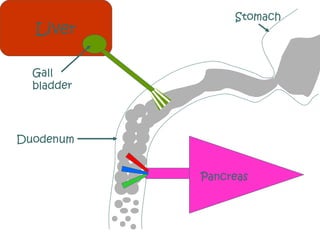
The duodenum The first part of the small intestine is called the duodenum.  Food, still mixed with gastric juice is squirted into it from the stomach.  The food is now a semi liquid, highly acidic mush. It needs to be neutralised and digestion needs to be continued…
Liver Gall bladder Duodenum Pancreas Stomach
Tour guide Mouth  Teeth √ Amylase enzyme (What are enzymes???) √ Oesophagus  Peristalsis √ Stomach  Protease enzyme Enzymes and pH √ Pancreas √ Amylase, Protease and Lipase Enzymes Small intestine  Amylase, Protease and Lipase Enzymes Absorption Large intestine  egestion
The small intestine The small intestine has 3 enzymes to complete digestion: Amylase  breaks  starch  down into  glucose . Protease  breaks  protein  down into  amino acids . Lipase  breaks fats down into  fatty acids  and  glycerol
Absorption The food is then ABSORBED through the wall of the small intestine into the blood stream. To do this effectively, the small intestine needs to have a large surface area. This is achieved in the following ways:
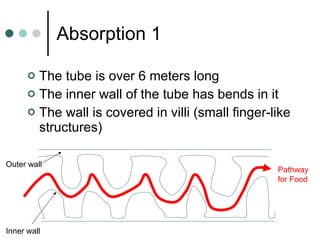
Absorption 1 The tube is over 6 meters long The inner wall of the tube has bends in it The wall is covered in villi (small finger-like structures) Pathway for Food Outer wall Inner wall
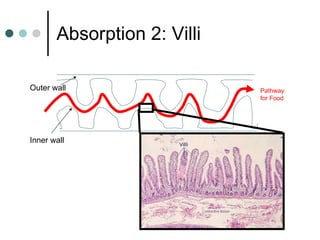
Absorption 2: Villi Outer wall Inner wall Pathway for Food
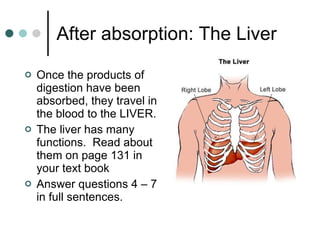
After absorption: The Liver Once the products of digestion have been absorbed, they travel in the blood to the LIVER. The liver has many functions.  Read about them on page 131 in your text book Answer questions 4 – 7 in full sentences.
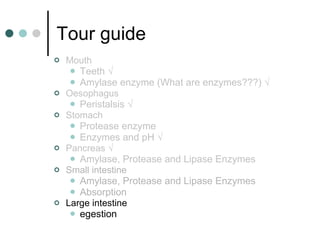
Tour guide Mouth  Teeth √ Amylase enzyme (What are enzymes???) √ Oesophagus  Peristalsis √ Stomach  Protease enzyme Enzymes and pH √ Pancreas √ Amylase, Protease and Lipase Enzymes Small intestine  Amylase, Protease and Lipase Enzymes Absorption Large intestine  egestion
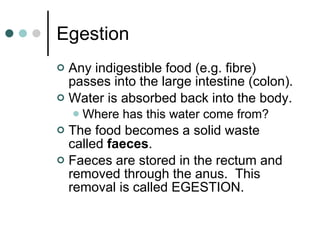
Egestion Any indigestible food (e.g. fibre) passes into the large intestine (colon). Water is absorbed back into the body. Where has this water come from? The food becomes a solid waste called  faeces .  Faeces are stored in the rectum and removed through the anus.  This removal is called EGESTION.
Thank you for travelling along Alimentary Canal. Have a nice day…

Digestion foundation level

  • 1.
  • 2.
    You are atube inside a tube… And although there are a few twists and turns along the way… It comes out here: Anything that goes in the top hole (mouth) does not become part of the body until it is absorbed (taken in) in a part called the small intestine. This tube is called the GUT . The tube starts here:
  • 3.
    A closer lookat absorption… Food is absorbed (taken in) to the body in the small intestine. The wall of the small intestine has small holes in it. Only small particles can pass through it: starch starch starch starch G G G GUT INSIDE THE BODY (BLOOD) Large particles (e.g. starch) are left in the gut and small particles (e.g. glucose) go through into the blood. G G G BUT large particles can be broken down into small particles. This is called DIGESTION
  • 4.
    TASK: Copyand complete this diagram underneath Question 8 on your worksheet: starch starch starch starch G G G GUT INSIDE THE BODY (BLOOD) G G G BEFORE ABSORPTION GUT INSIDE THE BODY (BLOOD) AFTER ABSORPTION
  • 5.
    What is thegut? The gut is a coiled tube where food is broken down (digested) and absorbed into the body. Any waste food is passed out of the body through the anus.
  • 6.
    Proof! We candemonstrate the need for digestion using a model gut. Visking Tubing has the same small holes in it. If we put a mixture of starch and glucose into it, which one will go through the holes?
  • 7.
    The Model Gutexperiment
  • 8.
    A journey throughthe gut For the rest of this topic we will be taking a trip through the gut from the starting hole (mouth) to the ending hole (anus). What are the parts of the gut? What will we see on the way?!
  • 9.
  • 10.
    Tour guide Mouth Teeth Amylase enzyme (What are enzymes???) Oesophagus peristalsis Stomach Protease enzyme Enzymes and pH Pancreas Amylase, Protease and Lipase Enzymes Small intestine (5 metres long!!) Amylase, Protease and Lipase Enzymes Absorption Large intestine egestion
  • 11.
    Tour guide Mouth Teeth Amylase enzyme (What are enzymes???) Oesophagus peristalsis Stomach Protease enzyme Enzymes and pH Pancreas Amylase, Protease and Lipase Enzymes Small intestine Amylase, Protease and Lipase Enzymes Absorption Large intestine egestion
  • 12.
    Teeth Teeth areneeded to tear, rip and chew food to physically break it into smaller pieces. Let’s look at the internal structure of teeth. You will need to cut up a copy of Worksheet 1 now.
  • 13.
    Teeth The crown is the part of the tooth above the gum line The root is the part of the tooth below the gum line The enamel is the white part you can see covering the crown. Enamel is the hardest substance in the human body It covers the dentine and stops bacteria getting inside the tooth
  • 14.
    Teeth The crown is the part of the tooth above the gum line The root is the part of the tooth below the gum line The dentine is the major component within the tooth. It is made from softer material than enamel so is easier to decay.
  • 15.
    Teeth The crown is the part of the tooth above the gum line The root is the part of the tooth below the gum line The pulp contains the nerves and blood vessels of the tooth. It is underneath the dentine. This is the bit which hurts when you have toothache!
  • 16.
    Teeth The crown is the part of the tooth above the gum line The root is the part of the tooth below the gum line The cementum is found outside the dentine in the root. It cements (holds) the tooth into the jaw bone.
  • 17.
    Types of teethThere are different types of teeth for different functions: Cutting and chopping food Sharp pointed teeth for cutting and tearing food Crushing and grinding food Grinding and mashing food
  • 18.
    Experiment Get amirror and look at your own teeth. Can you identify your incisors, canines, pre molars and molars?
  • 19.
    Experiment A dentistwould write your dental records as I: 2/2 C:1/1 PM:2/2 M:3/3 What do you think this means? What is your dental record? If you do not have a full set of teeth, can you explain why some teeth are missing?
  • 20.
    Tooth decay Whatdo you think causes tooth decay? Saliva is normally slightly alkaline. When we eat, bacteria in our mouth feed on sugar and turn it into acid. The sugar starts to attack the enamel and wear it away.
  • 21.
    Tooth decay Decayhas started in the enamel NO PAIN Decay has reached the dentine SLIGHT TOOTHACHE Decay reaches the pulp SEVERE TOOTHACHE Decay has spread down to the nerve root EXCRUCIATING PAIN!!
  • 22.
    Preventing Tooth DecayHow can we prevent tooth decay? How well do you brush your teeth?! What sort of foods should you avoid? Design a poster for a Year 7 student explaining what causes tooth decay and how to avoid it.
  • 23.
    Tour guide Mouth Teeth √ Amylase enzyme (What are enzymes???) Oesophagus peristalsis Stomach Protease enzyme Enzymes and pH Pancreas Amylase, Protease and Lipase Enzymes Small intestine Amylase, Protease and Lipase Enzymes Absorption Large intestine egestion
  • 24.
    Enzymes Remember :Large particles cannot be absorbed in the small intestine starch starch starch starch G G G GUT INSIDE THE BODY (BLOOD) Large particles (e.g. starch) are left in the gut and small particles (e.g. glucose) go through into the blood. G G G BUT large particles can be broken down into small particles. This is called DIGESTION
  • 25.
    Enzymes They needto be broken down chemically by ENZYMES. Enzymes are biological catalysts. They speed up chemical reactions in the body. Digestive enzymes speed up the breaking down process by holding the substrate (the large particle to be broken down) in place
  • 26.
    The enzyme fitsover the substrate perfectly – like a key fits a lock. It holds the starch molecule in place as a water molecule breaks the bond between two glucose particles Starch molecule Amylase enzyme
  • 27.
    This continues untilthe molecule has been broken down completely
  • 28.
    Digestive Enzymes Thereare 3 main types of digestive enzymes: Amylase breaks starch down into glucose . Protease breaks protein down into amino acids . Lipase breaks fats down into fatty acids and glycerol
  • 29.
    Digestive Enzymes StarchGlucose Protein Amino Acids Amylase Protease
  • 30.
    Digestive Enzymes GlycerolFatty Acid Fatty Acid Fatty Acid Glycerol Fatty Acid Fatty Acid Fatty Acid Lipase Fat Fatty Acids and Glycerol
  • 31.
    What factors affectthe rate of reaction of enzymes How do you think you can speed up the rate of an enzymic reaction? (Hint: It’s the same as any other reaction!)
  • 32.
    Amylase and StarchInvestigation Amylase enzyme breaks down starch into glucose. Iodine is the test for starch. If starch is present, iodine turns blue/black. Watch the demonstration of the experiment then answer the questions on your sheet.
  • 33.
    Apparatus Starch andIodine Amylase enzyme Water at 37 ˚ C Stopwatch, syringe x 2, thermometer,
  • 34.
    Method Heat thewater in the water bath to 37 ˚C. Measure out 1cm 3 of Starch solution and put it into a test tube. Put 5 drops of Iodine into the starch. It should turn blue/black. Put the test tube into the water bath for 2 minutes. Put 5 drops of Amylase into the starch and start the stopwatch. Stop timing when the blue/black colour disappears.
  • 35.
    Results It took_____ seconds for the Iodine and starch solution to turn colourless.
  • 36.
    Conclusion When thestarch has been digested into glucose by the amylase the blue/black colour disappears. It took _____ seconds for the amylase to digest the starch.
  • 37.
    Task Design anexperiment to investigate how to speed up the digestion of starch by amylase. Use the basic method in your worksheets but add detail to it. Carry out your investigation safely!
  • 38.
    Basic method Putinto a water bath for 2 minutes.  37˚C or  Different temperatures Add drops of Amylase enzyme.  5 drops or  Different number of drops Start the stopwatch! 1cm 3 of starch + 5 drops of iodine Stop the stopwatch when the blue/black colour disappears.
  • 39.
    Graph Numberof drops Or Temperature Time taken (s) Work out the times taken for each experiment in seconds (remember there are 60 seconds per minute!) and put it in your results table Work out the average time taken for each temperature/number of drops and put it in your results table Plot a graph of your AVERAGE results only.
  • 40.
    Tour guide Mouth Teeth √ Amylase enzyme (What are enzymes???) Oesophagus peristalsis Stomach Protease enzyme Enzymes and pH Pancreas Amylase, Protease and Lipase Enzymes Small intestine Amylase, Protease and Lipase Enzymes Absorption Large intestine egestion
  • 41.
    Mouth: What happensFood is crushed and ground up by teeth The salivary glands make saliva which makes the food moist and easy for swallowing Amylase enzyme (in saliva) breaks the carbohydrate starch down into glucose.
  • 42.
    Tour guide Mouth Teeth √ Amylase enzyme (What are enzymes???) √ Oesophagus peristalsis Stomach Protease enzyme Enzymes and pH Pancreas Amylase, Protease and Lipase Enzymes Small intestine Amylase, Protease and Lipase Enzymes Absorption Large intestine egestion
  • 43.
    Swallowing and PeristalsisWatch the animations and fill in your worksheet Times GCSE Biology: Digestion: Page 13-14 http://www.hopkins-gi.org/multimedia/database/intro_250_Swallow.swf
  • 44.
    Tour guide Mouth Teeth √ Amylase enzyme (What are enzymes???) √ Oesophagus Peristalsis √ Stomach Protease enzyme Enzymes and pH Pancreas Amylase, Protease and Lipase Enzymes Small intestine Amylase, Protease and Lipase Enzymes Absorption Large intestine egestion
  • 45.
    Stomach Stomach musclescontract and relax to mechanically break down the food They also mix the food up with gastric juice and hydrochloric acid The acid kills germs in the food The gastric juice contains the protease enzyme PEPSIN to digest protein into amino acids Food spends about 3-4 hours in here.
  • 46.
    Tour guide Mouth Teeth √ Amylase enzyme (What are enzymes???) √ Oesophagus Peristalsis √ Stomach Protease enzyme Enzymes and pH √ Pancreas Amylase, Protease and Lipase Enzymes Small intestine Amylase, Protease and Lipase Enzymes Absorption Large intestine egestion
  • 47.
    The duodenum Thefirst part of the small intestine is called the duodenum. Food, still mixed with gastric juice is squirted into it from the stomach. The food is now a semi liquid, highly acidic mush. It needs to be neutralised and digestion needs to be continued…
  • 48.
    Liver Gall bladderDuodenum Pancreas Stomach
  • 49.
    Tour guide Mouth Teeth √ Amylase enzyme (What are enzymes???) √ Oesophagus Peristalsis √ Stomach Protease enzyme Enzymes and pH √ Pancreas √ Amylase, Protease and Lipase Enzymes Small intestine Amylase, Protease and Lipase Enzymes Absorption Large intestine egestion
  • 50.
    The small intestineThe small intestine has 3 enzymes to complete digestion: Amylase breaks starch down into glucose . Protease breaks protein down into amino acids . Lipase breaks fats down into fatty acids and glycerol
  • 51.
    Absorption The foodis then ABSORBED through the wall of the small intestine into the blood stream. To do this effectively, the small intestine needs to have a large surface area. This is achieved in the following ways:
  • 52.
    Absorption 1 Thetube is over 6 meters long The inner wall of the tube has bends in it The wall is covered in villi (small finger-like structures) Pathway for Food Outer wall Inner wall
  • 53.
    Absorption 2: VilliOuter wall Inner wall Pathway for Food
  • 54.
    After absorption: TheLiver Once the products of digestion have been absorbed, they travel in the blood to the LIVER. The liver has many functions. Read about them on page 131 in your text book Answer questions 4 – 7 in full sentences.
  • 55.
    Tour guide Mouth Teeth √ Amylase enzyme (What are enzymes???) √ Oesophagus Peristalsis √ Stomach Protease enzyme Enzymes and pH √ Pancreas √ Amylase, Protease and Lipase Enzymes Small intestine Amylase, Protease and Lipase Enzymes Absorption Large intestine egestion
  • 56.
    Egestion Any indigestiblefood (e.g. fibre) passes into the large intestine (colon). Water is absorbed back into the body. Where has this water come from? The food becomes a solid waste called faeces . Faeces are stored in the rectum and removed through the anus. This removal is called EGESTION.
  • 57.
    Thank you fortravelling along Alimentary Canal. Have a nice day…