
Periodic Table
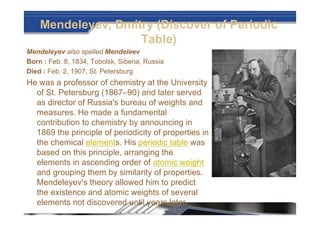
Mendeleyev, Dmitry (Discover of Periodic
Table)
Mendeleyev also spelled Mendeleev
Born : Feb. 8, 1834, Tobolsk, Siberia, Russia
Died : Feb. 2, 1907, St. Petersburg
He was a professor of chemistry at the University
of St. Petersburg (1867–90) and later served
as director of Russia's bureau of weights and
measures. He made a fundamental
contribution to chemistry by announcing in
1869 the principle of periodicity of properties in
the chemical elements. His periodic table was
based on this principle, arranging the
elements in ascending order of atomic weight
and grouping them by similarity of properties.
Mendeleyev's theory allowed him to predict
the existence and atomic weights of several
elements not discovered until years later.
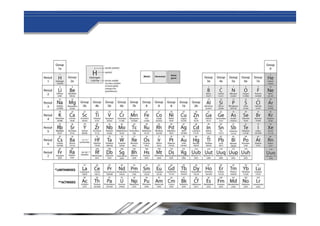
Periodic table
Organized array of all the chemical elements in approximately
increasing order of their atomic weight.
The elements show a periodic recurrence of certain properties, first
discovered in 1869 by Dmitry I. Mendeleyev. Those in the same
column (group) of the table as usually arranged have similar
properties. In the 20th century, when the structure of atoms was
understood, the table was seen to precisely reflect increasing order
of atomic number. Members of the same group in the table have the
same number of electrons in the outermost shells of their atoms and
form bonds of the same type, usually with the same valence; the
noble gases, with full outer shells, generally do not form bonds. The
periodic table has thus greatly deepened understanding of bonding
and chemical behaviour. It also allowed the prediction of new
elements, many of which were later discovered or synthesized
What is atomic Weight ?
Ratio of the average mass of a chemical element's atoms
to 1/12 the mass of an atom of the carbon-12 isotope.
The original standard of atomic weight, established in the
19th century, was hydrogen, with a value of 1. From c.
1900 until 1961, the reference standard was oxygen,
with a value of 16, and the unit of atomic mass was
defined as 1/16 the mass of an oxygen atom. Oxygen,
however, contains small amounts of two isotopes that
are heavier than the most abundant one, and 16 is
actually a weighted average of the masses of the three
isotopes of oxygen. Therefore, the standard was
changed to one based on carbon-12. The new scale
required only minimal changes to the values that had
been used for chemical atomic weights.
What is Electron ?
Lightest electrically charged subatomic particle known.
It carries a negative charge (see electric charge), the basic
charge of electricity. An electron has a small mass, less
than 0.1% the mass of an atom. Under normal
circumstances, electrons move about the nucleus of an
atom in orbitals that form an electron cloud bound in
varying strengths to the positively charged nucleus.
Electrons closer to the nucleus are held more tightly. The
first subatomic particle discovered, the electron was
identified in 1897 by J. J. Thomson.
What is Valence ?
Number of bonds (see bonding) an atom can form.
Hydrogen (H) always has valence 1, so other elements'
valences equal the number of hydrogen atoms they
combine with. Thus, oxygen (O) has valence 2, as in
water (H2O); nitrogen (N) has valence 3, as in ammonia
(NH3); and chlorine (Cl) has valence 1, as in hydrochloric
acid (HCl). The valence depends on the number of
unpaired electrons in the outermost (and, in transition
elements, the next) shell of the atom's structure. The
sharing of the unpaired (valence) electrons in a bond
mimics the stable configuration of the noble gases,
whose outer shells are full. Elements that can achieve
stable configurations by various combinations have more
than one valence.
What is bonding ?
Any of the interactions that account for the association of atoms into molecules,
ions, crystals, metals, and other stable species.
When atoms' nuclei and electrons interact, they tend to distribute themselves
so that the total energy is lowest; if the energy of a group arrangement is
lower than the sum of the components' energies, they bond. The physics
and mathematics of bonding were developed as part of quantum mechanics.
The number of bonds an atom can form—its valence—equals the number of
electrons it contributes or receives. Covalent bonds form molecules; atoms
bond to specific other atoms by sharing an electron pair between them. If
the sharing is even, the molecule is not polar; if it is uneven, the molecule is
an electric dipole. Ionic bonds are the extreme of uneven sharing; certain
atoms give up electrons, becoming cations. Other atoms take up the
electrons and become anions. All the ions are held together in a crystal by
electrostatic forces. In crystalline metals, a diffuse electron sharing bonds
the atoms (metallic bonding). Other types include hydrogen bonding; bonds
in aromatic compounds; coordinate covalent bonds; multicentre bonds,
exemplified by boranes (boron hydrides), in which more than two atoms
share electron pairs; and the bonds in coordination complexes (see
transition element), still poorly understood
The Long Form of
Periodic Table
Element of First Period
The first period corresponding to n = 1 is
unique because it contains only two
element. There can accommodate only
two electron in which one & two electron
are present in the first energy level. The
first Period contain hydrogen (1s) and
helium (1s).
Element of Second Period
The second period contain 8 element
because for n = 2, there are four orbitals I
second energy shell (L). In all, these four
orbital have a capacity of eight electron
and therefore, second period has eight
element in it.
It Start with Lithium (Z = 3) and with Neon
(Z = 10) in which the second shell is
completed.
Element of Third Period
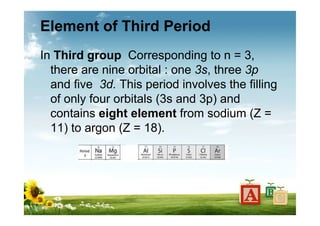
In Third group Corresponding to n = 3,
there are nine orbital : one 3s, three 3p
and five 3d. This period involves the filling
of only four orbitals (3s and 3p) and
contains eight element from sodium (Z =
11) to argon (Z = 18).
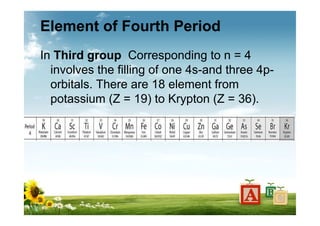
Element of Fourth Period
In Third group Corresponding to n = 4
involves the filling of one 4s-and three 4p-
orbitals. There are 18 element from
potassium (Z = 19) to Krypton (Z = 36).
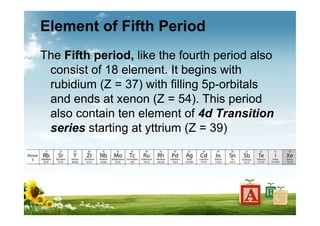
Element of Fifth Period
The Fifth period, like the fourth period also
consist of 18 element. It begins with
rubidium (Z = 37) with filling 5p-orbitals
and ends at xenon (Z = 54). This period
also contain ten element of 4d Transition
series starting at yttrium (Z = 39)
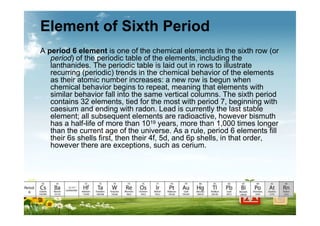
Element of Sixth Period
A period 6 element is one of the chemical elements in the sixth row (or
period) of the periodic table of the elements, including the
lanthanides. The periodic table is laid out in rows to illustrate
recurring (periodic) trends in the chemical behavior of the elements
as their atomic number increases: a new row is begun when
chemical behavior begins to repeat, meaning that elements with
similar behavior fall into the same vertical columns. The sixth period
contains 32 elements, tied for the most with period 7, beginning with
caesium and ending with radon. Lead is currently the last stable
element; all subsequent elements are radioactive, however bismuth
has a half-life of more than 1019 years, more than 1,000 times longer
than the current age of the universe. As a rule, period 6 elements fill
their 6s shells first, then their 4f, 5d, and 6p shells, in that order,
however there are exceptions, such as cerium.
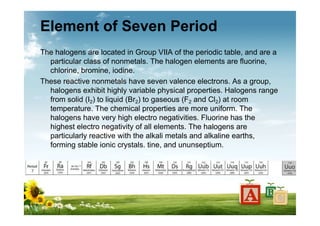
Element of Seven Period
The halogens are located in Group VIIA of the periodic table, and are a
particular class of nonmetals. The halogen elements are fluorine,
chlorine, bromine, iodine.
These reactive nonmetals have seven valence electrons. As a group,
halogens exhibit highly variable physical properties. Halogens range
from solid (I2) to liquid (Br2) to gaseous (F2 and Cl2) at room
temperature. The chemical properties are more uniform. The
halogens have very high electro negativities. Fluorine has the
highest electro negativity of all elements. The halogens are
particularly reactive with the alkali metals and alkaline earths,
forming stable ionic crystals. tine, and ununseptium.
Division of
Element Into s, p,
d and f Blocks
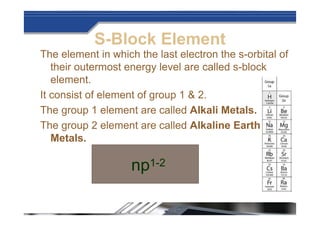
S-Block Element
The element in which the last electron the s-orbital of
their outermost energy level are called s-block
element.
It consist of element of group 1 & 2.
The group 1 element are called Alkali Metals.
The group 2 element are called Alkaline Earth
Metals.
np1-2
Characteristics of s-block
element
i. They are soft metals having low melting
and boiling point.
ii. They have low ionisation enthalpies.
iii. They are very reactive.
iv. They mostly form ionic compound except
lithium and beryllium.
p-Block Element
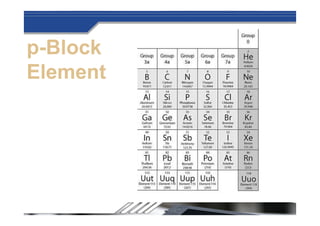
The element in which the last electron the p-orbital
of their outermost energy level are called s-block
element.
It consist of element of group 13 & 18.
General electric configuratuon of p block element
are :
ns2 np1-6
p-Block
Element
d-Block Element
The element in which the last electron the p-orbital
of their last but one (called penultimate) energy
level are called s-block element.
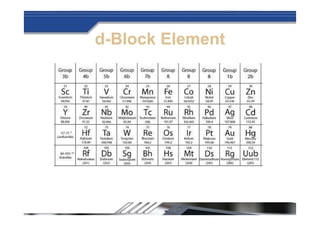
This block consist of the element lying between s
and p blocks. It consist of element of group 3 &
12.
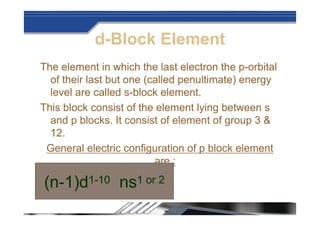
General electric configuration of p block element
are :
(n-1)d1-10 ns1 or 2
d-Block Element
Characteristics of d-block
element
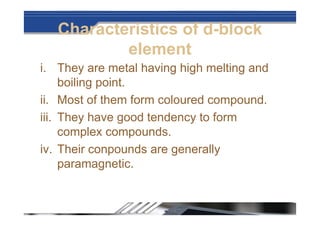
i. They are metal having high melting and
boiling point.
ii. Most of them form coloured compound.
iii. They have good tendency to form
complex compounds.
iv. Their conpounds are generally
paramagnetic.
f-Block Element
The element in which the last electron the f-
orbital of their atom are called s-block
element.
In hese element , the last electron is added
to the third to the outermost (called
antipenultimate) energy level; (n-2)f.
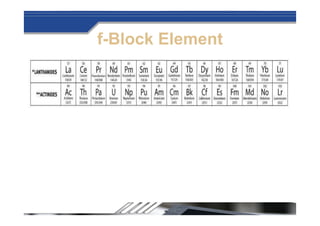
These consist of two series of element placed
at te bottom of the Periodic Table
A. The first series follows lanthanum,LA (Z = 57) and
the element present in this series {CE (58) – LU(71) }
B. The second series follows actinium,AC (Z = 89) and
the element present in this series {TH(90) – LR(103) }.
General electric configuration of p block element are :
(n-2)f1-14 (n-1)d0-2 ns2
f-Block Element
Characteristics of f-block
element
i. They are heavy metals
ii. They generally have high melting and
boiling point.
iii. They exhibit variable oxidation states.
iv. They form coloured compounds.
v. They have tendency to form Complex
compounds.
Classification of elements
in General Types
1. Noble Gases
Any of the seven chemical elements that make up the rightmost group
of the periodic table as usually arranged : helium, neon, argon,
krypton, xenon, radon, and element 118.
All are colorless, odorless, and nonflammable and, except for element
118, occur in tiny amounts in the atmosphere (though helium is the
most plentiful element in the universe after hydrogen). Their stable
electronic configurations, with no unpaired electrons to share, make
them extremely unreactive—hence “noble” (i.e., aloof) or
inert—though krypton, xenon, and radon, with outer electrons held
less firmly, can form compounds (mainly with fluorine). These gases
absorb and give off electromagnetic radiation in a much less
complex way than other substances, a property exploited in their
use in fluorescent lighting devices and discharge lamps. They glow
with a characteristic color when confined in a transparent container
at low pressure with an electric current passing through it. Their very
low boiling and melting points make them useful as refrigerants for
low-temperature research
2. Transition element
Any chemical element with valence electrons in two shells instead of only one.
This structure gives them their outstanding ability to form ions containing more
than one atom (complex ions, or coordination compounds), with a central
atom or ion (often of a transition metal) surrounded by ligands in a regular
arrangement. Theories on the bonding in these ions are still being refined.
The elements in the periodic table from scandium to copper (atomic
numbers 21–29), yttrium to silver (39–47), and lanthanum to gold (57–79,
including the lanthanide series) are frequently designated the three main
transition series. (Those in the actinide series and beyond, 89–111, also
qualify.) All are metals, many of major economic or industrial importance
(e.g., iron, gold, nickel, titanium). Most are dense, hard, and brittle, conduct
heat and electricity well, have high melting points, and form alloys with each
other and other metals. Their electronic structure lets them form compounds
at various valences. Many of these compounds are coloured and
paramagnetic (see paramagnetism) and (as do the metals themselves)
often act as catalysts
THANK YOU
Name : MUKUL
Class : XI

Periodic table.pdfx

  • 1.
  • 3.
    Mendeleyev, Dmitry (Discoverof Periodic Table) Mendeleyev also spelled Mendeleev Born : Feb. 8, 1834, Tobolsk, Siberia, Russia Died : Feb. 2, 1907, St. Petersburg He was a professor of chemistry at the University of St. Petersburg (1867–90) and later served as director of Russia's bureau of weights and measures. He made a fundamental contribution to chemistry by announcing in 1869 the principle of periodicity of properties in the chemical elements. His periodic table was based on this principle, arranging the elements in ascending order of atomic weight and grouping them by similarity of properties. Mendeleyev's theory allowed him to predict the existence and atomic weights of several elements not discovered until years later.
  • 4.
    Periodic table Organized arrayof all the chemical elements in approximately increasing order of their atomic weight. The elements show a periodic recurrence of certain properties, first discovered in 1869 by Dmitry I. Mendeleyev. Those in the same column (group) of the table as usually arranged have similar properties. In the 20th century, when the structure of atoms was understood, the table was seen to precisely reflect increasing order of atomic number. Members of the same group in the table have the same number of electrons in the outermost shells of their atoms and form bonds of the same type, usually with the same valence; the noble gases, with full outer shells, generally do not form bonds. The periodic table has thus greatly deepened understanding of bonding and chemical behaviour. It also allowed the prediction of new elements, many of which were later discovered or synthesized
  • 5.
    What is atomicWeight ? Ratio of the average mass of a chemical element's atoms to 1/12 the mass of an atom of the carbon-12 isotope. The original standard of atomic weight, established in the 19th century, was hydrogen, with a value of 1. From c. 1900 until 1961, the reference standard was oxygen, with a value of 16, and the unit of atomic mass was defined as 1/16 the mass of an oxygen atom. Oxygen, however, contains small amounts of two isotopes that are heavier than the most abundant one, and 16 is actually a weighted average of the masses of the three isotopes of oxygen. Therefore, the standard was changed to one based on carbon-12. The new scale required only minimal changes to the values that had been used for chemical atomic weights.
  • 6.
    What is Electron? Lightest electrically charged subatomic particle known. It carries a negative charge (see electric charge), the basic charge of electricity. An electron has a small mass, less than 0.1% the mass of an atom. Under normal circumstances, electrons move about the nucleus of an atom in orbitals that form an electron cloud bound in varying strengths to the positively charged nucleus. Electrons closer to the nucleus are held more tightly. The first subatomic particle discovered, the electron was identified in 1897 by J. J. Thomson.
  • 7.
    What is Valence? Number of bonds (see bonding) an atom can form. Hydrogen (H) always has valence 1, so other elements' valences equal the number of hydrogen atoms they combine with. Thus, oxygen (O) has valence 2, as in water (H2O); nitrogen (N) has valence 3, as in ammonia (NH3); and chlorine (Cl) has valence 1, as in hydrochloric acid (HCl). The valence depends on the number of unpaired electrons in the outermost (and, in transition elements, the next) shell of the atom's structure. The sharing of the unpaired (valence) electrons in a bond mimics the stable configuration of the noble gases, whose outer shells are full. Elements that can achieve stable configurations by various combinations have more than one valence.
  • 8.
    What is bonding? Any of the interactions that account for the association of atoms into molecules, ions, crystals, metals, and other stable species. When atoms' nuclei and electrons interact, they tend to distribute themselves so that the total energy is lowest; if the energy of a group arrangement is lower than the sum of the components' energies, they bond. The physics and mathematics of bonding were developed as part of quantum mechanics. The number of bonds an atom can form—its valence—equals the number of electrons it contributes or receives. Covalent bonds form molecules; atoms bond to specific other atoms by sharing an electron pair between them. If the sharing is even, the molecule is not polar; if it is uneven, the molecule is an electric dipole. Ionic bonds are the extreme of uneven sharing; certain atoms give up electrons, becoming cations. Other atoms take up the electrons and become anions. All the ions are held together in a crystal by electrostatic forces. In crystalline metals, a diffuse electron sharing bonds the atoms (metallic bonding). Other types include hydrogen bonding; bonds in aromatic compounds; coordinate covalent bonds; multicentre bonds, exemplified by boranes (boron hydrides), in which more than two atoms share electron pairs; and the bonds in coordination complexes (see transition element), still poorly understood
  • 9.
    The Long Formof Periodic Table
  • 10.
    Element of FirstPeriod The first period corresponding to n = 1 is unique because it contains only two element. There can accommodate only two electron in which one & two electron are present in the first energy level. The first Period contain hydrogen (1s) and helium (1s).
  • 11.
    Element of SecondPeriod The second period contain 8 element because for n = 2, there are four orbitals I second energy shell (L). In all, these four orbital have a capacity of eight electron and therefore, second period has eight element in it. It Start with Lithium (Z = 3) and with Neon (Z = 10) in which the second shell is completed.
  • 12.
    Element of ThirdPeriod In Third group Corresponding to n = 3, there are nine orbital : one 3s, three 3p and five 3d. This period involves the filling of only four orbitals (3s and 3p) and contains eight element from sodium (Z = 11) to argon (Z = 18).
  • 13.
    Element of FourthPeriod In Third group Corresponding to n = 4 involves the filling of one 4s-and three 4p- orbitals. There are 18 element from potassium (Z = 19) to Krypton (Z = 36).
  • 14.
    Element of FifthPeriod The Fifth period, like the fourth period also consist of 18 element. It begins with rubidium (Z = 37) with filling 5p-orbitals and ends at xenon (Z = 54). This period also contain ten element of 4d Transition series starting at yttrium (Z = 39)
  • 15.
    Element of SixthPeriod A period 6 element is one of the chemical elements in the sixth row (or period) of the periodic table of the elements, including the lanthanides. The periodic table is laid out in rows to illustrate recurring (periodic) trends in the chemical behavior of the elements as their atomic number increases: a new row is begun when chemical behavior begins to repeat, meaning that elements with similar behavior fall into the same vertical columns. The sixth period contains 32 elements, tied for the most with period 7, beginning with caesium and ending with radon. Lead is currently the last stable element; all subsequent elements are radioactive, however bismuth has a half-life of more than 1019 years, more than 1,000 times longer than the current age of the universe. As a rule, period 6 elements fill their 6s shells first, then their 4f, 5d, and 6p shells, in that order, however there are exceptions, such as cerium.
  • 16.
    Element of SevenPeriod The halogens are located in Group VIIA of the periodic table, and are a particular class of nonmetals. The halogen elements are fluorine, chlorine, bromine, iodine. These reactive nonmetals have seven valence electrons. As a group, halogens exhibit highly variable physical properties. Halogens range from solid (I2) to liquid (Br2) to gaseous (F2 and Cl2) at room temperature. The chemical properties are more uniform. The halogens have very high electro negativities. Fluorine has the highest electro negativity of all elements. The halogens are particularly reactive with the alkali metals and alkaline earths, forming stable ionic crystals. tine, and ununseptium.
  • 17.
    Division of Element Intos, p, d and f Blocks
  • 18.
    S-Block Element The elementin which the last electron the s-orbital of their outermost energy level are called s-block element. It consist of element of group 1 & 2. The group 1 element are called Alkali Metals. The group 2 element are called Alkaline Earth Metals. np1-2
  • 19.
    Characteristics of s-block element i.They are soft metals having low melting and boiling point. ii. They have low ionisation enthalpies. iii. They are very reactive. iv. They mostly form ionic compound except lithium and beryllium.
  • 20.
    p-Block Element The elementin which the last electron the p-orbital of their outermost energy level are called s-block element. It consist of element of group 13 & 18. General electric configuratuon of p block element are : ns2 np1-6
  • 21.
  • 22.
    d-Block Element The elementin which the last electron the p-orbital of their last but one (called penultimate) energy level are called s-block element. This block consist of the element lying between s and p blocks. It consist of element of group 3 & 12. General electric configuration of p block element are : (n-1)d1-10 ns1 or 2
  • 23.
  • 24.
    Characteristics of d-block element i.They are metal having high melting and boiling point. ii. Most of them form coloured compound. iii. They have good tendency to form complex compounds. iv. Their conpounds are generally paramagnetic.
  • 25.
    f-Block Element The elementin which the last electron the f- orbital of their atom are called s-block element. In hese element , the last electron is added to the third to the outermost (called antipenultimate) energy level; (n-2)f.
  • 26.
    These consist oftwo series of element placed at te bottom of the Periodic Table A. The first series follows lanthanum,LA (Z = 57) and the element present in this series {CE (58) – LU(71) } B. The second series follows actinium,AC (Z = 89) and the element present in this series {TH(90) – LR(103) }. General electric configuration of p block element are : (n-2)f1-14 (n-1)d0-2 ns2
  • 27.
  • 28.
    Characteristics of f-block element i.They are heavy metals ii. They generally have high melting and boiling point. iii. They exhibit variable oxidation states. iv. They form coloured compounds. v. They have tendency to form Complex compounds.
  • 29.
  • 30.
    1. Noble Gases Anyof the seven chemical elements that make up the rightmost group of the periodic table as usually arranged : helium, neon, argon, krypton, xenon, radon, and element 118. All are colorless, odorless, and nonflammable and, except for element 118, occur in tiny amounts in the atmosphere (though helium is the most plentiful element in the universe after hydrogen). Their stable electronic configurations, with no unpaired electrons to share, make them extremely unreactive—hence “noble” (i.e., aloof) or inert—though krypton, xenon, and radon, with outer electrons held less firmly, can form compounds (mainly with fluorine). These gases absorb and give off electromagnetic radiation in a much less complex way than other substances, a property exploited in their use in fluorescent lighting devices and discharge lamps. They glow with a characteristic color when confined in a transparent container at low pressure with an electric current passing through it. Their very low boiling and melting points make them useful as refrigerants for low-temperature research
  • 31.
    2. Transition element Anychemical element with valence electrons in two shells instead of only one. This structure gives them their outstanding ability to form ions containing more than one atom (complex ions, or coordination compounds), with a central atom or ion (often of a transition metal) surrounded by ligands in a regular arrangement. Theories on the bonding in these ions are still being refined. The elements in the periodic table from scandium to copper (atomic numbers 21–29), yttrium to silver (39–47), and lanthanum to gold (57–79, including the lanthanide series) are frequently designated the three main transition series. (Those in the actinide series and beyond, 89–111, also qualify.) All are metals, many of major economic or industrial importance (e.g., iron, gold, nickel, titanium). Most are dense, hard, and brittle, conduct heat and electricity well, have high melting points, and form alloys with each other and other metals. Their electronic structure lets them form compounds at various valences. Many of these compounds are coloured and paramagnetic (see paramagnetism) and (as do the metals themselves) often act as catalysts
  • 32.
    THANK YOU Name :MUKUL Class : XI