SPARK SUMMIT
EUROPE2016
Spark SQL 2.0/2.1
Experiences using TPC-DS
Berni Schiefer
IBM, Spark Technology Center
Motivation
• Spark SQL is very popular and rapidly evolving
• Today it is still deployed mostly on ”traditional”
Hadoop clusters
• What if we dared to “re-imagine” a different kind of
cluster, one designed for Spark?
• Let’s try this out, using the latest version of Spark
and a popular yet challenging industry-standard
workload at a large enterprise scale
2
About the TPC-DS Benchmark
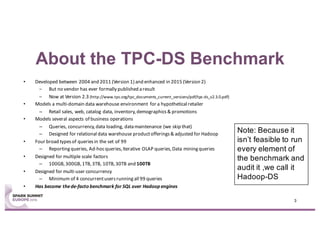
• Developed	between	2004	and	2011	(Version	1)	and	enhanced	in	2015	(Version	2)
‒ But	no	vendor	has	ever	formally	published	a	result
‒ Now	at	Version	2.3	(http://www.tpc.org/tpc_documents_current_versions/pdf/tpc-ds_v2.3.0.pdf)
• Models	a	multi-domain	data	warehouse	environment		for	a	hypothetical	retailer
– Retail	sales,	web,	catalog	data,	inventory,	demographics	&	promotions
• Models	several	aspects	of	business	operations
– Queries,	concurrency,	data	loading,	data	maintenance	(we	skip	that)
– Designed	for	relational	data	warehouse	product	offerings	&	adjusted	for	Hadoop
• Four	broad	types	of	queries	in	the	set	of	99
– Reporting	queries,	Ad-hoc	queries,	Iterative	OLAP	queries,	Data	mining	queries
• Designed	for	multiple	scale	factors
– 100GB,	300GB,	1TB,	3TB,	10TB,	30TB	and	100TB
• Designed	for	multi-user	concurrency
– Minimum	of	4	concurrent	users	running	all	99	queries
• Has	become	the	de-facto	benchmark	for	SQL	over	Hadoop	engines
3
Note: Because it
isn’t feasible to run
every element of
the benchmark and
audit it ,we call it
Hadoop-DS
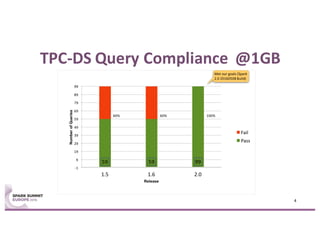
TPC-DS	Query	Compliance		@1GB
4
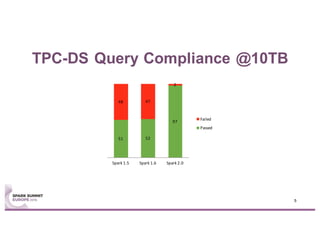
TPC-DS Query Compliance @10TB
51 52
97
48 47
2
Spark	1.5 Spark	1.6 Spark	2.0
Failed
Passed
5
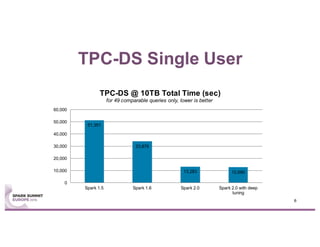
TPC-DS Single User
51,351
33,876
13,283 12,690
0
10,000
20,000
30,000
40,000
50,000
60,000
Spark 1.5 Spark 1.6 Spark 2.0 Spark 2.0 with deep
tuning
TPC-DS @ 10TB Total Time (sec)
for 49 comparable queries only, lower is better
6
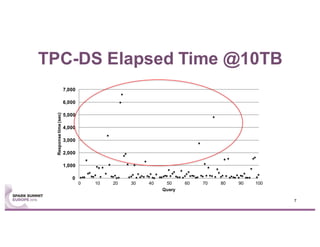
TPC-DS Elapsed Time @10TB
0
1,000
2,000
3,000
4,000
5,000
6,000
7,000
0 10 20 30 40 50 60 70 80 90 100
Responsetime(sec)
Query
7
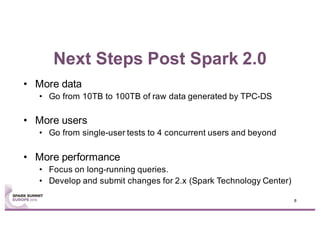
Next Steps Post Spark 2.0
• More data
• Go from 10TB to 100TB of raw data generated by TPC-DS
• More users
• Go from single-user tests to 4 concurrent users and beyond
• More performance
• Focus on long-running queries.
• Develop and submit changes for 2.x (Spark Technology Center)
8
IBM Technology Partners
to Evaluate “Spark SQL @ Scale”
9
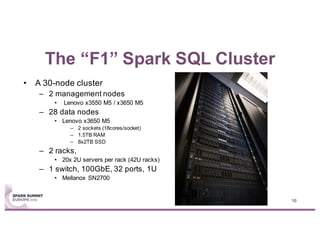
The “F1” Spark SQL Cluster
• A 30-node cluster
– 2 management nodes
• Lenovo x3550 M5 / x3650 M5
– 28 data nodes
• Lenovo x3650 M5
– 2 sockets (18cores/socket)
– 1.5TB RAM
– 8x2TB SSD
– 2 racks,
• 20x 2U servers per rack (42U racks)
– 1 switch, 100GbE, 32 ports, 1U
• Mellanox SN2700
10
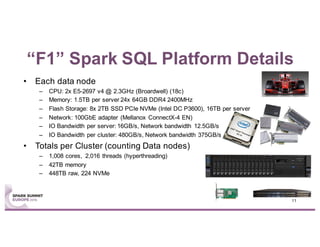
“F1” Spark SQL Platform Details
• Each data node
– CPU: 2x E5-2697 v4 @ 2.3GHz (Broardwell) (18c)
– Memory: 1.5TB per server 24x 64GB DDR4 2400MHz
– Flash Storage: 8x 2TB SSD PCIe NVMe (Intel DC P3600), 16TB per server
– Network: 100GbE adapter (Mellanox ConnectX-4 EN)
– IO Bandwidth per server: 16GB/s, Network bandwidth 12.5GB/s
– IO Bandwidth per cluster: 480GB/s, Network bandwidth 375GB/s
• Totals per Cluster (counting Data nodes)
– 1,008 cores, 2,016 threads (hyperthreading)
– 42TB memory
– 448TB raw, 224 NVMe
11
Configuring the OS
• Use a current OS (e.g. RHEL 7.2)
• We applied standard IBM Open Platform (IOP) guidance
– Tune memory segment management
– Increase process limit
– Disable transparent huge pages
– Tune the filesystem (we used XFS under HDFS)
• Validate I/O throughput (we use “TestIO” - see http://tate.cx)
12
Configuring the Network
• Again, we applied our ”best practice” recipes
• Even though we had a 100GbE Mellanox switch
there was ZERO unique tuning!
• Per-port and per-server tuning
• Lengthen timeouts & grow buffers – long/big queries
• Enable more retries and better keepalive
• Validate network performance
– iperf -c mer03x.svl.ibm.com -l 1024k -w 128k -P 4 -i 3 -t 30
13
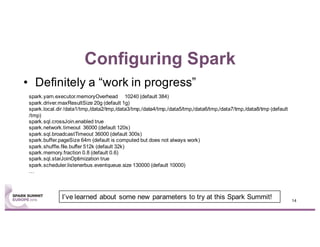
Configuring Spark
• Definitely a “work in progress”
14
spark.yarn.executor.memoryOverhead 10240 (default 384)
spark.driver.maxResultSize 20g (default 1g)
spark.local.dir /data1/tmp,/data2/tmp,/data3/tmp,/data4/tmp,/data5/tmp,/data6/tmp,/data7/tmp,/data8/tmp (default
/tmp)
spark.sql.crossJoin.enabled true
spark.network.timeout 36000 (default 120s)
spark.sql.broadcastTimeout 36000 (default 300s)
spark.buffer.pageSize 64m (default is computed but does not always work)
spark.shuffle.file.buffer 512k (default 32k)
spark.memory.fraction 0.8 (default 0.6)
spark.sql.starJoinOptimization true
spark.scheduler.listenerbus.eventqueue.size 130000 (default 10000)
…
I’ve learned about some new parameters to try at this Spark Summit!
Configuring Spark
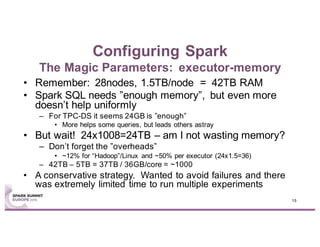
The Magic Parameters: executor-memory
• Remember: 28nodes, 1.5TB/node = 42TB RAM
• Spark SQL needs ”enough memory”, but even more
doesn’t help uniformly
– For TPC-DS it seems 24GB is ”enough”
• More helps some queries, but leads others astray
• But wait! 24x1008=24TB – am I not wasting memory?
– Don’t forget the ”overheads”
• ~12% for “Hadoop”/Linux and ~50% per executor (24x1.5=36)
– 42TB – 5TB = 37TB / 36GB/core = ~1000
• A conservative strategy. Wanted to avoid failures and there
was extremely limited time to run multiple experiments
15
Configuring Spark
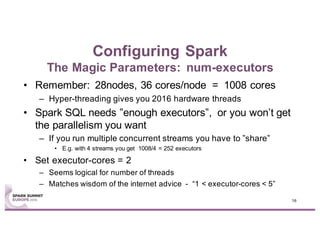
The Magic Parameters: num-executors
• Remember: 28nodes, 36 cores/node = 1008 cores
– Hyper-threading gives you 2016 hardware threads
• Spark SQL needs ”enough executors”, or you won’t get
the parallelism you want
– If you run multiple concurrent streams you have to ”share”
• E.g. with 4 streams you get 1008/4 = 252 executors
• Set executor-cores = 2
– Seems logical for number of threads
– Matches wisdom of the internet advice - “1 < executor-cores < 5”
16
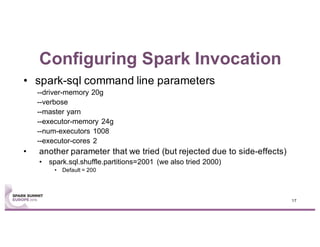
Configuring Spark Invocation
• spark-sql command line parameters
--driver-memory 20g
--verbose
--master yarn
--executor-memory 24g
--num-executors 1008
--executor-cores 2
• another parameter that we tried (but rejected due to side-effects)
• spark.sql.shuffle.partitions=2001 (we also tried 2000)
• Default = 200
17
0
500
1000
1500
2000
2500
3000
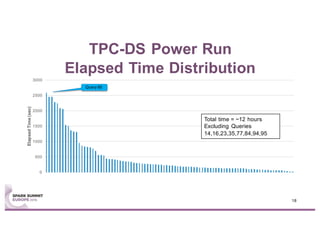
ElapsedTime(sec)
TPC-DS Power Run
Elapsed Time Distribution
Total time = ~12 hours
Excluding Queries
14,16,23,35,77,84,94,95
Query 80
18
SPARK-17791
Join Reordering Using Star Schema Detection
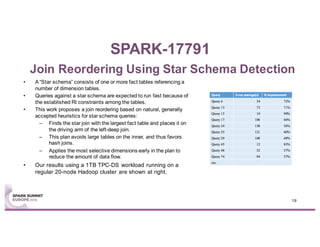
• A “Star schema” consists of one or more fact tables referencing a
number of dimension tables.
• Queries against a star schema are expected to run fast because of
the established RI constraints among the tables.
• This work proposes a join reordering based on natural, generally
accepted heuristics for star schema queries:
– Finds the star join with the largest fact table and places it on
the driving arm of the left-deep join.
– This plan avoids large tables on the inner, and thus favors
hash joins.
– Applies the most selective dimensions early in the plan to
reduce the amount of data flow.
• Our results using a 1TB TPC-DS workload running on a
regular 20-node Hadoop cluster are shown at right.
19
SPARK-17791
Join Reordering Using
Star Schema Detection
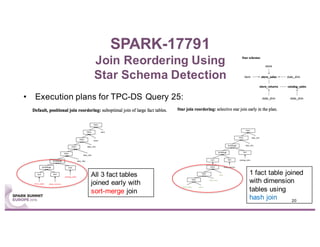
• Execution plans for TPC-DS Query 25:
20
All 3 fact tables
joined early with
sort-merge join
1 fact table joined
with dimension
tables using
hash join
Initial Analysis of “Failures”
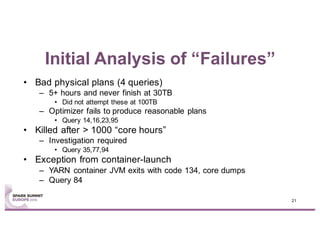
• Bad physical plans (4 queries)
– 5+ hours and never finish at 30TB
• Did not attempt these at 100TB
– Optimizer fails to produce reasonable plans
• Query 14,16,23,95
• Killed after > 1000 “core hours”
– Investigation required
• Query 35,77,94
• Exception from container-launch
– YARN container JVM exits with code 134, core dumps
– Query 84
21
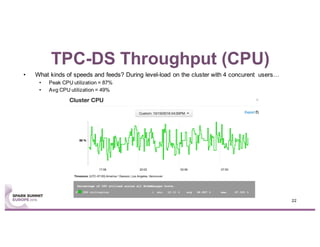
TPC-DS Throughput (CPU)
• What kinds of speeds and feeds? During level-load on the cluster with 4 concurent users…
• Peak CPU utilization = 87%
• Avg CPU utilization = 49%
22
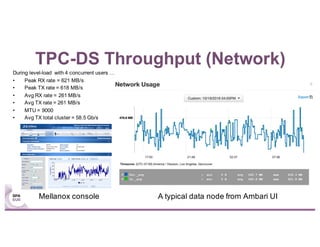
TPC-DS Throughput (Network)
During level-load with 4 concurrent users …
• Peak RX rate = 621 MB/s
• Peak TX rate = 618 MB/s
• Avg RX rate = 261 MB/s
• Avg TX rate = 261 MB/s
• MTU = 9000
• Avg TX total cluster = 58.5 Gb/s
23
A typical data node from Ambari UIMellanox console
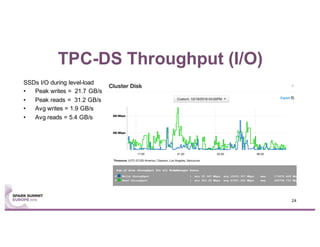
TPC-DS Throughput (I/O)
SSDs I/O during level-load
• Peak writes = 21.7 GB/s
• Peak reads = 31.2 GB/s
• Avg writes = 1.9 GB/s
• Avg reads = 5.4 GB/s
24
Summary
• Spark SQL 2.0 is a huge step forward. Spark SQL 2.1 seems stable.
• There are some valuable JIRAs in the queue
• Together, IBM, Intel, Lenovo and Mellanox constructed a ”State of the Art” system to
test out the hypothesis of a new Spark Cluster topology using latest Spark
• TPC-DS has proven itself to be a valuable and challenging workload
• The initial TPC-DS ”Power Test” (single user) did well
• Completing 92% (91 of 99 queries)
• The initial TPC-DS ”Throughput Test” with 4 concurrent users shows good scalability
• There are definitely areas that can and need to improve
• Great opportunities for the Spark community J
• Additional results will be forthcoming as we have time to run additional experiments.
25
SPARK SUMMIT
EUROPE2016
Thank-you!
schiefer@ca.ibm.com
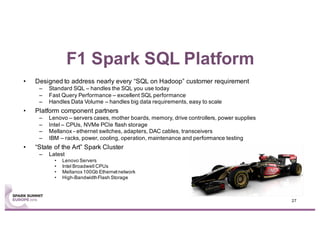
• Designed to address nearly every “SQL on Hadoop” customer requirement
– Standard SQL – handles the SQL you use today
– Fast Query Performance – excellent SQL performance
– Handles Data Volume – handles big data requirements, easy to scale
• Platform component partners
– Lenovo – servers cases, mother boards, memory, drive controllers, power supplies
– Intel – CPUs, NVMe PCIe flash storage
– Mellanox - ethernet switches, adapters, DAC cables, transceivers
– IBM – racks, power, cooling, operation, maintenance and performance testing
• “State of the Art” Spark Cluster
– Latest
• Lenovo Servers
• Intel Broadwell CPUs
• Mellanox 100Gb Ethernetnetwork
• High-BandwidthFlash Storage
F1 Spark SQL Platform
27
Intel® Xeon® Processor E5 v4
28
Intel® Xeon®
processor
E5-2600 v4
Intel® Xeon®
processor
E5-2600 v4
QPI
2 Channels
DDR4
LAN
Up to
4x10GbE
PCIe* 3.0, 40 lanes
Intel® C610
series
chipset
WBG
DDR4
DDR4
DDR4
DDR4
DDR4
DDR4
DDR4
Broadwell CPU
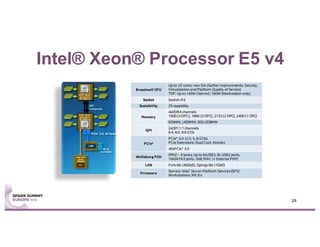
Up to 22 cores; new ISA (Gather improvements, Security,
Virtualization and Platform Quality of Service)
TDP: Up to 145W (Server); 160W (Workstation only)
Socket Socket-R3
Scalability 2S capability
Memory
4xDDR4 channels
1600 (3 DPC), 1866 (3 DPC), 2133 (2 DPC), 2400 (1 DPC)
RDIMM, LRDIMM, 3DS LRDIMM
QPI
2xQPI 1.1 channels
6.4, 8.0, 9.6 GT/s
PCIe*
PCIe* 3.0 (2.5, 5, 8 GT/s)
PCIe Extensions: Dual Cast, Atomics
40xPCIe* 3.0
Wellsburg PCH
DMI2 – 4 lanes; Up to 6xUSB3, 8x USB2 ports,
10xSATA3 ports; GbE MAC (+ External PHY)
LAN Fortville (40GbE), Springville (1GbE)
Firmware
Servers: Intel®
Server Platform Services (SPS)
Workstations: ME 9.x
Intel NVMe SSD Drives @2TB
29
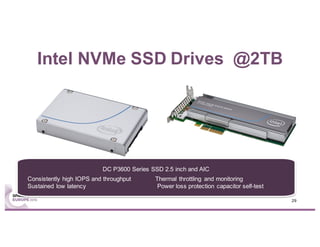
DC P3600 Series SSD 2.5 inch and AIC
Consistently high IOPS and throughput Thermal throttling and monitoring
Sustained low latency Power loss protection capacitor self-test
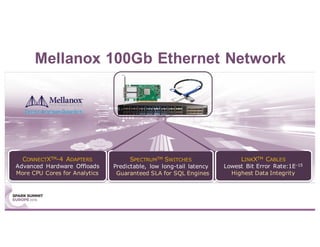
Mellanox 100Gb Ethernet Network
LINKXTM CABLES
Lowest Bit Error Rate:1E-15
Highest Data Integrity
CONNECTXTM-4 ADAPTERS
Advanced Hardware Offloads
More CPU Cores for Analytics
SPECTRUMTM SWITCHES
Predictable, low long-tail latency
Guaranteed SLA for SQL Engines
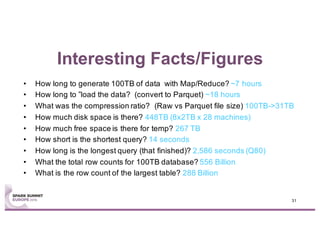
Interesting Facts/Figures
• How long to generate 100TB of data with Map/Reduce? ~7 hours
• How long to ”load the data? (convert to Parquet) ~18 hours
• What was the compression ratio? (Raw vs Parquet file size) 100TB->31TB
• How much disk space is there? 448TB (8x2TB x 28 machines)
• How much free space is there for temp? 267 TB
• How short is the shortest query? 14 seconds
• How long is the longest query (that finished)? 2,586 seconds (Q80)
• What the total row counts for 100TB database? 556 Billion
• What is the row count of the largest table? 288 Billion
31

Spark Summit EU talk by Berni Schiefer

  • 1.
    SPARK SUMMIT EUROPE2016 Spark SQL2.0/2.1 Experiences using TPC-DS Berni Schiefer IBM, Spark Technology Center
  • 2.
    Motivation • Spark SQLis very popular and rapidly evolving • Today it is still deployed mostly on ”traditional” Hadoop clusters • What if we dared to “re-imagine” a different kind of cluster, one designed for Spark? • Let’s try this out, using the latest version of Spark and a popular yet challenging industry-standard workload at a large enterprise scale 2
  • 3.
    About the TPC-DSBenchmark • Developed between 2004 and 2011 (Version 1) and enhanced in 2015 (Version 2) ‒ But no vendor has ever formally published a result ‒ Now at Version 2.3 (http://www.tpc.org/tpc_documents_current_versions/pdf/tpc-ds_v2.3.0.pdf) • Models a multi-domain data warehouse environment for a hypothetical retailer – Retail sales, web, catalog data, inventory, demographics & promotions • Models several aspects of business operations – Queries, concurrency, data loading, data maintenance (we skip that) – Designed for relational data warehouse product offerings & adjusted for Hadoop • Four broad types of queries in the set of 99 – Reporting queries, Ad-hoc queries, Iterative OLAP queries, Data mining queries • Designed for multiple scale factors – 100GB, 300GB, 1TB, 3TB, 10TB, 30TB and 100TB • Designed for multi-user concurrency – Minimum of 4 concurrent users running all 99 queries • Has become the de-facto benchmark for SQL over Hadoop engines 3 Note: Because it isn’t feasible to run every element of the benchmark and audit it ,we call it Hadoop-DS
  • 4.
  • 5.
    TPC-DS Query Compliance@10TB 51 52 97 48 47 2 Spark 1.5 Spark 1.6 Spark 2.0 Failed Passed 5
  • 6.
    TPC-DS Single User 51,351 33,876 13,28312,690 0 10,000 20,000 30,000 40,000 50,000 60,000 Spark 1.5 Spark 1.6 Spark 2.0 Spark 2.0 with deep tuning TPC-DS @ 10TB Total Time (sec) for 49 comparable queries only, lower is better 6
  • 7.
    TPC-DS Elapsed Time@10TB 0 1,000 2,000 3,000 4,000 5,000 6,000 7,000 0 10 20 30 40 50 60 70 80 90 100 Responsetime(sec) Query 7
  • 8.
    Next Steps PostSpark 2.0 • More data • Go from 10TB to 100TB of raw data generated by TPC-DS • More users • Go from single-user tests to 4 concurrent users and beyond • More performance • Focus on long-running queries. • Develop and submit changes for 2.x (Spark Technology Center) 8
  • 9.
    IBM Technology Partners toEvaluate “Spark SQL @ Scale” 9
  • 10.
    The “F1” SparkSQL Cluster • A 30-node cluster – 2 management nodes • Lenovo x3550 M5 / x3650 M5 – 28 data nodes • Lenovo x3650 M5 – 2 sockets (18cores/socket) – 1.5TB RAM – 8x2TB SSD – 2 racks, • 20x 2U servers per rack (42U racks) – 1 switch, 100GbE, 32 ports, 1U • Mellanox SN2700 10
  • 11.
    “F1” Spark SQLPlatform Details • Each data node – CPU: 2x E5-2697 v4 @ 2.3GHz (Broardwell) (18c) – Memory: 1.5TB per server 24x 64GB DDR4 2400MHz – Flash Storage: 8x 2TB SSD PCIe NVMe (Intel DC P3600), 16TB per server – Network: 100GbE adapter (Mellanox ConnectX-4 EN) – IO Bandwidth per server: 16GB/s, Network bandwidth 12.5GB/s – IO Bandwidth per cluster: 480GB/s, Network bandwidth 375GB/s • Totals per Cluster (counting Data nodes) – 1,008 cores, 2,016 threads (hyperthreading) – 42TB memory – 448TB raw, 224 NVMe 11
  • 12.
    Configuring the OS •Use a current OS (e.g. RHEL 7.2) • We applied standard IBM Open Platform (IOP) guidance – Tune memory segment management – Increase process limit – Disable transparent huge pages – Tune the filesystem (we used XFS under HDFS) • Validate I/O throughput (we use “TestIO” - see http://tate.cx) 12
  • 13.
    Configuring the Network •Again, we applied our ”best practice” recipes • Even though we had a 100GbE Mellanox switch there was ZERO unique tuning! • Per-port and per-server tuning • Lengthen timeouts & grow buffers – long/big queries • Enable more retries and better keepalive • Validate network performance – iperf -c mer03x.svl.ibm.com -l 1024k -w 128k -P 4 -i 3 -t 30 13
  • 14.
    Configuring Spark • Definitelya “work in progress” 14 spark.yarn.executor.memoryOverhead 10240 (default 384) spark.driver.maxResultSize 20g (default 1g) spark.local.dir /data1/tmp,/data2/tmp,/data3/tmp,/data4/tmp,/data5/tmp,/data6/tmp,/data7/tmp,/data8/tmp (default /tmp) spark.sql.crossJoin.enabled true spark.network.timeout 36000 (default 120s) spark.sql.broadcastTimeout 36000 (default 300s) spark.buffer.pageSize 64m (default is computed but does not always work) spark.shuffle.file.buffer 512k (default 32k) spark.memory.fraction 0.8 (default 0.6) spark.sql.starJoinOptimization true spark.scheduler.listenerbus.eventqueue.size 130000 (default 10000) … I’ve learned about some new parameters to try at this Spark Summit!
  • 15.
    Configuring Spark The MagicParameters: executor-memory • Remember: 28nodes, 1.5TB/node = 42TB RAM • Spark SQL needs ”enough memory”, but even more doesn’t help uniformly – For TPC-DS it seems 24GB is ”enough” • More helps some queries, but leads others astray • But wait! 24x1008=24TB – am I not wasting memory? – Don’t forget the ”overheads” • ~12% for “Hadoop”/Linux and ~50% per executor (24x1.5=36) – 42TB – 5TB = 37TB / 36GB/core = ~1000 • A conservative strategy. Wanted to avoid failures and there was extremely limited time to run multiple experiments 15
  • 16.
    Configuring Spark The MagicParameters: num-executors • Remember: 28nodes, 36 cores/node = 1008 cores – Hyper-threading gives you 2016 hardware threads • Spark SQL needs ”enough executors”, or you won’t get the parallelism you want – If you run multiple concurrent streams you have to ”share” • E.g. with 4 streams you get 1008/4 = 252 executors • Set executor-cores = 2 – Seems logical for number of threads – Matches wisdom of the internet advice - “1 < executor-cores < 5” 16
  • 17.
    Configuring Spark Invocation •spark-sql command line parameters --driver-memory 20g --verbose --master yarn --executor-memory 24g --num-executors 1008 --executor-cores 2 • another parameter that we tried (but rejected due to side-effects) • spark.sql.shuffle.partitions=2001 (we also tried 2000) • Default = 200 17
  • 18.
    0 500 1000 1500 2000 2500 3000 ElapsedTime(sec) TPC-DS Power Run ElapsedTime Distribution Total time = ~12 hours Excluding Queries 14,16,23,35,77,84,94,95 Query 80 18
  • 19.
    SPARK-17791 Join Reordering UsingStar Schema Detection • A “Star schema” consists of one or more fact tables referencing a number of dimension tables. • Queries against a star schema are expected to run fast because of the established RI constraints among the tables. • This work proposes a join reordering based on natural, generally accepted heuristics for star schema queries: – Finds the star join with the largest fact table and places it on the driving arm of the left-deep join. – This plan avoids large tables on the inner, and thus favors hash joins. – Applies the most selective dimensions early in the plan to reduce the amount of data flow. • Our results using a 1TB TPC-DS workload running on a regular 20-node Hadoop cluster are shown at right. 19
  • 20.
    SPARK-17791 Join Reordering Using StarSchema Detection • Execution plans for TPC-DS Query 25: 20 All 3 fact tables joined early with sort-merge join 1 fact table joined with dimension tables using hash join
  • 21.
    Initial Analysis of“Failures” • Bad physical plans (4 queries) – 5+ hours and never finish at 30TB • Did not attempt these at 100TB – Optimizer fails to produce reasonable plans • Query 14,16,23,95 • Killed after > 1000 “core hours” – Investigation required • Query 35,77,94 • Exception from container-launch – YARN container JVM exits with code 134, core dumps – Query 84 21
  • 22.
    TPC-DS Throughput (CPU) •What kinds of speeds and feeds? During level-load on the cluster with 4 concurent users… • Peak CPU utilization = 87% • Avg CPU utilization = 49% 22
  • 23.
    TPC-DS Throughput (Network) Duringlevel-load with 4 concurrent users … • Peak RX rate = 621 MB/s • Peak TX rate = 618 MB/s • Avg RX rate = 261 MB/s • Avg TX rate = 261 MB/s • MTU = 9000 • Avg TX total cluster = 58.5 Gb/s 23 A typical data node from Ambari UIMellanox console
  • 24.
    TPC-DS Throughput (I/O) SSDsI/O during level-load • Peak writes = 21.7 GB/s • Peak reads = 31.2 GB/s • Avg writes = 1.9 GB/s • Avg reads = 5.4 GB/s 24
  • 25.
    Summary • Spark SQL2.0 is a huge step forward. Spark SQL 2.1 seems stable. • There are some valuable JIRAs in the queue • Together, IBM, Intel, Lenovo and Mellanox constructed a ”State of the Art” system to test out the hypothesis of a new Spark Cluster topology using latest Spark • TPC-DS has proven itself to be a valuable and challenging workload • The initial TPC-DS ”Power Test” (single user) did well • Completing 92% (91 of 99 queries) • The initial TPC-DS ”Throughput Test” with 4 concurrent users shows good scalability • There are definitely areas that can and need to improve • Great opportunities for the Spark community J • Additional results will be forthcoming as we have time to run additional experiments. 25
  • 26.
  • 27.
    • Designed toaddress nearly every “SQL on Hadoop” customer requirement – Standard SQL – handles the SQL you use today – Fast Query Performance – excellent SQL performance – Handles Data Volume – handles big data requirements, easy to scale • Platform component partners – Lenovo – servers cases, mother boards, memory, drive controllers, power supplies – Intel – CPUs, NVMe PCIe flash storage – Mellanox - ethernet switches, adapters, DAC cables, transceivers – IBM – racks, power, cooling, operation, maintenance and performance testing • “State of the Art” Spark Cluster – Latest • Lenovo Servers • Intel Broadwell CPUs • Mellanox 100Gb Ethernetnetwork • High-BandwidthFlash Storage F1 Spark SQL Platform 27
  • 28.
    Intel® Xeon® ProcessorE5 v4 28 Intel® Xeon® processor E5-2600 v4 Intel® Xeon® processor E5-2600 v4 QPI 2 Channels DDR4 LAN Up to 4x10GbE PCIe* 3.0, 40 lanes Intel® C610 series chipset WBG DDR4 DDR4 DDR4 DDR4 DDR4 DDR4 DDR4 Broadwell CPU Up to 22 cores; new ISA (Gather improvements, Security, Virtualization and Platform Quality of Service) TDP: Up to 145W (Server); 160W (Workstation only) Socket Socket-R3 Scalability 2S capability Memory 4xDDR4 channels 1600 (3 DPC), 1866 (3 DPC), 2133 (2 DPC), 2400 (1 DPC) RDIMM, LRDIMM, 3DS LRDIMM QPI 2xQPI 1.1 channels 6.4, 8.0, 9.6 GT/s PCIe* PCIe* 3.0 (2.5, 5, 8 GT/s) PCIe Extensions: Dual Cast, Atomics 40xPCIe* 3.0 Wellsburg PCH DMI2 – 4 lanes; Up to 6xUSB3, 8x USB2 ports, 10xSATA3 ports; GbE MAC (+ External PHY) LAN Fortville (40GbE), Springville (1GbE) Firmware Servers: Intel® Server Platform Services (SPS) Workstations: ME 9.x
  • 29.
    Intel NVMe SSDDrives @2TB 29 DC P3600 Series SSD 2.5 inch and AIC Consistently high IOPS and throughput Thermal throttling and monitoring Sustained low latency Power loss protection capacitor self-test
  • 30.
    Mellanox 100Gb EthernetNetwork LINKXTM CABLES Lowest Bit Error Rate:1E-15 Highest Data Integrity CONNECTXTM-4 ADAPTERS Advanced Hardware Offloads More CPU Cores for Analytics SPECTRUMTM SWITCHES Predictable, low long-tail latency Guaranteed SLA for SQL Engines
  • 31.
    Interesting Facts/Figures • Howlong to generate 100TB of data with Map/Reduce? ~7 hours • How long to ”load the data? (convert to Parquet) ~18 hours • What was the compression ratio? (Raw vs Parquet file size) 100TB->31TB • How much disk space is there? 448TB (8x2TB x 28 machines) • How much free space is there for temp? 267 TB • How short is the shortest query? 14 seconds • How long is the longest query (that finished)? 2,586 seconds (Q80) • What the total row counts for 100TB database? 556 Billion • What is the row count of the largest table? 288 Billion 31