
Performance Characterization
of In-Memory Data Analytics on
a Scale-up Server
Ahsan Javed Awan
KTH Royal Institute of Technology
Motivation
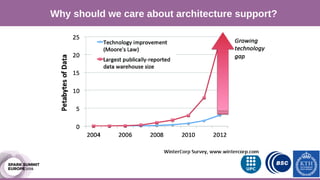
Why should we care about architecture support?
Motivation
Cont..
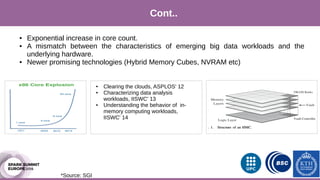
*Source: SGI
● Exponential increase in core count.
● A mismatch between the characteristics of emerging big data workloads and the
underlying hardware.
● Newer promising technologies (Hybrid Memory Cubes, NVRAM etc)
● Clearing the clouds, ASPLOS' 12
● Characterizing data analysis
workloads, IISWC' 13
● Understanding the behavior of in-
memory computing workloads,
IISWC' 14
Motivation
Cont...
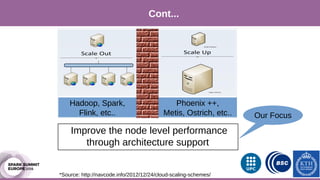
Improve the node level performance
through architecture support
*Source: http://navcode.info/2012/12/24/cloud-scaling-schemes/
Phoenix ++,
Metis, Ostrich, etc..
Hadoop, Spark,
Flink, etc.. Our Focus
Our Approach
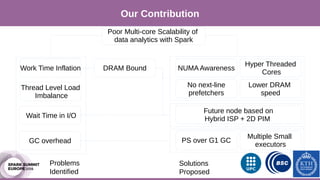
Our Contribution
Problems
Identified
Solutions
Proposed
Work Time Inflation
Poor Multi-core Scalability of
data analytics with Spark
Thread Level Load
Imbalance
Wait Time in I/O
GC overhead
DRAM Bound NUMA Awareness
Hyper Threaded
Cores
No next-line
prefetchers
Lower DRAM
speed
Future node based on
Hybrid ISP + 2D PIM
PS over G1 GC
Multiple Small
executors
Which Scale-out Framework ?
[Picture Courtesy: Amir H. Payberah]
● Tuning of Spark internal Parameters
● Tuning of JVM Parameters (Heap size etc..)
● Micro-architecture Level Analysis using Hardware Performance Counters.
Progress Meeting 12-12-14
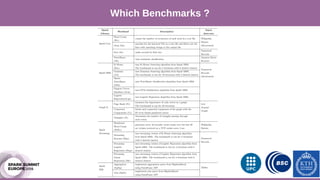
Which Benchmarks ?
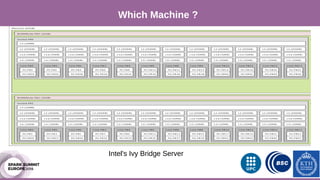
Our Hardware Configuration
Which Machine ?
Intel's Ivy Bridge Server
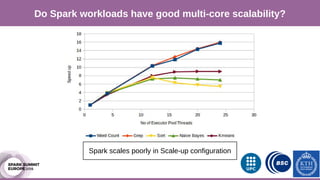
Multicore Scalability of Spark
Do Spark workloads have good multi-core scalability?
Spark scales poorly in Scale-up configuration
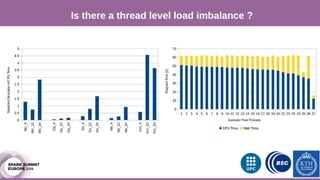
Is there a thread level load imbalance ?
Motivation
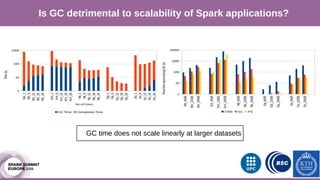
Is GC detrimental to scalability of Spark applications?
GC time does not scale linearly at larger datasets
Motivation
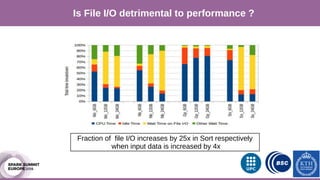
Is File I/O detrimental to performance ?
Fraction of file I/O increases by 25x in Sort respectively
when input data is increased by 4x
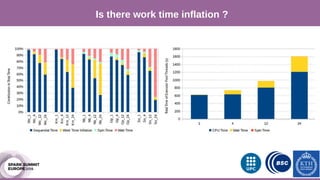
Is there work time inflation ?
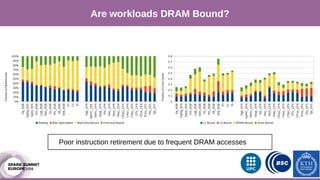
Are workloads DRAM Bound?
Poor instruction retirement due to frequent DRAM accesses
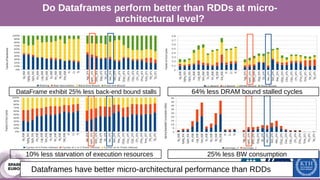
Do Dataframes perform better than RDDs at micro-
architectural level?
DataFrame exhibit 25% less back-end bound stalls 64% less DRAM bound stalled cycles
25% less BW consumption10% less starvation of execution resources
Dataframes have better micro-architectural performance than RDDs
Motivation
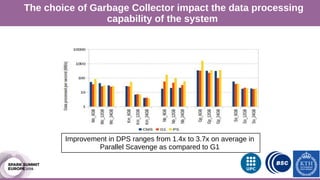
The choice of Garbage Collector impact the data processing
capability of the system
Improvement in DPS ranges from 1.4x to 3.7x on average in
Parallel Scavenge as compared to G1
Our Approach
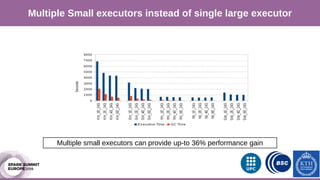
Multiple Small executors instead of single large executor
Multiple small executors can provide up-to 36% performance gain
Our Approach
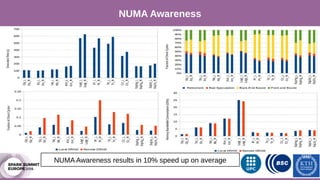
NUMA Awareness
NUMA Awareness results in 10% speed up on average
Our Approach
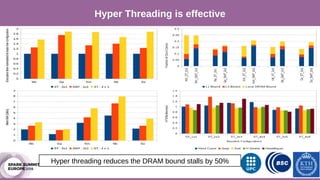
Hyper Threading is effective
Hyper threading reduces the DRAM bound stalls by 50%
Our Approach
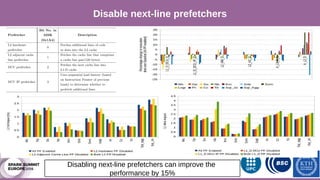
Disable next-line prefetchers
Disabling next-line prefetchers can improve the
performance by 15%
Our Approach
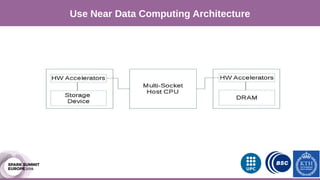
Use Near Data Computing Architecture
Our Approach
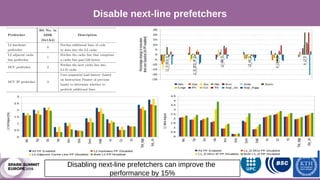
Disable next-line prefetchers
Disabling next-line prefetchers can improve the
performance by 15%
Our Approach
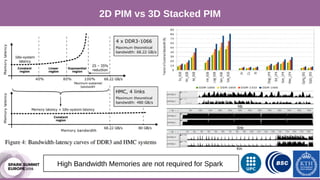
2D PIM vs 3D Stacked PIM
High Bandwidth Memories are not required for Spark
Our Approach
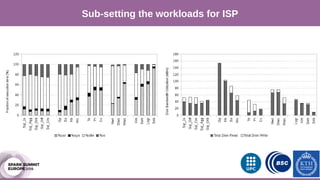
Sub-setting the workloads for ISP
Our Approach
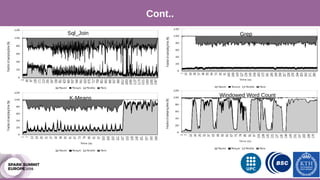
Cont..
Sql_Join Grep
K-Means
Windowed Word Count
Our Approach
Cont..
●
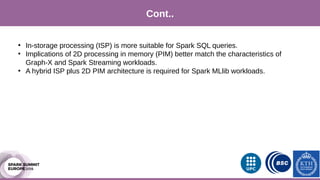
In-storage processing (ISP) is more suitable for Spark SQL queries.
●
Implications of 2D processing in memory (PIM) better match the characteristics of
Graph-X and Spark Streaming workloads.
●
A hybrid ISP plus 2D PIM architecture is required for Spark MLlib workloads.
Our Approach
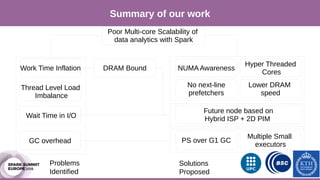
Summary of our work
Problems
Identified
Solutions
Proposed
Work Time Inflation
Poor Multi-core Scalability of
data analytics with Spark
Thread Level Load
Imbalance
Wait Time in I/O
GC overhead
DRAM Bound NUMA Awareness
Hyper Threaded
Cores
No next-line
prefetchers
Lower DRAM
speed
Future node based on
Hybrid ISP + 2D PIM
PS over G1 GC
Multiple Small
executors
Our Approach
Further Reading
●
Performance characterization of in-memory data analytics on a modern cloud server, in 5th
IEEE
Conference on Big Data and Cloud Computing, 2015 (Best Paper Award).
●
How Data Volume Affects Spark Based Data Analytics on a Scale-up Server in 6th
Workshop on
Big Data Benchmarks, Performance Optimization and Emerging Hardware (BpoE), held in
conjunction with VLDB 2015, Hawaii, USA .
●
Micro-architectural Characterization of Apache Spark on Batch and Stream Processing Workloads,
in 6th
IEEE Conference on Big Data and Cloud Computing, 2016.
●
Node Architecture Implications for In-Memory Data Analytics in Scale-in Clusters in 3rd
IEEE/ACM
Conference in Big Data Computing, Applications and Technologies, 2016.
●
Implications of In-Memory Data Analytics with Apache Spark on Near Data Computing
Architectures (under submission).
THANK YOU.
Email: ajawan@kth.se
Profile: www.kth.se/profile/ajawan/
Acknowledgements:
Mats Brorsson(KTH)
Vladimir Vlassov(KTH)
Eduard Ayguade(UPC/BSC)

Spark Summit EU talk by Ahsan Javed Awan

  • 1.
    Performance Characterization of In-MemoryData Analytics on a Scale-up Server Ahsan Javed Awan KTH Royal Institute of Technology
  • 2.
    Motivation Why should wecare about architecture support?
  • 3.
    Motivation Cont.. *Source: SGI ● Exponentialincrease in core count. ● A mismatch between the characteristics of emerging big data workloads and the underlying hardware. ● Newer promising technologies (Hybrid Memory Cubes, NVRAM etc) ● Clearing the clouds, ASPLOS' 12 ● Characterizing data analysis workloads, IISWC' 13 ● Understanding the behavior of in- memory computing workloads, IISWC' 14
  • 4.
    Motivation Cont... Improve the nodelevel performance through architecture support *Source: http://navcode.info/2012/12/24/cloud-scaling-schemes/ Phoenix ++, Metis, Ostrich, etc.. Hadoop, Spark, Flink, etc.. Our Focus
  • 5.
    Our Approach Our Contribution Problems Identified Solutions Proposed WorkTime Inflation Poor Multi-core Scalability of data analytics with Spark Thread Level Load Imbalance Wait Time in I/O GC overhead DRAM Bound NUMA Awareness Hyper Threaded Cores No next-line prefetchers Lower DRAM speed Future node based on Hybrid ISP + 2D PIM PS over G1 GC Multiple Small executors
  • 6.
    Which Scale-out Framework? [Picture Courtesy: Amir H. Payberah] ● Tuning of Spark internal Parameters ● Tuning of JVM Parameters (Heap size etc..) ● Micro-architecture Level Analysis using Hardware Performance Counters.
  • 7.
  • 8.
    Our Hardware Configuration WhichMachine ? Intel's Ivy Bridge Server
  • 9.
    Multicore Scalability ofSpark Do Spark workloads have good multi-core scalability? Spark scales poorly in Scale-up configuration
  • 10.
    Is there athread level load imbalance ?
  • 11.
    Motivation Is GC detrimentalto scalability of Spark applications? GC time does not scale linearly at larger datasets
  • 12.
    Motivation Is File I/Odetrimental to performance ? Fraction of file I/O increases by 25x in Sort respectively when input data is increased by 4x
  • 13.
    Is there worktime inflation ?
  • 14.
    Are workloads DRAMBound? Poor instruction retirement due to frequent DRAM accesses
  • 15.
    Do Dataframes performbetter than RDDs at micro- architectural level? DataFrame exhibit 25% less back-end bound stalls 64% less DRAM bound stalled cycles 25% less BW consumption10% less starvation of execution resources Dataframes have better micro-architectural performance than RDDs
  • 16.
    Motivation The choice ofGarbage Collector impact the data processing capability of the system Improvement in DPS ranges from 1.4x to 3.7x on average in Parallel Scavenge as compared to G1
  • 17.
    Our Approach Multiple Smallexecutors instead of single large executor Multiple small executors can provide up-to 36% performance gain
  • 18.
    Our Approach NUMA Awareness NUMAAwareness results in 10% speed up on average
  • 19.
    Our Approach Hyper Threadingis effective Hyper threading reduces the DRAM bound stalls by 50%
  • 20.
    Our Approach Disable next-lineprefetchers Disabling next-line prefetchers can improve the performance by 15%
  • 21.
    Our Approach Use NearData Computing Architecture
  • 22.
    Our Approach Disable next-lineprefetchers Disabling next-line prefetchers can improve the performance by 15%
  • 23.
    Our Approach 2D PIMvs 3D Stacked PIM High Bandwidth Memories are not required for Spark
  • 24.
  • 25.
  • 26.
    Our Approach Cont.. ● In-storage processing(ISP) is more suitable for Spark SQL queries. ● Implications of 2D processing in memory (PIM) better match the characteristics of Graph-X and Spark Streaming workloads. ● A hybrid ISP plus 2D PIM architecture is required for Spark MLlib workloads.
  • 27.
    Our Approach Summary ofour work Problems Identified Solutions Proposed Work Time Inflation Poor Multi-core Scalability of data analytics with Spark Thread Level Load Imbalance Wait Time in I/O GC overhead DRAM Bound NUMA Awareness Hyper Threaded Cores No next-line prefetchers Lower DRAM speed Future node based on Hybrid ISP + 2D PIM PS over G1 GC Multiple Small executors
  • 28.
    Our Approach Further Reading ● Performancecharacterization of in-memory data analytics on a modern cloud server, in 5th IEEE Conference on Big Data and Cloud Computing, 2015 (Best Paper Award). ● How Data Volume Affects Spark Based Data Analytics on a Scale-up Server in 6th Workshop on Big Data Benchmarks, Performance Optimization and Emerging Hardware (BpoE), held in conjunction with VLDB 2015, Hawaii, USA . ● Micro-architectural Characterization of Apache Spark on Batch and Stream Processing Workloads, in 6th IEEE Conference on Big Data and Cloud Computing, 2016. ● Node Architecture Implications for In-Memory Data Analytics in Scale-in Clusters in 3rd IEEE/ACM Conference in Big Data Computing, Applications and Technologies, 2016. ● Implications of In-Memory Data Analytics with Apache Spark on Near Data Computing Architectures (under submission).
  • 29.
    THANK YOU. Email: ajawan@kth.se Profile:www.kth.se/profile/ajawan/ Acknowledgements: Mats Brorsson(KTH) Vladimir Vlassov(KTH) Eduard Ayguade(UPC/BSC)