SPARK SUMMIT
EUROPE2016
Distributed Computing with Spark
for Actionable Business Insights!
Stephan Kessler
SAP SE, Spark Developer
Who I am
• Stephan Kessler
• SAP HANA Vora Team, Walldorf,
Germany
• Integrating SAP engines into Apache Spark
since almost two years
• 2nd Spark Summit as a speaker
Today’s talk
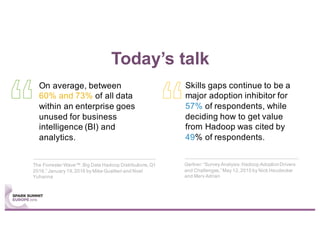
On average, between
60% and 73% of all data
within an enterprise goes
unused for business
intelligence (BI) and
analytics.
Skills gaps continue to be a
major adoption inhibitor for
57% of respondents, while
deciding how to get value
from Hadoop was cited by
49% of respondents.
The Forrester Wave™:Big Data Hadoop Distributions,Q1
2016,” January 19,2016 by Mike Gualtieri and Noel
Yuhanna
Gartner:“Survey Analysis:Hadoop AdoptionDrivers
and Challenges,” May 12,2015 by Nick Heudecker
and Merv Adrian
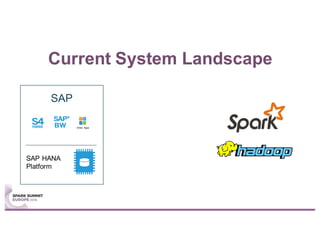
Current System Landscape
SAP
SAP HANA
Platform
Other Apps
What is missing?
• Business application perspective:
• Access to Big Data Landscape in a standardized way
• Similar SQL expressiveness
• Big Data / Data Science perspective:
• Access to specialized engines to perform analysis
close to the data
• Integration of ‘business engines’ into Spark
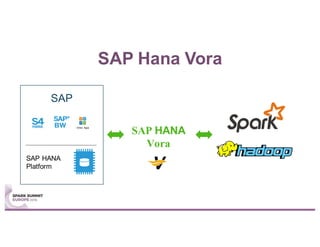
SAP Hana Vora
SAP
SAP HANA
Platform
Other Apps
SAP HANA
Vora
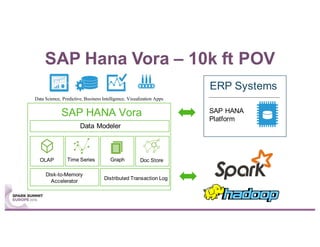
SAP Hana Vora – 10k ft POV
Data Science, Predictive, Business Intelligence, Visualization Apps
SAP HANA Vora
Data Modeler
OLAP Time Series Graph Doc Store
Disk-to-Memory
Accelerator
Distributed Transaction Log
ERP Systems
SAP HANA
Platform
Goals
• Make data and functionality available in
enterprise applications as well as Spark
applications
• Allow an easy consumption, i.e., allow users to
write SQL for computation jobs
Agenda
• Business functionality integration in Spark
• Utilizing different data sources in Spark
• HANA Vora 1.3
• Summary & Outlook
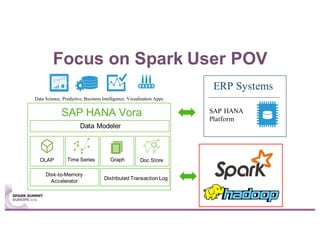
Focus on Spark User POV
Data Science, Predictive, Business Intelligence, Visualization Apps
SAP HANA Vora
Data Modeler
OLAP Time Series Graph Doc Store
Disk-to-Memory
Accelerator
Distributed Transaction Log
ERP Systems
SAP HANA
Platform
Business Functionality in Spark
• Questions answered in Spark:
– What is the sentiment of users for product XYZ?
– When will a certain part of this machinery fail?
• You might also want to know…
– What is the sales volume for XYZ?
– How much did this part cost?
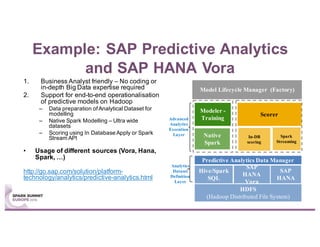
Example: SAP Predictive Analytics
and SAP HANA Vora
1. Business Analyst friendly – No coding or
in-depth Big Data expertise required
2. Support for end-to-end operationalisation
of predictive models on Hadoop
– Data preparation of Analytical Dataset for
modelling
– Native Spark Modelling – Ultra wide
datasets
– Scoring using In Database Apply or Spark
Stream API
• Usage of different sources (Vora, Hana,
Spark, …)
http://go.sap.com/solution/platform-
technology/analytics/predictive-analytics.html
HDFS
(Hadoop Distributed File System)
Hive/Spark
SQL
SAP
HANA
Vora
Model Lifecycle Manager (Factory)
Scorer
Predictive Analytics Data Manager
In-DB
scoring
Analytics
Dataset
Definition
Layer
Advanced
Analytics
Execution
Layer Spark
Streaming
Modeler -
Training
Native
Spark
SAP
HANA
Business Functionality in Spark
• Important typical ERP function
– Currency Conversion (i.e., EUR à GBP)
– Done via SQL UDF
• Required to analyze enterprise data in Spark
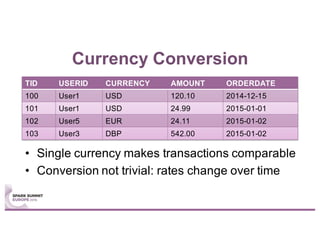
Currency Conversion
• Single currency makes transactions comparable
• Conversion not trivial: rates change over time
TID USERID CURRENCY AMOUNT ORDERDATE
100 User1 USD 120.10 2014-12-15
101 User1 USD 24.99 2015-01-01
102 User5 EUR 24.11 2015-01-02
103 User3 DBP 542.00 2015-01-02
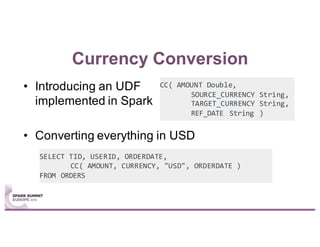
Currency Conversion
• Introducing an UDF
implemented in Spark
• Converting everything in USD
CC( AMOUNT Double,
SOURCE_CURRENCY String,
TARGET_CURRENCY String,
REF_DATE String )
SELECT TID, USERID, ORDERDATE,
CC( AMOUNT, CURRENCY, "USD", ORDERDATE )
FROM ORDERS
Currency Conversion
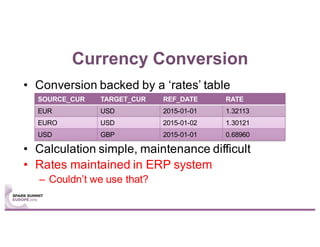
• Conversion backed by a ‘rates’ table
• Calculation simple, maintenance difficult
• Rates maintained in ERP system
– Couldn’t we use that?
SOURCE_CUR TARGET_CUR REF_DATE RATE
EUR USD 2015-01-01 1.32113
EURO USD 2015-01-02 1.30121
USD GBP 2015-01-01 0.68960
Specialized Engine: Time Series
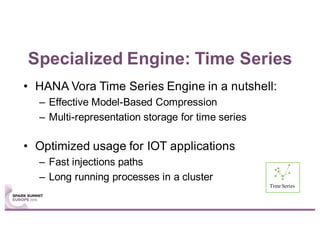
• HANA Vora Time Series Engine in a nutshell:
– Effective Model-Based Compression
– Multi-representation storage for time series
• Optimized usage for IOT applications
– Fast injections paths
– Long running processes in a cluster
Time Series
Specialized Engine: Time Series
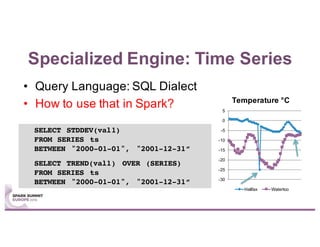
• Query Language: SQL Dialect
• How to use that in Spark?
-30
-25
-20
-15
-10
-5
0
5
Temperature °C
Halifax Waterloo
SELECT STDDEV(val1)
FROM SERIES ts
BETWEEN "2000-01-01", "2001-12-31”
SELECT TREND(val1) OVER (SERIES)
FROM SERIES ts
BETWEEN "2000-01-01", "2001-12-31”
Agenda
• Business functionality integration in Spark
• Utilizing different data sources in Spark
• HANA Vora 1.3
• Summary & Outlook
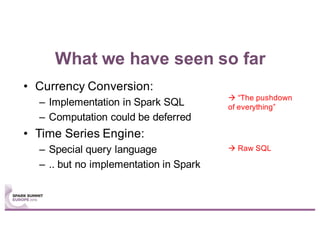
What we have seen so far
• Currency Conversion:
– Implementation in Spark SQL
– Computation could be deferred
• Time Series Engine:
– Special query language
– .. but no implementation in Spark
à “The pushdown
of everything”
à Raw SQL
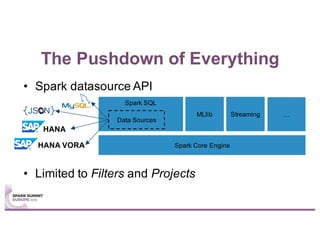
The Pushdown of Everything
• Spark datasource API
• Limited to Filters and Projects
Spark SQL
Spark Core Engine
Data Sources
MLlib Streaming …
HANA
HANA VORA
Vora Extension to Datasource API
• Datasource indicates its processing capabilities
• Arbitrary parts of logical plan can be computed
where the data is
• Details in Spark Summit Europe Talk 2015
– https://www.youtube.com/watch?v=QNaf2Z8l8IY
– “The Pushdown of Everything”
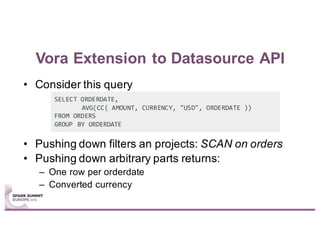
Vora Extension to Datasource API
• Consider this query
• Pushing down filters an projects: SCAN on orders
• Pushing down arbitrary parts returns:
– One row per orderdate
– Converted currency
SELECT ORDERDATE,
AVG(CC( AMOUNT, CURRENCY, "USD", ORDERDATE ))
FROM ORDERS
GROUP BY ORDERDATE
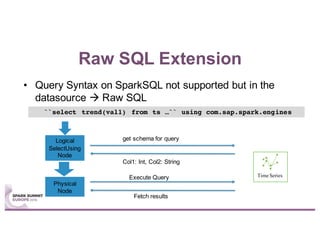
• Query Syntax on SparkSQL not supported but in the
datasource à Raw SQL
Raw SQL Extension
``select trend(val1) from ts …`` using com.sap.spark.engines
Logical
SelectUsing
Node
get schema for query
Col1: Int, Col2: String
Physical
Node
Execute Query
Fetch results
Time Series
Pushdown & Raw SQL
• Both extensions allow to incorporate other data
sources extensively
• Computation happens where the data is
• Integration is mostly seamless for Spark
developer
• Interfaces are open source:
– https://github.com/SAP/HANAVora-Extensions
Agenda
• Business functionality integration in Spark
• Utilizing different data sources in Spark
• HANA Vora 1.3
• Summary & Outlook
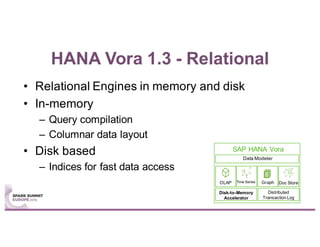
HANA Vora 1.3 - Relational
• Relational Engines in memory and disk
• In-memory
– Query compilation
– Columnar data layout
• Disk based
– Indices for fast data access
SAP HANA Vora
Data Modeler
OLAP Time Series Graph Doc Store
Disk-to-Memory
Accelerator
Distributed
Transaction Log
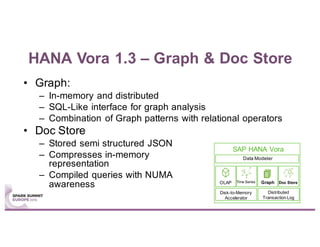
HANA Vora 1.3 – Graph & Doc Store
• Graph:
– In-memory and distributed
– SQL-Like interface for graph analysis
– Combination of Graph patterns with relational operators
• Doc Store
– Stored semi structured JSON
– Compresses in-memory
representation
– Compiled queries with NUMA
awareness
SAP HANA Vora
Data Modeler
OLAP Time Series Graph Doc Store
Disk-to-Memory
Accelerator
Distributed
Transaction Log
Agenda
• Business functionality integration in Spark
• Utilizing different data sources in Spark
• HANA Vora 1.3
• Summary & Outlook
Summary and Outlook
• Vora allows to combine all data source in an
enterprise environment
– Across different query languages
– While moving computation close to the data
• Business Insights are driven by all the available
data in the enterprise
• Integration into SQL makes it easily consumable
SPARK SUMMIT
EUROPE2016
THANK YOU.
Stephan Kessler – stephan.kessler@sap.com
BACKUP
HANA Vora 1.3
• Project started 2013 by HANA Research Teams
• Shared concepts and libraries with HANA but
independently developed
• Concepts
– In memory
– Distributed engines
– Low memory footprint SAP HANA
Vora
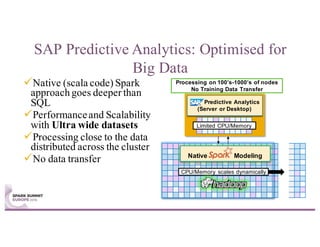
SAP Predictive Analytics: Optimised for
Big Data
üNative (scala code) Spark
approach goes deeper than
SQL
üPerformanceand Scalability
with Ultra wide datasets
üProcessing close to the data
distributed across the cluster
üNo data transfer
CPU/Memory scales dynamically
Native Modeling
Processing on 100’s-1000’s of nodes
No Training Data Transfer
Predictive Analytics
(Server or Desktop)
Limited CPU/Memory

Spark Summit EU talk by Stephan Kessler

  • 1.
    SPARK SUMMIT EUROPE2016 Distributed Computingwith Spark for Actionable Business Insights! Stephan Kessler SAP SE, Spark Developer
  • 2.
    Who I am •Stephan Kessler • SAP HANA Vora Team, Walldorf, Germany • Integrating SAP engines into Apache Spark since almost two years • 2nd Spark Summit as a speaker
  • 3.
    Today’s talk On average,between 60% and 73% of all data within an enterprise goes unused for business intelligence (BI) and analytics. Skills gaps continue to be a major adoption inhibitor for 57% of respondents, while deciding how to get value from Hadoop was cited by 49% of respondents. The Forrester Wave™:Big Data Hadoop Distributions,Q1 2016,” January 19,2016 by Mike Gualtieri and Noel Yuhanna Gartner:“Survey Analysis:Hadoop AdoptionDrivers and Challenges,” May 12,2015 by Nick Heudecker and Merv Adrian
  • 4.
    Current System Landscape SAP SAPHANA Platform Other Apps
  • 5.
    What is missing? •Business application perspective: • Access to Big Data Landscape in a standardized way • Similar SQL expressiveness • Big Data / Data Science perspective: • Access to specialized engines to perform analysis close to the data • Integration of ‘business engines’ into Spark
  • 6.
    SAP Hana Vora SAP SAPHANA Platform Other Apps SAP HANA Vora
  • 7.
    SAP Hana Vora– 10k ft POV Data Science, Predictive, Business Intelligence, Visualization Apps SAP HANA Vora Data Modeler OLAP Time Series Graph Doc Store Disk-to-Memory Accelerator Distributed Transaction Log ERP Systems SAP HANA Platform
  • 8.
    Goals • Make dataand functionality available in enterprise applications as well as Spark applications • Allow an easy consumption, i.e., allow users to write SQL for computation jobs
  • 9.
    Agenda • Business functionalityintegration in Spark • Utilizing different data sources in Spark • HANA Vora 1.3 • Summary & Outlook
  • 10.
    Focus on SparkUser POV Data Science, Predictive, Business Intelligence, Visualization Apps SAP HANA Vora Data Modeler OLAP Time Series Graph Doc Store Disk-to-Memory Accelerator Distributed Transaction Log ERP Systems SAP HANA Platform
  • 11.
    Business Functionality inSpark • Questions answered in Spark: – What is the sentiment of users for product XYZ? – When will a certain part of this machinery fail? • You might also want to know… – What is the sales volume for XYZ? – How much did this part cost?
  • 12.
    Example: SAP PredictiveAnalytics and SAP HANA Vora 1. Business Analyst friendly – No coding or in-depth Big Data expertise required 2. Support for end-to-end operationalisation of predictive models on Hadoop – Data preparation of Analytical Dataset for modelling – Native Spark Modelling – Ultra wide datasets – Scoring using In Database Apply or Spark Stream API • Usage of different sources (Vora, Hana, Spark, …) http://go.sap.com/solution/platform- technology/analytics/predictive-analytics.html HDFS (Hadoop Distributed File System) Hive/Spark SQL SAP HANA Vora Model Lifecycle Manager (Factory) Scorer Predictive Analytics Data Manager In-DB scoring Analytics Dataset Definition Layer Advanced Analytics Execution Layer Spark Streaming Modeler - Training Native Spark SAP HANA
  • 13.
    Business Functionality inSpark • Important typical ERP function – Currency Conversion (i.e., EUR à GBP) – Done via SQL UDF • Required to analyze enterprise data in Spark
  • 14.
    Currency Conversion • Singlecurrency makes transactions comparable • Conversion not trivial: rates change over time TID USERID CURRENCY AMOUNT ORDERDATE 100 User1 USD 120.10 2014-12-15 101 User1 USD 24.99 2015-01-01 102 User5 EUR 24.11 2015-01-02 103 User3 DBP 542.00 2015-01-02
  • 15.
    Currency Conversion • Introducingan UDF implemented in Spark • Converting everything in USD CC( AMOUNT Double, SOURCE_CURRENCY String, TARGET_CURRENCY String, REF_DATE String ) SELECT TID, USERID, ORDERDATE, CC( AMOUNT, CURRENCY, "USD", ORDERDATE ) FROM ORDERS
  • 16.
    Currency Conversion • Conversionbacked by a ‘rates’ table • Calculation simple, maintenance difficult • Rates maintained in ERP system – Couldn’t we use that? SOURCE_CUR TARGET_CUR REF_DATE RATE EUR USD 2015-01-01 1.32113 EURO USD 2015-01-02 1.30121 USD GBP 2015-01-01 0.68960
  • 17.
    Specialized Engine: TimeSeries • HANA Vora Time Series Engine in a nutshell: – Effective Model-Based Compression – Multi-representation storage for time series • Optimized usage for IOT applications – Fast injections paths – Long running processes in a cluster Time Series
  • 18.
    Specialized Engine: TimeSeries • Query Language: SQL Dialect • How to use that in Spark? -30 -25 -20 -15 -10 -5 0 5 Temperature °C Halifax Waterloo SELECT STDDEV(val1) FROM SERIES ts BETWEEN "2000-01-01", "2001-12-31” SELECT TREND(val1) OVER (SERIES) FROM SERIES ts BETWEEN "2000-01-01", "2001-12-31”
  • 19.
    Agenda • Business functionalityintegration in Spark • Utilizing different data sources in Spark • HANA Vora 1.3 • Summary & Outlook
  • 20.
    What we haveseen so far • Currency Conversion: – Implementation in Spark SQL – Computation could be deferred • Time Series Engine: – Special query language – .. but no implementation in Spark à “The pushdown of everything” à Raw SQL
  • 21.
    The Pushdown ofEverything • Spark datasource API • Limited to Filters and Projects Spark SQL Spark Core Engine Data Sources MLlib Streaming … HANA HANA VORA
  • 22.
    Vora Extension toDatasource API • Datasource indicates its processing capabilities • Arbitrary parts of logical plan can be computed where the data is • Details in Spark Summit Europe Talk 2015 – https://www.youtube.com/watch?v=QNaf2Z8l8IY – “The Pushdown of Everything”
  • 23.
    Vora Extension toDatasource API • Consider this query • Pushing down filters an projects: SCAN on orders • Pushing down arbitrary parts returns: – One row per orderdate – Converted currency SELECT ORDERDATE, AVG(CC( AMOUNT, CURRENCY, "USD", ORDERDATE )) FROM ORDERS GROUP BY ORDERDATE
  • 24.
    • Query Syntaxon SparkSQL not supported but in the datasource à Raw SQL Raw SQL Extension ``select trend(val1) from ts …`` using com.sap.spark.engines Logical SelectUsing Node get schema for query Col1: Int, Col2: String Physical Node Execute Query Fetch results Time Series
  • 25.
    Pushdown & RawSQL • Both extensions allow to incorporate other data sources extensively • Computation happens where the data is • Integration is mostly seamless for Spark developer • Interfaces are open source: – https://github.com/SAP/HANAVora-Extensions
  • 26.
    Agenda • Business functionalityintegration in Spark • Utilizing different data sources in Spark • HANA Vora 1.3 • Summary & Outlook
  • 27.
    HANA Vora 1.3- Relational • Relational Engines in memory and disk • In-memory – Query compilation – Columnar data layout • Disk based – Indices for fast data access SAP HANA Vora Data Modeler OLAP Time Series Graph Doc Store Disk-to-Memory Accelerator Distributed Transaction Log
  • 28.
    HANA Vora 1.3– Graph & Doc Store • Graph: – In-memory and distributed – SQL-Like interface for graph analysis – Combination of Graph patterns with relational operators • Doc Store – Stored semi structured JSON – Compresses in-memory representation – Compiled queries with NUMA awareness SAP HANA Vora Data Modeler OLAP Time Series Graph Doc Store Disk-to-Memory Accelerator Distributed Transaction Log
  • 29.
    Agenda • Business functionalityintegration in Spark • Utilizing different data sources in Spark • HANA Vora 1.3 • Summary & Outlook
  • 30.
    Summary and Outlook •Vora allows to combine all data source in an enterprise environment – Across different query languages – While moving computation close to the data • Business Insights are driven by all the available data in the enterprise • Integration into SQL makes it easily consumable
  • 31.
    SPARK SUMMIT EUROPE2016 THANK YOU. StephanKessler – stephan.kessler@sap.com
  • 32.
  • 33.
    HANA Vora 1.3 •Project started 2013 by HANA Research Teams • Shared concepts and libraries with HANA but independently developed • Concepts – In memory – Distributed engines – Low memory footprint SAP HANA Vora
  • 34.
    SAP Predictive Analytics:Optimised for Big Data üNative (scala code) Spark approach goes deeper than SQL üPerformanceand Scalability with Ultra wide datasets üProcessing close to the data distributed across the cluster üNo data transfer CPU/Memory scales dynamically Native Modeling Processing on 100’s-1000’s of nodes No Training Data Transfer Predictive Analytics (Server or Desktop) Limited CPU/Memory