1© Cloudera, Inc. All rights reserved.
Apache Kudu & Apache Spark SQL
for Fast Analytics on Fast Data
Mike Percy
Software Engineer at Cloudera
Apache Kudu PMC member
2© Cloudera, Inc. All rights reserved.
Kudu Overview
3© Cloudera, Inc. All rights reserved.
HDFS
Fast Scans, Analytics
and Processing of
Static Data
Fast On-Line
Updates &
Data Serving
Arbitrary Storage
(Active Archive)
Fast Analytics
(on fast-changing or
frequently-updated data)
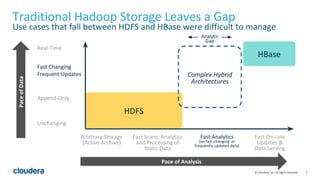
Traditional Hadoop Storage Leaves a Gap
Use cases that fall between HDFS and HBase were difficult to manage
Unchanging
Fast Changing
Frequent Updates
HBase
Append-Only
Real-Time
Complex Hybrid
Architectures
Analytic
Gap
Pace of Analysis
PaceofData
4© Cloudera, Inc. All rights reserved.
HDFS
Fast Scans, Analytics
and Processing of
Static Data
Fast On-Line
Updates &
Data Serving
Arbitrary Storage
(Active Archive)
Fast Analytics
(on fast-changing or
frequently-updated data)
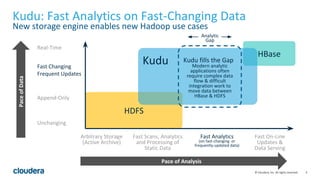
Kudu: Fast Analytics on Fast-Changing Data
New storage engine enables new Hadoop use cases
Unchanging
Fast Changing
Frequent Updates
HBase
Append-Only
Real-Time
Kudu Kudu fills the Gap
Modern analytic
applications often
require complex data
flow & difficult
integration work to
move data between
HBase & HDFS
Analytic
Gap
Pace of Analysis
PaceofData
5© Cloudera, Inc. All rights reserved.
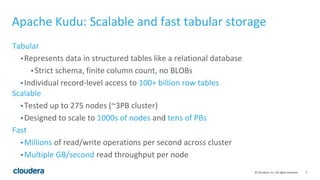
Apache Kudu: Scalable and fast tabular storage
Tabular
• Represents data in structured tables like a relational database
• Strict schema, finite column count, no BLOBs
• Individual record-level access to 100+ billion row tables
Scalable
• Tested up to 275 nodes (~3PB cluster)
• Designed to scale to 1000s of nodes and tens of PBs
Fast
• Millions of read/write operations per second across cluster
• Multiple GB/second read throughput per node
6© Cloudera, Inc. All rights reserved.
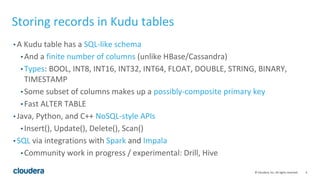
Storing records in Kudu tables
• A Kudu table has a SQL-like schema
• And a finite number of columns (unlike HBase/Cassandra)
• Types: BOOL, INT8, INT16, INT32, INT64, FLOAT, DOUBLE, STRING, BINARY,
TIMESTAMP
• Some subset of columns makes up a possibly-composite primary key
• Fast ALTER TABLE
• Java, Python, and C++ NoSQL-style APIs
• Insert(), Update(), Delete(), Scan()
• SQL via integrations with Spark and Impala
• Community work in progress / experimental: Drill, Hive
7© Cloudera, Inc. All rights reserved.
Kudu SQL access
- Kudu itself is just storage and native “NoSQL” APIs
- SQL access via integrations with Spark, Impala, etc.
8© Cloudera, Inc. All rights reserved.
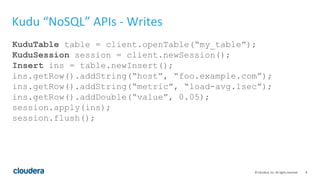
Kudu “NoSQL” APIs - Writes
KuduTable table = client.openTable(“my_table”);
KuduSession session = client.newSession();
Insert ins = table.newInsert();
ins.getRow().addString(“host”, “foo.example.com”);
ins.getRow().addString(“metric”, “load-avg.1sec”);
ins.getRow().addDouble(“value”, 0.05);
session.apply(ins);
session.flush();
9© Cloudera, Inc. All rights reserved.
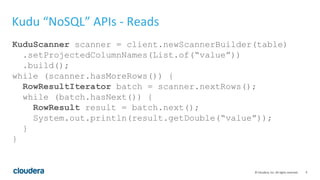
Kudu “NoSQL” APIs - Reads
KuduScanner scanner = client.newScannerBuilder(table)
.setProjectedColumnNames(List.of(“value”))
.build();
while (scanner.hasMoreRows()) {
RowResultIterator batch = scanner.nextRows();
while (batch.hasNext()) {
RowResult result = batch.next();
System.out.println(result.getDouble(“value”));
}
}
10© Cloudera, Inc. All rights reserved.
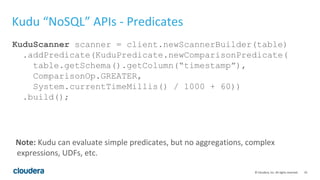
Kudu “NoSQL” APIs - Predicates
KuduScanner scanner = client.newScannerBuilder(table)
.addPredicate(KuduPredicate.newComparisonPredicate(
table.getSchema().getColumn(“timestamp”),
ComparisonOp.GREATER,
System.currentTimeMillis() / 1000 + 60))
.build();
Note: Kudu can evaluate simple predicates, but no aggregations, complex
expressions, UDFs, etc.
11© Cloudera, Inc. All rights reserved.
Tables and tablets
• Each table is horizontally partitioned into tablets
• Range or hash partitioning
• PRIMARY KEY (host, metric, timestamp) DISTRIBUTE BY
HASH(timestamp) INTO 100 BUCKETS
• Translation: bucketNumber = hashCode(row[‘timestamp’]) % 100
• Each tablet has N replicas (3 or 5), kept consistent with Raft consensus
• Tablet servers host tablets on local disk drives
12© Cloudera, Inc. All rights reserved.
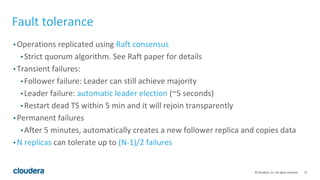
Fault tolerance
• Operations replicated using Raft consensus
• Strict quorum algorithm. See Raft paper for details
• Transient failures:
• Follower failure: Leader can still achieve majority
• Leader failure: automatic leader election (~5 seconds)
• Restart dead TS within 5 min and it will rejoin transparently
• Permanent failures
• After 5 minutes, automatically creates a new follower replica and copies data
• N replicas can tolerate up to (N-1)/2 failures
13© Cloudera, Inc. All rights reserved.
Metadata
• Replicated master
• Acts as a tablet directory
• Acts as a catalog (which tables exist, etc)
• Acts as a load balancer (tracks TS liveness, re-replicates under-replicated
tablets)
• Caches all metadata in RAM for high performance
• Client configured with master addresses
• Asks master for tablet locations as needed and caches them
14© Cloudera, Inc. All rights reserved.
Integrations
Kudu is designed for integrating with higher-level compute frameworks
Integrations exist for:
• Spark
• Impala
• MapReduce
• Flume
• Drill
15© Cloudera, Inc. All rights reserved.
What Kudu brings to Spark
• Parquet-like scan performance with 0-delay inserts and updates
• Push down predicate filters for fast & efficient scans
• Primary key indexing for fast point lookups (compared to Parquet)
16© Cloudera, Inc. All rights reserved.
Spark DataSource
17© Cloudera, Inc. All rights reserved.
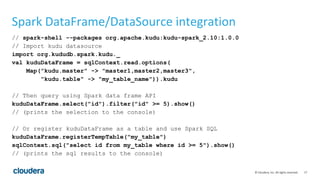
Spark DataFrame/DataSource integration
// spark-shell --packages org.apache.kudu:kudu-spark_2.10:1.0.0
// Import kudu datasource
import org.kududb.spark.kudu._
val kuduDataFrame = sqlContext.read.options(
Map("kudu.master" -> "master1,master2,master3",
"kudu.table" -> "my_table_name")).kudu
// Then query using Spark data frame API
kuduDataFrame.select("id").filter("id" >= 5).show()
// (prints the selection to the console)
// Or register kuduDataFrame as a table and use Spark SQL
kuduDataFrame.registerTempTable("my_table")
sqlContext.sql("select id from my_table where id >= 5").show()
// (prints the sql results to the console)
18© Cloudera, Inc. All rights reserved.
Quick demo
19© Cloudera, Inc. All rights reserved.
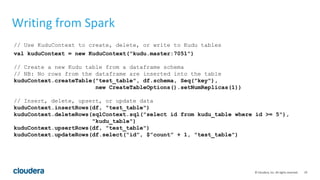
Writing from Spark
// Use KuduContext to create, delete, or write to Kudu tables
val kuduContext = new KuduContext("kudu.master:7051")
// Create a new Kudu table from a dataframe schema
// NB: No rows from the dataframe are inserted into the table
kuduContext.createTable("test_table", df.schema, Seq("key"),
new CreateTableOptions().setNumReplicas(1))
// Insert, delete, upsert, or update data
kuduContext.insertRows(df, "test_table")
kuduContext.deleteRows(sqlContext.sql("select id from kudu_table where id >= 5"),
"kudu_table")
kuduContext.upsertRows(df, "test_table")
kuduContext.updateRows(df.select(“id”, $”count” + 1, "test_table")
20© Cloudera, Inc. All rights reserved.
Spark DataSource optimizations
Column projection and predicate pushdown
- Only read the referenced columns
- Convert ‘WHERE’ clauses into Kudu predicates
- Kudu predicates automatically convert to primary key scans, etc
scala> sqlContext.sql("select avg(value) from metrics where host =
'e1103.halxg.cloudera.com'").explain
== Physical Plan ==
TungstenAggregate(key=[], functions=[(avg(value#3),mode=Final,isDistinct=false)], output=[_c0#94])
+- TungstenExchange SinglePartition, None
+- TungstenAggregate(key=[], functions=[(avg(value#3),mode=Partial,isDistinct=false)],
output=[sum#98,count#99L])
+- Project [value#3]
+- Scan org.apache.kudu.spark.kudu.KuduRelation@e13cc49[value#3]
PushedFilters: [EqualTo(host,e1103.halxg.cloudera.com)]
21© Cloudera, Inc. All rights reserved.
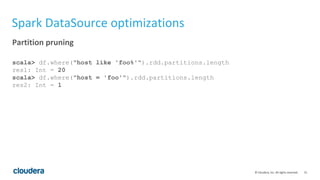
Spark DataSource optimizations
Partition pruning
scala> df.where("host like 'foo%'").rdd.partitions.length
res1: Int = 20
scala> df.where("host = 'foo'").rdd.partitions.length
res2: Int = 1
22© Cloudera, Inc. All rights reserved.
Use cases
23© Cloudera, Inc. All rights reserved.
Kudu use cases
Kudu is best for use cases requiring:
• Simultaneous combination of sequential and random reads and writes
• Minimal to zero data latencies
Time series
• Examples: Streaming market data; fraud detection & prevention; network monitoring
• Workload: Inserts, updates, scans, lookups
Online reporting / data warehousing
• Example: Operational Data Store (ODS)
• Workload: Inserts, updates, scans, lookups
24© Cloudera, Inc. All rights reserved.
Xiaomi use case
• World’s 4th
largest smart-phone maker (most popular in China)
• Gather important RPC tracing events from mobile app and backend service.
• Service monitoring & troubleshooting tool.
High write throughput
• >20 Billion records/day and growing
Query latest data and quick response
• Identify and resolve issues quickly
Can search for individual records
• Easy for troubleshooting
25© Cloudera, Inc. All rights reserved.
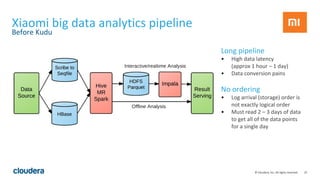
Xiaomi big data analytics pipeline
Before Kudu
Long pipeline
• High data latency
(approx 1 hour – 1 day)
• Data conversion pains
No ordering
• Log arrival (storage) order is
not exactly logical order
• Must read 2 – 3 days of data
to get all of the data points
for a single day
26© Cloudera, Inc. All rights reserved.
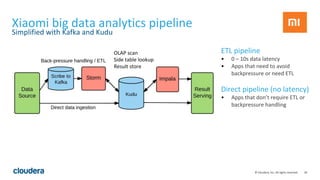
Xiaomi big data analytics pipeline
Simplified with Kafka and Kudu
ETL pipeline
• 0 – 10s data latency
• Apps that need to avoid
backpressure or need ETL
Direct pipeline (no latency)
• Apps that don’t require ETL or
backpressure handling
OLAP scan
Side table lookup
Result store
27© Cloudera, Inc. All rights reserved.
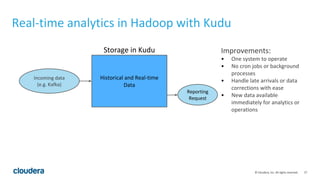
Real-time analytics in Hadoop with Kudu
Improvements:
• One system to operate
• No cron jobs or background
processes
• Handle late arrivals or data
corrections with ease
• New data available
immediately for analytics or
operations
Historical and Real-time
Data
Incoming data
(e.g. Kafka)
Reporting
Request
Storage in Kudu
28© Cloudera, Inc. All rights reserved.
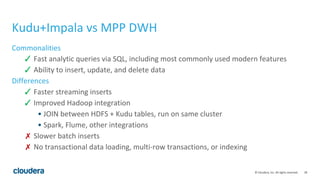
Kudu+Impala vs MPP DWH
Commonalities
✓ Fast analytic queries via SQL, including most commonly used modern features
✓ Ability to insert, update, and delete data
Differences
✓ Faster streaming inserts
✓ Improved Hadoop integration
• JOIN between HDFS + Kudu tables, run on same cluster
• Spark, Flume, other integrations
✗ Slower batch inserts
✗ No transactional data loading, multi-row transactions, or indexing
29© Cloudera, Inc. All rights reserved.
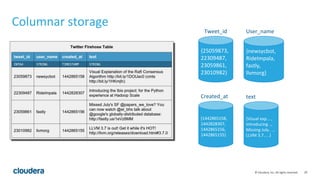
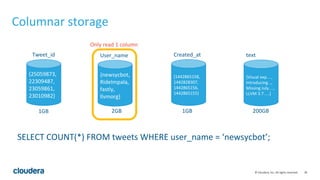
Columnar storage
{25059873,
22309487,
23059861,
23010982}
Tweet_id
{newsycbot,
RideImpala,
fastly,
llvmorg}
User_name
{1442865158,
1442828307,
1442865156,
1442865155}
Created_at
{Visual exp…,
Introducing ..,
Missing July…,
LLVM 3.7….}
text
30© Cloudera, Inc. All rights reserved.
Columnar storage
{25059873,
22309487,
23059861,
23010982}
Tweet_id
{newsycbot,
RideImpala,
fastly,
llvmorg}
User_name
{1442865158,
1442828307,
1442865156,
1442865155}
Created_at
{Visual exp…,
Introducing ..,
Missing July…,
LLVM 3.7….}
text
SELECT COUNT(*) FROM tweets WHERE user_name = ‘newsycbot’;
Only read 1 column
1GB 2GB 1GB 200GB
31© Cloudera, Inc. All rights reserved.
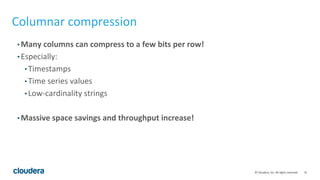
Columnar compression
• Many columns can compress to a few bits per row!
• Especially:
• Timestamps
• Time series values
• Low-cardinality strings
• Massive space savings and throughput increase!
32© Cloudera, Inc. All rights reserved.
Kudu Roadmap
33© Cloudera, Inc. All rights reserved.
Open Source “Roadmaps”?
- Kudu is an open source ASF project
- ASF governance means there is no guaranteed roadmap
- Whatever people contribute is the roadmap!
- But I can speak to what my team will be focusing on
- Disclaimer: quality-first mantra = fuzzy timeline commitments
34© Cloudera, Inc. All rights reserved.
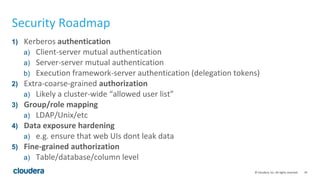
Security Roadmap
1) Kerberos authentication
a) Client-server mutual authentication
a) Server-server mutual authentication
b) Execution framework-server authentication (delegation tokens)
2) Extra-coarse-grained authorization
a) Likely a cluster-wide “allowed user list”
3) Group/role mapping
a) LDAP/Unix/etc
4) Data exposure hardening
a) e.g. ensure that web UIs dont leak data
5) Fine-grained authorization
a) Table/database/column level
35© Cloudera, Inc. All rights reserved.
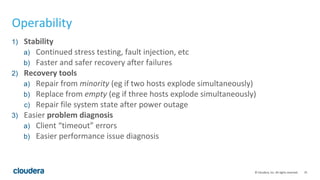
Operability
1) Stability
a) Continued stress testing, fault injection, etc
b) Faster and safer recovery after failures
2) Recovery tools
a) Repair from minority (eg if two hosts explode simultaneously)
b) Replace from empty (eg if three hosts explode simultaneously)
c) Repair file system state after power outage
3) Easier problem diagnosis
a) Client “timeout” errors
b) Easier performance issue diagnosis
36© Cloudera, Inc. All rights reserved.
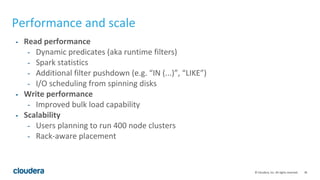
Performance and scale
- Read performance
- Dynamic predicates (aka runtime filters)
- Spark statistics
- Additional filter pushdown (e.g. “IN (...)”, “LIKE”)
- I/O scheduling from spinning disks
- Write performance
- Improved bulk load capability
- Scalability
- Users planning to run 400 node clusters
- Rack-aware placement
37© Cloudera, Inc. All rights reserved.
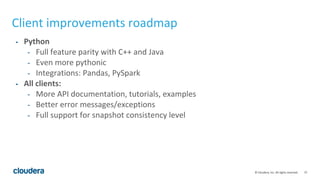
Client improvements roadmap
- Python
- Full feature parity with C++ and Java
- Even more pythonic
- Integrations: Pandas, PySpark
- All clients:
- More API documentation, tutorials, examples
- Better error messages/exceptions
- Full support for snapshot consistency level
38© Cloudera, Inc. All rights reserved.
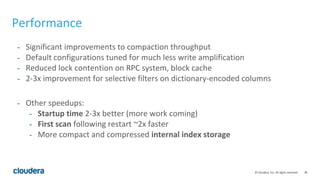
Performance
- Significant improvements to compaction throughput
- Default configurations tuned for much less write amplification
- Reduced lock contention on RPC system, block cache
- 2-3x improvement for selective filters on dictionary-encoded columns
- Other speedups:
- Startup time 2-3x better (more work coming)
- First scan following restart ~2x faster
- More compact and compressed internal index storage
39© Cloudera, Inc. All rights reserved.
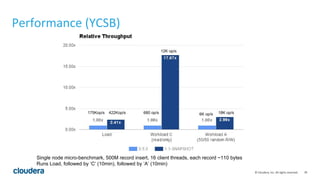
Performance (YCSB)
Single node micro-benchmark, 500M record insert, 16 client threads, each record ~110 bytes
Runs Load, followed by ‘C’ (10min), followed by ‘A’ (10min)
175Kop/s 422Kop/s 680 op/s
12K op/s
6K op/s 18K op/s
40© Cloudera, Inc. All rights reserved.
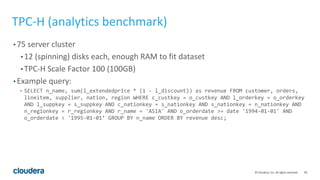
TPC-H (analytics benchmark)
• 75 server cluster
• 12 (spinning) disks each, enough RAM to fit dataset
• TPC-H Scale Factor 100 (100GB)
• Example query:
• SELECT n_name, sum(l_extendedprice * (1 - l_discount)) as revenue FROM customer, orders,
lineitem, supplier, nation, region WHERE c_custkey = o_custkey AND l_orderkey = o_orderkey
AND l_suppkey = s_suppkey AND c_nationkey = s_nationkey AND s_nationkey = n_nationkey AND
n_regionkey = r_regionkey AND r_name = 'ASIA' AND o_orderdate >= date '1994-01-01' AND
o_orderdate < '1995-01-01’ GROUP BY n_name ORDER BY revenue desc;
41© Cloudera, Inc. All rights reserved.
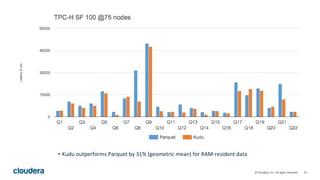
• Kudu outperforms Parquet by 31% (geometric mean) for RAM-resident data
42© Cloudera, Inc. All rights reserved.
Versus other NoSQL storage
• Apache Phoenix: OLTP SQL engine built on HBase
• 10 node cluster (9 worker, 1 master)
• TPC-H LINEITEM table only (6B rows)
43© Cloudera, Inc. All rights reserved.
Joining the growing community
44© Cloudera, Inc. All rights reserved.
Apache Kudu Community
45© Cloudera, Inc. All rights reserved.
Getting started as a user
• On the web: kudu.apache.org
• User mailing list: user@kudu.apache.org
• Public Slack chat channel (see web site for the link)
• Quickstart VM
• Easiest way to get started
• Impala and Kudu in an easy-to-install VM
• CSD and Parcels
• For installation on a Cloudera Manager-managed cluster
46© Cloudera, Inc. All rights reserved.
Getting started as a developer
• Source code: github.com/apache/kudu - all commits go here first
• Code reviews: gerrit.cloudera.org - all code reviews are public
• Developer mailing list: dev@kudu.apache.org
• Public JIRA: issues.apache.org/jira/browse/KUDU - includes bug history since 2013
Contributions are welcome and strongly encouraged!
47© Cloudera, Inc. All rights reserved.
kudu.apache.org
@mike_percy | @ApacheKudu

Spark Summit EU talk by Mike Percy

  • 1.
    1© Cloudera, Inc.All rights reserved. Apache Kudu & Apache Spark SQL for Fast Analytics on Fast Data Mike Percy Software Engineer at Cloudera Apache Kudu PMC member
  • 2.
    2© Cloudera, Inc.All rights reserved. Kudu Overview
  • 3.
    3© Cloudera, Inc.All rights reserved. HDFS Fast Scans, Analytics and Processing of Static Data Fast On-Line Updates & Data Serving Arbitrary Storage (Active Archive) Fast Analytics (on fast-changing or frequently-updated data) Traditional Hadoop Storage Leaves a Gap Use cases that fall between HDFS and HBase were difficult to manage Unchanging Fast Changing Frequent Updates HBase Append-Only Real-Time Complex Hybrid Architectures Analytic Gap Pace of Analysis PaceofData
  • 4.
    4© Cloudera, Inc.All rights reserved. HDFS Fast Scans, Analytics and Processing of Static Data Fast On-Line Updates & Data Serving Arbitrary Storage (Active Archive) Fast Analytics (on fast-changing or frequently-updated data) Kudu: Fast Analytics on Fast-Changing Data New storage engine enables new Hadoop use cases Unchanging Fast Changing Frequent Updates HBase Append-Only Real-Time Kudu Kudu fills the Gap Modern analytic applications often require complex data flow & difficult integration work to move data between HBase & HDFS Analytic Gap Pace of Analysis PaceofData
  • 5.
    5© Cloudera, Inc.All rights reserved. Apache Kudu: Scalable and fast tabular storage Tabular • Represents data in structured tables like a relational database • Strict schema, finite column count, no BLOBs • Individual record-level access to 100+ billion row tables Scalable • Tested up to 275 nodes (~3PB cluster) • Designed to scale to 1000s of nodes and tens of PBs Fast • Millions of read/write operations per second across cluster • Multiple GB/second read throughput per node
  • 6.
    6© Cloudera, Inc.All rights reserved. Storing records in Kudu tables • A Kudu table has a SQL-like schema • And a finite number of columns (unlike HBase/Cassandra) • Types: BOOL, INT8, INT16, INT32, INT64, FLOAT, DOUBLE, STRING, BINARY, TIMESTAMP • Some subset of columns makes up a possibly-composite primary key • Fast ALTER TABLE • Java, Python, and C++ NoSQL-style APIs • Insert(), Update(), Delete(), Scan() • SQL via integrations with Spark and Impala • Community work in progress / experimental: Drill, Hive
  • 7.
    7© Cloudera, Inc.All rights reserved. Kudu SQL access - Kudu itself is just storage and native “NoSQL” APIs - SQL access via integrations with Spark, Impala, etc.
  • 8.
    8© Cloudera, Inc.All rights reserved. Kudu “NoSQL” APIs - Writes KuduTable table = client.openTable(“my_table”); KuduSession session = client.newSession(); Insert ins = table.newInsert(); ins.getRow().addString(“host”, “foo.example.com”); ins.getRow().addString(“metric”, “load-avg.1sec”); ins.getRow().addDouble(“value”, 0.05); session.apply(ins); session.flush();
  • 9.
    9© Cloudera, Inc.All rights reserved. Kudu “NoSQL” APIs - Reads KuduScanner scanner = client.newScannerBuilder(table) .setProjectedColumnNames(List.of(“value”)) .build(); while (scanner.hasMoreRows()) { RowResultIterator batch = scanner.nextRows(); while (batch.hasNext()) { RowResult result = batch.next(); System.out.println(result.getDouble(“value”)); } }
  • 10.
    10© Cloudera, Inc.All rights reserved. Kudu “NoSQL” APIs - Predicates KuduScanner scanner = client.newScannerBuilder(table) .addPredicate(KuduPredicate.newComparisonPredicate( table.getSchema().getColumn(“timestamp”), ComparisonOp.GREATER, System.currentTimeMillis() / 1000 + 60)) .build(); Note: Kudu can evaluate simple predicates, but no aggregations, complex expressions, UDFs, etc.
  • 11.
    11© Cloudera, Inc.All rights reserved. Tables and tablets • Each table is horizontally partitioned into tablets • Range or hash partitioning • PRIMARY KEY (host, metric, timestamp) DISTRIBUTE BY HASH(timestamp) INTO 100 BUCKETS • Translation: bucketNumber = hashCode(row[‘timestamp’]) % 100 • Each tablet has N replicas (3 or 5), kept consistent with Raft consensus • Tablet servers host tablets on local disk drives
  • 12.
    12© Cloudera, Inc.All rights reserved. Fault tolerance • Operations replicated using Raft consensus • Strict quorum algorithm. See Raft paper for details • Transient failures: • Follower failure: Leader can still achieve majority • Leader failure: automatic leader election (~5 seconds) • Restart dead TS within 5 min and it will rejoin transparently • Permanent failures • After 5 minutes, automatically creates a new follower replica and copies data • N replicas can tolerate up to (N-1)/2 failures
  • 13.
    13© Cloudera, Inc.All rights reserved. Metadata • Replicated master • Acts as a tablet directory • Acts as a catalog (which tables exist, etc) • Acts as a load balancer (tracks TS liveness, re-replicates under-replicated tablets) • Caches all metadata in RAM for high performance • Client configured with master addresses • Asks master for tablet locations as needed and caches them
  • 14.
    14© Cloudera, Inc.All rights reserved. Integrations Kudu is designed for integrating with higher-level compute frameworks Integrations exist for: • Spark • Impala • MapReduce • Flume • Drill
  • 15.
    15© Cloudera, Inc.All rights reserved. What Kudu brings to Spark • Parquet-like scan performance with 0-delay inserts and updates • Push down predicate filters for fast & efficient scans • Primary key indexing for fast point lookups (compared to Parquet)
  • 16.
    16© Cloudera, Inc.All rights reserved. Spark DataSource
  • 17.
    17© Cloudera, Inc.All rights reserved. Spark DataFrame/DataSource integration // spark-shell --packages org.apache.kudu:kudu-spark_2.10:1.0.0 // Import kudu datasource import org.kududb.spark.kudu._ val kuduDataFrame = sqlContext.read.options( Map("kudu.master" -> "master1,master2,master3", "kudu.table" -> "my_table_name")).kudu // Then query using Spark data frame API kuduDataFrame.select("id").filter("id" >= 5).show() // (prints the selection to the console) // Or register kuduDataFrame as a table and use Spark SQL kuduDataFrame.registerTempTable("my_table") sqlContext.sql("select id from my_table where id >= 5").show() // (prints the sql results to the console)
  • 18.
    18© Cloudera, Inc.All rights reserved. Quick demo
  • 19.
    19© Cloudera, Inc.All rights reserved. Writing from Spark // Use KuduContext to create, delete, or write to Kudu tables val kuduContext = new KuduContext("kudu.master:7051") // Create a new Kudu table from a dataframe schema // NB: No rows from the dataframe are inserted into the table kuduContext.createTable("test_table", df.schema, Seq("key"), new CreateTableOptions().setNumReplicas(1)) // Insert, delete, upsert, or update data kuduContext.insertRows(df, "test_table") kuduContext.deleteRows(sqlContext.sql("select id from kudu_table where id >= 5"), "kudu_table") kuduContext.upsertRows(df, "test_table") kuduContext.updateRows(df.select(“id”, $”count” + 1, "test_table")
  • 20.
    20© Cloudera, Inc.All rights reserved. Spark DataSource optimizations Column projection and predicate pushdown - Only read the referenced columns - Convert ‘WHERE’ clauses into Kudu predicates - Kudu predicates automatically convert to primary key scans, etc scala> sqlContext.sql("select avg(value) from metrics where host = 'e1103.halxg.cloudera.com'").explain == Physical Plan == TungstenAggregate(key=[], functions=[(avg(value#3),mode=Final,isDistinct=false)], output=[_c0#94]) +- TungstenExchange SinglePartition, None +- TungstenAggregate(key=[], functions=[(avg(value#3),mode=Partial,isDistinct=false)], output=[sum#98,count#99L]) +- Project [value#3] +- Scan org.apache.kudu.spark.kudu.KuduRelation@e13cc49[value#3] PushedFilters: [EqualTo(host,e1103.halxg.cloudera.com)]
  • 21.
    21© Cloudera, Inc.All rights reserved. Spark DataSource optimizations Partition pruning scala> df.where("host like 'foo%'").rdd.partitions.length res1: Int = 20 scala> df.where("host = 'foo'").rdd.partitions.length res2: Int = 1
  • 22.
    22© Cloudera, Inc.All rights reserved. Use cases
  • 23.
    23© Cloudera, Inc.All rights reserved. Kudu use cases Kudu is best for use cases requiring: • Simultaneous combination of sequential and random reads and writes • Minimal to zero data latencies Time series • Examples: Streaming market data; fraud detection & prevention; network monitoring • Workload: Inserts, updates, scans, lookups Online reporting / data warehousing • Example: Operational Data Store (ODS) • Workload: Inserts, updates, scans, lookups
  • 24.
    24© Cloudera, Inc.All rights reserved. Xiaomi use case • World’s 4th largest smart-phone maker (most popular in China) • Gather important RPC tracing events from mobile app and backend service. • Service monitoring & troubleshooting tool. High write throughput • >20 Billion records/day and growing Query latest data and quick response • Identify and resolve issues quickly Can search for individual records • Easy for troubleshooting
  • 25.
    25© Cloudera, Inc.All rights reserved. Xiaomi big data analytics pipeline Before Kudu Long pipeline • High data latency (approx 1 hour – 1 day) • Data conversion pains No ordering • Log arrival (storage) order is not exactly logical order • Must read 2 – 3 days of data to get all of the data points for a single day
  • 26.
    26© Cloudera, Inc.All rights reserved. Xiaomi big data analytics pipeline Simplified with Kafka and Kudu ETL pipeline • 0 – 10s data latency • Apps that need to avoid backpressure or need ETL Direct pipeline (no latency) • Apps that don’t require ETL or backpressure handling OLAP scan Side table lookup Result store
  • 27.
    27© Cloudera, Inc.All rights reserved. Real-time analytics in Hadoop with Kudu Improvements: • One system to operate • No cron jobs or background processes • Handle late arrivals or data corrections with ease • New data available immediately for analytics or operations Historical and Real-time Data Incoming data (e.g. Kafka) Reporting Request Storage in Kudu
  • 28.
    28© Cloudera, Inc.All rights reserved. Kudu+Impala vs MPP DWH Commonalities ✓ Fast analytic queries via SQL, including most commonly used modern features ✓ Ability to insert, update, and delete data Differences ✓ Faster streaming inserts ✓ Improved Hadoop integration • JOIN between HDFS + Kudu tables, run on same cluster • Spark, Flume, other integrations ✗ Slower batch inserts ✗ No transactional data loading, multi-row transactions, or indexing
  • 29.
    29© Cloudera, Inc.All rights reserved. Columnar storage {25059873, 22309487, 23059861, 23010982} Tweet_id {newsycbot, RideImpala, fastly, llvmorg} User_name {1442865158, 1442828307, 1442865156, 1442865155} Created_at {Visual exp…, Introducing .., Missing July…, LLVM 3.7….} text
  • 30.
    30© Cloudera, Inc.All rights reserved. Columnar storage {25059873, 22309487, 23059861, 23010982} Tweet_id {newsycbot, RideImpala, fastly, llvmorg} User_name {1442865158, 1442828307, 1442865156, 1442865155} Created_at {Visual exp…, Introducing .., Missing July…, LLVM 3.7….} text SELECT COUNT(*) FROM tweets WHERE user_name = ‘newsycbot’; Only read 1 column 1GB 2GB 1GB 200GB
  • 31.
    31© Cloudera, Inc.All rights reserved. Columnar compression • Many columns can compress to a few bits per row! • Especially: • Timestamps • Time series values • Low-cardinality strings • Massive space savings and throughput increase!
  • 32.
    32© Cloudera, Inc.All rights reserved. Kudu Roadmap
  • 33.
    33© Cloudera, Inc.All rights reserved. Open Source “Roadmaps”? - Kudu is an open source ASF project - ASF governance means there is no guaranteed roadmap - Whatever people contribute is the roadmap! - But I can speak to what my team will be focusing on - Disclaimer: quality-first mantra = fuzzy timeline commitments
  • 34.
    34© Cloudera, Inc.All rights reserved. Security Roadmap 1) Kerberos authentication a) Client-server mutual authentication a) Server-server mutual authentication b) Execution framework-server authentication (delegation tokens) 2) Extra-coarse-grained authorization a) Likely a cluster-wide “allowed user list” 3) Group/role mapping a) LDAP/Unix/etc 4) Data exposure hardening a) e.g. ensure that web UIs dont leak data 5) Fine-grained authorization a) Table/database/column level
  • 35.
    35© Cloudera, Inc.All rights reserved. Operability 1) Stability a) Continued stress testing, fault injection, etc b) Faster and safer recovery after failures 2) Recovery tools a) Repair from minority (eg if two hosts explode simultaneously) b) Replace from empty (eg if three hosts explode simultaneously) c) Repair file system state after power outage 3) Easier problem diagnosis a) Client “timeout” errors b) Easier performance issue diagnosis
  • 36.
    36© Cloudera, Inc.All rights reserved. Performance and scale - Read performance - Dynamic predicates (aka runtime filters) - Spark statistics - Additional filter pushdown (e.g. “IN (...)”, “LIKE”) - I/O scheduling from spinning disks - Write performance - Improved bulk load capability - Scalability - Users planning to run 400 node clusters - Rack-aware placement
  • 37.
    37© Cloudera, Inc.All rights reserved. Client improvements roadmap - Python - Full feature parity with C++ and Java - Even more pythonic - Integrations: Pandas, PySpark - All clients: - More API documentation, tutorials, examples - Better error messages/exceptions - Full support for snapshot consistency level
  • 38.
    38© Cloudera, Inc.All rights reserved. Performance - Significant improvements to compaction throughput - Default configurations tuned for much less write amplification - Reduced lock contention on RPC system, block cache - 2-3x improvement for selective filters on dictionary-encoded columns - Other speedups: - Startup time 2-3x better (more work coming) - First scan following restart ~2x faster - More compact and compressed internal index storage
  • 39.
    39© Cloudera, Inc.All rights reserved. Performance (YCSB) Single node micro-benchmark, 500M record insert, 16 client threads, each record ~110 bytes Runs Load, followed by ‘C’ (10min), followed by ‘A’ (10min) 175Kop/s 422Kop/s 680 op/s 12K op/s 6K op/s 18K op/s
  • 40.
    40© Cloudera, Inc.All rights reserved. TPC-H (analytics benchmark) • 75 server cluster • 12 (spinning) disks each, enough RAM to fit dataset • TPC-H Scale Factor 100 (100GB) • Example query: • SELECT n_name, sum(l_extendedprice * (1 - l_discount)) as revenue FROM customer, orders, lineitem, supplier, nation, region WHERE c_custkey = o_custkey AND l_orderkey = o_orderkey AND l_suppkey = s_suppkey AND c_nationkey = s_nationkey AND s_nationkey = n_nationkey AND n_regionkey = r_regionkey AND r_name = 'ASIA' AND o_orderdate >= date '1994-01-01' AND o_orderdate < '1995-01-01’ GROUP BY n_name ORDER BY revenue desc;
  • 41.
    41© Cloudera, Inc.All rights reserved. • Kudu outperforms Parquet by 31% (geometric mean) for RAM-resident data
  • 42.
    42© Cloudera, Inc.All rights reserved. Versus other NoSQL storage • Apache Phoenix: OLTP SQL engine built on HBase • 10 node cluster (9 worker, 1 master) • TPC-H LINEITEM table only (6B rows)
  • 43.
    43© Cloudera, Inc.All rights reserved. Joining the growing community
  • 44.
    44© Cloudera, Inc.All rights reserved. Apache Kudu Community
  • 45.
    45© Cloudera, Inc.All rights reserved. Getting started as a user • On the web: kudu.apache.org • User mailing list: user@kudu.apache.org • Public Slack chat channel (see web site for the link) • Quickstart VM • Easiest way to get started • Impala and Kudu in an easy-to-install VM • CSD and Parcels • For installation on a Cloudera Manager-managed cluster
  • 46.
    46© Cloudera, Inc.All rights reserved. Getting started as a developer • Source code: github.com/apache/kudu - all commits go here first • Code reviews: gerrit.cloudera.org - all code reviews are public • Developer mailing list: dev@kudu.apache.org • Public JIRA: issues.apache.org/jira/browse/KUDU - includes bug history since 2013 Contributions are welcome and strongly encouraged!
  • 47.
    47© Cloudera, Inc.All rights reserved. kudu.apache.org @mike_percy | @ApacheKudu