Crystal symmetry
Introduction
Crystallography is a natural science with the
scope of investigating matter in the crystalline
state. In modern era, this mainly implies
determining the arrangement of atoms in
crystals. The word "crystallography" derives
from the Greek words crystallon “cold drop,
frozen drop", with its meaning extending to all
solids with some degree of transparency,
and graphic "to write".
Crystal Symmetry It explains how similar atoms or group of
atoms (motif) repeated symmetrically in
space to produce ordered structure. In
many crystals, regularity of arrangement
of these plane faces occurs, and a careful
study of such a crystal will reveal
elements of symmetry.
Symmetry Operation
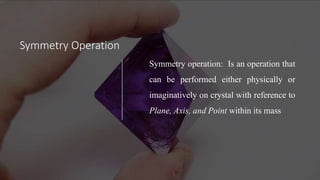
Symmetry operation: Is an operation that
can be performed either physically or
imaginatively on crystal with reference to
Plane, Axis, and Point within its mass
Symmetry Operation
Achieved By • Select the plane which shows
mirror image
• Rotating the crystal in particular
axis
• Select the point which shows
equidistance
Plane of symmetry
It is an imaginary plane, which passes
through the centre of a crystal can,
divides it into two equal portions, which
are exactly the mirror images of each
other
Axis of Symmetry
An axis of symmetry or axis of rotation is
an imaginary line, passing through the
crystal such that when the crystal is rotated
about this line, it presents the same
appearance more than once in one complete
revolution i.e., in a rotation through 360̊.
Four Axis of Symmetry
• On the rotation about the axis, if the
same faces or same view occurs 2
times, the axis termed as Diad axis
i.e. 3600/1800= 2 rotations
• On the rotation about the axis, , if the
same faces or same view occurs 3
times, the axis termed as Triad axis
i.e. 3600/1200= 3 rotations
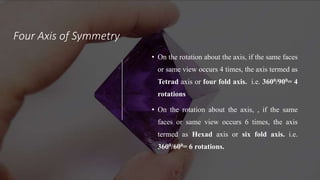
Four Axis of Symmetry
• On the rotation about the axis, if the same faces
or same view occurs 4 times, the axis termed as
Tetrad axis or four fold axis. i.e. 3600/900= 4
rotations
• On the rotation about the axis, , if the same
faces or same view occurs 6 times, the axis
termed as Hexad axis or six fold axis. i.e.
3600/600= 6 rotations.
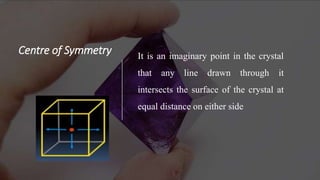
Centre of Symmetry It is an imaginary point in the crystal
that any line drawn through it
intersects the surface of the crystal at
equal distance on either side
Isometric system
Isometric system has highest degree of
symmetry and having total 23crystal
symmetry among which 9 plane of
symmetry and 13 axis of symmetry
present i.e. this having 6-II fold axis,4-
IIIfold axis, 3-IV fold axis no VI fold axis
and also centre of symmetry is present.
Symmetrical characteristics of six crystal system
Tetragonal system • Tetragonal system having total 11
symmetry among which, 5 plane of
symmetry and axis of symmetry
present i.e. this having 04-II fold
axis, no III-fold axis, 01-IV fold
axis no VI fold axis and also centre
of symmetry is present
Orthorhombic system
Orthorhombic system having total 7
symmetry among which , 3 plane of
symmetry and axis of symmetry
present i.e. this having 3-II fold axis,
no III-fold axis, no IV fold axis no VI
fold axis and also centre of symmetry
is present.
Hexagonal system Hexagonal system having total 15
symmetry among which, seven plane
of symmetry and axis of symmetry
present i.e. his having 6-II fold axis, no
III-fold axis, and no IV fold axis 01-VI
fold axis and centre of symmetry is
present
Monoclinic system Monoclinic system having total 3
symmetry among which, 1 plane of
symmetry and a axis of symmetry
present i.e. this system having 01-II
fold axis, no III-fold axis no IV fold
axis no VI fold axis and also centre of
symmetry is present.
Triclinic System
This system has lest degree of
symmetry and having only centre of
symmetry. Plane of symmetry and
Axis of symmetry is absent
Crystallographic Axes
A set of reference axes in a crystal that
are used to describe the crystal systems.
These are distinct and different from the
classic Cartesian axis x, y, z are used the
angles are denoted as α, β, ϒ and the
exception of the hexagonal system the
axes are designated a, b and c
Crystallographic Planes
Crystal plane may be defined by
considering how the plane intersects
the main crystallographic axes of the
crystal.
Crystallographic notation
Crystallographic notation is the symbolic
representation of relationship of any
crystal face to crystallographic axes. This
crystallographic notation system can be
explained by two methods.
WEISS Parameter
Weiss parameter is the relative
numbers of at which given crystal face
cuts the crystallographic axesThe most
general expression for Weiss
parameter is
na:mb:pc
Where n, m, p are the length cut off by
the face on the a, b, & c axes
respectively
Miller Indices
Miller Indices are a symbolic
representation for the orientation of
plane in a crystal lattice & are defined
as the reciprocals of the fractional
intercepts, which the plane makes with
the crystallographic axes
Most common Millerian symbol is
h,k,l
Miller indices
• To find the Miller indices of a plane,
take the following steps:
• Determine the intercepts of the plane
along each of the three crystallographic
directions.
• Take the reciprocals of the intercepts.
• If fractions result, multiply each by the
denominator of the smallest fraction
Conclusion
Crystals have an ordered internal
arrangement of atoms. This ordered
arrangement shows
symmetry. These crystal faces
reflect the ordered internal
arrangement of atoms and thus
reflect the symmetry of the crystal
lattice.
THANK YOU

Crystal stmmetry

  • 1.
  • 2.
    Introduction Crystallography is anatural science with the scope of investigating matter in the crystalline state. In modern era, this mainly implies determining the arrangement of atoms in crystals. The word "crystallography" derives from the Greek words crystallon “cold drop, frozen drop", with its meaning extending to all solids with some degree of transparency, and graphic "to write".
  • 3.
    Crystal Symmetry Itexplains how similar atoms or group of atoms (motif) repeated symmetrically in space to produce ordered structure. In many crystals, regularity of arrangement of these plane faces occurs, and a careful study of such a crystal will reveal elements of symmetry.
  • 4.
    Symmetry Operation Symmetry operation:Is an operation that can be performed either physically or imaginatively on crystal with reference to Plane, Axis, and Point within its mass
  • 5.
    Symmetry Operation Achieved By• Select the plane which shows mirror image • Rotating the crystal in particular axis • Select the point which shows equidistance
  • 6.
    Plane of symmetry Itis an imaginary plane, which passes through the centre of a crystal can, divides it into two equal portions, which are exactly the mirror images of each other
  • 7.
    Axis of Symmetry Anaxis of symmetry or axis of rotation is an imaginary line, passing through the crystal such that when the crystal is rotated about this line, it presents the same appearance more than once in one complete revolution i.e., in a rotation through 360̊.
  • 8.
    Four Axis ofSymmetry • On the rotation about the axis, if the same faces or same view occurs 2 times, the axis termed as Diad axis i.e. 3600/1800= 2 rotations • On the rotation about the axis, , if the same faces or same view occurs 3 times, the axis termed as Triad axis i.e. 3600/1200= 3 rotations
  • 9.
    Four Axis ofSymmetry • On the rotation about the axis, if the same faces or same view occurs 4 times, the axis termed as Tetrad axis or four fold axis. i.e. 3600/900= 4 rotations • On the rotation about the axis, , if the same faces or same view occurs 6 times, the axis termed as Hexad axis or six fold axis. i.e. 3600/600= 6 rotations.
  • 10.
    Centre of SymmetryIt is an imaginary point in the crystal that any line drawn through it intersects the surface of the crystal at equal distance on either side
  • 11.
    Isometric system Isometric systemhas highest degree of symmetry and having total 23crystal symmetry among which 9 plane of symmetry and 13 axis of symmetry present i.e. this having 6-II fold axis,4- IIIfold axis, 3-IV fold axis no VI fold axis and also centre of symmetry is present. Symmetrical characteristics of six crystal system
  • 12.
    Tetragonal system •Tetragonal system having total 11 symmetry among which, 5 plane of symmetry and axis of symmetry present i.e. this having 04-II fold axis, no III-fold axis, 01-IV fold axis no VI fold axis and also centre of symmetry is present
  • 13.
    Orthorhombic system Orthorhombic systemhaving total 7 symmetry among which , 3 plane of symmetry and axis of symmetry present i.e. this having 3-II fold axis, no III-fold axis, no IV fold axis no VI fold axis and also centre of symmetry is present.
  • 14.
    Hexagonal system Hexagonalsystem having total 15 symmetry among which, seven plane of symmetry and axis of symmetry present i.e. his having 6-II fold axis, no III-fold axis, and no IV fold axis 01-VI fold axis and centre of symmetry is present
  • 15.
    Monoclinic system Monoclinicsystem having total 3 symmetry among which, 1 plane of symmetry and a axis of symmetry present i.e. this system having 01-II fold axis, no III-fold axis no IV fold axis no VI fold axis and also centre of symmetry is present.
  • 16.
    Triclinic System This systemhas lest degree of symmetry and having only centre of symmetry. Plane of symmetry and Axis of symmetry is absent
  • 17.
    Crystallographic Axes A setof reference axes in a crystal that are used to describe the crystal systems. These are distinct and different from the classic Cartesian axis x, y, z are used the angles are denoted as α, β, ϒ and the exception of the hexagonal system the axes are designated a, b and c
  • 18.
    Crystallographic Planes Crystal planemay be defined by considering how the plane intersects the main crystallographic axes of the crystal.
  • 19.
    Crystallographic notation Crystallographic notationis the symbolic representation of relationship of any crystal face to crystallographic axes. This crystallographic notation system can be explained by two methods.
  • 20.
    WEISS Parameter Weiss parameteris the relative numbers of at which given crystal face cuts the crystallographic axesThe most general expression for Weiss parameter is na:mb:pc Where n, m, p are the length cut off by the face on the a, b, & c axes respectively
  • 21.
    Miller Indices Miller Indicesare a symbolic representation for the orientation of plane in a crystal lattice & are defined as the reciprocals of the fractional intercepts, which the plane makes with the crystallographic axes Most common Millerian symbol is h,k,l
  • 22.
    Miller indices • Tofind the Miller indices of a plane, take the following steps: • Determine the intercepts of the plane along each of the three crystallographic directions. • Take the reciprocals of the intercepts. • If fractions result, multiply each by the denominator of the smallest fraction
  • 23.
    Conclusion Crystals have anordered internal arrangement of atoms. This ordered arrangement shows symmetry. These crystal faces reflect the ordered internal arrangement of atoms and thus reflect the symmetry of the crystal lattice.
  • 24.