CRYSTALLOGRAPHY
INTRODUCTION
• crystallography is the study of crystal shapes
based on symmetry
• atoms combine to form geometric shapes on
smallest scale-- these in turn combine to form
seeable crystal shapes if mineral forms in a
nonrestrictive space (quartz crystal vs massive
quartz)
• symmetry functions present on a crystal of a
mineral allows the crystal to be categorized or
placed into one of 32 classes comprising the 6
crystal systems
SYMMETRY FUNCTIONS
• 1. Axis of rotation
• rotation of a crystal through 360 degrees on an axis may
reveal 2,3,4, or 6 reproductions of original face or faces--
these kinds of fold axes are:
• A2= 2-fold--a reproduction of face(s) twice
• A3= 3-fold--the same 3 times
• A4= 4-fold--the same 4 times
• A6= 6-fold--the same 6 times
• a crystal can have more than 1 kind and multiple of the
kind of fold axis each located in a perpendicular plane to
another or in some isometric classes the same at a 45
degree plane.
• An axis of rotation can represent only 1 YAX
• Mirror plane (symmetry plane)
• plane dividing a crystal in equal halves in which
one is a mirror image of the other
• there may be 0-9 different mirror planes on a
crystal
• designation of total mirror images on a crystal is
given by the absolute number of mirror planes
followed by a small m--four mirror images is
designated as 4m
• mirror planes, if present, occur in the same plane as
rotation axes and in the isometric, also at 45
degrees to the axes
• in determination of rotation axes and mirror planes, do
not count the same yAx or m more than once.
Center of symmetry
• Exists if the same surface feature is located on exact
opposite sides of the crystal and are both equal
distance from the center of crystal
• surface features include points, corners, edges, or
faces
• a crystal has or lacks a center of symmetry and if it
has, there are an infinite number of cases on the
crystal
• i is the symbol which indicates the presence of a
center of symmetry
Axis of rotoinversion
• is present if a reproduction of the face or faces on the
crystal is obtained through a rotation axis, then
inverting the crystal
• if done so on an A3 axis, the symmetry is designated
as an A3 with a bar above
• there can be a barA3, barA4 or barA6 but only one of
these roto inversion axes can exist on a crystal if
present
• although an important symmetry function, it is not
necessary to use it to categorize crystals---if present
a combination of the other 3 symmetry functions
substitutes for it
• a barA3 is equivalent to an A3 + an i; a barA4, to an A2 ; a
barA6 to an A3+ m
• If the total symmetry of crystal is ascertained, (
substitute symmetries if an axis of roto inversion
exists) the crystal can be categorized in one of 32
classes---see table
• mother nature limits the combinations of symmetry
functions which can occur with crystals--for
example;
• an A6 cannot be present with an A4 and vice versa
• an A6 cannot be present with an A3 and vice versa
• the number or kind of symmetry function(s) can lend
important information
• the presence of a 1A4 signifies a tetragonal class crystal
and if more A4 there must be 3A4, then belonging to the
isomeric class
• presence of 1A3 signifies a hexagonal class, if more,
there must be 4A3 present and belongs in an isometric
class
• HOLOHEDRAL refers to the respective class in
each crystal system possessing the highest (most
complex) symmetry
• even though crystals may not appear to look the
same, they may have the exact same symmetry
• NOW LET’S spend time on determining crystal
symmetry on wooden blocks and to which crystal
class and system each belongs
CRYSTAL FORMS
• a group of faces on a crystal related to the same symmetry
functions
• the faces of the group are usually the same size and shape
on the crystal
• recognition of crystal forms can help determine the
symmetry functions present on a crystal and vice versa
• forms related to non isometric classes are quite different
than those related to isometric classes
• since more than one form can exist on a crystal, it is more
difficult to ascertain each form in the “full form”--each “full
form” will be shown in the following presentation--also note
the symmetry related to the form--see page 127 for axes
symbols
Rotation axis Symbol
or for
Inversion axis axis
• Non-isometric forms
• pedion--a single face
• pinacoid--an open form comprised of 2 parallel faces--
many possible locations on crystal
• dome--open form with 2 non parallel faces with respect
to a mirror plane and A2--located at top of crystal
• sphenoid--two nonparallel faces related to an A2--located
at top of crystal
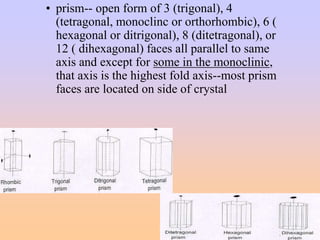
• prism-- open form of 3 (trigonal), 4
(tetragonal, monoclinc or orthorhombic), 6 (
hexagonal or ditrigonal), 8 (ditetragonal), or
12 ( dihexagonal) faces all parallel to same
axis and except for some in the monoclinic,
that axis is the highest fold axis--most prism
faces are located on side of crystal
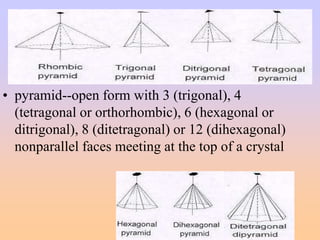
• pyramid--open form with 3 (trigonal), 4
(tetragonal or orthorhombic), 6 (hexagonal or
ditrigonal), 8 (ditetragonal) or 12 (dihexagonal)
nonparallel faces meeting at the top of a crystal
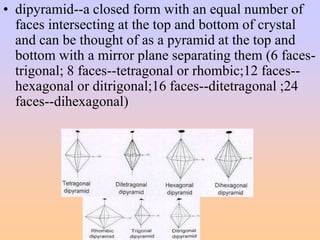
• dipyramid--a closed form with an equal number of
faces intersecting at the top and bottom of crystal
and can be thought of as a pyramid at the top and
bottom with a mirror plane separating them (6 faces-
trigonal; 8 faces--tetragonal or rhombic;12 faces--
hexagonal or ditrigonal;16 faces--ditetragonal ;24
faces--dihexagonal)
• trapezohedron--a closed form with 6, 8, or 12 faces
with 3 (trigonal), 4 (tetragonal) or 6 (hexagonal)
upper faces offset with each of the same number at
bottom--no mirror plane separates top set from
bottom--note the 3 sets of A2 at the sides
• scalenohedron--a closed form with 8
(tetragonal) or 12 (hexagonal) faces grouped
in symmetrical pairs--note the inversion 4
fold and inversion 3 fold and A2 axes
associated with each
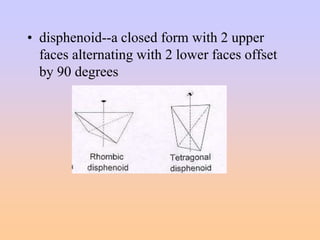
• disphenoid--a closed form with 2 upper
faces alternating with 2 lower faces offset
by 90 degrees
ISOMETRIC FORMS
• Many of these forms are based on a triad of isometric
forms, the cube (hexahedron), octahedron, and tetrahedron--
the name of a form often includes the suffix of the triad with
a prefix
• cube (hexahedron)--6 equal faces intersecting at 90
degrees
• octahedron--8 equilateral triangular faces
• tetrahedron--4 equilateral triangular faces
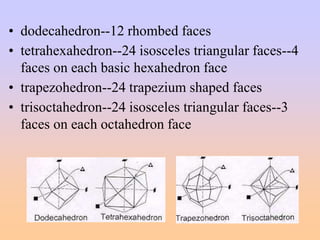
• dodecahedron--12 rhombed faces
• tetrahexahedron--24 isosceles triangular faces--4
faces on each basic hexahedron face
• trapezohedron--24 trapezium shaped faces
• trisoctahedron--24 isosceles triangular faces--3
faces on each octahedron face
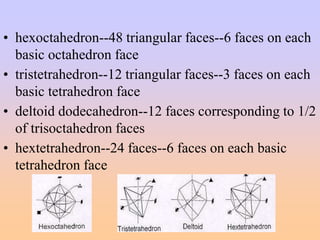
• hexoctahedron--48 triangular faces--6 faces on each
basic octahedron face
• tristetrahedron--12 triangular faces--3 faces on each
basic tetrahedron face
• deltoid dodecahedron--12 faces corresponding to 1/2
of trisoctahedron faces
• hextetrahedron--24 faces--6 faces on each basic
tetrahedron face
• diploid--24 faces
• pyritohedron--12 pentagonal faces
• It is possible to identify the class of the crystal in
some cases based on the form(s) present--this can be
done with much practice in identifying crystal forms
• refer to the table with all possible forms which can
exist in a crystal class of each crystal system--
examples of key forms present on crystals are:
• the rhombic dipyramid can only occur in the rhombic
dipyramidal class
• the ditrigonal dipyramid can only occur in the ditrigonal
dipyramidal class
• the hextetrahedron can occur only in the hextetrahedral
class
• the tetrahexahedron can occur only in the hextetrahedral
class
• crystal class names are based on the most outstanding
form possible--NOW, GO TO IT

Crystallography

  • 1.
  • 2.
    INTRODUCTION • crystallography isthe study of crystal shapes based on symmetry • atoms combine to form geometric shapes on smallest scale-- these in turn combine to form seeable crystal shapes if mineral forms in a nonrestrictive space (quartz crystal vs massive quartz) • symmetry functions present on a crystal of a mineral allows the crystal to be categorized or placed into one of 32 classes comprising the 6 crystal systems
  • 5.
    SYMMETRY FUNCTIONS • 1.Axis of rotation • rotation of a crystal through 360 degrees on an axis may reveal 2,3,4, or 6 reproductions of original face or faces-- these kinds of fold axes are: • A2= 2-fold--a reproduction of face(s) twice • A3= 3-fold--the same 3 times • A4= 4-fold--the same 4 times • A6= 6-fold--the same 6 times • a crystal can have more than 1 kind and multiple of the kind of fold axis each located in a perpendicular plane to another or in some isometric classes the same at a 45 degree plane.
  • 6.
    • An axisof rotation can represent only 1 YAX • Mirror plane (symmetry plane) • plane dividing a crystal in equal halves in which one is a mirror image of the other • there may be 0-9 different mirror planes on a crystal • designation of total mirror images on a crystal is given by the absolute number of mirror planes followed by a small m--four mirror images is designated as 4m • mirror planes, if present, occur in the same plane as rotation axes and in the isometric, also at 45 degrees to the axes
  • 7.
    • in determinationof rotation axes and mirror planes, do not count the same yAx or m more than once. Center of symmetry • Exists if the same surface feature is located on exact opposite sides of the crystal and are both equal distance from the center of crystal • surface features include points, corners, edges, or faces • a crystal has or lacks a center of symmetry and if it has, there are an infinite number of cases on the crystal • i is the symbol which indicates the presence of a center of symmetry
  • 8.
    Axis of rotoinversion •is present if a reproduction of the face or faces on the crystal is obtained through a rotation axis, then inverting the crystal • if done so on an A3 axis, the symmetry is designated as an A3 with a bar above • there can be a barA3, barA4 or barA6 but only one of these roto inversion axes can exist on a crystal if present • although an important symmetry function, it is not necessary to use it to categorize crystals---if present a combination of the other 3 symmetry functions substitutes for it • a barA3 is equivalent to an A3 + an i; a barA4, to an A2 ; a barA6 to an A3+ m
  • 9.
    • If thetotal symmetry of crystal is ascertained, ( substitute symmetries if an axis of roto inversion exists) the crystal can be categorized in one of 32 classes---see table • mother nature limits the combinations of symmetry functions which can occur with crystals--for example; • an A6 cannot be present with an A4 and vice versa • an A6 cannot be present with an A3 and vice versa • the number or kind of symmetry function(s) can lend important information • the presence of a 1A4 signifies a tetragonal class crystal and if more A4 there must be 3A4, then belonging to the isomeric class
  • 10.
    • presence of1A3 signifies a hexagonal class, if more, there must be 4A3 present and belongs in an isometric class • HOLOHEDRAL refers to the respective class in each crystal system possessing the highest (most complex) symmetry • even though crystals may not appear to look the same, they may have the exact same symmetry • NOW LET’S spend time on determining crystal symmetry on wooden blocks and to which crystal class and system each belongs
  • 11.
    CRYSTAL FORMS • agroup of faces on a crystal related to the same symmetry functions • the faces of the group are usually the same size and shape on the crystal • recognition of crystal forms can help determine the symmetry functions present on a crystal and vice versa • forms related to non isometric classes are quite different than those related to isometric classes • since more than one form can exist on a crystal, it is more difficult to ascertain each form in the “full form”--each “full form” will be shown in the following presentation--also note the symmetry related to the form--see page 127 for axes symbols
  • 12.
    Rotation axis Symbol orfor Inversion axis axis
  • 13.
    • Non-isometric forms •pedion--a single face • pinacoid--an open form comprised of 2 parallel faces-- many possible locations on crystal • dome--open form with 2 non parallel faces with respect to a mirror plane and A2--located at top of crystal • sphenoid--two nonparallel faces related to an A2--located at top of crystal
  • 14.
    • prism-- openform of 3 (trigonal), 4 (tetragonal, monoclinc or orthorhombic), 6 ( hexagonal or ditrigonal), 8 (ditetragonal), or 12 ( dihexagonal) faces all parallel to same axis and except for some in the monoclinic, that axis is the highest fold axis--most prism faces are located on side of crystal
  • 15.
    • pyramid--open formwith 3 (trigonal), 4 (tetragonal or orthorhombic), 6 (hexagonal or ditrigonal), 8 (ditetragonal) or 12 (dihexagonal) nonparallel faces meeting at the top of a crystal
  • 16.
    • dipyramid--a closedform with an equal number of faces intersecting at the top and bottom of crystal and can be thought of as a pyramid at the top and bottom with a mirror plane separating them (6 faces- trigonal; 8 faces--tetragonal or rhombic;12 faces-- hexagonal or ditrigonal;16 faces--ditetragonal ;24 faces--dihexagonal)
  • 17.
    • trapezohedron--a closedform with 6, 8, or 12 faces with 3 (trigonal), 4 (tetragonal) or 6 (hexagonal) upper faces offset with each of the same number at bottom--no mirror plane separates top set from bottom--note the 3 sets of A2 at the sides
  • 18.
    • scalenohedron--a closedform with 8 (tetragonal) or 12 (hexagonal) faces grouped in symmetrical pairs--note the inversion 4 fold and inversion 3 fold and A2 axes associated with each
  • 19.
    • disphenoid--a closedform with 2 upper faces alternating with 2 lower faces offset by 90 degrees
  • 20.
    ISOMETRIC FORMS • Manyof these forms are based on a triad of isometric forms, the cube (hexahedron), octahedron, and tetrahedron-- the name of a form often includes the suffix of the triad with a prefix • cube (hexahedron)--6 equal faces intersecting at 90 degrees • octahedron--8 equilateral triangular faces • tetrahedron--4 equilateral triangular faces
  • 21.
    • dodecahedron--12 rhombedfaces • tetrahexahedron--24 isosceles triangular faces--4 faces on each basic hexahedron face • trapezohedron--24 trapezium shaped faces • trisoctahedron--24 isosceles triangular faces--3 faces on each octahedron face
  • 22.
    • hexoctahedron--48 triangularfaces--6 faces on each basic octahedron face • tristetrahedron--12 triangular faces--3 faces on each basic tetrahedron face • deltoid dodecahedron--12 faces corresponding to 1/2 of trisoctahedron faces • hextetrahedron--24 faces--6 faces on each basic tetrahedron face
  • 23.
    • diploid--24 faces •pyritohedron--12 pentagonal faces
  • 24.
    • It ispossible to identify the class of the crystal in some cases based on the form(s) present--this can be done with much practice in identifying crystal forms • refer to the table with all possible forms which can exist in a crystal class of each crystal system-- examples of key forms present on crystals are: • the rhombic dipyramid can only occur in the rhombic dipyramidal class • the ditrigonal dipyramid can only occur in the ditrigonal dipyramidal class • the hextetrahedron can occur only in the hextetrahedral class • the tetrahexahedron can occur only in the hextetrahedral class • crystal class names are based on the most outstanding form possible--NOW, GO TO IT