PLANCK’S QUANTUM THEORY,
X-RAYS & ATOMIC NUMBER
CHAPTER # 2
ATOMIC STRUCTURE
Prepared By: Sidra Javed
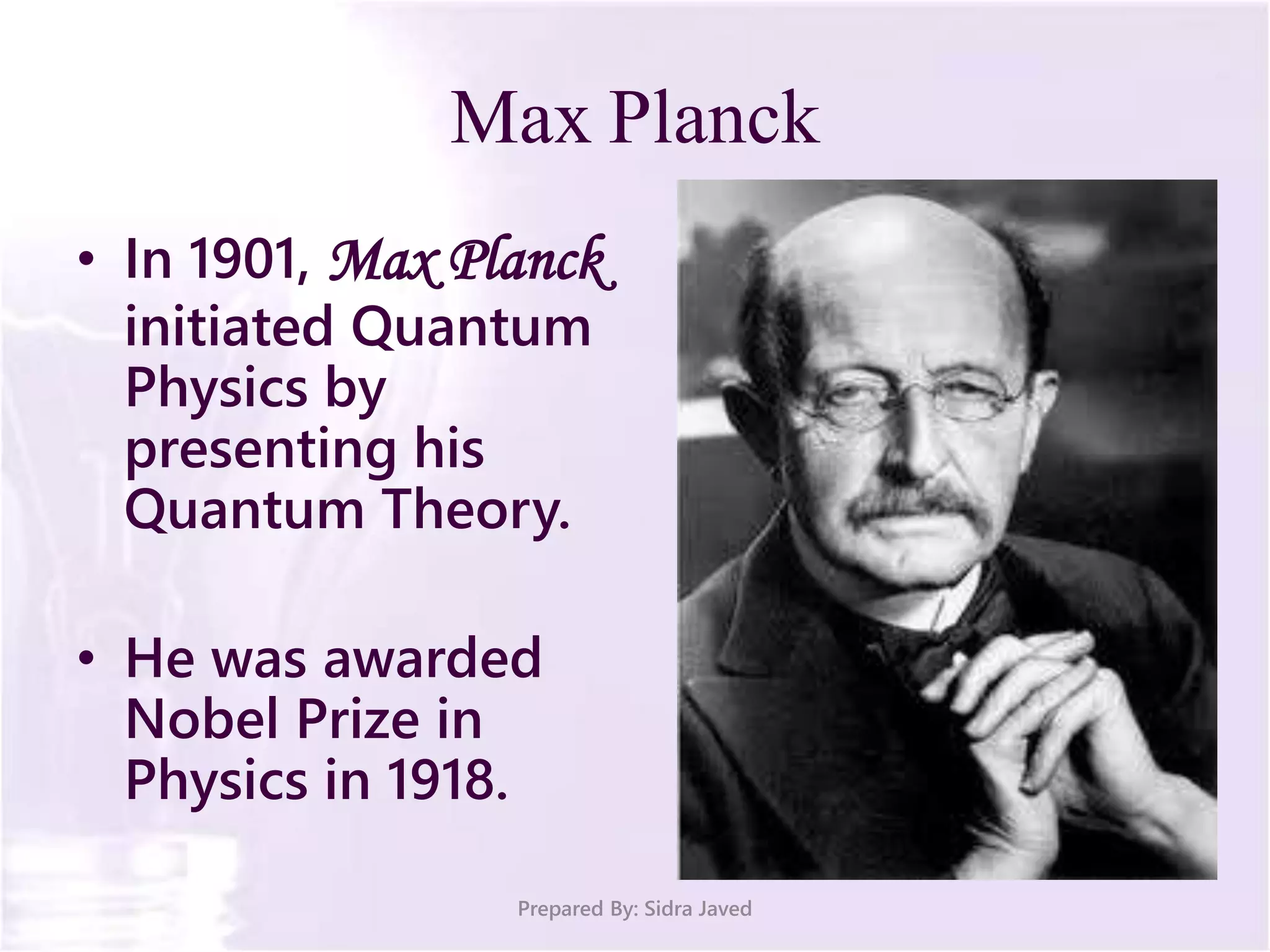
Max Planck
• In 1901, Max Planck
initiated Quantum
Physics by
presenting his
Quantum Theory.
• He was awarded
Nobel Prize in
Physics in 1918.
Prepared By: Sidra Javed
Planck’s Quantum Theory
a) Energy is not emitted or absorbed
continuously. It is emitted or absorbed in the
form of wave packets or quanta.
In case of light the quantum
of energy is often
called Photon.
Prepared By: Sidra Javed
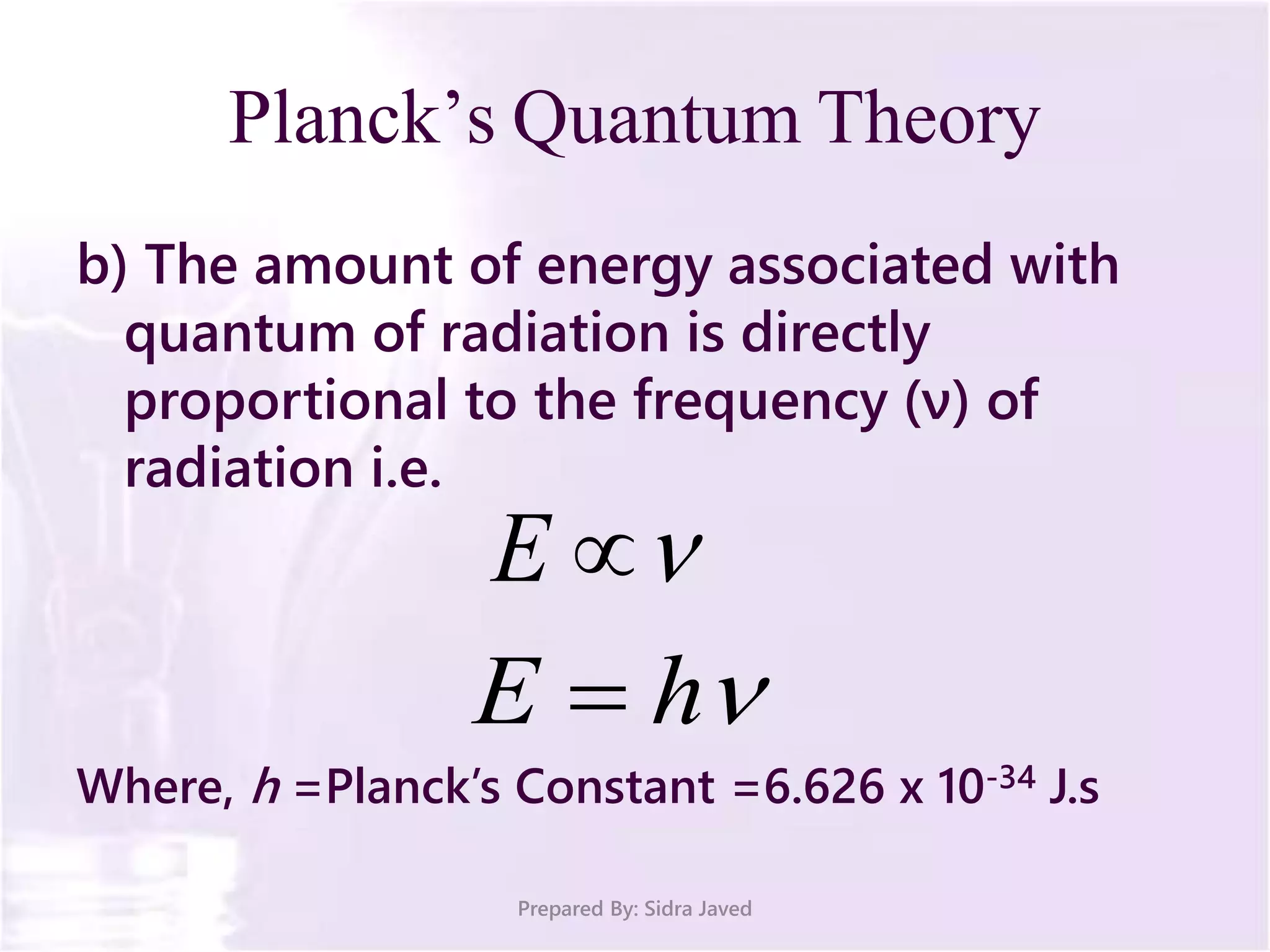
b) The amount of energy associated with
quantum of radiation is directly
proportional to the frequency (ν) of
radiation i.e.
Where, h =Planck’s Constant =6.626 x 10⁻³⁴ J.s
Prepared By: Sidra Javed
Planck’s Quantum Theory
E
hE 
Planck’s Quantum Theory
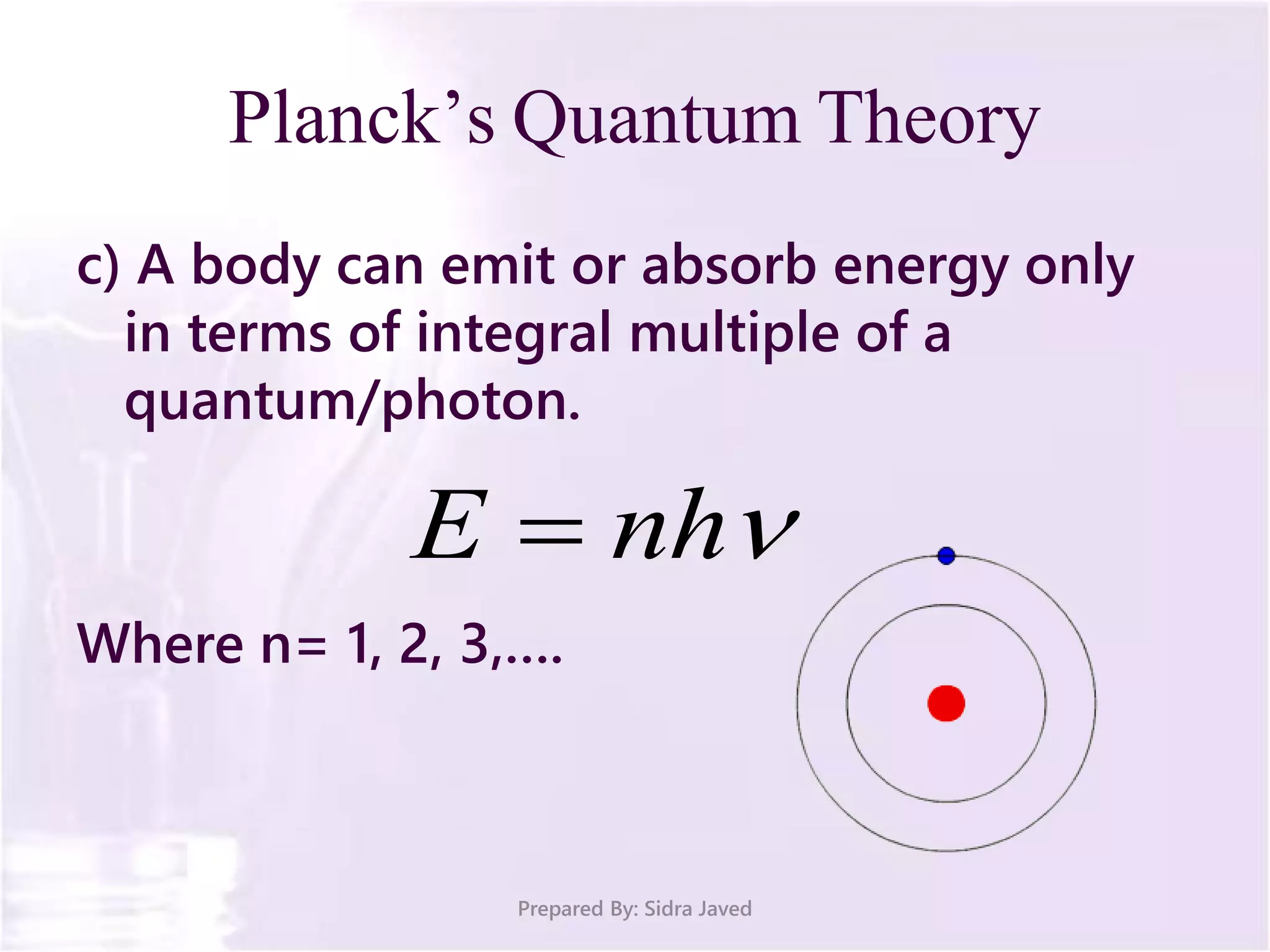
c) A body can emit or absorb energy only
in terms of integral multiple of a
quantum/photon.
Where n= 1, 2, 3,….
Prepared By: Sidra Javed
nhE 
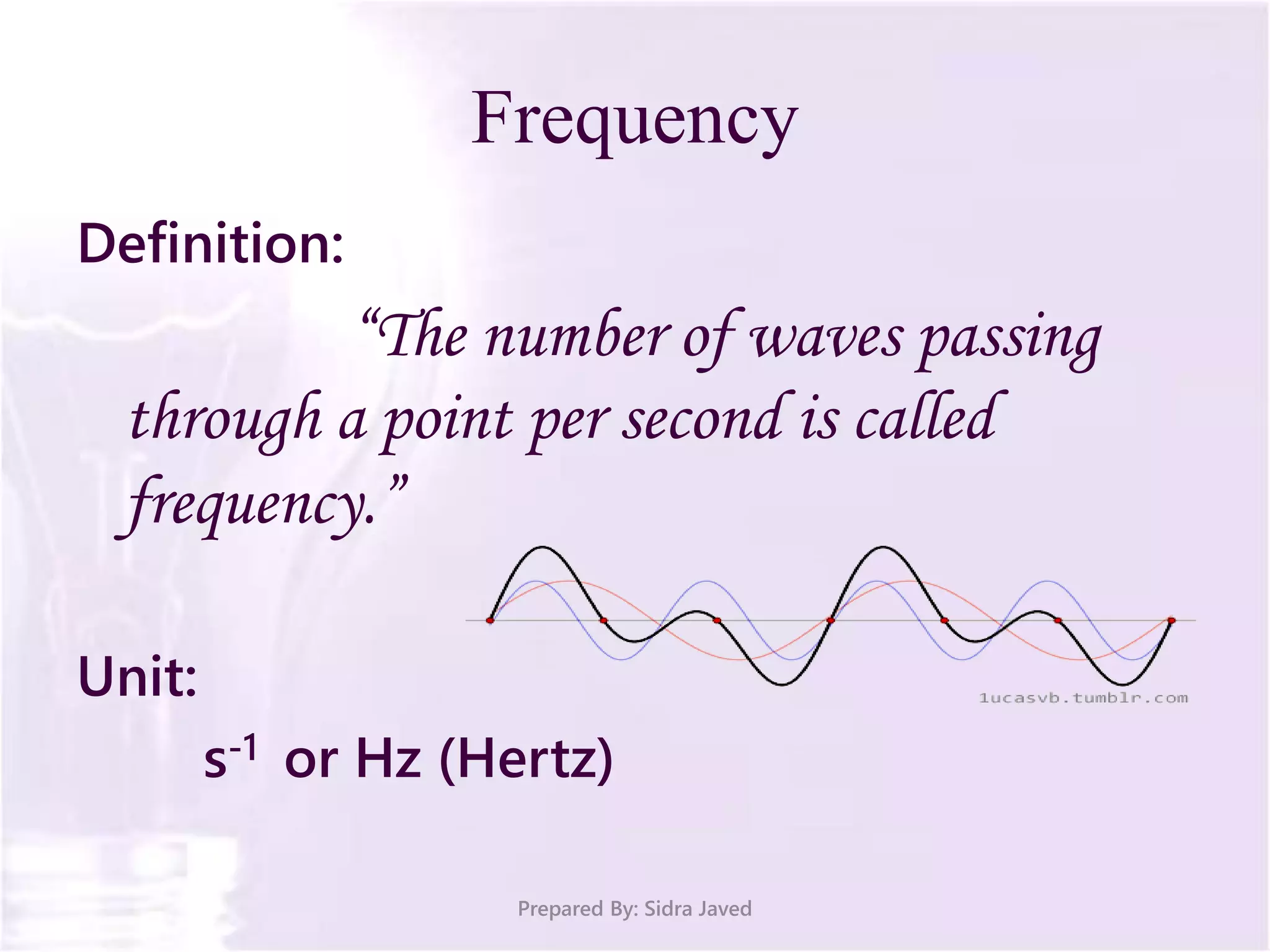
Frequency
Definition:
“The number of waves passing
through a point per second is called
frequency.”
Unit:
s-1 or Hz (Hertz)
Prepared By: Sidra Javed
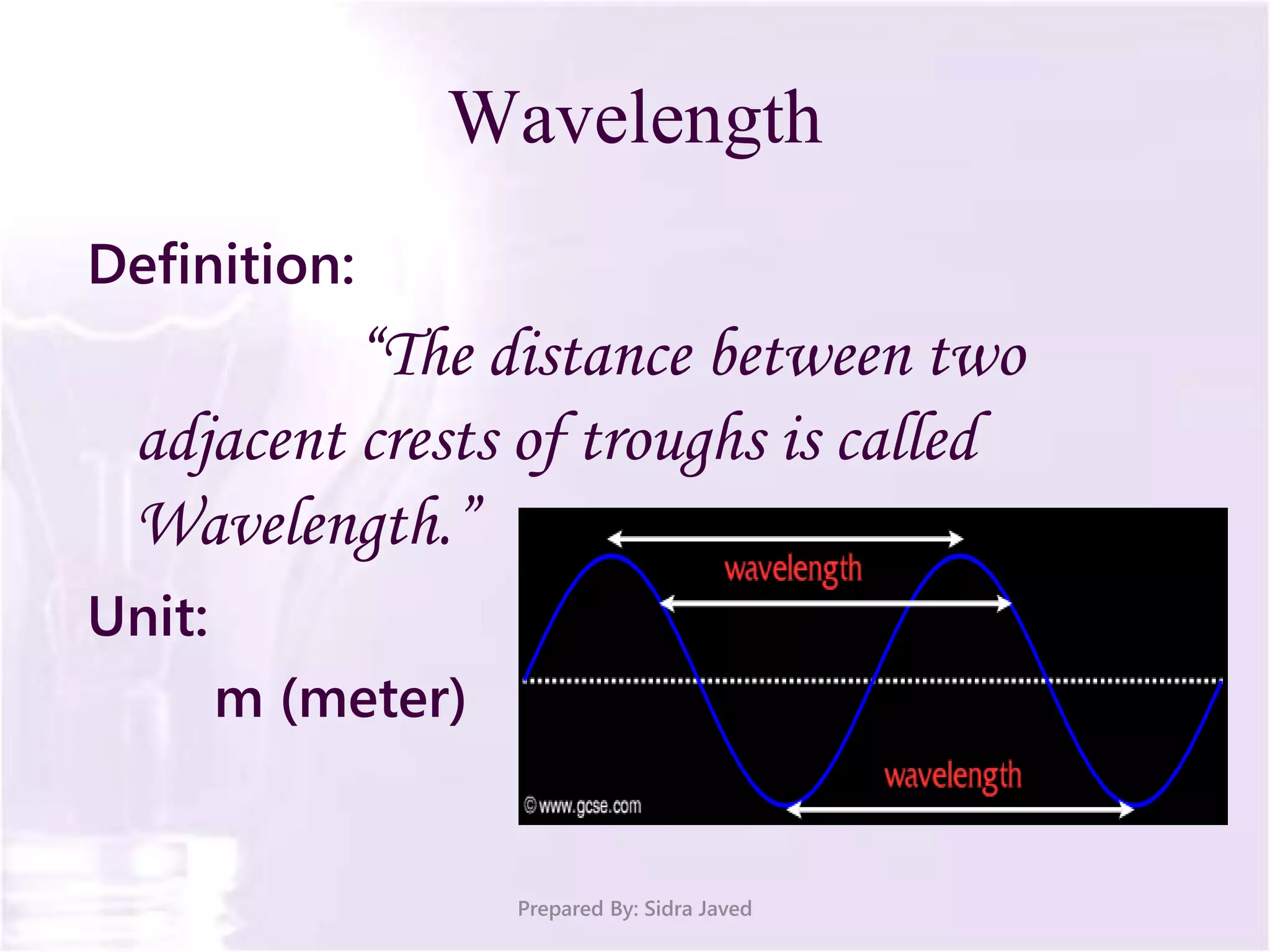
Wavelength
Definition:
“The distance between two
adjacent crests of troughs is called
Wavelength.”
Unit:
m (meter)
Prepared By: Sidra Javed
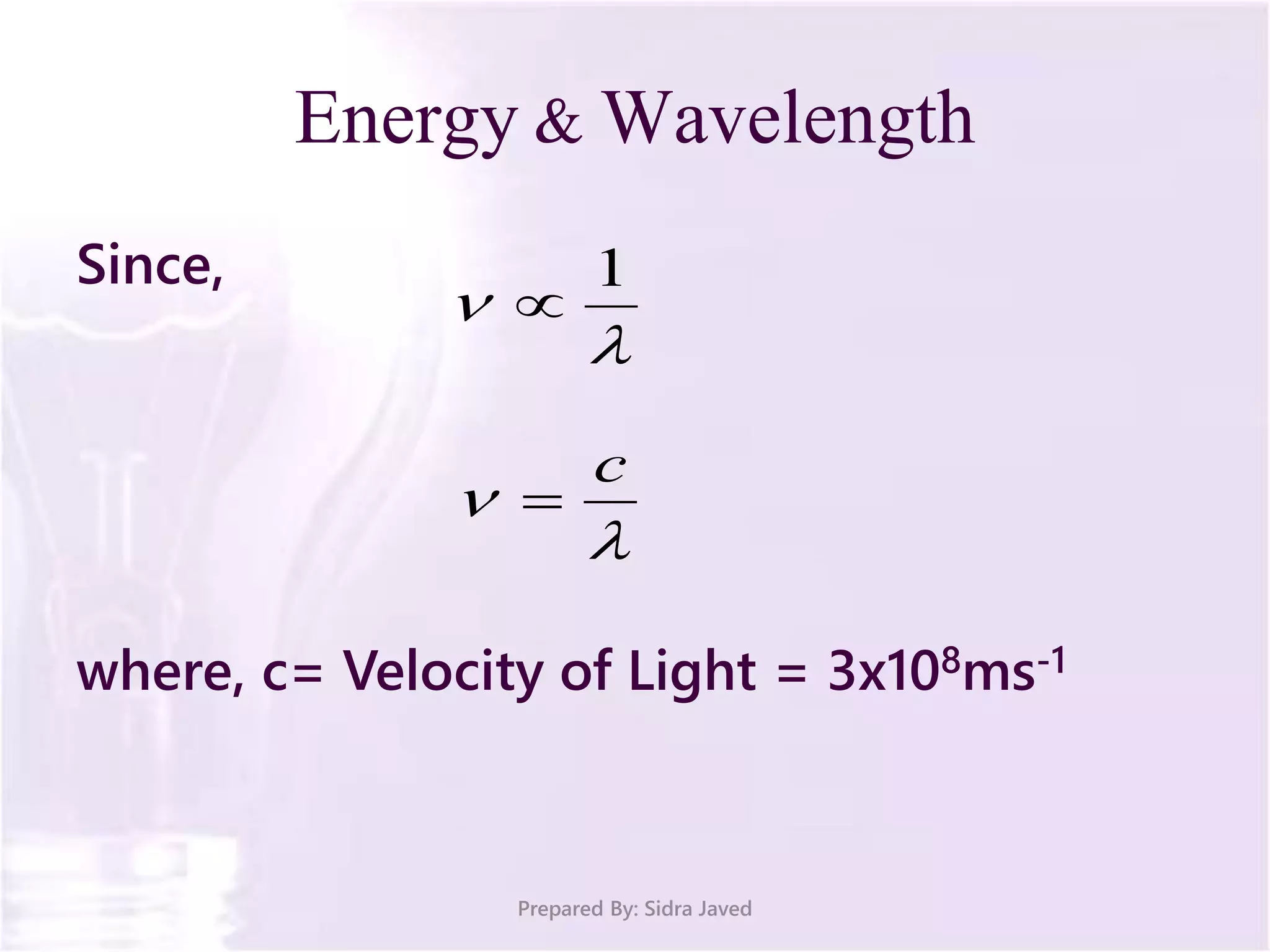
Energy & Wavelength
Since,
where, c= Velocity of Light = 3x10⁸ms-1
Prepared By: Sidra Javed


1



c

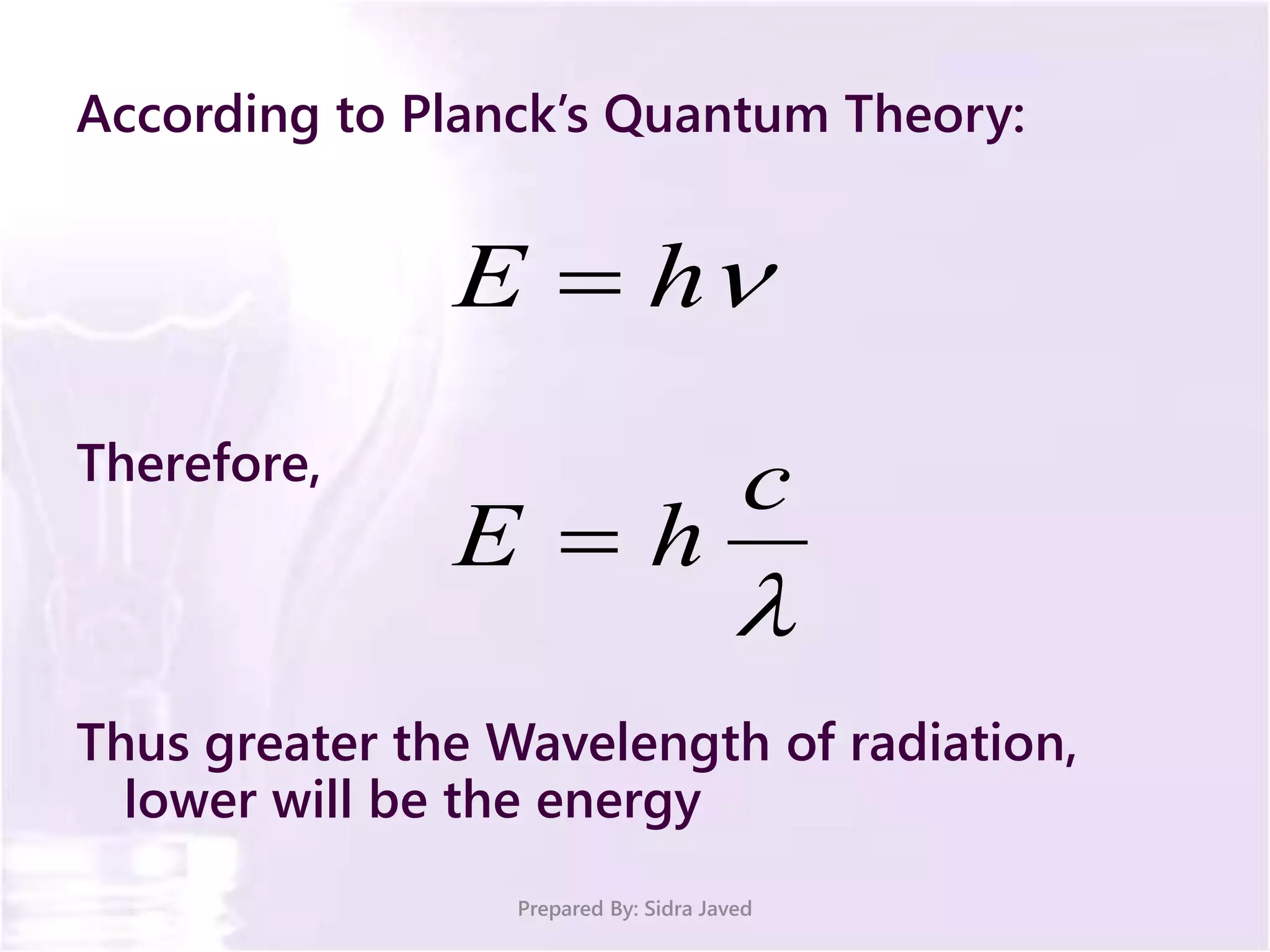
According to Planck’s Quantum Theory:
Therefore,
Thus greater the Wavelength of radiation,
lower will be the energy
Prepared By: Sidra Javed
hE 

c
hE 
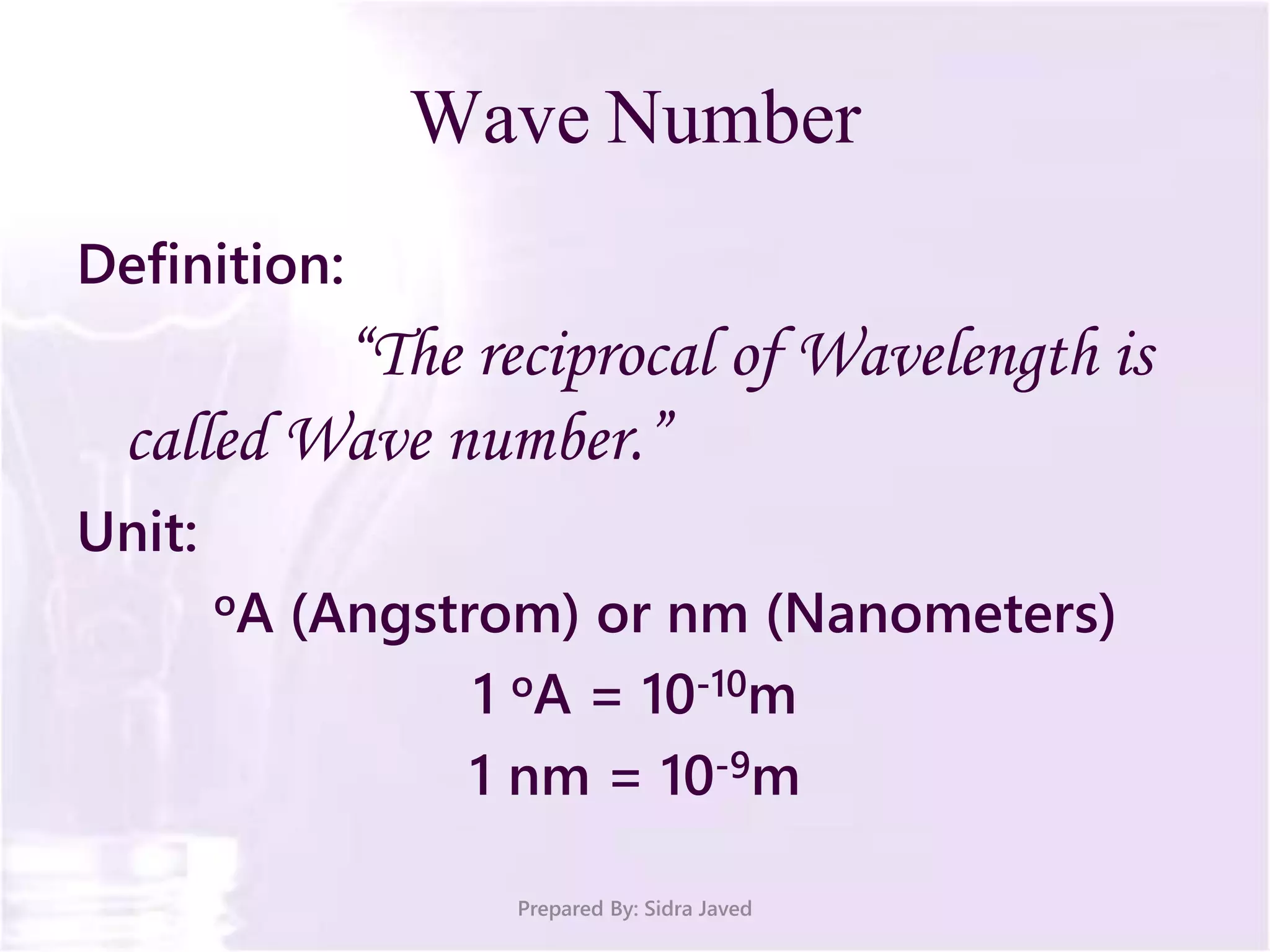
Wave Number
Definition:
“The reciprocal of Wavelength is
called Wave number.”
Unit:
oA (Angstrom) or nm (Nanometers)
1 oA = 10-10m
1 nm = 10-9m
Prepared By: Sidra Javed
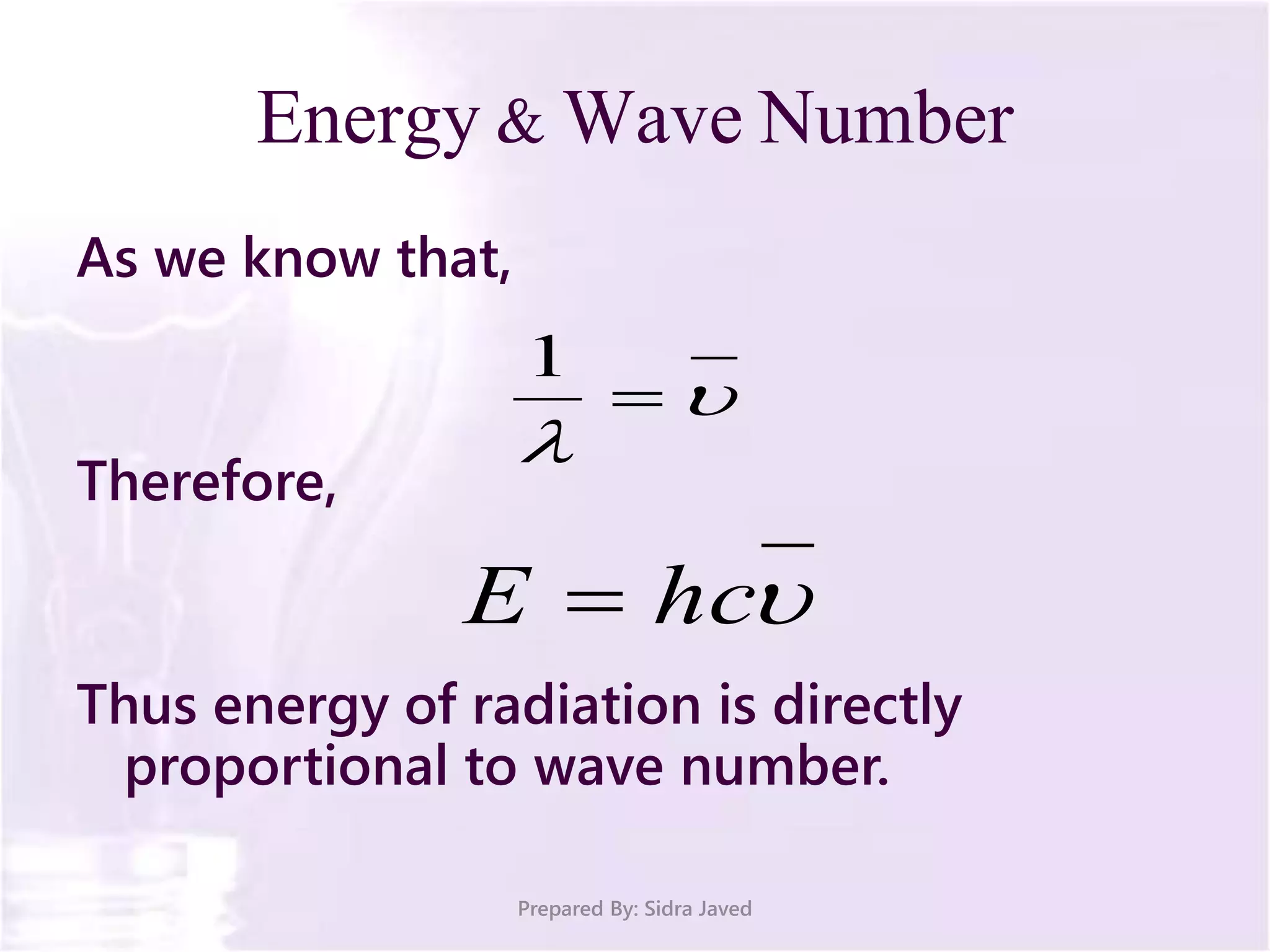
Energy & Wave Number
As we know that,
Therefore,
Thus energy of radiation is directly
proportional to wave number.
Prepared By: Sidra Javed



1
hcE 
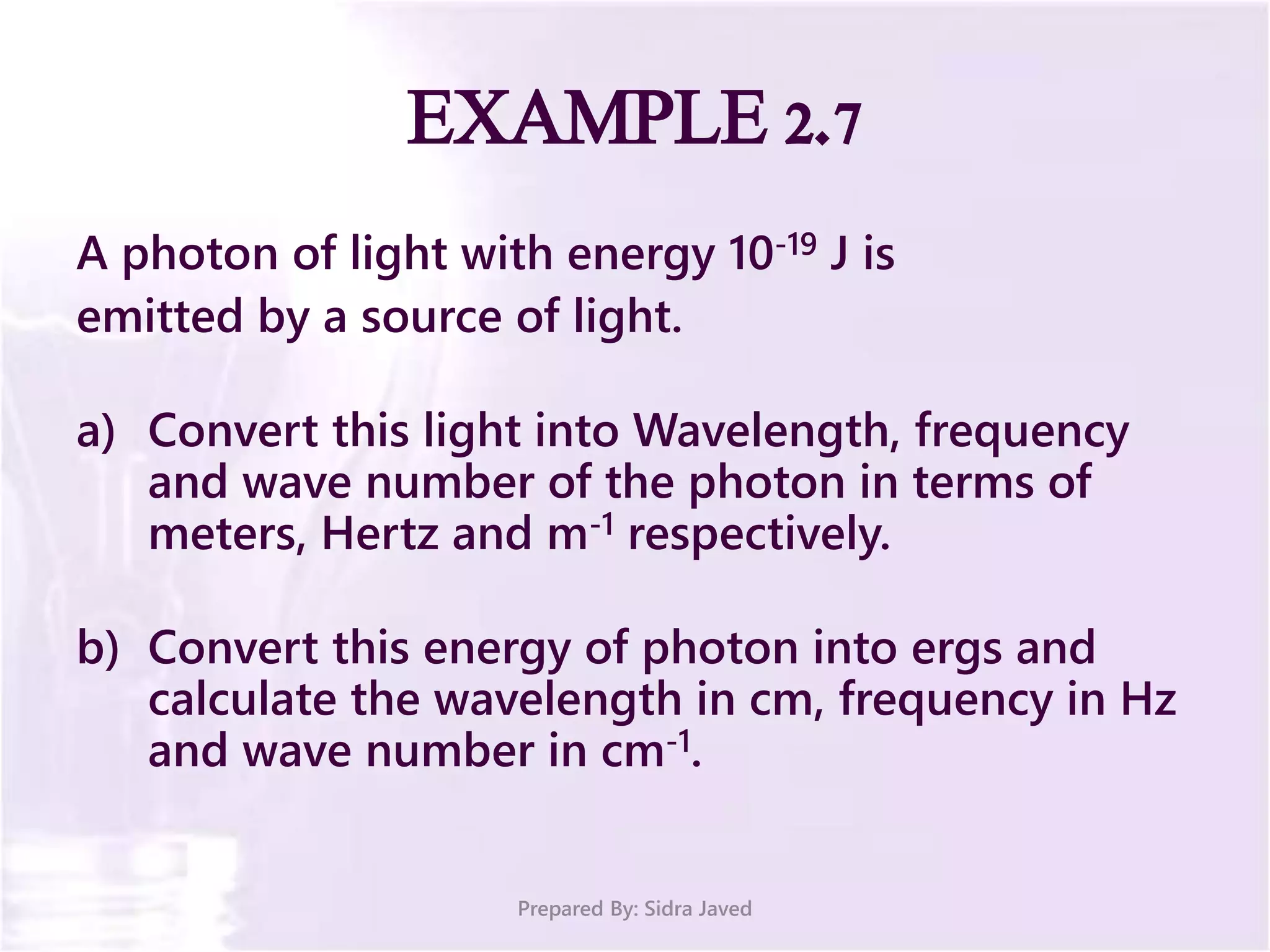
EXAMPLE 2.7
A photon of light with energy 10-19 J is
emitted by a source of light.
a) Convert this light into Wavelength, frequency
and wave number of the photon in terms of
meters, Hertz and m-1 respectively.
b) Convert this energy of photon into ergs and
calculate the wavelength in cm, frequency in Hz
and wave number in cm-1.
Prepared By: Sidra Javed
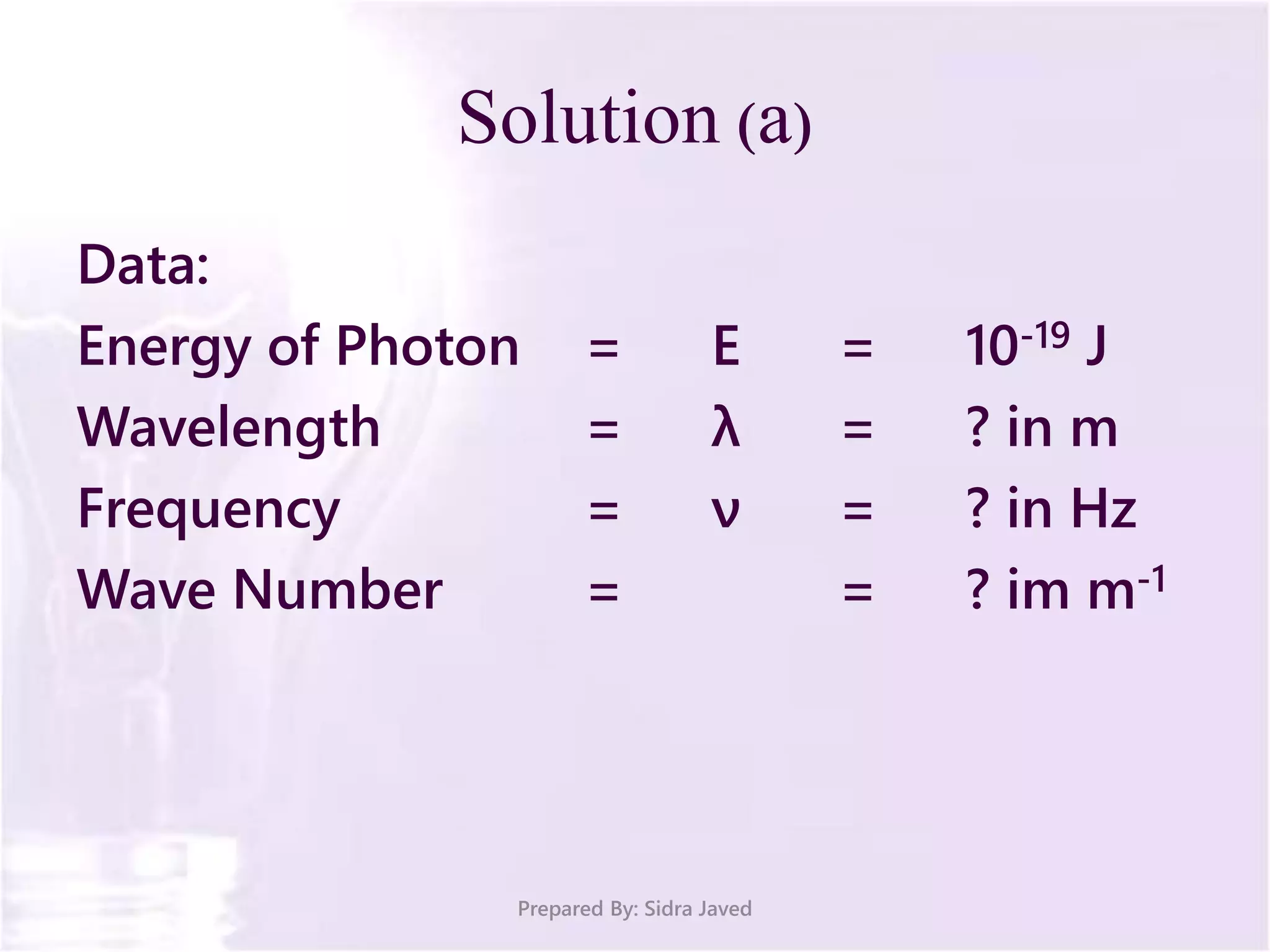
Solution (a)
Data:
Energy of Photon = E = 10-19 J
Wavelength = λ = ? in m
Frequency = ν = ? in Hz
Wave Number = = ? im m-1
Prepared By: Sidra Javed
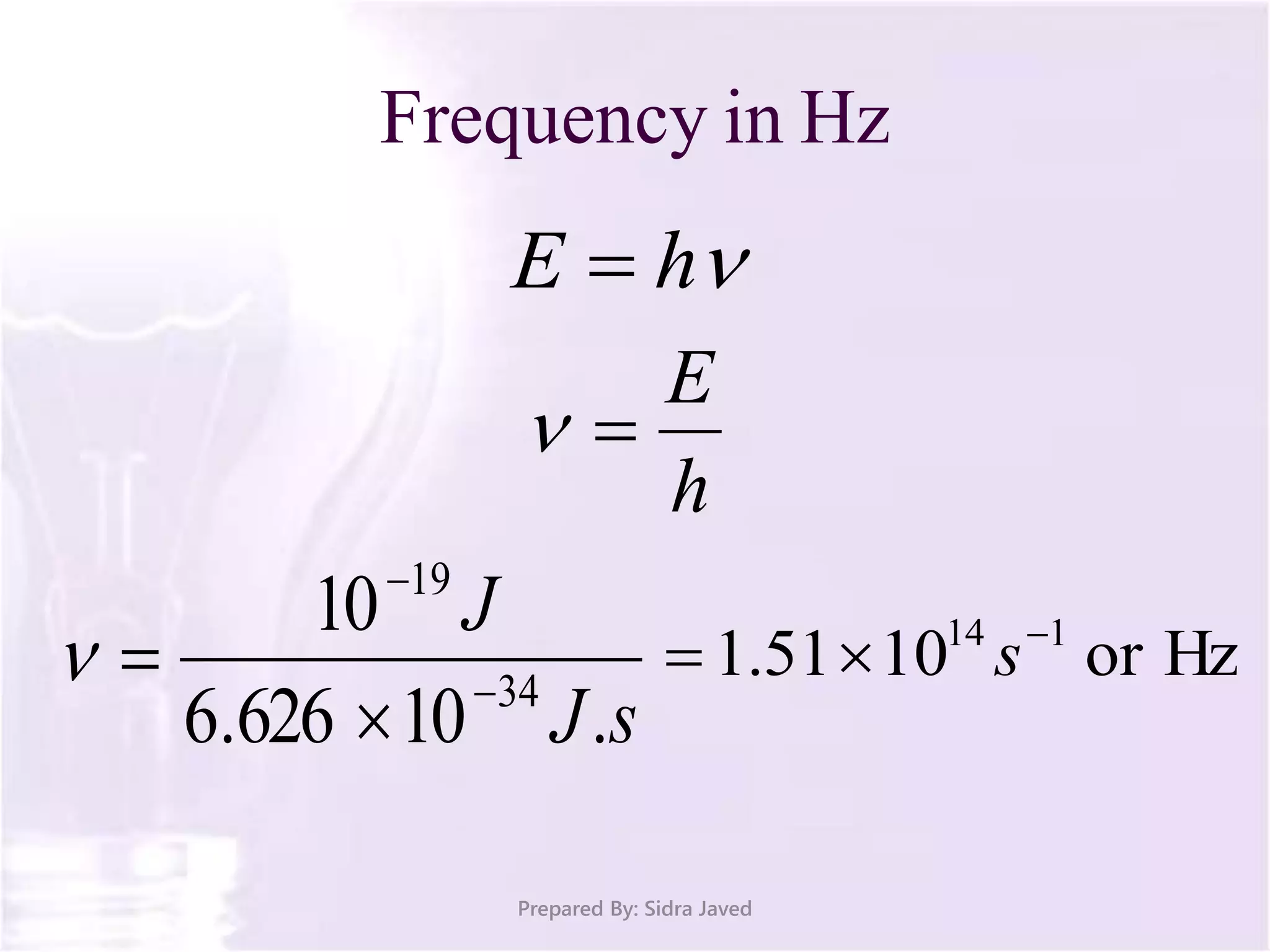
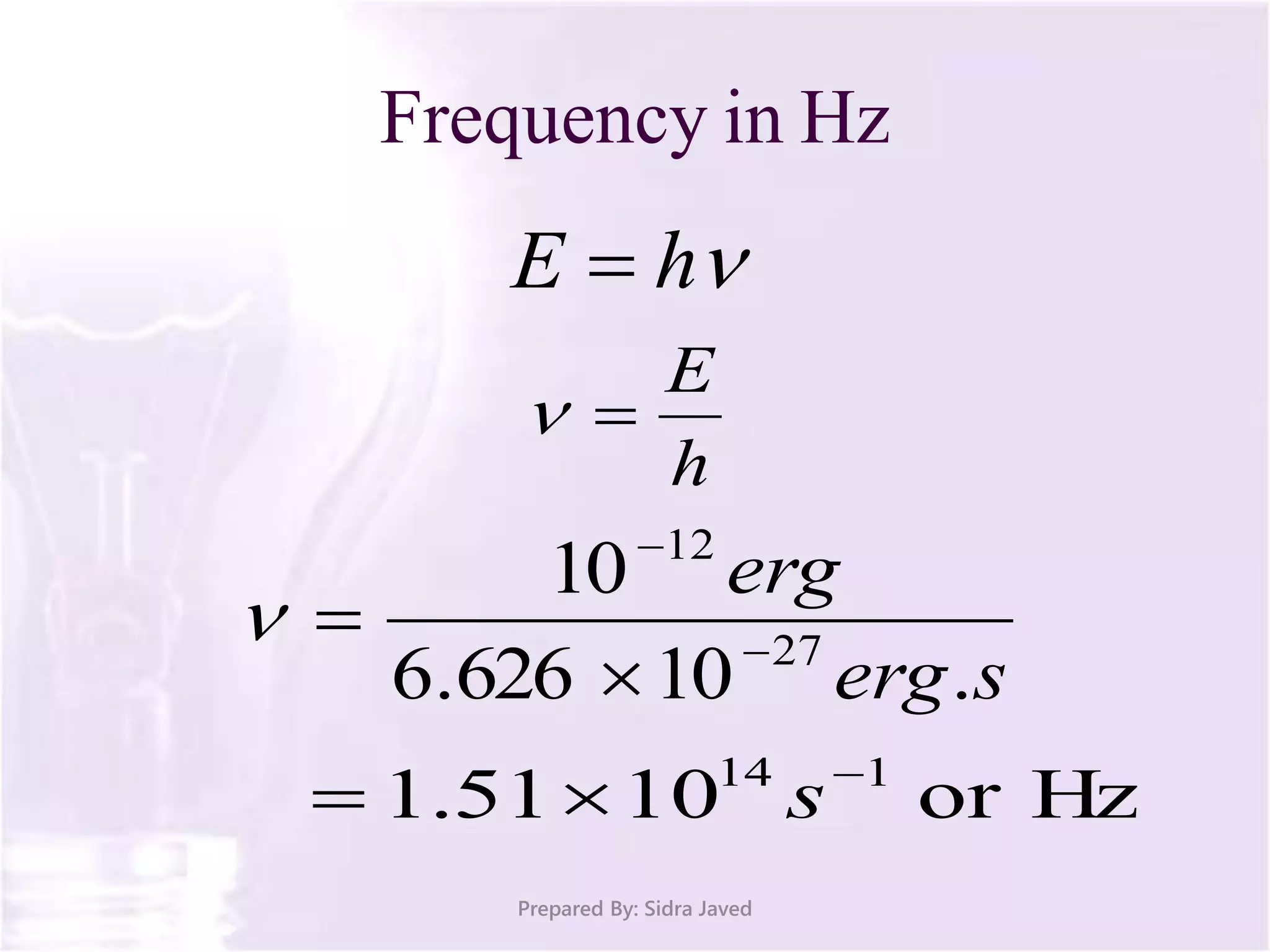
Frequency in Hz
Prepared By: Sidra Javed
hE 
h
E

sJ
J
.10626.6
10
34
19



 or Hz1051.1 114 
 s
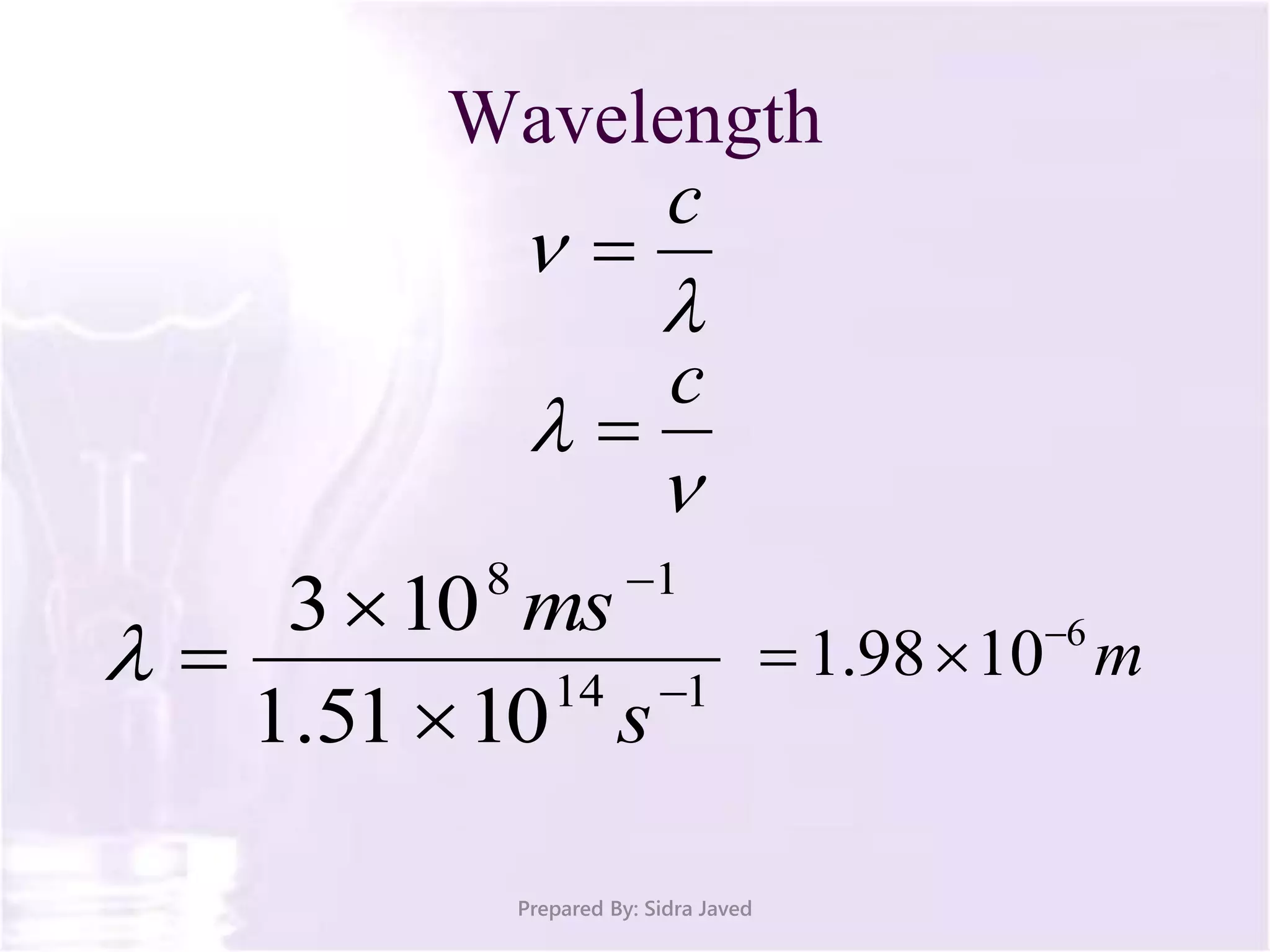
Wavelength
Prepared By: Sidra Javed


c

114
18
1051.1
103





s
ms
 m6
1098.1 



c

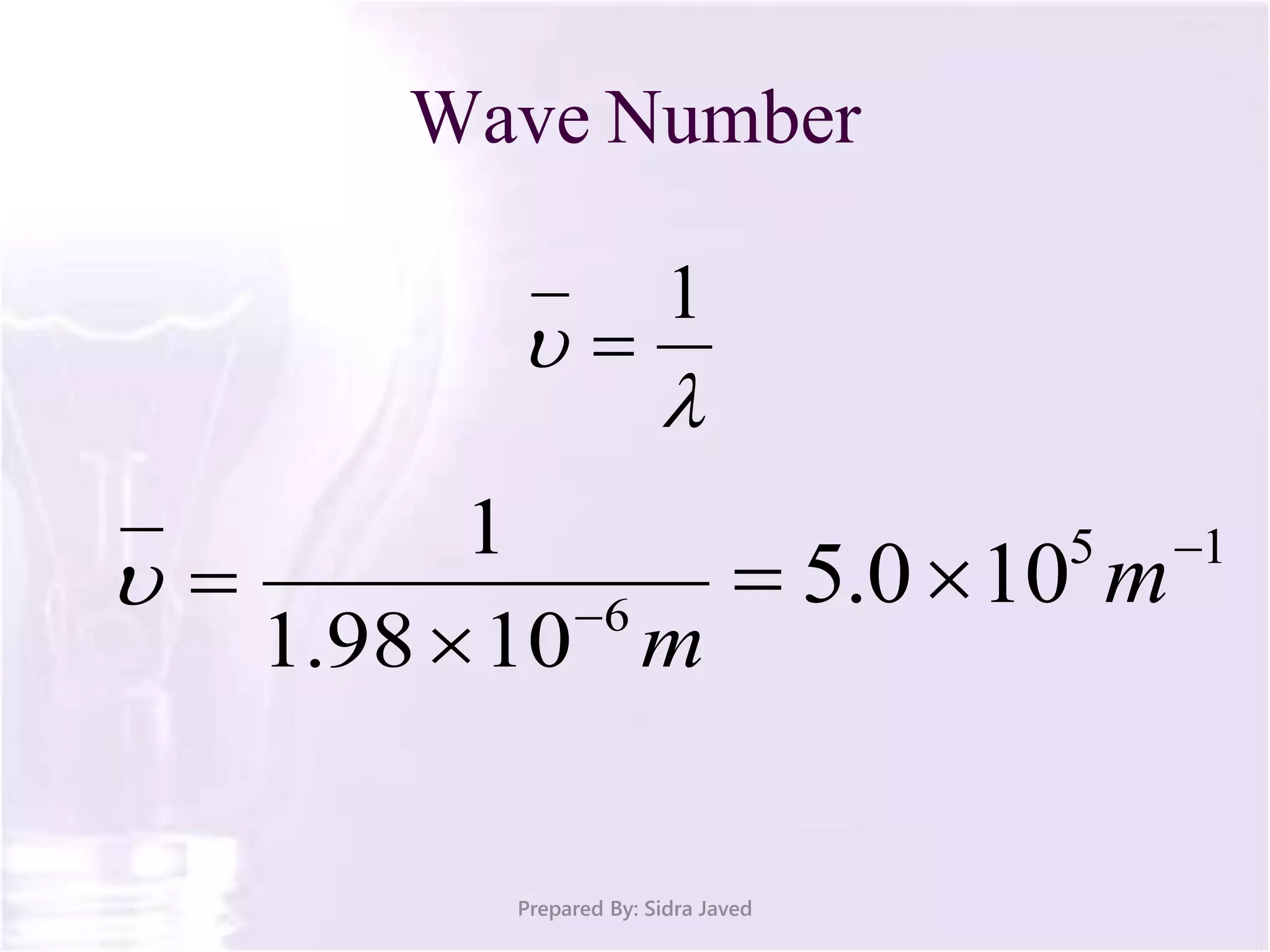
Wave Number
Prepared By: Sidra Javed


1

m6
1098.1
1


 15
100.5 
 m
Solution (b)
Data:
Energy = E = ? in erg
Wavelength = λ = ? in cm
Frequency = ν = ? in Hz
Wave Number = = ? in cm-1
Prepared By: Sidra Javed
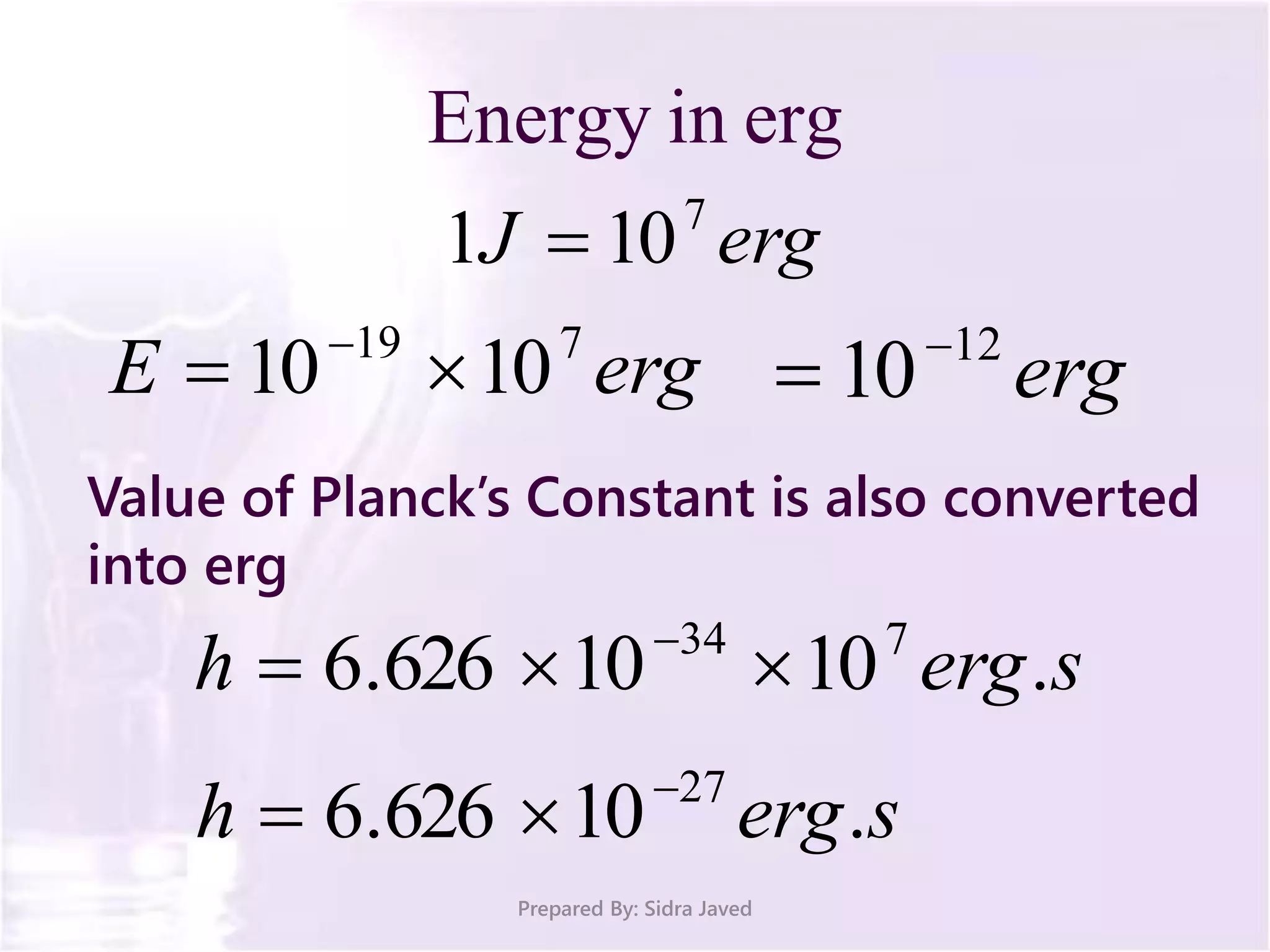
Energy in erg
Prepared By: Sidra Javed
ergJ 7
101 
ergE 719
1010  
erg12
10

Value of Planck’s Constant is also converted
into erg
sergh .1010626.6 734
 
sergh .10626.6 27

Frequency in Hz
Prepared By: Sidra Javed
hE 
h
E

serg
erg
.10626.6
10
27
12




or Hz1051.1 114 
 s
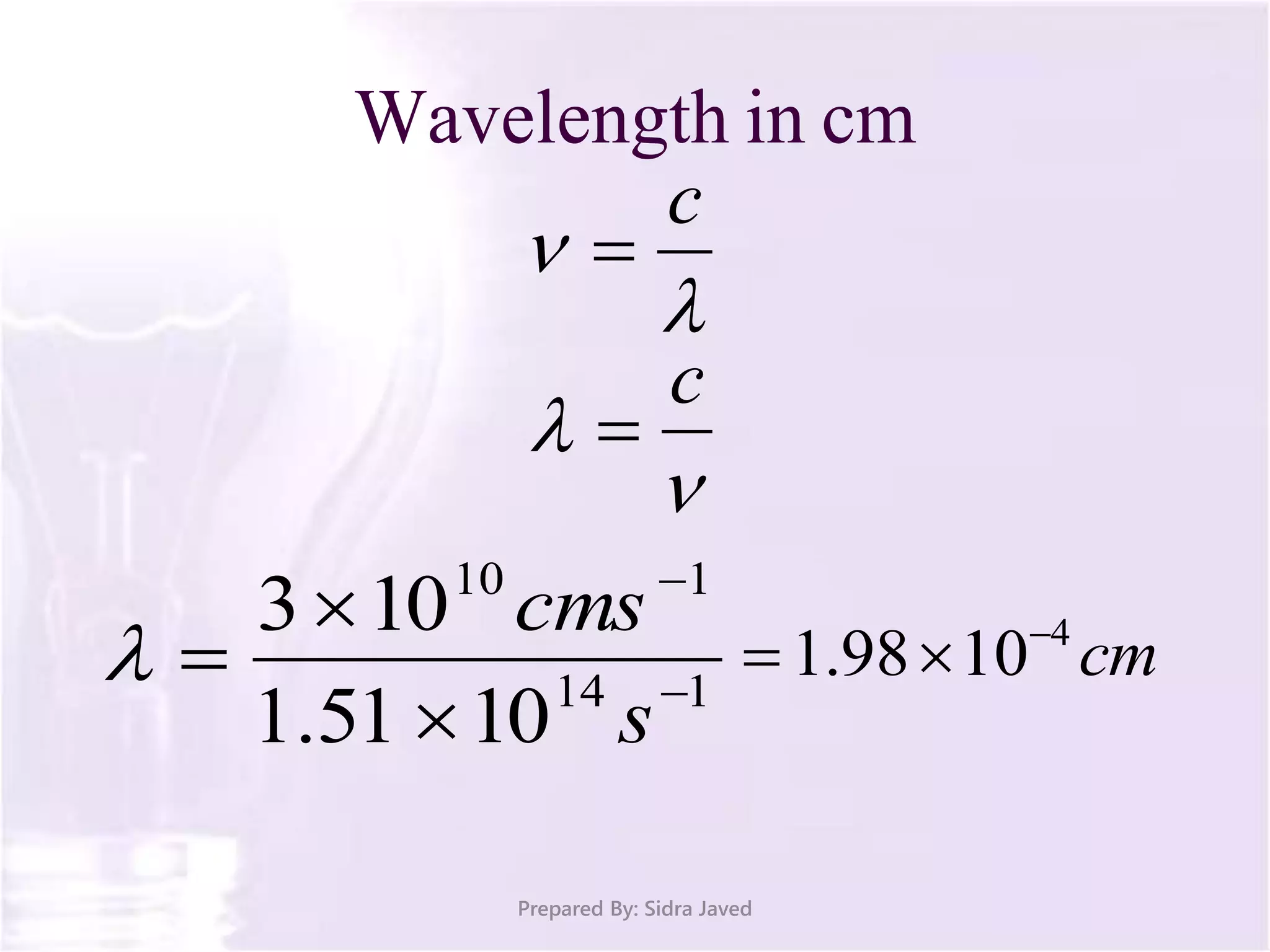
Wavelength in cm
Prepared By: Sidra Javed


c

114
110
1051.1
103





s
cms
 cm4
1098.1 



c

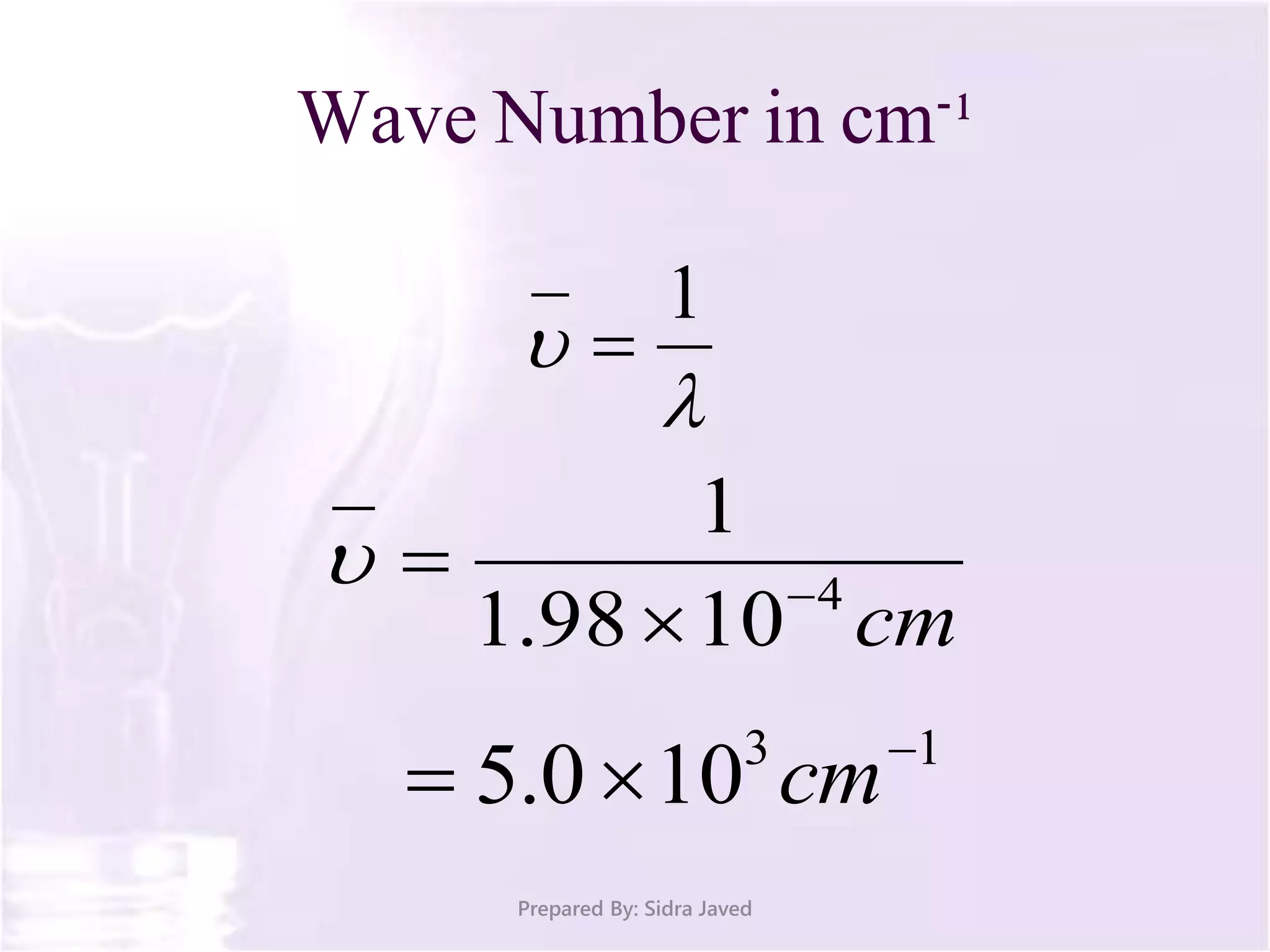
Wave Number in cm-1
Prepared By: Sidra Javed


1

cm4
1098.1
1



13
100.5 
 cm
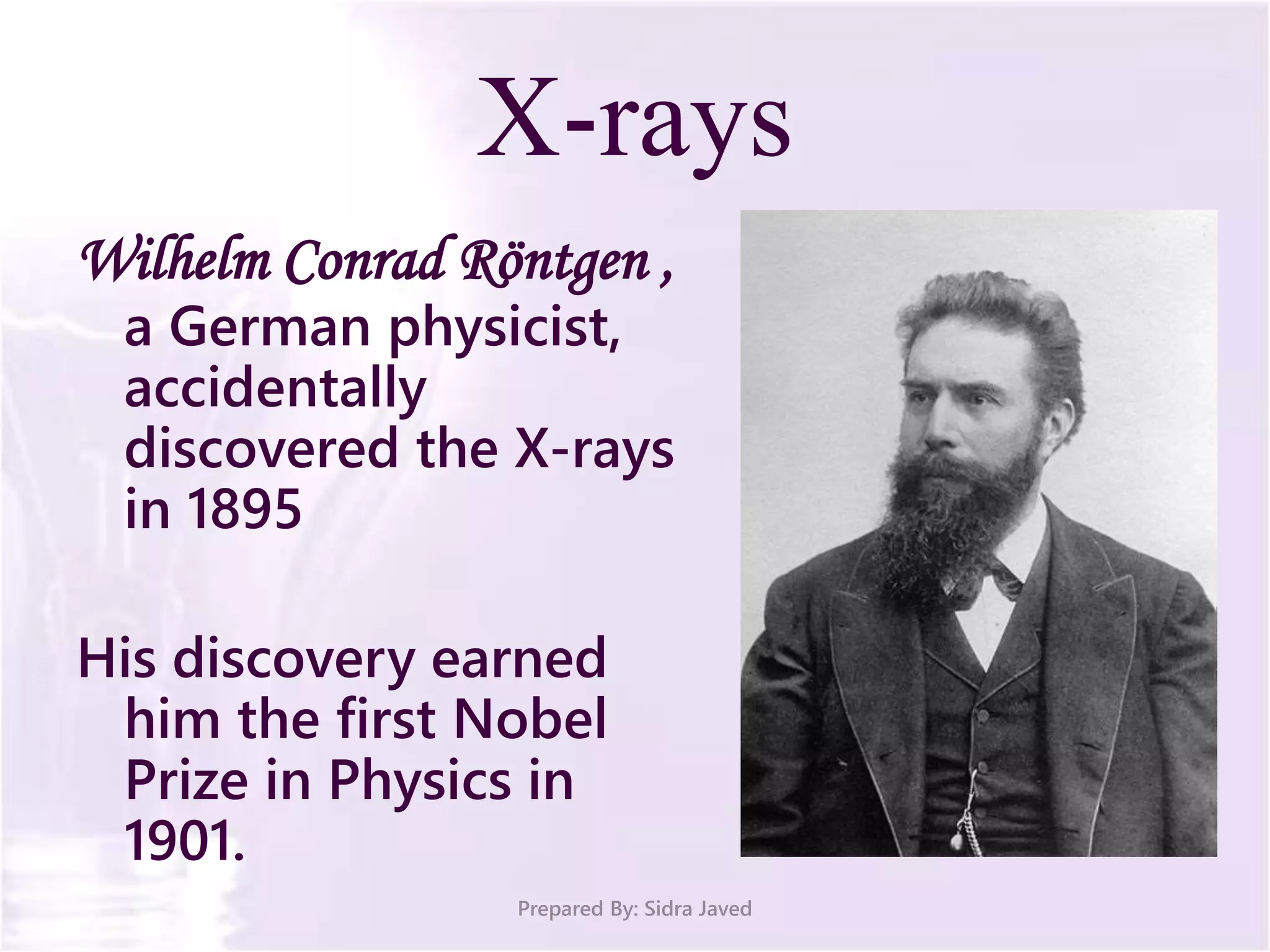
X-rays
Wilhelm Conrad Röntgen ,
a German physicist,
accidentally
discovered the X-rays
in 1895
His discovery earned
him the first Nobel
Prize in Physics in
1901.
Prepared By: Sidra Javed
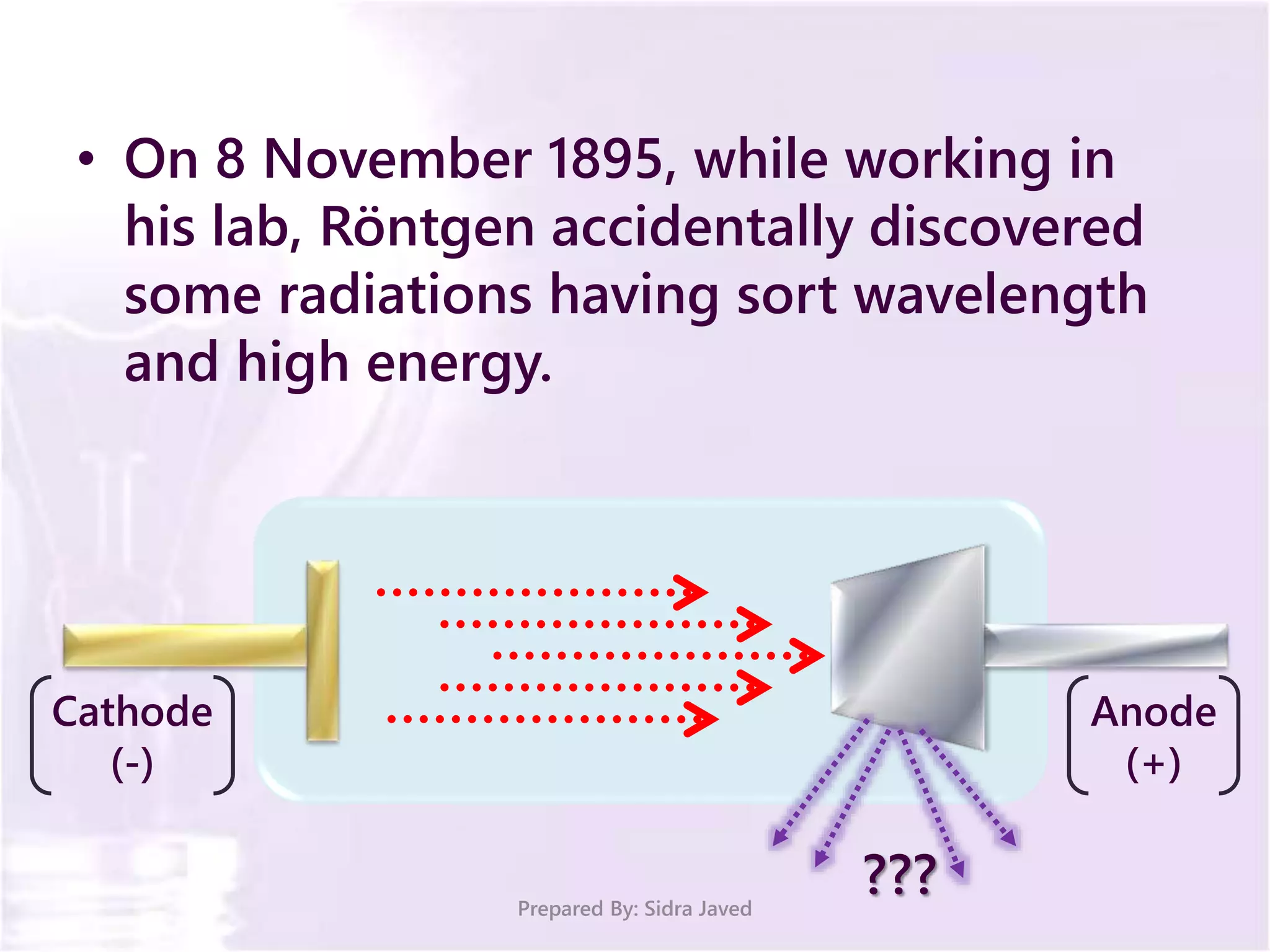
• On 8 November 1895, while working in
his lab, Röntgen accidentally discovered
some radiations having sort wavelength
and high energy.
Prepared By: Sidra Javed
Cathode
(-)
Anode
(+)
???
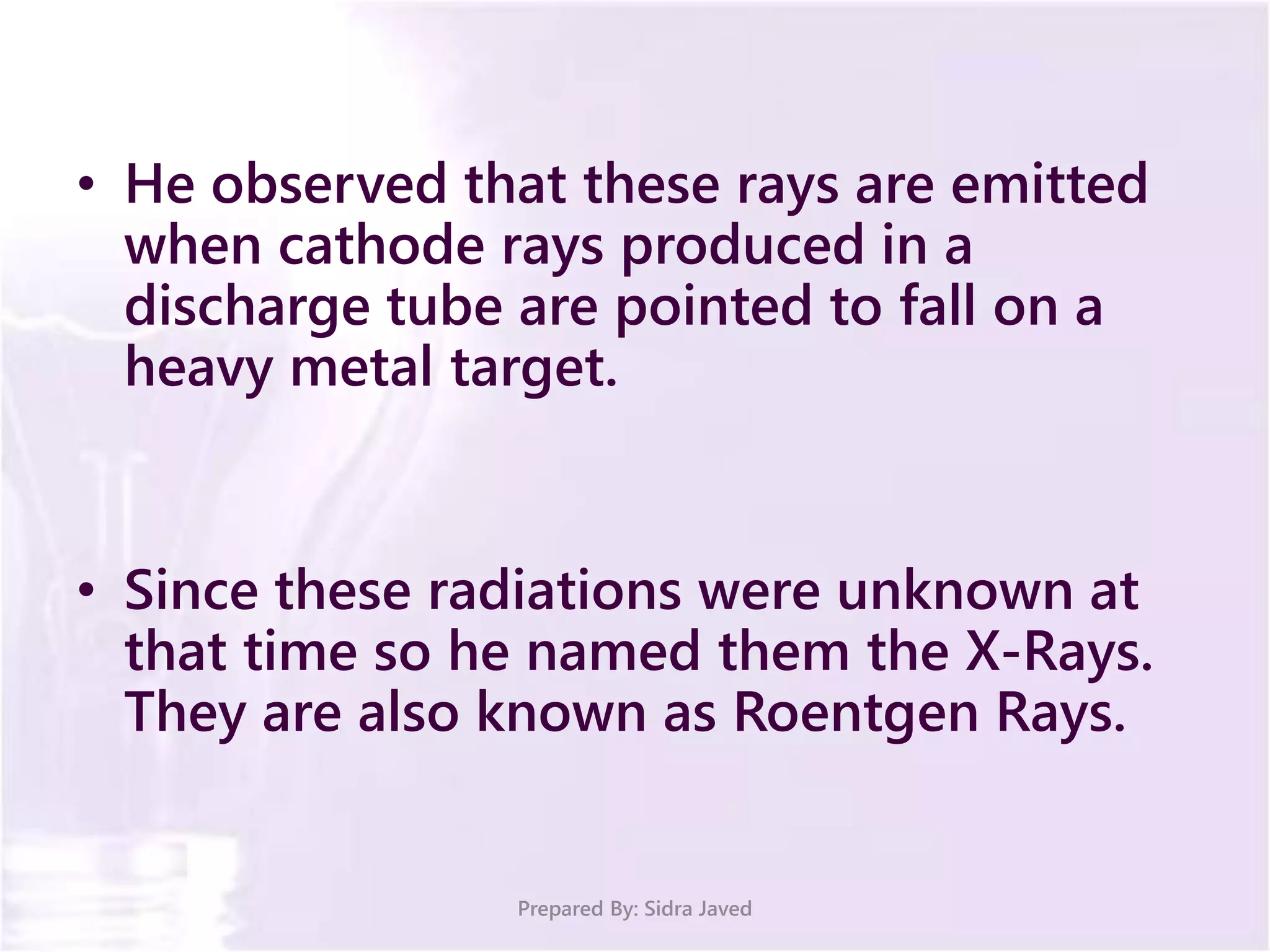
• He observed that these rays are emitted
when cathode rays produced in a
discharge tube are pointed to fall on a
heavy metal target.
• Since these radiations were unknown at
that time so he named them the X-Rays.
They are also known as Roentgen Rays.
Prepared By: Sidra Javed
HOW X-RAYS ARE PRODUCED?
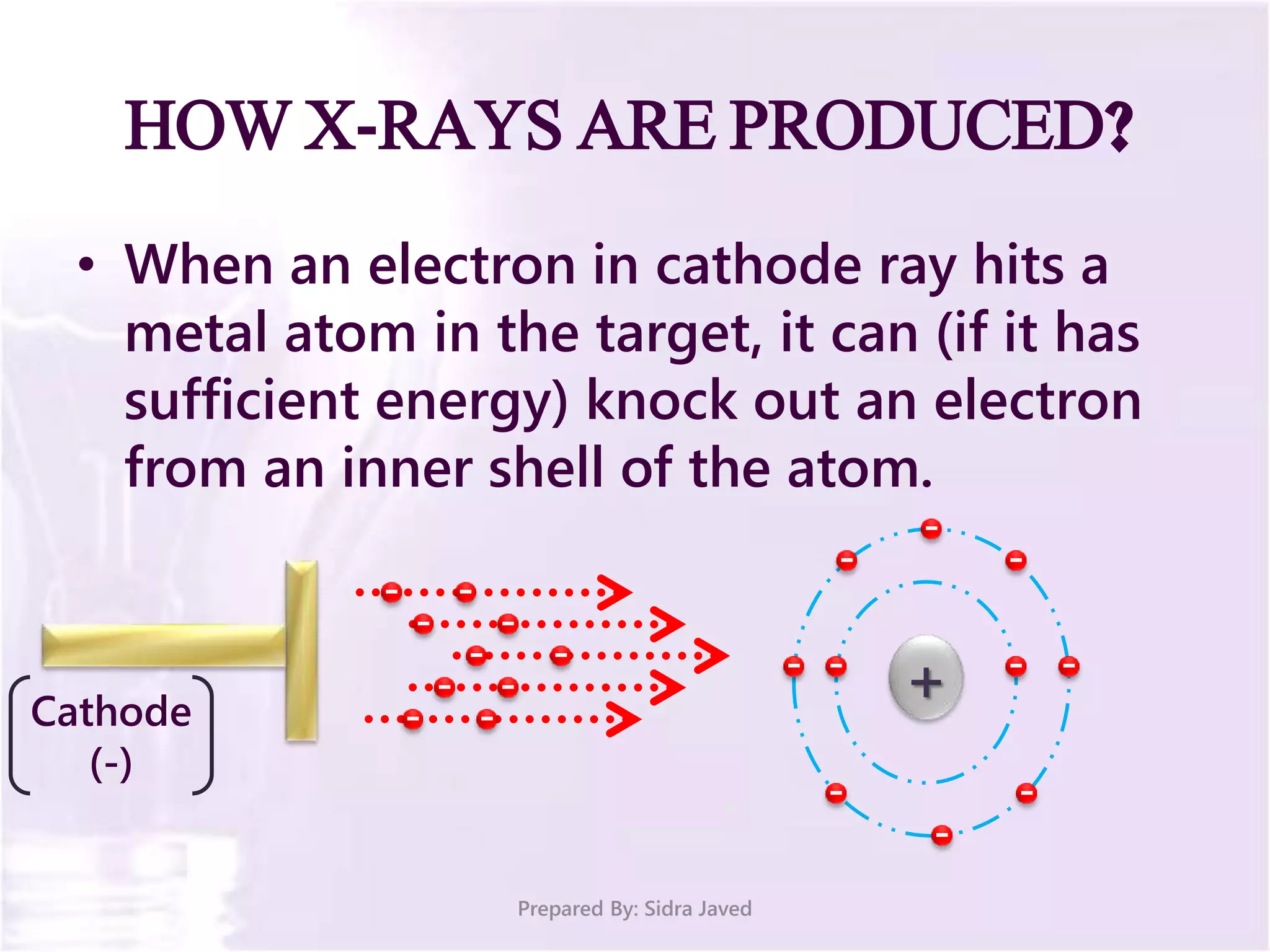
• When an electron in cathode ray hits a
metal atom in the target, it can (if it has
sufficient energy) knock out an electron
from an inner shell of the atom.
Prepared By: Sidra Javed
+-
-
-
-
--
--
--
Cathode
(-)
-
-
-
-
-
-
-
--
-
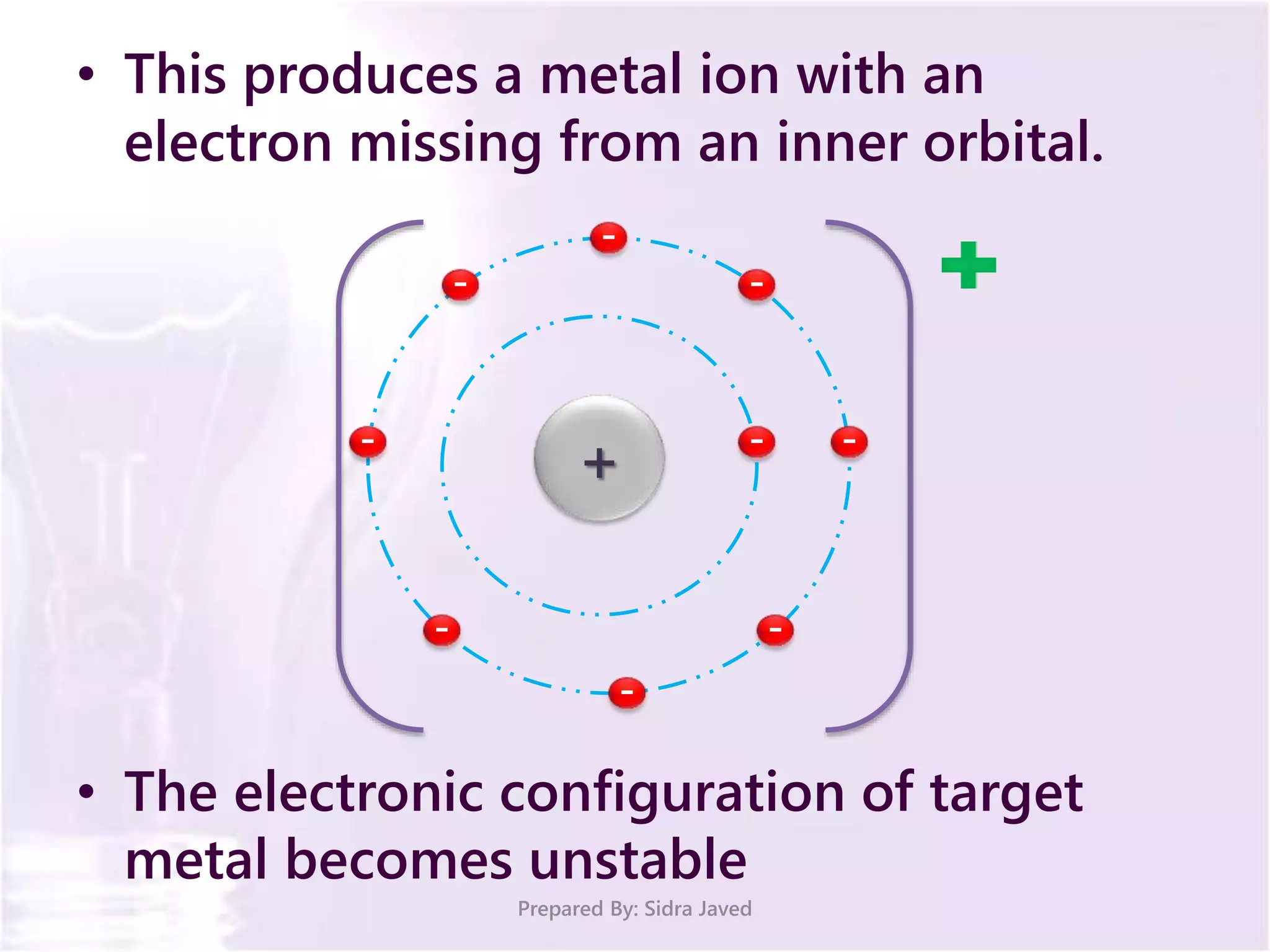
• This produces a metal ion with an
electron missing from an inner orbital.
• The electronic configuration of target
metal becomes unstable
Prepared By: Sidra Javed
+
-
-
-
--
--
--
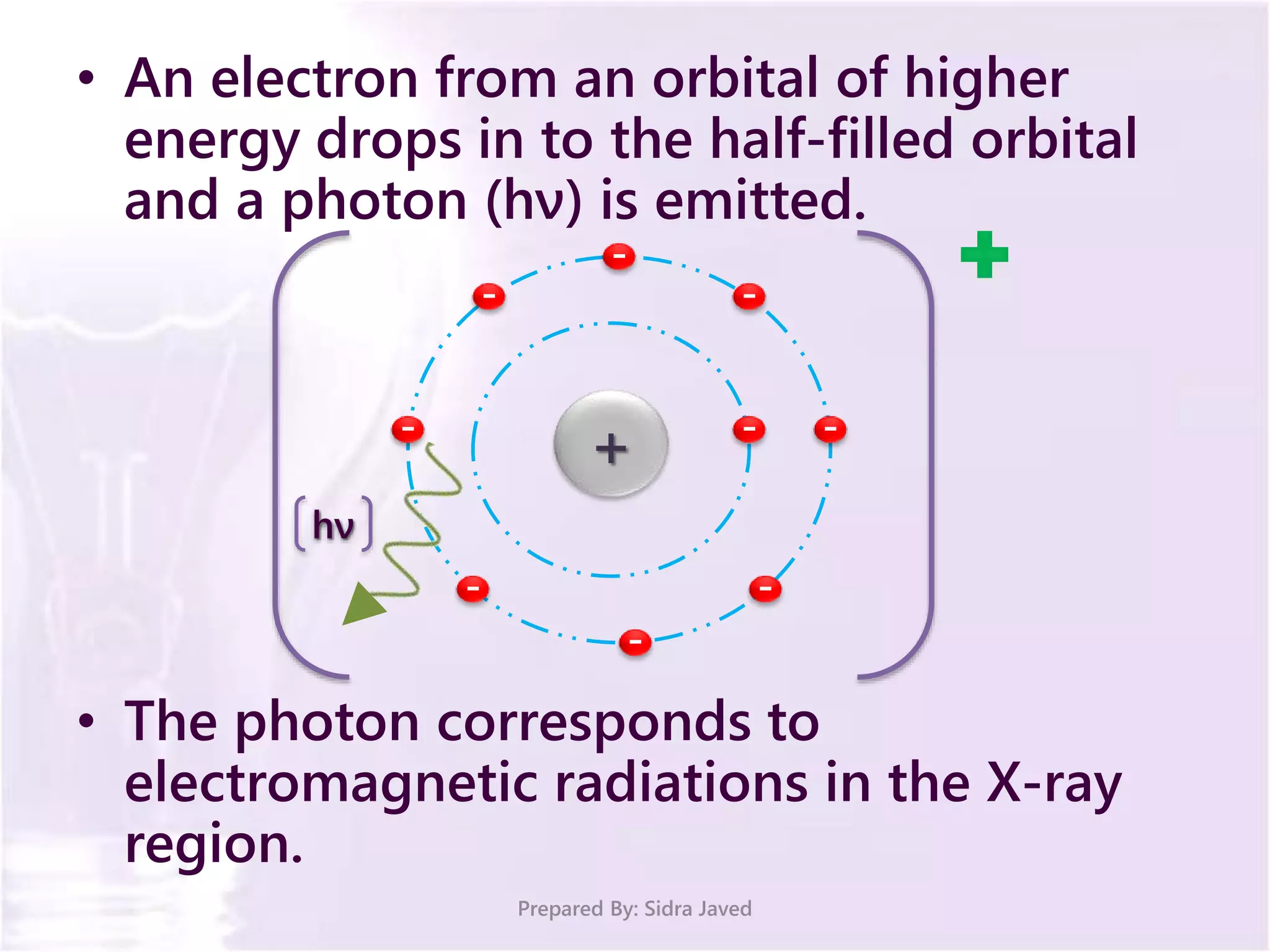
• An electron from an orbital of higher
energy drops in to the half-filled orbital
and a photon (hν) is emitted.
• The photon corresponds to
electromagnetic radiations in the X-ray
region.
Prepared By: Sidra Javed
+
-
-
-
--
--
--
hν
PROPERTIES OF X-RAYS
1. The X-rays are electromagnetic
radiations of very high frequency and
energy.
2. Energy and λ of X-rays depends upon
the nature of anode.
3. Every metal has its own characteristic X-
rays.
4. X-Rays are emitted from the target in all
directions.
Prepared By: Sidra Javed
X-RAYS & THE DISCOVERY OF
ATOMIC NUMBER (Z)
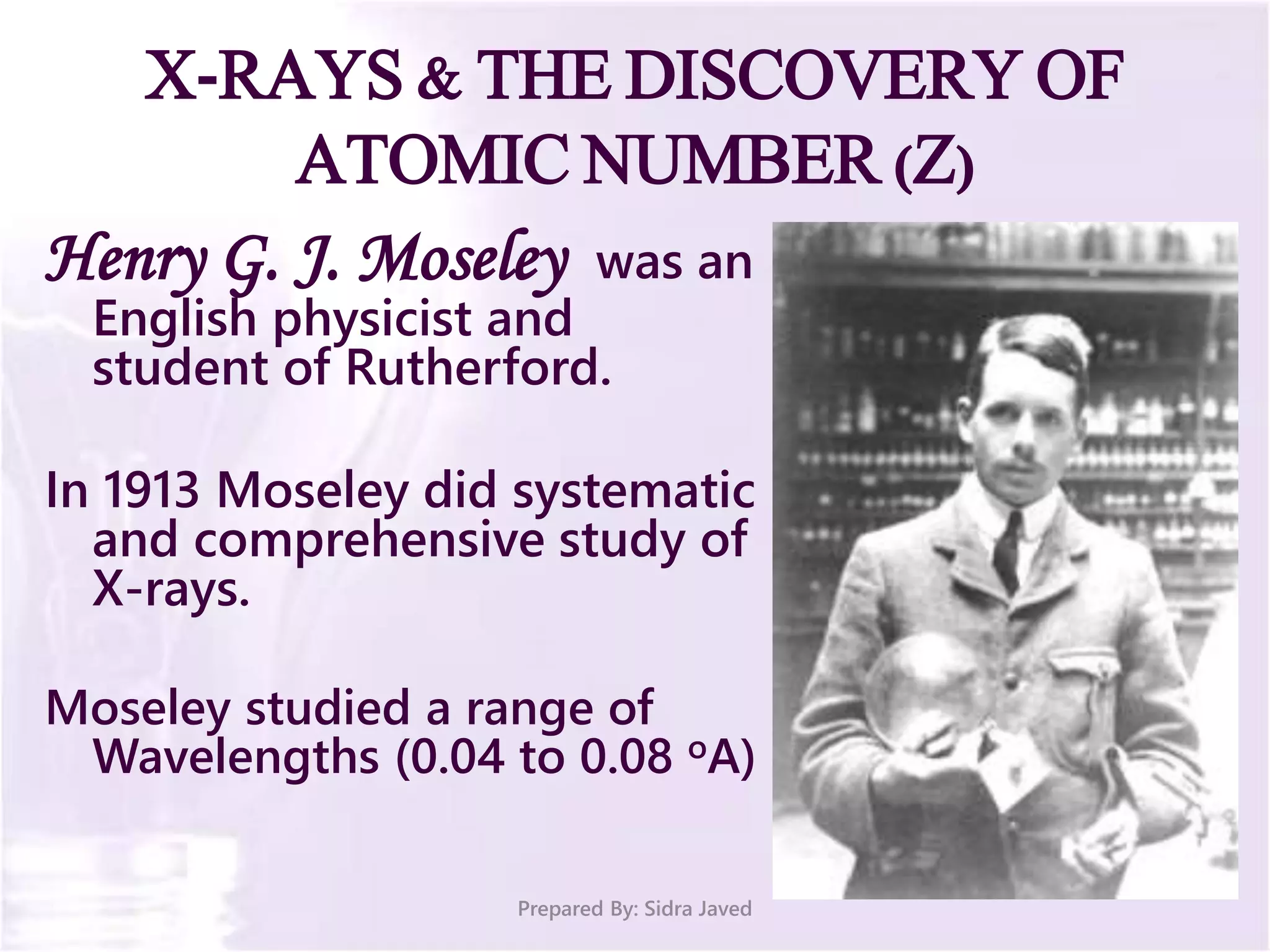
Henry G. J. Moseley was an
English physicist and
student of Rutherford.
In 1913 Moseley did systematic
and comprehensive study of
X-rays.
Moseley studied a range of
Wavelengths (0.04 to 0.08 oA)
Prepared By: Sidra Javed
MOSELEY’S RESEARCH
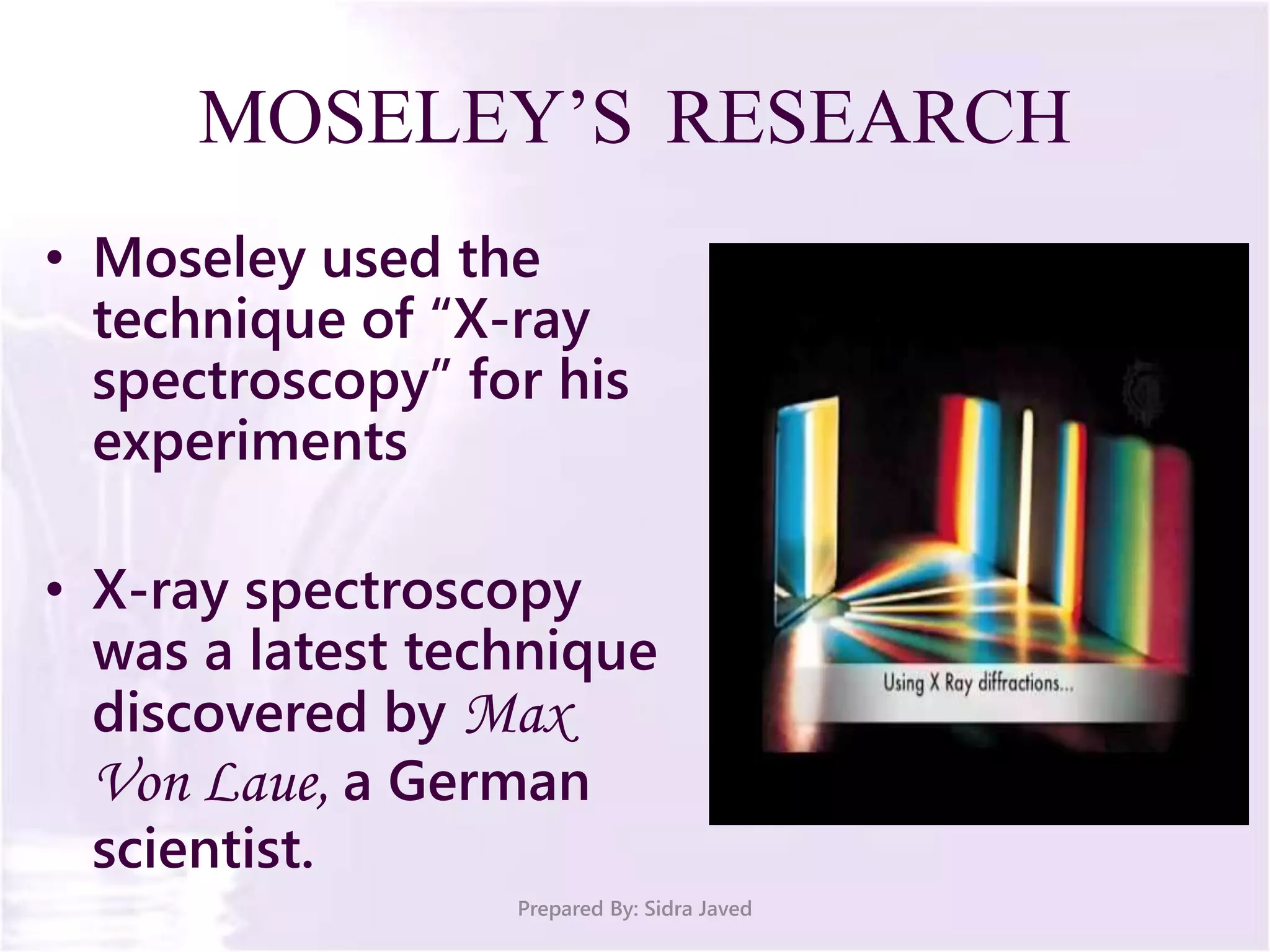
• Moseley used the
technique of “X-ray
spectroscopy” for his
experiments
• X-ray spectroscopy
was a latest technique
discovered by Max
Von Laue, a German
scientist.
Prepared By: Sidra Javed
DETERMINATION OF ATOMIC
NUMBER
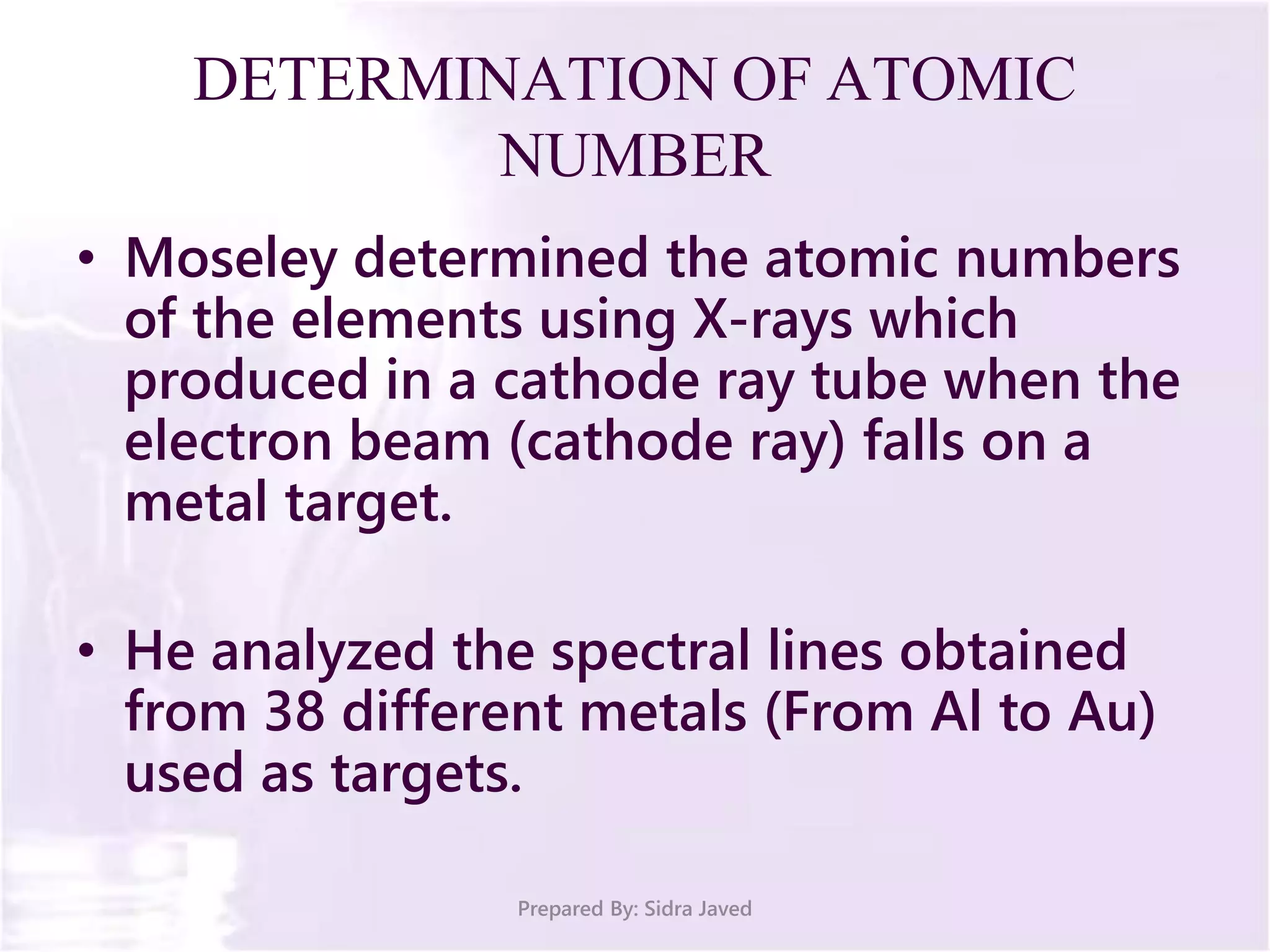
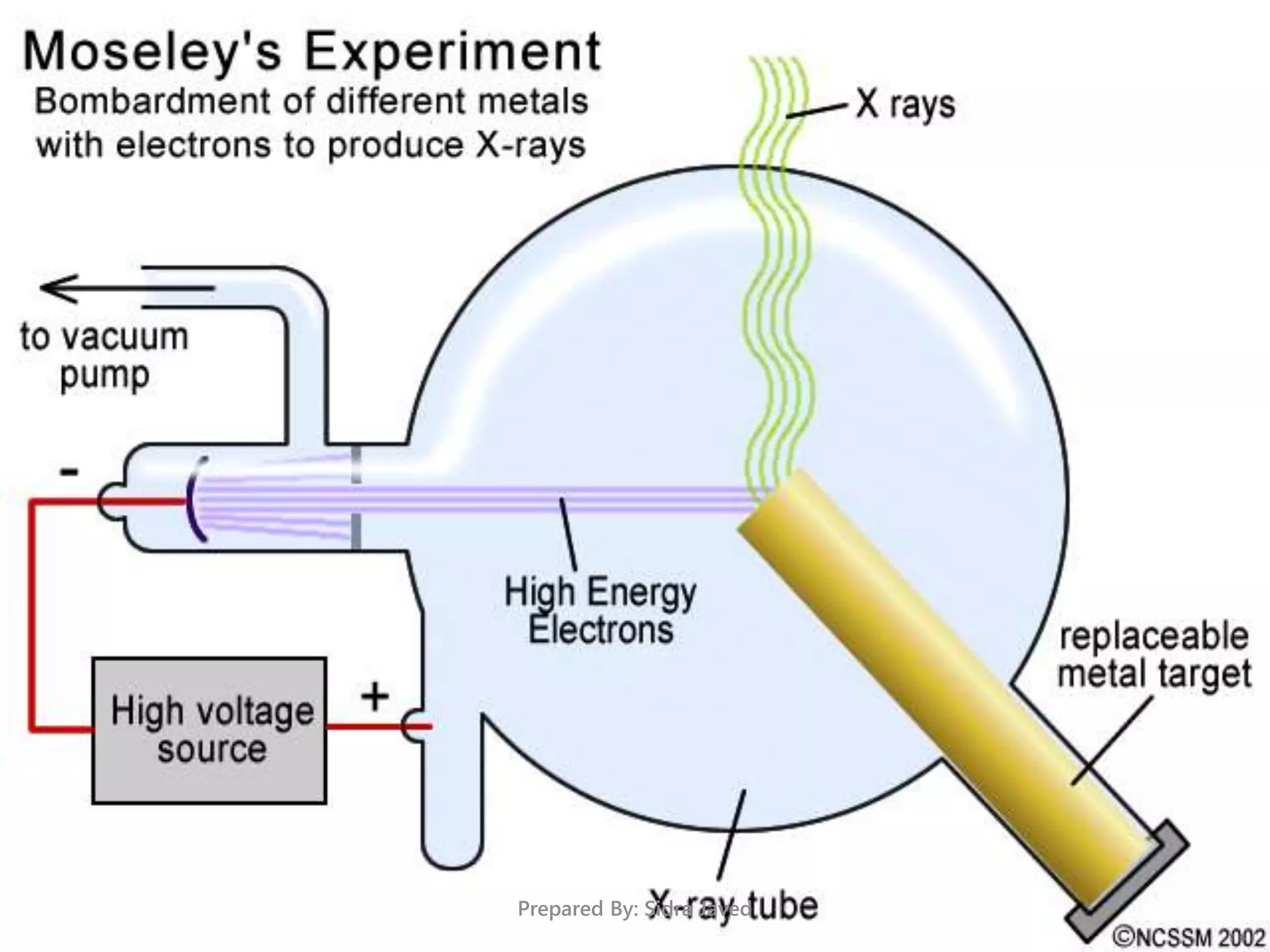
• Moseley determined the atomic numbers
of the elements using X-rays which
produced in a cathode ray tube when the
electron beam (cathode ray) falls on a
metal target.
• He analyzed the spectral lines obtained
from 38 different metals (From Al to Au)
used as targets.
Prepared By: Sidra Javed
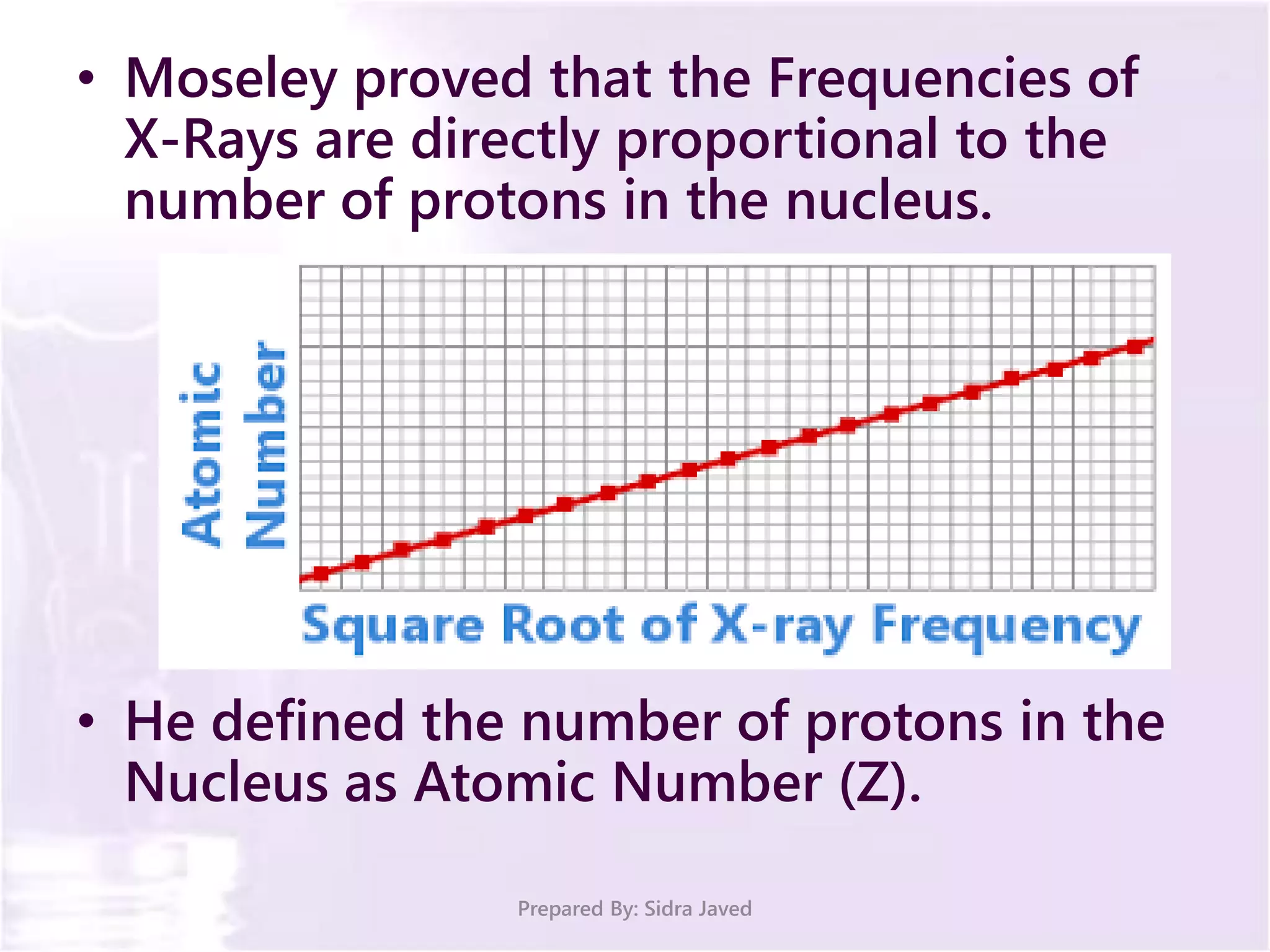
• Moseley proved that the Frequencies of
X-Rays are directly proportional to the
number of protons in the nucleus.
• He defined the number of protons in the
Nucleus as Atomic Number (Z).
Prepared By: Sidra Javed
CONCLUSIONS OF MOSELEY’S
ANALYSIS
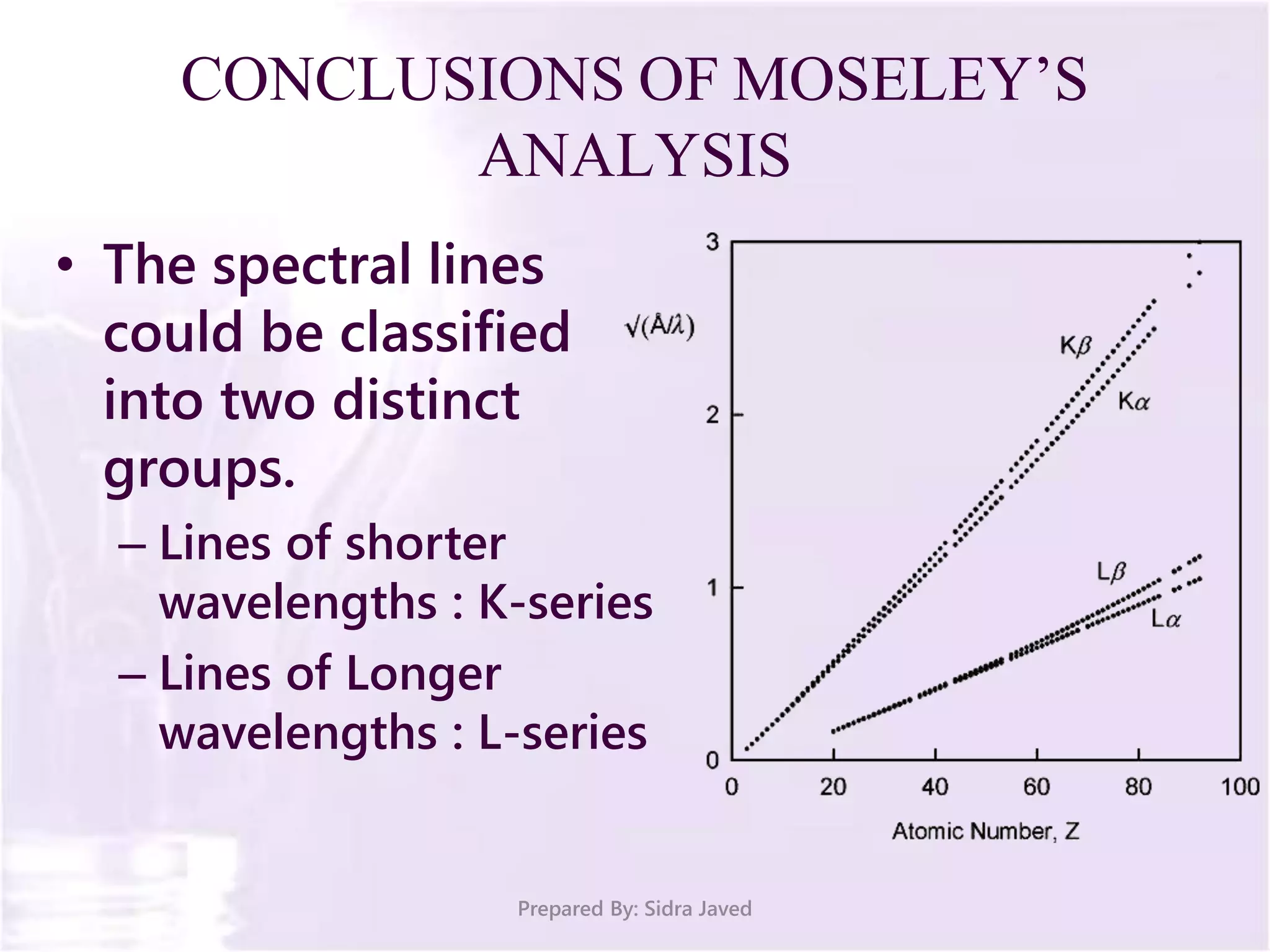
• The spectral lines
could be classified
into two distinct
groups.
– Lines of shorter
wavelengths : K-series
– Lines of Longer
wavelengths : L-series
Prepared By: Sidra Javed
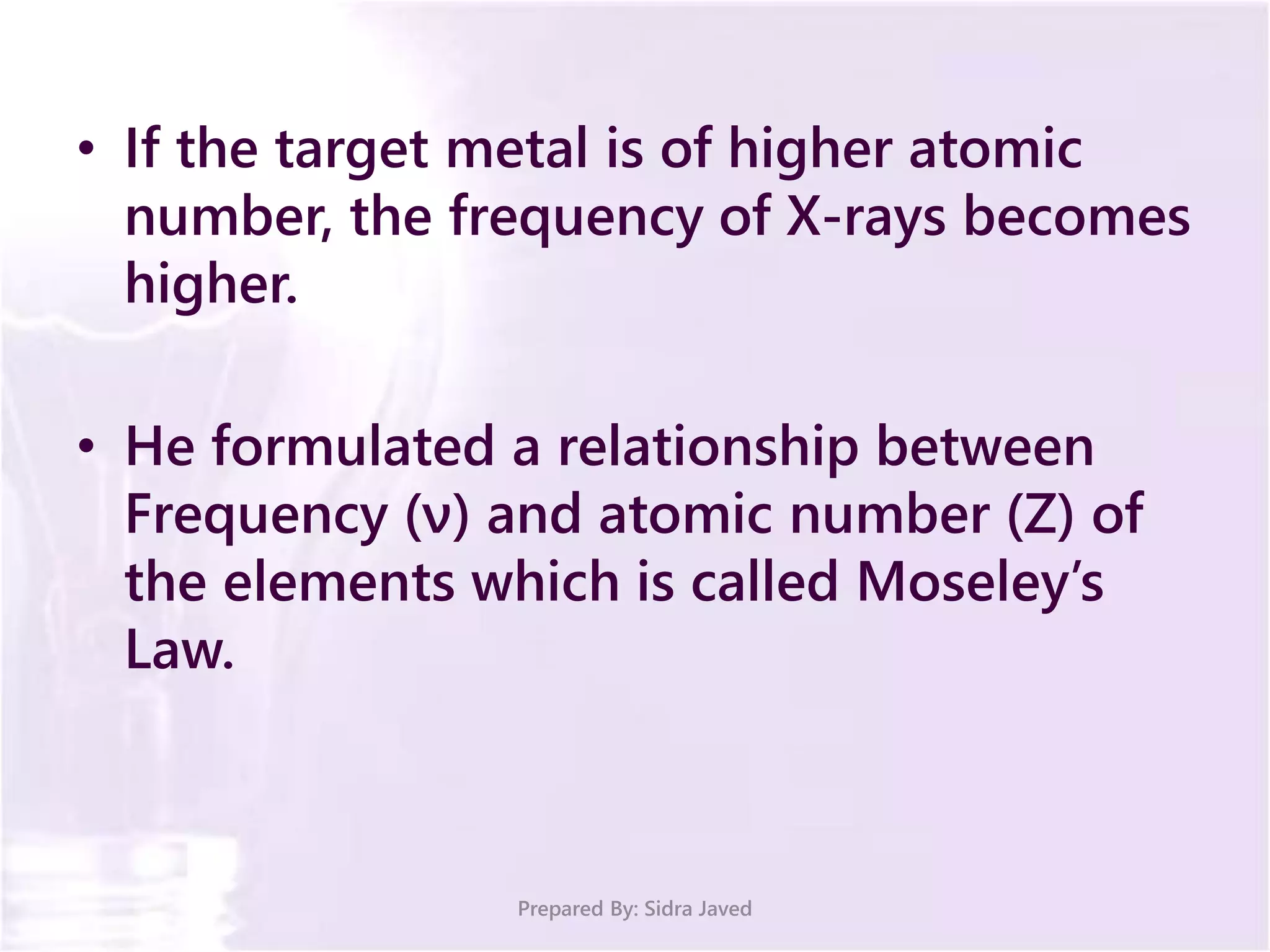
• If the target metal is of higher atomic
number, the frequency of X-rays becomes
higher.
• He formulated a relationship between
Frequency (ν) and atomic number (Z) of
the elements which is called Moseley’s
Law.
Prepared By: Sidra Javed
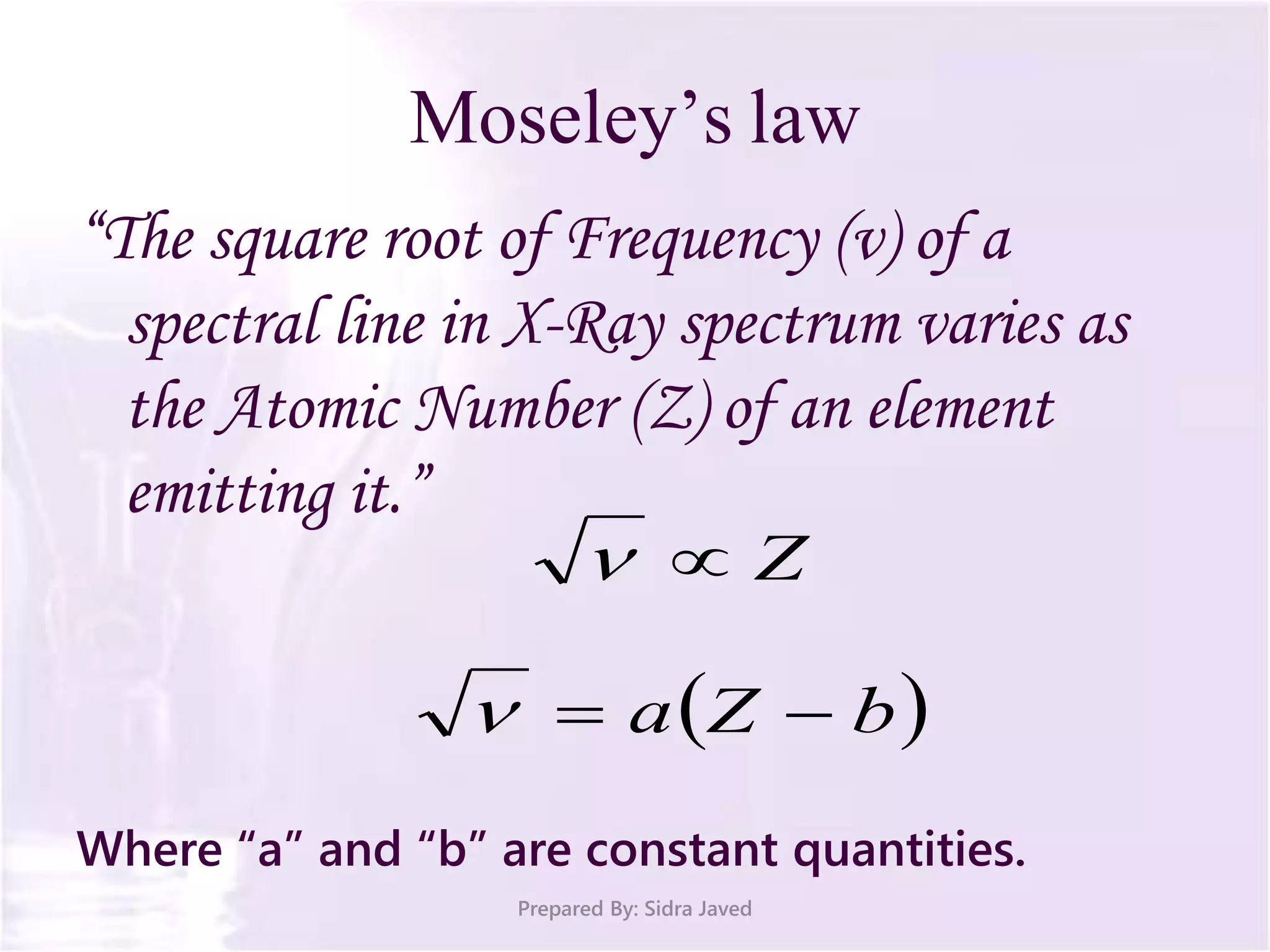
Moseley’s law
“The square root of Frequency (ν) of a
spectral line in X-Ray spectrum varies as
the Atomic Number (Z) of an element
emitting it.”
Where “a” and “b” are constant quantities.
Prepared By: Sidra Javed
Z
 bZa 
Prepared By: Sidra Javed
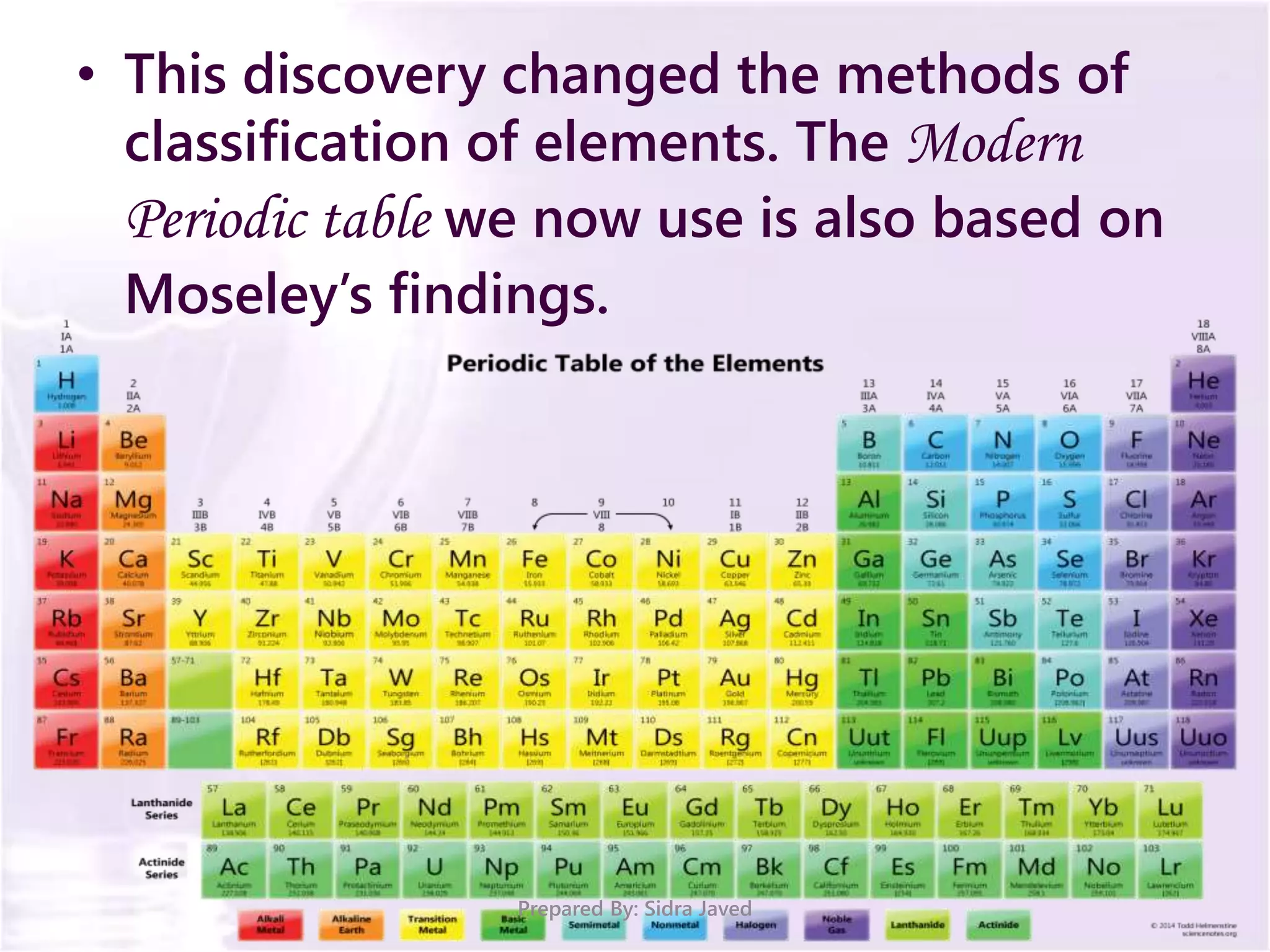
• This discovery changed the methods of
classification of elements. The Modern
Periodic table we now use is also based on
Moseley’s findings.
• This was the time when World War I broke out
in Western Europe. Moseley volunteered for
the Royal engineers of British Army.
• In a tragic loss to science, Moseley was shot
and killed during the Battle of Gallipoli on
August 10, 1915, at the age of just 27.
• A number of prominent authors, have
speculated that Moseley would have been
deserving of the Nobel Prize in Physics in 1916
which was awarded to nobody that year.
Prepared By: Sidra Javed
PRACTICAL APPLICATIONS OF
X-RAYS
• After the discovery of X-Rays by
Roentgen in December 1895, scientists
started experimenting with X-rays in
order to fine their practical applications.
• Since X-rays have different penetrating
powers for different types of matter so
they can be used to photograph interior
of an object.
Prepared By: Sidra Javed
Surgical Assistance
• Since X-rays have
different penetrating
powers for different types
of matter so they can be
used to photograph
interior of an object.
• In January 1986, scientists
successfully used X-rays
to assist in setting a
person’s broken arm.
Prepared By: Sidra Javed
Crystal Structures
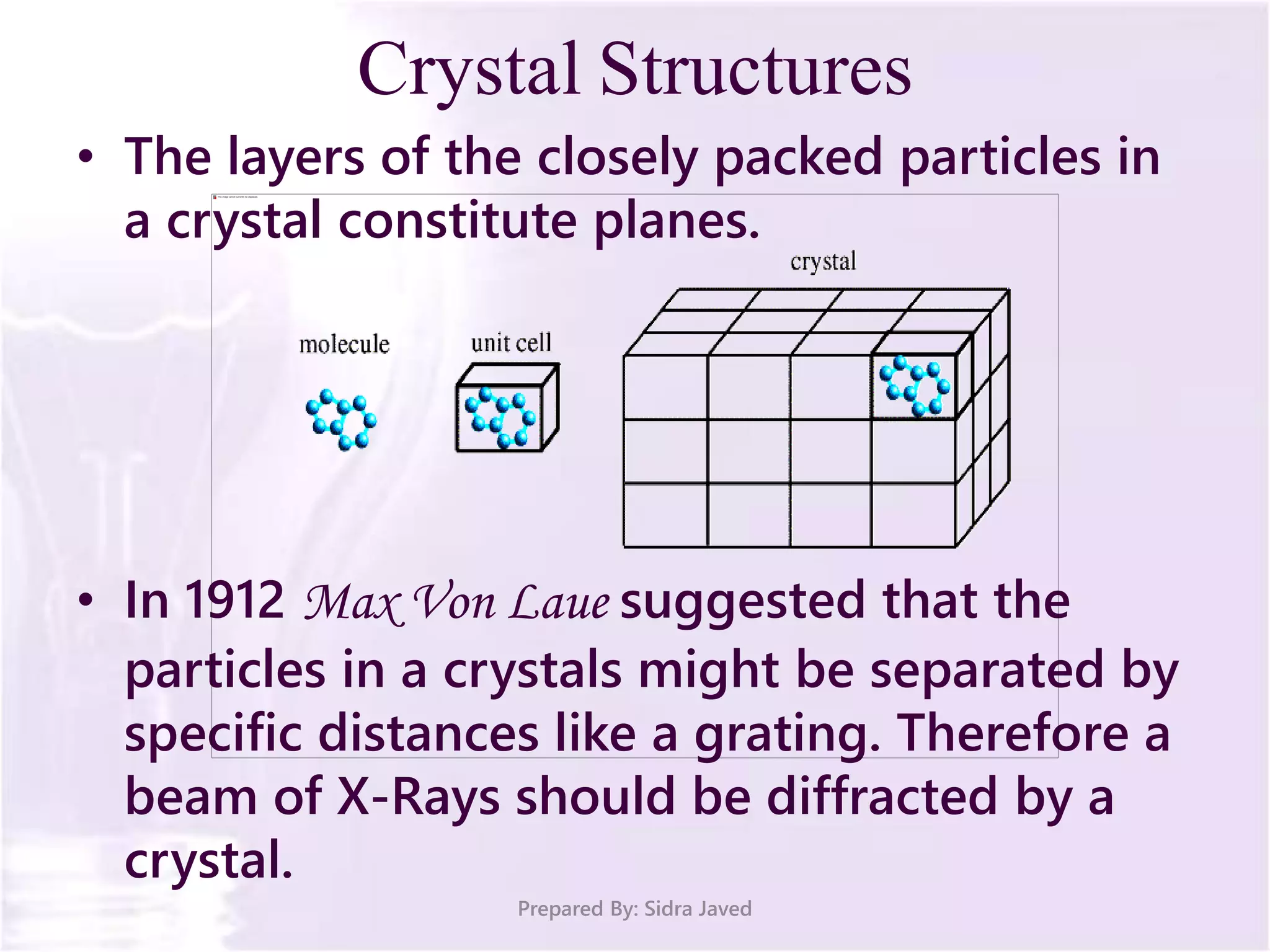
• The layers of the closely packed particles in
a crystal constitute planes.
• In 1912 Max Von Laue suggested that the
particles in a crystals might be separated by
specific distances like a grating. Therefore a
beam of X-Rays should be diffracted by a
crystal.
Prepared By: Sidra Javed
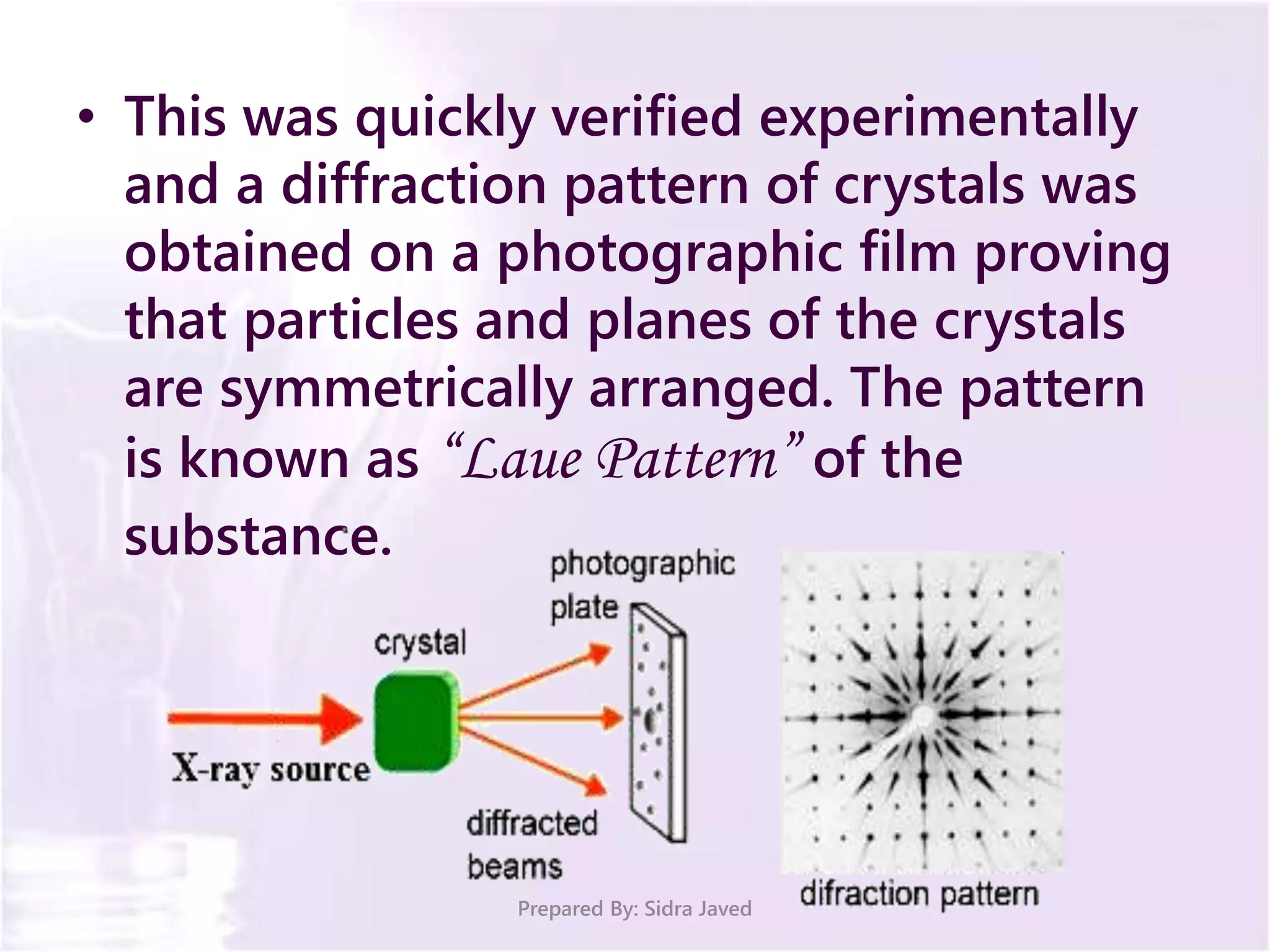
• This was quickly verified experimentally
and a diffraction pattern of crystals was
obtained on a photographic film proving
that particles and planes of the crystals
are symmetrically arranged. The pattern
is known as “Laue Pattern” of the
substance.
Prepared By: Sidra Javed
X-ray Diffraction
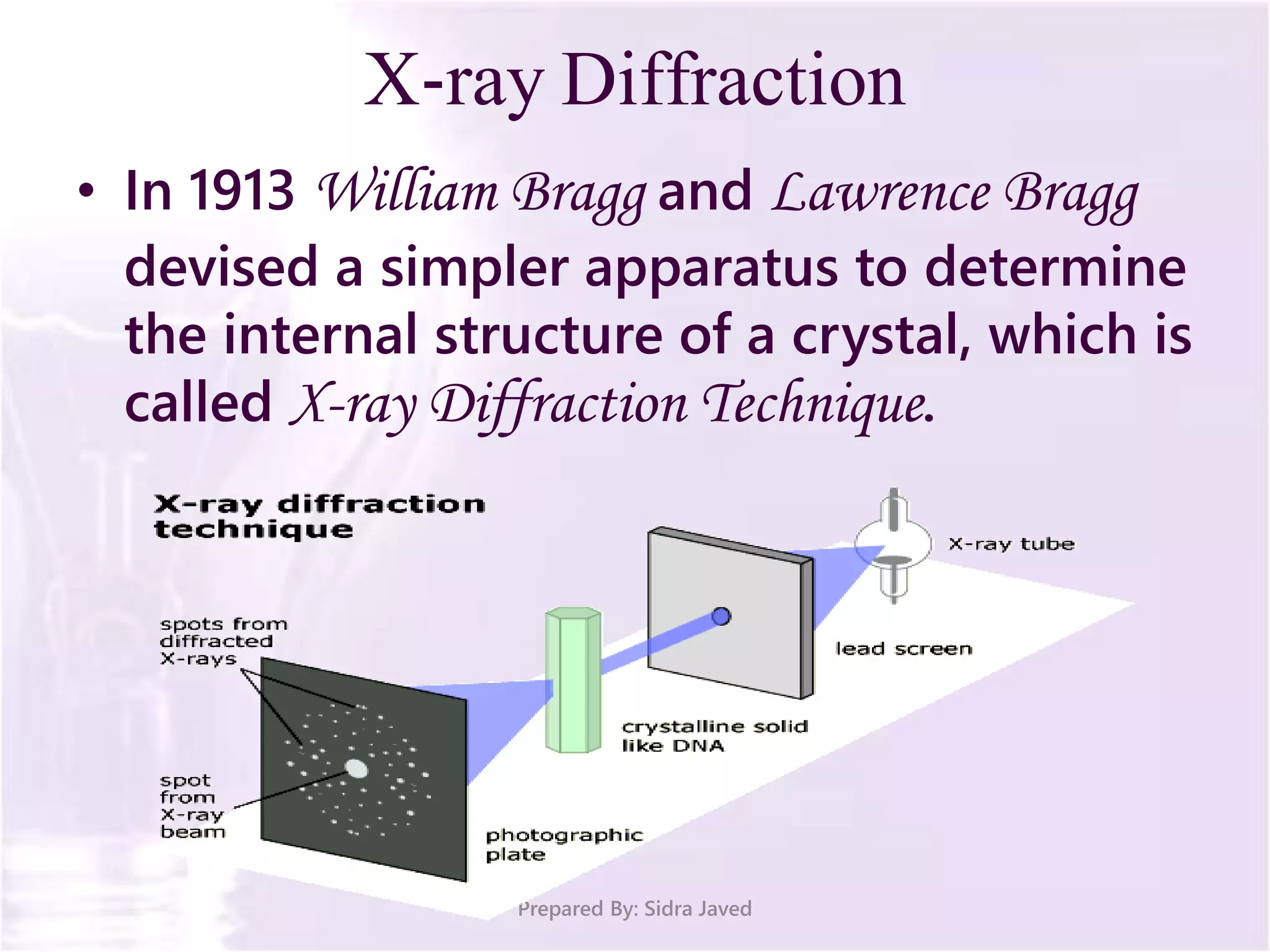
• In 1913 William Bragg and Lawrence Bragg
devised a simpler apparatus to determine
the internal structure of a crystal, which is
called X-ray Diffraction Technique.
Prepared By: Sidra Javed
THE END

Planck's Quantum Theory and Discovery of X-rays

  • 1.
    PLANCK’S QUANTUM THEORY, X-RAYS& ATOMIC NUMBER CHAPTER # 2 ATOMIC STRUCTURE Prepared By: Sidra Javed
  • 2.
    Max Planck • In1901, Max Planck initiated Quantum Physics by presenting his Quantum Theory. • He was awarded Nobel Prize in Physics in 1918. Prepared By: Sidra Javed
  • 3.
    Planck’s Quantum Theory a)Energy is not emitted or absorbed continuously. It is emitted or absorbed in the form of wave packets or quanta. In case of light the quantum of energy is often called Photon. Prepared By: Sidra Javed
  • 4.
    b) The amountof energy associated with quantum of radiation is directly proportional to the frequency (ν) of radiation i.e. Where, h =Planck’s Constant =6.626 x 10⁻³⁴ J.s Prepared By: Sidra Javed Planck’s Quantum Theory E hE 
  • 5.
    Planck’s Quantum Theory c)A body can emit or absorb energy only in terms of integral multiple of a quantum/photon. Where n= 1, 2, 3,…. Prepared By: Sidra Javed nhE 
  • 6.
    Frequency Definition: “The number ofwaves passing through a point per second is called frequency.” Unit: s-1 or Hz (Hertz) Prepared By: Sidra Javed
  • 7.
    Wavelength Definition: “The distance betweentwo adjacent crests of troughs is called Wavelength.” Unit: m (meter) Prepared By: Sidra Javed
  • 8.
    Energy & Wavelength Since, where,c= Velocity of Light = 3x10⁸ms-1 Prepared By: Sidra Javed   1    c 
  • 9.
    According to Planck’sQuantum Theory: Therefore, Thus greater the Wavelength of radiation, lower will be the energy Prepared By: Sidra Javed hE   c hE 
  • 10.
    Wave Number Definition: “The reciprocalof Wavelength is called Wave number.” Unit: oA (Angstrom) or nm (Nanometers) 1 oA = 10-10m 1 nm = 10-9m Prepared By: Sidra Javed
  • 11.
    Energy & WaveNumber As we know that, Therefore, Thus energy of radiation is directly proportional to wave number. Prepared By: Sidra Javed    1 hcE 
  • 12.
    EXAMPLE 2.7 A photonof light with energy 10-19 J is emitted by a source of light. a) Convert this light into Wavelength, frequency and wave number of the photon in terms of meters, Hertz and m-1 respectively. b) Convert this energy of photon into ergs and calculate the wavelength in cm, frequency in Hz and wave number in cm-1. Prepared By: Sidra Javed
  • 13.
    Solution (a) Data: Energy ofPhoton = E = 10-19 J Wavelength = λ = ? in m Frequency = ν = ? in Hz Wave Number = = ? im m-1 Prepared By: Sidra Javed
  • 14.
    Frequency in Hz PreparedBy: Sidra Javed hE  h E  sJ J .10626.6 10 34 19     or Hz1051.1 114   s
  • 15.
    Wavelength Prepared By: SidraJaved   c  114 18 1051.1 103      s ms  m6 1098.1     c 
  • 16.
    Wave Number Prepared By:Sidra Javed   1  m6 1098.1 1    15 100.5   m
  • 17.
    Solution (b) Data: Energy =E = ? in erg Wavelength = λ = ? in cm Frequency = ν = ? in Hz Wave Number = = ? in cm-1 Prepared By: Sidra Javed
  • 18.
    Energy in erg PreparedBy: Sidra Javed ergJ 7 101  ergE 719 1010   erg12 10  Value of Planck’s Constant is also converted into erg sergh .1010626.6 734   sergh .10626.6 27 
  • 19.
    Frequency in Hz PreparedBy: Sidra Javed hE  h E  serg erg .10626.6 10 27 12     or Hz1051.1 114   s
  • 20.
    Wavelength in cm PreparedBy: Sidra Javed   c  114 110 1051.1 103      s cms  cm4 1098.1     c 
  • 21.
    Wave Number incm-1 Prepared By: Sidra Javed   1  cm4 1098.1 1    13 100.5   cm
  • 22.
    X-rays Wilhelm Conrad Röntgen, a German physicist, accidentally discovered the X-rays in 1895 His discovery earned him the first Nobel Prize in Physics in 1901. Prepared By: Sidra Javed
  • 23.
    • On 8November 1895, while working in his lab, Röntgen accidentally discovered some radiations having sort wavelength and high energy. Prepared By: Sidra Javed Cathode (-) Anode (+) ???
  • 24.
    • He observedthat these rays are emitted when cathode rays produced in a discharge tube are pointed to fall on a heavy metal target. • Since these radiations were unknown at that time so he named them the X-Rays. They are also known as Roentgen Rays. Prepared By: Sidra Javed
  • 25.
    HOW X-RAYS AREPRODUCED? • When an electron in cathode ray hits a metal atom in the target, it can (if it has sufficient energy) knock out an electron from an inner shell of the atom. Prepared By: Sidra Javed +- - - - -- -- -- Cathode (-) - - - - - - - -- -
  • 26.
    • This producesa metal ion with an electron missing from an inner orbital. • The electronic configuration of target metal becomes unstable Prepared By: Sidra Javed + - - - -- -- --
  • 27.
    • An electronfrom an orbital of higher energy drops in to the half-filled orbital and a photon (hν) is emitted. • The photon corresponds to electromagnetic radiations in the X-ray region. Prepared By: Sidra Javed + - - - -- -- -- hν
  • 28.
    PROPERTIES OF X-RAYS 1.The X-rays are electromagnetic radiations of very high frequency and energy. 2. Energy and λ of X-rays depends upon the nature of anode. 3. Every metal has its own characteristic X- rays. 4. X-Rays are emitted from the target in all directions. Prepared By: Sidra Javed
  • 29.
    X-RAYS & THEDISCOVERY OF ATOMIC NUMBER (Z) Henry G. J. Moseley was an English physicist and student of Rutherford. In 1913 Moseley did systematic and comprehensive study of X-rays. Moseley studied a range of Wavelengths (0.04 to 0.08 oA) Prepared By: Sidra Javed
  • 30.
    MOSELEY’S RESEARCH • Moseleyused the technique of “X-ray spectroscopy” for his experiments • X-ray spectroscopy was a latest technique discovered by Max Von Laue, a German scientist. Prepared By: Sidra Javed
  • 31.
    DETERMINATION OF ATOMIC NUMBER •Moseley determined the atomic numbers of the elements using X-rays which produced in a cathode ray tube when the electron beam (cathode ray) falls on a metal target. • He analyzed the spectral lines obtained from 38 different metals (From Al to Au) used as targets. Prepared By: Sidra Javed
  • 32.
  • 33.
    • Moseley provedthat the Frequencies of X-Rays are directly proportional to the number of protons in the nucleus. • He defined the number of protons in the Nucleus as Atomic Number (Z). Prepared By: Sidra Javed
  • 34.
    CONCLUSIONS OF MOSELEY’S ANALYSIS •The spectral lines could be classified into two distinct groups. – Lines of shorter wavelengths : K-series – Lines of Longer wavelengths : L-series Prepared By: Sidra Javed
  • 35.
    • If thetarget metal is of higher atomic number, the frequency of X-rays becomes higher. • He formulated a relationship between Frequency (ν) and atomic number (Z) of the elements which is called Moseley’s Law. Prepared By: Sidra Javed
  • 36.
    Moseley’s law “The squareroot of Frequency (ν) of a spectral line in X-Ray spectrum varies as the Atomic Number (Z) of an element emitting it.” Where “a” and “b” are constant quantities. Prepared By: Sidra Javed Z  bZa 
  • 37.
    Prepared By: SidraJaved • This discovery changed the methods of classification of elements. The Modern Periodic table we now use is also based on Moseley’s findings.
  • 38.
    • This wasthe time when World War I broke out in Western Europe. Moseley volunteered for the Royal engineers of British Army. • In a tragic loss to science, Moseley was shot and killed during the Battle of Gallipoli on August 10, 1915, at the age of just 27. • A number of prominent authors, have speculated that Moseley would have been deserving of the Nobel Prize in Physics in 1916 which was awarded to nobody that year. Prepared By: Sidra Javed
  • 39.
    PRACTICAL APPLICATIONS OF X-RAYS •After the discovery of X-Rays by Roentgen in December 1895, scientists started experimenting with X-rays in order to fine their practical applications. • Since X-rays have different penetrating powers for different types of matter so they can be used to photograph interior of an object. Prepared By: Sidra Javed
  • 40.
    Surgical Assistance • SinceX-rays have different penetrating powers for different types of matter so they can be used to photograph interior of an object. • In January 1986, scientists successfully used X-rays to assist in setting a person’s broken arm. Prepared By: Sidra Javed
  • 41.
    Crystal Structures • Thelayers of the closely packed particles in a crystal constitute planes. • In 1912 Max Von Laue suggested that the particles in a crystals might be separated by specific distances like a grating. Therefore a beam of X-Rays should be diffracted by a crystal. Prepared By: Sidra Javed
  • 42.
    • This wasquickly verified experimentally and a diffraction pattern of crystals was obtained on a photographic film proving that particles and planes of the crystals are symmetrically arranged. The pattern is known as “Laue Pattern” of the substance. Prepared By: Sidra Javed
  • 43.
    X-ray Diffraction • In1913 William Bragg and Lawrence Bragg devised a simpler apparatus to determine the internal structure of a crystal, which is called X-ray Diffraction Technique. Prepared By: Sidra Javed
  • 44.
    Prepared By: SidraJaved THE END