

INTRODUCTION TO PARTIAL ORDERING 
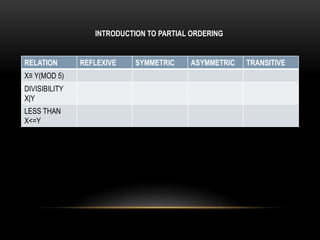
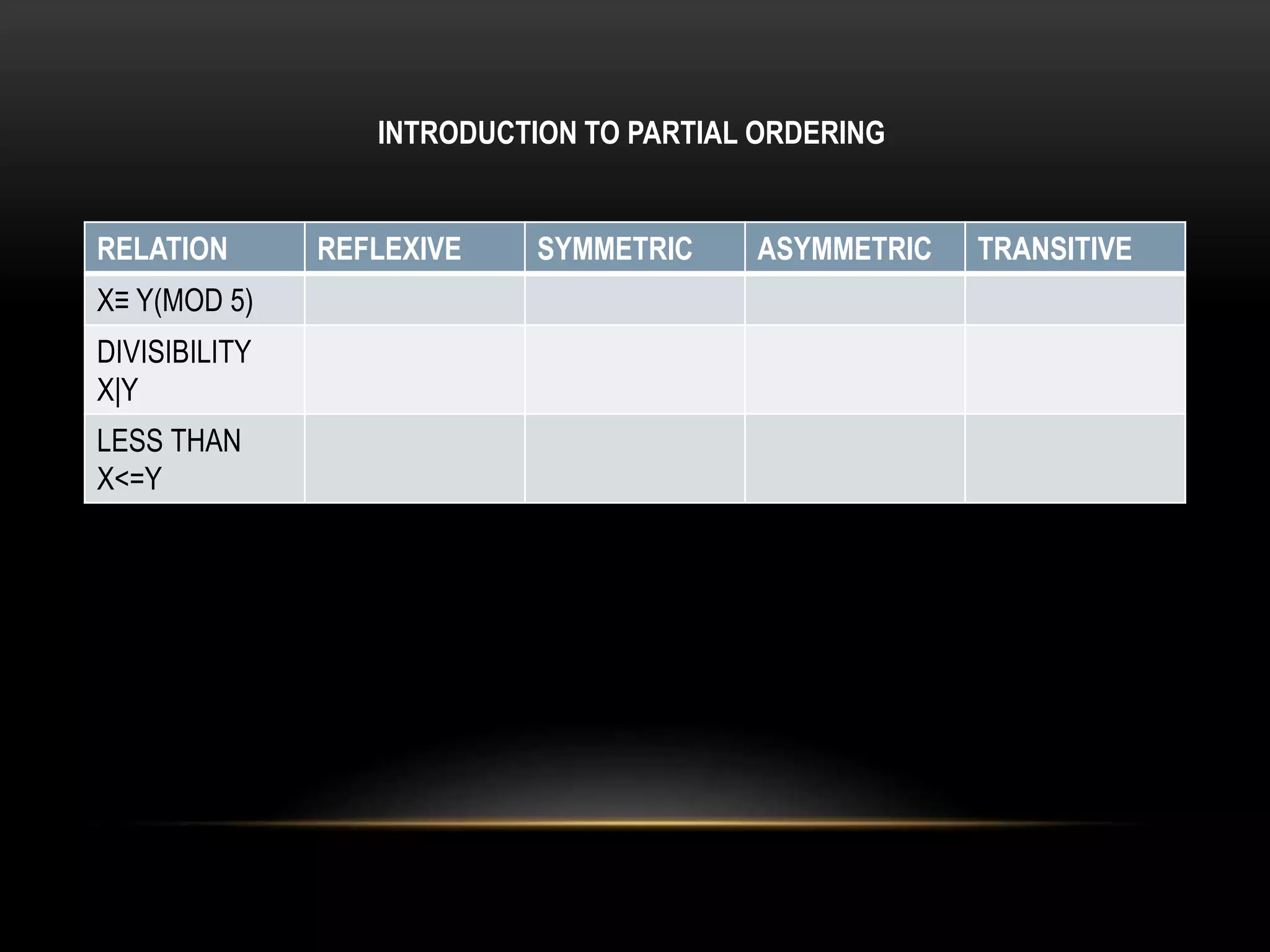
RELATION REFLEXIVE SYMMETRIC ASYMMETRIC TRANSITIVE 
X≡ Y(MOD 5) 
DIVISIBILITY 
X|Y 
LESS THAN 
X<=Y
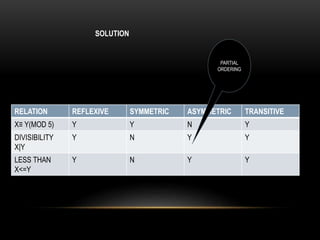
PARTIAL 
ORDERING 
SOLUTION 
RELATION REFLEXIVE SYMMETRIC ASYMMETRIC TRANSITIVE 
X≡ Y(MOD 5) Y Y N Y 
DIVISIBILITY 
Y N Y Y 
X|Y 
LESS THAN 
X<=Y 
Y N Y Y
PARTIALLY ORDERED SETS->HD 
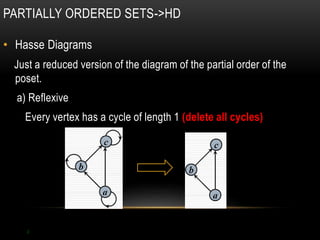
• Hasse Diagrams 
Just a reduced version of the diagram of the partial order of the 
poset. 
a) Reflexive 
Every vertex has a cycle of length 1 (delete all cycles) 
3
PARTIALLY ORDERED SETS->HD 
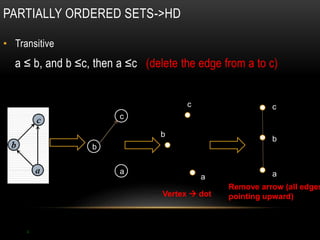
• Transitive 
a ≤ b, and b ≤c, then a ≤c (delete the edge from a to c) 
4 
b 
c 
a 
a 
b 
c 
Vertex  dot 
c 
b 
a 
Remove arrow (all edges 
pointing upward)
EXAMPLE 
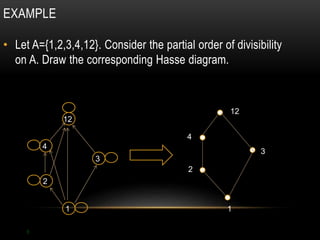
• Let A={1,2,3,4,12}. Consider the partial order of divisibility 
on A. Draw the corresponding Hasse diagram. 
5 
12 
4 
2 
1 
3 
12 
4 
2 
1 
3
Shirt 
innerwear 
Tie 
Jacket 
Trouser 
Belt 
HASSE DIAGRAM 
Left Sock Right Sock 
Left Shoe Right Shoe
Shirt 
innerwear 
Tie 
Jacket 
Trouser 
Belt 
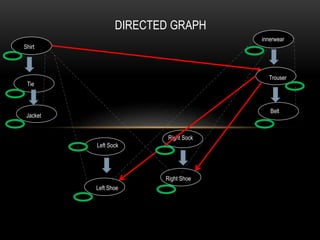
DIRECTED GRAPH 
Left Shoe 
Right Shoe 
Left Sock 
Right Sock
EXTREMAL ELEMENTS & BOUNDS 
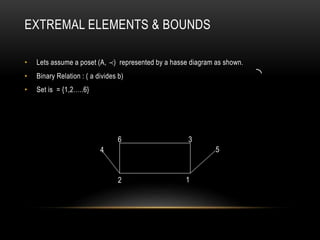
• Lets assume a poset (A, p) represented by a hasse diagram as shown. 
• Binary Relation : ( a divides b) 
• Set is = {1,2…..6} 
6 3 
4 5 
2 1
EXTREMAL ELEMENTS & BOUNDS 
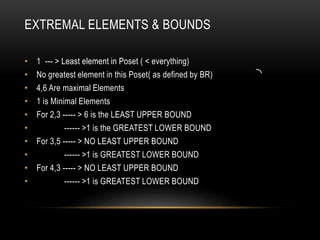
• 1 --- > Least element in Poset ( < everything) 
• No greatest element in this Poset( as defined by BR) 
• 4,6 Are maximal Elements 
• 1 is Minimal Elements 
• For 2,3 ----- > 6 is the LEAST UPPER BOUND 
• ------ >1 is the GREATEST LOWER BOUND 
• For 3,5 ----- > NO LEAST UPPER BOUND 
• ------ >1 is GREATEST LOWER BOUND 
• For 4,3 ----- > NO LEAST UPPER BOUND 
• ------ >1 is GREATEST LOWER BOUND
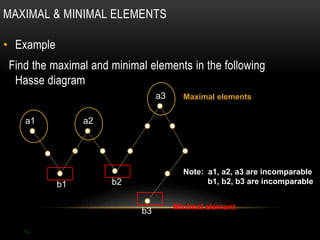
MAXIMAL & MINIMAL ELEMENTS 
• Example 
Find the maximal and minimal elements in the following 
Hasse diagram 
a1 a2 
10 
a3 
b1 b2 
b3 
Maximal elements 
Note: a1, a2, a3 are incomparable 
b1, b2, b3 are incomparable 
Minimal element
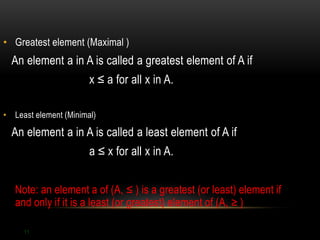
• Greatest element (Maximal ) 
An element a in A is called a greatest element of A if 
x ≤ a for all x in A. 
• Least element (Minimal) 
An element a in A is called a least element of A if 
a ≤ x for all x in A. 
Note: an element a of (A, ≤ ) is a greatest (or least) element if 
and only if it is a least (or greatest) element of (A, ≥ ) 
11
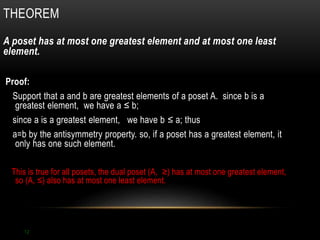
THEOREM 
A poset has at most one greatest element and at most one least 
element. 
Proof: 
Support that a and b are greatest elements of a poset A. since b is a 
greatest element, we have a ≤ b; 
since a is a greatest element, we have b ≤ a; thus 
a=b by the antisymmetry property. so, if a poset has a greatest element, it 
only has one such element. 
This is true for all posets, the dual poset (A, ≥) has at most one greatest element, 
so (A, ≤) also has at most one least element. 
12
• Unit element 
The greatest element of a poset, if it exists, is denoted by I 
and is often called the unit element. 
• Zero element 
The least element of a poset, if it exists, is denoted by 0 and 
is often called the zero element. 
13
EXAMPLE 
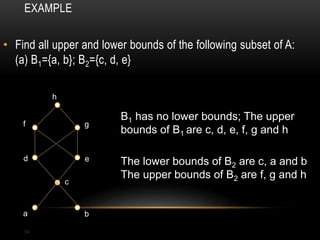
• Find all upper and lower bounds of the following subset of A: 
(a) B1={a, b}; B2={c, d, e} 
14 
h 
f g 
d e 
c 
a b 
B1 has no lower bounds; The upper 
bounds of B1 are c, d, e, f, g and h 
The lower bounds of B2 are c, a and b 
The upper bounds of B2 are f, g and h
BOUNDS 
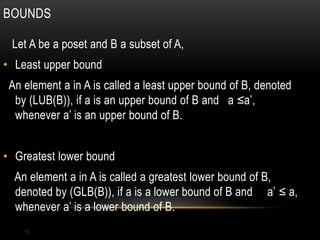
Let A be a poset and B a subset of A, 
• Least upper bound 
An element a in A is called a least upper bound of B, denoted 
by (LUB(B)), if a is an upper bound of B and a ≤a’, 
whenever a’ is an upper bound of B. 
• Greatest lower bound 
An element a in A is called a greatest lower bound of B, 
denoted by (GLB(B)), if a is a lower bound of B and a’ ≤ a, 
whenever a’ is a lower bound of B. 
15
EXAMPLE 
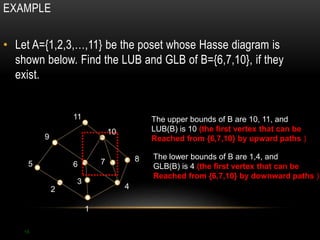
• Let A={1,2,3,…,11} be the poset whose Hasse diagram is 
shown below. Find the LUB and GLB of B={6,7,10}, if they 
exist. 
5 6 7 8 
16 
1 
2 
3 
4 
10 
9 
11 The upper bounds of B are 10, 11, and 
LUB(B) is 10 (the first vertex that can be 
Reached from {6,7,10} by upward paths ) 
The lower bounds of B are 1,4, and 
GLB(B) is 4 (the first vertex that can be 
Reached from {6,7,10} by downward paths )
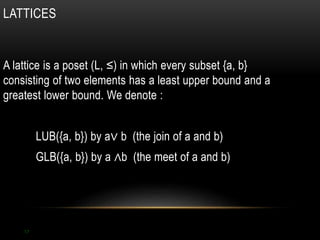
LATTICES 
A lattice is a poset (L, ≤) in which every subset {a, b} 
consisting of two elements has a least upper bound and a 
greatest lower bound. We denote : 
LUB({a, b}) by a∨ b (the join of a and b) 
GLB({a, b}) by a ∧b (the meet of a and b) 
17
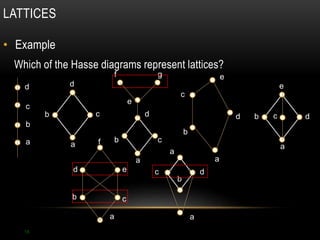
LATTICES 
• Example 
Which of the Hasse diagrams represent lattices? 
d 
c 
b 
a 
18 
f g 
b c 
a 
d 
e 
a 
c 
b 
e 
d 
a 
b c 
e 
d 
d 
b c 
a 
d e 
b c 
a 
f 
c d 
a 
b 
a
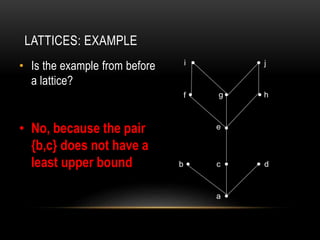
LATTICES: EXAMPLE 
• Is the example from before 
a lattice? 
g h 
b d 
a 
i 
f 
e 
c 
j 
• No, because the pair 
{b,c} does not have a 
least upper bound
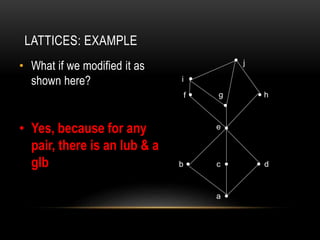
LATTICES: EXAMPLE 
• What if we modified it as 
shown here? 
g h 
b d 
a 
i 
f 
e 
c 
j 
• Yes, because for any 
pair, there is an lub & a 
glb
Distributive lattices
THANK YOU 
-- Aarti Jivrajani 
-- Debarati Das

Lattices AND Hasse Diagrams

  • 1.
    INTRODUCTION TO PARTIALORDERING RELATION REFLEXIVE SYMMETRIC ASYMMETRIC TRANSITIVE X≡ Y(MOD 5) DIVISIBILITY X|Y LESS THAN X<=Y
  • 2.
    PARTIAL ORDERING SOLUTION RELATION REFLEXIVE SYMMETRIC ASYMMETRIC TRANSITIVE X≡ Y(MOD 5) Y Y N Y DIVISIBILITY Y N Y Y X|Y LESS THAN X<=Y Y N Y Y
  • 3.
    PARTIALLY ORDERED SETS->HD • Hasse Diagrams Just a reduced version of the diagram of the partial order of the poset. a) Reflexive Every vertex has a cycle of length 1 (delete all cycles) 3
  • 4.
    PARTIALLY ORDERED SETS->HD • Transitive a ≤ b, and b ≤c, then a ≤c (delete the edge from a to c) 4 b c a a b c Vertex  dot c b a Remove arrow (all edges pointing upward)
  • 5.
    EXAMPLE • LetA={1,2,3,4,12}. Consider the partial order of divisibility on A. Draw the corresponding Hasse diagram. 5 12 4 2 1 3 12 4 2 1 3
  • 6.
    Shirt innerwear Tie Jacket Trouser Belt HASSE DIAGRAM Left Sock Right Sock Left Shoe Right Shoe
  • 7.
    Shirt innerwear Tie Jacket Trouser Belt DIRECTED GRAPH Left Shoe Right Shoe Left Sock Right Sock
  • 8.
    EXTREMAL ELEMENTS &BOUNDS • Lets assume a poset (A, p) represented by a hasse diagram as shown. • Binary Relation : ( a divides b) • Set is = {1,2…..6} 6 3 4 5 2 1
  • 9.
    EXTREMAL ELEMENTS &BOUNDS • 1 --- > Least element in Poset ( < everything) • No greatest element in this Poset( as defined by BR) • 4,6 Are maximal Elements • 1 is Minimal Elements • For 2,3 ----- > 6 is the LEAST UPPER BOUND • ------ >1 is the GREATEST LOWER BOUND • For 3,5 ----- > NO LEAST UPPER BOUND • ------ >1 is GREATEST LOWER BOUND • For 4,3 ----- > NO LEAST UPPER BOUND • ------ >1 is GREATEST LOWER BOUND
  • 10.
    MAXIMAL & MINIMALELEMENTS • Example Find the maximal and minimal elements in the following Hasse diagram a1 a2 10 a3 b1 b2 b3 Maximal elements Note: a1, a2, a3 are incomparable b1, b2, b3 are incomparable Minimal element
  • 11.
    • Greatest element(Maximal ) An element a in A is called a greatest element of A if x ≤ a for all x in A. • Least element (Minimal) An element a in A is called a least element of A if a ≤ x for all x in A. Note: an element a of (A, ≤ ) is a greatest (or least) element if and only if it is a least (or greatest) element of (A, ≥ ) 11
  • 12.
    THEOREM A posethas at most one greatest element and at most one least element. Proof: Support that a and b are greatest elements of a poset A. since b is a greatest element, we have a ≤ b; since a is a greatest element, we have b ≤ a; thus a=b by the antisymmetry property. so, if a poset has a greatest element, it only has one such element. This is true for all posets, the dual poset (A, ≥) has at most one greatest element, so (A, ≤) also has at most one least element. 12
  • 13.
    • Unit element The greatest element of a poset, if it exists, is denoted by I and is often called the unit element. • Zero element The least element of a poset, if it exists, is denoted by 0 and is often called the zero element. 13
  • 14.
    EXAMPLE • Findall upper and lower bounds of the following subset of A: (a) B1={a, b}; B2={c, d, e} 14 h f g d e c a b B1 has no lower bounds; The upper bounds of B1 are c, d, e, f, g and h The lower bounds of B2 are c, a and b The upper bounds of B2 are f, g and h
  • 15.
    BOUNDS Let Abe a poset and B a subset of A, • Least upper bound An element a in A is called a least upper bound of B, denoted by (LUB(B)), if a is an upper bound of B and a ≤a’, whenever a’ is an upper bound of B. • Greatest lower bound An element a in A is called a greatest lower bound of B, denoted by (GLB(B)), if a is a lower bound of B and a’ ≤ a, whenever a’ is a lower bound of B. 15
  • 16.
    EXAMPLE • LetA={1,2,3,…,11} be the poset whose Hasse diagram is shown below. Find the LUB and GLB of B={6,7,10}, if they exist. 5 6 7 8 16 1 2 3 4 10 9 11 The upper bounds of B are 10, 11, and LUB(B) is 10 (the first vertex that can be Reached from {6,7,10} by upward paths ) The lower bounds of B are 1,4, and GLB(B) is 4 (the first vertex that can be Reached from {6,7,10} by downward paths )
  • 17.
    LATTICES A latticeis a poset (L, ≤) in which every subset {a, b} consisting of two elements has a least upper bound and a greatest lower bound. We denote : LUB({a, b}) by a∨ b (the join of a and b) GLB({a, b}) by a ∧b (the meet of a and b) 17
  • 18.
    LATTICES • Example Which of the Hasse diagrams represent lattices? d c b a 18 f g b c a d e a c b e d a b c e d d b c a d e b c a f c d a b a
  • 19.
    LATTICES: EXAMPLE •Is the example from before a lattice? g h b d a i f e c j • No, because the pair {b,c} does not have a least upper bound
  • 20.
    LATTICES: EXAMPLE •What if we modified it as shown here? g h b d a i f e c j • Yes, because for any pair, there is an lub & a glb
  • 21.
  • 22.
    THANK YOU --Aarti Jivrajani -- Debarati Das