A SEMINAR ON
CRYSTAL STRUCTURE
PRESENTED
BY

K. GANAPATHI RAO
(13031D6003)

Presence of
Mr. V V Sai sir
CONTENT
 INTRODUCTION.

 TRANSLATION VECTOR.
 BASIS & UNIT CELL.
 BRAVAIS & SPACE LATTICES.
 FUNDAMENTAL QUANTITIES.
 MILLER INDICES.
 INTER-PLANAR SPACING.
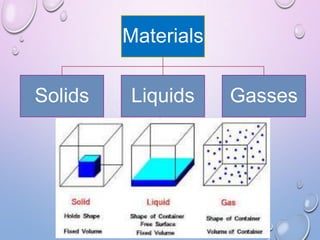
Materials
Solids

Liquids

Gasses
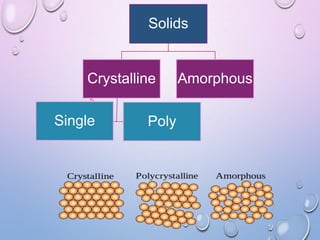
Solids

Crystalline
Single

Poly

Amorphous
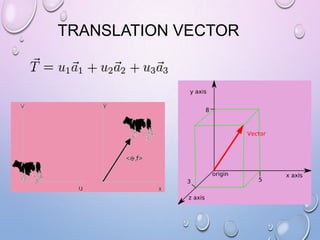
TRANSLATION VECTOR
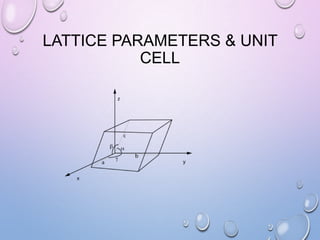
LATTICE PARAMETERS & UNIT
CELL
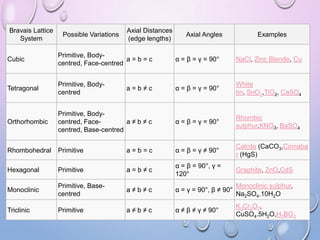
Bravais Lattice
System

Possible Variations

Axial Distances
(edge lengths)

Axial Angles

Examples

Cubic

Primitive, Bodya=b=c
centred, Face-centred

α = β = γ = 90°

NaCl, Zinc Blende, Cu

Tetragonal

Primitive, Bodycentred

a=b≠c

α = β = γ = 90°

White
tin, SnO2,TiO2, CaSO4

Orthorhombic

Primitive, Bodycentred, Facea≠b≠c
centred, Base-centred

α = β = γ = 90°

Rhombic
sulphur,KNO3, BaSO4

Rhombohedral

Primitive

a=b=c

α = β = γ ≠ 90°

Calcite (CaCO3,Cinnaba
r (HgS)

Hexagonal

Primitive

a=b≠c

α = β = 90°, γ =
120°

Graphite, ZnO,CdS

Monoclinic

Primitive, Basecentred

a≠b≠c

α = γ = 90°, β ≠ 90°

Monoclinic sulphur,
Na2SO4.10H2O

Triclinic

Primitive

a≠b≠c

α ≠ β ≠ γ ≠ 90°

K2Cr2O7,
CuSO4.5H2O,H3BO3
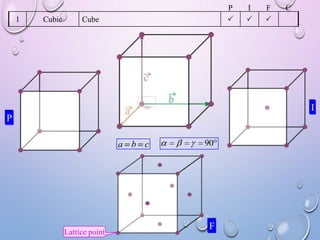
1

Cubic

P


Cube

I


F


C

I
P
a b c

Lattice point

90

F
P
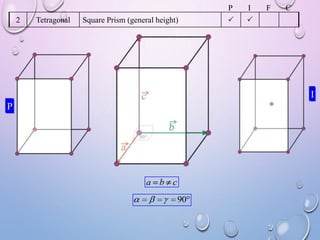
2

Tetragonal

Square Prism (general height)

I



F

C



I
P

a b c
90
P
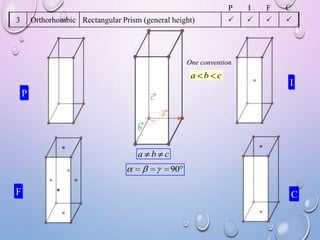
3

Orthorhombic Rectangular Prism (general height)

I

F

C









One convention

a b c

I

P

a b c
90

F

C
P
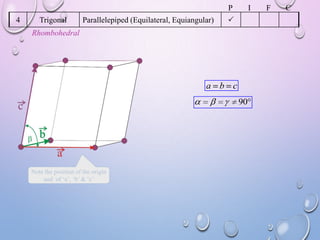
4

Trigonal

Parallelepiped (Equilateral, Equiangular)

I



Rhombohedral

a b c
90

Note the position of the origin
and of ‘a’, ‘b’ & ‘c’

F

C
P
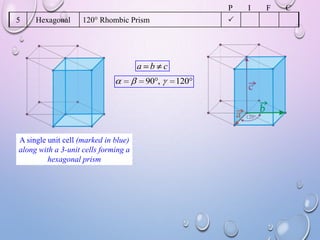
5

Hexagonal



120 Rhombic Prism

a b c
90 ,

A single unit cell (marked in blue)
along with a 3-unit cells forming a
hexagonal prism

120

I

F

C
P
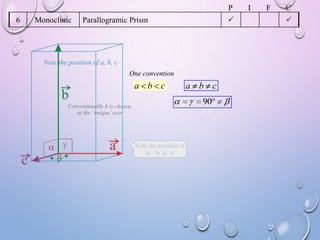
6

Monoclinic



Parallogramic Prism

One convention

a b c

a b c
90

Note the position of
‘a’, ‘b’ & ‘c’

I

F

C

P
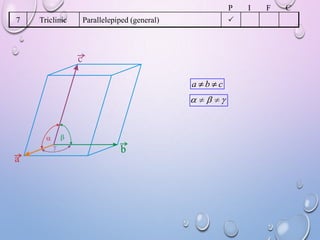
7

Triclinic



Parallelepiped (general)

a b c

I

F

C
FUNDAMENTAL QUANTITIES
• NEAREST NEIGHBOUR DISTANCE (2R).
• ATOMIC RADIUS (R).
• COORDINATION NUMBER (N).
• ATOMIC PACKING FACTOR.
SIMPLE CUBIC STRUCTURE (SC)
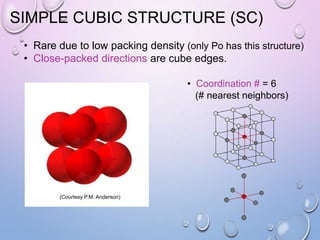
• Rare due to low packing density (only Po has this structure)
• Close-packed directions are cube edges.
• Coordination # = 6
(# nearest neighbors)

(Courtesy P.M. Anderson)
ATOMIC PACKING FACTOR
(APF):SC
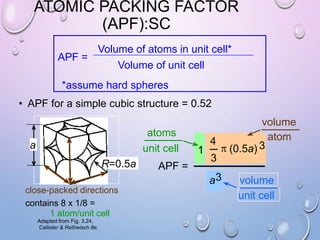
APF =

Volume of atoms in unit cell*

Volume of unit cell

*assume hard spheres
• APF for a simple cubic structure = 0.52
atoms
unit cell

a
R=0.5a

APF =

1

4

3
a3

close-packed directions
contains 8 x 1/8 =
1 atom/unit cell
Adapted from Fig. 3.24,
Callister & Rethwisch 8e.

volume
atom
(0.5a) 3
volume
unit cell
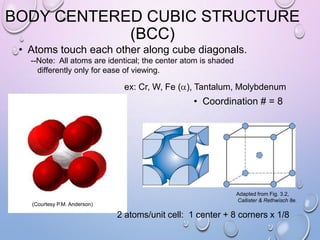
BODY CENTERED CUBIC STRUCTURE
(BCC)
• Atoms touch each other along cube diagonals.
--Note: All atoms are identical; the center atom is shaded
differently only for ease of viewing.

ex: Cr, W, Fe ( ), Tantalum, Molybdenum

• Coordination # = 8

(Courtesy P.M. Anderson)

Adapted from Fig. 3.2,
Callister & Rethwisch 8e.

2 atoms/unit cell: 1 center + 8 corners x 1/8
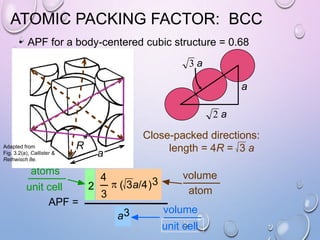
ATOMIC PACKING FACTOR: BCC
• APF for a body-centered cubic structure = 0.68
3a

a
2a
Adapted from
Fig. 3.2(a), Callister &
Rethwisch 8e.

atoms

R

Close-packed directions:
length = 4R = 3 a

a

4

2
unit cell
3
APF =

( 3a/4) 3
a3

volume
atom
volume
unit cell
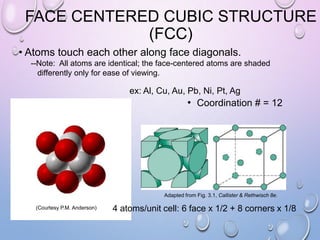
FACE CENTERED CUBIC STRUCTURE
(FCC)
• Atoms touch each other along face diagonals.
--Note: All atoms are identical; the face-centered atoms are shaded
differently only for ease of viewing.

ex: Al, Cu, Au, Pb, Ni, Pt, Ag

• Coordination # = 12

Adapted from Fig. 3.1, Callister & Rethwisch 8e.
(Courtesy P.M. Anderson)

4 atoms/unit cell: 6 face x 1/2 + 8 corners x 1/8
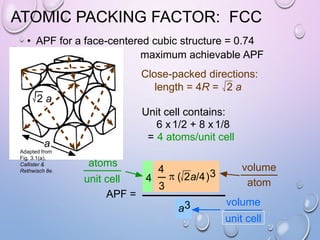
ATOMIC PACKING FACTOR: FCC
• APF for a face-centered cubic structure = 0.74
maximum achievable APF
Close-packed directions:
length = 4R = 2 a
2a

a
Adapted from
Fig. 3.1(a),
Callister &
Rethwisch 8e.

Unit cell contains:
6 x 1/2 + 8 x 1/8
= 4 atoms/unit cell
atoms
4
4
unit cell
3
APF =

( 2a/4) 3
a3

volume
atom
volume
unit cell
MILLER INDICES
• PROCEDURE FOR WRITING DIRECTIONS IN MILLER INDICES
• DETERMINE THE COORDINATES OF THE TWO POINTS IN THE
DIRECTION. (SIMPLIFIED IF ONE OF THE POINTS IS THE ORIGIN).

• SUBTRACT THE COORDINATES OF THE SECOND POINT FROM
THOSE OF THE FIRST.
• CLEAR FRACTIONS TO GIVE LOWEST INTEGER VALUES FOR ALL
COORDINATES
MILLER INDICES
• INDICES ARE WRITTEN IN SQUARE BRACKETS WITHOUT
COMMAS (EX: [HKL])
• NEGATIVE VALUES ARE WRITTEN WITH A BAR OVER THE
INTEGER.

[hkl]

• EX: IF H<0 THEN THE DIRECTION IS
•
MILLER INDICES
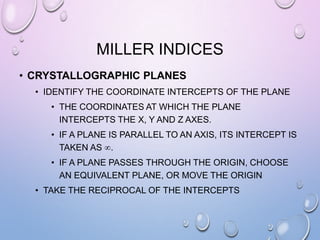
• CRYSTALLOGRAPHIC PLANES
• IDENTIFY THE COORDINATE INTERCEPTS OF THE PLANE
• THE COORDINATES AT WHICH THE PLANE
INTERCEPTS THE X, Y AND Z AXES.
• IF A PLANE IS PARALLEL TO AN AXIS, ITS INTERCEPT IS
TAKEN AS .
• IF A PLANE PASSES THROUGH THE ORIGIN, CHOOSE
AN EQUIVALENT PLANE, OR MOVE THE ORIGIN
• TAKE THE RECIPROCAL OF THE INTERCEPTS
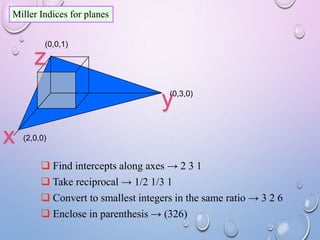
Miller Indices for planes
(0,0,1)

z

y

(0,3,0)

x

(2,0,0)

 Find intercepts along axes → 2 3 1
 Take reciprocal → 1/2 1/3 1
 Convert to smallest integers in the same ratio → 3 2 6
 Enclose in parenthesis → (326)
MILLER INDICES
• CLEAR FRACTIONS DUE TO THE RECIPROCAL,
BUT DO NOT REDUCE TO LOWEST INTEGER
VALUES.
• PLANES ARE WRITTEN IN PARENTHESES, WITH
BARS OVER THE NEGATIVE INDICES. [hkl]

• EX: (HKL) OR IF H<0 THEN IT BECOMES
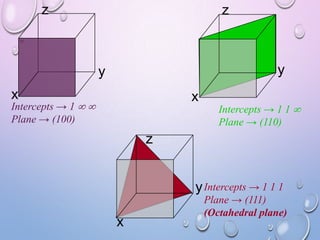
z

z

y

y
x

x

Intercepts → 1
Plane → (100)

Intercepts → 1 1
Plane → (110)

z
y Intercepts → 1 1 1
x

Plane → (111)
(Octahedral plane)
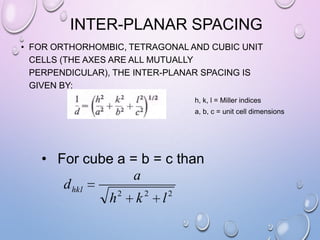
INTER-PLANAR SPACING
• FOR ORTHORHOMBIC, TETRAGONAL AND CUBIC UNIT
CELLS (THE AXES ARE ALL MUTUALLY
PERPENDICULAR), THE INTER-PLANAR SPACING IS
GIVEN BY:
h, k, l = Miller indices

a, b, c = unit cell dimensions

• For cube a = b = c than
a
d hkl
h2 k 2 l 2
REFRENCES
• APPLIED PHYSICS BY P.K. PALANISAMY
• http://en.wikipedia.org/wiki/crystal_structure
• http://journals.iucr.org/c/
• http://www.scirp.org/journal/csta/
• http://www.asminternational.org/portal/site/www/subje
ctguideitem/?vgnextoid=ad7cdc8cc359d210vgnvcm10
0000621e010arcrd
Crystral structure
Crystral structure

Crystral structure

  • 1.
    A SEMINAR ON CRYSTALSTRUCTURE PRESENTED BY K. GANAPATHI RAO (13031D6003) Presence of Mr. V V Sai sir
  • 2.
    CONTENT  INTRODUCTION.  TRANSLATIONVECTOR.  BASIS & UNIT CELL.  BRAVAIS & SPACE LATTICES.  FUNDAMENTAL QUANTITIES.  MILLER INDICES.  INTER-PLANAR SPACING.
  • 3.
  • 4.
  • 5.
  • 6.
  • 7.
    Bravais Lattice System Possible Variations AxialDistances (edge lengths) Axial Angles Examples Cubic Primitive, Bodya=b=c centred, Face-centred α = β = γ = 90° NaCl, Zinc Blende, Cu Tetragonal Primitive, Bodycentred a=b≠c α = β = γ = 90° White tin, SnO2,TiO2, CaSO4 Orthorhombic Primitive, Bodycentred, Facea≠b≠c centred, Base-centred α = β = γ = 90° Rhombic sulphur,KNO3, BaSO4 Rhombohedral Primitive a=b=c α = β = γ ≠ 90° Calcite (CaCO3,Cinnaba r (HgS) Hexagonal Primitive a=b≠c α = β = 90°, γ = 120° Graphite, ZnO,CdS Monoclinic Primitive, Basecentred a≠b≠c α = γ = 90°, β ≠ 90° Monoclinic sulphur, Na2SO4.10H2O Triclinic Primitive a≠b≠c α ≠ β ≠ γ ≠ 90° K2Cr2O7, CuSO4.5H2O,H3BO3
  • 8.
  • 9.
    P 2 Tetragonal Square Prism (generalheight) I  F C  I P a b c 90
  • 10.
    P 3 Orthorhombic Rectangular Prism(general height) I F C     One convention a b c I P a b c 90 F C
  • 11.
    P 4 Trigonal Parallelepiped (Equilateral, Equiangular) I  Rhombohedral ab c 90 Note the position of the origin and of ‘a’, ‘b’ & ‘c’ F C
  • 12.
    P 5 Hexagonal  120 Rhombic Prism ab c 90 , A single unit cell (marked in blue) along with a 3-unit cells forming a hexagonal prism 120 I F C
  • 13.
    P 6 Monoclinic  Parallogramic Prism One convention ab c a b c 90 Note the position of ‘a’, ‘b’ & ‘c’ I F C 
  • 14.
  • 15.
    FUNDAMENTAL QUANTITIES • NEARESTNEIGHBOUR DISTANCE (2R). • ATOMIC RADIUS (R). • COORDINATION NUMBER (N). • ATOMIC PACKING FACTOR.
  • 16.
    SIMPLE CUBIC STRUCTURE(SC) • Rare due to low packing density (only Po has this structure) • Close-packed directions are cube edges. • Coordination # = 6 (# nearest neighbors) (Courtesy P.M. Anderson)
  • 17.
    ATOMIC PACKING FACTOR (APF):SC APF= Volume of atoms in unit cell* Volume of unit cell *assume hard spheres • APF for a simple cubic structure = 0.52 atoms unit cell a R=0.5a APF = 1 4 3 a3 close-packed directions contains 8 x 1/8 = 1 atom/unit cell Adapted from Fig. 3.24, Callister & Rethwisch 8e. volume atom (0.5a) 3 volume unit cell
  • 18.
    BODY CENTERED CUBICSTRUCTURE (BCC) • Atoms touch each other along cube diagonals. --Note: All atoms are identical; the center atom is shaded differently only for ease of viewing. ex: Cr, W, Fe ( ), Tantalum, Molybdenum • Coordination # = 8 (Courtesy P.M. Anderson) Adapted from Fig. 3.2, Callister & Rethwisch 8e. 2 atoms/unit cell: 1 center + 8 corners x 1/8
  • 19.
    ATOMIC PACKING FACTOR:BCC • APF for a body-centered cubic structure = 0.68 3a a 2a Adapted from Fig. 3.2(a), Callister & Rethwisch 8e. atoms R Close-packed directions: length = 4R = 3 a a 4 2 unit cell 3 APF = ( 3a/4) 3 a3 volume atom volume unit cell
  • 20.
    FACE CENTERED CUBICSTRUCTURE (FCC) • Atoms touch each other along face diagonals. --Note: All atoms are identical; the face-centered atoms are shaded differently only for ease of viewing. ex: Al, Cu, Au, Pb, Ni, Pt, Ag • Coordination # = 12 Adapted from Fig. 3.1, Callister & Rethwisch 8e. (Courtesy P.M. Anderson) 4 atoms/unit cell: 6 face x 1/2 + 8 corners x 1/8
  • 21.
    ATOMIC PACKING FACTOR:FCC • APF for a face-centered cubic structure = 0.74 maximum achievable APF Close-packed directions: length = 4R = 2 a 2a a Adapted from Fig. 3.1(a), Callister & Rethwisch 8e. Unit cell contains: 6 x 1/2 + 8 x 1/8 = 4 atoms/unit cell atoms 4 4 unit cell 3 APF = ( 2a/4) 3 a3 volume atom volume unit cell
  • 22.
    MILLER INDICES • PROCEDUREFOR WRITING DIRECTIONS IN MILLER INDICES • DETERMINE THE COORDINATES OF THE TWO POINTS IN THE DIRECTION. (SIMPLIFIED IF ONE OF THE POINTS IS THE ORIGIN). • SUBTRACT THE COORDINATES OF THE SECOND POINT FROM THOSE OF THE FIRST. • CLEAR FRACTIONS TO GIVE LOWEST INTEGER VALUES FOR ALL COORDINATES
  • 23.
    MILLER INDICES • INDICESARE WRITTEN IN SQUARE BRACKETS WITHOUT COMMAS (EX: [HKL]) • NEGATIVE VALUES ARE WRITTEN WITH A BAR OVER THE INTEGER. [hkl] • EX: IF H<0 THEN THE DIRECTION IS •
  • 24.
    MILLER INDICES • CRYSTALLOGRAPHICPLANES • IDENTIFY THE COORDINATE INTERCEPTS OF THE PLANE • THE COORDINATES AT WHICH THE PLANE INTERCEPTS THE X, Y AND Z AXES. • IF A PLANE IS PARALLEL TO AN AXIS, ITS INTERCEPT IS TAKEN AS . • IF A PLANE PASSES THROUGH THE ORIGIN, CHOOSE AN EQUIVALENT PLANE, OR MOVE THE ORIGIN • TAKE THE RECIPROCAL OF THE INTERCEPTS
  • 25.
    Miller Indices forplanes (0,0,1) z y (0,3,0) x (2,0,0)  Find intercepts along axes → 2 3 1  Take reciprocal → 1/2 1/3 1  Convert to smallest integers in the same ratio → 3 2 6  Enclose in parenthesis → (326)
  • 26.
    MILLER INDICES • CLEARFRACTIONS DUE TO THE RECIPROCAL, BUT DO NOT REDUCE TO LOWEST INTEGER VALUES. • PLANES ARE WRITTEN IN PARENTHESES, WITH BARS OVER THE NEGATIVE INDICES. [hkl] • EX: (HKL) OR IF H<0 THEN IT BECOMES
  • 27.
    z z y y x x Intercepts → 1 Plane→ (100) Intercepts → 1 1 Plane → (110) z y Intercepts → 1 1 1 x Plane → (111) (Octahedral plane)
  • 28.
    INTER-PLANAR SPACING • FORORTHORHOMBIC, TETRAGONAL AND CUBIC UNIT CELLS (THE AXES ARE ALL MUTUALLY PERPENDICULAR), THE INTER-PLANAR SPACING IS GIVEN BY: h, k, l = Miller indices a, b, c = unit cell dimensions • For cube a = b = c than a d hkl h2 k 2 l 2
  • 29.
    REFRENCES • APPLIED PHYSICSBY P.K. PALANISAMY • http://en.wikipedia.org/wiki/crystal_structure • http://journals.iucr.org/c/ • http://www.scirp.org/journal/csta/ • http://www.asminternational.org/portal/site/www/subje ctguideitem/?vgnextoid=ad7cdc8cc359d210vgnvcm10 0000621e010arcrd